India's Big Trade Deals with the EU, UK, and US in 2025–26: What's Different and How It Will Affect Exports and Competitiveness
- Mar 07, 2026
India's Big Trade Deals with the EU, UK, and US in 2025–26: What's Different and How It Will Affect Exports and Competitiveness
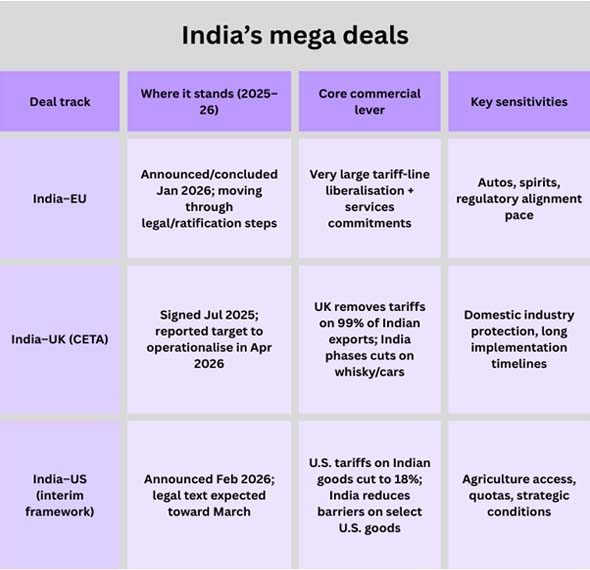
India's trade strategy changed from "many talks, few breakthroughs" to a fast-moving, high-stakes phase between mid-2025 and early-2026.
As per India Import Data by Import Globals, this included a landmark pact with the UK (signed in 2025 and moving toward implementation in 2026), a headline India–EU deal framed publicly as the "mother of all deals" (announced January 2026), and an interim trade framework with the United States (February 2026) that cut U.S. tariffs on Indian goods to about 18% in exchange for major market-access and strategic commitments. India is also using recently signed agreements, such as the India–EFTA TEPA (which goes into effect in October 2025), as well as existing accords with the UAE and Australia, to open up more markets and make its supply chains more diverse.
These are not "policy headlines" for Indian firms. They change the prices, compliance, sourcing options, and where the next wave of exports can realistically come from. This includes textiles, jewels, pharmaceuticals, auto parts, IT services, and processed foods.
This article explains what the EU, UK, and US tracks are, what the figures mean, and how Indian exporters and importers should read the new playing field in 2025–26.
1) The Larger Picture: A Trade Pivot on Three Fronts
India's "mega deals" for 2025–26 all have the same goal: to lock in demand-side certainty (export access) while leaving leeway for policy changes in sensitive sectors (particularly agriculture and some industries) and leveraging trade frameworks to bring in investment and technology.
As per India Export Data by Import Globals, the three tracks are different: the EU track is a comprehensive, modern agreement that covers commodities, services, and rules. Its goal is to change India's access to a high-end market and lower non-tariff barriers.
UK: a focused, business-driven deal that cuts tariffs on Indian exports by a lot and gives India time to make concessions on high-profile UK goods, such automobiles and whisky.
US: a temporary plan to lower tariffs and align supply chains, with a focus on agricultural, industrial tariffs, energy purchases, and strategic trade-offs.
2) The India-EU Deal: Why It's "Mega" in Scope and Not Just for Show
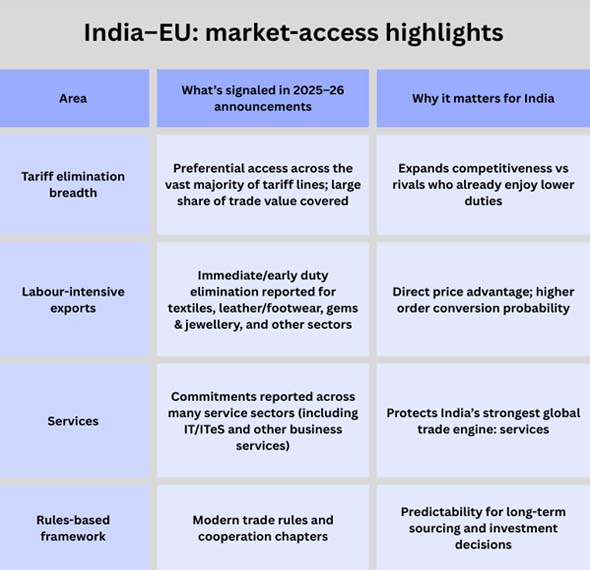
The India–EU deal is important because it addresses two long-standing problems for Indian exporters:
- As per India Import Export Trade Data by Import Globals, tariffs on textiles, leather, shoes, diamonds, some processed foods, and other goods where India competes on a large scale
- Regulatory problems in high-end markets (standards, certification, sustainability, and supply-chain paperwork)
When it comes to market access, published fact sheets and EU summaries show that a lot of tariff lines and trade value are covered. For exporters, a key operational point is that the deal structure seems to front-load considerable duty elimination for exports that require a lot of labor, while phasing in intricate sensitivity over time.
As per India Import Custom Data by Import Globals, the "headline sensitivities" are cars and spirits. Reports on the arrangement say that there will be systematic tariff cuts on vehicles with quota systems and phased timetables, as well as a strategy to lower duties on spirits. That means that for Indian imports to be competitive, there will be more pressure on prices in high-end markets and a stronger reason to improve domestic value chains instead of relying on tariff walls.
A second-order effect is that getting into the EU market generally means more than simply tariffs; it often means compliance "handshakes." Companies who can promptly provide paperwork for traceability, testing, labeling, and sustainability are likely to make big profits.
3) The India-uk Pact (Signed in 2025): A Tariff Reset for India's Traditional Export Strengths
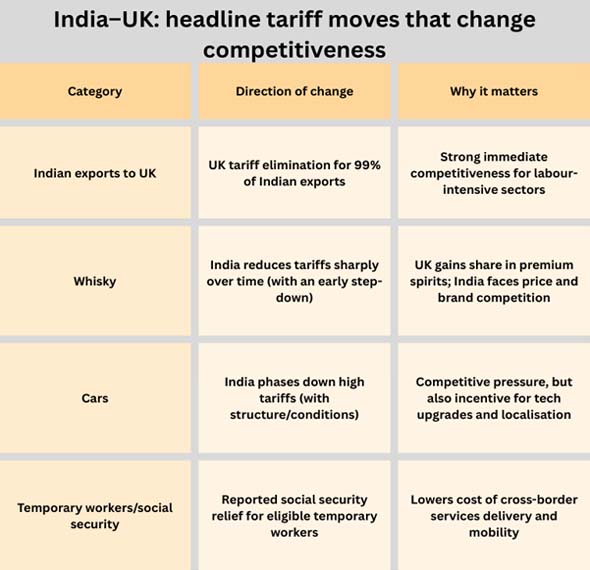
In business terms, the UK agreement is easier to grasp. It is set up such that Indian exports to the UK will have almost no duties, while India will slowly lower tariffs on high-value UK exports, with automobiles and whisky being the main focus.
As per India Import Trade Analysis by Import Globals, Indian exporters of clothing, diamonds, leather, marine goods, and engineering goods will gain because the UK is a demand market where landed-cost disparities can have a big impact on margins. Taking away tariffs might turn "maybe" orders into "yes" orders, especially for product areas where prices are competitive.
When you put anything into action counts. Reports say that the goal is to be operational by April 2026, which is vital for business because many UK customers sign contracts on a seasonal basis. Exporters might gain sooner if operationalization lines up with buying cycles.
4) The India–us Interim Framework (2026): Lower Tariffs With Significant Trade-offs in Terms of Strategy
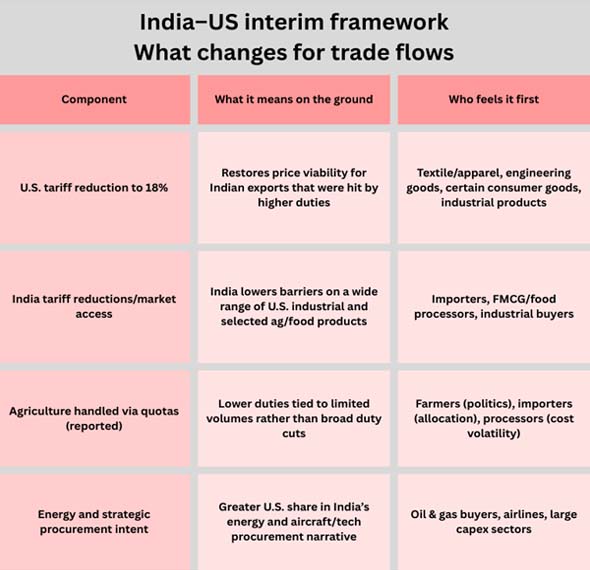
As per India Exporter Data by Import Globals, the U.S. track has the most political and strategic tension. The main point is clear: U.S. tariffs on Indian imports are going down from far higher levels to roughly 18%. The interim deal is moving toward a formalized legal language and signing schedule. The U.S. framework is different from traditional FTAs in that it focuses on lowering tariffs, giving targeted market access, and aligning strategies (especially in energy and supply chains).
A useful lesson is that exporters get a break, but the deal's long-term success depends on following the rules, sequencing, and managing local politics, especially in agriculture.
The agriculture design is a key stabilizer. Reports say that India is employing quotas on many farm items, which means that only a small number of goods can enjoy lower taxes. This protects domestic producers from a sudden flood of imports. That's a typical political-economy compromise: it makes the market less volatile, but it also makes things more complicated for the government and adds the risk of uncertainty for importers when it comes to quotas.
5) "Other FTAs" That Make the Big Deals Even Bigger: Tepa (Efta) and the Push for More Variety
As per India Importer Data by Import Globals, India's big transactions aren't just one thing. The India–EFTA TEPA, which went into effect in October 2025, is especially important since it incorporates a widely-cited framework for investment and jobs combined with trade liberalization. The EFTA markets are smaller than the EU, but the agreement is good for high-value manufacturing, R&D-linked sectors, pharma/chemicals, precision engineering, and services.
Existing agreements with countries like the UAE and Australia also support the idea of diversification: don't rely too much on one market, and create different routes for goods and services.
6) What It Means for Indian Exports: Where the Most Good Things Happen
A) The EU and UK give a real tariff advantage to manufacturing that needs a lot of workers
When tariffs go down, textiles, leather and shoes, gems and jewelry, toys, sports products, some marine and processed food categories become more competitive. As per India Import Shipment Data by Import Globals, this is where "margin math" can change quickly: a few percentage points of duty can frequently make the difference between choosing a supplier.
B) Pharma and chemicals gain, but compliance is the key
In Europe and the UK, market access is never relied exclusively on tariffs. Documentation, testing, batch traceability, and following the rules are what decide if companies may take use of the chance. Companies who can manage audits and certifications on a large scale should win.
C) The trade in services is a huge win, especially with the EU
As per India Import Export Trade Analysis by Import Globals, India's biggest trade engine is services, therefore agreements to access services and treat all countries equally can be just as significant as tariff cuts. This can help IT/ITeS, professional services, and innovative ways of delivering goods across borders.
D) The US deal provides a way for exporters who are having trouble to get some relief
For companies that have been affected by high U.S. tariffs, a move to ~18% makes prices possible again and lowers uncertainty, but there are still concerns of implementation and politics.
7) What It Means for Imports and Competitiveness at Home: Cheaper Inputs vs. More Pressure
People commonly call trade treaties "export opportunities," but the consequences on imports are just as important:
- As per India Export Import Global Trade Data by Import Globals, cheaper capital goods and industrial inputs can boost productivity and help India move up the value chains.
- There is more competition from imports in the premium consumer categories (such spirits and high-end cars), which might change how prices and brands work.
- Quota systems and phased openings are getting a lot of attention since agriculture is still a political red line.
- The import side of things is not just a "threat" for Indian enterprises. For a lot of enterprises, more competitive imported inputs can lower prices and make exports more competitive. This is especially true in industries like electronics, engineering, and chemicals where supply chains cross multiple countries.
8) The List of things Firms Should do in 2026
These bargains are more about being ready than being hopeful. A helpful list of things to do:
- Map HS codes and tariff schedules (what goes to zero right away vs. what goes to zero over time)
- Prepare for rules of origin by getting supplier declarations, traceability, and paperwork ready.
- Improve compliance systems by adding labeling, testing, and sustainability documentation for the EU and UK.
- After the tariff change, modify the prices of the goods (strategically share the gains with purchasers, not blindly).
- Keep an eye on quotas and safeguard provisions, especially in US agriculture and other critical areas.
Plan for the time it takes to get logistics and certification (a duty cut is pointless if the paperwork slows down shipping). Import Globals is a leading data provider of India Import Export Trade Data.
FAQs
Que. What makes the EU and UK deals "mega" for India?
Ans. This is because they combine very wide tariff cuts with strategies to make regulations less of a problem, which makes India's service sector stronger and makes it easier for labor-intensive exports to compete.
Que. Will Indian exports automatically skyrocket because of the US's temporary deal?
Ans. It lowers tariffs, which makes prices better, but the results rely on how well it is put into action, what products it covers, and how long it lasts politically, especially in agriculture and strategic conditions.
Que. Which parts of India will gain the most quickly?
Ans. Usually textiles and clothing, leather and shoes, jewels and jewelry, some marine and processed foods, and some engineering goods—because taking away duties lowers the cost of landing.
Que. What is the biggest threat to businesses?
Ans. If you think "FTA = automatic orders." Rules of origin, compliance documentation, standards testing, and phased schedules are often the true problems.
Que. Where to get detailed India Import Export Global Data?
Ans. Visit www.importglobals.com.