Mexico's Agricultural Exports Include Avocados, Berries, and Processed Foods (2025–26 Outlook)
- Mar 24, 2026
Mexico's Agricultural Exports Include Avocados, Berries, and Processed Foods (2025–26 Outlook)
Mexico's agricultural export engine is no longer just about "fresh produce."
As per Mexico Import Data by Import Globals, Mexico's strength in 2025–2026 is best understood as a three-lane highway: (1) high-value fresh fruits led by avocados and berries, (2) fresh vegetables (with tomatoes as a heavyweight), and (3) processed foods and drinks—especially beer and tequila—that consistently bring in export earnings with brand power and high prices.
This combination gives Mexico something that is hard to find in global agri-trade: size and variety. When the weather changes or there is a market disagreement, another crop often helps protect the first one. Because the U.S. is adjacent to Mexico and relies on Mexican crops in important seasons, Mexican exporters benefit from quick delivery, a mature cold chain, and a well-connected distribution system.
1) As per Mexico Export Data by Import Globals, the Larger Picture: What Makes Mexico One of the Best Countries for Exporting Food
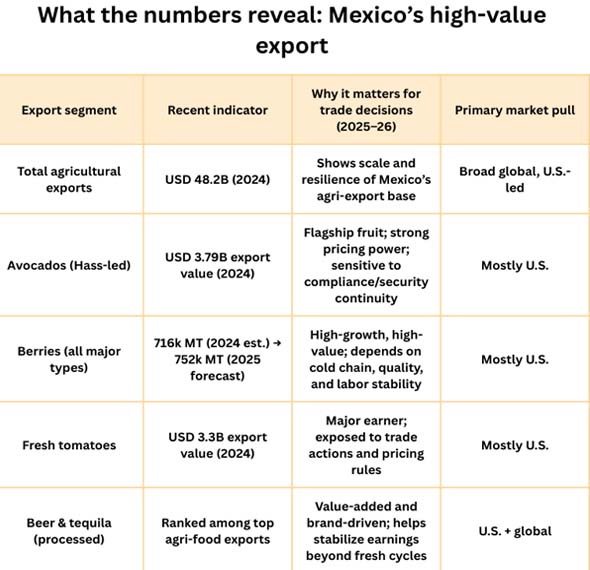
Mexico's agricultural exports are big enough to have an impact on the world, but they are also specialized enough to provide them price power in some areas. Recent official projections say that Mexico's overall agricultural exports (using a normal international definition) will be roughly USD 48.2 billion in 2024. This shows how big and strong the sector is. Vegetables, drinks, and fruits make up the largest part of Mexico's exports. As per Mexico Import Export Trade Data by Import Globals, this is a good fit with Mexico's competitive advantages, which include a wide range of climates, being close to North American consumers, and strong agro-industrial supply chains.
The Main Question for 2025–26 is Not "Will Mexico Export?" It Will. The Real Questions Are:
- Can Mexico keep up the pace in high-value products (such avocados and berries) even though it has to deal with compliance, security, and climate issues?
- Can processed foods grow quicker than fresh foods, which would increase their value-added share?
- How will trade tensions, like tomato tariffs, change how companies market their products and how they enter new markets?
2) Avocados: Mexico's Most Important Fruit Export
As per Mexico Import Custom Data by Import Globals, Hass avocados come from Mexico, which is the world standard. The export concept is based on:
- Concentrated production areas (like Michoacán) and growing capacity in other places.
- Packing that meets export standards and is free of pests,
- Windows for year-round supply that meet U.S. retail demand and sales.
- Two statistics show how important avocados are to Mexico's economy: they are always among the most valuable agricultural exports from Mexico.
- As per Mexico Import Trade Analysis by Import Globals, Mexico has sent the most avocados to the U.S. in recent years, which means that the U.S. market is very important to Mexico's avocado export economy.
What to Look Forward to in 2025–26
Avocados are popular because they are healthy, easy to get, and widely eaten, thus demand is anticipated to be strong. The biggest risks are operational: the safety of workers in the areas where the goods are made, the ability to keep up with certification and inspection, and the ability to increase supply without causing pricing to become unstable.
3) Berries: As per Mexico Exporter Data by Import Globals, Volume Increase Matches the Characteristics of the Premium Category
The fruit boom in Mexico has turned into a complex export system that encompasses strawberries, raspberries, blackberries, and blueberries. Berries are different from some bulk goods in that they are:
- Very sensitive to how the cold chain works,
- Retailer quality standards have a big impact on
- When consistency is high, they often charge extra for them.
As per Mexico Importer Data by Import Globals, recent official predictions say that berry exports (all main berry types combined) will go increase from about 716,000 metric tons in 2024 to about 752,000 metric tons in 2025. This is because of strong demand in the U.S. and changes in currency. This is important for 2025–26 since it shows that berries are still growing in volume, even though they are now a key export category.
What to look forward to in 2025–26
Berries are set to stay one of Mexico's top fruit exports, although the market is getting more competitive. The choice of varieties and the output of the farm will determine success.
Managing costs and finding workers, Quality consistency (which makes customers want to shop from the same store again), Efficiency in handling and logistics after the harvest.
4) Tomatoes and Fresh Vegetables: The "Quiet Giant" of Export Profits
As per Mexico Import Trade Statistics by Import Globals, this site is mostly about avocados, berries, and processed foods, but you can't talk about Mexico's agricultural exports without mentioning tomatoes. The U.S. market is very dependent on Mexico's supply of tomatoes, which is a big export earner. That reliance can also cause problems; when trade laws change, tomatoes are often at the center of the problem. Mexico's tomato exports were almost USD 3.3 billion in 2024. This shows how big this one type of vegetable is in North America's produce commerce.
What to Look Forward to in 2025–26
Vegetable exports will be high, but they are more vulnerable to:
- Changes in price and volume during different seasons,
- Trade fights and measures against dumping,
- Requirements for compliance and paperwork.
- Diversifying into new categories and adding value through processing is a good way for exporters to manage risk.
5) Processed Goods and Drinks: Where Mexico Makes the Most Money
As per Mexico Import Shipment Data by Import Globals, processed foods are the "value capture" lane of Mexico's agricultural export route. Mexico doesn't just provide fresh fruits and vegetables; it also sends items with branding, packaging, and processing built in. This frequently leads to higher margins and more stable demand.
6) The Biggest Beneficiaries in Processed Foods
Beer is always one of the top exports since it is made in large quantities and there is a lot of demand for it in North America. Tequila and other agave-based spirits are a high-end category that combines farming, branding, and controlled denomination systems. Processed fruits and vegetables include sauces, preserved foods, and industrial food ingredients used in North American food production.
As per Mexico Import Export Trade Analysis by Import Globals, processed foods also have a second benefit: they are less likely to go bad quickly, which is a problem with fresh berries or avocados. That makes it possible to create markets farther away from North America, which is helpful if there is more regional tension.
7) The Forecast for 2025–26: Chances and Dangers
Chances
Premiumization: Better types, branding, and quality segmentation can raise the value of avocados and berries.
Value-Added Growth: Over time, processed foods can grow quicker than fresh foods, which makes revenues more stable.
Logistics Advantage: Being close to the U.S. is still a structural benefit, especially for exports of goods that go bad quickly.
Dangers
Changes in the weather, like heat, drought, and extreme occurrences, can affect harvests and shipment schedules.
- Trade Friction: As per Mexico Export Import Global Trade Data by Import Globals, tomatoes are a good example of how changes in regulations may quickly impact how much money a business makes.
- Operational Constraints: The availability of workers, the safety of producing corridors, and the ability to keep inspections going can all have an impact on execution.
Final Thoughts
Mexico's agricultural exports will be strong in 2025–26 because they will be a rare mix of high-quality fresh goods (like avocados and berries) and high-performing processed goods (like beer, tequila, and other meals). This is because Mexico is so close to the world's most important consumer market. The data reveals the size of the problem, but the more important point is that Mexico is not only exporting commodities; it is also exporting systems including cold chains, packing standards, traceability, branding, and supply reliability. In 2025 and 2026, exporters and buyers will make the best trade decisions by balancing expansion with resilience. This means growing premium categories, putting money into processing, and finding new routes and markets where possible. Import Globals is a leading data provider of Mexico Import Export Trade Data.
FAQs
Que. What makes avocados such an important part of Mexico's agricultural exports?
Ans. They are a high-value flagship fruit that is in high demand in the U.S. and has established export systems, so they make a lot of money.
Que. What kinds of berries does Mexico export the most?
Ans. Strawberries, raspberries, blackberries, and blueberries are some of the things that Mexico exports. These fruits are in high demand at premium retail stores and are growing in volume.
Que. Are processed foods actually "agricultural exports"?
Ans. Yes, many processed goods and drinks are tied to agriculture and are some of Mexico's best-selling exports because they add value after they leave the farm.
Que. What is the largest risk for 2025–26?
Ans. Trade problems and problems with operations (weather, logistics, and compliance). Fresh produce categories are especially sensitive since they can spoil and are open to regulatory changes.
Que. Where to get detailed Mexico Import Export Global Data?
Ans. Visit www.importglobals.com.