Philippines Trade Partners: How the U.S., China, and ASEAN Are Affecting the Country's Trade Strategy Around the World
- Mar 25, 2026
Philippines Trade Partners: How the U.S., China, and ASEAN Are Affecting the Country's Trade Strategy Around the World
From 2025 to 2026, the Philippines will be one of the most active trading economies in Southeast Asia. As per Philippines import data by Import Globals, exports are going up swiftly, regions are getting more connected, and global supply chains are changing.
The country is doing well in the Indo-Pacific and is exploiting its relationships with important global and regional partners like the US, China, and the ASEAN economies to boost trade. In 2025, the Philippines did a lot more business with other countries.
As per Philippines Import Data by Import Globals, there was higher demand for technology, manufactured goods, and energy items, which meant that more objects were shipped and received. In the first half of 2025, trade in goods alone was worth more than $100 billion. This signifies that the economy is doing well and the world is connected. At the heart of this success story lies a complicated but well-balanced trade approach. It means working together with Western countries for a long time, having strong supply chains in Asia, and more countries in ASEAN working together.
Philippines Trade Overview (2025–2026)
The Philippines' trade in 2025–2026 shows that it is strong and changing. The country still has a trade imbalance because it mostly acquires its raw resources, oil, and other goods from other countries. But the margin is getting less since exports are rising, especially in electronics. Exports of goods went grown a considerably, from around $73 billion in 2024 to more than $84 billion in 2025. According to Philippines Export Data by Import Globals, this shows that there is a lot of demand for Philippine goods around the world. Imports also went up to more over $130 billion, thanks to growth in industry and improvements to infrastructure. Electronics, semiconductors, and machinery are still the primary things that are exported. Fuel, capital goods, and electronic parts are the key things that are imported.
The Philippines' Most Important Trade Partners
The Philippines has a wide range of commercial partners in North America, East Asia, and Europe. But its worldwide commerce strategy is built on three main pillars:
- The United States is the main place where goods are sent.
- China is the biggest provider of imports.
- ASEAN countries are an important part of the regional commerce ecosystem.
- Based on Philippines Import Export Trade Data by Import Globals, the United States is the Philippines' most important export partner.
- The Philippines' export economy still depends heavily on the United States. It regained its status as the country's top export destination in 2025, a big change after years of competing with Asian markets.
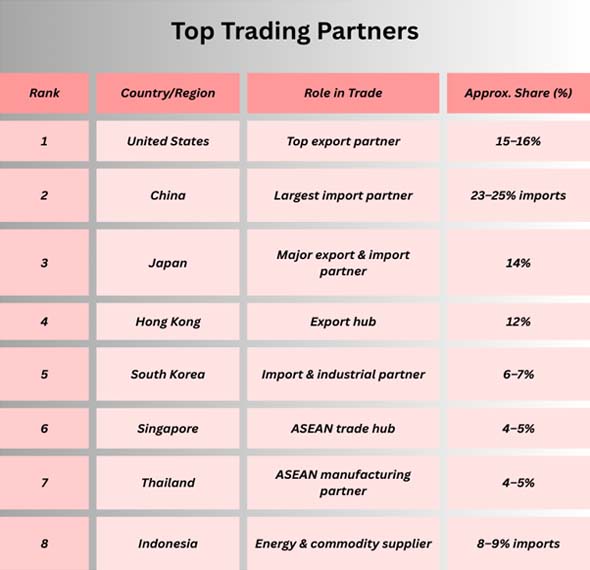
Important Trends in Trade
- The U.S. gets around 15% to 16% of the Philippines' goods.
- In the past, the two countries did more than $23 billion worth of business with each other every year.
- It sends out a lot of electronics, semiconductors, garments, and agriculture commodities.
- The histories, economies, and investments of the two countries are very closely linked, which makes their relationship strong. The Philippines has a lot of people who buy things, and the U.S. needs gadgets and services from the Philippines.
Important for Planning
The U.S. alliance is useful:
- Exports that are worth a lot of money, like semiconductors.
- The business process outsourcing (BPO) and services sector is getting bigger.
- There is foreign direct investment coming in.
- As per Philippines Import Custom Data by Import Globals, even if there are often worries about tariffs and trade talks, the U.S. is still a consistent and important market for Philippine exports.
China: The Most Important Partner for Imports and the Supply Chain's Anchor
The Philippines' most major commercial partner is China, which is also a key part of its manufacturing supply chain. It makes up about 23–25% of all imports, which shows that it is quite necessary for manufacturers to make items.
- Important Trade Changes provides forth raw materials, machines, and parts for electronics.
- Helps the industries that make things and send them abroad.
- Is a major hub for moving intermediate commodities.
- According to Philippines Import Trade Analysis by Import Globals, China makes a lot of electronics because the Philippines' exports depend on parts that come from China.
Important for Planning
China makes it feasible for:
- More industry growth and more efficient production
- Getting cheap materials for production
- Being part of global value chains
- But the Philippines needs to be careful not to rely too much on this so they don't become overly dependent on one source.
ASEAN: The Engine of Regional Growth
As per Philippines Exporter Data by Import Globals, the Philippines is putting more and more emphasis on the Association of Southeast Asian Nations (ASEAN) in its economic policy. ASEAN is a huge market and a critical supply chain network, with a combined GDP of more than $4 trillion and a population of more than 600 million.
Important Partners in ASEAN
- Singapore is a center for finance and logistics.
- Thailand—trade in cars and manufacturers
- Indonesia: energy and goods
- Malaysia and Vietnam—electronics and supply chain integration
Why ASEAN is Important
ASEAN gives:
- Lower tariffs because of regional trade agreements
- Strong integration of the supply chain
- Being close to each other and having fewer shipping costs
- Based on Philippines Importer Data by Import Globals, the continuous improvements to ASEAN trade accords, such as better collaboration in the digital and green economies, are likely to increase trade between countries in the area even more.
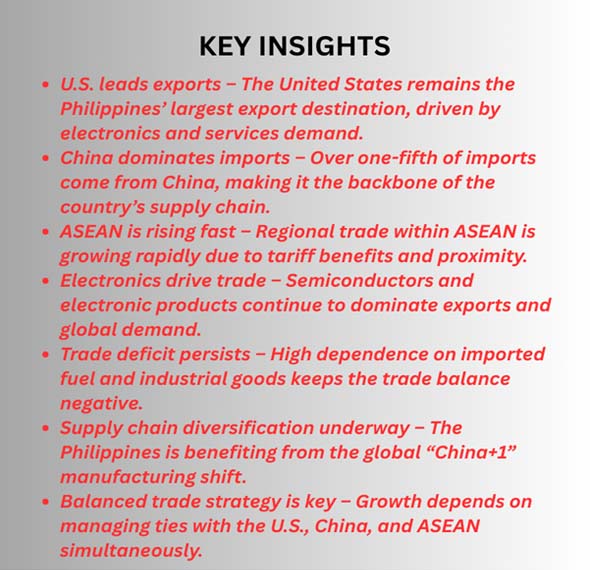
Electronics: The Most Important Thing in Philippine Trade
According to Philippines Import Shipment Data by Import Globals, Electronics are still the most important export sector, making up a large part of all exports. The Philippines is an important part of the worldwide semiconductor supply chain. It sends semiconductors to places like the U.S., Japan, and China.
Key Points
- A lot of exports are electronics.
- A lot of demand from tech companies around the world
- Working with Asian supply chains
Trade ties are intimately tied to the sector's success:
- U.S. → market for ultimate consumers
- China → inputs for the supply chain
- ASEAN => networks of production in the region
Trade Strategy: Finding a Balance Between Global and Regional Powers
As per Philippines Import Export Trade Analysis by Import Globals, the Philippines is following a multi-aligned trade policy that strengthens links with other countries in the area while keeping good relations with the world's big powers.
A Strategy with Three Pillars
- U.S. – Market for high-value exports
- China: the backbone of the supply chain
- ASEAN: development and integration in the region
This balanced strategy lets the Philippines:
- Spread out trade risks
- Get more access to markets
- Make the economy more resilient
Problems with trade in the Philippines
There are still certain problems, even though growth is strong:
1. Trade Gap
Imports always outnumber exports because the country depends on fuel and capital items.
2. Dependence on the Supply Chain
Relying too much on China for inputs makes you weak.
3. Gaps in Infrastructure
According to Philippines Export Import Global Trade Data by Import Globals, inefficient logistics and ports make it harder for exports to compete.
4. Uncertainty Over the World
Changes in trade policies and geopolitical conflicts affect trade flows.
Chances to Grow (2026 and Beyond)
The Philippines is in a good position to take advantage of changes in global trade:
1. The China+1 Strategy
Companies from all around the world are moving away from China, and the Philippines is becoming a new place to make things.
2. Growth of Digital Trade
More e-commerce, digital services, and IT exports.
3. Joining ASEAN
More cooperation between regions will lead to more trade.
4. Agreements on Free Trade
New and improved FTAs will make it easier to get into new markets.
What will trade in the Philippines be like in 2026?
As time goes on, the Philippines is likely to become an even more important player in global trade by:
- Increasing exports to the U.S. and Europe
- Lessening reliance on a single source of imports
- Improving trade links between ASEAN countries
- Putting money into infrastructure and manufacturing
- For the country to be able to deal with global economic uncertainty, it will need to keep its trade strategy balanced.
Conclusion
Balance, diversity, and regional integration are the main ideas behind the Philippines' trade plan for 2025–2026. The US, China, and ASEAN all have different but connected roles in defining the country's economic future.
The U.S. is a stable and valuable export market, China is the backbone of the supply chain, and ASEAN offers chances for expansion in the region. These partnerships are the basis of the Philippines' worldwide trade strategy.
As global supply networks change and economic alliances change, the Philippines is in a good place to become a strong and competitive trading nation in the future. Import Globals is a leading data provider of Philippines Import Export Trade Data.
FAQs
Que. Who will be the Philippines' biggest trading partner in 2025–2026?
Ans. The US is the biggest partner for exports, and China is the biggest source for imports.
Que. What does ASEAN mean for commerce in the Philippines?
Ans. ASEAN brings countries in the region closer together, lowers tariffs, and makes supply chains stronger.
Que. What are the main things the Philippines sells to other countries?
Ans. Clothes, electronics, semiconductors, machinery, and agricultural goods.
Que. What is the most difficult thing about trading in the Philippines?
Ans. A trade deficit that won't go away because we rely too much on imports, notably for gasoline and industrial goods.
Que. Where to get detailed Philippines Import Export Global Data?
Ans. Visit www.importglobals.com.