Mexico's Top 5 Imports (2025–26): What Mexico Buys the Most
- Feb 05, 2026
- 30 Views
Mexico's Top 5 Imports (2025–26): What Mexico Buys the Most
Mexico's import basket for 2025–26 presents a clear story: the country is one of the most significant places in the world for manufacturing and assembly.
As per Mexico Import Data by Import Globals, it is closely linked to North American supply chains and is becoming more connected to Asian component ecosystems. That location affects what Mexico buys the most: electronics, industrial machinery, auto parts, gasoline, and plastics.
A useful technique to look at Mexico's import structure is to put together: Ranking by product level (which categories are most popular by HS chapter), and; As per Mexico Export Data by Import Globals, use-based structure (how much is intermediate, consumer, or capital products) is especially helpful for understanding Mexico's trade economy, which is built on factories.
Below, "Top 5" is shown using a common HS-chapter view of Mexico's import composition (with shares) and then looked at via the lens of 2025–26, which shows how these imports help with production, logistics, and consumption.
The Top Five things Mexico will Import in 2025–26
These five types of items are always at the top of Mexico's import bill since they are the tools and materials that keep factories running, make cars, power the industry and transportation, and make food and consumer goods.
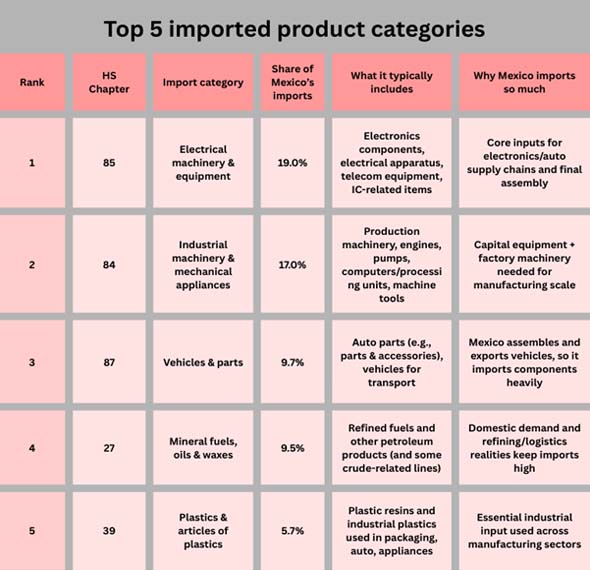
1) Electrical Machinery & Equipment (HS 85): The #1 Import Engine
Because modern manufacturing uses a lot of electronics, even more than just consumer electronics, electrical machinery is Mexico's biggest import sector. As per Mexico Import Export Trade Data by Import Globals, electrical parts and systems are needed for cars, appliances, medical gadgets, industrial controls, communication networks, and factory automation.
What is Really in HS 85?
- Parts and subassemblies that go into making electronics in factories.
- Electrical tools for power distribution and industrial applications
- Value chains for electronics and telecom equipment.
Why it will Still be Number one in 2025–26
Mexico's ability to compete hinges on its ability to make and ship a lot of manufactured goods. As per Mexico Import Custom Data by Import Globals, they need to get high-value parts from other countries that aren't always created in the proper volumes or with the right level of complexity. Also, progress in electrification (such smart manufacturing, industrial automation, and energy systems) keeps the need for these imports high.
A note on the Supplier Chain: The United States sends a lot of Mexico's HS 85 goods. This shows how well the industries of the two countries work together.
2) Industrial Machinery and Mechanical Appliances (HS 84): The Heart of Making Things
HS 84 is the "skeleton and muscle" of modern production, and HS 85 is the "nervous system." As per Mexico Import Trade Analysis by Import Globals, tools that shape metal, transfer materials, create parts, and run production lines are all examples of machinery imports. There are also a lot of computers, processing devices, and mechanical systems in HS structures in this group.
What does HS 84 have?
- Industrial systems and machine tools for building factories.
- Pumps, compressors, turbines, and other specialized instruments that work with machines.
- Computers or processing units that are part of industrial workflows (depending on how they are classified).
Why it Matters in 2025–26
According to Mexico Exporter Data by Import Globals, Mexico is still a favorable destination to invest in manufacturing because of its location, trade agreements, and quick access to North America. That growth needs:
- New tools for new lines.
- Parts to keep things going.
- Improvements in productivity, include systems and automation that can handle more work.
- As long as Mexico maintains creating and selling stuff, equipment will always be one of its top imports.
3) Vehicles and Pieces (HS 87): Bringing in Pieces to Construct Things That Are Already Made
Mexico is a prominent player in the global vehicle business. As per Mexico Importer Data by Import Globals, it makes cars and parts for big markets that buy them. That job in manufacturing means that a lot of parts, modules, and specialty vehicles that aren't created here have to be brought in.
What is in HS 87?
- Parts and accessories for cars and trucks (a big part of many trade portfolios).
- Vehicles for business and specialist transportation.
- Parts that go to assembly plants and Tier-1 suppliers.
Why it stays in the top three in 2025–26
Automotive supply chains are quite flexible. As per Mexico Import Trade Statistics by Import Globals, even if a car is put together in Mexico, many parts that are worth a lot of money (electronics, precision parts, and specialist subsystems) traverse borders many times. This kind of "intra-industry trade" is common in regions with integrated production.
Note About the Supply Chain: The U.S. is also a key source of HS 87 imports, which fits with the North American auto ecosystem.
4) Mineral Fuels, Oils & Waxes (HS 27): The Truth About Energy on an Industrial Scale
Even though Mexico has its own energy sources, it nonetheless imports a lot of fuel-related goods. As per Mexico Import Shipment Data by Import Globals, transportation, logistics, and manufacturing all need a lot of energy, and the way fuel is imported often depends on the layout of the refinery, the mix of products needed, and the cost of logistics.
What is in HS 27?
Commonly found are petroleum products and refined fuels. Other mineral fuel-related goods and waxes that fall within HS categorization. There may also be some lines connected to crude, depending on trade trends and the time period for reporting.
Why HS 27 is still in the top 5 in 2025–26
- Energy is what makes industrial economies work. Fuel imports also respond to: the need for transportation (freight, distribution, and mobility).
- Energy needs for making things
- Changes in price and limits on supply
This group can alter more than others because of changes in oil prices and policy, but it is still structurally important.
5) Plastics (HS 39): The Quiet Workhorse of Making Things
As per Mexico Import Export Trade Analysis by Import Globals, plastics are one of the most common things utilized in factories around the world, and Mexico's manufacturing presence makes HS 39 a continuously high-value import category.
What is in HS 39?
- Industrial polymers and plastic resins.
- Plastic materials for electronics cases, appliance housings, car interiors, and packaging.
- Materials utilized in both consumer items and industrial production
Why it's among the top five in 2025–26.
Even though finished goods are created in Mexico, many polymer inputs are brought in from other countries because they are cheaper, easier to find, or meet certain specifications. Plastics can go increase in demand as factories make more of them.
What Mexico's Import Structure Says About 2025–26
1) Most of What We Import is "Inputs," Not "Finished Goods."
Mexico's official trade reports demonstrate that most of its imports are intermediate items. This shows that Mexico is a good place to make things. Consumer goods are significant, but not as vital as the story of industrial inputs.
2) North America is Still the Most Important Place for Origin Patterns
As per Mexico Export Import Global Trade Data by Import Globals, the United States is the top origin for several of the top categories, which shows that there are strong cross-border production networks.
3) Policy and Tariffs Can Change the Composition at the Edges
Changes in Mexico's trade policy and tariffs can have a small effect on sourcing routes or categories, especially for commodities from countries that are not part of the FTA. The industrial reasoning underlying the top five categories is solid enough that the ranking stays the same even when sourcing changes.
In Conclusion, Mexico Gets What It Needs to Build (and Export) on a Large Scale
Mexico's top five imports in 2025–26—electrical machinery (HS 85), industrial machinery (HS 84), automobiles and parts (HS 87), mineral fuels (HS 27), and plastics (HS 39)—show that the country is built around industrial manufacturing, supply-chain integration, and large-scale assembly.
These five groups are the best place to start if you want to look at Mexico for trade strategy, procurement, logistics, or market entry because they cover almost all of the major industrial clusters: automotive, electronics, appliances, packaging, and energy-intensive manufacturing. Import Globals is a leading data provider of Mexico Import Export Trade Data.
FAQs
Que. What is the largest category of goods that Mexico imports in 2025–26?
Ans. Electrical machinery and equipment (HS 85) is the category with the most imports.
Que. Why does Mexico buy so much machinery (HS 84)?
Ans. Mexico's factories run on machinery imports, which include tools for production lines, industrial systems, and increases to productivity.
Que. If Mexico makes cars, why does it import so many vehicles and auto parts (HS 87)?
Ans. This is because Mexico puts cars together using parts from all around the world. Parts often cross borders many times in integrated supply chains.
Que. Are most of the fuels (HS 27) we import refined products?
Ans. Refined petroleum products and other mineral-fuel commodities that suit domestic demand and industrial logistics demands are commonly included in fuel imports.
Que. Where to get detailed Mexico Import Export Global Data?
Ans. Visit www.importglobals.com.