Spain's Import Needs: A Breakdown of Machinery, Chemicals, and Energy Inputs (2025–26)
- Mar 23, 2026
Spain's Import Needs: A Breakdown of Machinery, Chemicals, and Energy Inputs (2025–26)
When it comes to business, Spain boasts one of the best economies in Europe. There are many different kinds of businesses there, such those that make cars, tools, food, drugs, chemicals, and other items that people buy. The country can only compete well if it receives the right things, like "productive inputs" that keep firms running, supply chains moving, and energy sources stable.
As per Spain Import Data by Import Globals, the best method to figure out what Spain will need to buy in 2025–26 is to look at three primary areas: machinery (like electrical equipment), chemicals (like pharmaceuticals and industrial chemicals), and energy inputs (such crude oil, refined commodities, and gas). By default, this import profile does not break. A lot of economies that make things now also send out things that are worth more. They bring in a lot of raw materials and capital goods. Spain's largest strategic challenge is how to keep the industrial sector operating and make energy security stronger while also dealing with rising energy prices, problems with the supply chain, and shifting trade ties.
The Big Picture: What Spain Buys and Why It Matters
In 2023, Spain imported about $469 billion worth of goods, while in 2024, it imported about $451.3 billion worth of products. As per Spain Export Data by Import Globals, the small change from year to year is usual for trade cycles, price changes (particularly in energy), and demand situations. But the structure is stable: Spain imports a lot of goods that help manufacturing and services grow.
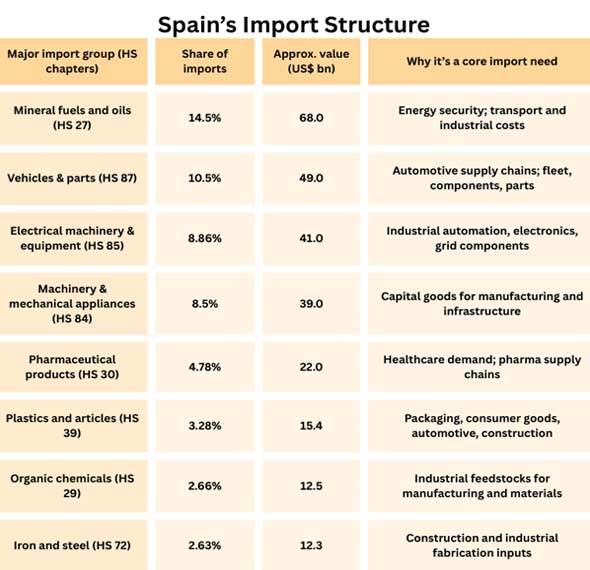
In general, Spain's dependency on imports can be broken down into: Energy inputs to power transportation, industry, and some energy generation. Tools and machines to help with manufacturing, infrastructure, and technology Chemicals and drugs to meet the needs of the healthcare and industrial sectors (as well as vehicles and parts, metals, polymers, and other intermediate commodities that make up the industrial ecosystem).
1) Machinery Imports: The Key to Staying Competitive
Spain imports machinery for a simple reason: contemporary industry needs machinery to be productive. Capital equipment affects the cost of each unit, the quality of the product, how energy-efficient it is, and how well it can comply with regulations. As per Spain Import Export Trade Data by Import Globals, Spain makes some of its own gear, but it still buys a lot of specialized machines, high-tech parts, and equipment for specific industries.
What is Considered "Machinery" in Real Life
Spain's machinery-related import needs usually include: industrial production lines and robotics/automation equipment; machine tools and specialized manufacturing equipment; pumps, compressors, turbines, and industrial mechanical systems; parts, spares, and sub-assemblies that cut down on downtime; and power-related equipment and grid components (which often overlap with electrical machinery).
Why Advanced Economies Are Importing More Machinery
When corporations update their facilities (with automation, accuracy, and energy efficiency), infrastructure projects speed up, supply chains move toward higher-spec production, and companies spend money to fulfill stricter environmental and safety standards, machinery imports often go up.
As per Spain Import Custom Data by Import Globals, Spain's machinery imports in 2025–26 are best seen as "capex for competitiveness." The gain doesn't come right away like consumer imports do. It comes from more output, better quality, and shorter manufacturing cycles.
2) Chemicals and Pharmaceuticals: The Silent Pillar of Healthcare and Industry
Chemicals are the building blocks of most high-value supply chains. Under the chemical umbrella are pharmaceuticals, industrial chemicals, feedstocks for plastics, coatings, adhesives, specialty chemicals, and fertilizers.
As per Spain Import Trade Analysis by Import Globals, Spain imports a lot of chemicals because: plastics, paints, coatings, detergents, and packaging are all chemical intermediates that are used in manufacturing; pharmaceuticals need complex inputs and active ingredients that come from all over the world; and industrial processes (from food processing to automotive) use specialized chemical formulations.
A 2025–26 Issue: Supply Chain Exposure and Trade Policy Risk
Energy pricing, shipping problems, and trade policies can all affect chemical supply chains. In 2025, industry experts cautioned that tariff pressures could hurt performance. As per Spain Exporter Data by Import Globals, they also talked about how much chemical and pharmaceutical trade flows between Spain and major partners like the United States. For Spain, the strategic need isn't only "importing chemicals," but also making sure that important chemical inputs that support downstream industry keep coming in.
3) Energy Inputs: Why Spain Still Gets So Much Gas and Fuel from Other Countries
Spain still relies heavily on imported crude oil, processed petroleum products, and gas, even though it has a lot of renewable energy and has modernized its power grid. Energy inputs have an effect on: costs of transportation and logistics, costs of running a business, inflation in households, energy security, and geopolitical exposure.
Mineral fuels were the biggest group of imports in 2023. As per Spain Importer Data by Import Globals, the figure at the product level clearly shows how big these flows are: crude oil imports were one of the most important imports, and refined petroleum products were also very important.
Petroleum gases (including LNG-related categories) made up a big part of the market. 2025–26 trend: Suppliers' change in gas.
Spain's gas sources have been changing. In early 2025, data showed that LNG imports from the United States were going up quickly, giving the US a bigger percentage of Spain's gas supply while other sources fell. This shows the real strategic need: Spain isn't just "importing gas"; it's also actively controlling the security of supply and the diversity of suppliers.
How These Imports Help Spain's Growth Plan
Spain’s economy is deeply integrated into European and global value chains. As per Spain Import Trade Statistics by Import Globals, Imports of machinery, chemicals, and energy inputs support:
- Automotive production and parts ecosystems
- Food processing and packaging
- Pharmaceutical manufacturing and healthcare supply
- Construction and infrastructure development
- Technology and electrical equipment deployment
- This is why import dependence can be productive: Spain imports inputs and capital goods that help generate value-added output—both for domestic consumption and for exports.
The 2025–26 Challenge: Making Industries Less Vulnerable While Keeping Their Output Up
Spain's demand for imports makes it vulnerable to three kinds of shocks:
- Fluctuations in energy prices
- As per Spain Import Shipment Data by Import Globals, Prices for oil and gas can change quickly, which can affect inflation and business expenditures.
- Problems in the supply chain
- Parts for machines, chemical intermediates, and shipping problems can all hold down manufacturing.
- Risk of tariffs and trade policy
- Changes in policy that can raise costs have a big effect on chemicals and industrial inputs.
- A useful response for 2025–26 is not to "cut imports," but to: as per Spain Import Export Trade Analysis by Import Globals, make things more efficient and diversify energy sources to make them less sensitive; protect access to important industrial inputs like machinery parts and chemical intermediates; deepen supplier diversification and logistics resilience; and put productive imports ahead of those that don't.
Conclusion
The main reason Spain needs to import goods in 2025–26 is to maintain its sophisticated industrial economy running smoothly. As per Spain Export Import Global Trade Data by Import Globals, Imports of machinery boost capacity, innovation, and efficiency. Chemical and pharmaceutical imports are important for both the health care system and the manufacturing process. Energy imports are still very important for transportation, industry, and keeping prices stable. At the same time, diversifying supplies is becoming more and more important. Spain's long-term advantage is how successfully it turns these imported goods into higher-value products, stronger exports, and a better ability to handle shocks from outside. Import Globals is a leading data provider of Spain Import Export Trade Data.
FAQs
Que. Why does Spain buy so much machinery when it has a lot of factories?
Ans. Because many machines, high-tech parts, and specialized tools are made in other countries and are needed to bring factories and infrastructure up to date.
Que. What else are chemical imports vital for outside health care?
Ans. Chemicals are used in many industries, such as packaging, making cars, building materials, food processing, detergents, coatings, and more.
Que. Why are energy imports so important for Spain?
Ans. Oil and gas affect the costs of transportation and production, as well as inflation. Even with renewable energy sources, fossil fuels are still a big element of the energy system.
Que. By 2026, what can make Spain less likely to rely on imports?
Ans. More efficiency, a wider range of suppliers (particularly for gas), improved logistics resilience, and a sustained move toward steady, low-carbon generation in the home country.
Que. Where to get detailed Spain Import Export Global Data?
Ans. Visit www.importglobals.com.