UK Aerospace Export Data: Global Market Analysis

- Oct 14, 2026
- 59 Views
UK Aerospace Export Data: Global Market Analysis
In 2025, the UK was still one of the leading exporters of aerospace-related goods in the world, supplying wings, engines, avionics systems, landing gear, and precision equipment to aircraft producers around the world.
UK exports of aircraft and spacecraft (HS 88) were at US$35.8 billion in 2025, ranking this category among the 10 most significant export items. Total aerospace, defence, security, and space exports were about US$66 billion in 2025, compared to about US$60 billion in the previous year, which means a growth of approximately 10%.
The two biggest trading partners of the UK were the EU and the US in the goods mentioned. The European Union imported US$6.8 billion from the UK, which made it the largest importer, while the US counted US$3.36 billion as its imports from the UK. Together, these markets represented around 60% of the total goods mentioned, which clarifies the fact that the UK aerospace industry is very closely integrated into European and transatlantic supply chains since parts and components cross borders several times before they finally get assembled, reported UK Export Data.
UK Aerospace Export Summary
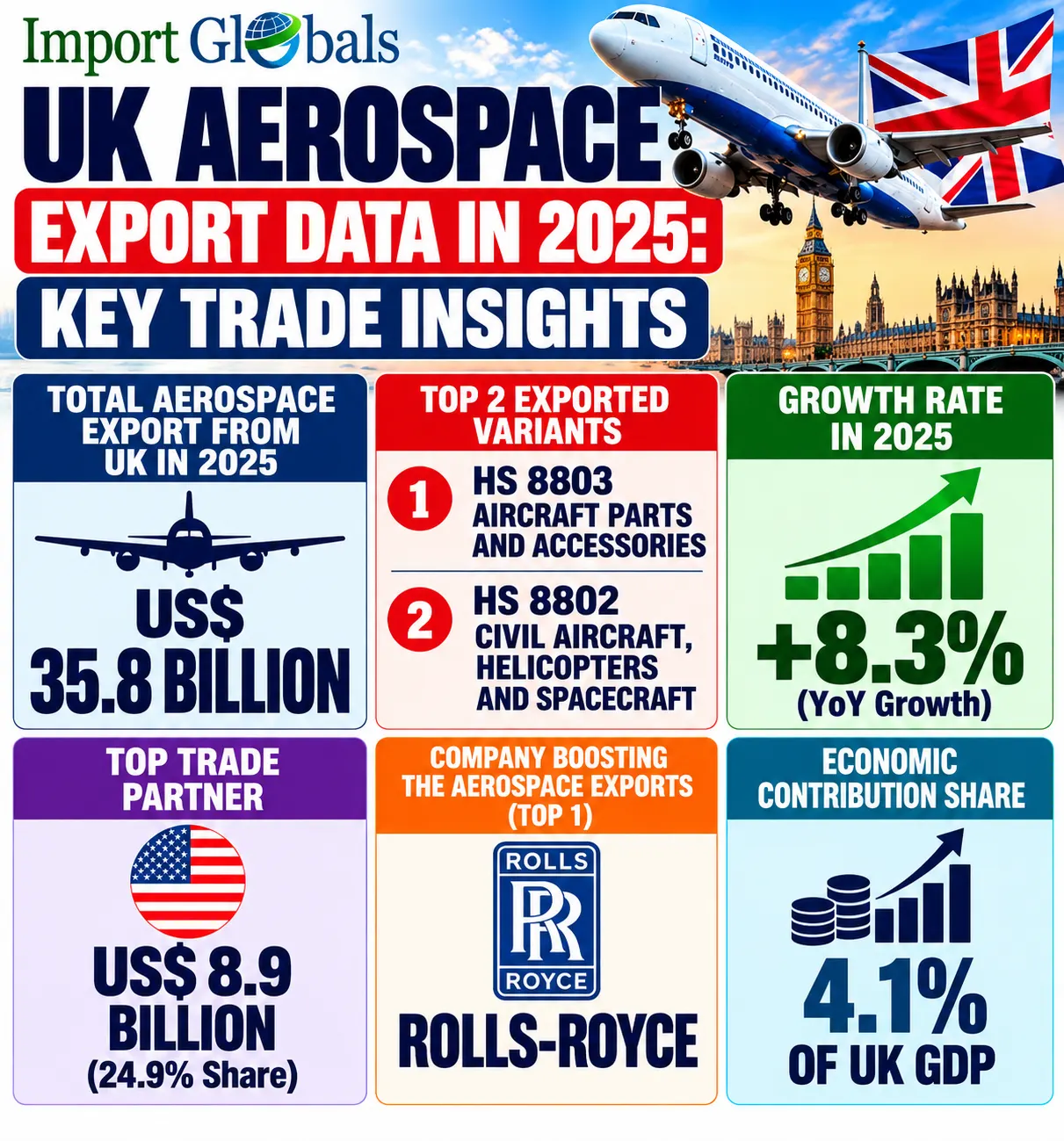
In 2025, the aerospace exports sector in the UK accounted for a large part of the country’s foreign trade, with the total aerospace exports value amounting to about $35.8 billion. The industry demonstrated an annual growth rate of 8.3%, which indicates its importance for aerospace and advanced manufacturing domains in the UK. The major product categories include HS 8803, which deals with aircraft appliances and accessories, and HS 8802 related to civil aircraft, helicopters, and spacecraft.
As for trade partners, it is important to note that the United States is one of the biggest customers of aerospace exports; accounting for $8.9 billion or 24.9% of the total export value indicated in the infographic. Additionally, Rolls-Royce is mentioned as a leading company in the aerospace sector, says UK Customs Data. In addition to its export earnings, the aerospace sector of the country's economy makes a valuable contribution to the development of the country in terms of skilled jobs, technological innovations, and international supply chain cooperation. The infographic shows that the aerospace segment accounts for 4.1% of the UK’s GDP.
Top 10 Aerospace Products Exported From UK in 2025
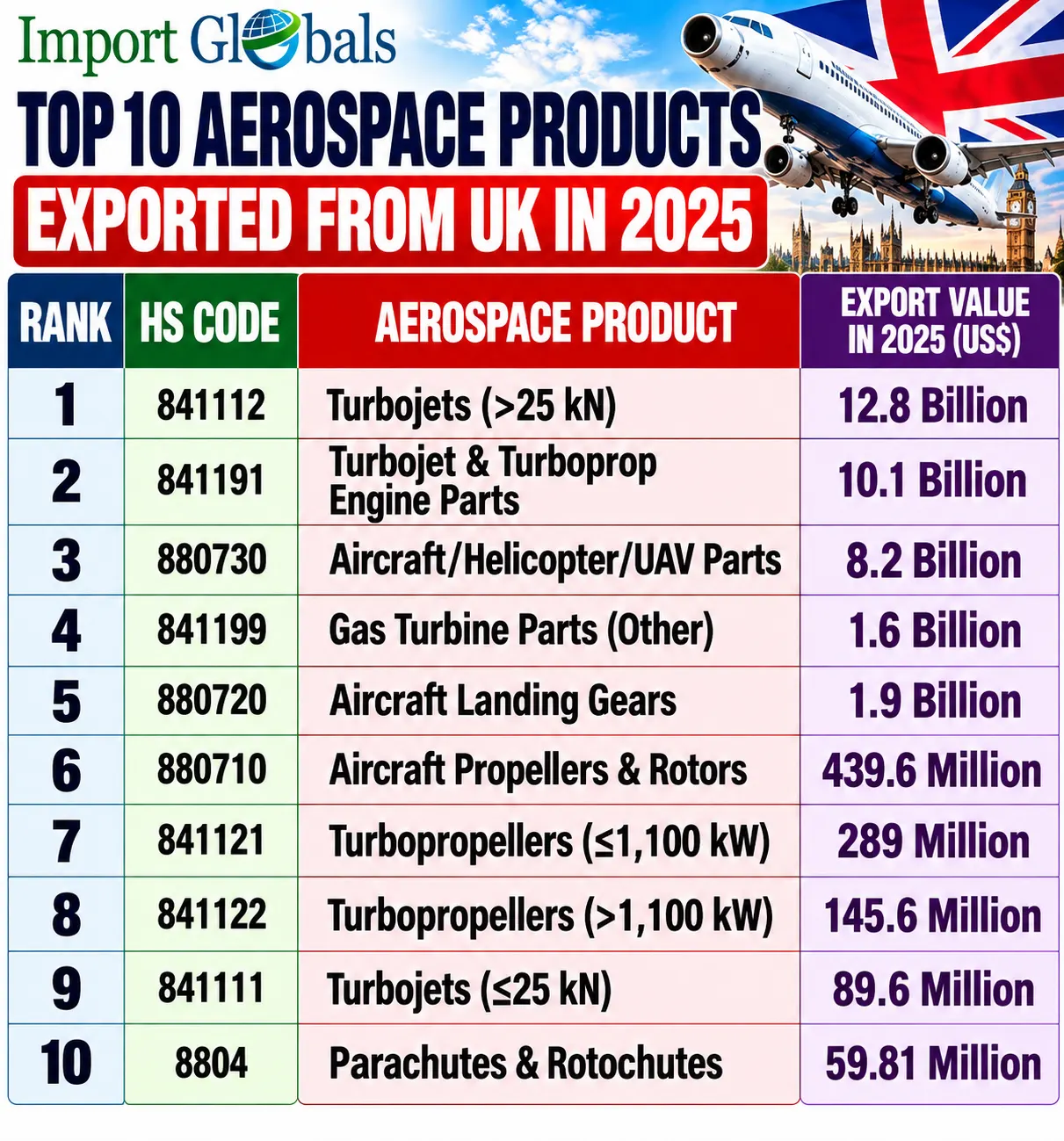
- HS 841112 – Turbojets of More Than 25 kN Thrust
Export value reported: US$12.8 billion.
These are turbojet engines designed for commercial and military use. Their export signals the UK’s proficiency in propulsion technology, sophisticated engineering and aviation technology.
- HS 841191 – Components of Turbojets and Turboprop Engines
Export value reported: US$10.1 billion.
A category representing specialized components for engines used in propulsion systems. Such components contribute to operations involving the manufacturing, maintenance, repair, and overhaul of engines in the aviation industry.
- HS 880730 – Components of Airplanes, Helicopters, or Unmanned Aircraft
Export value reported: US$8.2 billion.
Components of specialized construction and use in manufacturing airplanes and helicopters; they are necessary for airplane assembly and for aircraft replacement, repair, and maintenance.
- HS 841199 – Other Components of Gas Turbines
Export value reported: US$1.6 billion.
Products falling into the category of gas turbines which do not specifically relate either to turbojets or turboprop engines. Such products are involved in specific applications from propulsion to power generation.
- HS 880720 – Airplane Landing Gear and Components
Export value reported: US$1.9 billion.
Airplane Landing Gear and Components are the top 5th exported variant of aerospace from UK in 2025, as per UK Shipments Data. The accountability of the specific product is at a staggering rate of 1.9 billion US dollars in 2025. The overall demand from the global consumers has driven the demand rate.
- HS 880710 — Aircraft Propellers, Rotors and Parts
Reported export valuation: $439.6 million
The propellers and rotors serve to provide the required thrust or lift for different kinds of aircraft. Their components support aviation manufacturing, replacement demand, and maintenance across civil and specialized aviation markets.
- HS 841121 — Turbopropellers Not Exceeding 1,100 kW
Reported export valuation for 2025: $289 million
These engines power aircraft commonly used for regional transport, cargo operations, and special missions. This design incorporates turbine efficiency; with propeller performance for operations over shorter routes and less dense airports.
- HS 841122 — Turbopropellers Exceeding 1,100 kW
Reported export valuation for 2025: $145.6 million
Higher-powered turbopropeller engines provide engine power for larger aircraft designed to operate regional passenger services, freight transport, and special missions. International demand relies on fleet requirements, engine performance, and maintenance needs.
- HS 841111 — Turbojets Not Exceeding 25kN Thrust
Reported export valuation for 2025: $89.6 million
These smaller turbojet engines serve selected light aircraft and special applications in aviation. Their trade reflects demand for compact propulsion systems, replacement engines; and technologies suitable for specific aircraft designs.
- HS 8804 — Parachutes and Rotochutes
Reported export valuation: $59.81 million
This category includes parachutes and rotochutes employed in aviation, as well as emergency recovery and specialized applications. These products support safety.
Top 10 Companies Boosting the Aerospace Products Export of UK in 2025
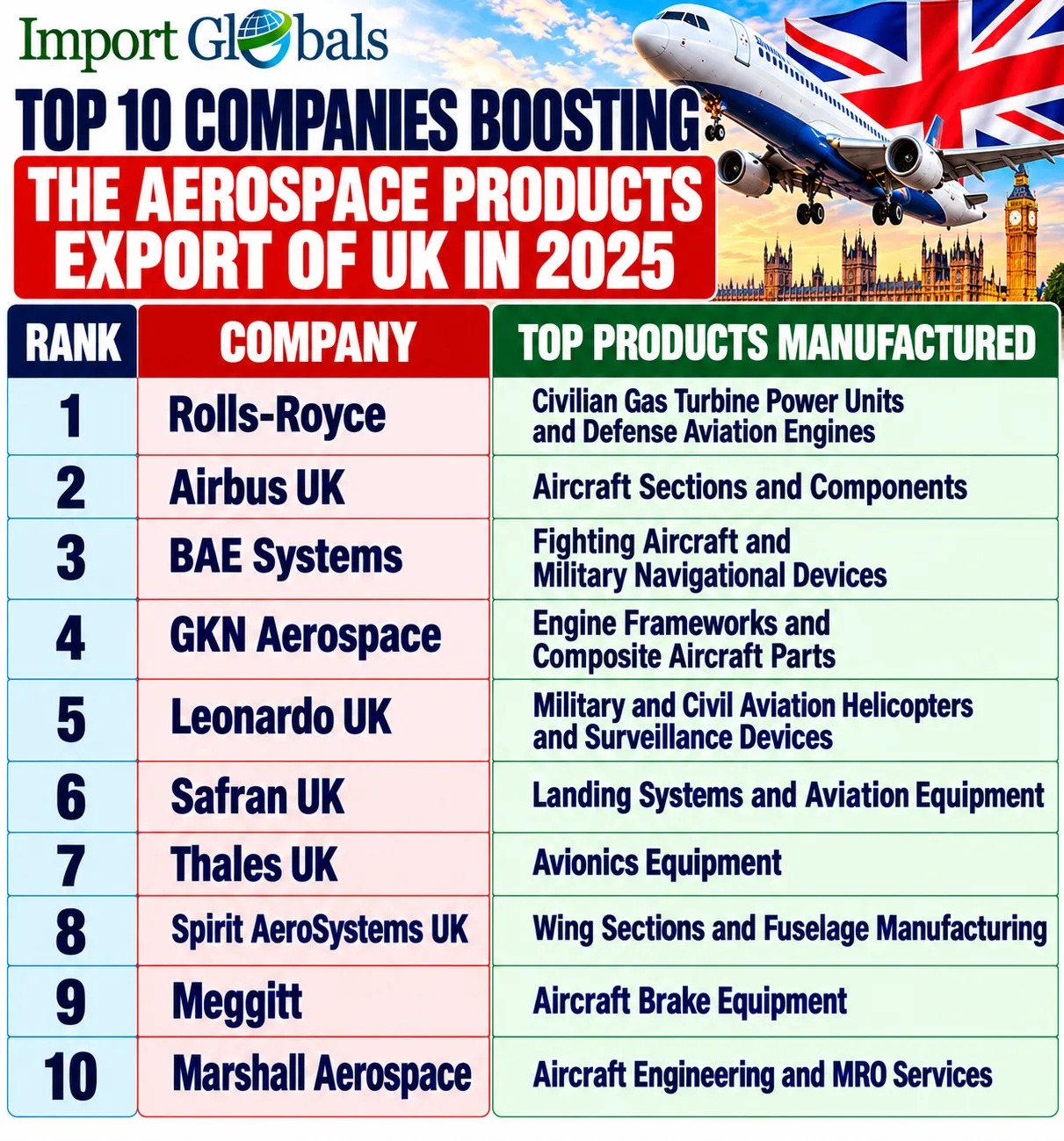
- Rolls-Royce — Top Products Manufactured - Civilian Gas Turbine Power Units and Defense Aviation Engine Systems
Rolls-Royce is involved in the UK aerospace industry by working with propeller engine technology, production of gas turbines, and international repair services. Its products facilitate the civil and defense aviation sector across the world, says UK Customs Shipment Data.
- Airbus UK — Top Products Manufactured - Sections of Airlines and Outbuildings of Aircraft
Airbus UK designs and produces key components of airplanes for worldwide aviation projects. Its capabilities in wing design and composite engineering enable it to take part in aircraft production and supply chains throughout the world.
- BAE Systems —Top Products Manufactured - Fighting Aircraft and Military Navigational Devices
BAE Systems serves the aerospace and defense industries in the UK through its programs in fighting aviation and advanced electronics and global defense collaborations.
- GKN Aerospace —Top Products Manufactured - Engine Frameworks and Parts of Aircraft Produced from Composite Materials
GKN Aerospace manufactures lightweight components and frameworks of aviation engines for commercial and military aviation. Its products allow optimization of aircraft performance and improve the efficiency of the aircraft construction industry.
- Leonardo UK — Top Products Manufactured - Military and Civil Aviation Helicopters and Devices for Information Gathering
Leonardo UK is engaged in the production of helicopters and advanced avionics products. The company also provides assistance in civil aviation and defense, and the entire infrastructure for upgrades.
- Safran UK —Top Products Manufactured - Landing System and Aviation Equipment
Safran UK is a manufacturer of aviation instruments and specialist equipment. Its braking systems and advanced components ensure the safety and operational reliability of aircraft and the entire international aviation supply chain.
- Thales UK — Top Products Manufactured: Avionics Equipment
Thales UK is a developer of electronic equipment for air navigation, monitoring, and control purposes. Its aerospace products meet the demand for reliable equipment used in all commercial and other aviation sectors.
- Spirit Aero Systems UK —Top Products Manufactured: Wing Shop and Fuselage Manufacturing
Spirit Aero Systems UK is a manufacturer of key structural components for international aircraft programs. UK Import Data says that Its products are important for aircraft assembly, lightweight manufacturing, and international supply chains.
- Meggitt — Top Products Manufactured: Aircraft Brake Equipment
Meggitt is a supplier of advanced aerospace technologies important for aircraft safety, environmental control, and operational control. Its equipment satisfies both commercial and military aviation needs, including servicing and spare parts supply.
- Marshall Aerospace —Top Products Manufactured - Aircraft Engineering and MRO Services
Marshall Aerospace is a provider of services in the field of aircraft engineering, modification, and lifecycle services. Its capabilities support military and civilian operators in prolonging their service life.
Top 10 Export Partners of UK for Aerospace Products Trade
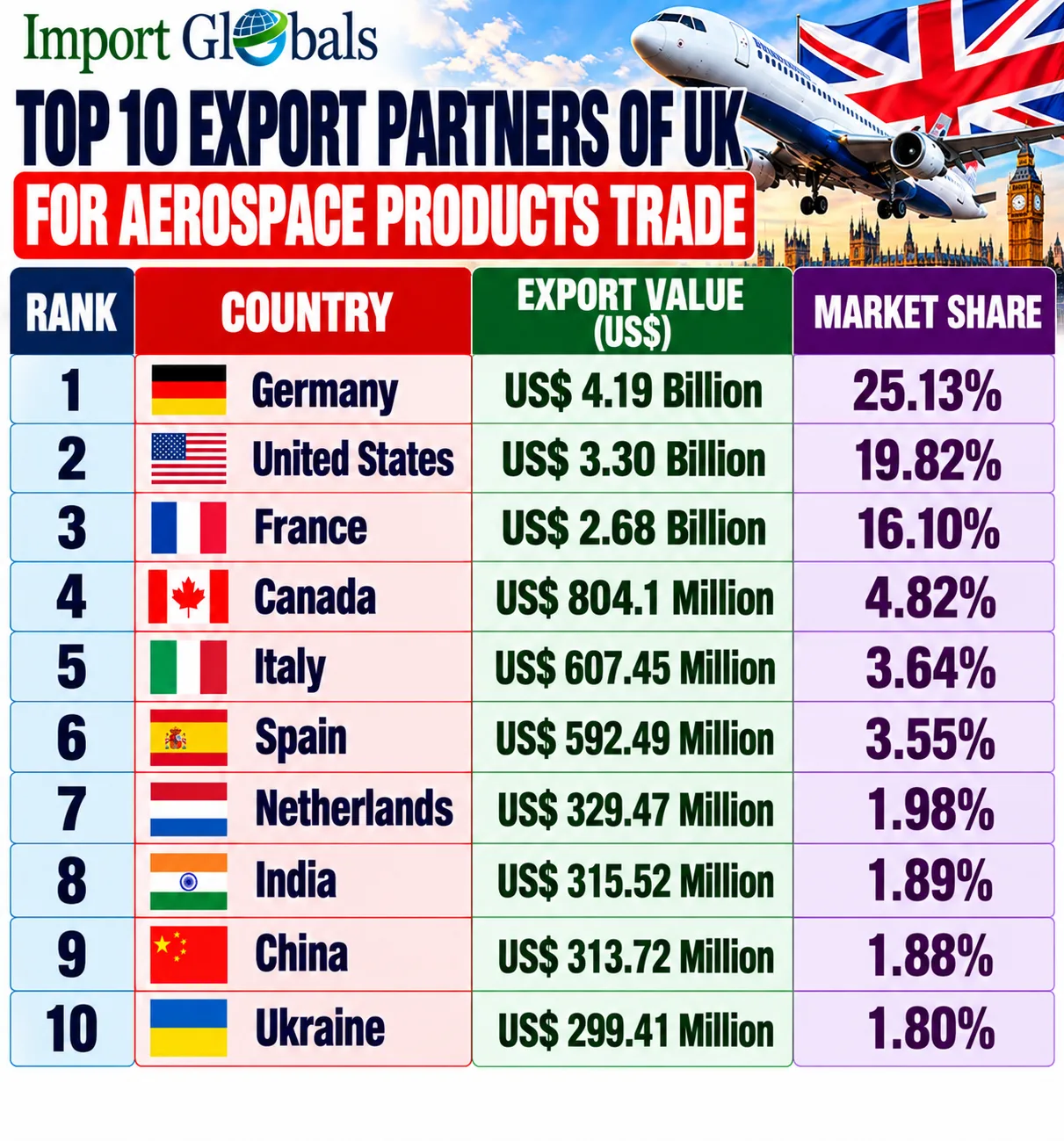
- Germany — US$4.19 Billion | Market Share: 25.13%
Germany was the primary country mentioned in the UK Trade Data. The trade in aerospace with the UK looks at how manufacturing networks, aircraft production, components, and cooperation across borders work.
- United States — US$3.30 Billion | Market Share: 19.82%
The United States was a notable country for UK aerospace products, as aircraft components and propulsion technologies were the reason for this.
- France — US$2.68 Billion | Market Share: 16.10%
France is one of the top 3 countries importing UK aerospace products, so there is a good amount of trade happening there. Cooperation in the sphere of aviation is one of the reasons for this.
- Canada — US$804.1 Million | Market Share: 4.82%
Canada, being an aerospace market, gives UK suppliers of aircraft components and specialized technology an opportunity to supply products. The aviation business is also well-developed in this country.
- Italy — US$607.45 Million | Market Share: 3.64%
Italy generates a need for several products in the aerospace sphere, such as aircraft components. Italy’s role in the European industrial community is essential in terms of international trade.
- Spain—US$592.49 Million | Market Share: 3.55%
Spain is a major European aerospace manufacturing country. The UK’s aerospace industry contributes to the manufacture of aircraft components, engineering products, and special equipment for the production and servicing of aircraft.
- Netherlands—US$329.47 Million | Market Share: 1.98%
The Netherlands makes its contribution to the European aviation logistics network and aerospace infrastructure. Its role as an international distribution centre and in engineering and procurement of components helps the UK aerospace industry increase its export volume due to the availability of opportunities in this field.
- India—US$315.52 Million | Market Share: 1.89%
India is a promising market for aerospace components, aviation technology, and special engineering products. With the growth of aviation activities and manufacturing, the UK may find good market opportunities in India.
- China—US$313.72 Million | Market Share: 1.88%
China is a significant market for some modules and technologies in the aerospace sector. The UK aerospace industry can pursue the opportunities that are created by the growth of the Chinese aerospace market, as per UK Trade Statistics.
- Ukraine—US$299.41 Million | Market Share: 1.80%
The requirements of Ukraine’s aerospace industry create good opportunities for the UK exporters of special components. In order to seize these opportunities, various factors need to be considered, such as the market situation.
Statistical Analysis of UK Aerospace Products Till 2025
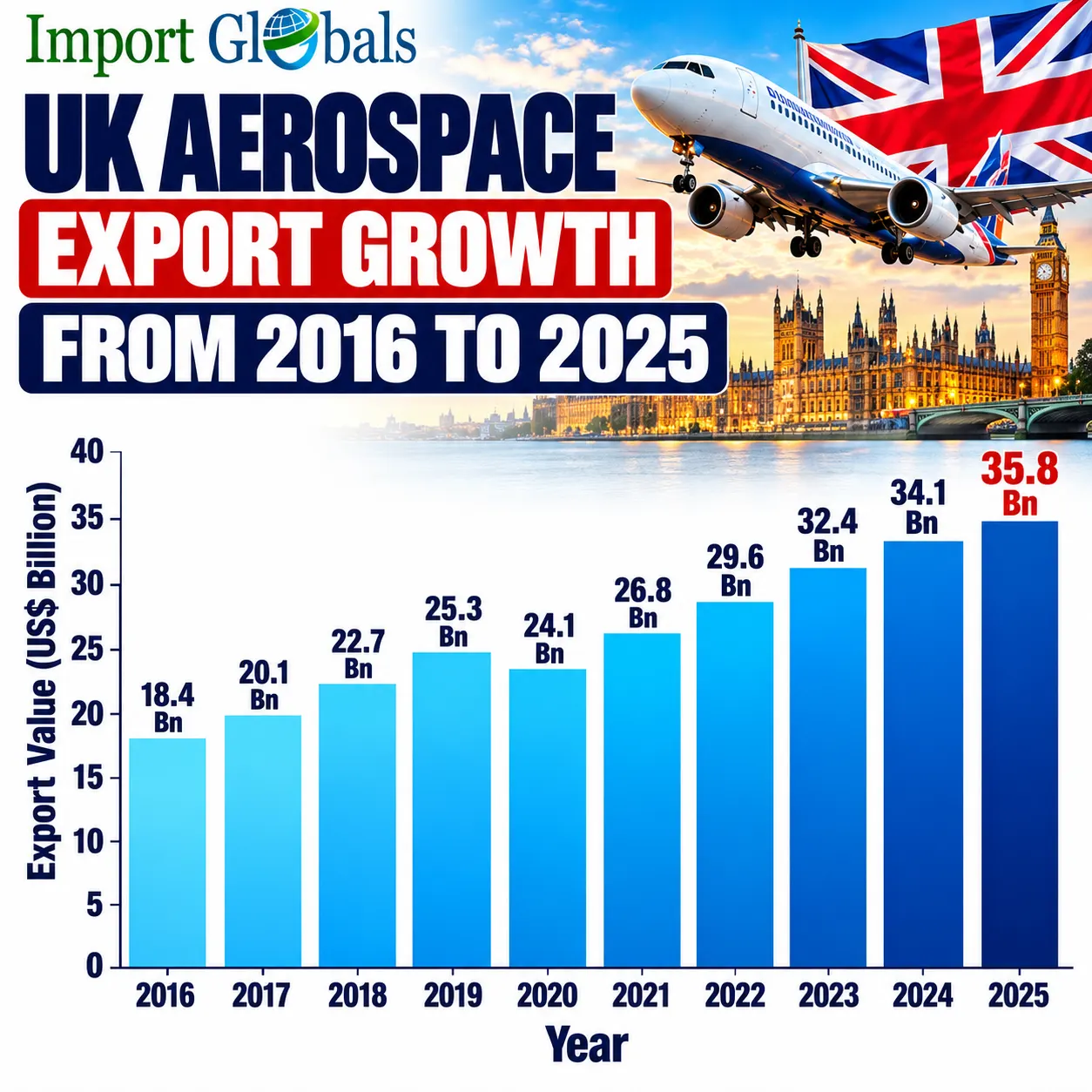
Over the period between 2016 and 2025, the UK aerospace industry has seen an extraordinary development in its export figures, suggesting that the sector is becoming more important in global trade and advanced manufacturing. The data indicate that the overall value of aerospace exports rose from $18.4 billion in 2016 to $35.8 billion in 2025, which means that an increase of 94.6% was observed. Its exports reached $20.1 billion in 2017 and $22.7 billion in 2018, followed by an increase to $25.3 billion in 2019. The value of exports decreased to $24.1 billion in 2020; which can be regarded as a temporary decline.
The sector then experienced recovery in the subsequent years; with exports rising to $26.8 billion in 2021 and $29.6 billion in 2022. In 2023, the value of exports increased to $32.4 billion, while $34.1 billion was exported in 2024. In 2025, these amounted to $35.8 billion, which is the highest number available in the graph. Overall, the figures highlight the importance of aircraft manufacture, propulsion systems, aerial components, and advanced technologies in forming UK export performance. Even if we see the decline in 2020, the recovery indicates constant development during the studied period. Overall, the graph reflects positive tendencies for UK aerospace export development, reported UK Import Export Data.
Bilateral Trade Overview: The Top Trade Partner’s Contribution
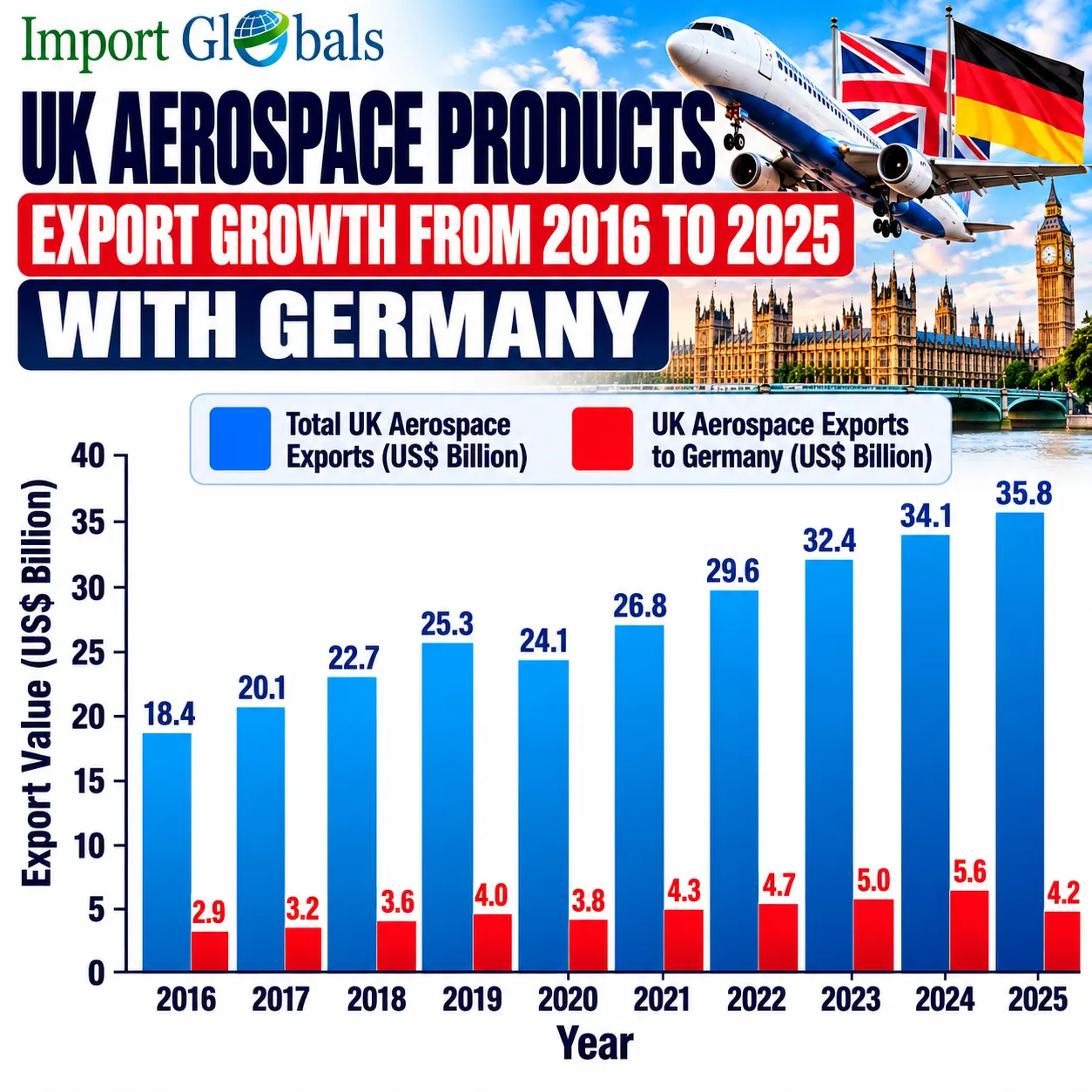
Aerospace exports from the United Kingdom grew enormously from 2016 to 2025. Germany was one of the primary export markets for UK aerospace products. Based on the chart, it is clear that the total amount of aerospace exports from the UK had a steep rise from US$18.4 million in 2016 to US$35.8 million in 2025, following a doubling trend. Exports to Germany saw a complete increase; starting from US$2.9 billion in 2016 and reaching US$4.2 billion in 2025.
From 2016 to 2019, UK aerospace exports underwent yearly growth during the period, going from US$18.4 billion to US$25.3 billion. Similarly, exports to Germany showed good growth as numbers increased from US$2.9 billion to US$4.0 billion during the period.
In the year 2020, however, this growth was disrupted as the total amount of aerospace exports from the UK went down to US$24.1 billion and US$3.8 billion was exported to Germany. But soon, the industry recovered, and by 2021 the total aerospace exports from the UK reached US$26.8 billion, and US$32.4 billion in 2023. Exports to Germany also rose, hitting US$5.0 billion in 2023 and US$5.6 billion in 2024.
Challenges of the UK Aerospace Products Trade
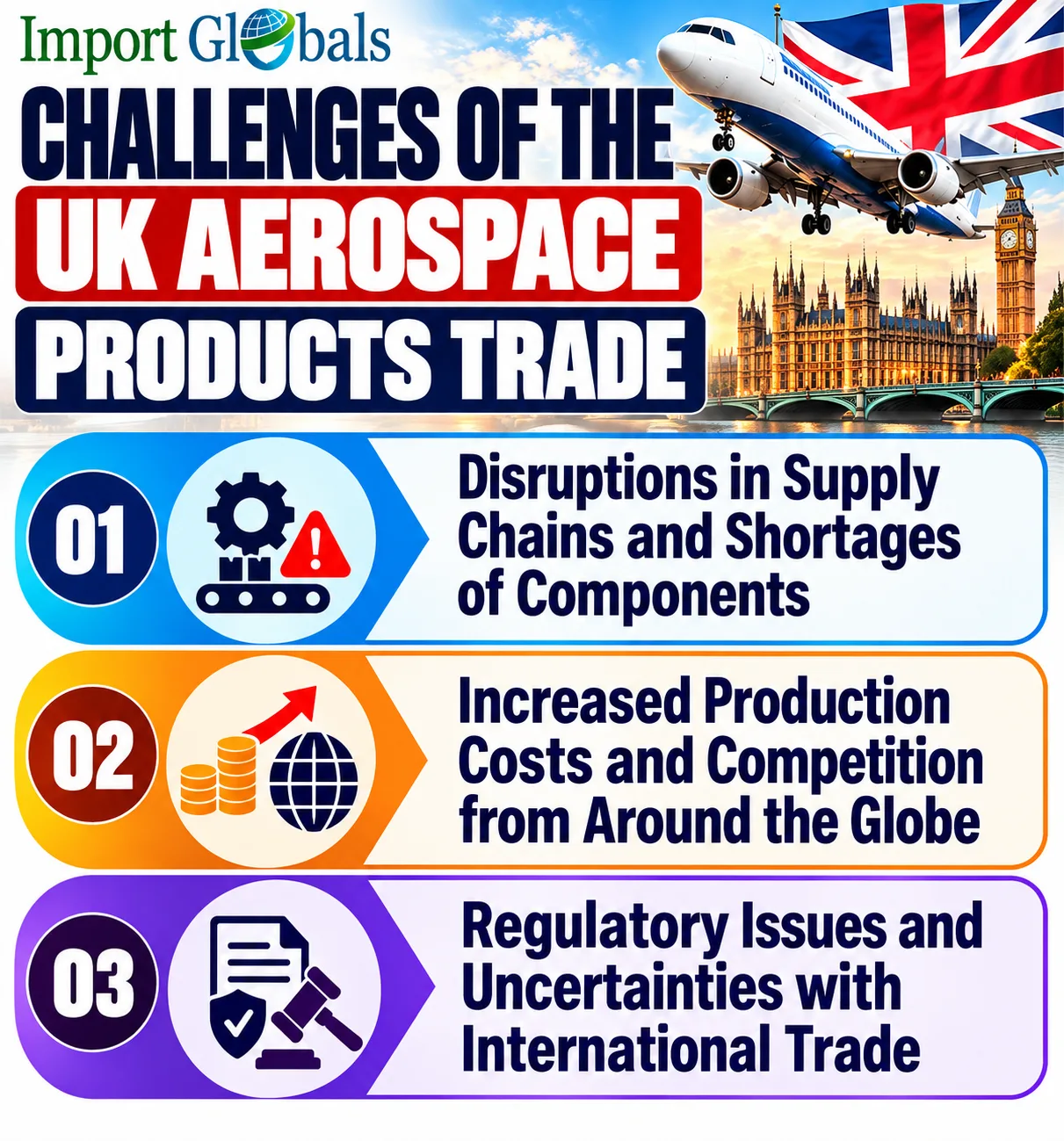
- Disruptions in Supply Chains and Shortages of Components
The aerospace industry in the UK relies on foreign suppliers for its advanced technology, parts, and materials. Transportation disruptions, delays, and shortages can lead to production cost increases, delivery delays, and loss of competitiveness in the export market, says UK Customs Data.
- Increased Production Costs and Competition from Around the Globe
To achieve success in manufacturing aerospace industry products, a lot of money is needed for research, skilled staff hiring, engineering practices; and compliance with laws. Increased costs of operations and competition with other international companies can put pressure on prices and profits of UK exporters.
- Regulatory Issues and Uncertainties with International Trade
The fact that there are different certification levels in aviation and various customs procedures complicates the process of exports in relation to aviation. Changes in trade regulations, policies, and geopolitical reality can create unnecessary burdens and confuse UK manufacturers that operate overseas.
Future Trade Outlook of UK Aerospace Products
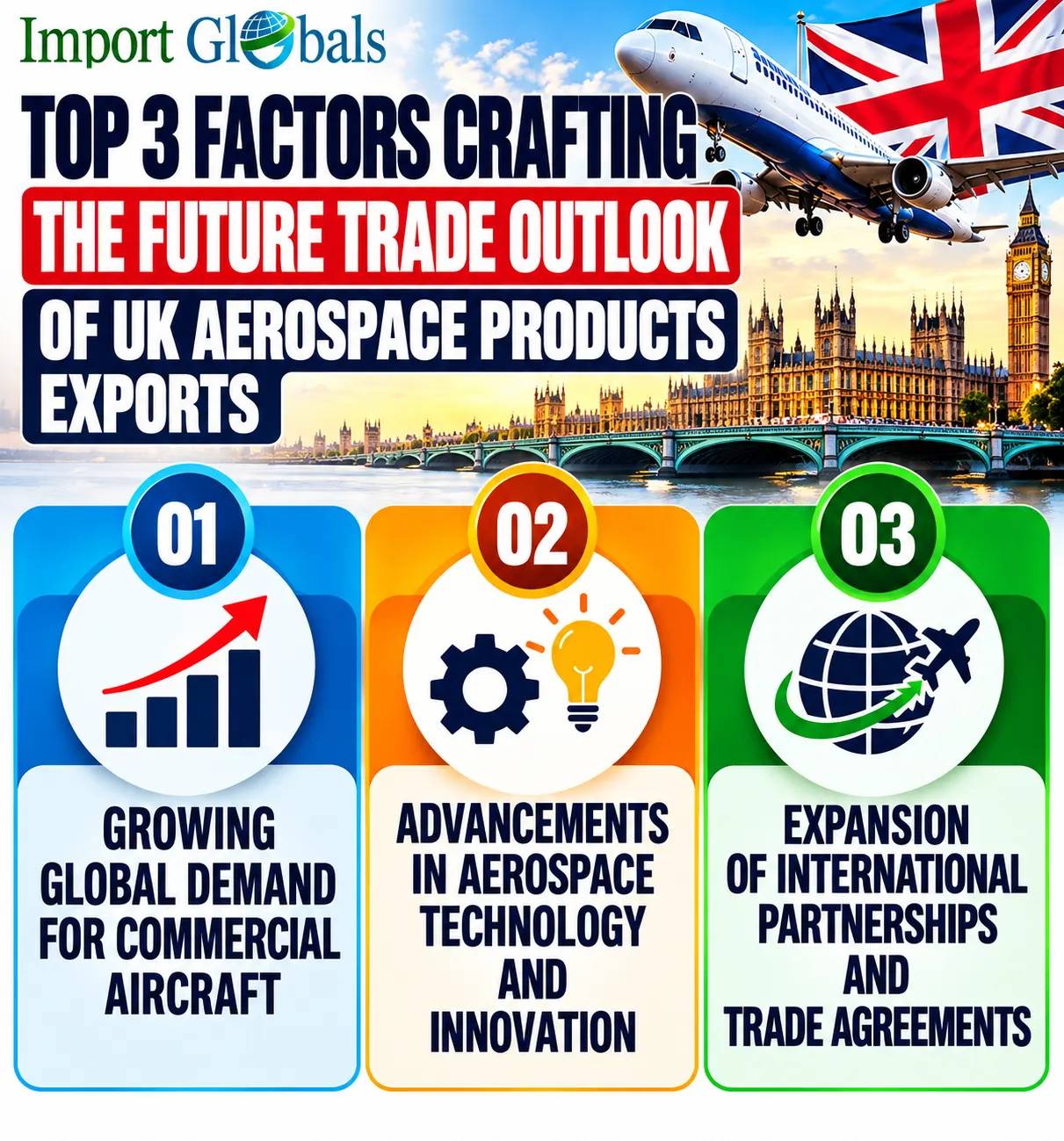
Exports of aerospace products manufactured in the UK are expected to keep growing owing to demand for aircraft, engines and components around the world. Investment in technological innovations in research, engineering and manufacturing will strengthen the UK's position on the global aerospace market. The increased demand for efficient aircraft, light-weight materials and technologies in the field of aviation opens more opportunities for exports.
Germany, the US and other traditional markets continue to play an important role in the field of trade in this industry. Meanwhile, the expanding aviation sectors in Asia and other growing economies provide additional options for business expansion through tapping into new markets. Finally, the presence of a great number of innovative propulsion systems, aircraft structures, avionics, and maintenance products in the product portfolio will allow UK exporters to continue doing business globally.
Conclusion
The United Kingdom’s aerospace products are one of the significant contributors to the country’s economic growth rate, as reported by the UK Customs Shipment Data. The country has attained an overall valuation of 35.8 billion U.S. dollars of aerospace products trade in 2025, with a respective increase of 8.3%. Aircraft engines, aircraft parts, aero structures, and avionics are some of the top traded variants of the nation, and the major aerospace manufacturers are mainly contributing to engineering innovation, component production, and aircraft systems.
The opportunities are posing ease to the challenges involving the component shortages, production costs, and international competition, but the challenges remain. The UK aerospace industry is now providing opportunities to strengthen its global position by expanding into emerging markets while developing advanced aviation technologies.
CTA
If you are looking for the latest information regarding the United Kingdom aerospace product shipments, then you have come to the right platform. Import Globals resolves all the complexities of trade, providing the latest active insights regarding UK aerospace shipments. Subscribe to www.importglobals.com or drop an email at info@importglobals.com to get the latest information regarding the nation's aerospace product exports and transform your international business growth.
FAQs
Que. What is the total valuation of aerospace products exported from the United Kingdom in 2025?
Ans. The total valuation of aerospace products exported from the United Kingdom in 2025 is 35.8 billion U.S. dollars.
Que. How much have aerospace exports from the UK grown between 2016 and 2025?
Ans. Aerospace exports from the UK have grown by 94.6% between 2016 and 2025.
Que. Name the leading aerospace products exported from the UK.
Ans. Turbojet engines and aircraft structures are the top aerospace products exported by the United Kingdom in 2025.
Que. What is the HS code for UK aerospace products?
Ans. The HS code for UK aerospace products includes HS 841112, HS 841191, and HS 880730 for specific aircraft parts.
Que. Name the countries that are the top destinations for UK aerospace products export.
Ans. Germany is one of the top destinations for UK aerospace products export.
Que. What is the role of Germany in UK aerospace trade?
Ans. Germany is an important trade partner for the UK’s aerospace products. Participation in interconnected European manufacturing has solidified both countries’ positioning as a reliable trader on the global marketplace.
Que. How does UK import-export data support business growth?
Ans. UK import-export data supports business growth via proper identification of buyers, suppliers, analysis of market demand, and development of effective market expansion strategies.
Que. What information is available in UK trade data?
Ans. UK trade data covers importer name, exporter name, shipment date, HS code, product details, quantity, pricing information, origin country, importing country, and port details.
Que. How frequently is the UK trade data updated?
Ans. UK trade data is updated on a monthly basis.
Que. Where can you obtain detailed information on UK trade data?
Ans. Visit www.importglobals.com or drop an email at info@importglobals.com for detailed updates on UK trade data.