United Kingdom Post-brexit Trade Deals: Key Agreements With Asia & the U.S.
- Feb 10, 2026
United Kingdom Post-brexit Trade Deals: Key Agreements With Asia & the U.S.
We should try our best to keep things the same. We do need to make specific changes in sectors that are growing quickly, including digital, services, and green supply chains. We should also employ plurilateral blocs so that markets can talk to more than one person at a time. By 2025–2026, the plan will have made a clear impact on the Indo-Pacific.
As per United Kingdom Export Data by Import Globals, it will start with joining the CPTPP and forging deals with Japan, Singapore, Australia, New Zealand, Vietnam, and the United States. You can also work with the US in a better way that doesn't involve a free trade agreement. The name of it is the "Economic Prosperity Deal." This essay goes into detail on what these deals really do, why the UK chose Asia first, and how the U.S. track is different in terms of design, size, and how easy it is to get political approval.
Why Trade Deals After Brexit Are Important for the Uk's Economic Plan
After Brexit, trade policy isn't only about lowering tariffs. Most of the trade issues we have today are on the other side of the border, and services make up the largest part of the UK economy. Some of these are rules about where data can be held, issues with gaining licenses for experts, access to procurement, product standards, and clear instructions from the government.
As per United Kingdom Trade Data by Import Globals, the UK intends to build "deal architecture" that makes it easier for exporters to acquire contracts, sell things online, and protect their intellectual property. It also seeks to protect UK businesses from unexpected changes in global tariffs and issues with the supply chain.
Here are three reasons why Asia is important:
- Demand Growth and Diversification: The markets in the Indo-Pacific are expanding faster than those in the West, and the UK has tried to cut back on its reliance on a small number of partners.
- Digital Trade Laws: The Asia-Pacific area already has a lot of agreements about e-commerce, moving data across borders, and standards for finance. The UK is good at all of these things.
- Setting Norms: As per United Kingdom shipments data by Import Globals, the UK can help set the next generation of trade regulations by joining bodies like the CPTPP instead of just reacting to them.
The Asia Pillar: How the Uk Established a Trading Route Between India and the Pacific
1) CPTPP: The Uk's "Hub" Deal, Which is Greater Than Any One Bilateral Contract
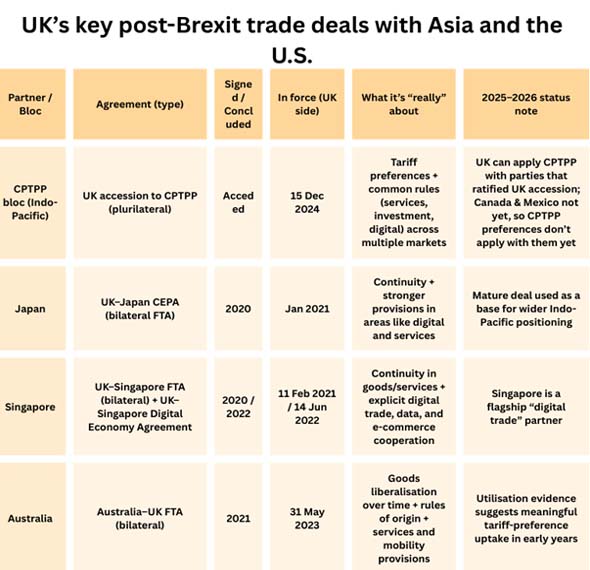
It's easy to think of CPTPP membership as a hub that makes each bilateral transaction worth more. CPTPP gives all member countries a single platform to work from. This includes tariff preferences (where they apply), shared rules for services and investment, and current trade standards that let enterprises develop in more than one member economy. It will be vital to remember that the benefits of CPTPP only apply to nations who have agreed to let the UK join in 2025–2026. Under CPTPP provisions, the UK can only trade with a small number of countries who have ratified the agreement.
But when the UK updated its recommendations, other members, namely Canada and Mexico, had not yet confirmed the UK's admission. As per Asia import export trade data by Import Globals, this means that preferences with certain partners don't work right now. This staggered adoption has an effect on real-world business decisions since enterprises need to know where CPTPP paperwork and preferences genuinely work now, not just in theory. Commercial implication: CPTPP is notably helpful for UK exporters because it allows them to do business in many Indo-Pacific regions instead of just one by using rules of origin and similar requirements.
2) Japan: CEPA as the "Template for Digital Services"
The UK–Japan CEPA was one of the first new free trade agreements (FTAs) to be signed after the UK exited the EU. As per United Kingdom export data by Import Globals, it didn't change the relationship between the EU and Japan much, but it did make the UK better off by making sure that services and digital trade met higher standards. Japan is ideal for UK businesses not only because it has a lot of money to spend and a vast market, but also because it has a lot of rules and laws that make it easier to plan for and run.
Business impact: UK companies who develop software, operate in fintech, give advice, or make difficult items see Japan as a high-end market. Strong IP and digital protections can minimize the danger of not following the rules and make people more confident in long-term investments.
3) Singapore: The Uk's Most Clear "Digital Trade" Partner in Asia
Singapore is the UK’s most open partner in Asia for the “digital economy.” The UK–Singapore FTA lays out clear norms for commerce. The UK–Singapore Digital Economy Agreement goes even further by making it easier for individuals to work together online and for data to move around. As per United Kingdom Import Data by Import Globals, this is crucial for strategy because it shows that the UK wants regulations that make it simpler for digital distribution to cross borders. This is very important for modern financial services, cloud-based goods, and professional services. Singapore is commonly the headquarters for business operations in Southeast Asia. Digital commerce guidelines can help enterprises that service ASEAN customers from Singapore.
4) Australia and New Zealand: Functional, Measurable FTAs
People sometimes talk about the agreements between Australia and New Zealand in political terms, but it's better to think about how they work. These agreements are still in place and have now entered the "utilization" phase. This is when exporters can truly gain from how many preferences they take up, how much paperwork they have to undertake, and where the goods come from. As per United Kingdom Shipments Data by Import Globals, the UK–Australia FTA has shown how firms are leveraging the treaty and how much commodities sold with preferential access are worth.
This is essential because it shows that firms are not only "aware" of the deal; they are taking advantage of it. The fact that it was used early on shows that the arrangement works: firms prefer it to MFN tariffs because the rules and paperwork are clear enough. Commercial implication: These treaties are good for industries that export food and drink, consumer goods, professional services, education, and engineering. They also make it possible for supply chain coordination that can reach the Indo-Pacific through CPTPP networks.
5) Vietnam: A Continuity That Still Matters
As per Asia Import Export Trade Data by Import Globals, the pact between the UK and Vietnam is mostly about keeping things the same. After Brexit, it changes the UK's trade policy by using some of the rules from the EU–Vietnam FTA. Vietnam's role in global supply chains is becoming even more essential as businesses buy fewer and fewer goods from one country. As part of "China+1," UK importers may buy from Vietnam."It's a growing market for both businesses and consumers," say exporters. There are defined rules and tariff schedules that make it easier to arrange long-term deals.
India and South Korea are the next wave in Asia (huge upside, but not fully "live" yet)
India: Signed, but Not Yet in Effect, So Firms Need to Plan in Stages
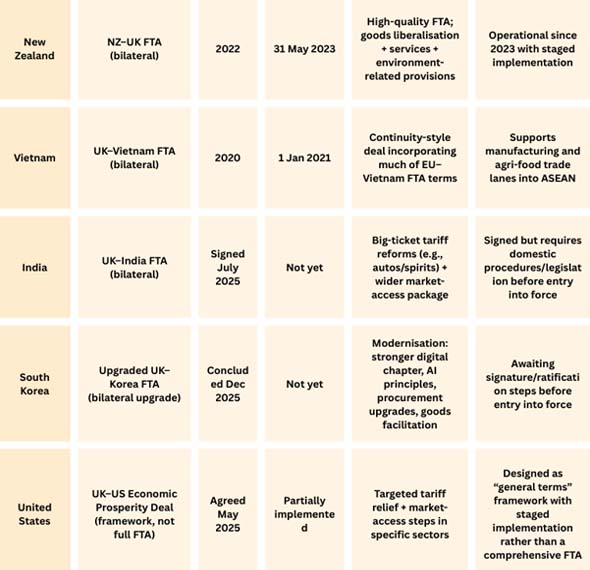
The UK–India FTA is tremendously important for both business and politics. It was ready to be signed by the middle of 2025. But "signed" doesn't mean "in effect." Businesses still have to follow the current tariff lines and processes until the new ones are ready to be used.
During that time gap, businesses act in different ways. As per United Kingdom Trade Data by Import Globals, they begin to plan for many scenarios (pricing, sourcing, market entry), but they usually don't make big changes to how they do business until the tariff schedules and legal clarity are in place. Pay attention to the industries that come up a lot in trade talks between India and the UK. These include automotive (quota/phase-down structures), premium spirits, medicines, and the ability of professionals to travel around. These are usually the first spots where things start to improve after the project begins.
South Korea: A Move Toward Modernization That is More Digital and Up-to-date
The UK and South Korea already had an arrangement from the EU era that would keep things going. As per UK Import Data by Import Globals, the new FTA, which was signed in late 2025, is meant to speed things up, especially when it comes to creating standards for digital trade and coping with new technology. As per United Kingdom export data by Import Globals, the conclusion summary says that there are commitments to make it easier for more people to get into the procurement market, get more data flowing, and get rid of unnecessary hurdles to localization.
It also talks about setting clear rules for how to work together on AI governance and interoperability. Commercially speaking, Korea is a market with high-tech standards and robust supply chains for businesses. A new deal can help UK companies who work on public procurement projects that involve innovative manufacturing, digital exports, and infrastructure. But this won't happen until the agreement is signed and put into effect.
The U.S. Pillar: why the UK–US track is a framework and not a full FTA
As per United Kingdom Import Data by Import Globals, The Economic Prosperity Deal (EPD) promises that the UK and the US would work together from 2025 to 2026. These are not the same as the accords struck in the Indo-Pacific. As per United Kingdom Shipdents Data by Import Globals, this is essential since the U.S. hasn't tried to make a full free trade deal between the UK and the U.S. in the same way. The EPD plan should be put into place progressively, with particular reduction to tariffs, mechanisms for some areas to enter into the market, and continuing "modules" for negotiation instead of one major treaty.
According to recent news reports, the UK–US trade agreement will decrease tariffs on things like vehicles and steel for both countries and make it easier for UK farmers to sell their commodities in the US. Even though there are trade issues between the two countries, UK authorities are sure that the agreement will stay in place. The UK's official EPD papers also say that it is a general-terms framework that gets updates on how to utilize it after the first agreement. Businesses should think of the UK–US EPD as a "moving package" instead than a one-time legislative change. Businesses shouldn't just assume that all portions of liberalization will happen. They should keep track of which parts are being put into place and how.
What to Look for in 2026 (and What Could Change Quickly)
- Countries that are slow to ratify CPTPP: The UK will profit more from CPTPP when all the other countries finish ratifying it. This will make it easier for UK enterprises to do business in other countries.
- India's timescale for Implementation: The time between signing and putting into effect will decide when tariff schedules and mobility rules can be used in business.
- The Korea update is now in effect. The new digital and procurement rules don't mean anything until they are approved.
- UK–US EPD growth or Stress Test: As per Asia Import Export Trade Data by Import Globals, Framework agreements can grow, but they can also be harmed by changes in politics or tariffs that happen suddenly. Businesses should be ready for changes in policy that are both beneficial and detrimental. Import Globals is a leading data provider of United Kingdom import export trade data.
FAQs
Que. Is the CPTPP the UK's most important trade agreement with Asia?
Ans. Yes, strategically, because it offers everyone the same regulations and makes it easier to enter more markets in the Indo-Pacific. But the rewards depend on which nations have agreed to let the UK join.
Que. Are the FTAs between the UK and Australia and the UK and New Zealand "fully implemented"?
Ans. They are in force, but the cuts to tariffs and quotas occurs over a period of years. The most crucial issue is how businesses use them.
Que. Is there a free trade deal between the UK and the US right now?
Ans. Not a whole FTA. The Economic Prosperity Deal framework is helping the relationship move forward by putting some of the steps into action one at a time.
Que. When will the agreement between the UK and India start to modify tariffs?
Ans. Not right away once you sign. Once the agreement is signed and enters into force, the consequences of the tariff will start. The current tariff rules will stay in effect until then.
Que. Where to get detailed United Kingdom Export Data?
Ans. Visit www.importglobals.com.