Why Ivory Coast Sees Strong Exports of Cocoa Main Crop as El Nino Looms Over Output?
- Jun 08, 2026
Why Ivory Coast Sees Strong Exports of Cocoa Main Crop as El Nino Looms Over Output?
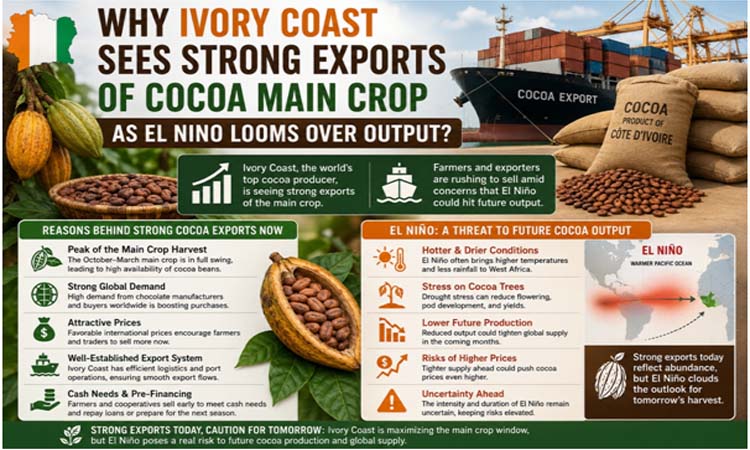
Every chocolate bar you eat starts with a journey from one country, which is the Ivory coast. It controls nearly 45% of global cocoa supply. When this country ships well, the global chocolate industry runs smoothly. When it does not, prices climb and procurement teams panic.
Right now, main crop exports are performing strongly. Shipments are leaving Abidjan and San Pedro at a healthy pace. International buyers are signing forward contracts earlier than usual, and the trade data backs up this urgency completely.
But here is what the optimistic headlines are quietly ignoring. El Nino is building across the Pacific Ocean, and West Africa's cocoa belt has felt its damage before. The 2015 episode crushed yields and sent prices surging for months. Current atmospheric readings are drawing uncomfortable comparisons to that period.
Buyers who have understood this market well, know that strong exports today do not promise supply tomorrow. The window to act intelligently is open now, but it might not stay open indefinitely. This article breaks down the current export picture, the real El Nino risk, and how trade intelligence helps businesses make smarter decisions before this market tightens.
Ivory Coast Strengthens Its Position in the Global Cocoa Trade
Ivory Coast does not just influence the cocoa market but it essentially runs it. The country wields unparalleled power over prices, supply schedules and buyer behaviour globally. European grinders, Asian processors and American manufacturers all are dependent on a steady flow from Ivory Coast to keep their production lines going.
Why Global Buyers Keep Coming Back to Ivory Coast, Season After Season:
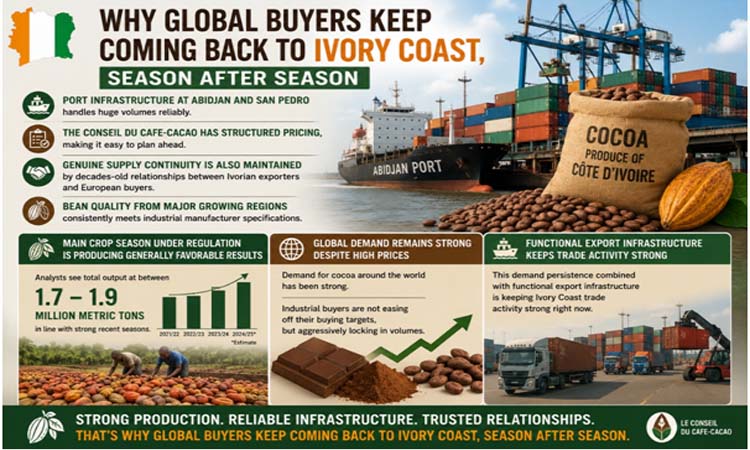
- Port infrastructure at Abidjan and San Pedro handles huge volumes reliably.
- The Conseil du Cafe-Cacao has structured pricing, making it easy to plan ahead.
- Genuine supply continuity is also maintained by decades-old relationships between Ivorian exporters and European buyers.
- Bean quality from major growing regions consistently meets industrial manufacturer specifications.
The main crop season currently under regulation is producing generally favourable results. Analysts see total output at between 1.7 million and 1.9 million metric tons, in line with strong recent seasons.
Despite high prices in recent years, demand for cocoa around the world has been strong. Industrial buyers are not easing off their buying targets, but aggressively locking in volumes. This demand persistence combined with functional export infrastructure is keeping Ivory Coast trade activity strong right now.
What Trade Intelligence Reveals About Ivory Coast Cocoa Shipments?
General market reports tell you what analysts think is happening. Ivory Coast Import Export Customs Data shows you exactly what is happening at every shipment level. Customs records provide verified, factual detail that no secondary research source can match. For procurement teams and trading houses, this is genuinely operational intelligence rather than background reading.
What Ivory Coast Import Export Customs Data Captures in Each Record:
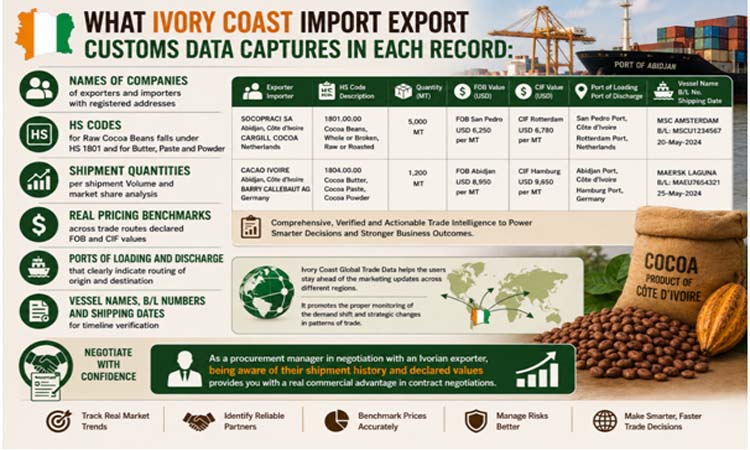
- Names of companies of exporters and importers with registered addresses.
- HS Codes for Raw Cocoa Beans falls under HS 1801 and for Butter, Paste and Powder.
- Shipment quantities per shipment Volume and market share analysis.
- Real pricing benchmarks across trade routes declared FOB and CIF values.
- Ports of loading and discharge that clearly indicate routing of origin and destination.
- Vessel names B/L numbers and shipping dates for timeline verification.
Ivory Coast Global Trade Data helps the users stay ahead of the marketing updates across different regions. It promotes the proper monitoring of the demand shift and strategic changes in patterns of trade. As a procurement manager in negotiation with an Ivorian exporter, being aware of their shipment history and declared values provides you with a real commercial advantage in contract negotiations.
Why Do Cocoa Exports Remain Resilient Despite Weather Concerns?
Current export volumes reflect genuine market confidence despite the El Nino risk building in the background. Several factors are keeping shipment activity strong through the main crop period.
What is Sustaining Strong Export Performance Right Now:
- Main crop harvest arrived without significant disruption and bean quality is meeting buyer requirements.
- International buyers are placing orders ahead of normal lead times as a forward accumulation strategy.
- The mid-crop faces greater El Nino exposure but remains months away from its critical growth window.
- Both major ports are processing loadings steadily without congestion or operational delays.
- The CCC pricing framework is stabilizing seller behavior and preventing erratic supply-side responses.
Buyers with genuine supply chain experience are not waiting for a public yield warning before acting. They are positioning now while terms remain reasonable and supply is still available at current price levels.
How El Nino Affects Cocoa Production?
El Nino is a natural climate phenomenon that occurs because of unusual warming of surface waters in the Pacific Ocean. This warming further causes a disruption in atmospheric circulation which changes the distribution of rainfall in tropical areas such as the cocoa belt of West Africa.
Cocoa trees are deeply vulnerable because they depend entirely on consistent rainfall without any meaningful irrigation alternative across most Ivorian growing areas. When rainfall drops during critical pod development windows, the yield damage cannot be recovered after the growing period ends.
How El Nino Directly Affects Cocoa Growing Conditions in West Africa:
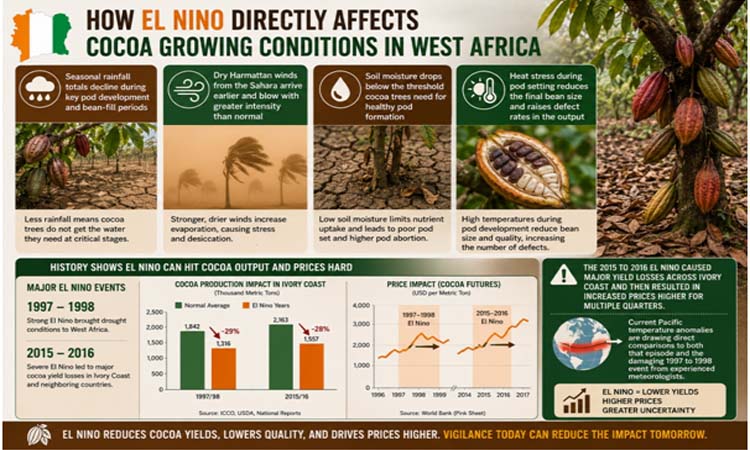
- Seasonal rainfall totals decline during key pod development and bean-fill periods.
- Dry Harmattan winds from the Sahara arrive earlier and blow with greater intensity than normal.
- Soil moisture drops below the threshold cocoa trees need for healthy pod formation.
- Heat stress during pod setting reduces the final bean size and raises defect rates in the output.
The 2015 to 2016 El Nino caused major yield losses across Ivory Coast and then resulted in increased prices higher for multiple quarters. Current Pacific temperature anomalies are drawing direct comparisons to both that episode and the damaging 1997 to 1998 event from experienced meteorologists.
Why Are Cocoa Growers Closely Watching Future Output Risks?
For the farmers in the growing regions of the Ivory Coast, the concern is financial and immediate, not analytical. Erratic rainfall patterns are already impacting flowering consistency in some inland areas into the second half of the season.
What is Genuinely Alarming Growers and Industry Watchers:
- Newly planted trees from recent reforestation efforts are now experiencing their first major drought stress.
- Farmers who have put inputs in ahead of the main crop are facing real uncertainty about mid-crop returns.
- Weather stress limiting bean fill makes meeting CCC price support quality thresholds more difficult.
- Early below average soil moisture readings are reported in key growing areas of Bas-Sassandra and Goh-Djiboua.
What the Broader Industry is Tracking Heading Into the Mid-crop Period:
- Meteorological Services real-time rainfall data in the cocoa belt.
- CCC forward purchase volumes as a formal measure of confidence in future harvest.
- Processing demand levels in the Netherlands and Malaysia based on grinding data.
- Futures price movements on London and New York exchanges as early trader sentiment indicators.
Strong exports today do not guarantee stable supply across the next two to three quarters. Businesses treating current performance as a signal of future comfort are accepting a risk they have not fully accounted for yet.
How Cocoa Export Data Helps Businesses Discover New Opportunities?
As per Ivory Coast Import Data trade intelligence creates real commercial opportunity across every part of the cocoa supply chain. Businesses using it actively gain advantages that those relying on general market reports simply cannot access.
1. Finding Active Cocoa Buyers
Cocoa Ivory Coast Import Export Data identifies companies currently receiving cocoa shipments across destination markets. Ivory Coast cocoa export data is considered a reliable tool for proper configuration of the competitors' activities with trade proposals promoting market knowledge.
2. Monitoring Competitor Export Activity
The shipment-level information on cocoa export data helps businesses monitor the declared trade values by the top trading authorities. The latest intelligence supports the pricing decisions with verified evidence based on actual trade insights.
3. Identifying Emerging Import Markets
Cocoa Ivory Coast Export Data enhances the marketing strategies with growing imports across different regions worldwide. The demand rate from Southeast Asia and the Middle East markets has maintained the developmental growth rate with proper utilization of the real opportunity for suppliers.
4. Understanding Pricing Trends
Declared values inside Ivory Coast Import Export Trade Data provide grounded pricing benchmarks across trade routes and product categories. This strengthens commercial negotiations beyond what exchange-traded futures benchmarks can offer alone.
5. Generating Qualified Sales Leads
For logistics providers, inspection agencies, and trade finance companies, Global Import Export Data connected to the cocoa trade delivers verified, active prospects rather than speculative contact lists.
Key Insights Businesses Can Extract from Ivory Coast Cocoa Trade Data
Ivory Coast Import Export Market Intelligence delivers actionable insights that help in supporting strategic planning and daily commercial decisions.
What Consistent Analysis of Destination Market Data Reveals:
- Netherlands volumes reflect European grinding demand and near-term inventory positioning behavior.
- Malaysia shipment patterns indicate Asian processing activity and regional distribution trends.
- United States import frequency signals stable consumer market demand across key product categories.
- Indonesia's rising import volumes point to expanding regional processing capacity worth monitoring.
- Germany trade records reveal premium chocolate manufacturing procurement cycles and quality preferences.
Patterns Experienced Analysts Track Systematically Across Seasons:
- Shipment timing clusters indicating major buyers accumulating stock ahead of anticipated price moves.
- Supplier concentration levels showing whether key markets carry dangerous over-reliance on single exporters.
- Seasonal volume shifts between main crop and mid-crop serving as real-time harvest performance indicators.
- New buyer-supplier relationships appearing in records signaling active sourcing diversification by importers.
Businesses building systematic monitoring around this data stop reacting to market movements and start anticipating them before competitors recognize the same signals.
Latest Developments Shaping Ivory Coast Cocoa Trade
The latest export activities through Abidjan and San Pedro are currently operating at healthy volumes. The proper declaration of the shipment values relative to a five-year average growth rate has affected the strong demand and tight global supply chain conditions.
Temperature inconsistencies have maintained compatibility with the El Niño conditions across the Pacific Ocean, preceding the previous West African harvest disruptions. The weather forecasters have been alarmed about the increasing risk assessment during the second half of 2025, although no rainfall deficits have been officially declared yet.
The forward activity of purchase has increased the compatibility of trade in the previous seasons. The behavioural shift, maintaining the supply chain concern, has maintained the thriving positioning of the Ivory Coast as a speculative trader. The current pricing patterns with historical seasonal patterns have normally contributed to trade continuity.
Conclusion
Ivory Coast's main crop export performance is strong and the trade data confirms it clearly. Shipments are moving, buyers are active, and the harvest has delivered within expectations this season. However, El Nino is not a background concern to dismiss lightly. It is a historically validated threat that has disrupted West African cocoa production multiple times and current atmospheric conditions are drawing serious comparisons to those previous damaging episodes.
Businesses with cocoa supply chain exposure should use this period of relative stability to gather intelligence, build supplier relationships, and position procurement decisions before conditions force reactive choices at higher prices. Trade intelligence is not background research in a market moving this quickly. It is a direct competitive advantage that separates prepared businesses from exposed ones.
Frequently Asked Questions
Que. What details are available in Ivory Coast import export trade records?
Ans. Ivory Coast customs data includes the following information:
- Exporter and Importer names
- HS Codes
- Product Description
- Shipment Quantities
- Trade Values
- Loading & Unloading Port Names
- Bill of lading references
- Vessel Names
- Shipping Dates
Que. How can I find active cocoa buyers using trade data?
Ans. Filter Cocoa Import Data using “HS code 1801” to get verified Importer Names, purchase volumes, shipment frequency, and existing supplier relationships. This will give you a ready list of qualified buyers for direct outreach.
Que. How frequently is Ivory Coast cocoa export shipments data updated?
Ans. Most platforms update this data weekly or monthly. That is enough to track active trade lanes and spot buyer behavior changes before they appear in general industry reports.
Que. Which countries import the most cocoa from Ivory Coast?
Ans. The Netherlands leads as Europe's top grinding hub, followed by Germany, Belgium, the United States, Malaysia, and Indonesia. Trade data helps you monitor volume shifts and spot the fastest growing destinations.
Que. Can I monitor competitor cocoa export activity using shipment data?
Ans. Yes. Filtering shipment records by competitor names reveals their export volumes, destination markets, and buyer relationships. This supports smarter pricing strategies and helps you identify gaps in their market coverage.
Que. Does cocoa trade data show both buyers and suppliers together?
Ans. Yes. Each shipment record captures both the exporter and importer, letting you map full commercial relationships across trade lanes in one dataset. This supports both sourcing and sales development at once.
Que. How reliable is cocoa trade data for real commercial decisions?
Ans. Customs data is highly reliable for identifying companies, tracking volumes, and analyzing trade values. Combining it with futures market data gives a more complete pricing picture, especially during supply disruptions.
Que. How does trade data help when entering a new cocoa export market?
Ans. It shows you exactly which companies are importing cocoa, how much they buy, and who supplies them. This removes guesswork and lets you focus outreach on markets with proven, active demand.
Que. Which industries benefit most from cocoa trade intelligence?
Ans. Cocoa manufacturers, trading houses, logistics providers, commodity analysts, and trade finance firms all benefit. Each uses the data differently, from sourcing and cargo tracking to supply chain modeling and credit risk assessment.
Que. Can trade data reveal cocoa pricing trends effectively?
Ans. Yes. Import Globals Trade Data Reveal.
Explore Cocoa Market Intelligence With Import Globals
The cocoa market is moving fast and supply conditions may tighten sooner than most businesses currently expect. Buyers and suppliers acting on verified trade intelligence right now will be far better positioned than those waiting for public confirmation of problems already visible in the data.
Import Globals provides shipment-level trade intelligence covering Ivory Coast cocoa exports, active buyer identification, supplier discovery, competitor monitoring, and emerging market analysis.
Visit www.importglobals.com to explore Global Trade Intelligence solutions built for businesses that take cocoa markets seriously.