AI and Data Center Demand: A New Era for South Korea's Chip Exports (2025–2026)
- Mar 17, 2026
AI and Data Center Demand: A New Era for South Korea's Chip Exports (2025–2026)
The rise of artificial intelligence around the world has started one of the strongest technology cycles in the last few decades. The semiconductor sector is at the heart of this change.
It gives AI models the computational power they need to learn, manage cloud platforms, and run huge data centers. As per South Korea Import Data by Import Globals, South Korea has benefited from this change more than most other countries. For a long time, South Korea has been the world's top maker of semiconductors.
Samsung Electronics and SK Hynix are two of the biggest companies in the memory chip market. They are also very important to the global technological ecosystem. The country's semiconductor exports have reached record highs because of the high demand for chips used in AI servers, increased-performance computing, and data centers in 2025 and 2026. As per South Korea Export Data by Import Globals, this new wave of demand is not only increasing exports, but it is also changing the whole economy of South Korea. Korean IT businesses are entering a new era of growth because to investments in AI infrastructure, growing chip prices, and the growth of data center capacity throughout the world. This strengthens Korea's position as a worldwide semiconductor powerhouse.
The Semiconductor Engine and South Korea's Export Economy
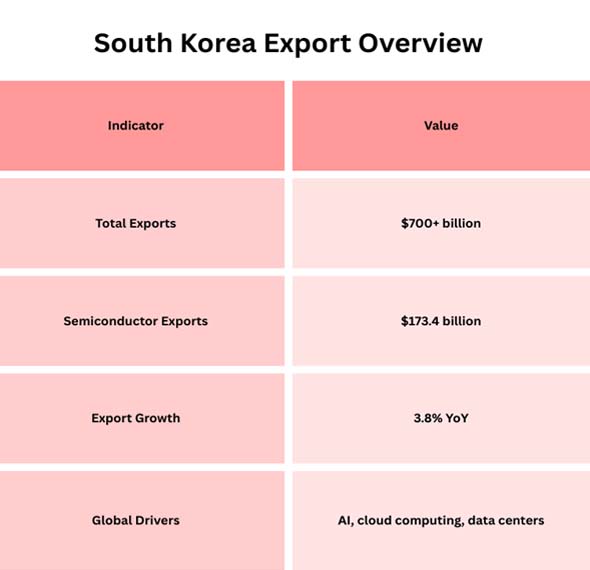
Semiconductors are still South Korea's most important export product, and the country has one of the most export-driven economies in the world. As per South Korea Import Export Trade Data by Import Globals, the sector has helped the economy bounce back from global technology cycles more than once. In 2025, the government had its best trade results ever. This was mostly because it needed chips to run AI infrastructure. As tech businesses around the world rushed to construct AI infrastructure, the number of chip shipments rose. Data centers need a lot of computing power, and AI systems need memory chips to store all the information they need.
Why AI Is Making Semiconductor Demand Go Up
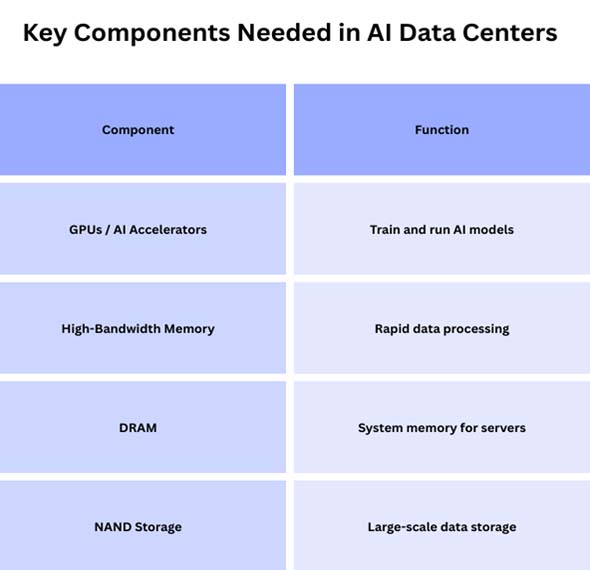
AI systems need powerful hardware that can handle a lot of data at once. To train modern AI models, you need a lot of fast RAM, powerful GPUs, and accelerators. Because of this demand, the need for specialist semiconductor parts has grown a lot. As per South Korea Import Custom Data by Import Globals, AI needs high-bandwidth memory (HBM), DRAM, and NAND devices the most. A lot of money is being spent by big IT corporations throughout the world on data centers that will enable AI services. This, in turn, makes people want these pieces more. A lot of the world's finest tech companies get their chips from South Korean companies, South Korea is at the center of this ecosystem. As AI spreads to more fields, such as banking, healthcare, manufacturing, and self-driving cars, the need for more powerful CPUs grows.
Data Centers: The Infrastructure That Made AI Possible
Artificial intelligence needs big data centers to grow quickly. These facilities have thousands of servers with special processors and memory modules that are designed to do AI work. One of the most important tech topics of the mid-2020s is building AI data centers all around the world. As per South Korea Import Trade Analysis by Import Globals, the semiconductor industry is quite big because governments and businesses are spending billions of dollars on computer infrastructure. This significant increase in investment is favorable for Korean companies because they are the biggest players in the memory chip market throughout the world. The need for these parts has caused chip prices to go up and exports to grow.
As AI applications spread to new fields, the market for processors in data centers is also expected to grow significantly. This shows how vital semiconductors are for today's infrastructure.
The Growth of Semiconductor Exports is Speeding Up
The rise of AI has made South Korea's semiconductor exports go up more faster. Early 2026 trade data suggests that the sector is developing at an amazing rate. As companies throughout the world got better at using AI, semiconductor shipments rose a lot. As per the South Korea Exporter Data by Import Globals, in certain months, chip exports have more than doubled compared to the same month previous year. This indicates how intense the cycle of demand is. These numbers show how swiftly the industry has grown since more people are using AI around the world. A big part of South Korea's export economy is currently semiconductors.
What Samsung and SK Hynix Do
Samsung Electronics and SK Hynix are the two biggest businesses in South Korea's semiconductor industry. They control a large part of the worldwide memory chip market and make many of the parts that AI servers use. SK Hynix has been one of the companies that has gained the most from the rise of AI. In 2025, the corporation had its best revenues and profits ever since demand for high-performance memory shot up. As per South Korea Importer Data by Import Globals, the company's results show how the AI business is changing the market for semiconductors. High-bandwidth memory chips for AI data centers are now one of the most profitable parts of the semiconductor market. Samsung Electronics, the biggest maker of memory chips in the world, is also increasing its production capacity to keep up with the increased demand for AI-related parts.
Investing in AI around the world helps Korea's tech sector
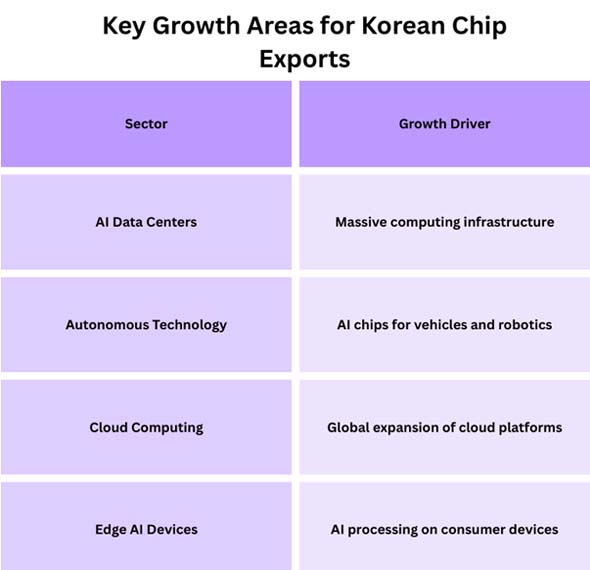
The fast growth of AI isn't just happening in the field of software development. Companies that make computers around the world are spending a lot of money on computing infrastructure, which is a multi-trillion-dollar potential for hardware makers. These investments include cloud computing platforms, hyperscale data centers, technologies that work on their own, and robotics systems. Advanced semiconductor parts are needed in all of these fields. As per South Korea Import Shipment Data by Import Globals, recent investments in industry show how the AI revolution is changing Korea's technological ecosystem. For instance, big companies are putting a lot of money into AI infrastructure and high-performance computing facilities that will help next-generation technology. As these initiatives grow, the need for South Korean-made memory chips and processors is likely to grow even more.
The Chip Boom's Market Dynamics
There are a number of reasons why South Korea's semiconductor exports are increasing so quickly. First, AI programs need a lot more computational power than regular software systems. This means that each server needs more chips. Second, the growth of cloud services has led businesses to create massive computing clusters. These buildings may hold tens of thousands of CPUs and memory chips. Third, the need to compete with other global IT companies has sped up investments in AI infrastructure. To stay ahead of the competition, companies are rushing to construct increasingly powerful computers. These factors have come together to create one of the greatest semiconductor demand cycles in years.
Korea's Important Role in the Global Chip Industry
South Korea is in a special spot in the global supply chain for semiconductors. The country makes more memory chips than any other and sells parts to some of the top IT companies. This kind of leadership is more important now that AI is here, because AI needs better memory technology to perform well. High-bandwidth memory lets processors quickly access big datasets, which speeds up the training and inference of machine-learning models. As per South Korea Import Export Trade Analysis by Import Globals, there aren't many companies in the world that can make these parts in large amounts, so suppliers in South Korea have been very busy. The country is even more competitive in the global market since it keeps investing in semiconductor production facilities.
Dangers and Problems
These sectors suggest that semiconductor exports could remain the backbone of South Korea’s trade economy for the foreseeable future. As per South Korea Export Import Global Trade Data by Import Globals, if AI adoption continues to accelerate, Korea’s chip manufacturers will likely remain essential suppliers to the global technology industry.
Conclusion
Artificial intelligence is reshaping the global technology landscape, and South Korea is at the heart of this transformation. The explosion of demand for AI computing power has created an unprecedented surge in semiconductor exports, particularly memory chips used in data centers.
Record export figures, rising chip prices, and major investments in AI infrastructure all point to a new phase of growth for the Korean semiconductor industry. Companies such as Samsung Electronics and SK Hynix are benefiting from this trend as they expand production to meet global demand. As AI applications continue to spread across industries, the need for powerful computing infrastructure will only increase. This positions South Korea’s semiconductor sector as one of the most important pillars of the global digital economy. In many ways, the current moment represents a new era for Korean technology exports—one driven not only by electronics manufacturing but by the rapidly evolving world of artificial intelligence. Import Globals is a leading data provider of South Korea Import Export Trade Data.
FAQs
Que. Why are South Korea’s chip exports rising?
Ans. Global investment in artificial intelligence and data centers has dramatically increased demand for memory semiconductors produced by Korean companies.
Que. Which companies lead South Korea’s semiconductor industry?
Ans. Samsung Electronics and SK Hynix are the two dominant global players, particularly in memory chip production.
Que. What role do data centers play in chip demand?
Ans. AI data centers require massive computing capacity, which means large quantities of processors, memory chips, and storage devices.
Que. Will the AI boom continue to boost exports?
Ans. Most analysts expect strong demand for AI hardware for several years as industries adopt artificial intelligence technologies.
Que. Where to get detailed South Korea Import Export Global Data?
Ans. Visit www.importglobals.com.