America's New Trade Engagements in Southeast Asia: Trends and Opportunities
- Feb 24, 2026
America's New Trade Engagements in Southeast Asia: Trends and Opportunities
Southeast Asia has gone from being "just another fast-growing market" to becoming a key part of America's trade strategy in 2025–2026. The reasons are practical: manufacturing networks are changing, supply chains are becoming less dependent on one country, and U.S. companies are looking for reliable capacity in electronics, machinery, clothing, and more recently, sustainable energy parts.
The U.S. Today does Most of its Trading in Southeast Asia
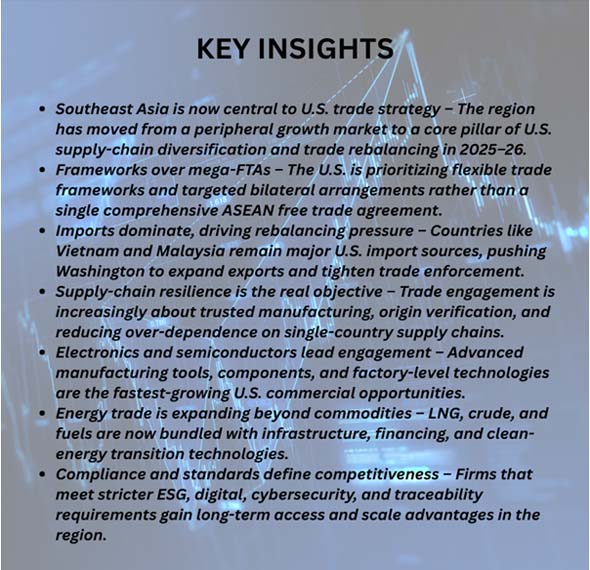
At the same time, the number of people in Southeast Asia who buy things keeps growing. As per Asia Import Data by Import Globals, this creates a need for U.S. exports including planes, energy products, farm goods, medical technologies, and high-value services. But the broader story isn't only about the numbers; it's also about how the U.S. is becoming involved. Washington is moving away from the idea of a single, all-encompassing "mega-FTA" and toward more flexible frameworks, targeted bilateral agreements, and cooperation in specific sectors. These can move faster and focus on today's problems, such as standards, trusted supply chains, digital rules, critical minerals, and financing for clean energy.
What's "New" about U.S. Involvement in 2025–26
The most obvious difference is that people now prefer tangible, deal-by-deal market access and supply-chain results. Several Southeast Asian partners have been in talks with the U.S. over tariffs and market access difficulties in late 2025 and early 2026. These talks are generally linked to bigger promises about regulatory issues, purchase agreements, or priority industries. As per Asia import export trade data by Import Globals, Vietnam is a clear illustration of this new style.
In early 2026, Vietnam said it was eager to buy more U.S. goods, especially machinery and high-tech items, while talks about tariffs and commercial MOUs for U.S. energy and agricultural products were still going on. That pattern—trade negotiations along with real buying and investment cooperation—has become more and more widespread. The U.S. still sees the Indo-Pacific Economic Framework (IPEF) as a key way for countries in the region to work together. IPEF isn't a typical free trade agreement that cuts tariffs, but it is important because it focuses on the "rules and resilience" layer of trade, which includes supply chains, collaboration on a clean economy, and aligning standards. This is where a lot of the problems and chances between the U.S. and ASEAN are right now.
The Truth About Trade: Southeast Asia is Already a Major U.S. Import Center
Southeast Asia's position in U.S. trade was already big, and in certain nations, it was even more so from the U.S. point of view. The U.S. Census Bureau's numbers below illustrate how much the U.S. trades goods with six important Southeast Asian partners. Please note that the totals for 2025 are for January through November 2025 (the release for December 2025 was pushed back), therefore they should be read as "2025 YTD (Jan–Nov)."
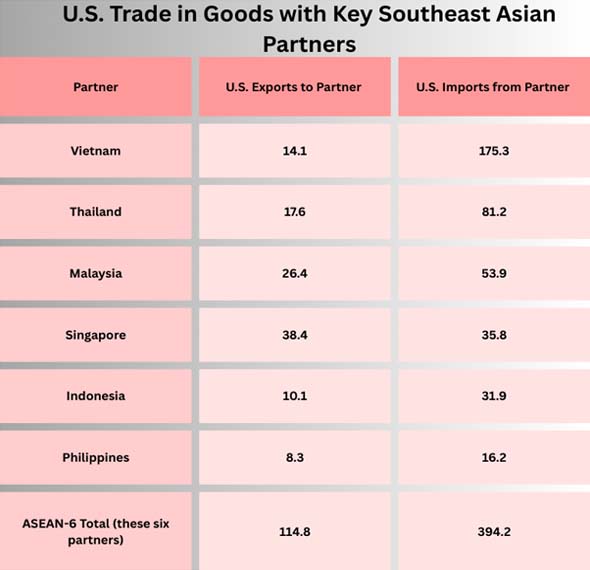
These Data Show Two Fundamental Truths
- Southeast Asia is currently one of the most important places for the U.S. to get goods, especially electronics, industrial, and consumer goods.
- Because the U.S. relies heavily on imports, its involvement in 2025–26 will focus on rebalancing (more U.S. exports to the region) and restructuring (more trusted, resilient supply chains).
The "Opportunity Zones" That U.s. Firms Are Going After
The quickest chances tend to be where the U.S. has an edge (technology, capital goods, energy, high-quality agricultural exports, advanced services) and where Southeast Asia has a pressing need (industrial upgrading, infrastructure, grid modernization, manufacturing expansion).
1) Electronics, semiconductors, and sophisticated manufacturing
As per USA Import Data by Import Globals, Malaysia, Vietnam, Thailand, Singapore, and the Philippines all have diverse jobs in the electronics value chain, such as assembling, testing, packing, making parts, and making things with great accuracy. For U.S. exporters, the chance to sell chips isn't the only one. They may also sell the "factory stack," which includes semiconductor manufacturing equipment, industrial automation, metrology tools, process chemicals, cleanroom systems, and engineering services.
Standards and compliance make up the second tier. More and more, U.S. companies see Southeast Asia as a "trusted capacity" region only if supply chains can meet requirements for traceability, cybersecurity, and ESG/labor monitoring. That makes people want more certification services, compliance technology, and safe logistics.
2) Energy trade: LNG, crude oil, power tools, and fuels for the transition
Energy has been a key topic in U.S.–Southeast Asia relations. Some regional economies need dependable energy supply for industrial growth, and they are also working on strategies for the changeover. This makes two demands:
In the near future: LNG, crude oil, refined products, and gas infrastructure
For the next few years, we need grid equipment, flexible generation, storage systems, and technology that make things more efficient. This becomes "new trade" (not only goods) when long-term supply, financing, and technology are bundled together, typically with U.S. companies acting as end-to-end partners.
3) Food and agricultural inputs
Southeast Asia is a big market for U.S. agricultural exports like grains, feed inputs, oils, and high-value foods. The 2025–26 trade approach, which combines conversations with real purchase agreements, can make this channel much bigger. As per USA Trade Data by Import Globals, food security and price stability are still important to ASEAN importers, therefore reliability of suppliers and performance of logistics are competitive advantages.
4) Digital trading, protecting computers from hackers, and building smart cities
Digital policy can influence who wins, even when tariffs aren't the major issue. Southeast Asia's boom in e-commerce, fintech, cloud adoption, and data-center buildouts is driving up demand for cloud and enterprise software.
- Tools and services for cybersecurity
- Systems for payments and risk
- Advisory on data governance and compliance
- Programs in the U.S. that integrate public-sector demands with private-sector solutions, especially in the areas of smart cities and cybersecurity, also increase "services exports," even when products trade is the main focus.
5) Exports of aviation, defense, and high-value industrial goods
In Southeast Asia, U.S. exporters are still competitive in big-ticket areas like buying planes, upgrading airports, and buying defense equipment. As per USA Export Data by Import Globals, long-term alliances, finance, training, and maintenance ecosystems are how these transactions are won. In 2025–26, these industries will also benefit from the region's larger "trusted partner" story.
What to Look Out for: Things That Can Slow Down Progress
The chance is genuine, but so are the problems:
- Uncertainty about Tariffs and "Reciprocal" Trade Politics: If the U.S. uses tariffs to try to balance trade, exporters and importers will have to deal with planning risk and cycles of re-pricing.
- Rules of Origin and Transshipment Checks: As supply chains change, U.S. customs enforcement and origin checks becoming stricter, especially for items with parts that move between nations.
- Labor, Environment, and Compliance Expectations: As per Asia Import Data by Import Globals, buyers (and regulators) are asking for proof, not promises—audits, traceability, and demonstrable ESG controls. Import Globals is a leading data provider of Asia import export trade data.
- Geopolitical Stress and Supply-Chain Security: Security issues, export controls, and investment screening are now all connected to technology trade. These factors affect what can be sold, where, and with whom.
In Short, the Trade Playbook is Changing, and Southeast Asia is at the Center of It
America's trade relationship with Southeast Asia in 2025–26 is becoming more practical. There will be more targeted talks, more collaboration in specific sectors, and more "trade + investment + purchases" packages. For companies, this is a time to make sure their plans match the region's genuine needs, such as updating factories, getting reliable energy, building digital infrastructure, and making manufacturing networks more resilient. The winners won't be those who just "enter ASEAN." Instead, they will be those that come with solutions that fit with Southeast Asia's next growth cycle and meet higher standards for compliance, cybersecurity, and traceability. Import Globals is a leading data provider of USA Import Export Trade Data.
FAQs
Que. Will the U.S. sign a full free trade agreement with all of ASEAN in 2025–26?
Ans. The U.S. is not interested in the traditional FTA model, which cuts tariffs. Instead, it is more interested in frameworks and specific arrangements that speed up supply chains, standards, and sector priorities.
Que. Which Southeast Asian country does the most commerce with the U.S. in goods?
Ans. Vietnam stands out as a large supplier of imports for the U.S., considerably ahead of other regional partners in the statistics shown.
Que. What are the U.S. exporter's fastest-growing opportunity sectors?
Ans. Advanced manufacturing tools, energy (including LNG and infrastructure), agricultural inputs, and digital and cybersecurity services.
Que. What is the biggest risk for businesses that want to grow in 2026?
Ans. Policy uncertainty, especially when it comes to tariffs, rules about where goods come from, and compliance expectations, can quickly modify landed costs and timetables.
Que. Where to get detailed Asia Import Data?
Ans. Visit www.importglobals.com.