An Examination of the New Trade Agreement Between Indonesia and the United States (2026)

- Mar 14, 2026
An Examination of the New Trade Agreement Between Indonesia and the United States (2026)
Why this deal matters now: On February 20, 2026, Indonesia and the United States signed a broad trade agreement following months of negotiations that sped up in 2025 when Washington threatened to raise "reciprocal" tariffs and Jakarta fought to protect its main exports.
As per Indonesia Import Data by Import Globals, the arrangement is meant to open up a market with more than 280 million consumers for the U.S., make it easier to do business, and make sure that the supply chain works together (especially when it comes to important minerals). The main goal for Indonesia is to lower tariffs and make its exports more predictable, especially palm oil, coffee, cocoa, rubber, and spices. The country also wants to attract investment in energy, infrastructure, and downstream processing.
At First Sight, the Main Points Are
The main part of the deal is a "trade rebalancing" framework. Indonesia eliminates tariffs and other trade obstacles by a lot, while the U.S. lowers its duties and gives Indonesia's export basket a lot of exemptions.
1) Changes in Tariffs: What Really Moves and Where
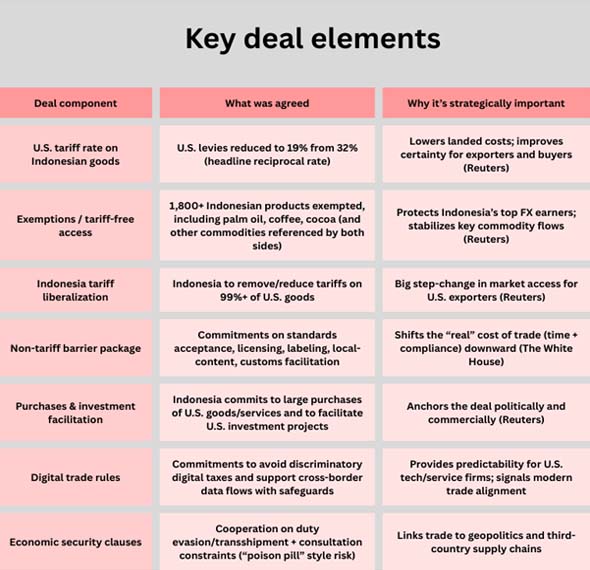
The U.S. side: a lower rate and a long list of exemptions. The deal's best selling point for Indonesia is the combination of a drop in the U.S. reciprocal tariff burden from 32% to 19%, and; As per Indonesia Export Data by Import Globals, there are a lot of products that are not subject to the tax, including more than 1,800 Indonesian goods, such as palm oil, coffee, and cocoa.
This structure is important since Indonesia's exports to the U.S. include both manufactured goods (which are susceptible to even slight changes in tariffs) and commodities (which can keep volumes and prices stable).
The Indonesia Side: almost all tariffs on U.S. imports are gone.
On paper, Indonesia's promise to get rid of or lower duties on more than 99% of U.S. exports is a big deal. But the effect on the economy relies on:
How quickly the adjustments are put into action, whether sensitive product lines are subject to carve-outs, quotas, or phase-ins, and how well non-tariff measures work in real life.
2) Exemptions and Carve-outs: The List of "Strategic Commodities," Palm Oil, and Coffee
Why Palm Oil is the "Must-win" in Politics and Business
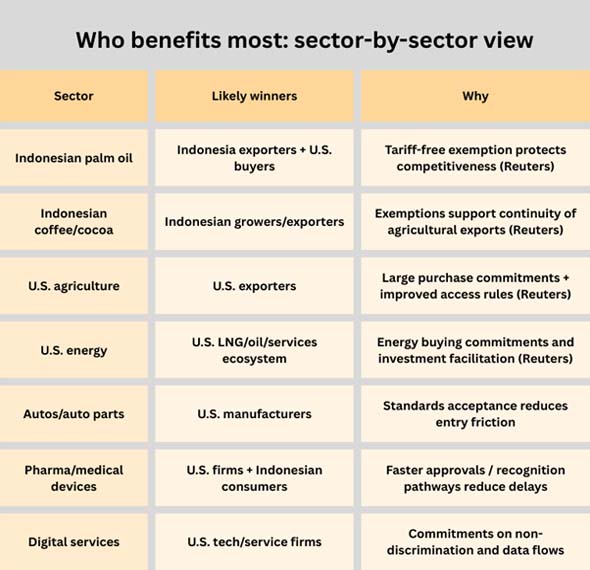
As per Indonesia Import Export Trade Data by Import Globals, Palm oil is more than just an export line; it affects the lives of people in Indonesia's rural areas, the country's finances, and its balance of trade. The accord says that palm oil is one of the main tariff-free exemptions, along with coffee, cocoa, rubber, and spices.
What the Exception Really Does
- Keeps Indonesian palm oil competitive with other suppliers and replacements in U.S. buyers' portfolios.
- Lowers the chance of quick demand destruction from a sudden tariff shock.
- Helps Indonesian exporters get longer-term contracts with fewer "tariff reopener" conditions.
Coffee and Cocoa: Worth Less Than Palm Oil but Bigger in Terms of Signaling
As per Indonesia Import Custom Data by Import Globals, even while coffee and cocoa volumes may be smaller than palm oil, their exclusions are important since they:
- Support supply chains for higher-value brands and niche items,
- Help industries that are connected to smallholders, and
- Send a message that the arrangement protects politically important types of farming.
- Textiles and other types of sensitive information
As per Indonesia Import Trade Analysis by Import Globals, some reports say that there would be special treatment procedures (like quota-style arrangements) for particular categories, like textiles. The details will be worked out after the signing. That means that the deal might include both general norms and sector-specific side deals, which is a frequent technique to fill in politically challenging gaps.
3) Non- Tariff Barriers: The "Hidden Tariff" That is Often More Important
Tariffs are just one part. The deal also aims to get rid of procedural and regulatory problems, which are the charges that slow down shipments, add compliance hurdles, or keep people from entering the market altogether.
- Local Content Rules: a big deal breaker
- Indonesia promised to let U.S. companies and items from the U.S. off of some local content restrictions. This is a big deal for electronics and other manufactured goods.
- Standards and Approvals: As per Indonesia Exporter Data by Import Globals, cars, drugs, and medical devices can get in faster
The agreement says that the parties will follow U.S. standards and methods in a number of regulated sectors, such as:
- Standards for the safety and emissions of motor vehicles, as well as
- Acceptance of U.S. FDA-related evidence in some medical device and pharmaceutical circumstances, as stated in the agreement wording.
- Customs facilitation: trade speed as a way to compete
- As per Indonesia Importer Data by Import Globals, Indonesia also agrees to trade facilitation methods like digital procedures, pre-arrival processing, and paperless commerce. These steps can help importers and exporters spend less time at the port and be less confident about what will happen.
4) Purchases and Investment Promises: Making the Deal Real With Figures
As per Indonesia Import Shipment Data by Import Globals, People often use big "purchase commitments" to make trade deals last because they create groups of people who gain right now.
Reported Commitments to Buy and Invest
Several sources say that Indonesia has agreed to buy things in a number of areas, including energy, agriculture, and others, as well as help U.S. investment projects.
How to Make Sense of These Numbers
These promises are generally limited by time, phased in, or based on business terms, finance, and delivery dates. Politically, they are also useful because they give both sides "wins" that can be immediately measured.
5) What this Means for Indonesia's Strategy
A) Keeping the External Balance and Export Growth Going
As per Indonesia Import Export Trade Analysis by Import Globals, Indonesia's trading position was robust going into 2026. Reports reveal that the country had a trade surplus of nearly $41.05 billion in 2025, and the surplus with the U.S. rose from 2024 to 2025.
In this case, tariff relief and exclusions lower the risk of losing: export quantities,
- The direction of the current account,
- And the mood of investors.
B) Tension in Industrial Policy: Openness vs. Improving Things at Home
Indonesia has been trying to climb up the value chain for a long time, notably in minerals and processing that happens after mining. This deal can assist bring in money, but it can also cause problems if:
Or if market access obligations limit the policy tools that can be utilized to improve industry.
C) A Minerals and Energy Lever That Doesn't "Give Away the Store"
The language of the agreement and the reports stress working together on industrial inputs and important minerals, as well as making it easier for people to invest.
- Indonesia's challenge will be to find a balance between:
- Sovereign control over the speed and terms of extraction, processing, and export rules.
6) What this Means for the Us in Terms of Strategy
A) Access to Markets That Goes Beyond Tariffs
As per Indonesia Export Import Global Trade Data by Import Globals, the biggest benefit for the U.S. may not be lower tariffs, but the non-tariff package, which includes standards recognition,
- Streamlined labeling and licensing,
- Modernizing customs,
- Local-content carve-outs,
- And rules that are easier to understand.
These rules can be like a big tariff decrease for U.S. corporations since they lower the "all-in" cost of selling to Indonesia.
B) Strategy for the Supply Chain and Economic Security
The agreement has wording about working together to stop duty evasion and transshipment, as well as language on broader alignment and consultation that connects trade preferences to what happens in other countries. This is in line with what the U.S. usually does: using trade treaties to protect the supply chain and align strategies, not just make the market work better.
C) Export Wins That Are Easy to Talk About at Home
In the U.S., agriculture, energy, and aviation are politically important areas. Making big purchases helps build a long-lasting story of job support and export growth.
7) Important Hazards and Things to Keep an Eye on (Reality of Implementation in 2026)
1) Clear and easy-to-understand exemptions list: "1,800+ products exempt" is strong, but exporters need to know exactly how to map tariff lines, rules of origin, documentation, and enforcement. How well customs officials follow those rules will affect trade.
2) Non- Tariff Compliance, Which is Where Transactions Often Go Wrong
Changes to rules can be politically sensitive at home. If promised changes (including licensing, labeling, and local content carve-outs) aren't put into place evenly, company confidence can lag after the main announcement.
3) Geopolitical "Conditionality"
Provisions linking favors to third-country agreements create uncertainty for Indonesia's broader economic diplomacy, especially if Jakarta pursues additional trade agreements that Washington perceives as contrary to "essential interests."
4) The Political Economy in Both Countries
Trade agreements last when they get long-term support from all parties involved. But changes in commodity prices, exchange rates, or electoral politics might still make the deal harder to keep.
In Conclusion, a Huge Deal With a Modern Trading Structure
The 2026 Indonesia–U.S. trade agreement is not only a small change to tariffs; it is a multi-pillar economic agreement that includes a lower U.S. reciprocal tariff rate.
- A long list of Indonesian products that are excluded from tariffs to preserve basic goods,
- A broad lowering of Indonesian tariffs on U.S. products,
- A big plan for non-tariff reform,
- And a business package of goods and help with investments.
If the deal is put into action consistently, it can change the flow of trade between the two countries by lowering not only tariffs but also the operational friction that frequently makes it hard to access genuine markets. The strategic subtext—supply chains, minerals, and digital rules—shows that both countries regard trade as a way to improve their economies and stay competitive in the long run. Import Globals is a leading data provider of Indonesia Import Export Trade Data.
FAQs
Que. When was the deal signed and when does it go into effect?
Ans. It was finalized on February 20, 2026, and reports say it goes into effect after it is ratified, with a waiting period mentioned in coverage.
Que. What Indonesian goods are not subject to U.S. tariffs?
Ans. Reports specifically include palm oil, coffee, and cocoa as exempt products in a larger list of more than 1,800 Indonesian goods.
Que. What does the U.S. get back from Indonesia?
Ans. Indonesia promises to lower or get rid of tariffs on more than 99% of U.S. items and to deal with a multitude of non-tariff barriers, such as worries about local content and standards/approval processes.
Que. What is the biggest risk to making this happen?
Ans. Administration of non-tariff reforms and exemptions: Even a good agreement can go wrong if different ports and agencies don't follow the same rules for changes to regulations, standards recognition, and customs processes.
Que. Where to get detailed Indonesia Import Export Global Data?
Ans. Visit www.importglobals.com.