
Bulgaria's Non-EU Imports Rise 25.6%: What Is Driving the Import Boom in 2025?
- Nov 14, 2026
- 69 Views
Bulgaria's Non-EU Imports Rise 25.6%: What Is Driving the Import Boom in 2025?
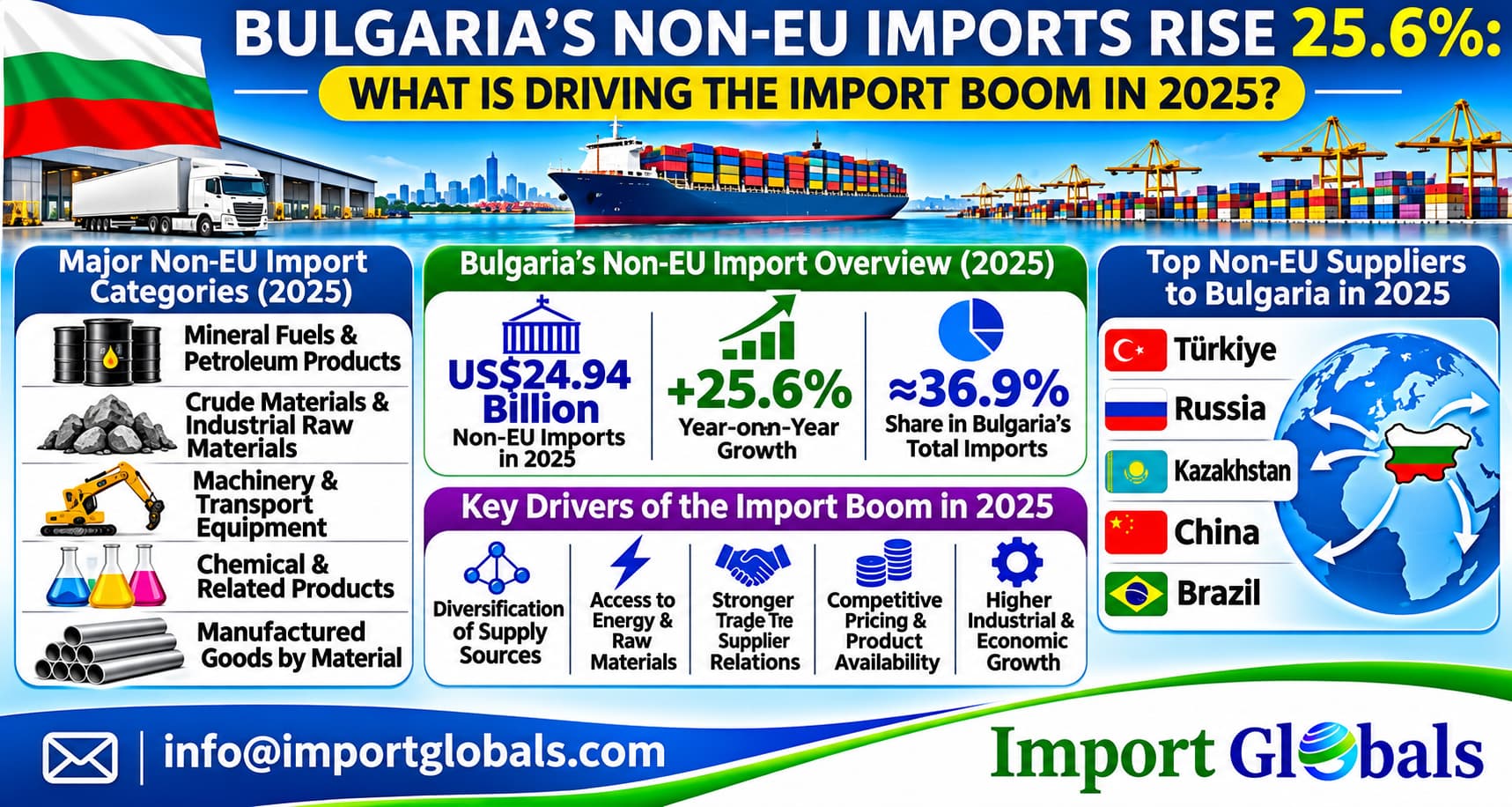
The import sector of Bulgaria is one of the strongest factors that have been shaping economic development and international trade relationships.
The country's membership in the European Union has been reported by the Bulgaria Shipments Data as factors maintaining the extensive import connections with both European and non-European markets while fulfilling the domestic consumption and industrial requirements. The import demand is a massive covering area for a wide range of commodities, including mineral fuels, machinery, and transportation equipment.
Non-EU trading partners are important contributors to diversifying the international sourcing network while ensuring a consistent supply of essential raw materials. Non-European Union imports have increased by 25.6% because of the time frame clarification regarding the country's trade. Turkey, China, Kazakhstan, and Serbia were the major non-European Union import partners that have been shaping the import landscape of Bulgaria in 2025. The growing dependence on diversified international sourcing has demonstrated a strategic position in the European market, maintaining global connectivity rates.
Short Summary of Bulgaria's Total Imports in 2025
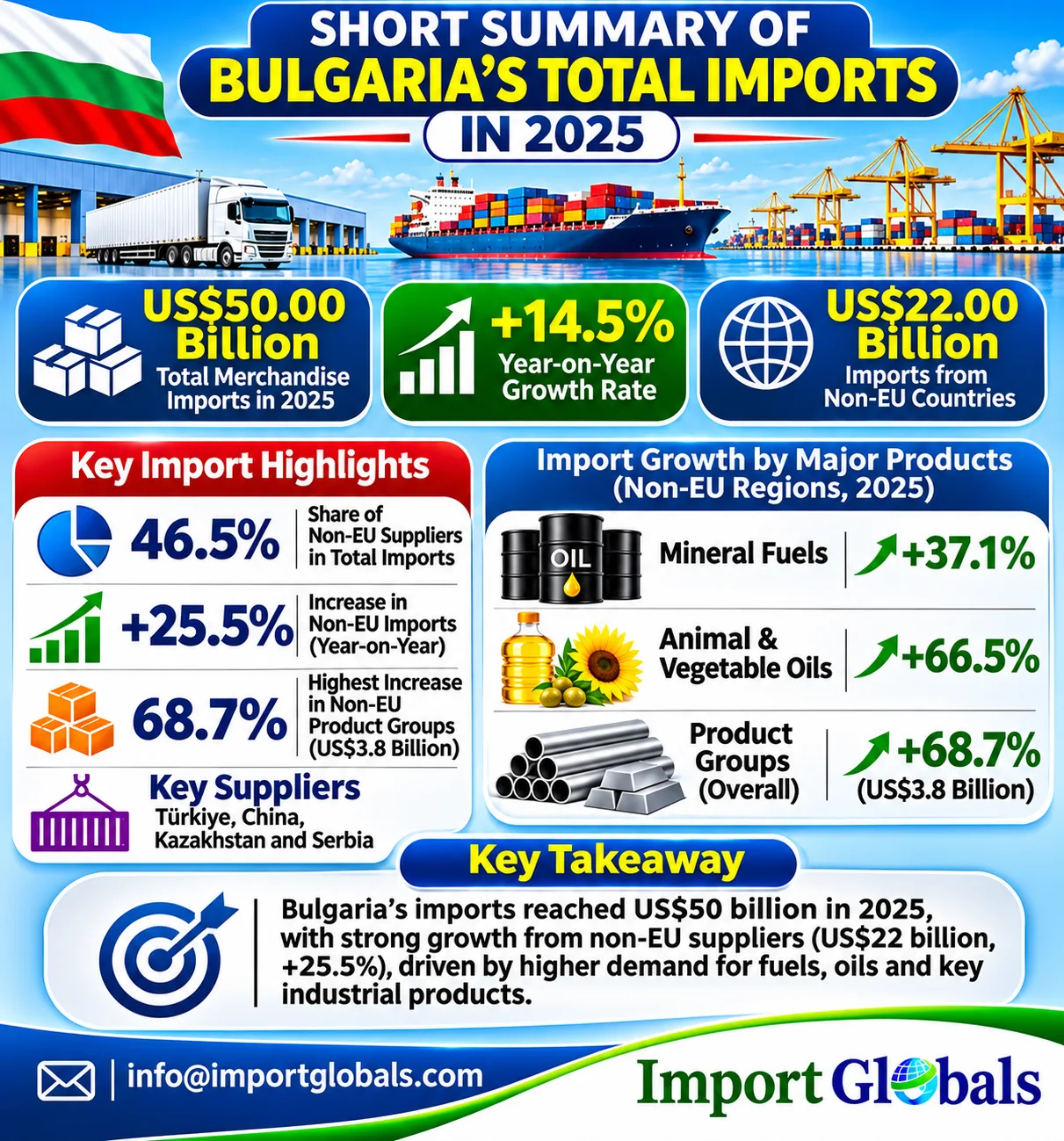
Bulgaria's total merchandise imports have reached a staggering rate of 50 billion U.S. dollars, with a 14.5% year-on-year growth rate. Bulgaria Customs Data listed that the total imports from non-European Union countries are at a staggering rate of 22 billion U.S. dollars, with a respective hike of 25.5% from the previous year.
The non-European Union suppliers are accounting for an approximate rate of 46.5% of the total import valuation of Bulgaria with a proper representation of the country's supply chain. The strong increase in the non-EU product groups were among the 68.7% accountability holder by a rate of 3.8 billion U.S. dollars in 2025. Animal and vegetable oils account for 66.5%, whereas mineral fuels report 37.1%. Turkey and China were the leading non-European Union suppliers, followed by Kazakhstan and Serbia.
Significance of Non-EU Suppliers in Bulgaria’s Imports
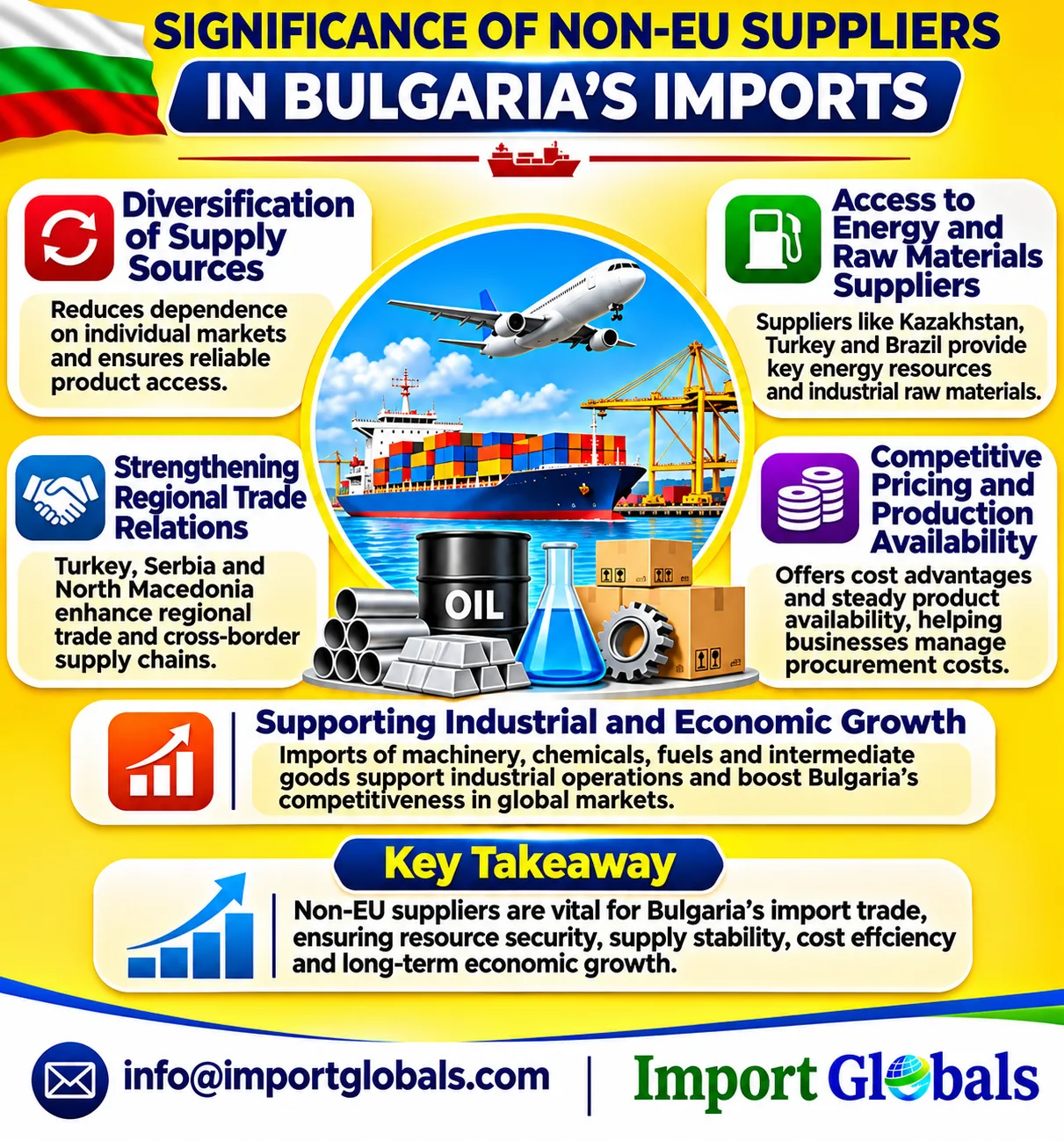
1. Diversification of supply sources - Bulgaria Trade Statistics listed the active diversification of supply sources as the main factor solidifying the non-European Union suppliers' role in reducing dependence on individual markets. Reliable access to alternative products and international sourcing efficiencies have maintained effective trade.
2. Access to energy and raw materials suppliers - Contributions from countries such as Kazakhstan, Turkey, and Brazil have maintained the important energy resources and industrial raw materials trade. It overall supports Bulgaria's manufacturing capacity with infrastructure development and domestic production requirements.
3. Strengthening regional trade relations - Turkey, Serbia, and North Macedonia are responsible for strengthening the regional commercial connections while facilitating cross-border supply chains. The distribution networks and economic cooperation have maintained effective trade across Southeast Europe.
4. Competitive pricing and production availability - Another major factor supporting the non-European Union region's role in Bulgaria's imports is competitive pricing and product availability. It supports helping businesses with proper management of the procurement costs while responding to changing consumer demand rates.
5. Supporting industrial and economic growth - The import of machinery, chemicals, fuels, and intermediate goods is responsible for the non-European Union partners' support of industrial operations. It helps the Bulgarian companies maintain competitiveness in the international markets.
Top 10 Specific Products Imported From Non-Eu Regions
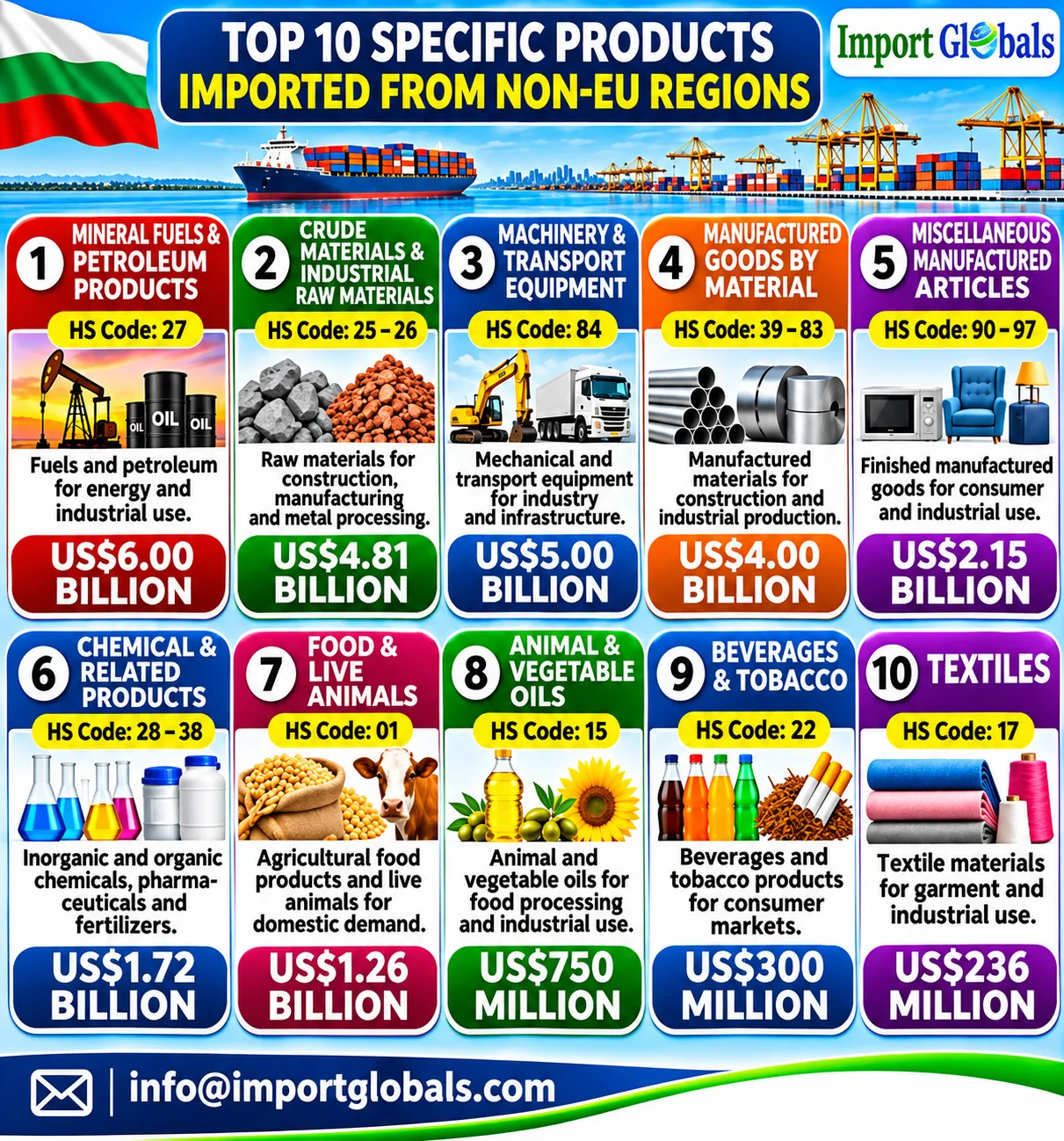
1. Mineral fuels and petroleum products, HS 27, 6 billion U.S. dollars - Bulgaria Import Data reported mineral fuels and petroleum products as the top imported category, mainly from the non-European Union regions. The active use of mineral fuels in industrial productivity and energy generation has maintained the demand for the commodity, mainly for functioning across transportation, industrial operation, and energy requirements.
2. Crude materials and industrial raw materials, HS 25 to 26, 4.81 billion U.S. dollars - Crude materials are one of the second-largest imported categories for Bulgaria from non-European Union regions. The materials imported are mainly used to support construction, manufacturing, metal processing, and industrial production.
3. Machinery and transport equipment, HS 84, 5 billion U.S. dollars - Machinery and transport equipment are the third-largest imported category from the non-European Union regions. Mechanical appliances, electrical equipment, and components are the largest ones supporting manufacturing and infrastructure development.
4. Manufactured goods classified by material, HS 39 to 83, 4 billion U.S. dollars - Manufactured goods classified by material are in the fourth position in the imported variants list from the non-European Union regions. These imports are mainly for supplying construction, manufacturing, and other industrial activities.
5. Miscellaneous manufactured articles, HS 90 to 97, 2.15 billion U.S. dollars - Miscellaneous manufactured goods are traded globally, among which Bulgaria is a top importing country. The import of the commodity is for supporting consumer markets, commercial distribution, and specialized industrial applications.
6. Chemical and related products, HS 28 to 38, 1.72 billion U.S. dollars - Chemical imports mainly encompass inorganic chemicals, organic compounds, pharmaceuticals, and fertilizers. The import of these essential commodities is for maintaining inputs for agriculture, healthcare, and industrial processing.
7. Food and live animals, HS 01, 1.26 billion U.S. dollars - The reason for trading food and live animals is to meet the demands for the diet needs and production of poultry for international trade. The international suppliers have provided agricultural goods in support of the live animal trade.
8. Animal and vegetable oils, HS 15, 750 million U.S. dollars - Animal and vegetable oils are the eighth-largest imported variant of Bulgaria from the European Union. The products' active use in food manufacturing and selected industrial applications has supported the demand for Bulgarian processors and distributors.
9. Beverages and tobacco, HS 22, 300 million U.S. dollars - Importation of drinks and tobacco is the most resource-intensive form of variants and ranked at the ninth place due to the level of resourcing required by international brands. Commodities and transactions.
10. Textiles, HS 17, 236, million US dollars - Textiles are the least categorized variant of resources imported from non-European Unions by Bulgaria. The active requirement of the industrial sector for maintaining the export stability of garments has made the commodity a top essential resource.
Top 10 Non-Eu Import Partners of Bulgaria in 2025
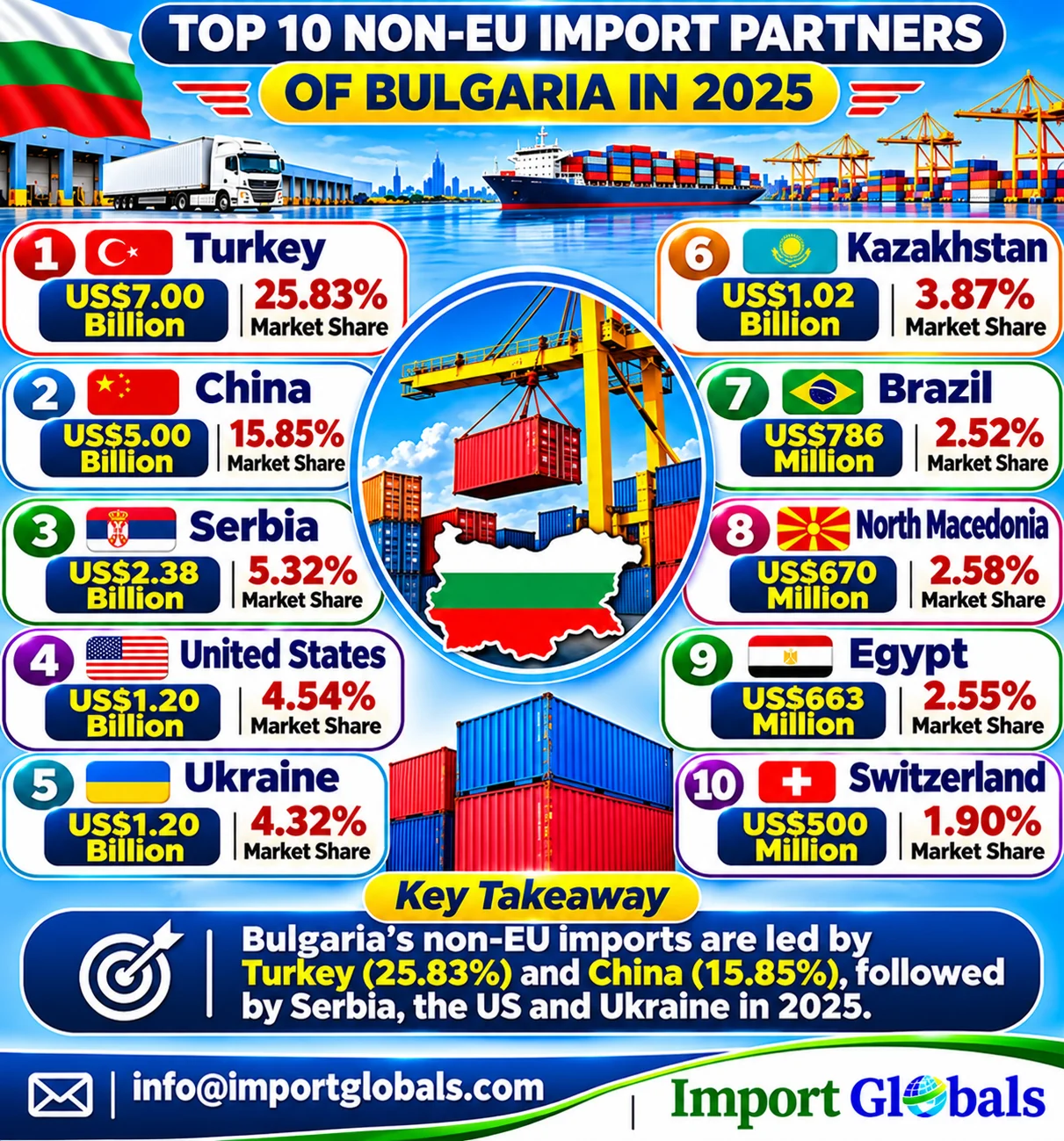
- Turkey, 7 billion US dollars, 25.83% import market share - Turkey is the top import partner of Bulgaria because of its leading regional trade links, geographical proximity, and the extensive cross-border commercial connection.
- China, 5 billion US dollars, 15.85% import market share - China is one of the top second import partner of Bulgaria with a reported import market share of 15.85%. The country's representation of the highlights for Asian sourcing and the Bulgarian supply chain has maintained the distribution across sectors.
- Serbia, 2.38 billion, 5.32% import market share - Serbia is listed by the Bulgarian trade statistics as the third-largest import partner for the nation. The significance of neighbouring Balkan trade and the establishment of regional supply networks have supported the industry and commerce, says Bulgaria Export Data.
- United States, 1.2 billion US dollars, 4.54% import market share - The United States is the fourth-largest import partner because of the role of transatlantic suppliers in Bulgaria's non-EU sourcing mix for local industries and businesses.
- Ukraine, 1.2 billion US dollars, 4.32% import market share - Ukraine is the top fifth import partner, with a proper representation of the continuous commercial links and 4.31% import market share. The importance of the nearby Eastern European supply routes has maintained the importers' and manufacturers' trade growth.
- Kazakhstan, 1.02 billion US dollars, 3.87% import market share - Kazakhstan has mainly contributed to the 3.97% non-EU import market share of the nation. The trade connections with Central Asia and resource-linked markets have maintained industrial inputs and material sourcing.
- Brazil, 786 million US dollars, 2.52% import market share - Brazil is responsible for an effective supply rate of 786 million U.S. dollars from the non-European Union region. The strengthening trade integrity is because of the active participation in Bulgaria's supplier base and sourcing options.
- Republic of North Macedonia, 670 million U.S. dollars, 2.58% import market share - North Macedonia captures a 2.58% import market share with an eighth-place ranking, reflecting the close geographic links and establishment of the Balkan trade connection. It supports regional commercial integration and supply networks.
- Egypt, 663 million U.S. dollars, 2.55% import market share - Egypt supplied 663 million U.S. dollars of essentials to Bulgaria. The positioning of North Africa among Bulgaria's notable external sourcing regions has maintained the trade integrity for Bulgarian businesses.
- Switzerland, 500 million U.S. dollars, 1.90% import market share - Wrapping up the list of the top import partners of Bulgaria, Switzerland is in the tenth position. The presence is a high representation of the income generated for European supply to Bulgaria's non-EU network across several key sectors.
Top Industries Driving Bulgaria's Imports From Non-European Union Countries
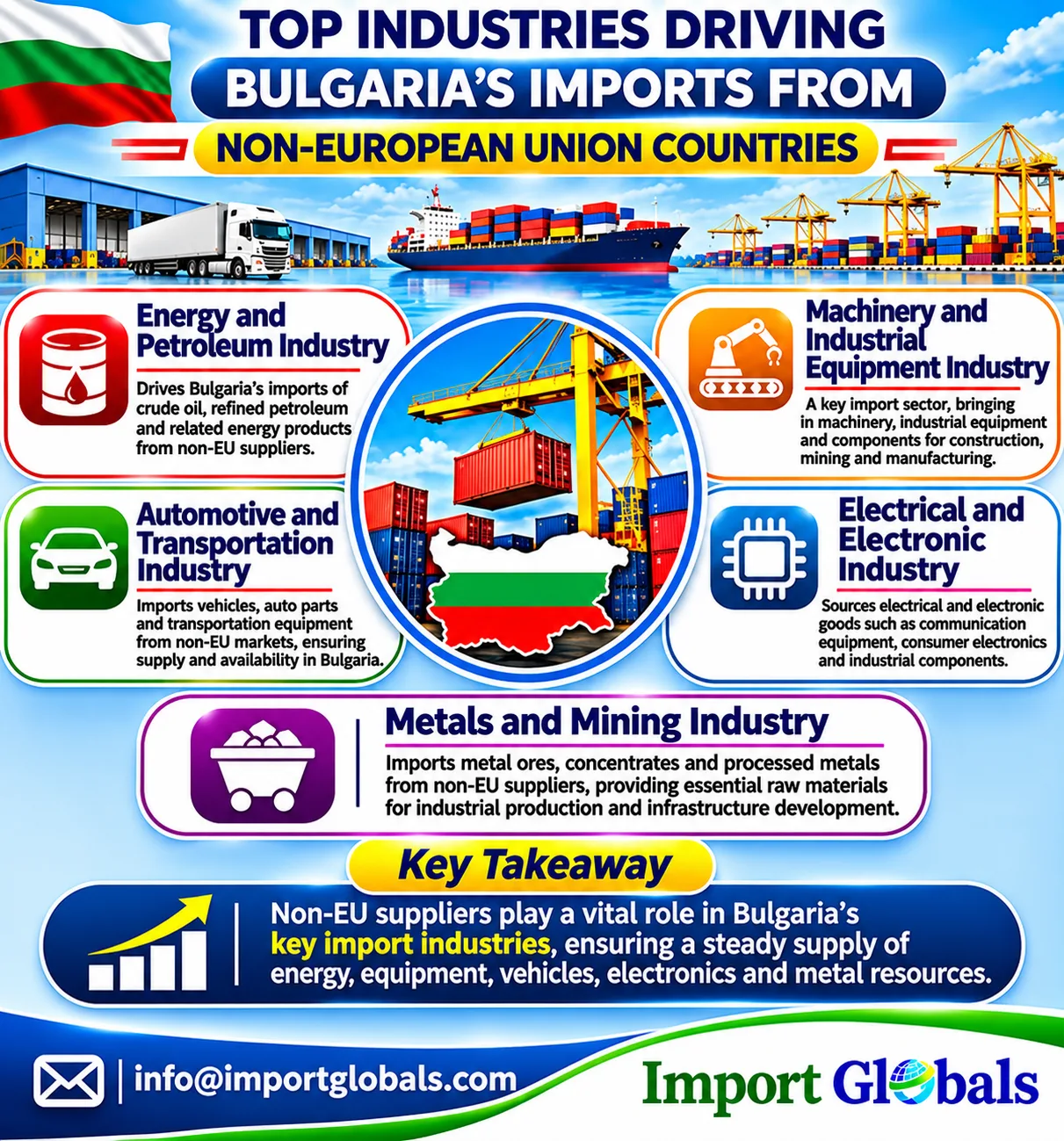
1. Energy and petroleum industry - The energy and petroleum industry is the top contributing factor supporting Bulgaria's effective resourcing of petroleum products from the non-European Union region. The industrial operation and domestic fuel requirements have supported the overall trade.
2. Machinery and industrial equipment industry - The machinery and industrial equipment industry as reported by the Bulgaria Custom Shipments Data is one of the top second industries supporting the import from the non-European Union region. The international equipment suppliers have provided opportunities for construction, mining, and industrial processing.
3. Automotive and transportation industry - It is the third-largest sector driving Bulgaria's imports from the non-European Union region. The international automotive suppliers’ contribution to vehicle availability has maintained effective resourcing.
4. Electrical and electronic industry - The electrical and electronic industry is a massive and reliable factor in communication equipment. It supports telecommunications, consumer electronics, and Bulgaria's expanding technology-related manufacturing activities.
5. Metals and mining industry - The metals and mining industry is an important acquirer of concentrates and processed metals. The international mining companies help the authorities connect Bulgarian businesses with essential mineral resources and metal inputs.
Tariff Framework Supporting Bulgaria's Imports From Non-European Union Region
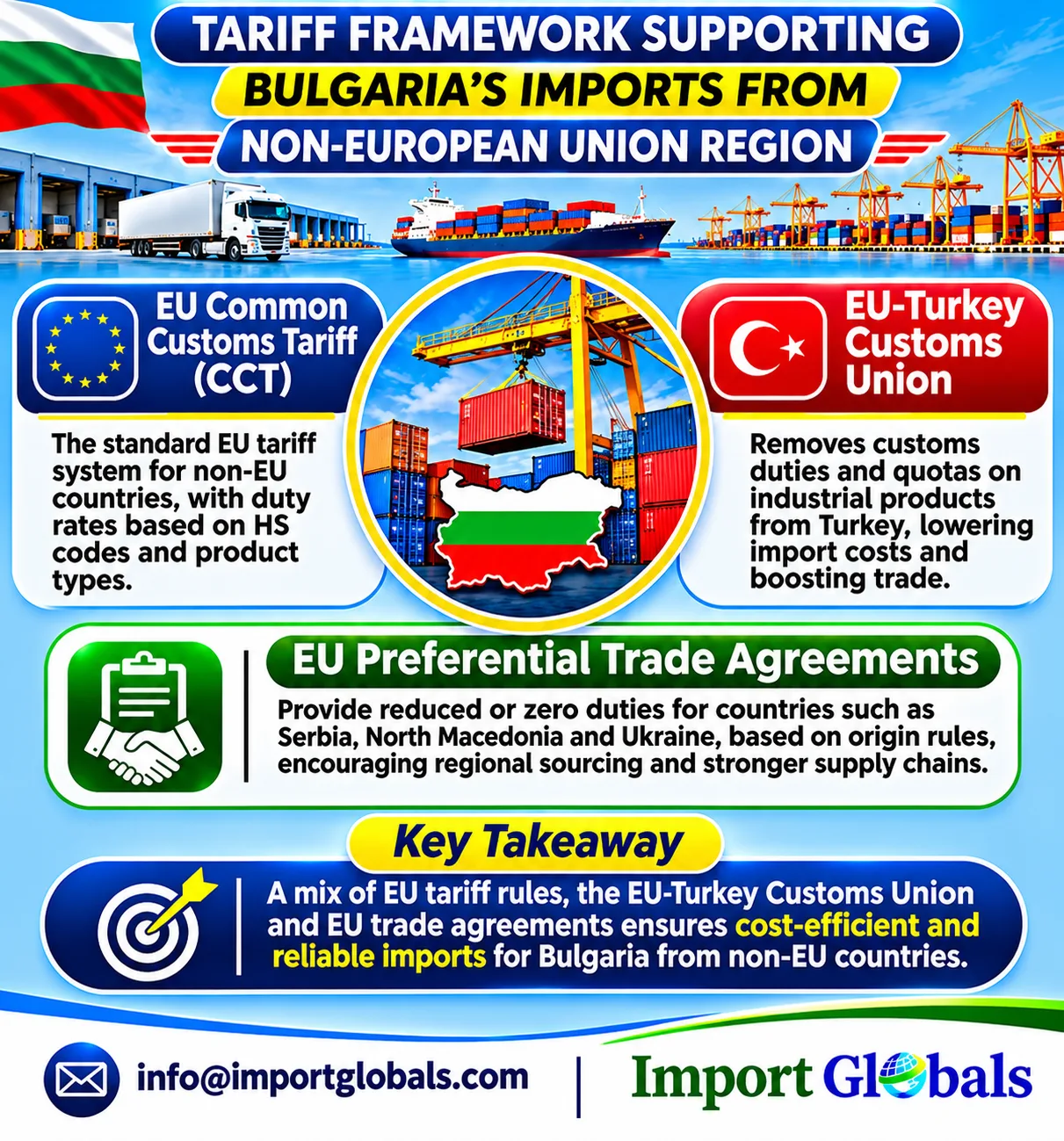
1. EU Common Customs Tariff, CCT - Bulgaria Trade Statistics list the EU Common Customs Tariff as the main one supporting the solidification of the non-European Union countries without preferential arrangement. The import duty rates vary according to the HS classification, product category, and the origin. The unified framework is responsible for allowing Bulgarian businesses to source from global suppliers.
2. EU-Turkey Customs Union - The EU-Turkey Customs Union is responsible for imports from Turkey, which removes customs duties and quotas on covered industrial products. The arrangement overall strengthens cross-border trade while reducing the import costs and supporting the Bulgarian manufacturers' sourcing of machinery.
3. EU preferential trade agreements - The EU agreements with countries such as Serbia, North Macedonia, and Ukraine are the top preferential market access providing authorities supporting the non-European Union countries' trade with Bulgaria. The reduction or elimination of duties is subject to the origin requirement. It eventually encourages regional sourcing and strengthens the supply chains while improving the trade opportunities for Bulgarian importers.
Future Trade Outlook of Bulgaria's Non-European Union Imports
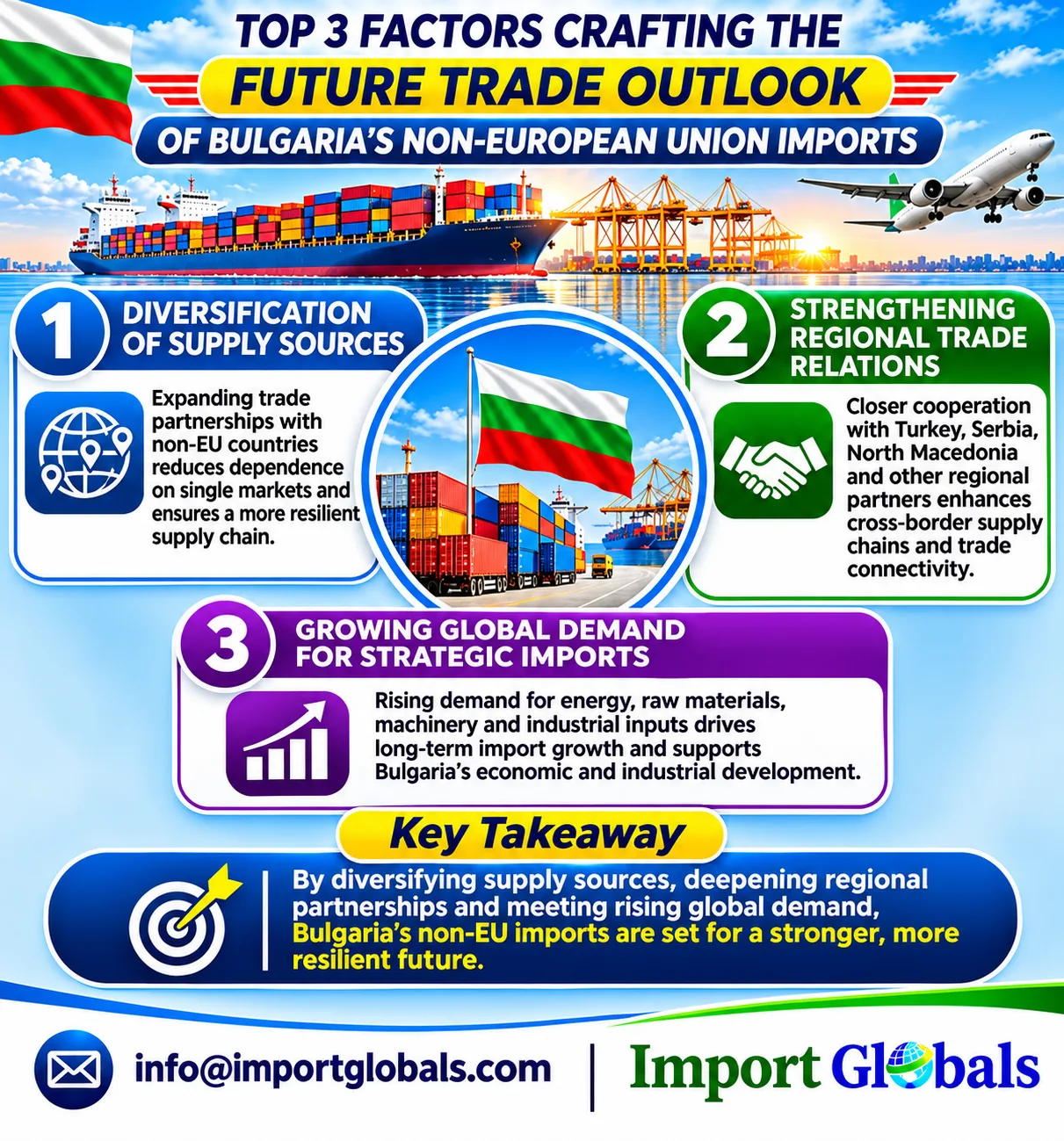
Bulgaria's non-European Union imports are on a gradual trade hike because of the active resourcing of machinery, industrial raw materials, and manufactured goods supporting the economic activity. The strong import growth is a key indicator of the increasing engagement with suppliers outside the European Union. The growing demand for mineral fuel, chemicals, and machinery is responsible for creating additional sourcing opportunities with countries like Kazakhstan, Brazil, Serbia, and the United States.
Bulgaria is increasingly diversifying the supplier base to reduce supply chain risk while managing fluctuations in international commodity prices; geopolitical developments and transport costs are affecting import valuation. Regulatory compliance and sustainable procurement have been helping Bulgarian businesses maintain their competitiveness in European and global markets.
Conclusion
The non-European Union imports of Bulgaria have maintained the growing importance of international sourcing. The 25.5% increase in demand for essential commodities has supported trade. Turkey and China are the leading non-European Union suppliers, contributing to the diversified import network.
The rising contribution of non-European Union markets has highlighted the strategic position in regional and global supply chains. Bulgaria Customs Data and Bulgaria Shipments Trade Data provide valuable insights into the product demand-supply relationship and emerging sourcing opportunities. The detailed trade information will help the authorities for identification of reliable partners and evaluation of market potential, along with development of effective international trade strategies.
CTA
Looking for a proper understanding of the changing import landscape with detailed trade intelligence, Import Globals is here to assist you with accurate shipment insights. Bulgaria shipment data helps the businesses get detailed analysis of the product-wise import trends with exploration of the shipment-level records and discovery of emerging business opportunities. The updated trade information helps the importers make informed decisions while strengthening their national sourcing strategies. Subscribe to www.importglobals.com or drop an email at [email protected] for detailed updates on Bulgaria's imports from the non-European Union regions in order to thrive globally.
FAQ’s
Que. What is the total value of Bulgaria's imports in 2025?
Ans. The total value of Bulgaria's imports in 2025 is 52 billion U.S. dollars.
Que. How much has Bulgaria imported from the non-European countries in 2025?
Ans. Bulgaria has imported 22 billion U.S. dollars of products from the non-European Union countries in 2025.
Que. What is the total import market share of non-European Union countries in Bulgaria?
Ans. The total import market share of non-European Union countries in Bulgaria is 46.5%.
Que. Name the largest non-European Union import partner of Bulgaria.
Ans. Turkey was the largest non-European Union import partner of Bulgaria.
Que. Name the countries that were the major non-European Union import partners.
Ans. China, Serbia, and the United States were the countries that are the major non-European Union import partners.
Que. Name the categories contributing to Bulgaria's non-European Union imports.
Ans. Mineral fuels, crude materials, and transport equipment are the categories contributing to Bulgaria's non-European Union imports.
Que. How does Bulgaria's import-exportdata support business growth?
Ans. Bulgaria Import-Export Data supports business growth via proper identification of buyers, suppliers, analysis of market demand, and development of effective market expansion strategies.
Que. What information is available in Bulgaria trade data?
Ans. Bulgariatrade data covers importer name, exporter name, shipment date, HS code, product details, quantity, pricing information, origin country, importing country, and port details.
Que. How frequently is the Bulgaria Trade Data updated?
Ans. Bulgaria Trade Data is updated on a monthly basis.
Que. Where can you obtain detailed information on Bulgaria trade data?
Ans. Visit www.importglobals.com or drop an email at [email protected] for detailed updates on Bulgaria trade data.
You Can Also Visit :-
Southeast Europe's Export Sectors From Bulgaria Include Farming and It Services
