
Bulgaria's Top Trading Partners in 2026: Turkiye, Germany, Romania, China and Greece – Import, Export and Trade Statistics
- Nov 25, 2026
- 27 Views
Bulgaria's Top Trading Partners in 2026: Turkiye, Germany, Romania, China and Greece – Import, Export and Trade Statistics
Bulgaria has become one of the most popular destinations of international trade in Southeastern Europe, being a bridge between the markets of the European Union, Turkey, China and other economies of the world.
The country’s strategic location between Central Europe, Balkan region, Black Sea and Turkey makes it a preferable place for manufacturers, exporters, importers and international sourcing companies.
Bulgaria’s international trade in goods continued to expand in 2026, with the industrial manufacturing, machinery, energy products, chemicals, agricultural products, metals and consumer goods sectors leading the growth. Among European countries the main trade partners of Bulgaria were Germany, Romania and Greece, while Türkiye and China kept their positions in Bulgaria’s trade with non-EU countries.
As per the preliminary NSI data, the country’s merchandise exports reached about $41.39 billion in the January-September period of 2026, or an increase of 11.3 per cent compared to the corresponding period of 2025, as of November 11, 2026. Imports, however, are at about $51.81 billion, up by 14.5%.
According to the latest NSI data, imports grew by 14.5% in the first nine months of 2026, compared to an increase of 11.3% in exports. The increased imports has been on the back of the widening merchandise trade deficit.
Major Industries Contributing to Bulgaria's International Trade
Several key industries contribute significantly to Bulgaria's international trade performance:
- Machinery and transport equipment
- Mineral fuels and energy products
- Electrical and electronic equipment
- Chemical and pharmaceutical products
- Agricultural and food commodities
- Copper, metals, and manufactured materials
- Textiles, clothing, and consumer products
Companies that can access Bulgaria Import Data can benefit from knowing all about the goods shipped to know the kind of goods imported into the country, the regular international suppliers, the frequency of supply of their products and if there is any shift in the demand for some imported goods.
Turkey–Bulgaria Trade Relations: Imports, Exports and Business Opportunities
Turkey is one of Bulgaria's most important trading partners outside the EU. The large-scale border merchandise trade between the two countries is facilitated by the geographical proximity, the developed transport infrastructure network and the industrial supply chain connections.
Trade between Bulgaria and Turkey includes a variety of goods such as machines, metals, chemicals, textiles, plastics, petroleum products and agricultural produce. The trading activities generate business opportunities for producers, exporters, importers and also for international sourcing firms.
Turkey – Bulgaria Trade Statistics (January–September 2026)
According to published statistical data of NSI (National Statistical Institute) the bilateral trade in goods between Bulgaria and Turkey for January – September 2026 was estimated as follows:
- Bulgarian exports to Turkey: Approximately US$2.30 billion
- Bulgarian imports from Turkey: Approximately US$6.39 billion
- Export Growth: Declined by 8.0% year-on-year.
- Import Growth: Increased by 34.6% year-on-year.
The figures presented show a considerable growth of the imports of the Bulgarian products from Turkey and a decrease of the exports to Turkey.
Major Products Traded Between Bulgaria and Turkey
Bulgaria and Turkey trade a diverse range of products across several industrial and commercial sectors. The major product categories include:
1. Petroleum Oils and Fuels (HS Code 2710): Petroleum products and their uses in the energy, transport and industry sectors.
2. Iron and Steel Products (HS Code 7208): Steel products are used in the construction, infrastructure and manufacturing industries.
3. Plastics and Plastic Articles (HS Codes 3901–3926): Plastics and their uses in packaging, automotive and manufacturing industry.
4. Electrical Machinery (HS Codes 8501–8548): Electrical equipment, machines, engines and electronic components used in industrial and commercial application.
5. Textile Fabrics (HS Codes 5208–5516): Textiles, such as cotton, artificial fibers etc. and clothing.
6. Pharmaceutical Products (HS Codes 3003–3004): Pharmaceuticals, medicines and other healthcare products.
7. Industrial Machinery (HS Codes 8401–8487): Machinery and mechanical devices for use in various manufacturing operations.
Business and Trade Opportunities Between Turkey and Bulgaria
Turkey has a developed manufacturing sector, giving Bulgarian companies the opportunity to purchase industrial raw materials, building materials, textile materials, machines and consumer goods. Bulgarian exporters may find opportunities to trade in the Turkish market for chemicals, agricultural products, machinery and manufactured products.
HS Code analysis of Bulgaria Export Data helps international traders to know the products exported to Türkiye, declared value of trade, pattern of suppliers and buyers, yearly performance in exports.
Such information on imports and exports would be helpful for businesses in identifying the right trading partners, estimating demand, identifying trends and planning their international business strategies.
Germany–Bulgaria Trade Relations: Europe's Important Industrial Partnership

Germany is one of the most important trade partners of Bulgaria in the EU . Good business links between the countries in automotive supply chain, industrial manufacturing, engineering, electronics, chemistry and machinery help trade.
Germany–Bulgaria Trade Statistics (January–August 2026)
Based on the provided trade statistics, Bulgaria reported the following merchandise trade figures with Germany in the period January-August 2026:
- Bulgarian exports to Germany: Approximately US$5.42 billion.
- Bulgarian imports from Germany: Approximately US$4.57 billion.
- Export growth: Increased by 27.0% year-on-year.
- Import growth: Increased by 6.7% year-on-year.
Germany–Bulgaria Trade Overview
1. Bulgarian Exports to Germany – US$5.42 Billion: Bulgarian exports to Germany amounted to about US$5.42 billion. There is a strong trade relationship and demand for Bulgarian products on the German market.
2. Bulgarian Imports from Germany – US$4.57 Billion: Imports from Germany to Bulgaria stood at about US$4.57 billion, indicating the importance of Germany as a source of machinery, vehicles, industrial machinery and other manufactured products.
3. Trade Balance – +US$0.85 Billion: Germany had a positive trade balance of about US$850 million with Bulgaria, as during the given period Bulgaria’s exports exceeded imports.
Major Products Traded Between Germany and Bulgaria
The following product categories and HS codes are relevant to analyzing bilateral trade between the two countries:
Nuclear Reactors, Boilers and Machinery (HS Code 84): Machinery, mechanical articles, boilers, industrial parts.
Electrical Machinery and Equipment (HS Code 85): Appliances, electrical, electronic, generators, motors and appliances related.
Vehicles and Automotive Components (HS Code 87): Trucks, Parts, Transport Equipment, Motor Vehicles.
Pharmaceutical Products (HS Code 30): Pharmaceutical compositions and pharmaceutical articles.
Organic Chemicals (HS Code 29): Industrial chemicals, chemical substances and industrial materials.
Plastics and Plastic Articles (HS Code 39): Raw materials for plastics, packaging materials and plastic products.
Optical and Medical Instruments (HS Code 90): Medical supplies, precision instruments, optical instruments, measuring instruments.
Business and Trade Opportunities Between Germany and Bulgaria
Germany and Bulgaria offer many opportunities for international manufacturers, exporters, importers and sourcing companies.
Import Opportunities: The German manufacturers are suppliers for machinery, vehicles, industrial equipment, electricals and manufacturing components.
Export Opportunities: Opportunities for Bulgaria exporters are in automobile parts, electricals, metals, industrial materials, processed products.
Supplier Identification: Analysis of trade statistics at product level identifies potential suppliers in Germany and potential manufacturers in Bulgaria.
Market Research: By analyzing the import/export trends, businesses can find out more about product demand, trade value and changes in trading activities between countries.
Importance of Bulgaria Customs Data
Bulgaria Customs Analysis Where allowed by law, data can enable businesses to research international shipments, HS code, description of goods, declared value of shipment, and country trading information. It can be useful for companies wishing to establish new supplier relationships or expand their international business to know Germany's position in Bulgaria's trading network.
Romania–Bulgaria Trade Relations: Growing Opportunities in Southeast Europe

Romania is an important trading partner of Bulgaria because of its geographical proximity and the existence of a common border along the Danube River and the fact that both countries are members of the European Union.
Romania–Bulgaria Trade Statistics (January–August 2026)
During January–August 2026, Bulgaria's merchandise trade with Romania recorded the following results:
1. Bulgarian Exports to Romania – US$3.87 Billion: Exports of Bulgaria to Romania amounted to about US$3.87 billion, indicating good business relations and demand for Bulgarian goods in Romania.
2. Bulgarian Imports from Romania – US$3.14 Billion: Imports of products from Romania to Bulgaria totaled US$ 3.14 billion. It proved that Romania is one of the important suppliers of goods for Bulgaria.
3. Export Growth – 14.9%: In the corresponding period of 2025, Bulgaria's exports to Romania increased by 14.9%, indicating the growth of bilateral exports.
4. Import Growth – 7.5%: Import from Romania to Bulgaria grew by 7.5% year on year, showing a higher demand for Romanian goods and materials.
Romania–Bulgaria Trade Overview
Bulgarian Exports to Romania – US$3.87 Billion: Exports to Romania from Bulgaria reached US$3.87 billion.
Bulgarian Imports from Romania – US$3.14 Billion: The import from Romania was US$3.14 billion reflecting the importance of regional sourcing and relationship.
Trade Balance – +US$0.73 Billion: Bulgaria’s trade balance with Romania in January-August 2026 recorded a trade surplus of about US$730 million, with exports exceeding imports.
Major Products Traded Between Romania and Bulgaria
The following product categories and HS codes provide a useful starting point for examining bilateral merchandise trade:
Mineral Fuels and Oils (HS Chapter 27): Other mineral fuels, petroleum products Other transport and industrial energy products.
Iron and Steel Products (HS Chapter 72): Building & construction, infrastructures Iron and steel products.
Electrical Machinery (HS Chapter 85): Electrical and electronic equipment: generators and motors.
Mechanical Machinery (HS Chapter 84): Machinery and mechanical apparatus; boilers and other goods for industrial use.
Plastics and Plastic Articles (HS Chapter 39): Raw materials for plastics Plastic packages and plastic products manufactured for use in different sectors.
Fertilizers (HS Chapter 31): Agricultural fertilizers and fertilizer products which assist agriculture and farming.
Cereals (HS Chapter 10): Wheat, maize, barley and other cereal based products for food industry ingredient trade.
Vehicles and Components (HS Chapter 87): Transport means, motor vehicles, automotive spare parts, transport products.
Business and Trade Opportunities Between Romania and Bulgaria
Romania and Bulgaria are attractive for companies wanting to do business in South Eastern Europe.
Import Opportunities: Bulgarian importers can rely on Romanian suppliers of agricultural products, industrial raw materials, machinery, fertilizers and manufactured goods.
Export Opportunities: Bulgarian manufacturers can target Romanian buyers of industrial inputs, automotive spare parts, electrical products, construction materials and manufactured products.
Regional Distribution: Companies may capitalize on Romania's geographical position to build up their distribution networks and reach other Southeast European markets.
Supplier Identification: The trade studies on the product levels will help the companies to identify the potential suppliers, buyers and partners from the two countries.
Market Analysis: The firms will be able to assess the market dynamics and find out business opportunities by monitoring the trade volumes between the two countries and the demand for the products.
Importance of Bulgaria Import and Export Data
Companies can use country wise trade analysis and Bulgaria Import Trade Data to estimate demand for the products, identify their buyers, compare international suppliers and get insights into cross border merchandise flows.
In addition, the Bulgaria Export Trade Data by HS Code will enable businesses to analyze the product categories and their trade volumes.
Greece–Bulgaria Trade Relations: Cross-Border Commerce and Regional Supply Chains

Greece has become an important trading partner for Bulgaria in the region, thanks to the geographical proximity, efficient transport links and access to the unified market of the European Union. Good commercial ties between these two countries offer numerous possibilities for a wide range of industries including agriculture, energy, pharmaceuticals, machinery, chemicals, and manufactured goods.
Greece–Bulgaria Trade Statistics (January–August 2026)
During January–August 2026, Bulgaria's merchandise trade with Greece recorded the following results:
Bulgarian Exports to Greece – US$1.90 Billion: Bulgaria exported about $1.90 billion worth of goods to Greece. This shows how important the Greek market is to Bulgarian exporters and regional suppliers.
Bulgarian Imports from Greece – US$2.35 Billion: The total value of imports of Bulgaria from Greece amounted to about $2.35 billion, which emphasizes Greece as an important supplier of goods and industrial products.
Export Growth – Declined by 3.7%: Bulgarian exports to Greece were down 3.7% year-on-year.
Import Growth – Increased by 13.2%: Imports from Greece to Bulgaria increased by 13.2% year-on-year.
Greece–Bulgaria Trade Overview
Bulgarian Exports to Greece – US$1.90 Billion: For the first eight months of 2026, Bulgarian exports to Greece totaled about US$1.90 billion.
Bulgarian Imports from Greece – US$2.35 Billion: Bulgaria imported almost US$2.35 billion worth of goods from Greece, which is a good business relationship between the two countries.
Trade Balance – US$0.45 Billion: During the period, importation surpassed exportation. Bulgaria had a trade deficit with Greece of approximately US$450 million.
Major Products Traded Between Greece and Bulgaria
Mineral Fuels and Petroleum Products (HS Chapter 27): Mineral fuels, energy commodities and petroleum products applied to transport and industry.
Pharmaceutical Products (HS Chapter 30): Pharmaceutical products and pharmacy preparations.
Plastics and Plastic Articles (HS Chapter 39): Raw materials for plastics, packaging materials and plastic products for industry.
Machinery and Mechanical Appliances (HS Chapter 84): Manufacture of articles, boilers, mechanical apparatus, machines.
Electrical Equipment (HS Chapter 85): Generators and motors.
Aluminium and Aluminium Articles (HS Chapter 76): Aluminum products are used in construction, transportation and manufacturing industries.
Food Preparations (HS Chapter 21): Products including processed foods, food ingredients and prepared food items that may be traded internationally in food between the two markets.
Fruits and Vegetables (HS Chapters 07–08): International agricultural trade in the region by fresh and prepared agricultural produce such as vegetables, fruits, and nuts.
Business and Trade Opportunities Between Greece and Bulgaria
Import Opportunities: Bulgarian companies can source food items, agricultural produce, chemicals, industrial materials, machinery and manufactured goods from Greek suppliers.
Export Opportunities: Opportunities for Bulgarian exporters exist in Greece in the areas of industrial products, machines, metals, agricultural products and manufactured goods.
Supplier Identification: Businesses may evaluate product-wise trade data to find Greek suppliers and Bulgarian buyers.
Regional Market Expansion: “Greece is an important market for companies looking to extend their networks in Southeast Europe because of geographical proximity and transport facilities.
Trade Performance Analysis: Import and export values can help businesses understand trends in product demand and trading opportunities.
Comparison of Bulgaria's Five Important Trading Partners in 2026
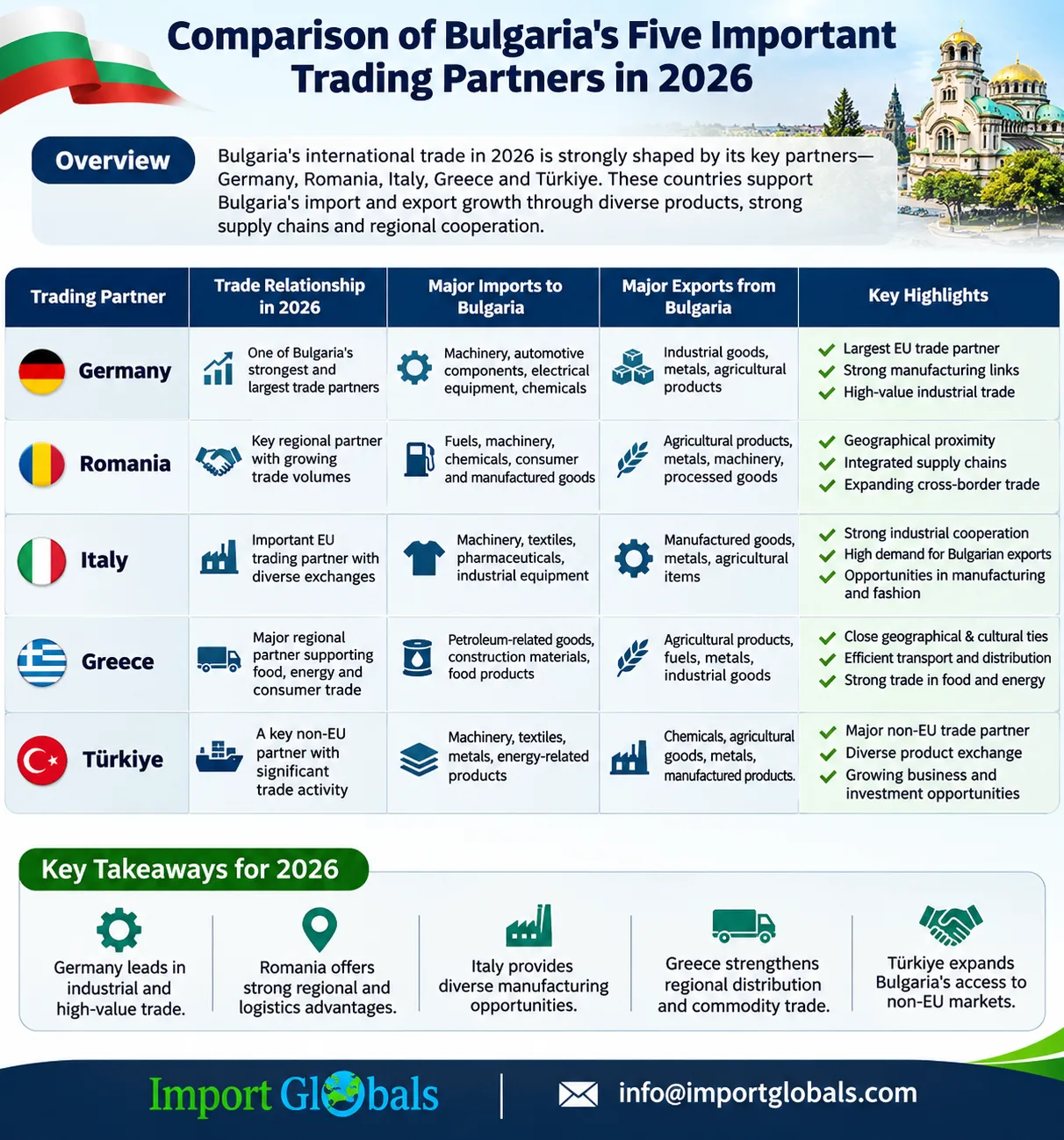
In 2026, Bulgaria's links with international trade continue to grow, supported by the country's close ties with Europe and growing business relations with neighboring and foreign markets. Five leading trading partners, namely Germany, Romania, Italy, Greece and Turkey, account for the bulk of Bulgaria’s imports and exports. These provide a variety of business opportunities for domestic companies and foreign suppliers.
1. Germany: Germany is one of the main trade partners for Bulgaria with considerable exchange of business in machinery, automobile parts, electrical equipment and industrial goods. Germany’s advanced manufacturing industry is an important market for Bulgarian exports and imports.
2. Romania: Romania benefits from geographic proximity and regional supply chains. Products traded are agricultural produce, fuels, machinery, chemicals and manufactured products.
3. Italy: Italy and Bulgaria have close commercial relations in machinery, textiles, fashion, pharmaceuticals and industrial equipment. More export, more to Italy to be a good place for Bulgarian business.
4. Greece: Greece is a big player in the business of the region. It is involved in the business of food products, petroleum products, construction materials and consumer products.
5. Turkey: Bulgaria's most important non-EU trading partner is Turkey. It plays a great role for the imports and exports of Bulgaria.
Conclusion
As for the top trading countries of Bulgaria in 2026, ie Turkey, Germany, Romania, China and Greece, it is important to point out that these countries have a great influence on the structure of Bulgaria's international business environment. Bulgaria’s main trading partners support its import and export activities by exchanging various goods, including machinery, automotive parts, electronic equipment, textiles, energy and agricultural products. Germany and Romania have great connections in Europe, Turkey and China are in the world trade, Greece develops regional trade and distribution processes.
CTA
Discover Bulgaria's leading trading partners in 2026 with Import Globals! Discover business opportunities with useful import-export statistics, trade intelligence and information about global suppliers. [email protected] or www.importglobals.com to develop your international trade strategy and increase your international business network.
FAQ’s
Que. Who are the top five trading partners of Bulgaria in 2026?
Ans. The five major trading partners of Bulgaria include Turkey, Germany, Romania, China, and Greece, which help in facilitating Bulgaria’s international imports and exports.
Que. What are the main imports of Bulgaria from Germany?
Ans. The major imports of Bulgaria from Germany include machinery, automobiles, electrical equipment, chemicals, and industrial items.
Que. What does Bulgaria export to Turkey?
Ans. Bulgaria exports machinery, agricultural goods, metals, chemicals, and manufactured products to Turkey.
Que. How important is Romania for Bulgaria's international trade?
Ans. Romania is an important neighbouring country and trading partner with transactions of agricultural products, fuels, machinery, and manufactured goods.
Que. What are Bulgaria's main imports from China?
Ans. Bulgaria imports electronics, machinery, textiles, consumer goods, and manufactured products from China.
Que. Which products from Bulgaria are exported to Greece?
Ans. Some of the products exported to Greece include agricultural products, food products, fuel, metals, and industrial products.
Que. Why is Germany an important trading partner to Bulgaria?
Ans. Germany provides Bulgaria with a good link in manufacturing, industrial supply chains, and export opportunities.
Que. How does Turkey help in Bulgaria’s import-export market?
Ans. Turkey helps Bulgaria in its regional trade because of its proximity and good transport links.
Que. How frequently is Bulgaria's Import-Export Trade Data updated?
Ans. Update frequency depends on the reporting source and data category; Import Globals import-export trade statistics are generally released monthly, with annual summaries published periodically.
Que. How does Import Globals support Bulgaria's import-export trade research?
Ans. Import Globals provides Bulgaria Import-Export Trade Data and shipment insights to help businesses identify buyers, analyse competitors, discover key trading partners, and explore global trade opportunities. Visit www.importglobals.com or email [email protected].
You Can Also Visit :-
