Finland’s Trade Relations with the EU and Asia
- Jan 21, 2026
Finland’s Trade Relations with the EU and Asia
Finland is a classic “small, open economy”: it relies on international trade to sustain industrial output, employment, and investment. But Finland’s trade relationships are not evenly spread across the world.
As per Finland Export Data by Import Globals, two regions dominate the story in different ways. The European Union is Finland’s closest, most integrated trading ecosystem—essential for both day-to-day supply chains and export demand. Asia, meanwhile, is Finland’s most important long-distance growth and dependency corridor—especially through China and selected industrial value chains.
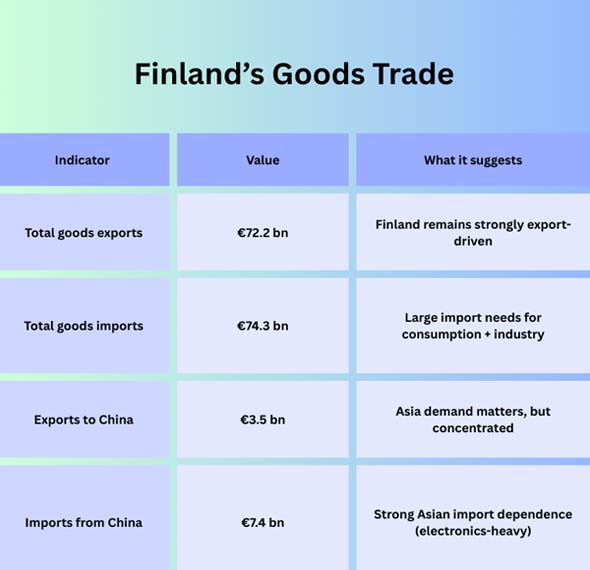
In 2025, Finland’s goods exports were about €72.2 billion and imports about €74.3 billion, reflecting a large trade footprint relative to the size of the domestic economy. As per Finland Import Export Trade Data by Import Globals, at the same time, the geography of that trade shows a clear pattern: Finland is deeply European in structure but increasingly global in exposure—particularly toward Asia’s manufacturing and electronics backbone.
The 2025 Snapshot: EU Core, Asia Strategic
A straightforward way to understand Finland’s trade structure is to separate it into “integration trade” (EU) and “strategic global trade” (Asia).
EU trade is where Finland’s Supply Chains Run Most Smoothly: lower barriers, aligned regulations, short logistics routes, and dense business networks. As per Finland Import Custom Data by Import Globals, Asia trade tends to be more specialized: critical import categories (electronics and manufactured goods) and targeted export flows (industrial goods, pulp and paper inputs, and selected machinery).
How Central Is the EU for Finland?
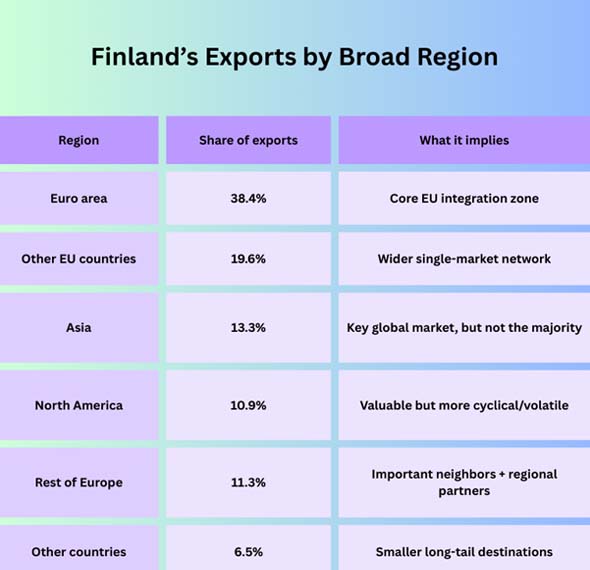
The EU is Finland’s anchor market—not just because it’s close, but because it is structurally “plugged into” Finland’s industrial model. In 2025, the EU share of Finland’s goods exports was about 58%, and the EU share of imports was about 58.4% (based on preliminary official data). As per Finland Import Trade Analysis by Import Globals, this tells you two things:
- Finland sells a majority of its goods inside the EU.
- Finland’s industrial system also sources a majority of inputs and goods from the EU.
That second point is often overlooked: Finland’s EU relationship is as much about importing intermediate inputs and capital goods as it is about exporting.
Finland’s EU Trade: A Supply-Chain Relationship, Not Just a Sales Channel
As per Finland Exporter Data by Import Globals, Finland’s strongest EU trade relationships often look like this:
Finland exports industrial outputs (chemicals, metals, forest industry products, machinery-related goods). Finland imports capital goods, industrial inputs, and consumer goods, enabling production and domestic demand.
In practical terms, many Finnish exporters are simultaneously EU importers. As per Finland Importer Data by Import Globals, a machinery exporter, for example, may import components and equipment from Germany or Sweden, assemble or process in Finland, and export finished goods back into the EU market.
This mutual dependence helps explain why Finland’s EU relationship is resilient even during weaker global cycles: it is rooted in production networks, not only final consumer demand.
Asia’s Role: Smaller Share, Higher Strategic Sensitivity
Asia’s share of Finland’s exports is smaller than the EU’s, but it is strategically important. As per Finland Import Trade Statistics by Import Globals, in Finland’s 2025 export distribution by broad regions, Asia accounted for 13.3% of exports. That makes Asia a meaningful export destination—yet still far behind the combined EU categories.
The strategic sensitivity shows up more strongly on the import side—especially through China—because Asian manufacturing ecosystems supply goods that are hard to replace quickly or cheaply.
- The EU Partner Picture: Sweden and Germany as Industrial Gateways
- Finland’s closest EU partners are also its most “industrial.” Two partners stand out: Sweden and Germany—both as markets and supply chain counterparts.
As per Finland Import Data by Import Globals, Finland sent roughly €8.1 billion worth of goods to Sweden and about €8.1 billion worth of goods to Germany in 2025. Finland spent about €8.6 billion on products from Sweden and €10.4 billion on things from Germany. This shows that Germany is more important when it comes to locating industrial items, machinery, and equipment. The Asia Partner Picture: China Dominates the Headline
Finland’s Asia trade discussion inevitably revolves around China because it is both a major supplier and a significant customer.
- Exports to China in 2025: €3.5 billion
- Imports from China in 2025: €7.4 billion
As per Finland Import Shipment Data by Import Globals, European economies often have this kind of imbalance. Because China is a global manufacturing powerhouse, many countries import a lot of completed goods and electronics, but exports are usually limited to certain types of items.
What Finland Sells to China: Industrial + Resource-Based Strength
Finland’s exports to China have a distinct profile compared to its EU exports. The structure is shaped by Finland’s core strengths: forest industry outputs and industrial machinery.
As per Finland Import Export Trade Analysis by Import Globals, a notable 2025 feature is the strong role of pulp and waste paper and industrial machinery in exports to China.
The Big Trend: EU Stability + Asia Exposure
Finland’s trade relations with the EU and Asia are not competing narratives; they’re complementary.
- The EU provides the stable operating environment: large markets, nearby suppliers, predictable standards, and integrated industrial networks.
- Asia provides scale manufacturing, electronics supply, and a major industrial customer base—alongside more geopolitical and supply-chain uncertainty.
- As per Finland Export Import Global Trade Data by Import Globals, going forward, Finland’s trade strategy usually comes down to balancing three goals:
- Deepen EU value-chain advantages (especially in advanced manufacturing and clean technologies).
- Diversify Asian exposure (more partners, more categories, less single-supplier risk).
Move up the value chain in exports to Asia (more machinery and specialized tech, not only resource-linked goods).
Conclusion
Finland’s trade relations reflect a modern, integrated European economy with global dependencies. The EU remains Finland’s core trading ecosystem by both exports and imports, reinforcing stable industrial supply chains and nearby market access. The future will likely be shaped by how Finland strengthens EU-based competitiveness while managing Asia-linked supply risks and expanding higher-value export categories across Asian markets. Import Globals is a leading data provider of Finland Import Export Trade Data.
FAQs
Que. Is the EU the region that Finland does the most business with?
Ans. Yes. In 2025, the EU was responsible for almost 58% of Finland's goods exports and 58.4% of its imports.
Que. Why is China so important in Finland’s Asia trade?
Ans. China is a major destination for Finland’s industrial exports and a very large source of imports, especially electronics and equipment.
Que. What does Finland export to Asia compared to the EU?
Ans. Asia gets most of its exports from the industrial and forest-related sectors, such as pulp and machinery. The EU, on the other hand, exports a wider range of goods that are tightly interwoven into the supply chain.
Que. What is the most dangerous thing about trade between Finland and Asia?
Ans. Too much concentration in important import categories, especially electronics and equipment, and a greater risk of global supply chain or geopolitical shocks.
Que. Where to get detailed Finland Import Export Global Data?
Ans. Visit www.importglobals.com.