
France’s Energy Import Landscape: Oil, Gas, and Renewables at a Glance
- Oct 19, 2026
- 69 Views
France’s Energy Import Landscape: Oil, Gas, and Renewables at a Glance
The French energy imports has been one of the main reason driving the import growth rate and the import revenue. The country spent US$50.8 billion on net energy imports, which was a drop of 21% from the previous year, as per France Customs Data. The net energy imports of France also fell by 3.5%, while the domestic primary energy production increased by 2%. In this way, the energy self-sufficiency of the country reached 62.7%, which was the highest level since 1970.
The crude oil imports were approximately 46.9 million tonnes of oil equivalent, which was an increase of 3% compared to the previous year’s figure. The largest supplier of crude oil was the United States, which accounted for around 22% of the entire volume of crude oil imports. Norway was the major supplier of natural gas with a 36% share in the country's gas imports. Natural gas import volumes increased by 8% to 518 terawatt-hours (TWh), of which 64% was represented by liquefied natural gas (LNG).
Energy Import Summary: The Latest Insights
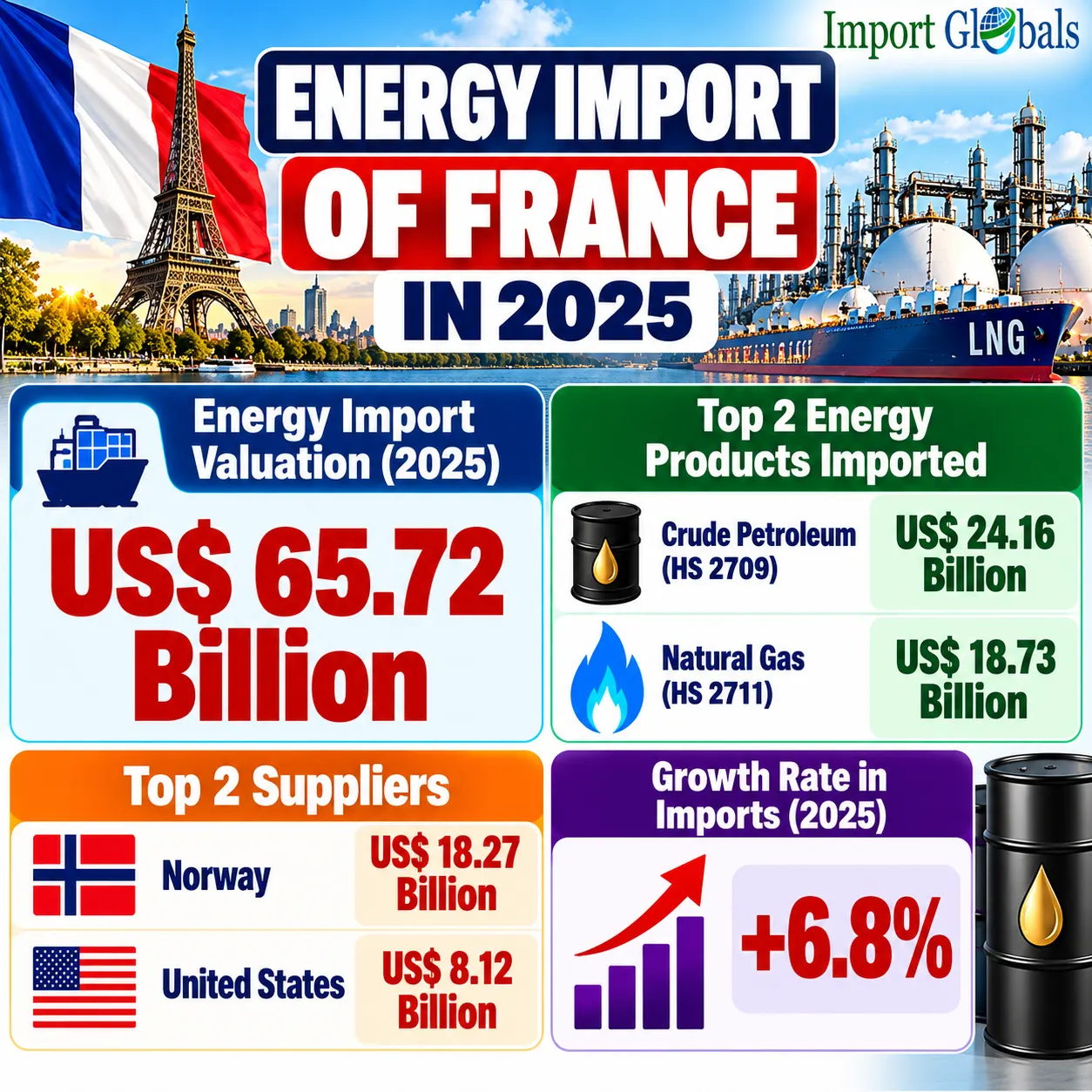
The energy imports scenario of France in 2025 indicates France's heavy reliance on global suppliers to meet its demands for oil and natural gas. The total value of France's energy imports was US$65.72 billion; and the rate of growth in energy imports was 6.8% in 2025, reported France Import Data. Among the imports, crude oil and natural gas were the top two import products in the year 2025. The crude oil belonging to the HS Code 2709 accounted for almost US$24.16 billion worth of products, showing its great contribution to the French oil refining industry, transport sector, and industrial activities.
The import of natural gas, having HS Code 2711, marked another major import with a value of US$18.73 billion; indicating the significance of natural gas in heating, industrial consumption, and energy consumption. Among the exporters, Norway is the top country depicted in the infographic, with a contribution of US$18.27 billion in energy imports. The other exporter is the USA, which is in second position with a contribution of energy imports of USD 8.12 billion, showing the importance of transatlantic energy trade.
Top Energy Import Variants of France in 2025
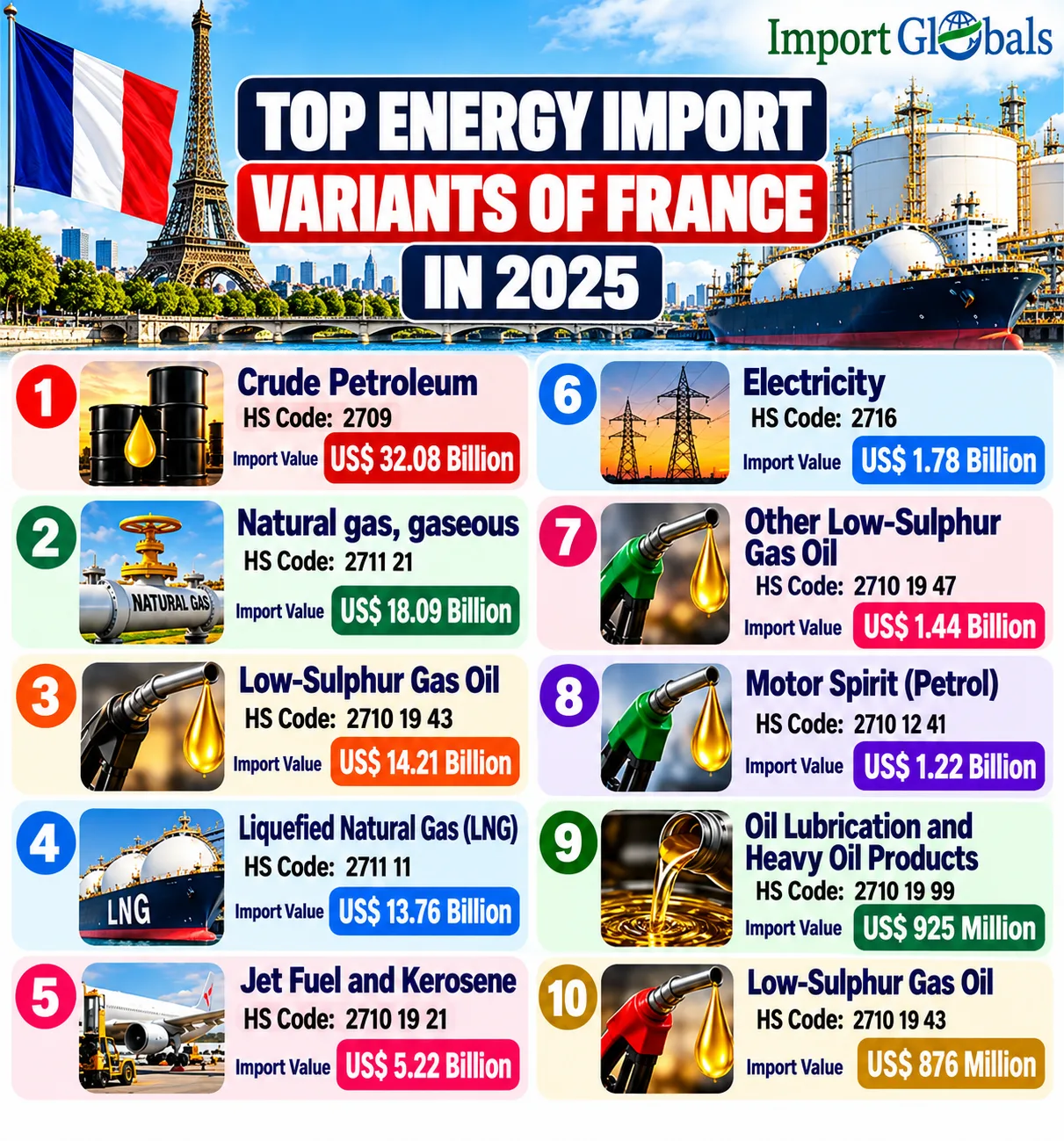
- Crude Petroleum: $32.08 Billion
Crude petroleum is imported by France for refining purposes. The leading suppliers of crude oil to France are the United States, Algeria, Kazakhstan, and Nigeria.
- Natural Gas, Gaseous: $18.09 Billion
- Natural gas that is transported through pipelines is an essential energy source for residential heating and power generation in France; amongst many other purposes. Norway is one of the leading suppliers of natural gas to France, says France Export Data.
- Low-Sulphur Gas Oil — $14.21 Billion
Low-sulphur gas oil is a refined petroleum product that finds application in the diesel market, the transportation sector, and the industrial sector. France’s environmental standards and fuel requirements are met by the low-sulphur gas oil.
- Liquefied Natural Gas (LNG) — $13.76 Billion
HS Code: 2711
LNG is natural gas cooled into its liquid form. France has established terminals for LNG imports, enabling France to procure its gas from other countries apart from the gas delivered through pipelines.
- Jet Fuel and Kerosene — US$5.22 Billion
HS Code: 2710
Kerosene type jet fuel is used in commercial aviation, airport operations, and air freight operations. Imports reduce the problem of matching aviation fuel demand and domestic refinery production. Consistent supplies are necessary for the operation of France’s international aviation and logistics systems, says France Trade Statistics.
- Electricity — US$1.78 Billion
Electricity imports contribute towards balancing electricity demand and supply. France directly participates in the European electricity market and exports electricity, so gross electricity imports must be distinguished from the overall net electricity trade position of the country.
- Other Low-Sulphur Gas Oil — US$1.44 Billion
HS Code: 2710 19 47
This classification contains certain refined oil products with distinct sulphur content and characteristics. Imports cater to the fuel market and industrial uses.
- Motor Spirit (Petrol) — US$1.22 Billion
HS Code: 2710 12 41
This classification represents a specific type of unleaded motor spirit with a research octane number below 95. Imports help to fuel automobile traffic and make up for the deficit between domestic refinery production and total customer demand in the French market.
- Oil Lubrication and Heavy Oil Products — US$925 Million
HS Code: 2710 19 99
Petroleum oils and products help in the operation of machinery, production processes, car maintenance, and keep industrial machines in working order. Oil use has various applications due to the component content, viscosity, and specified technical characteristics. Imports will enable French companies to accomplish transportation, engineering, and manufacturing operations due to oil availability on the French market.
- Low-Sulphur Gas Oil — US$876 Million
HS Code: 2710 19 43
This item could be classified as a unique commodity in the previous report’s customs classification. Since it falls under the same HS code as the previous item, it should be investigated based on the underlying data to see if it constitutes a separate item or overlaps with the previous entry.
Top Import Partners of France for Energy Trade in 2025
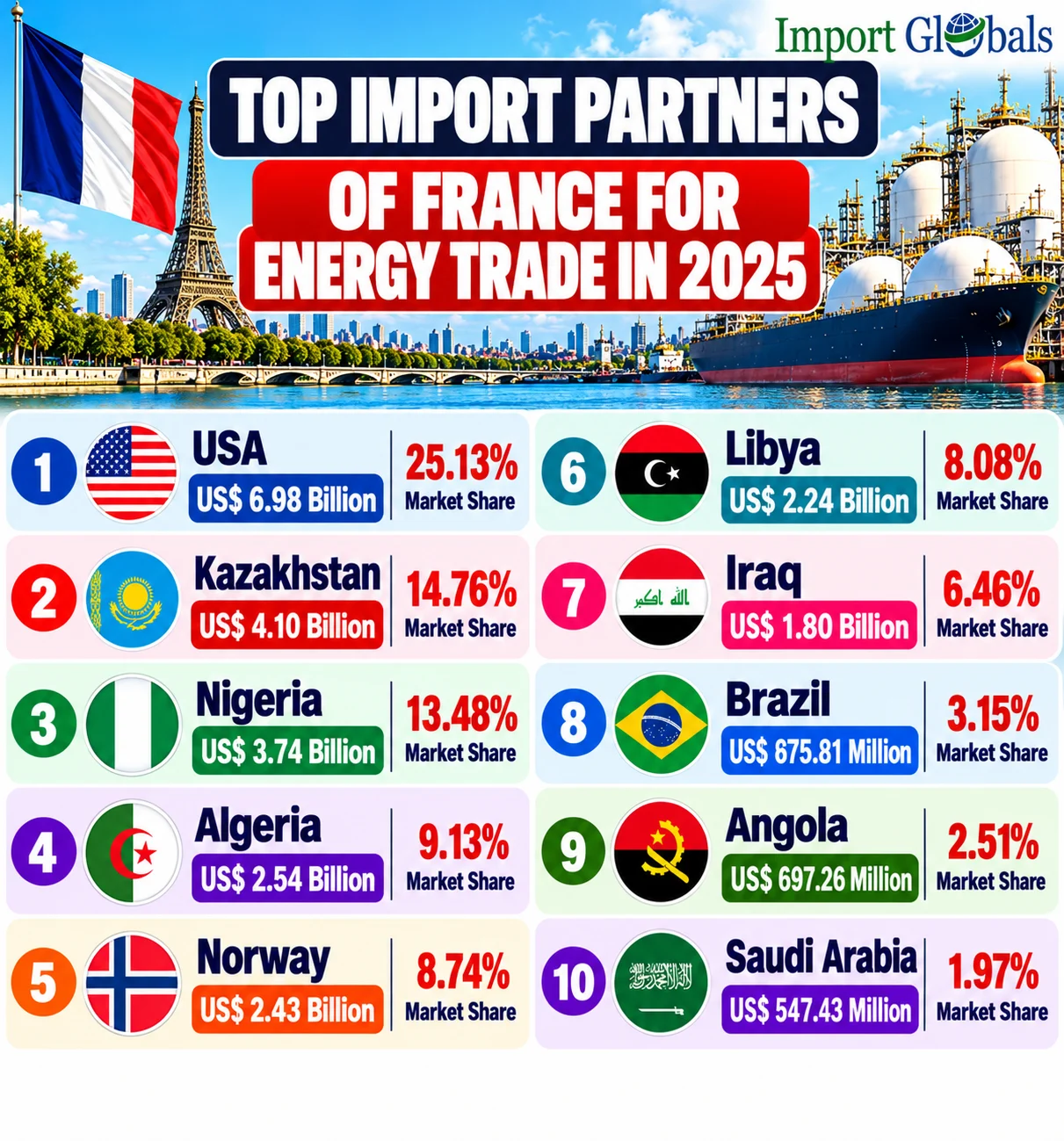
- USA - US$6.98 Billion | 25.13% Market Share
The USA is France’s top crude oil provider according to the examined data. The USA’s extensive capacity to produce oil, advanced technology for oil export, and viable maritime routes are some factors that simplify oil supply operations to the French refineries and create a more diversified way of energy supply for France.
- Kazakhstan - US$4.10 Billion | 14.76% Market Share
Kazakhstan is one of the largest crude oil producers, due to its oil export capacity. The service from Kazakhstan helps to ensure less reliance on any geographical source of supply and reinforces France’s access to oil trading market.
- Nigeria - US$3.74 Billion | 13.48% Market Share
Nigeria is an oil-producing country with a highly developed oil-exporting operation and has become a strong economic partner of France in West Africa. It is therefore one of the important sources of oil supply for France’s strategies related to oil procurement says France Export Trade Data.
- Algeria - US$2.54 Billion | 9.13% Market Share
The geographical proximity of Algeria to Europe, as well as its historical cooperation in the energy sector with France, makes it one of the main oil suppliers of this country.
- Norway—US $2.43 billion | 8.74% Market Share
Norway is a significant energy supplier in Europe, supplying important gas supplies to France. The production in the North Sea and the existing pipeline infrastructure make Norway an outstanding partner in the trade of gas and petroleum.
- Libya—US $2.24 billion | 8.08% Market Share
Libya plays an important role in the production of crude oil as part of France's diversified supply chain. Libya is located on the Mediterranean Sea, which makes its oil supplies closer to Europe, although the current internal situation in the country and fluctuations in production can affect the stability of supplies.
- Iraq—US $1.80 billion | 6.46% Market Share
Iraq is a significant oil-producing country with existing infrastructure for the export of crude oil to other countries, says France Customs Shipment Data. The oil supplies of Iraq, in turn, allow France to diversify its oil supplies.
- Brazil—US $875.81 million | 3.15% Market Share
Oil production in Brazil significantly contributes to the establishment of the oil market and its cooperation with France. The bilateral integrity has been continuously progressing because of the production ability of Brazilian authorities.
- Angola - US $ 697.26 million | 2.51% Market Share
Angola is a well-known African exporter of crude oil with large offshore production. The country’s international shipping connections make it possible for Angola to contribute to France’s crude oil supply mix together with other producers of crude oil from the region of Sub-Saharan Africa.
- Saudi Arabia - US $ 547.43 million | 1.97% Market Share
Saudi Arabia is one of the leading oil producers on the global market with a well-unified export infrastructure. Crude oil supplies from Saudi Arabia provide France with additional opportunity from the Middle East, and in addition, the company has other oil-related businesses connected to the trade of refined petroleum products worldwide.
Companies Thriving the Energy Imports of France
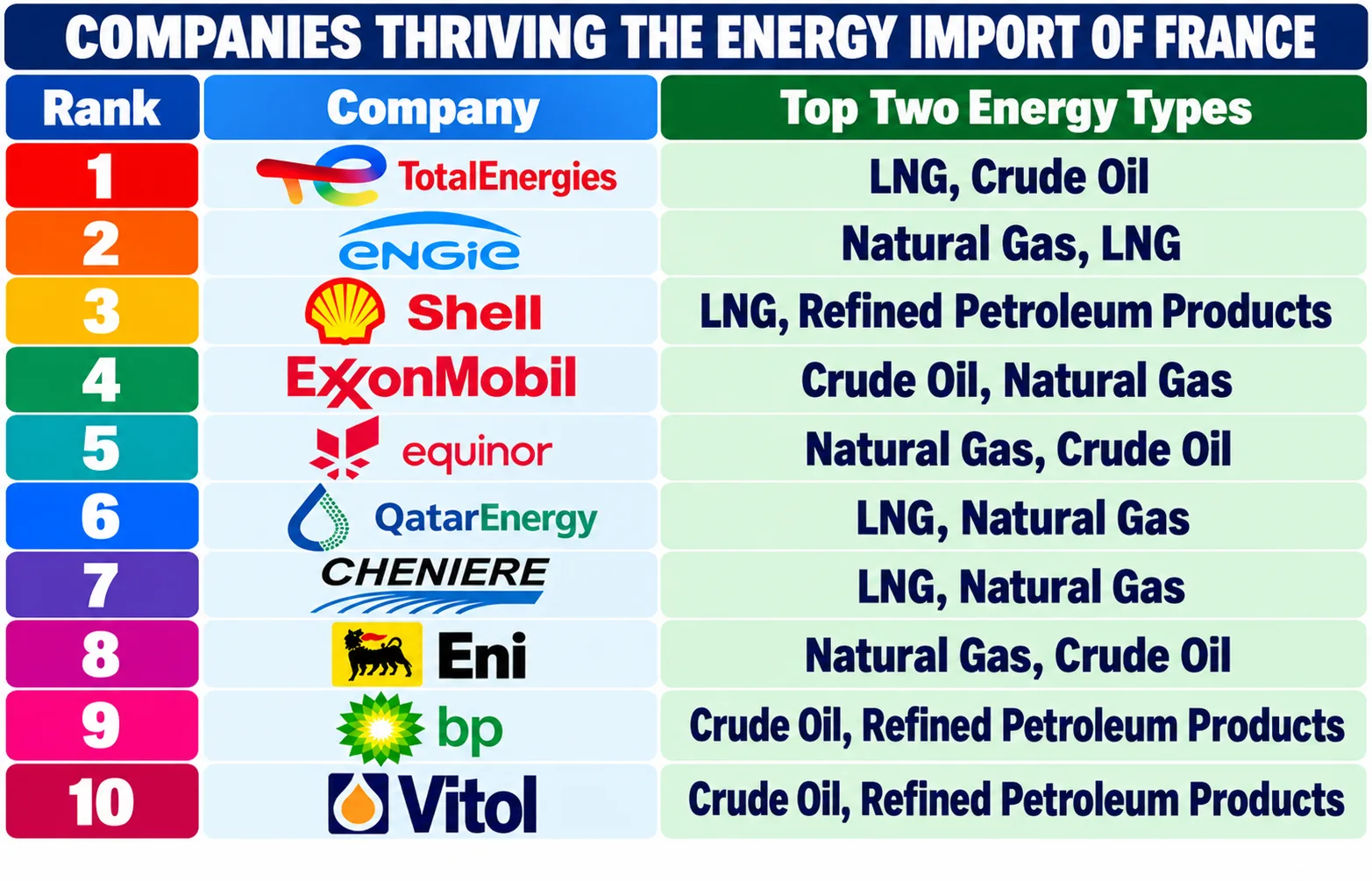
Total Energies
Top Two Energy Types - LNG, Crude Oil
Total Energies is engaged in oil and gas extraction, LNG trade, and the production of energy. It boasts an international LNG portfolio and regasification capacity in Europe, which enables TotalEnergies to connect the global gas producers with the French and European markets.
ENGIE
Top Two Energy Types: Natural Gas, LNG
ENGIE performs a vital role in gas supply and infrastructure. Its daughter company, Elengy, operates the LNG terminals in France, where imported LNG reaches the terminals and is stored and regasified before entering the national gas network.
Shell
Top Two Energy Types: Lng, Refined Petroleum Products
Shell is in business in the global LNG market and has an oil production, refining, and distribution business. The company boasts an international network that provides energy producers with access to EU markets, the change in 2025 valuation for imports into France of Shell and LNG is to be verified separately.
ExxonMobil
Top Two Energy Types: Crude Oil, Natural Gas
France Import Statistics says that ExxonMobil is a prominent producer in the global crude oil and natural gas markets. ExxonMobil's upstream production and global marketing business holds a solidifying contribution in the economy making it a top destination holder.
Equinor
Top Two Energy Types: Natural Gas and Crude Oil
Equinor is a major Norwegian energy producer. In 2025, Norway provided around 36% of France’s imports of natural gas, which confirms the importance of Norwegian production and the pipelines connecting Norway to the French gas market.
Qatar Energy
Top two energy types: LNG and Natural Gas
Qatar Energy is a big LNG player with signed contracts abroad. Its portfolio of exports is important for the world’s LNG market and supplies an additional source of natural gas to European customers, although it is hard to confirm direct deliveries and prices for France.
Cheniere Energy
Top Two Energy Types: LNG and Natural Gas
Cheniere has large LNG export plants in the USA and sells LNG abroad. In 2025, LNG supplied by the USA played an important role in France's natural gas imports, thus promoting the diversification of gas supplies beyond pipelines.
Eni
Top Two Energy Types: Natural Gas and Crude Oil
Eni is involved in the trading, production, and supply of oil and gas. Eni’s activities in the international markets have been proven effective for the solid resourcing of energy essentials from foreign authorities in the nation.
BP
Top Two Energy Types — Crude Oil and Refined Petroleum Products
The two energy products being discussed are Crude Petroleum and Refined Petroleum Products. BP is involved in the entire process from the extraction of crude oil to refining and trading, as well as marketing this fuel. BP sells crude oil and refined petroleum products in foreign markets, notably Europe.
Vitol
Top Two Energy Types - Crude Oil and Refined Petroleum Products
The two energy products being discussed are Crude Petroleum and Refined Petroleum Products. Vitol is a well-known independent trader that operates in crude oil and refined petroleum markets. It conducts the entire process, from crude oil procurement to shipping and trading, making all oil deliveries in various international markets, notably Europe.
France Energy Import Statistics of the Past 10 Years
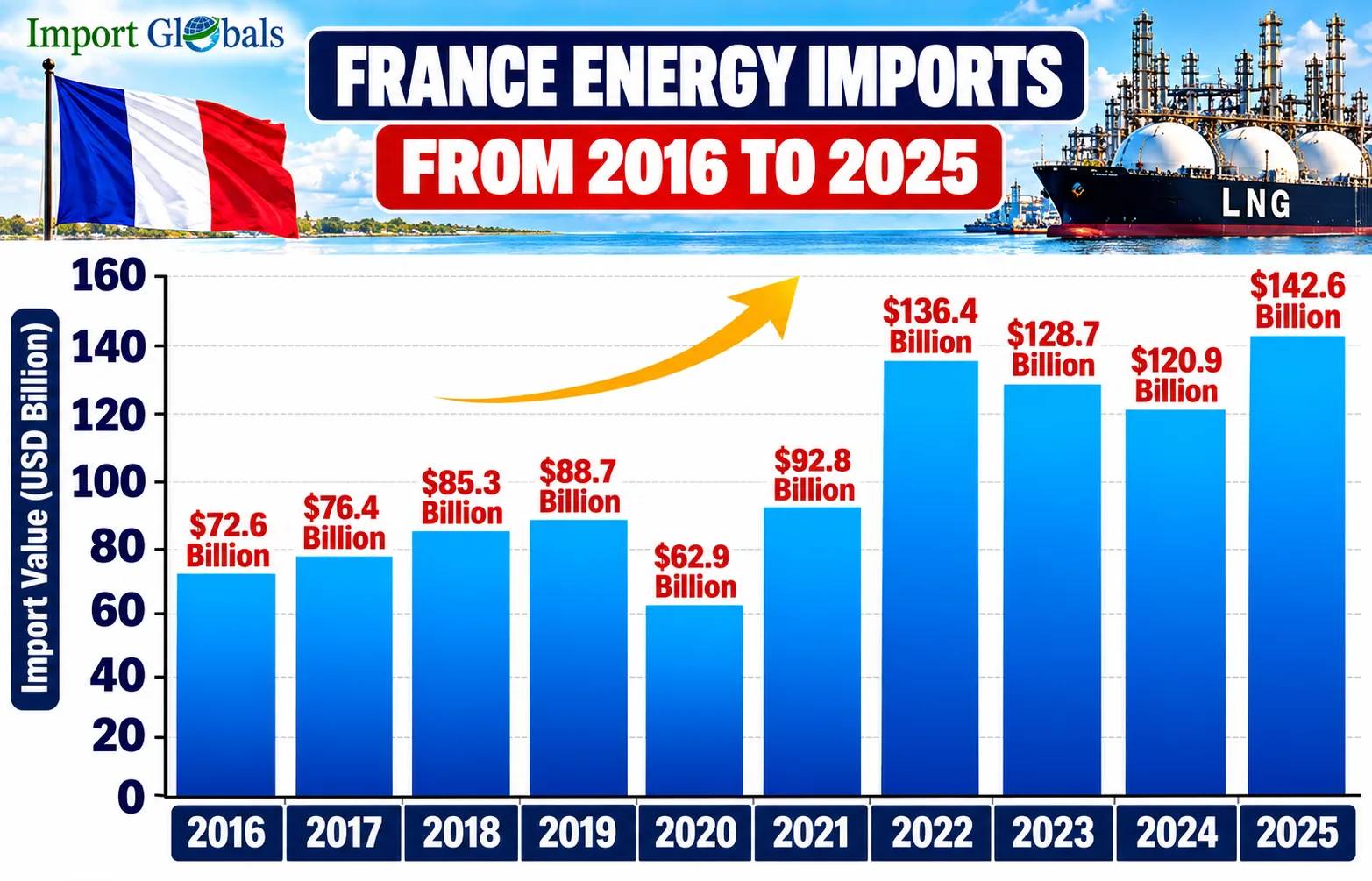
Between 2016 and 2025, France’s energy imports saw many changes due to fluctuating international energy prices and other factors. The information in the infographic shows that the valuation of the nation’s energy imports was US$72.6 billion in 2016, followed by an increase to US$76.4 billion in 2017 and to US$85.3 billion in 2018. The growth was sustained in 2019 when the total imports reached US$88.7 billion, reported France Customs Trade Data. Unfortunately, in 2020, there was a sharp decline in expenses, with a significant drop to US$62.9 billion due to a lack of global demand caused by the pandemic.
The import of energy rose again in 2021 and the valuation reached US$92.8 billion and in 2022 increased sharply to US$136.4 billion connected with the increase in oil prices and volatility in international markets.Then, in 2023, imports dropped to US$128.7 billion and decreased to US$120.9 billion in 2024. Nevertheless, these imports continued to grow again in 2025 with the record-high expenditure of US$142.6 billion.
Bilateral Relationship Overview; The Top Foreign Import Partner
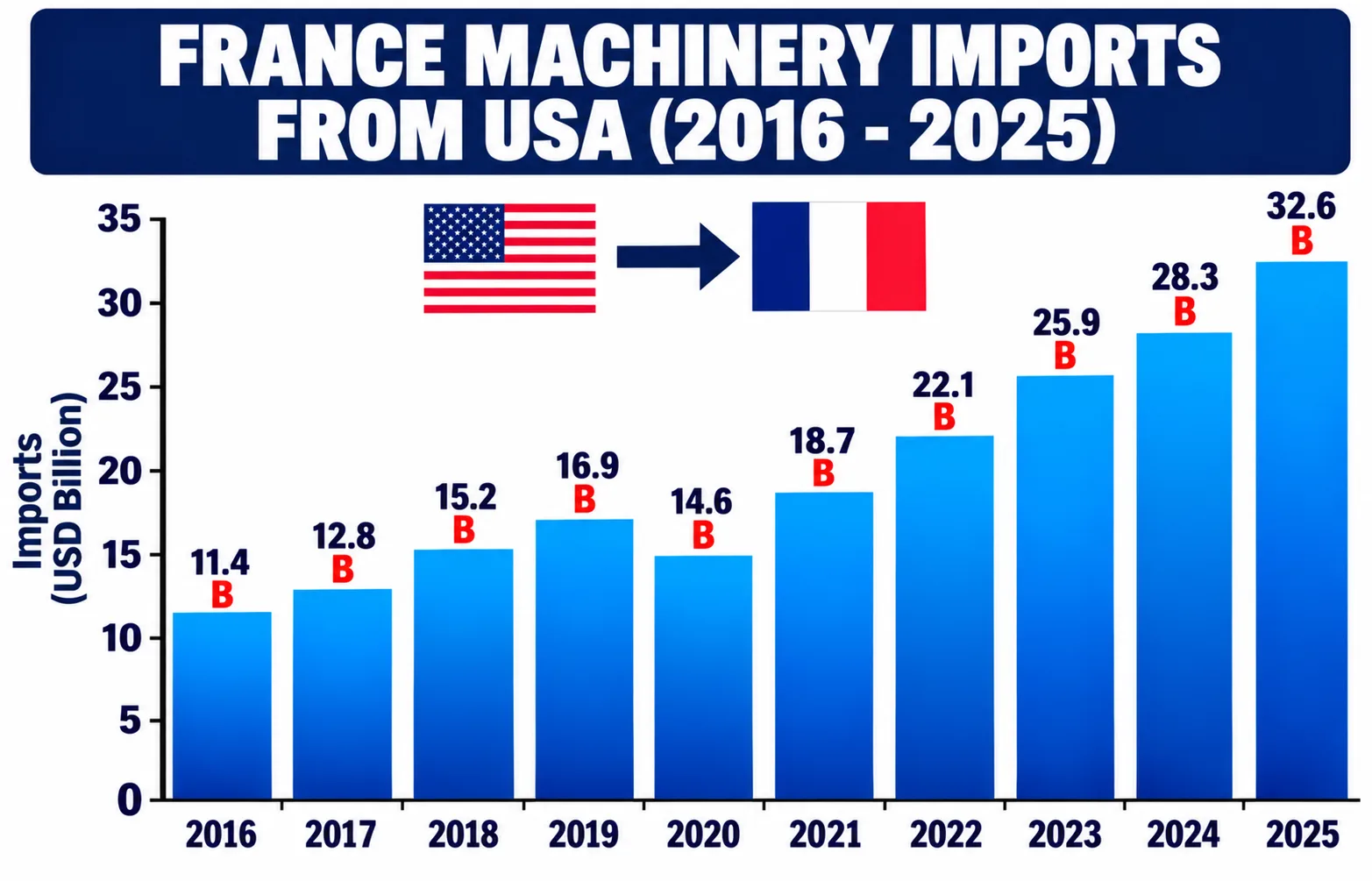
The United States is now a significant trade partner of France, with the growing statistics presenting an increase in machinery imports from the U.S. from 2016 until 2025. The infographic provided indicates machinery imports to France from the United States amounted to US$11.4 billion in 2016, rising to US$12.8 billion in the following year and increasing further to US$15.2 billion in 2018. Machinery imports showed a steady increase to US$16.9 billion in 2019; it dropped to US$14.6 billion in 2020 due to the global economic situation.
The market improved again in 2021 and reached US$18.7 billion, growing further to US$22.1 billion by 2022, as per France Import Export Data. The U.S.A. manufactures high-tech machinery and provides machinery with specific machinery capabilities. Effective logistic channels between the US and France are in place to facilitate trading operations.
Factors Promoting the Energy Import of France
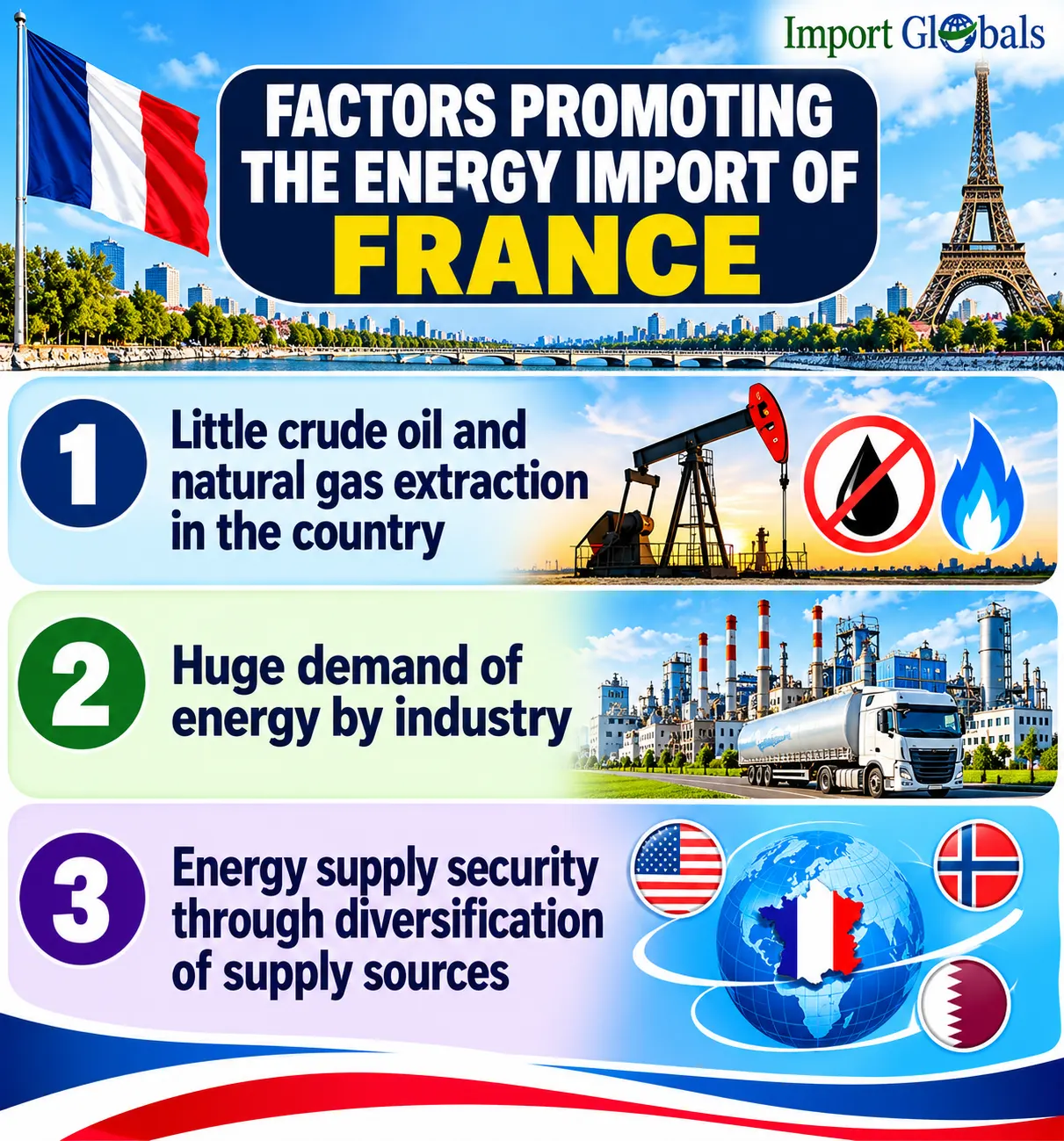
- Little Crude Oil and Natural Gas Extraction in the Country
The amount of crude oil and natural gas that France can produce locally is very little. Thus, the various industries (including transport) and households get their energy supplies from foreign producers. For instance, France gets imported crude oil and gas from such countries as Norway and the USA.
- Huge Demand for Energy by Industry
France has high energy requirements for all of its industries and transportation systems. Refineries ought to purchase crude oil from abroad to process oil products. So, France is obliged to buy more energy abroad, reported France Trade Data.
- Energy Supply Security through Diversification of Supply Sources
By importing energy from different countries, France aims at decreasing its dependency on one supplier and ensuring more secure energy supply. Thus, Norway has huge supplies of natural gas to France while USA ships crude oil and liquefied natural gas.
Future Trade Outlook of the France Energy Imports
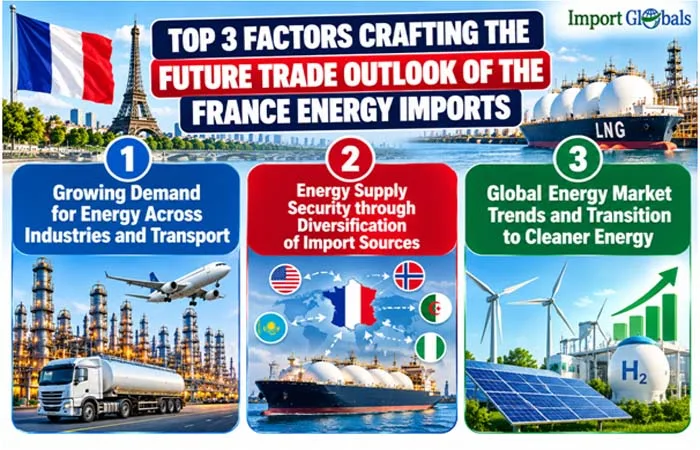
The future of France’s energy imports depends on global prices of oil and gas, the country’s own supply of energy, and clean energy endeavours. In the next few years, crude oil and natural gas will remain key imported commodities due to continual demand for reliable energy sources in transport, production, and industries. The major partners in this business will be the USA and Norway, especially in regards to crude oil and natural gas consumption.
Nevertheless, the growing generation of renewable energy, the expansion of nuclear power sources, and energy efficiency efforts will gradually reduce the country’s reliance on imports of fossil fuels reported France Trade Statistics. Moreover, the presence of LNG will continue to contribute to greater flexibility in the gas supply sourcing. Yet, geopolitical instability, problems with shipping, fluctuations of the currency, and pricing instability may influence the future expenditure on imports. Overall, the energy trade will keep balancing between the need for supply security, its affordability, and its environmental implications.
Conclusion
In 2025, France’s energy import landscape emphasizes the fact that the country remains dependent on foreign suppliers for crude oil, natural gas, LNG, and refined oil products. The illustration in this paper demonstrates that the main players in the energy supply of France are the USA, Norway, Kazakhstan, Nigeria and Algeria. The role of the crude and natural gas continues to be considerable in transportation, manufacturing, heating and other economic activities of France.
The last ten years that have passed have shown that the value of imports of energy sources fluctuated strongly due to volatility of prices across the globe, disruptions in supply, and changing situation on the world market. However, the production of energy within France, the power of nuclear plants and the generation of renewable electricity play also a significant role in the future energy policy of the country. The diversity of suppliers and the increase of energy sources of smoothening out the moment of rise in energy prices will allow to strengthen energy independence and to cut down oil price fluctuations.
CTA
Trying to have the latest information regarding the France energy shipments of 2025? You have landed up at the right platform here. Import Globals helps businesses craft detailed market entry strategies with accurate information regarding France energy shipments of 2025. Subscribe to www.importglobals.com or drop an email at info@importglobals.com for detailed information regarding the France energy shipments to understand your international business growth.
FAQ’s
Que. What is the energy import valuation of France in 2025?
Ans. The energy import valuation of France in 2025 is 65.72 billion U.S. dollars, with a growth rate of 6.8%.
Que. What are the two leading energy products imported by France in 2025?
Ans. Crude petroleum and natural gas are the two leading energy products imported by France in 2025.
Que. What is the HS code encompassing crude petroleum?
Ans. Crude petroleum encompassing HS code is 2709.
Que. Name the country that is the top import partner of France Energy Essentials.
Ans. United States is the top import partner of France Energy Essentials.
Que. Why France has been currently importing energy from multiple countries?
Ans. The effort towards diversifying the energy sources has improved the supply security, due to which France is importing energy from multiple countries.
Que. What is the top factor influencing the France energy imports?
Ans. Little crude oil and natural gas extraction in the country Is the top factor influencing the France energy imports.
Que. How does France’s import-export data support business growth?
Ans. France’s import-export data supports business growth
via proper identification of buyers, suppliers, analysis of market demand, and development of effective market expansion strategies.
Que. What information is available in France trade data?
Ans. France trade data covers importer name, exporter name, shipment date, HS code, product details, quantity, pricing information, origin country, importing country, and port details.
Que. How frequently is the France trade data updated?
Ans. France trade data is updated on a monthly basis.
Que. Where can you obtain detailed information on France trade data?
Ans. Visit www.importglobals.com or drop an email at info@importglobals.com for detailed updates on France trade data.
You Can Also Visit :-
