France and Germany's Efforts to Develop New EU Trade Defense Mechanisms: Interpretations of the 2026 Proposal for Europe and China
- Oct 15, 2026
- 145 Views
France and Germany's Efforts to Develop New EU Trade Defense Mechanisms: Interpretations of the 2026 Proposal for Europe and China
European leaders have described the EU as an open economy that operates according to the norms. However, on 5 October 2026, the heads of the two largest EU countries announced that this position is insufficient. France and Germany have called for a brand new trade defense instrument allowing Brussels to introduce countermeasures against countries that violate the EU's interests.
The timing of the proposal is not accidental. On 5 October, Emmanuel Macron and Friedrich Merz wrote a letter to European Commission President Ursula von der Leyden, only ten days before the discussion of Chinese trade distortions with EU representatives in Brussels. The letter, therefore, falls into a context of complicated relations between China and the EU and allows us to determine the level of urgency and hope that Europe can convert the past complaints into something practical, as per France Customs Data.
Which Industries Do the France and Germany EU Trade Defense Mechanisms Affect?
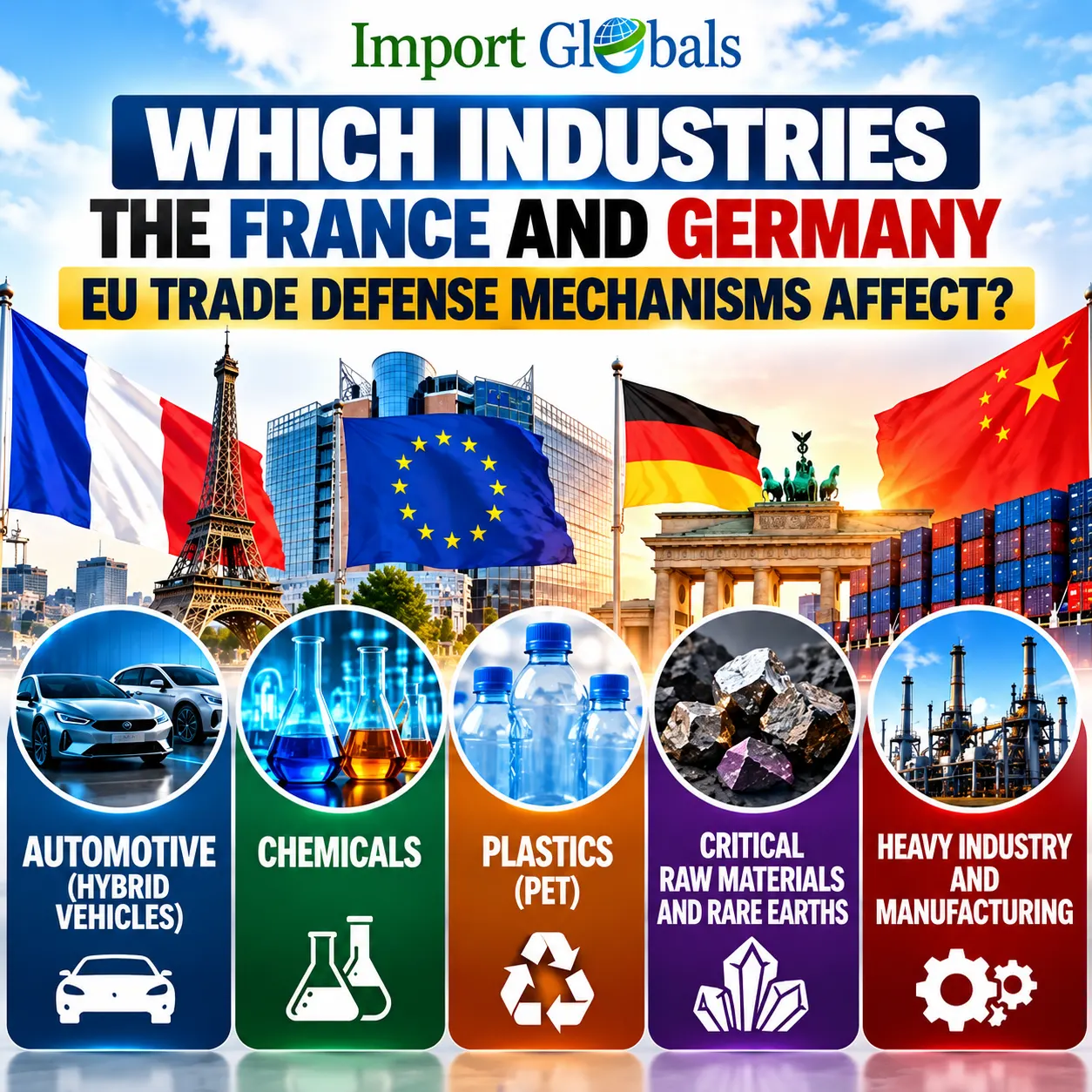
- Automotive (Hybrid Vehicles): The document mentions hybrid automobiles as a matter that requires prompt action. There was also a discussion on hybrid imports during the meetings in Beijing. European automakers benefit from protection, but may still be subject to China's retaliation.
- Chemicals: The report mentions the issue of chemicals as an urgent issue. The energy-intensive European producers are not able to cope with cheaper imports; therefore, chemicals will be one of the first to be targeted for anti-dumping measures.
- Plastics (PET): The report mentions the use of PET as urgent. Imposing tariffs here will increase the prices for packaging and beverage producers, but it can also protect European plastics producers, reported France Shipment Data.
- Critical Raw Materials and Rare Earths: The talks are dealing with Chinese restrictions on rare earths and other critical materials. The report's tool for diversification aims at avoiding dependency, thus supporting the policies of mining, processing, and magnet production.
- Heavy Industry and Manufacturing (My Inference): The report calls for a comprehensive approach covering entire industries and names industries endangered by Europe’s industry. Iron, machinery and similar industries might be included in this, although they are not mentioned in the report.
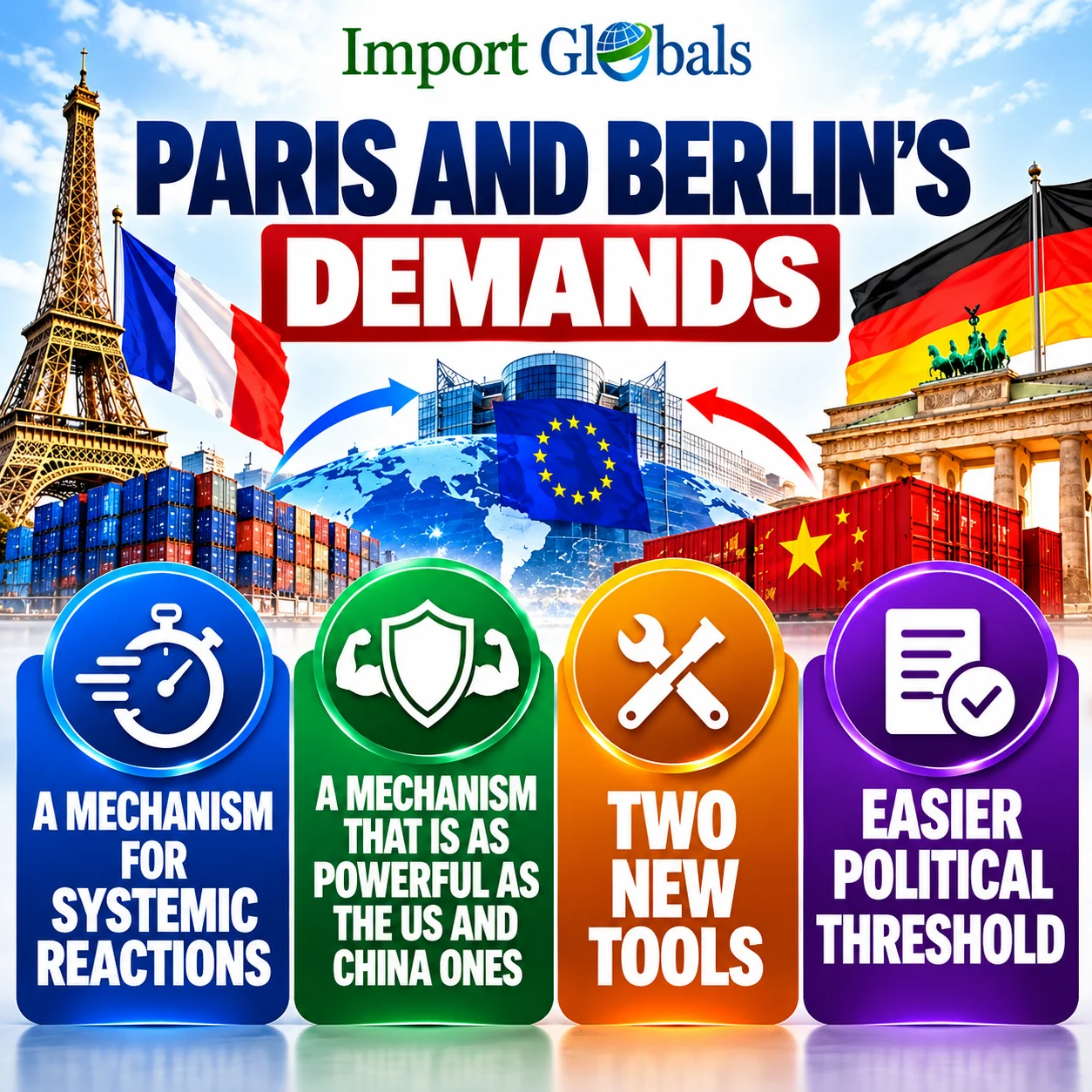
Paris and Berlin's Demands
The primary demand is for a new "quick-acting" mechanism. The France-German paper cautions that ongoing and serious market distortions put the Eurozone economy, specifically its industrial segment, in jeopardy, which leads to a number of jobs being lost.
The Proposed Reply Consists of Several Parts.
- A Mechanism for Systemic Reactions - Paris and Berlin would like a new "systemic reaction mechanism," which would allow Brussels to react against market distortions induced by China, along with the ability to plan retaliatory acts and revise existing trade defense mechanisms. The main feature of this mechanism is the speed of its activation. According to the document provided by the Germany Customs Data, the measures should be promptly activated, while German officials indicated that it could mean a time frame of days.
- A Mechanism that is As Powerful as the US and China Ones - German officials assert that the EU needs a mechanism similar in power to the Section 301 tariffs in the USA or to China's restrictions on the export of crucial minerals. A source cited by France 24 confirms this statement. The USA and China are capable of retaliating at a rapid pace and with much greater force than the European Union.
- Two New Tools - France and Germany have called for the Commission to propose two new tools, which are to address issues of diversification of sources and economic security. The second is the more remarkable one. It will limit access to the single market for countries that resort to political or economic actions against conditions of fair competition. The paper does not indicate what events would trigger it or what decisions would be made by the EU.
- Easier Political Threshold - From the standpoint of the decision-making process, the proposal by the Commission on the use of countermeasures against countries can be approved unless a qualified majority of member states rejects it. France Export Data says, this contradicts the existing procedure, which requires the Commission to get a majority support for its decisions before they are implemented.
Top 10 Companies Exposed to the New EU Trade Defense Mechanisms
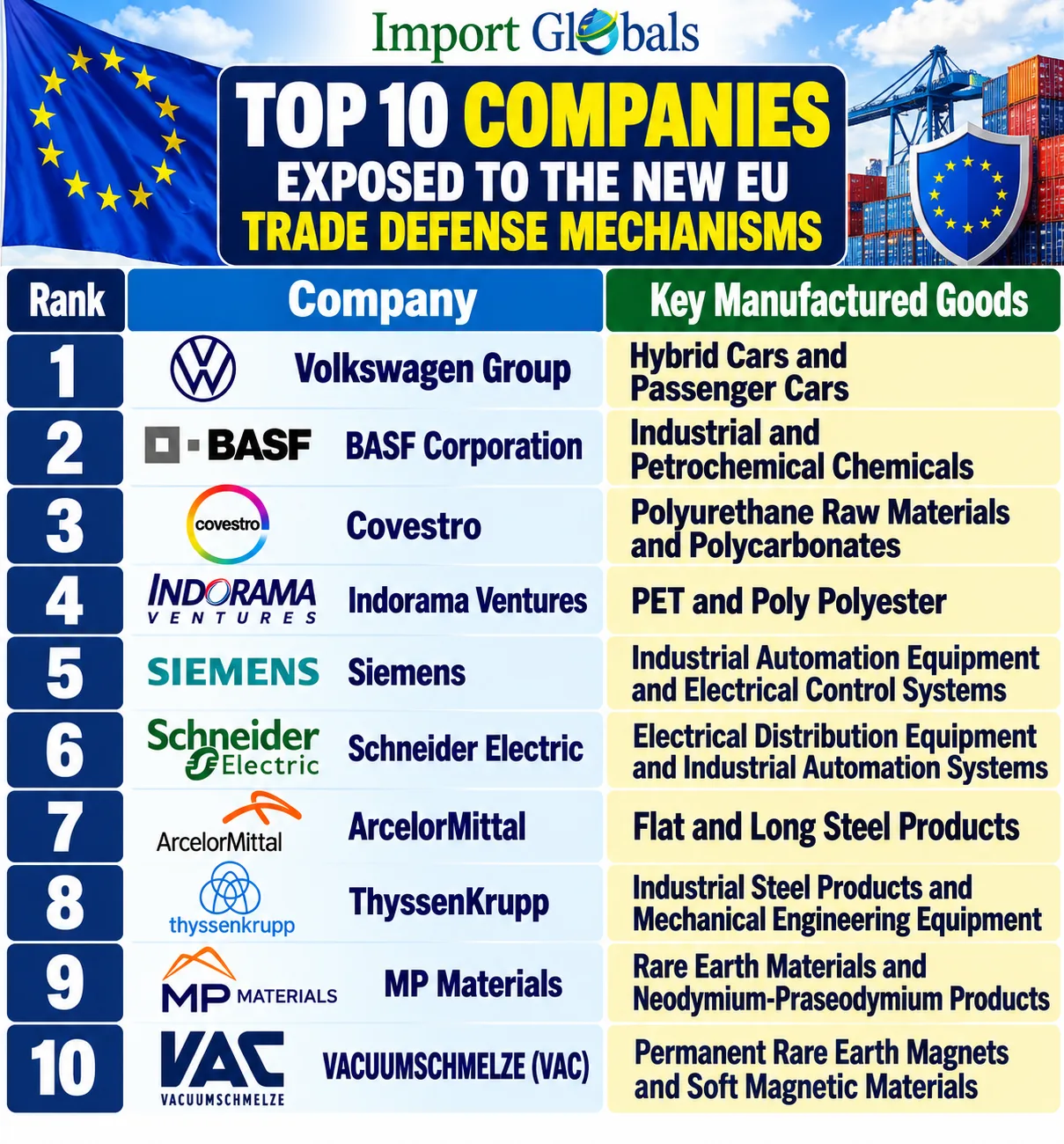
1. Volkswagen Group
Key Manufactured Goods: Hybrid Cars and Passenger Cars
Volkswagen Group is one of the leading automotive companies in Europe, as it produces vehicles and operates global supply chains.
2. BASF Corporation
Key Manufactured Goods: Industrial and Petrochemical Chemicals
BASF is a leading European chemical company supplying various materials that are essential for the manufacturing, agriculture, automotive, and consumer goods industries.
3. Covestro
Key Manufactured Goods: Polyurethane Raw Materials and Polycarbonates
Covestro produces advanced polymers used in various industries, including automotive, construction, electronics, and consumer goods.
4. Indorama Ventures
Key Manufactured Goods: PET and Poly Polyester
Indorama Ventures is a worldwide producer of petrochemicals and polyester-based materials. The PET resin and polyester products produced by this company contribute to the bilateral trade, reported France Trade Statistics.
5. Siemens
Key Manufactured Goods: Industrial Automation Equipment and Electrical Control Systems
Siemens provides automation, electrification, and digital industrial technologies. The products provided by Siemens contribute directly to the trade upgrade within both regions.
6. Schneider Electric
Key Manufactured Goods: Electrical Distribution Equipment and Industrial Automation Systems
Schneider Electric makes technologies for power management, electrical distribution, and automation. Its product lines make the company relevant to the global demand rates.
7. ArcelorMittal
Main Products: Flat and Long Steel Products
ArcelorMittal is a leading company in producing steel products for automotive and construction sectors. The source states that iron and steel are included in sectors that experience import pressure, meaning that producers of steel are important to the issue of safeguards and trade defense.
8. ThyssenKrupp
Major Products: Industrial Steel Products and Mechanical Engineering Equipment
Source of Steel Production and Industrial Engineering Supply. The company’s exposure is related to articles regarding steel import, machinery competition and industrial job creation. Changes in trade policy can affect sourcing costs, production competitiveness and market access.
9. MP Materials
Major Products: Rare Earth Materials and Neodymium-Praseodymium Products
MP Materials is a topRare Earth Materials Manufacturer, as per Germany Trade Statistics. Its products serve the article’s interest in Europe’s attempts to diversify critical-material supplies by reducing reliance on certain sources of rare earths.
10. VACUUMSCHMELZE (VAC)
Major Products: Permanent Rare Earth Magnets and Soft Magnetic Materials
It is one of the top manufacturer of Permanent Rare Earth Magnets and Soft Magnetic Materials. The growing global demand rates has made the survival rate of the specific product continuous in the production.
Why Are EU Trade Defense Mechanisms Launched From France and Germany?
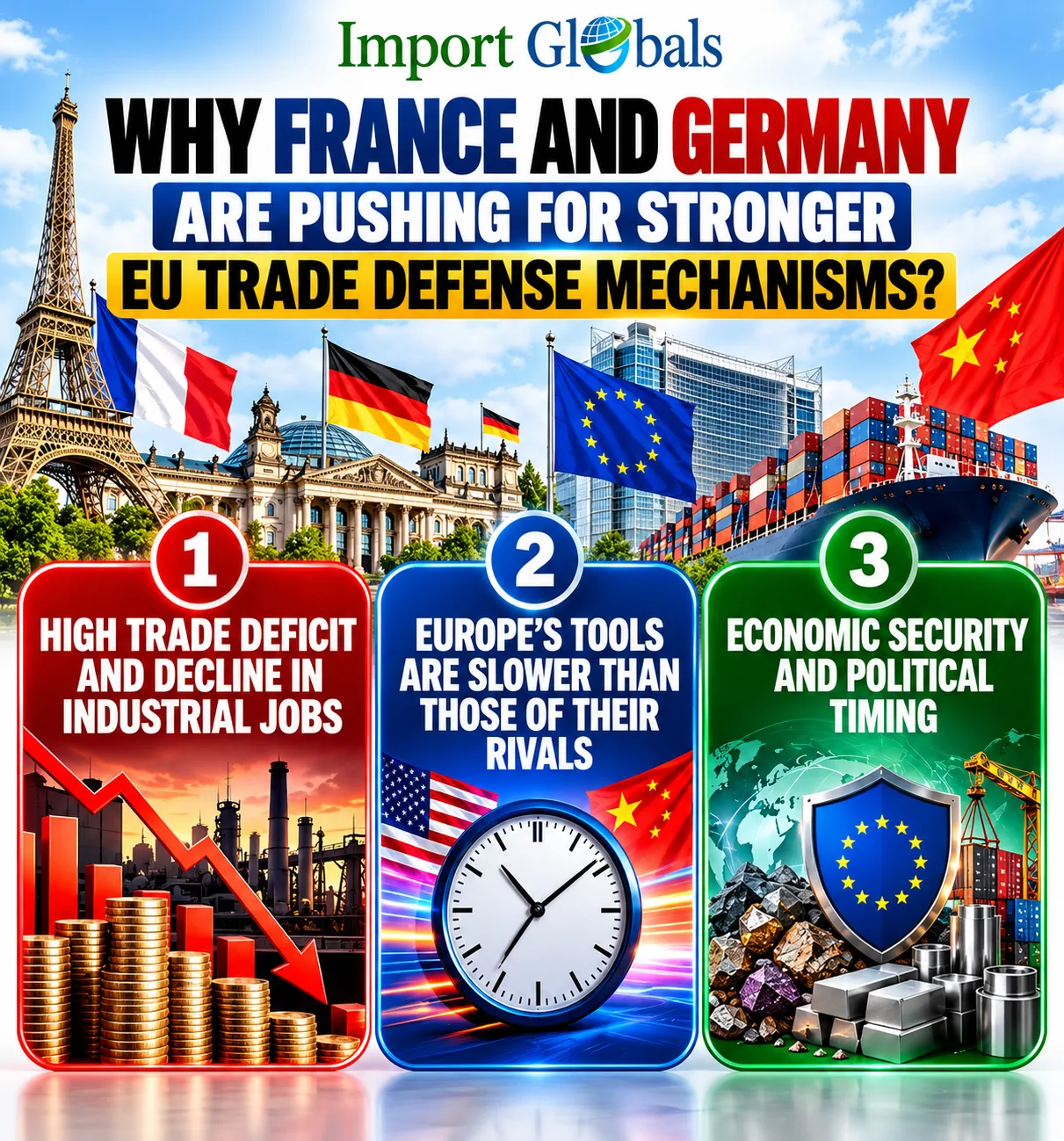
- High Trade Deficit and Decline in Industrial Jobs - Both governments regard the trade imbalance with China as a risk to their industrial sector. Germany Import Data listed that The EU's deficit is now more than €1 billion per day. Their report warns of the threats that market distortions pose to the industrial base and employment. Germany and France have a significant level of manufacturing; thus, shutdowns have political consequences. Šefčovič set a deadline for China to decrease the imbalance in trade. With the deadline coming up, Paris and Berlin decided to start pushing for more action instead of waiting.
- Europe's Tools are Slower than those of Its Rivals - German officials have said that the EU requires an equally powerful tool as US Section 301 tariffs or Chinese restrictions on the export of critical minerals. The United States and China can retaliate much quicker and more strongly than the EU. The current approach takes several months and works on a product-by-product basis, as I understand it. That is why the two countries want the EU to have the power to act in just a few days. In a world of weaponized trade, delays are perceived as weaknesses.
- Economic Security and Political Timing - China's restrictions on rare earth and other necessary minerals highlight Europe's vulnerability in this respect. Therefore, the paper calls for new mechanisms of economic security and diversification.Germany Shipment Data listed that the timing has also given the two countries leverage. The letter was sent just several days before the trade commissioner flew to Beijing and ten days before EU leaders would actually discuss the trade imbalance with China. According to a French advisor, the two countries want to put an end to their trade. The support from the two largest economies in the EU has allowed for putting pressure on other capitals and the Commission.
Products Causing the Trade Deficit: The Probable Reasons Behind France and Germany's New EU Trade Defence Measures in 2026
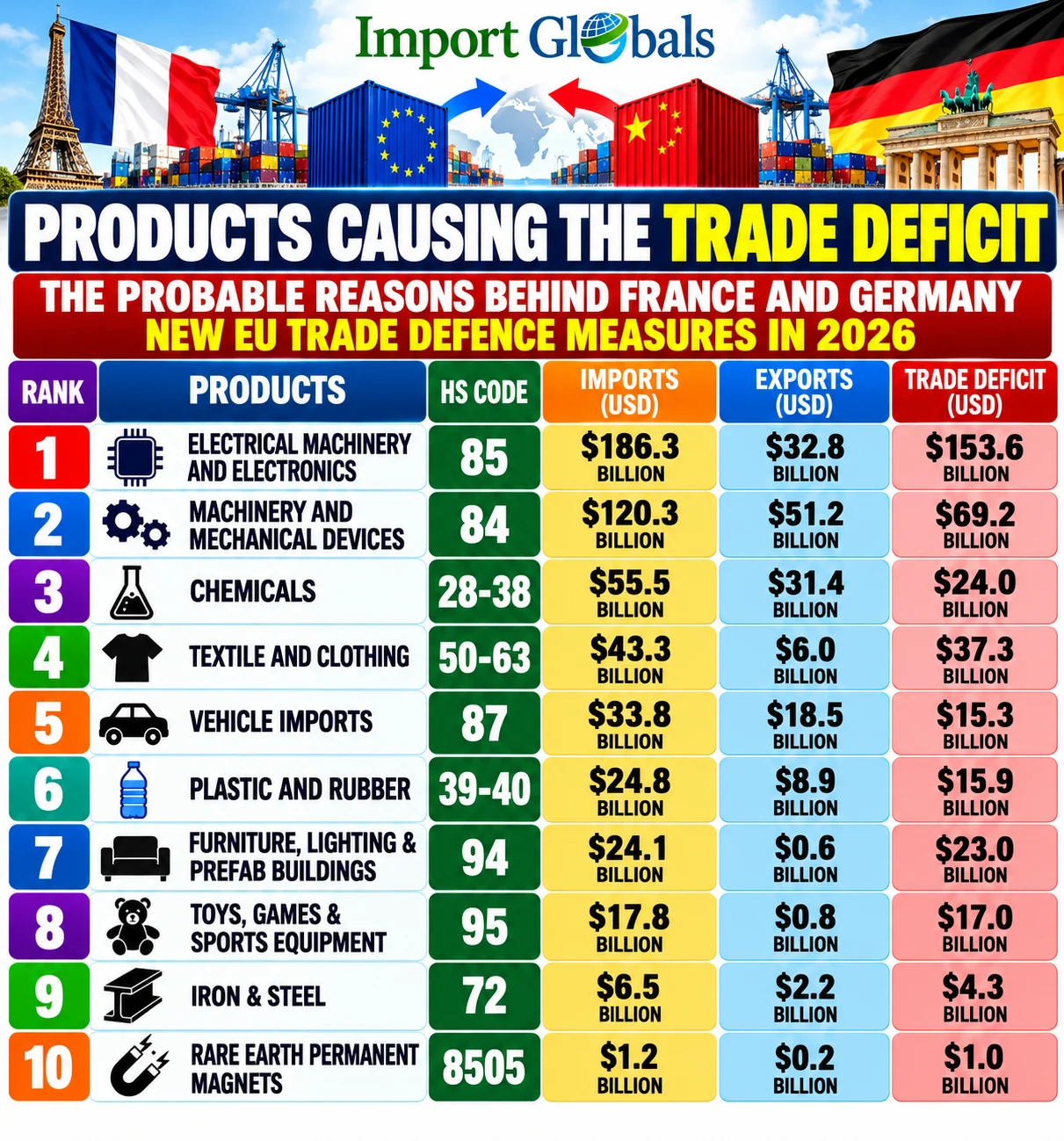
1. Electrical Machinery and Electronics: HS 85, $153.6 Billion Deficit
This sector shows the most significant import level. The amount of electrical machinery imported amounts to $186.3 billion, accounting for 30% of all imports from China, while EU exports only total $32.8 billion. These electrical items include batteries and electronic components, making the sector a focal area for economic-security issues addressed by Paris and Berlin.
2. Machinery and Mechanical Devices: HS 84, $69.2 Billion Deficit
Germany's industry dominates this sector: $120.3 billion worth of machinery devices have been imported compared to only $51.2 billion of EU exports. According to Germany Shipment Data, 2026 was marked by the highest level of machinery imports among the sectors mentioned above.
3. Chemicals: HS 28–38, $24.0 Billion Deficit
Chemicals imported from China have reached a total of $55.5 billion, while EU-exported chemicals came to only $31.4 billion. There is also a considerable rise in imports of organic chemicals.
4. Textile and Clothing: HS 50-63, $37.3 Billion Deficit
Textile and clothing imports stood at $43.3 billion while the EU exports amounted to $6.0 billion. Commission trade officials maintain that textiles have been one of the industries that have seen an unusual continuous increase in imports, which has allowed cheap textiles to become a threat to European producers and hence pushing for increased trade defense against the industry.
5. Vehicle Imports: HS 87, $15.3 Billion Deficit
Vehicle imports stood at $33.8 billion while the EU made $18.5 billion in vehicle exports. Hybrid vehicles were identified as urgent in the Franco-German paper; with EU vehicle and parts exports having decreased by $9.6 billion in 2025.
6. Plastic and rubber: HS 39–40, $15.9 Billion Deficit
Plastic and rubber imports accounted for $24.8 billion, while the EU made only $8.9 billion in exports. The report highlights PET as urgent; hinting that there are fears that cheaper Chinese supply has severely affected European resin producers and manufacturing companies.
7. Furniture, Lighting & Prefab Buildings: HS 94, Deficit of $23 Billion
Total imports reach $24.1 billion, while EU exports are negligible, as imports of Chinese furniture from other countries stand at just $627 million in 2025; resulting in a deficit of roughly $23 billion. Consumer products of this type demonstrate how well-stocked China is beyond its heavy industry.
8. Toys, Games & Sports Equipment: HS 95, Deficit of $17 Billion
According to Germany Export Data; toy and sports imports are valued at $17.8 billion in 2025. Assuming EU exports are insignificant, the deficit can then be estimated at approximately $17 billion. Mass-produced consumer goods continue to add to the general economic imbalance, which a French advisor called unsustainable.
9. Iron & Steel: HS 72, Deficit of $4.3 Billion
Iron and steel imports were recorded at $6.5 billion vs. $2.2 billion in EU exports, with the iron and steel articles (HS 73) contributing $15.8 billion. EU Commission officials have identified iron and steel as a sector with abnormal import growth and steel being the typical candidate for safeguards.
10. Rare Earth Permanent Magnets: HS 8505, Deficit of $1 Billion
In 2025, imports of EU permanent magnets totalled around $1.2 billion, being supplied 88 percent by China. Assuming that exports to China are negligible, the deficit can then be estimated at around $1 billion.
The Legal and Political Hurdles
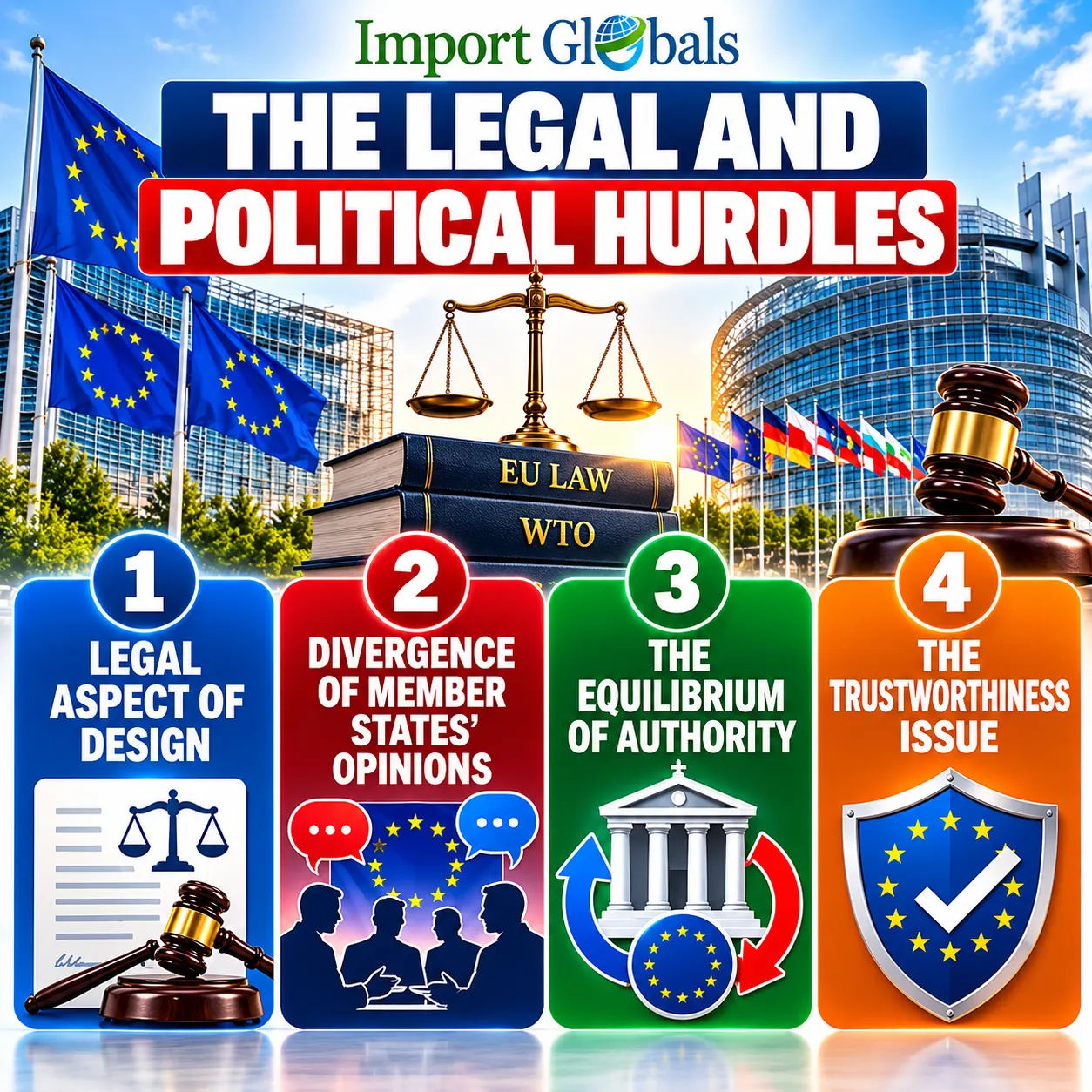
The letter conveys a political message as opposed to being a norm of law. The legislation for the new tool is going to have to pass approval by the governments of the EU and the European Parliament. There are a number of challenges ahead.
- Legal Aspect of Design - The Commission would have to devise the tool which accommodates EU laws and laws of the World Trade Organization. The paper does leave the situations under which the tool may be used unexplained, and it is quite difficult to create a tool that is quick to use and, at the same time, legally cogent. The thing is that the quicker you are, the more chances you have to face lawsuits and WTO disputes.
- Divergence of Member States’ Opinions - The EU does not have a unified position on China. For many countries, it is important to have tougher measures, while others worry about their exports, their automotive, and investment relationships with China. The rule of blocking a majority makes the situation easier for the Commission, despite the fact that convincing the minority at the very last moment is still possible.
- The Equilibrium of Authority - Providing the Commission with wide-ranging powers to act beforehand and be subsequently rejected means a transfer of authority from the member states. Some member states’ capitals may fear giving away that discretion despite agreeing with the objective, reported France Import Data.
- The Trustworthiness Issue - Analysts caution that threats without action make Europe weaker. One comment pointed out that if Šefčovič comes back empty-handed, the credibility of future threats made by Europe will decline. The same goes for the newly established tool, which will not deter anyone if it exists but is never used.
France and Germany Trade: Why the Two Economies Speak With One Voice on EU Trade Defense
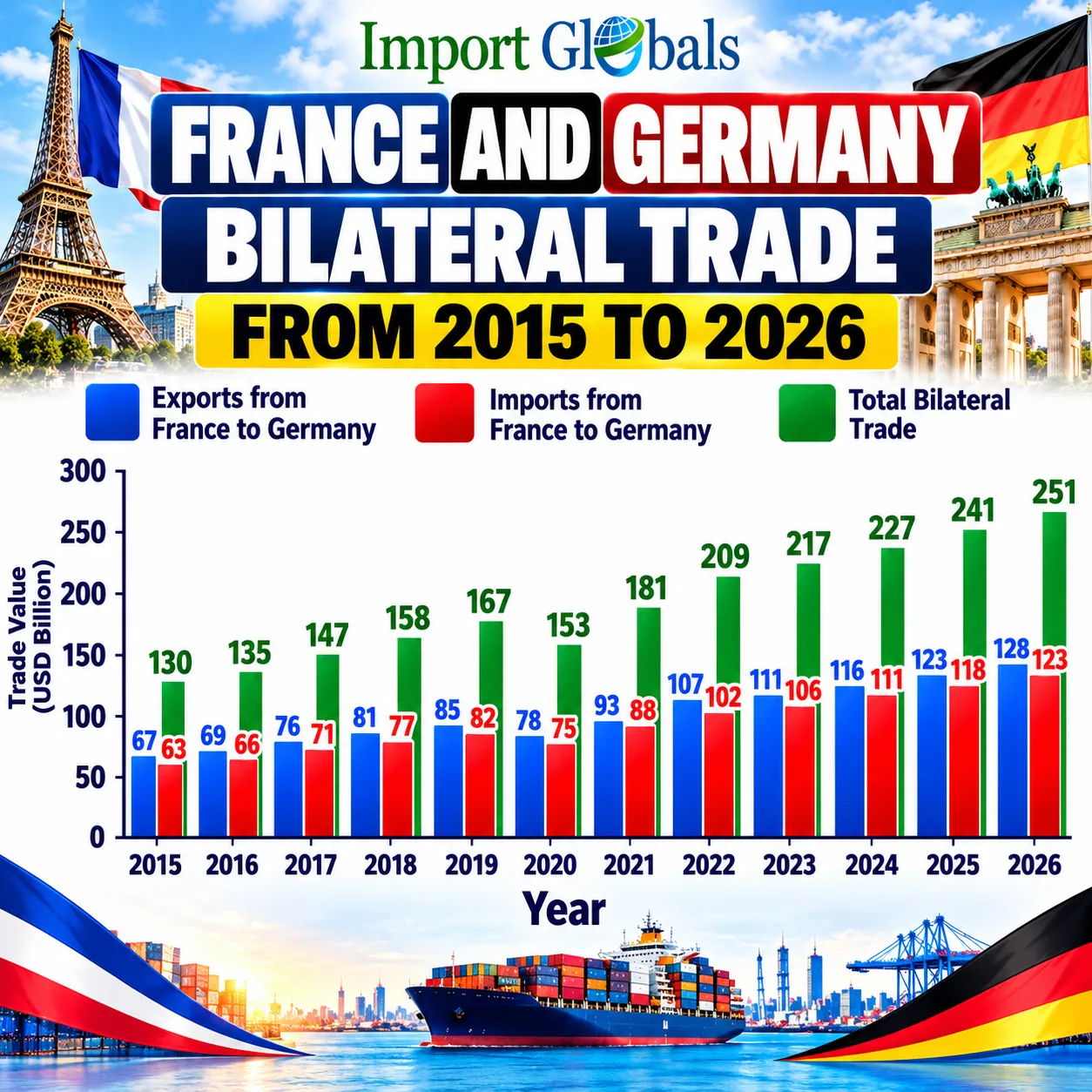
France and Germany are important trade partners in Europe, although they are in different positions concerning trade. Germany recorded an overall goods surplus of $226.6 billion in 2025, whereas France has a deficit of about $105.3 billion. In terms of trade with third countries, Germany and France are also substantial players, with Germany’s figure amounting to 26.1% and France’s to 10.6%.
The goods traded between the countries include vehicles and aircraft. In 2024, the most significant exports from Germany to France were cars, aircraft parts, and vehicle parts, while France’s key exports to Germany were aircraft segments, vehicle parts, and cars. The trade occurs in industries that are also facing Chinese competition, which explains why Germany and France are currently speaking in unison, reported Germany Import Export Data.
Future Trade Outlook of France and Germany's Efforts to Develop New EU Trade Defense Mechanisms
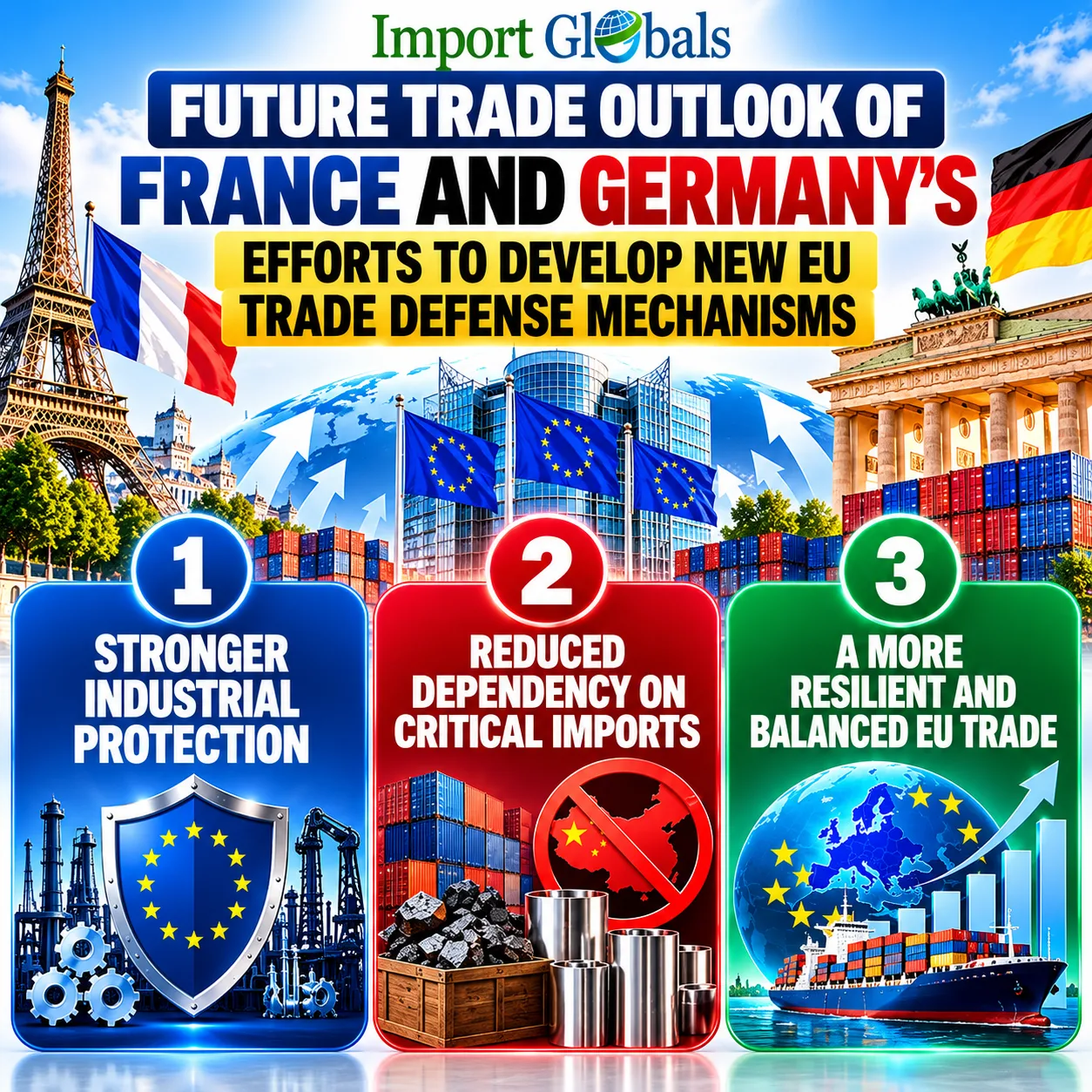
The future of EU-China trade rests on events after the leaders' summit and provides a clear picture of increased pressure on Beijing. In the short term, Brussels is likely to make use of its existing set of instruments, starting 32 new trade investigations by the end of 2025, averaging only 12 per year; the metals sector, chemicals, steel, and hybrid vehicles industries are the most vulnerable ones.
The newly published rapid response mechanism will take time; according to one of the estimates, it will be available no sooner than next year, and the proposal needs approval from the governments and the European Parliament. In the meantime, the deficit keeps growing, reaching €98bn in Q1 2026, the biggest figure since late 2022. Beijing has warned that any restrictions applied by the EU would provoke its response; therefore, European companies can expect retaliation measures. There is a possibility of escalation or a soft compromise if member states do not agree on costs.
Conclusion
France and Germany have provided Europe with a clear message: the continent needs to be able to respond to trade aggressions in a swift, credible and united manner. The proposal involves quick response tools, relevant use of tools that already exist, and being prepared for retaliation.
Whether this becomes a reality depends on factors that cannot be influenced by any government: drafting the law, opinions of 25 other countries, opinions of the European Parliament, and reactions from China. However, there are difficult questions that remain unanswered: what will trigger this instrument, and how will the expenses be covered in case of trade wars? For the time being, the French-German message has changed the tone of the discussion.
CTA
Looking for the latest information regarding the France and Germany trade of 2025 and the defense measures proposed for the European Union? Then Import Globals is here to help, the platform takes all the responsibility for resolving your trade complexities in order to transform international business growth. Subscribe to www.importglobals.com or drop an email at info@importglobals.com for detailed information regarding the defense measures taken by the French and German authorities in order to craft your international business strategies.
FAQ’s
Que. What have France and Germany proposed in 2026?
Ans. France and Germany have proposed a new rapid action tool for the EU, so Paris and Berlin can move fast against market distortions.
Que. Why have France and Germany made the proposal now?
Ans. France and Germany have made the proposal now because of the Chinese trade imbalances in Brussels.
Que. What are the top products causing the trade deficit leading to France and Germany “EU DEFENSE MEASURES”?
Ans. Electrical Machinery and Electronics are the top products causing the trade deficit leading to France and Germany “EU DEFENSE MEASURES”.
Que. Is the proposal mainly for China?
Ans. The paper does not categorically name China as the top partner. The new measures are targeting a specific country, with highlights of dumping, widespread subsidies, and currency restrictions.
Que. Name the top products that are mentioned in the proposal.
Ans. Hybrid vehicles and chemicals are the top products that are proposed in the EU defense measure by France and Germany.
Que. How have Chinese authorities responded to the France and Germany proposed initiative?
Ans. Beijing has presently taken a firm line. The trade commissioner has stated the initiative is unsustainable.
Que. How do France and Germany's import-export data support business growth?
Ans. France and Germany's import-export data support business growth via proper identification of buyers, suppliers, analysis of market demand, and development of effective market expansion strategies.
Que. What information is available in France and Germany trade data?
Ans. France and Germany trade data covers importer name, exporter name, shipment date, HS code, product details, quantity, pricing information, origin country, importing country, and port details.
Que. How frequently is the France and Germany trade data updated?
Ans. France and Germany trade data is updated on a monthly basis.
Que. Where can you obtain detailed information on France and Germany trade data?
Ans. Visit www.importglobals.com or drop an email at info@importglobals.com for detailed updates on France and Germany trade data.
You Can Also Visit :-