HS Codes Every Analyst Should Know for U.S.- Venezuela Trade Data
- Apr 02, 2026
HS Codes Every Analyst Should Know for U.S.- Venezuela Trade Data
When you work with U.S.–Venezuela trade data, you have to deal with a relationship that might change quickly because of changes in energy flows, logistics problems, and policy changes.
Why HS Codes are the "Language" of trade analysis between the U.S. and Venezuela
In that situation, HS codes are the only "common language" that makes sure your analysis is the same across all datasets, ports, and reporting systems. The Harmonized System (HS) is a way to group products together based on 6-digit identifiers that most countries use to keep track of trade in goods. The six numbers are the most important part. They make it possible to compare "crude oil" or "pharmaceuticals" across borders.
Countries then go beyond 6 digits for their own requirements. The Harmonized Tariff Schedule (HTS) is used to classify imports in the U.S., while Schedule B codes are used to classify exports. As per Venezuela Export Data by Import Globals, both are based on HS, although they have different rules, details, and occasionally ways of splitting into categories. When looking at the U.S.-Venezuela relationship, HS codes are important because the headlines ("oil is back," "imports collapsed," "fuel shipments surged") usually tell a story about codes: which petroleum streams, which chemical inputs, which food staples, which medical supplies, and how these baskets change from month to month.
How to think About the U.S. Classification Stack (Without Getting Lost)
Three Places Where Analysts Often Get Confused are:
- HS (6 digits) vs. U.S. detail (10 digits)
- Most of the time, you require HS-6 for your international comparisons. For your U.S. compliance, tariff, or highly detailed trend analysis, you often need HTS-10 (for imports) or Schedule B-10 (for exports).
- The truth about commerce between the U.S. and Venezuela: it's mostly about oil, but not solely about energy.
Imports and Exports Are Not the Same Thing
There is a "Venezuela → U.S." flow in both U.S. import data and Venezuela export data, but the way the value is calculated, when it happens, and how the products are split might all be different.
How to Use This Hs List to Give Analysts a Significant Edge
- Energy is a story that goes on for more than one chapter.
- As per Venezuela Trade Export Data by Import Globals, "Chapter 27" is a common headline for trade news about Venezuela, but true operational research frequently looks at more than one code, such as crude streams, refined products, blending inputs, and downstream petrochemicals.
- People pay more attention to energy items since they are worth more when flows open up. But trade analytics' "daily life" is often in the background:
- There is a big difference between "crude is up" and "refined is up" when it comes to fuel mixing and refinery feedstocks.
- Petrochemicals and plastics are used in industry (for example, to make packaging and consumer goods).
- Food essentials include cereals and oils that can be eaten.
- Pharmaceuticals and medical supplies (high signal during supply shocks).
- Machinery and electrical equipment (infrastructure and maintenance cycles).
- That's why a good U.S.–Venezuela The HS watchlist should have (a) the energy core, (b) industrial inputs, and (c) the most important health and consumer categories.
Make Three Dashboards:
- Energy core: 2710 + 2711 + 2713 + 2714
As per Venezuela Import Data by Import Globals, to prevent making mistakes, add up the unit values and compare crude and refined shares. For example, "trade is up" can only mean that the price is up.
- The industrial heartbeat is 3901/3902/3917 + 7304 + 8413 + 8502.
This collection often lets you know if operations and maintenance are really happening, not just in the news.
- Essentials basket: 1001/1005/1507/1701 + 3004 + 9018
Helpful for macro stress signals and for figuring out if trade is leaning toward fundamental necessities.
Then follow these two rules:
- When it comes to energy and fertilizers, always pair value with quantity.
- Watch for code movement (occasionally traders and filers move between similar categories; a "drop" might be a reclassification).
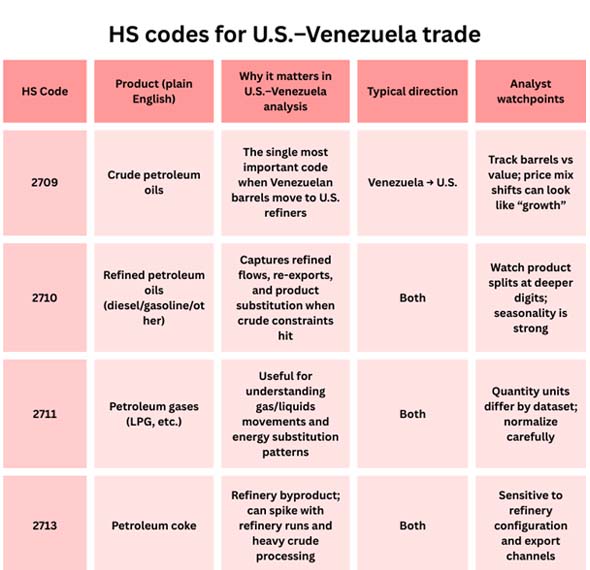
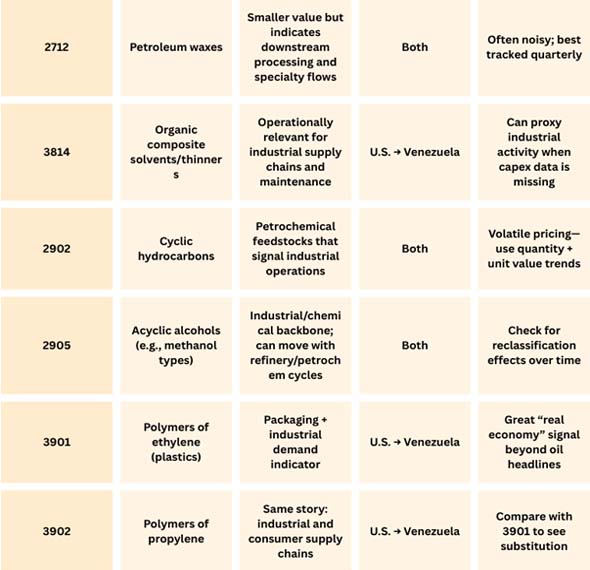
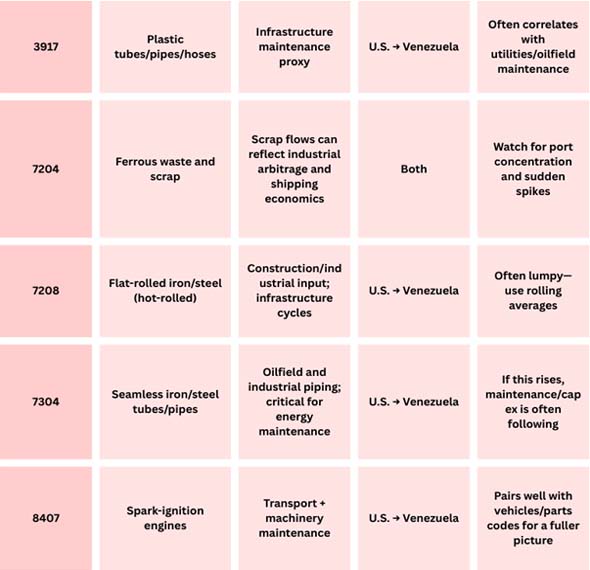
HS Codes as Early Warning Signs in Trade Between the US and Venezuela
As per Venezuela Trade Data by Import Globals, HS codes do more than only classify goods; they also serve as early warning signs of changes in the structure of trade between the U.S. and Venezuela. Changes in activity in some HS chapters often happen weeks or months before changes in trade as a whole. For example, when machinery, pumps, pipes, or electric generating equipment start to move more, it usually means that refineries need maintenance, infrastructure needs to be fixed, or the energy sector needs to stabilize, even if crude oil exports stay the same. Instead of reacting to headline oil statistics after the event, analysts who keep an eye on these supporting HS codes can see changes in output coming up.
Understanding Non-Oil HS Codes as Economic Signals
As per USA Import Data by Import Globals, petroleum makes up most of Venezuela's economy, but non-oil HS codes give the best picture of how the country's economy is doing. More imports of food staples, drugs, and medical devices show that commerce is driven by stress, not growth.
On the other hand, more plastics, steel goods, and industrial chemicals show that operations are returning to normal. These HS patterns assist U.S. exporters tell the difference between shipments for humanitarian reasons and shipments for commercial reasons. Analysts sometimes overestimate recovery or underestimate systemic fragility in bilateral trade patterns when they don't pay attention to these categories.
Conclusion
HS codes are more than simply identifiers for trade between the U.S. and Venezuela. They are your early warning system. You will be able to find turning points earlier and explain them more convincingly if you can reliably maintain track of crude vs. refined (2709 vs. 2710), monitor industrial maintenance signals (pipes, pumps, generators), and keep an eye on basics (food and medical categories).
Make a repeatable dashboard from this brief list, and only then get into more detailed numbers when the story needs them. Import Globals is a leading data provider of Venezuela Import Export Trade Data.
FAQs
Que. Should I look at HS-6 or U.S. 10-digit codes for work between the U.S. and Venezuela?
Ans. When you need compliance-grade detail or to separate classes of refined products, use the 10-digit HTS/Schedule B. For cross-country comparisons and macro narratives, utilize HS-6.
Que. Why does crude (2709) sometimes look "flat" and refined (2710) spikes?
Ans. Because the mix can change because of demand at the refinery, blending limits, and logistics. Refined products can also travel even when crude flows are limited.
Que. What's the quickest strategy to prevent making mistakes in energy trading?
Ans. Don't just look at value. Keep track of the number of shares and the value of each unit, and compare crude and refined shares over time.
Que. What are the best "real economy" indicators for non-oil HS codes?
Ans. Plastics (3901/3902), pipelines (7304), pumps (8413), generators (8502), and commodities like maize/wheat (1005/1001) and medicines (3004).
Que. Where to get detailed USA customs data?
Ans. Visit www.importglobals.com.