Philippines Trade Deficit of 5.48 Billion Us Dollars in 2026: The Factors Driving the Import Surge and the Latest Market Opportunities
- Jul 04, 2026
- 39 Views
Philippines Trade Deficit of 5.48 Billion Us Dollars in 2026: The Factors Driving the Import Surge and the Latest Market Opportunities
The trade performance of the Philippines is continuously improving because of the contributions from global exporters, importers, manufacturers, sourcing agencies, and investors. The trade deficit is expected to be valued at 5.48 billion US dollars in 2026.
The increase in imports is supported by the rising domestic consumption, infrastructure development, industrial modernization, energy requirements, and higher purchases of capital equipment. The wide trade gap is a representation of the import dependence, demonstrating the expanding industrial capacity and the growing consumer market.
The Philippines Trade Data says that the country has emerged as one of the fastest-growing economies, backed up by favourable demographics, increasing urbanization, digital transformation, and continuous government investment. As per the latest Philippines Export Data, the imports outpacing exports have crafted the source, machinery, electronics, mineral fuels, transport equipment, and chemicals as the foreign exchange earners. The strategic geographical location in the Asia-Pacific region has positioned the nation as an important gateway connecting East Asia, Southeast Asia, Oceania, and global shipping routes. The modernization of the port's expansion has been strengthening the positioning of the country as the preferred investment destination.
The shipment level intelligence helps the exporters, importers, manufacturers, distributors, and international traders in identifying market trends and expansion of commercial activities. Philippines Import Data says that the businesses trying to be progressive can evaluate the shipment patterns and monitor the competitors' strategies to discover the emerging market opportunities. Import Globals is a leading provider of Philippines Import Export Trade Data, catering to detailed shipment-level intelligence containing importer details, exporter information, HS code, shipment quantity, shipment value, and transportation mode.
The Latest Overview of the Philippines 2026 Trade Deficit
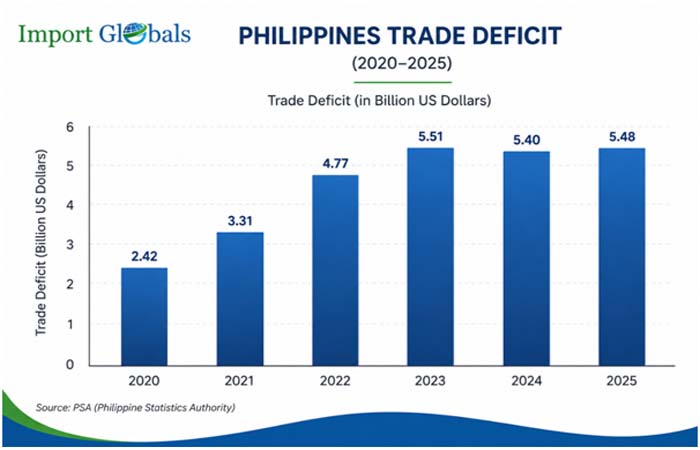
The country has attained a trade deficit worth 5.48 billion in May 2026 because imports exceeded exports. The economy has resulted in a stronger purchase of machinery, electrical equipment, transport vehicles, and petroleum products. The economic expansion is generated by the substantial demand for imported capital goods, supporting the manufacturing facilities, transportation infrastructure, and industrial production.
The widening of the trade deficit in export industries has maintained the stable performance through electronics, semiconductors, coconut products, bananas, pineapples, and processed foods. The Philippines has strengthened its trade relationships with China, Japan, the United States, South Korea, and Singapore, while diversifying the sourcing strategies for critical industrial products.
What is Driving the Philippines' Import Surge?
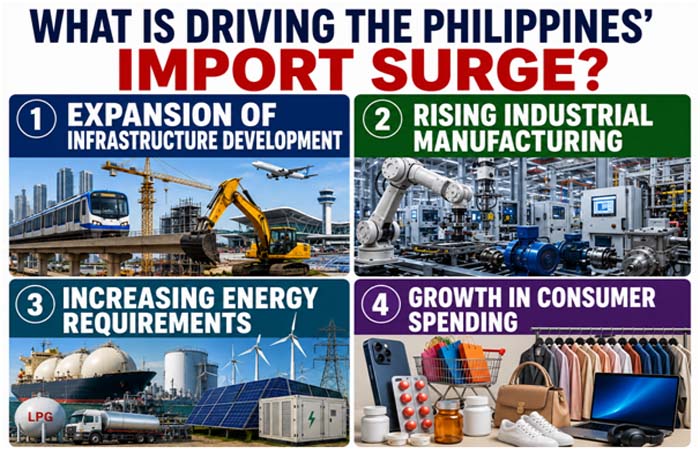
Different economic and industrial sectors are collaboratively contributing to the rapid increase in imports during 2026. Below are the factors driving the Philippines' import surge as per Philippines Customs Data.
1. Expansion of Infrastructure Development - Large-scale government investments like railways, airports, renewable energy facilities, and smart cities are increasing the demand for construction machinery, contributing to the hike in the import trade.
2. Rising Industrial Manufacturing - The specific hike in the use of industrial essentials like sophisticated machinery, industrial automation equipment, robotics, compressors, pumps, and production technologies has contributed to the productivity rate, generating a proper hike in the import revenue through the sourcing of different essentials.
3. Increasing Energy Requirements - The industrial activities have reported a hike in the energy requirements, backed up by the increased imports of crude petroleum, refined petroleum products, LPG, and renewable energy. Thus, solar panels, wind turbines, batteries, and electrical transformers are imported from foreign countries to balance the trade regulation, says Philippines Trade Data.
4. Growth in Consumer Spending - The expansion of the middle-class population has driven the imports of smartphones. The use in an extensive manner by the consumer base has supported the pharmaceuticals, fashion products, and consumer electronics trade.
Why is the Trade Deficit of the Philippines Not Considered a Whole Negative Impact on the Country's Trade?
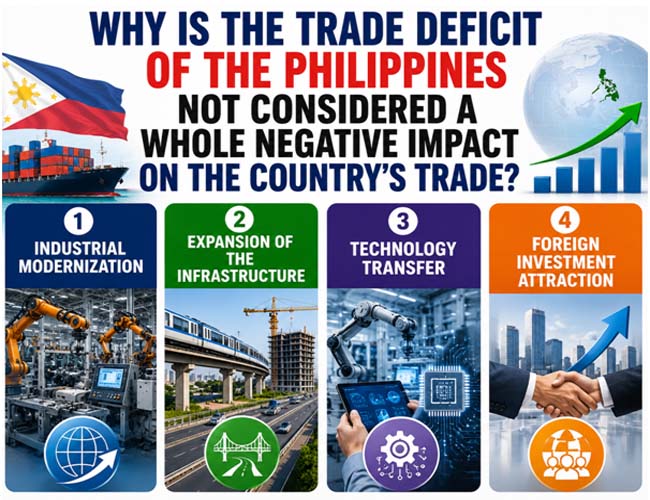
The widening of the trade deficit is unfavourable for the memorandum, but it is not considered completely negative for the economic expansion because the imports consist mainly of capital goods and industrial equipment that will eventually facilitate the productivity rate, supporting the exports. Below are the factors that represent how the imports will not be entirely negative for the Philippines' overall trade, as represented by the Philippines Customs Shipment Data.
1. Industrial Modernization - The imports of different machinery from foreign sources will proliferate the growth rate while increasing the export competitiveness.
2. Expansion of the Infrastructure - The expansion of the manufacturing infrastructure will maintain the construction-related import support towards economic growth while improving the transportation efficiency.
3. Technology Transfer - The sophisticated manufacturing technologies in the domestic region will enable the authorities to produce higher-value products.
4. Foreign Investment Attraction - The increasing attraction of the foreign investment authorities will lead to higher investments in manufacturing facilities supporting the industrial paths.
The Exclusive Role of the Philippines' Import-Export Data in Facilitating Business Decisions
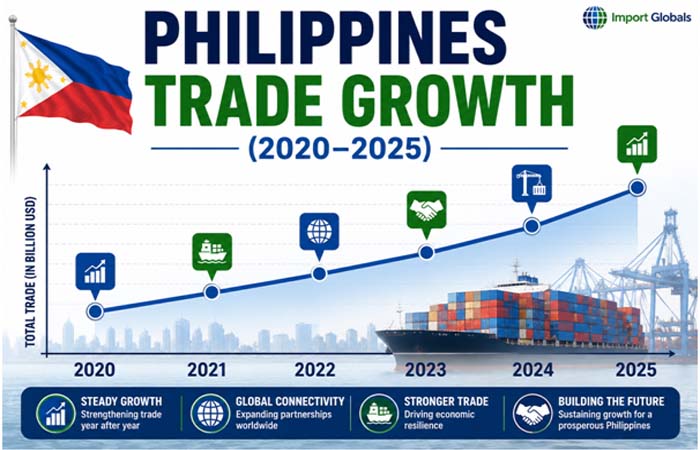
The shipment-level intelligence on Philippines Import Export Data is considered beneficial because it helps the authorities with expansion into Southeast Asian markets. The detailed intelligence includes different information about the country's importer name, exporter name, buyer information, supplier information, product description, HS code, shipment quantity, shipment value, unit price, country of origin, destination country, port of loading, port of discharge, transportation mode, shipment date, and consignee details.
The businesses trying to be progressive can easily utilize this information to stay updated with the latest activities of the buyers and sellers in the specific category. They can even evaluate the pricing strategies to understand the seasonal demand fluctuations and optimize the sourcing decisions.
The Latest Import Categories Driving the Philippines' Trade Deficit
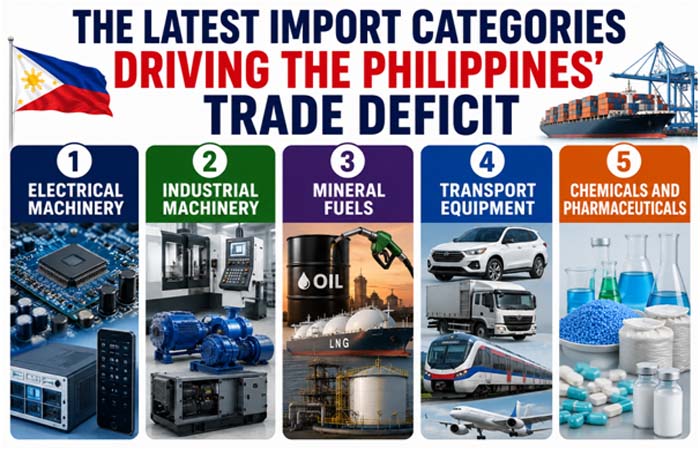
1. Electrical Machinery - Electrical machinery is considered a significant factor resulting in a hike in the Philippines trade deficit. The integrated circuits, semiconductors, processors, electrical equipment, and telecommunication devices imports are driving the overall trade surge.
2. Industrial Machinery - Machine tools, pumps, compressors, and generators are imported in large quantities in the Philippines due to the manufacturing equipment demand rate and the fastest-growing trade portfolio.
3. Mineral Fuels - The crude petroleum, refined petroleum products, LNG, and diesel imports have contributed to a significant share of the Philippines' trade due to the increasing industrial energy consumption.
4. Transport Equipment - The passenger vehicles, commercial trucks, buses, railway equipment, aircraft components, and automotive parts are considered supportive of transportation modernization.
5. Chemicals and Pharmaceuticals - Industrial chemicals, fertilizers, plastics, pharmaceutical ingredients, and laboratory chemicals are considered factors contributing to the trade deficit. The overall unit has witnessed a rise in the import demand across multiple industries.
The Latest Exports Promoting the Philippines' Economy
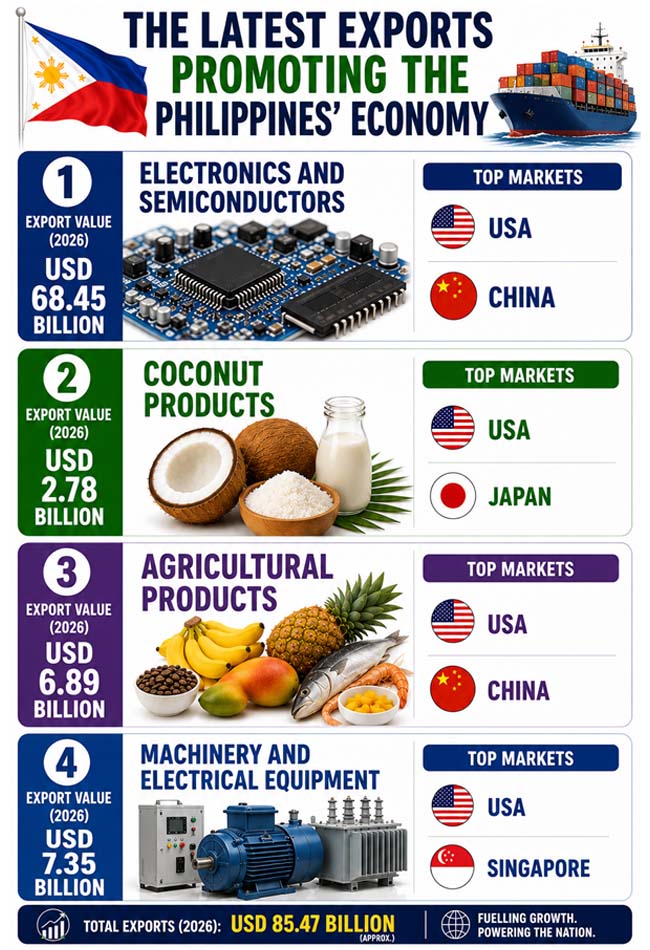
With the continuous hike in the import expansion, Philippines Export Trade Data has reported that the supply rate of the nation has also been an important contributor to the foreign exchange earnings and most probably the trade deficit. Below are the topmost factors supporting the Philippines' economy.
1. Electronics and Semiconductors - The trade of integrated circuit semiconductor devices, electronic assemblies, and storage devices holds a majority share in the Philippines export portfolio. The growing demand rate of the global consumer base regarding the Philippines' manufactured essentials has maintained the export image of the nation.
2. Coconut Products - Desiccated coconut, activated carbon, coconut milk, coconut water, and other processed coconut products are in high demand due to the growing productivity rate.
3. Agricultural Products - Bananas, pineapples, mangoes, processed fruits, coffee, seafood, and sugar products are traded in different categories and their derivatives to maintain global trade compliance.
4. Machinery and Electrical Equipment - Industrial electrical equipment also holds a huge significance for the Philippines' trade, backed up by the continuous funding of the strong international demand.
The Latest Industries Benefiting From the Import Surge in the Philippines
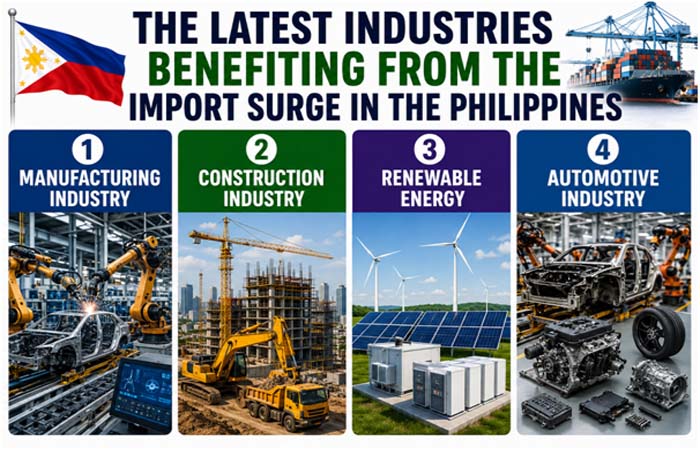
1. Manufacturing Industry - The manufacturing industry is considered a significant beneficiary of the imports of the Philippines. The advanced production technologies, industrial automation, robotics, and efficient machinery have been driving the surge in trade.
2. Construction Industry - Infrastructure expansion has reported an increase in the demand for heavy equipment, cranes, steel production, and cement machinery. The growing demand in the domestic consumer base has supported the overall trade as per Philippines Customs Data.
3. Renewable Energy - Solar panels, wind turbines, battery storage systems, electrical transformers, and smart grid technologies have supported renewable energy development. The import of the specific essential has facilitated the export growth rate in the energy sector.
4. Automotive Industry - Vehicle assembly plants are the significant beneficiaries of the import hike in the Philippines. The import of automotive components, engines, transmissions, electronics, and manufacturing equipment is continuously maintained to facilitate the trade deficit.
The Latest Opportunities Related to the Import Expansion of the Philippines
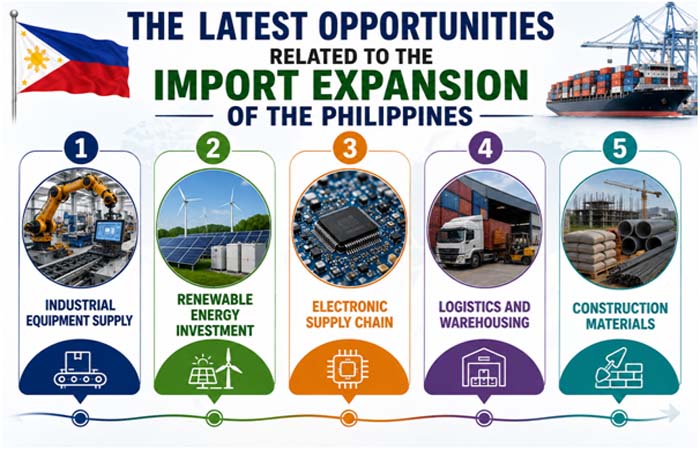
1. Industrial Equipment Supply - The proper supply of machinery, automation systems, robotics, and packaging equipment is continued due to the attention given by the foreign resources to the valuable tariff rates.
2. Renewable Energy Investment - The heightened investment in solar, wind, battery storage, and electrical infrastructure has been creating opportunities for equipment manufacturers, enabling compliance with the latest engineering standards.
3. Electronic Supply Chain - The global suppliers of semiconductors, materials, integrated circuits, and manufacturing equipment are also maintained with the proper expansion in the Philippines electronics ecosystem.
4. Logistics and Warehousing - The higher trade volumes are maintaining the increase in the demand for freight forwarding, with the proper maintenance of customs brokerage, cold chain logistics, and supply chain management.
5. Construction Materials - The infrastructure projects are creating sustained opportunities for the cement equipment, electrical systems, and pipes, valves, and traders.
How Does the Philippines' Trade Data Support International Business?
The shipment-level intelligence on Philippines Customs Data is considered beneficial for the business authorities to stay progressive because it promotes the identification of profitable export and import opportunities. The companies trying to be progressive can refer to the Philippines Trade Data for identification of verified overseas buyers, analysis of competitor shipment activities, monitoring of pricing trends, tracking of seasonal demand rates, evaluation of supplier performance, and optimization of sourcing strategies.
The latest availability of customs intelligence reduces the market uncertainty with an improvement in decision-making across procurement, sales, logistics, and international trade operations.
The Challenges Associated With the Philippines' Import Hike
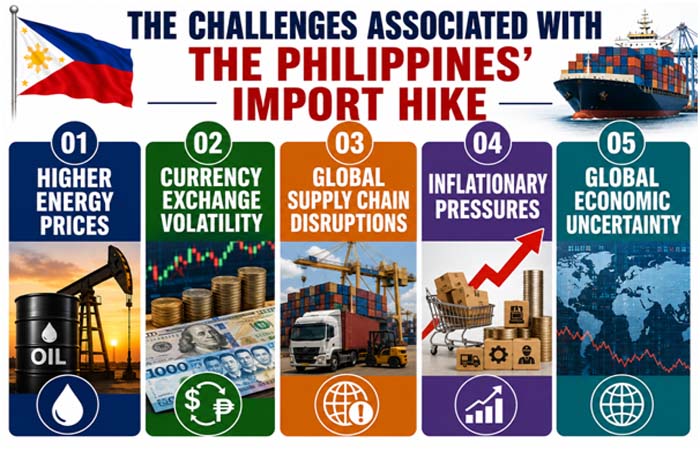
1. Higher Energy Prices - The fluctuations in international crude oil prices have increased the import expenditure.
2. Currency Exchange Volatility - The foreign exchange fluctuations are directly influencing the import costs, supporting the overall business profitability.
3. Global Supply Chain Disruptions - The container shortages, freight cost fluctuations, and geopolitical uncertainties are affecting international trade efficiency.
4. Inflationary Pressures - The higher transportation costs, labour expenses, and logistics costs are maintaining the hike in the production expenses across different industries.
5. Global Economic Uncertainty - The changing international demand rate and the geopolitical tensions have maintained the evolution of the trade regulations while continuously influencing the import and export performance.
Future Trade Outlook of the Philippines' Import
The long-term trade outlook for the Philippines will be highly promising despite the increasing trade deficit. The investments made by the government authorities in infrastructure, manufacturing, renewable energy, digital transformation, and logistics modernization will support the strong import demand in the coming period. The government initiative's support towards diversification will promote the free trade agreements and industrial competitiveness to facilitate the country's image as a reliable trader.
The electronics industry will continue to serve as the leading export sector with advanced manufacturing and digital technology trade. The strategic location will keep on expanding the consumer market with an improvement in the logistics infrastructure, competitive workforce, and favourable investment environment.
Conclusion
The Philippines' trade deficit is at a staggering rate of 5.48 billion US dollars in 2026, reflecting the expanding economy and the weakening industrial sector. The hike in imports is because of infrastructure development, industrial modernization, energy requirements, manufacturing expansion, and rising consumer demand. The imports are exceeding the exports with an activation of productive capital goods, which is expected to enhance the future manufacturing capacity.
The exporters, importers, manufacturers, logistics providers, sourcing agencies, and international investors can rely on the shipment-level trade intelligence on the Philippines Customs Data to craft their business intelligence resource.
The detailed customs information enables businesses to identify reliable trading partners, monitor market movements, and optimize supply chains. The Philippines will continue to maintain its position as a thriving trade player in the Asian region because of its advanced manufacturing and digital transformation.
CTA
Trying to expand your trade with the Philippines? You have landed at the right platform here. Import Globals is skilled in providing detailed intelligence on the latest activities of the Philippines trade. Subscribe to www.importglobals.com or send an email to info@importglobals.com to stay updated with the latest market insights to foster your business growth.
FAQ'S
Que. Why was the Philippines' trade deficit at 5.48 billion U.S. dollars in 2026?
Ans. The trade deficit of the Philippines is at 5.48 billion U.S. dollars in 2026 because the expansion of the imports of machinery, electronics, petroleum products, transport equipment, and capital goods is faster than the growth of merchandise exports.
Que. What is the top sector contributing to the Philippines' import surge?
Ans. Electrical machinery, semiconductors, industrial machinery, and mineral fuels are the top sectors contributing to the Philippines' import surge.
Que. Why is a higher trade deficit considered negative for a country's growth?
Ans. The trade deficit hike is considered negative for a country's growth because it impacts the productivity rate and hinders future export potential.
Que. Name the latest industries benefiting the most from the Philippines import growth.
Ans. Manufacturing, construction, renewable energy, automotive, electronics, and healthcare are the top industries benefiting from the increased imports of the Philippines.
Que. How does the Philippines Trade Data support business growth?
Ans. Philippines Trade Data supports business growth via proper identification of buyers, suppliers, analysis of market demand, and development of effective market expansion strategies.
Que. What information is available in the Philippines Export Trade Data?
Ans. Philippines Export Trade Data covers Importer names, Exporter names, Shipment date, HS Code, Product Details, quantity, values, pricing information, origin country, importing country & port details.
Que. What are the major challenges associated with the Philippines' trade performance?
Ans. Higher energy prices, supply chain disruptions, and inflationary pressures are the latest challenges associated with the Philippines' trade performance.
Que. How frequently is the Philippines Trade Data updated?
Ans. Philippines Trade Data is updated on a monthly basis.
Que. Where can I get detailed information on Philippines Trade Data?
Ans. Visit www.importglobals.com or send an email to info@importglobals.com to get a reliable understanding of the Philippines latest trade activities.
You Can Also Visit :-