
US Aircraft and Aerospace Exports: Global Buyers, Industry Growth and Trade Opportunities
- Nov 10, 2026
- 11 Views
US Aircraft and Aerospace Exports: Global Buyers, Industry Growth and Trade Opportunities
The USA is one of the biggest exporters of aircraft, parts, accessories and engines in the aviation industry. The U.S. aerospace industry is an important part of international commercial activity, supplying products and services to commercial airlines, aircraft manufacturers, aviation maintenance companies, governments and space agencies around the world.
The technical know-how, manufacturing expertise and continuous advancement in technology of the American aerospace industries give them a significant presence in the international market.
The increasing demand of the commercial aviation, aircraft upgrading, defense systems and aviation maintenance opens new opportunities for the American exporters and manufacturers. The aviation firms are working on fuel efficient engines, navigation systems and lightweight materials, while airlines are expanding their fleet of aircrafts, and aircraft operators are upgrading their old equipment.
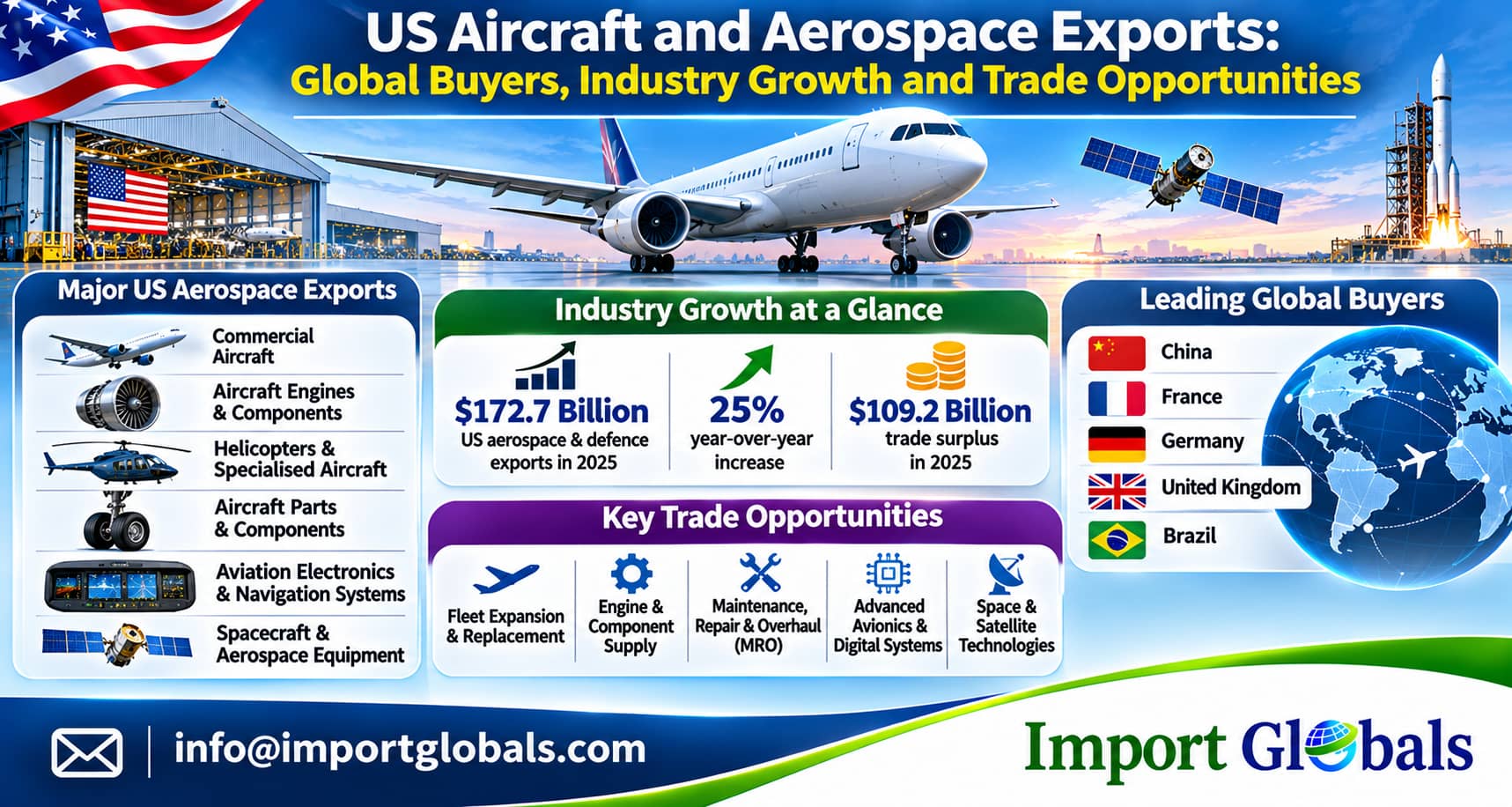
U.S. aerospace and defense exports totaled $172.7 billion in 2025, up 25 percent from the previous year, according to the Aerospace Industries Association’s 2026 report. This sector also had a $109.2 billion trade surplus, illustrating the importance of this sector to American manufacturing.
The manufacturer, supplier, importer and exporter can identify the business opportunities if they are aware of the international demand. US Export Data can help you do that. Detailed information at shipment level may be useful to understand buyer/supplier behavior.
Import Globals offers international trade data and services to help companies analyze international trade trends, find potential buyers and suppliers, track the competition and explore new markets. This paper looks at the major US aircraft and aerospace exports, major global buyers, industry growth factors, trade opportunities and the importance of trade intelligence.
The majority of aerospace products are made in states such as Washington, California, Texas, Kansas, Florida and Connecticut. These areas are involved in the assembly of aircraft, the production of engines, the creation of components and research. Sales in the U.S. aerospace and defense industry reached about $988.6 billion in 2025, employing an estimated 2.1 million people, according to the Aerospace Industries Association.
By looking at how products move and who the trading partners are, analysis using US Trade Data can offer insight into the wider business environment. Such data analysis can help the aerospace manufacturers to assess the market.
Major Aircraft and Aerospace Products Exported by the USA
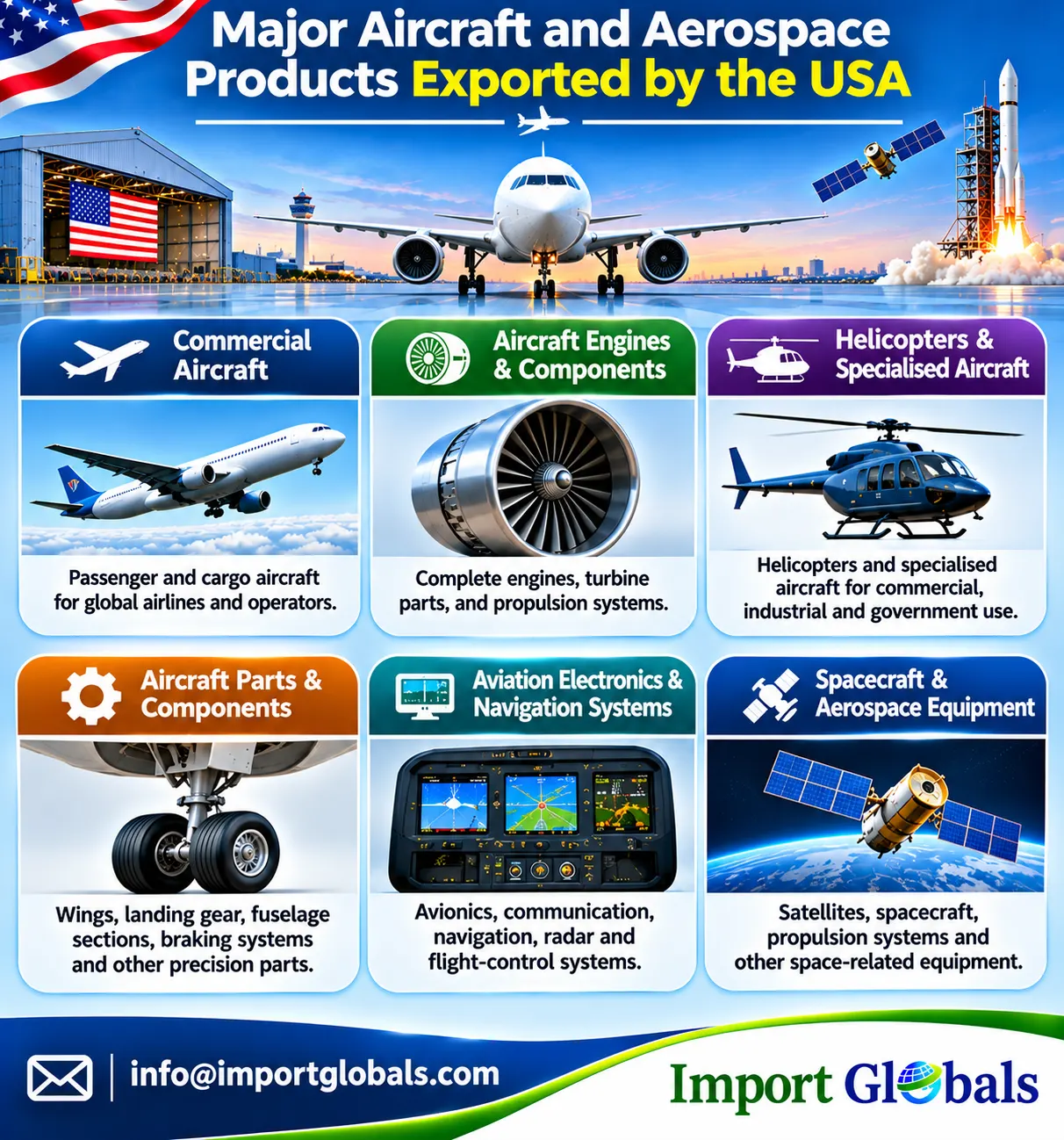
The U.S. sells aerospace products and aircraft in a broad range of segments. All of them have their own clienteles and sectors which provides a lot of opportunity for the manufacturers as well as exporters.
1. Commercial Aircraft
Commercial aircraft can be considered as one of the most recognizable segments among the US aerospace products. US manufacturers make a variety of aircraft for carriers throughout the world.
Foreign airlines buy the planes to expand their networks and replace aging fleets. Demand is driven by a range of factors including traffic, tourism and growth.
2. Aircraft Engines and Engine Components
Aircraft engines are among the most costly equipment that demand a complex engineering and manufacturing process. The US supplies entire engines, engine parts, turbines and specialized propulsion systems.
Airlines throughout the world are also supplied with spare parts and maintenance equipment by engine manufacturers. The increasing usage and fleet expansion is driving the demand for such products.
3. Helicopters and Specialised Aircraft
Many industries employ helicopters and other specialized aircraft, such as transportation, emergency services, industry, government agencies and defense. Medical transportation companies, offshore energy operators, public safety agencies and airlines are among the international buyers.
4. Aircraft Parts and Components
Airplane components include landing gear, airplane body components, wings, brakes, electrical systems, control systems, and precision components. These parts are used by airplane manufacturers, maintenance organizations and suppliers for the purpose of manufacturing and repairing airplanes.
5. Aviation Electronics and Navigation Systems
Modern airplanes require sophisticated electronic systems for communication, navigation, monitoring and management of flights. The United States sells avionics, radars, sensors and flight control technology.
6. Spacecraft and Aerospace Equipment
The U.S. aerospace industry also satisfies the needs of foreign customers for spacecraft, satellites, propulsion and specialized space products. The possibility of exports depends on the nature of the product, the destination country, licensing regulations and the export control laws.
This is because the classification of the goods will vary for various goods like aircraft, engines, components and aerospace electronics and thus identification of the right product category is necessary before comparing trade values.
Leading Global Buyers of US Aircraft and Aerospace Products
International buyers are an important factor in the growth of American aerospace exports. Foreign customers are national airlines, private air transportation companies, aircraft leasing companies, maintenance and repair companies, aerospace manufacturers and other government customers.
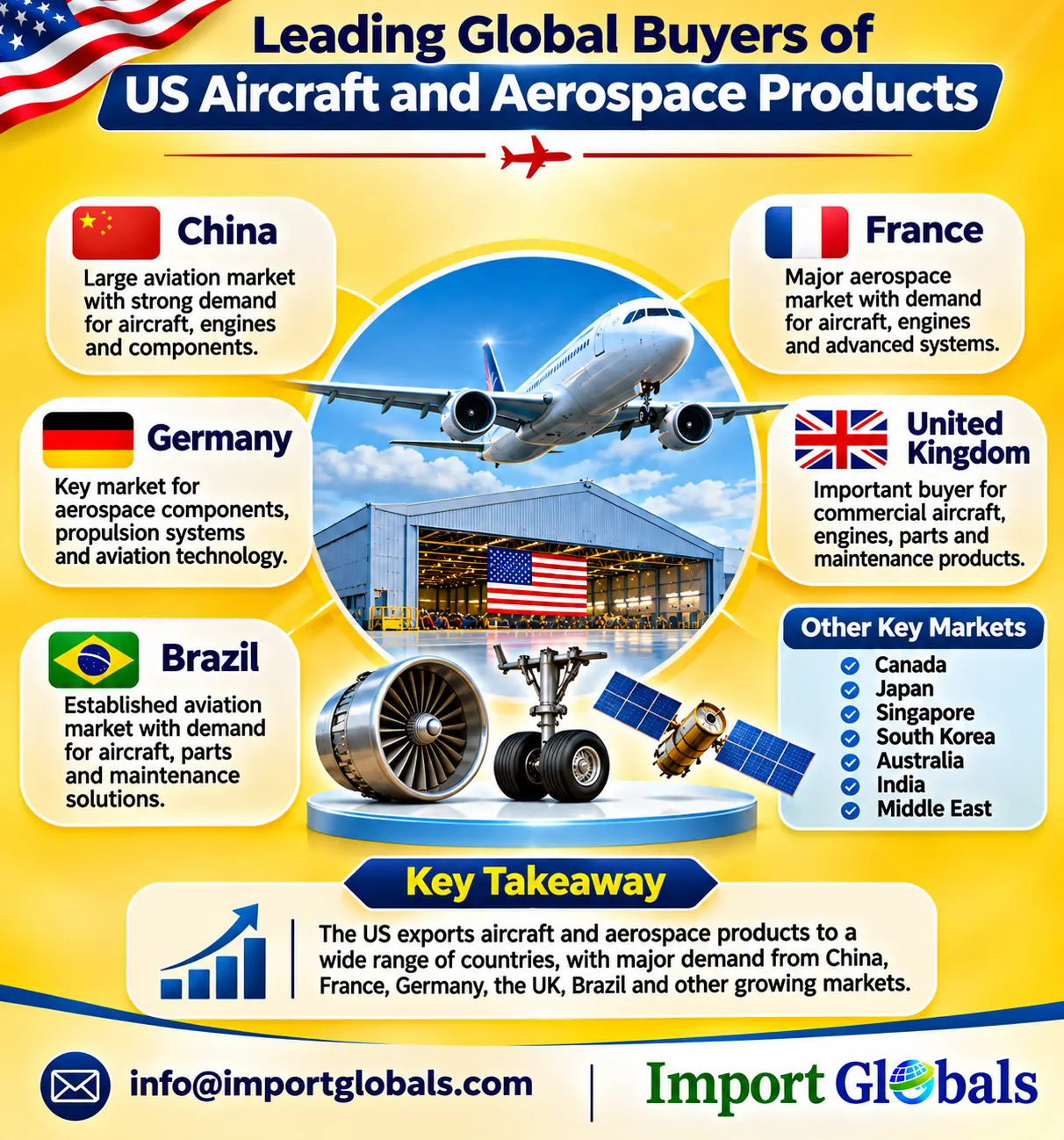
The Aerospace Industries Association’s 2026 report notes that in 2025, the largest recipients of U.S. aerospace and defense exports were China, France, Germany, the United Kingdom and Brazil.
Some important international markets include:
1. China: China has a substantial demand for aircraft, aviation parts and technology. However, consideration will need to be given to the various controls that may exist in exporting any of these goods.
2. France: France is a major market for the aerospace business, with some of the top players in this field being aircraft manufacturers, engine manufacturers, component makers and aviation service companies. US exports can lead to joint ventures in manufacturing.
3. Germany: Germany is asking for aircraft parts, propulsion technology, special equipment and maintenance equipment.
4. United Kingdom: The UK aerospace market covers commercial aviation, aircraft engine manufacturing, defense aviation and maintenance services. There are opportunities in the manufacture of precision engineered components and advanced aerospace systems.
5. Brazil: Brazil already has an aerospace manufacturing base and a huge market for commercial aviation. Its aerospace industry could use parts, maintenance tools and aviation technologies for a variety of parts.
Other markets that can be considered are Canada, Japan, Singapore, South Korea, Australia, India and Middle East. They can differ in their attractiveness depending on the type of product, aircraft programs, fleet requirements, local regulations and commercial needs.
It is important to separate total aerospace/defense export/import rankings from rankings for specific aircraft products. Depending on the type of the goods analyzed: aircrafts, engines, components, defense products or aerospace industry, the top exporters/importers may be different.
US Import Data enables companies to know about foreign suppliers and components in US aerospace market. The analysis of import/export flows will help to understand the situation of international sourcing and manufacturing dependence.
Growth of US Aircraft and Aerospace Exports in International Markets
There have been extensive trade activities within the US aerospace industry mainly due to the global demand for aircraft, aviation equipment, and advanced manufacturing products.
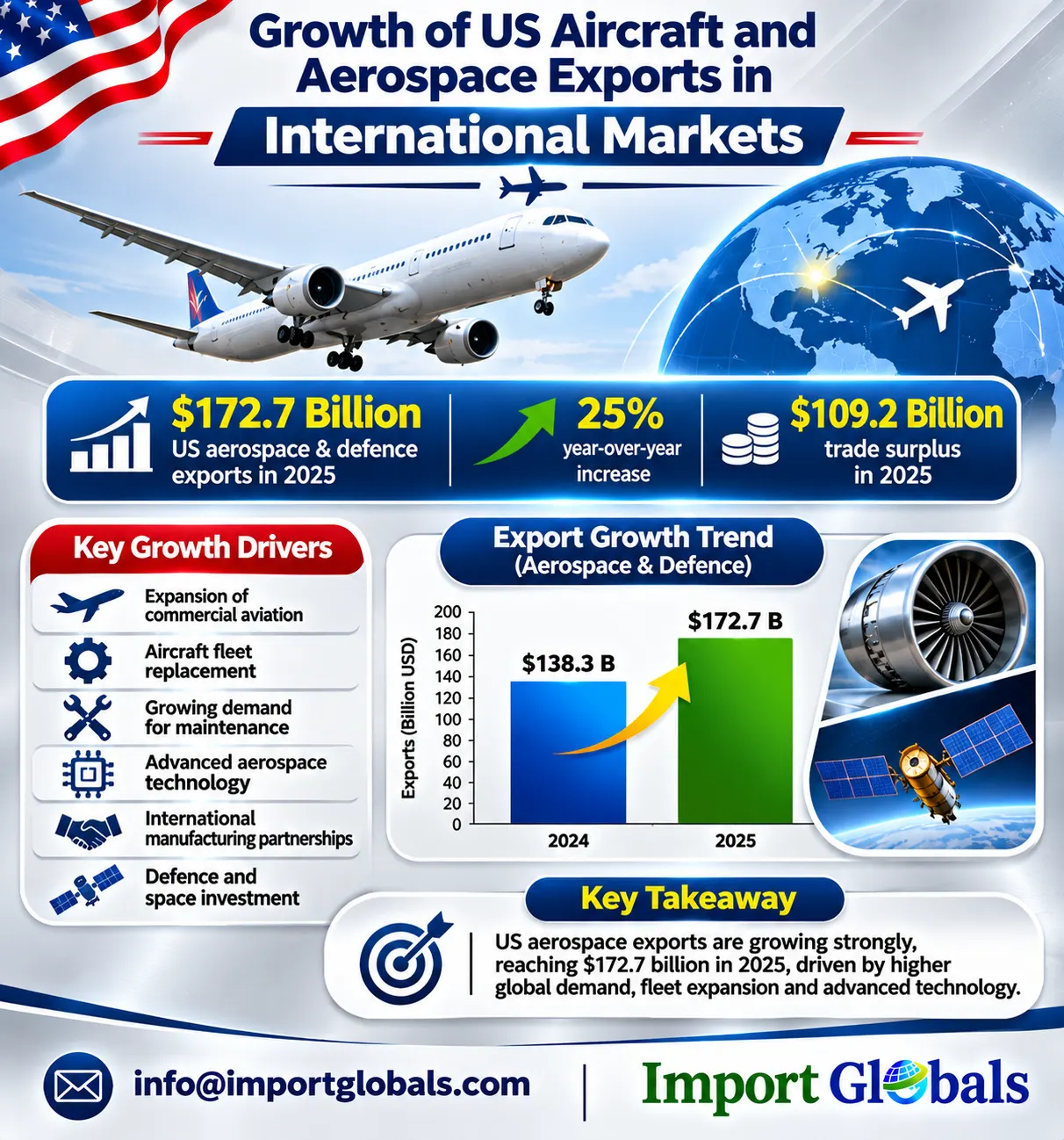
According to the Aerospace Industries Association report, US aerospace and defense exports reached $172.7 billion in 2025, up 25% from the previous year. Trade in the industry had a surplus of $109.2 billion. This information covers the whole aerospace and defense industry and is not to be interpreted as aircraft exports only.
The other helpful indicator is the general customs classification code for aircraft, spacecraft and their respective parts under HS Chapter 88. Exports in this class have reached about $165 billion in 2025, against about $135 billion in 2024, according to the compilation of US Census Bureau data. This class contains more than commercial aircraft only and should be analyzed together with the appropriate product-level classification in research.
Several factors are contributing to this growth:
1. Expansion of Commercial Aviation: Airlines are putting new airplanes into service to handle rising passenger and freight traffic.
2. Aircraft Fleet Replacement: Older aircraft are being replaced with newer aircraft which may be more fuel efficient.
3. Growing Demand for Maintenance: Big fleets have to service and maintain and replace worn-out parts.
4. Advanced Aerospace Technology: Modern aircraft are based on advanced technology systems like avionics and communication systems.
5. International Manufacturing Partnerships: The manufacture of airplanes worldwide depends on manufacturers and suppliers in many countries.
6. Defence and Space Investment: Aerospace equipment manufacturing also contributes to industrial activity in the wider industry.
The value of exports of civilian aircraft rose by $15.7 billion in 2025 and the value of exports of civilian aircraft engines rose by $12.6 billion, the U.S. Bureau of Economic Analysis said. This means variations in the export values of each of the two categories.
Tracking US Trade Statistics allows companies to follow the changes in export values, as well as the demand for products and their performance in the international arena. The analysis of statistics data collected during several years may help to establish whether there is a real growth or some deliveries of planes influence the figures.
Major Factors Driving Global Demand for American Aerospace Products
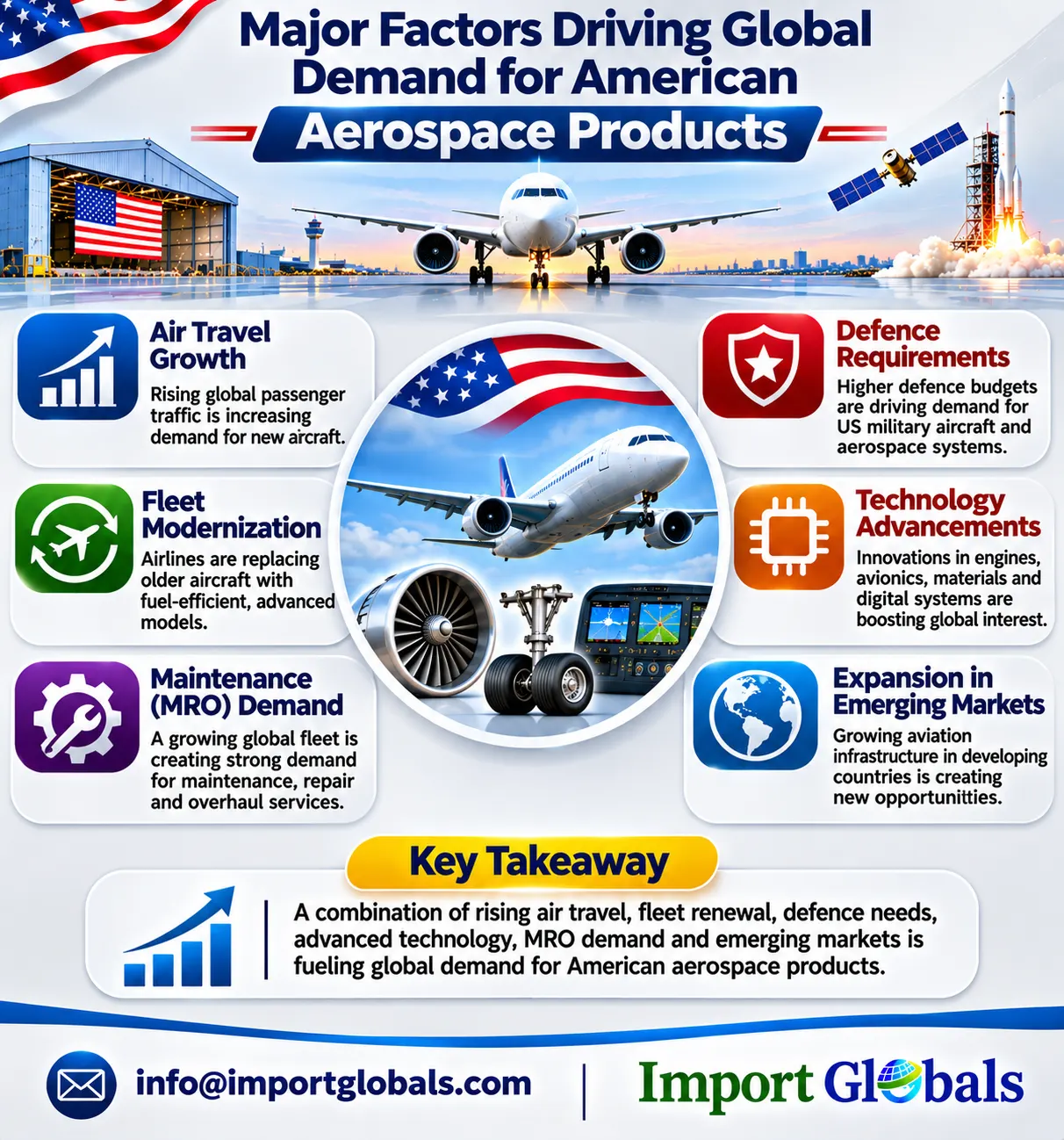
The demand for U.S.-produced aircraft and aerospace equipment is a function of numerous commercial, technological and economic determinants.
1. Growth in Global Passenger Aviation
International air traffic is a big factor affecting the demand for aircraft as more flights mean airlines could need to buy more planes, engines and aviation equipment.
Airlines also take into account cost efficiency, consumption, maintenance requirements and availability of aircraft when buying.
2. Expansion of Air Cargo Operations
International e-commerce, manufacturing and commerce make air freight a very important part of global logistics. Freight carriers require aircraft, engines, loading equipment and aviation components to function.
This creates a demand for American aerospace companies that make cargo aircraft and equipment.
3. Aircraft Modernisation
The business of Airlines and Aircraft Operators is continuously upgrading itself for better safety, effectiveness and efficiency. The upgrade may involve navigation systems, communication systems, cockpits and engine and cabin systems.
4. Demand for Aircraft Maintenance and Replacement Parts
Aircraft are always going to need inspections, maintenance services and replacement parts during their entire life cycle. The growth of aircraft fleets worldwide has increased demand for replacement parts and repair products.
5. Technological Innovation
The industry is moving forward with improvements in light weight materials, electronic aircrafts, automation, engine efficiency and aerospace engineering. Companies that provide competitive and reliable technologies can expand their market presence internationally.
6. Global Aerospace Supply Chain Integration
Aircraft production involves international networks of component suppliers, material suppliers and technologies. This opens the door for US exporters to provide specialized products used in the overseas manufacture and maintenance of the aircraft.
Opportunities for US Aerospace Manufacturers and Exporters
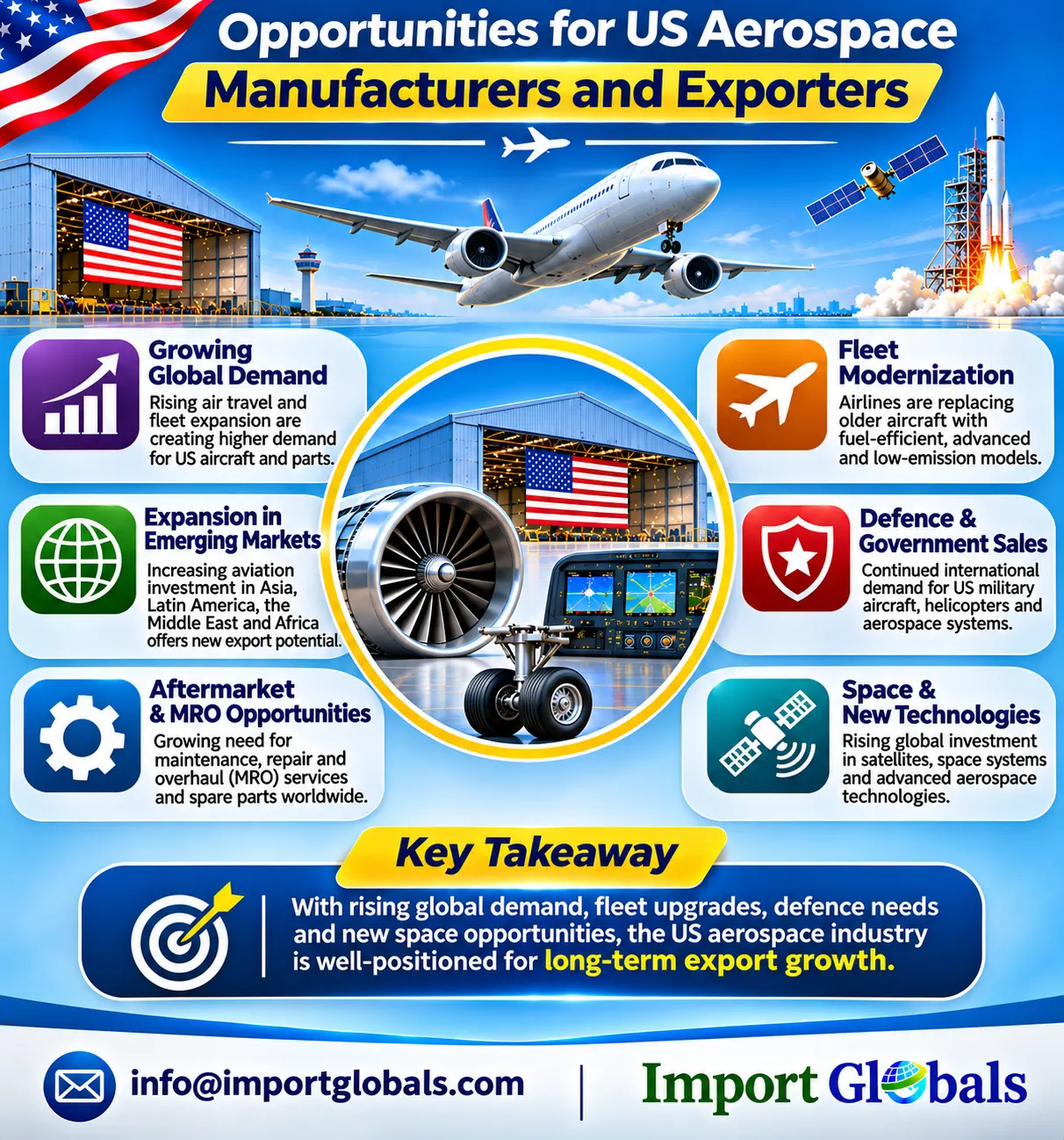
In the global market for aerospace products, there are opportunities for existing firms as well as specialists. But, they will have to know the right product categories, markets and its needs before making any investment on the exporting front.
Some important opportunities include:
1. Commercial Aircraft Exports: Aircraft manufacturers can sell to international airlines, to leasing companies, and to companies that replace and expand fleets.
2. Engine and Propulsion Products: Aircraft makers, maintainers and aviation services companies can buy their products from engine makers and component suppliers.
3. Replacement Parts and Components: Certified parts suppliers, including landing gear, braking systems, electrical equipment makers and others, can go after maintenance and repair companies worldwide.
4. Aviation Electronics: Aircraft operators and aerospace manufacturers can be customers of makers of Naviation, communication, monitoring and flight control systems.
5. Maintenance, Repair and Overhaul Markets: The world is seeing an increase in the number of aircrafts which provides opportunities for companies manufacturing maintenance equipment, spare parts and special technical products.
6. Space and Satellite Equipment: Firms in the aerospace industry which deal with space craft technology, satellite systems and propulsion equipment may consider the possibility of entering the international market depending on the export restrictions.
7. Regional Aerospace Partnerships: Companies could also look at working with foreign distributors, suppliers, maintenance facilities and aircraft makers.
Exporters should not assume that strong domestic demand will be reflected in immediate sales. The aerospace industry has long qualification processes for purchases.
Challenges Facing US Aircraft and Aerospace Exporters
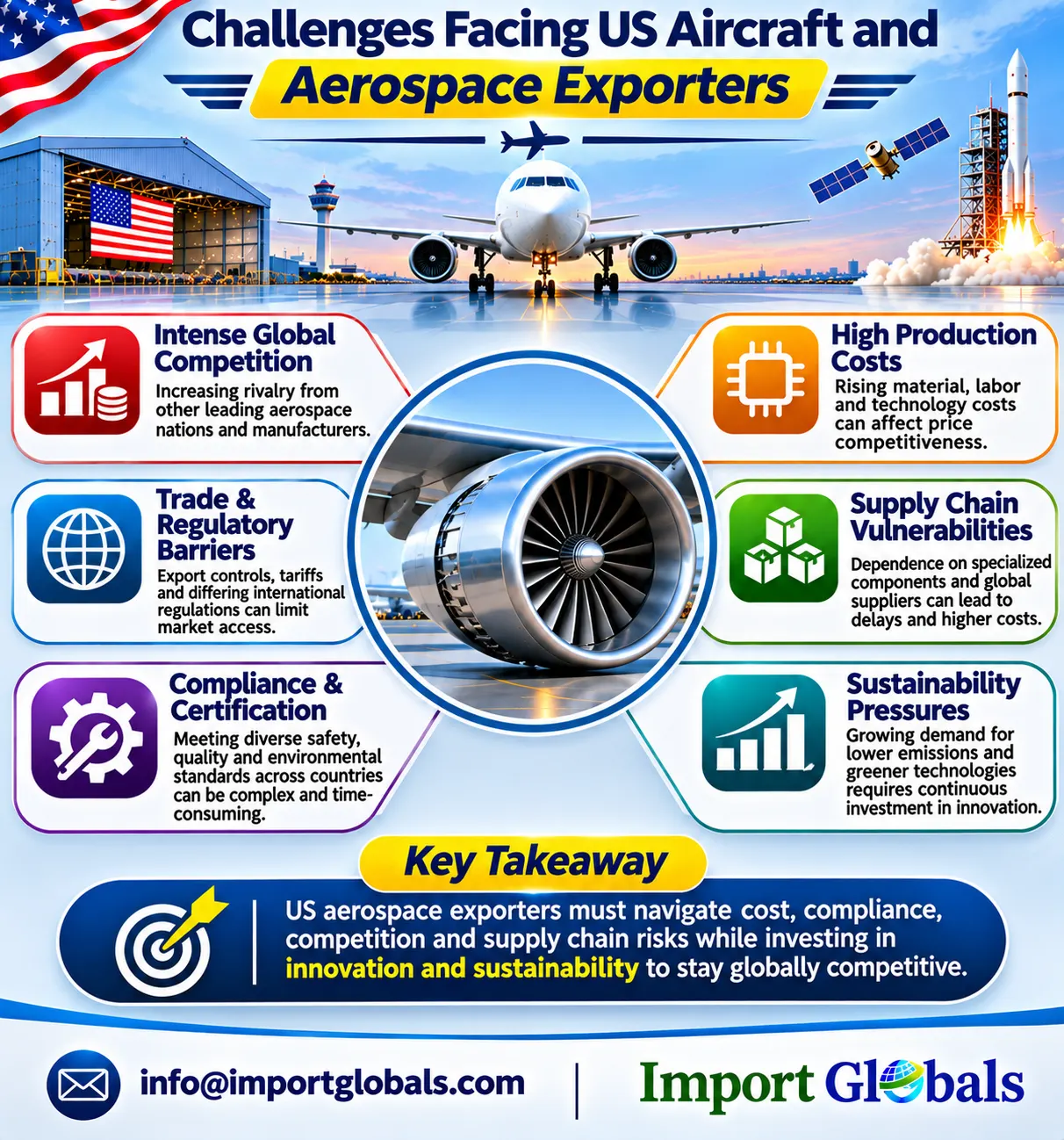
Despite a high level of international demand for aerospace products, there are several factors that could affect the aerospace exporter’s production and international competitiveness.
1. Strict Regulatory Requirements
The exporter must fulfill certain technical, safety and airworthiness requirements for the aircraft and aviation parts and produce certification documents and technical information.
2. Export Controls and Licensing
Some aerospace technologies and technical information are included in the category of the restricted items under the US export control rules.
3. Supply Chain Disruptions
The aerospace industry is very dependent on specialized materials and electronic parts, precision parts and specialized suppliers, and delays in any of the above will affect the production schedule.
4. High Manufacturing Costs
For example, huge investments are made in aircraft production in terms of engineering, equipment and testing.
5. International Competition
The US manufacturers compete with aerospace companies of Europe, Canada, Brazil and many other countries with strong manufacturing capabilities in their economies. Buyers look at technical ability, delivery time, financing, after-sale service and running costs.
6. Geopolitical and Market Uncertainty
Aerospace sales are influenced by government procurement programs, trade embargoes, diplomatic events and policy change by governments. Exporters should assess political and business risks before moving into new markets.
7. Long Sales and Procurement Cycles
Aircraft and major parts thereof are valuable products. Buyers will perform technical and business evaluations before entering into contracts, which will extend the sales cycle relative to other industries.
Such knowledge will be useful for developing rational export plans and reducing business risks.
Importance of Export Regulations and Aerospace Certifications
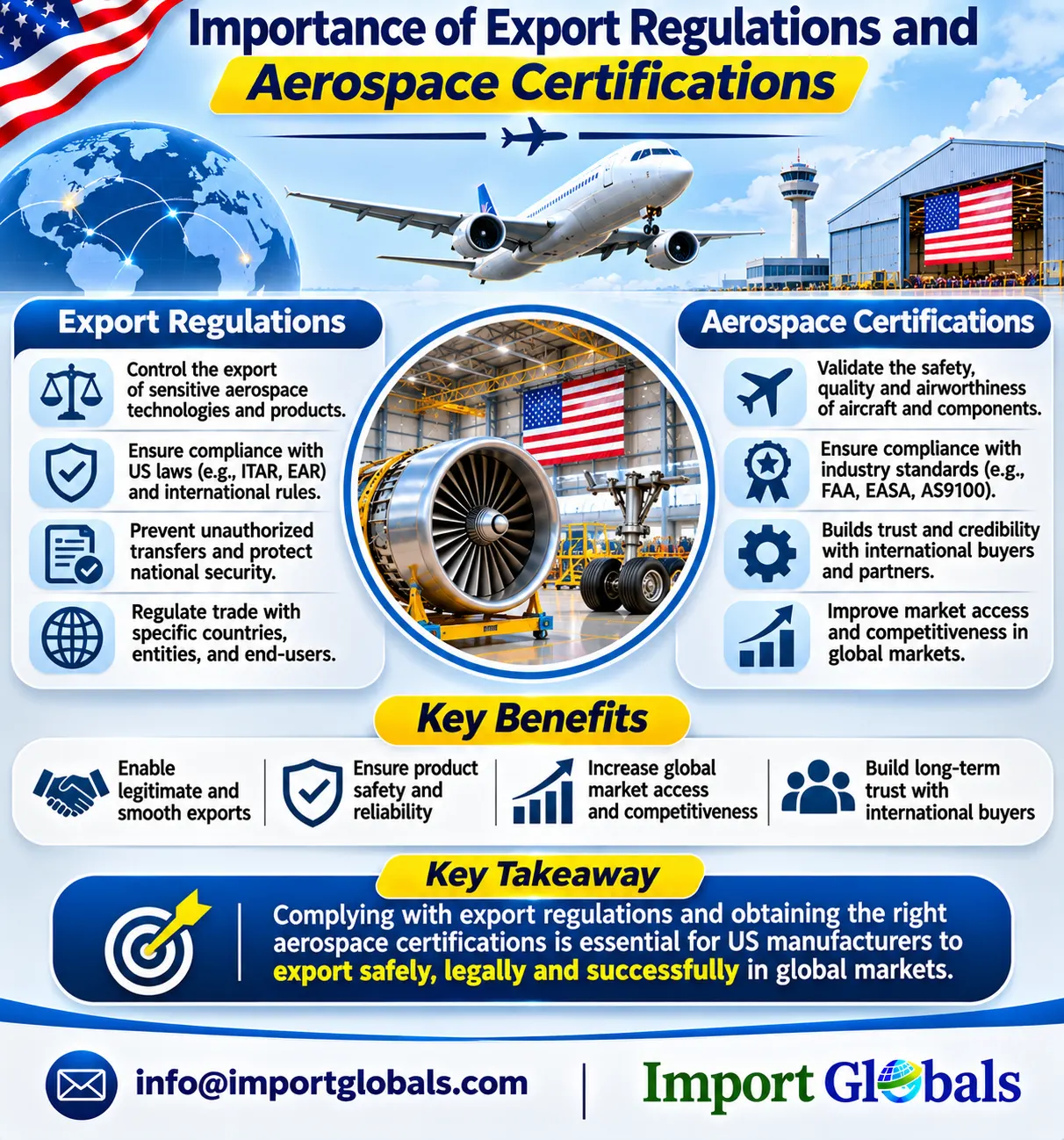
Compliance is one of the main criteria that companies involved in the international business of aircraft and aerospace need to meet. Aircraft, engines and aviation parts must meet all technical and regulatory requirements before being exported to another country.
Some of the aircraft, engines, propellers and other aviation parts are issued export airworthiness approval by the Federal Aviation Administration (FAA). Its process distinguishes between different types of approvals:
- FAA Form 8130-4: Export Certificate of Airworthiness for the entire aircraft.
- FAA Form 8130-3: Authorized release certificate/airworthiness approval tag (for engines, propellers and other qualifying items).
The FAA states that a certificate of airworthiness is not, in itself, authority to operate the aircraft. Also the requirements and agreements of the importing country have to be taken into consideration.
It is also important for exporters to distinguish between commercial aerospace goods and defense items. The Export Administration Regulations (EAR) are regulated by the United States Department of Commerce pertaining to certain commodities, software and technology. Some defense articles and services are regulated by the US Department of State.
Before completing an export transaction, businesses should consider:
1. Correct product classification and export control regulations.
2. Restrictions and licensing in the country of destination.
3. Screening of buyers and users.
4. end-use verification and documentation
5. Certification and importation in the destination country.
6. Description of the product and customs documentation.
Export control responsibilities will depend on the product. One should not assume that export control regulations apply to all aircraft products. You should instead reach out to the appropriate authorities and compliance people.
Role of US Shipments Data in Identifying Aerospace Buyers
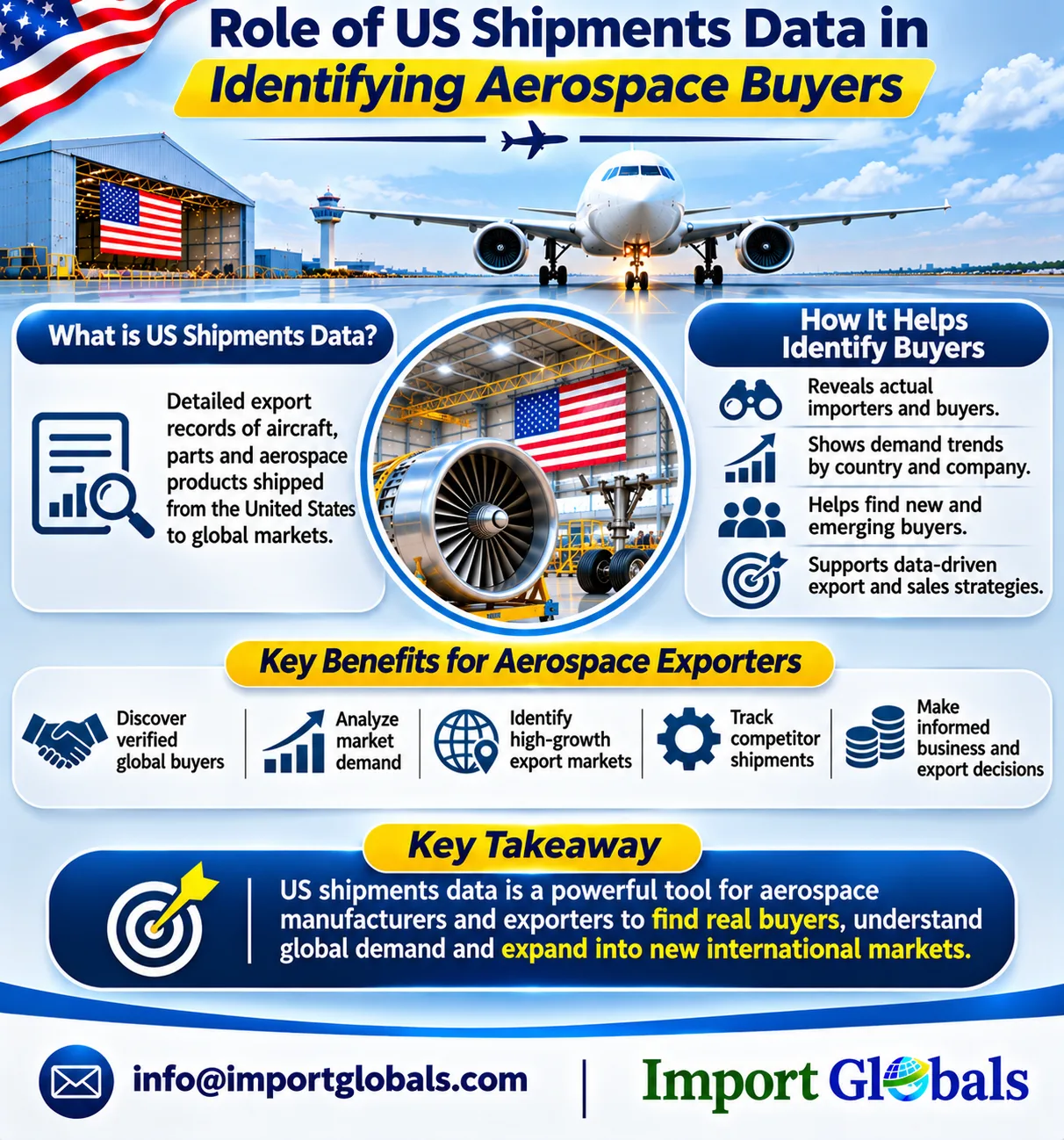
One of the essential steps in developing a successful business exporting aerospace products is to identify actual international buyers. Manufacturers and suppliers need to understand precisely who is purchasing aircraft products, where shipments are heading and which markets have consistent demand.
US Shipments Data can assist in analyzing shipments in detail depending on the data source used and the scope of reporting.
Aerospace companies can use shipment intelligence to:
1. Identify the international buyers and importers.
2. Track movements of shipments associated with certain product categories.
3. Be aware of the countries involved in aerospace trade.
4. Examine the relationships between suppliers and buyers.
5. Investigate competitors’ activities.
6. Create new markets for aircraft parts and aviation equipment.
For example, an American exporter of aircraft parts may use international shipment intelligence to identify countries that import such products and then analyze the activities of potential maintenance providers, distributors, and aviation companies in the areas of interest.
However, note that not all sales of aircraft are included in the data on shipments. In addition, there may be relatively little shipment information concerning major aircraft operations, defense shipments and other sensitive shipments.
With the help of shipment intelligence combined with company and market research, an exporter will be able to develop a sound export business development plan.
How US Trade Data Helps Businesses Analyse Aerospace Export Markets
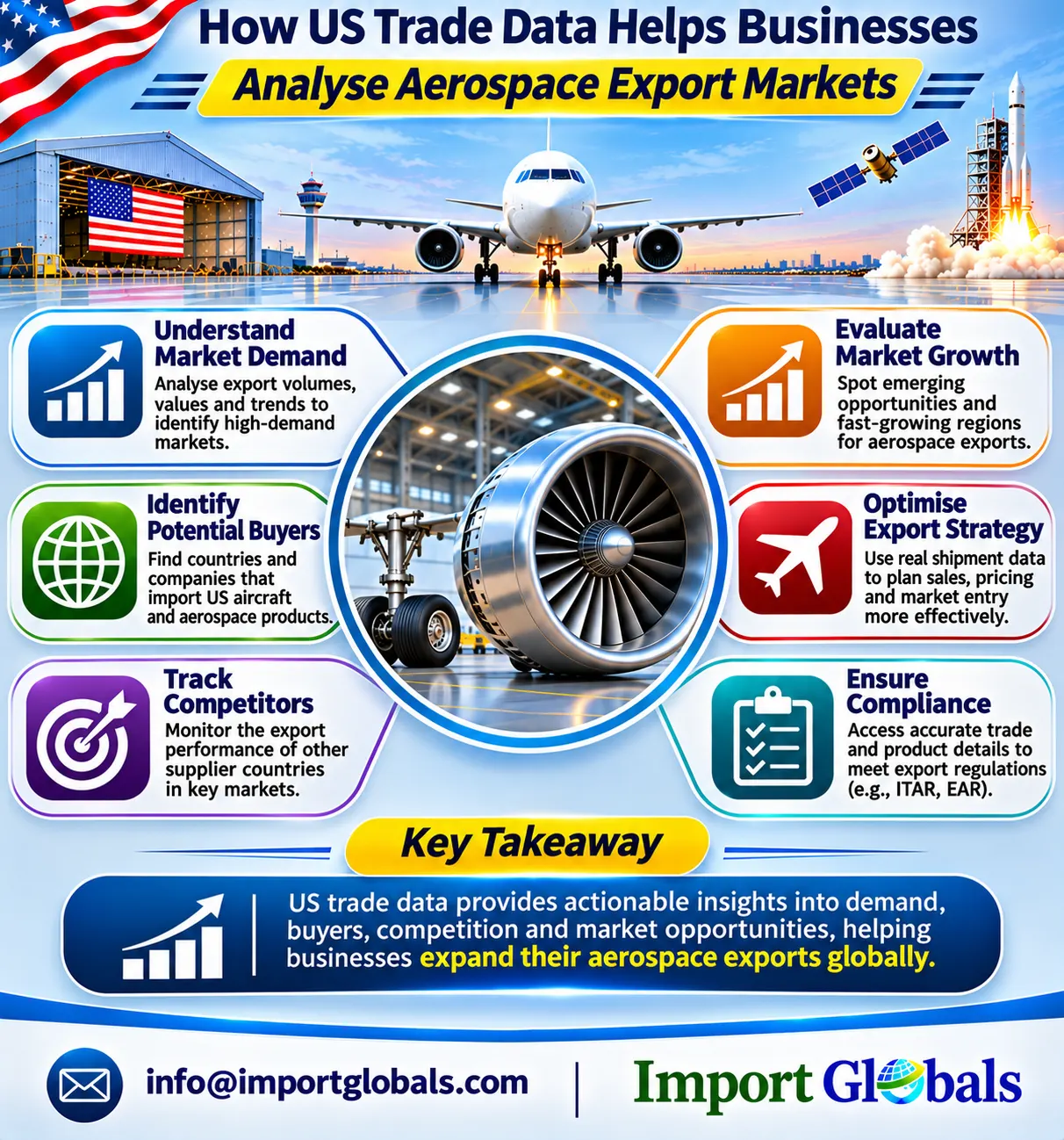
Trade information is one important factor that can influence the decisions made in international business operations. One of the most important steps in business operations for aerospace manufacturing companies can be seen as the choice of export destinations among different countries.
US Trade Data helps businesses to understand the importance of some markets for commercial purposes and analyze trends in international trade.
Important applications include:
1. Market Selection: Firms can use country comparisons to find out if there is any demand for aerospace imports in countries.
2. Competitor Analysis: Exporters can study the trade activity so they know the global presence of competing exporters.
3. Buyer Research: Information on trade and company data, where available, can be used to aid in the identification of potential importers and distributors.
4. Product Demand Analysis: Companies can look at the movements in aircraft, engine parts and aviation equipment to get a sense of market activity.
5. Supplier Research: Information on imports can help learn about global supply chains serving U.S. aerospace industry.
6. Long-Term Planning: Understanding the history of trade can help us make sense of what is happening in the markets today.
For example, an aircraft engine component specialist can look at exports in Europe and Asia and combine this information with changes in airline fleets, maintenance requirements and local certifications to identify potential customers.
It is also worth noting that customs trade data and shipment information are indicators of different sides of foreign trade. They should not be viewed as measures of aircraft orders, deliveries, revenues or future demand.
Emerging Trends Shaping the Future of US Aircraft and Aerospace Exports
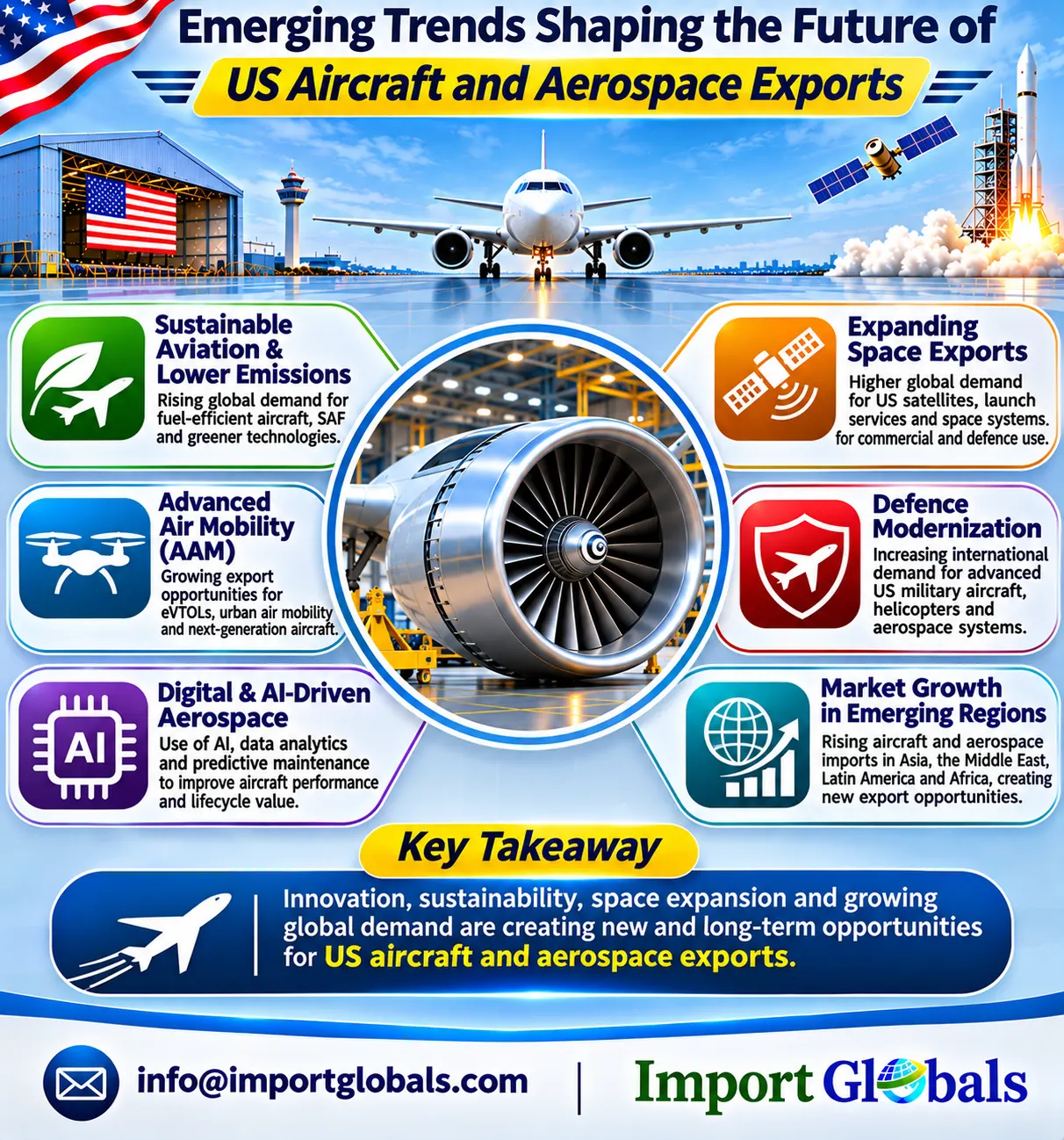
New technologies, airline investment, and shifts in worldwide demand for aviation will determine the future of U.S. aerospace exports.
Several important trends are worth monitoring.
1. Fuel-Efficient Aircraft and Engines
Airlines are giving more weight to efficiency and green credentials. That opens up prospects for manufacturers of engines and parts that could reduce fuel consumption.
2. Sustainable Aviation Technologies
Aviation companies are beginning to explore sustainable aviation fuel, more fuel-efficient aircraft designs and other propulsion technologies. Such technologies are researched and designed by US companies.
3. Digital Aviation Systems
Today the aviation industry is full of connected technology, advanced sensors, digital monitoring and predictive maintenance. Those technologies generate requirements for avionics, software-enabled equipment and electronic components.
4. Advanced Manufacturing
Automation, 3D printing, precision machining and quality control through digitalization are transforming the aerospace manufacturing industry. Firms investing in such capabilities might achieve greater efficiency of production and uniformity of products.
5. Growth in Aircraft Maintenance Markets
The continuous operation of large fleets of commercial aircraft generates a long-term demand for maintenance, spare parts and technical equipment.
6. Expansion of Space-Related Industries
The satellite manufacturing industry, launching systems, spacecraft technologies and space infrastructure are new business opportunities for companies engaged in the wider aerospace industry.
7. International Supply Chain Diversification
Aerospace companies are looking at their supply chains to ensure production continuity and to manage any supply chain risks. It can open up business opportunities for well prepared firms in other countries.
How Businesses Can Use US Trade Statistics to Discover New Opportunities
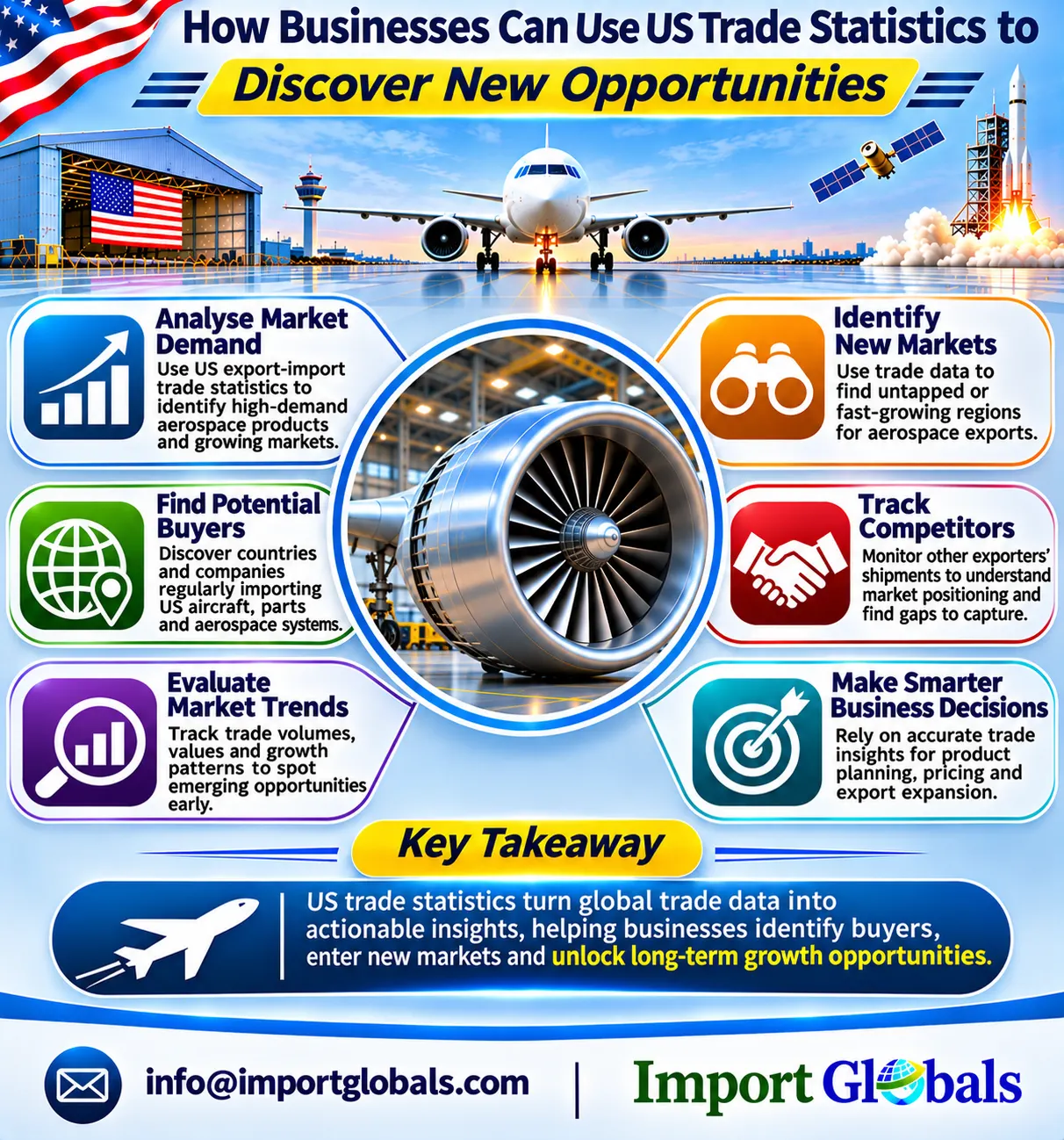
Statistics of trade will help aerospace industries to overcome assumptions of market operations and to realize certain patterns of international trade.
US Trade Statistics provide a basis for the analysis of export values, types of products, trading partners and market activities. The company will be able to use such data to make certain decisions about product placement, buyer profiles and international expansion.
A practical market research process can include the following steps:
1. Identify the Product Category: Determine if the industry trades in complete aircraft, engines, parts, avionics or other aerospace products.
2. Check the Correct HS Classification: Make sure you select the right customs category to get realistic comparisons.
3. Review Historical Exports: Analyze changes in export volumes and values where available.
4. Compare Destination Markets: Identify the nations that import the relevant products from the USA.
5. Research Potential Buyers: Research on airlines, maintenance facilities, distributors & aerospace companies.
6. Analyse Competitors: Identify the suppliers that operate in the target markets.
7. Check Market Regulations: Review the certification/licensing/imports/end use requirements.
8. Develop an Export Strategy: Choose markets based on their demand and your feasibility.
They also need to know the difference between general industry data and customs classification data. The data regarding aerospace and defense exports. Chapter 88 of HS covers aircrafts and spacecraft and their parts. An example is the data provided by the Aerospace Industries Association which is $172.7 billion.
Incorporating trade intelligence with regulatory and commercial research allows companies to better identify real market opportunities.
How Import Globals Supports Businesses in the Aerospace Trade Industry
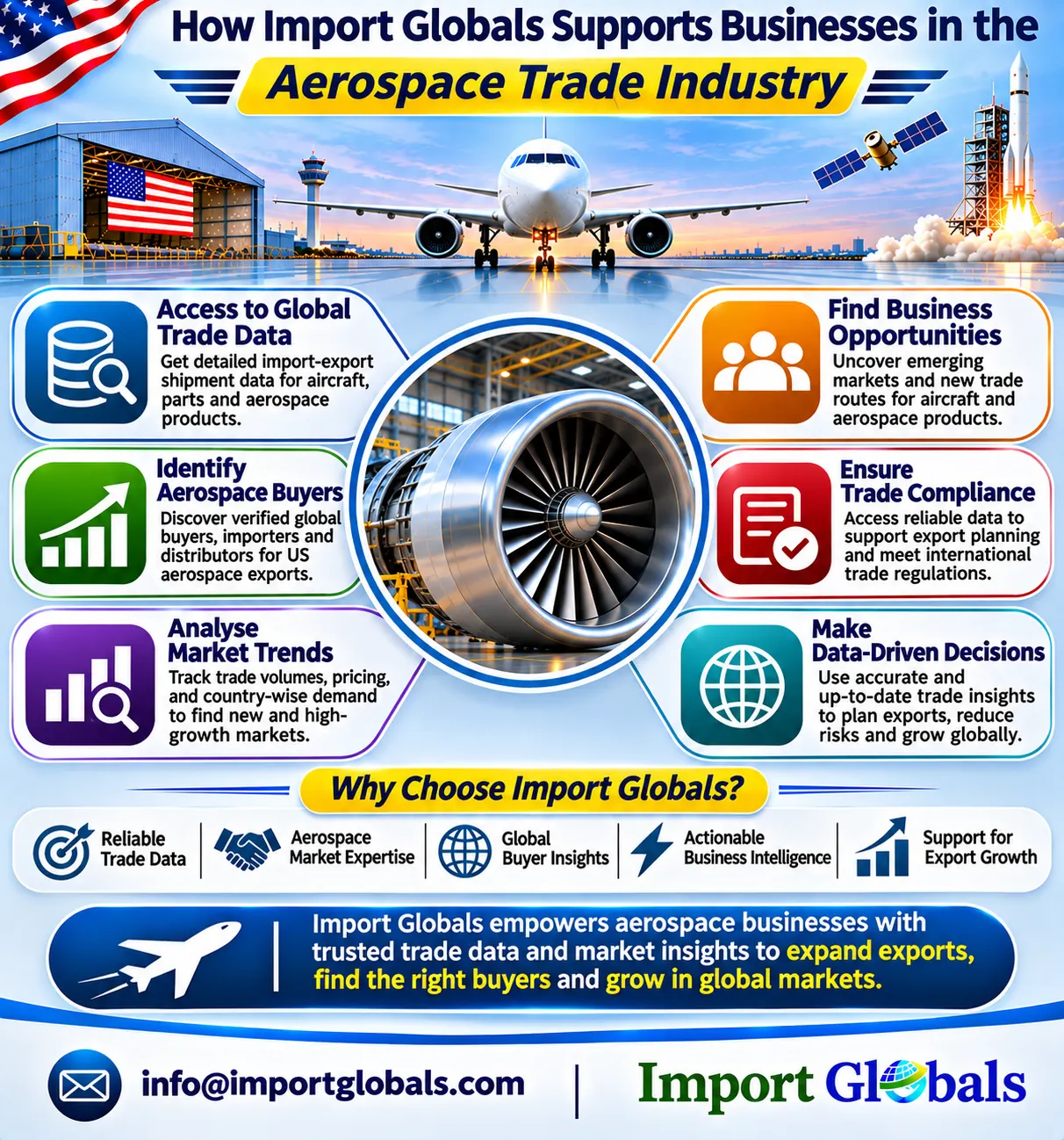
Aerospace industry consists of a complex network of international supply channels involving aircraft manufacturers, components suppliers, aviation maintenance companies, distributors and other specialized companies. Accurate market intelligence is needed to find adequate partners for trade and to get an idea of the dynamics of international markets.
Import Globals is a company specializing in information services on international import/export markets.
For companies involved in aircraft and aerospace exports, Import Globals can support market research through:
- International Market Research: Search for possible markets for aerospace goods sales and identification of trade flows.
- Buyer and Supplier Identification: Look for foreign firms that are active traders in the products in question.
- Competitor Analysis: Study the trade data to find suppliers in the markets.
- Shipment Movement Analysis: Analyze shipment level data to identify the relationship between the traders internationally.
- Product Demand Research: Establish the type of relevant products and their import/export tendencies.
- Market Expansion Planning: Compare markets and make international business decisions with trade intelligence.
Companies looking to export U.S. aerospace products will be able to use U.S. trade intelligence to assess the aircraft-related products category, identify active trading partners, and learn about international trade flows.
Import Globals provides a company with access to trade intelligence from multiple countries and allows the company to compare international markets, not just the domestic market alone.
Future Outlook: What to Expect from US Aircraft and Aerospace Exports

The outlook for the US aerospace and aircraft export industry is positive. This is based on the importance of international aviation and the need for aircraft replacement, maintenance and technology. Aerospace companies are improving their manufacturing capabilities. Airlines need aircraft and parts.
Several developments are likely to influence the industry's future:
1. Continued International Aircraft Demand: Rising demand for commercial aircraft and related products can be fueled by growth in the airline industry and fleet renewal.
2. Higher Demand for Aerospace Components: Some parts would still be required for maintenance, repair and manufacturing processes.
3. Advanced Engine Technology: Better performance and fuel efficiency of engines would impact the manufacturing and replacement market of aircraft.
4. Digital Aviation Development: Avionic systems, automation, connectivity and predictive maintenance will create new product lines.
5. Sustainable Aviation Investment: Research on low emissions and efficient aircraft systems would influence future purchase decisions.
6. Stronger International Partnerships: The manufacturers will continue to use their worldwide network of suppliers and manufacturers.
7. Greater Focus on Export Compliance: Licensing, certification, customer screening and product classification will continue to be an integral part of any international aerospace business.
The industry will have to contend with challenges around manufacturing capacity, logistics, the competitive environment and changing geopolitics and regulation. The firms that combine product innovation with good market research and compliance with regulations will be well placed to compete internationally.
The analysis of international trade trends can be a first step for exporters and suppliers to find out where new business opportunities may exist.
Conclusion
The USA continues to be a significant player in the world aircraft and aerospace products industry, due to its advanced manufacturing technology, engineering knowhow and robust demand in the international market. Exports and imports of the United States include commercial airplanes, engines, aerospace components, navigational systems and other specialized aerospace products.
CTA
Step into the world of international aerospace trade with the trade intelligence reports of Import Globals. Identify aircraft buyers, track shipments, monitor competitors and find new export opportunities. Utilize import/export data to make better decisions for your business. Contact Us www.importglobals.com or Email at [email protected].
FAQs
Que. What are the top exports in the US aerospace and aircraft industry?
Ans. The answer is. This includes commercial aircraft, aircraft engines, helicopters, avionics, aircraft parts, spacecraft and others.
Que. What are the main importers of US aerospace products?
Ans. Top importers include China, France, Germany, United Kingdom and Brazil, according to 2025 industry figures.
Que. How much was US aerospace and defense total export in 2025?
Ans. US aerospace and defense exports in 2025 were around $172.7 billion according to the Aerospace Industries Association.
Que. What drives the demand for US aircraft exports?
Ans. The US Aircraft exports are driven by demand for fleet expansion, aircraft replacement, growing air traffic, defense requirements and maintenance parts.
Que. What are the important documents for export of aircrafts from US?
Ans. These may include commercial invoices, shipping documents, export declaration forms, license where required and FAA airworthiness certificates.
Que. What is an FAA Export Certificate of Airworthiness?
Ans. It is a certificate of approval for exportation of an aircraft, stating that it meets all the required criterion of airworthiness. It does not, however, authorize operation of the aircraft.
Que. Are there restrictions on aerospace exports from the US?
Ans. Yup. The export regulations would depend on what is being exported and how it is classified under the Export Administration Regulations (EAR) or other regulations.
Que. What can US Export data do for aerospace exporters?
Ans. US Export Data can help exporters to analyze export patterns and destination countries, compare product demand.
Que. How frequently is US aircraft and aerospace trade data updated?
Ans. US aircraft and aerospace trade data is generally updated monthly, depending on the data source and reporting schedule.
Que. Where can you obtain detailed information on US aircraft and aerospace trade data?
Ans. Visit www.importglobals.com or drop an email at [email protected] for detailed updates on US aircraft and aerospace trade data.
