Asia’s Semiconductors Export Boom of 2025: The Trade Performance Across Different Regions

- Jun 11, 2026
Asia’s Semiconductors Export Boom of 2025: The Trade Performance Across Different Regions
The artificial intelligence systems, cloud computing infrastructure, electric vehicles, industrial automation, and advanced defense technologies have upgraded the overall export of semiconductors from Asia.
Asia Import Export Global Trade Data reported the presence of top semiconductor manufacturing hubs in the region as the main factor accounting for the majority of the global chip production share. The rising demand for AI processors, high-performance computing chips, memory semiconductors, automotive electronics, and next-generation communication technologies has been promoting the remarkable growth rate of the continent's semiconductor exports.
The trade intelligence regarding the semiconductor export of Asia has become one of the valuable resources for the export authorities trying to upgrade their services on specific categories. The shipment-level trade insights are important because they help businesses identify active buyers with proper monitoring of competitor activities. Thus, semiconductor technology has become a strategic asset because it helps them plan the performance across different regions in order to strengthen their position among the globally leading traders. Subscribe to Import Globals to get the detailed insights regarding the semiconductor export of Asia via the Asia Trade Data.
Significance of the Semiconductor Industry in Asia’s Growth by 2025
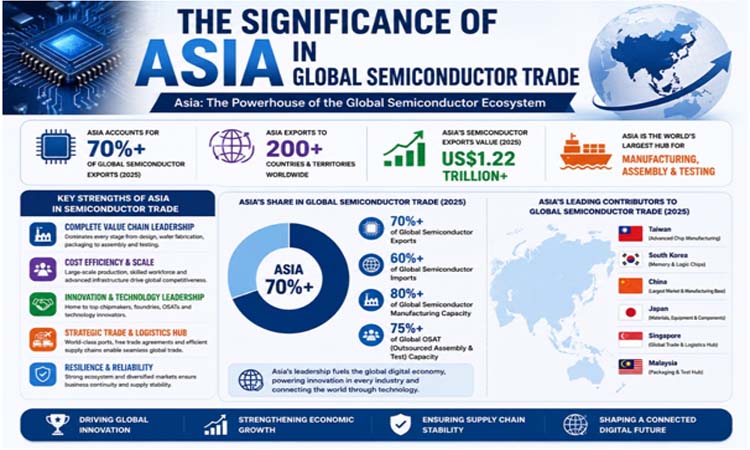
Increasing adoption of artificial intelligence, machine learning applications, cloud computing, and electric vehicles as per the global trade compliance will solidify the export of this specific category. Asia Import Global Trade Data reported the continent as one of the successful traders of technological equipment. Thus, the specific sector is responsible for the proper upgrade of different industries like artificial intelligence and data centres, consumer electronics, automotive manufacturing, telecommunication infrastructure, aerospace, and defense systems.
Tremendous amounts of employment generation have been acknowledged in these industries due to the increasing production of semiconductors in the manufacturing units. The growing global demand rate has made semiconductors a major contributor to Asia's overall trade performance. It eventually supports high-volume manufacturing activities while creating millions of employment opportunities for the skilled professionals in the region.
Why is Asia a Leading Player in Global Semiconductor Exports?
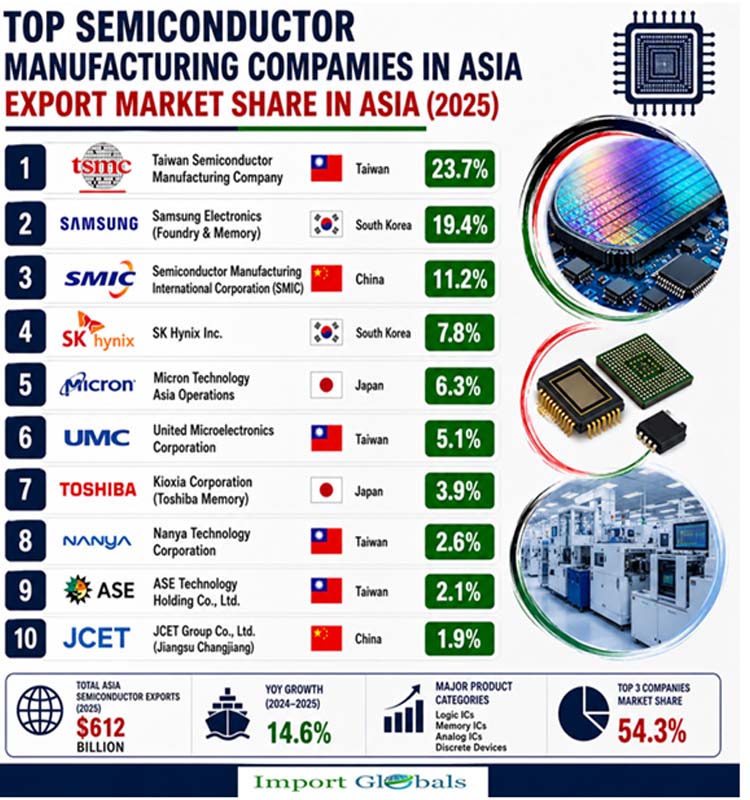
Asia Export Market Research Data reported that the dominance of the country in the global semiconductor industry is mainly because of the decades of investment in the manufacturing capabilities, research and development, and advanced engineering expertise. The quintessential factors facilitating the semiconductor export trade of Asia in 2025 are,
- Proper Upgrade of the Manufacturing Infrastructure - The heavy investment made by the Asian authorities in semiconductor fabrication facilities is initiated to increase the highly efficient manufacturing ecosystems.
- Strong Government Support - The focus of the government authorities on expanding the semiconductor industry through financial incentives and tax benefits will promote the proper maintenance of technological competitiveness.
- Skilled Workforce - The highly skilled workforce engaged in the manufacturing units influences the role of Asia as a top reliable supplier. The specialization of the continent in engineering, material science, semiconductor manufacturing, and advanced electronics production has maintained the export continuity.
- Integrated Supply Chain - Asia Export Market Analysis reported the integrity maintained by the continent with the globally demanded supply requirements as the factor solidifying the overall network connectivity. Packaging, testing, assembly, and distribution are properly managed via the demanded categories.
- AI-Driven Demand Rate - The expansion of artificial intelligence applications is supposed to boost the global demand for advanced semiconductors. The manufacturing units will benefit from the Asian authorities' dominance in production capacities.
What Information is Highlighted in the Semiconductor Export Trade Data?
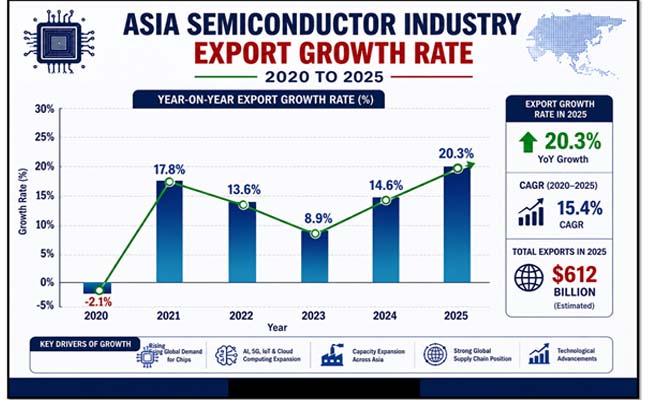
Asia Semiconductor Import Export Trade Data often provides global and detailed insights regarding the specific safe shipments from different regions within the continent to cater to the latest data-driven decision requirements of South Asian authorities. The information on the latest shipments from the regional traders includes exporter names, importer names, product description, HS code classification, shipment quantities, unit pricing information, trade valuation, destination countries, origin countries, port information, shipping dates, buyer details, transportation methods, and regional demand trends.
All this information highlighted and concluded together in one place gives a basic idea to the research authorities regarding the proper methodologies they should adopt in their trade expansion approach. The understanding of the market dynamics will eventually improve the strategic decision-making while keeping the businesses competitive amidst the global trade fluctuations.
Top 10 Semiconductor Export Variants of Asia in 2025
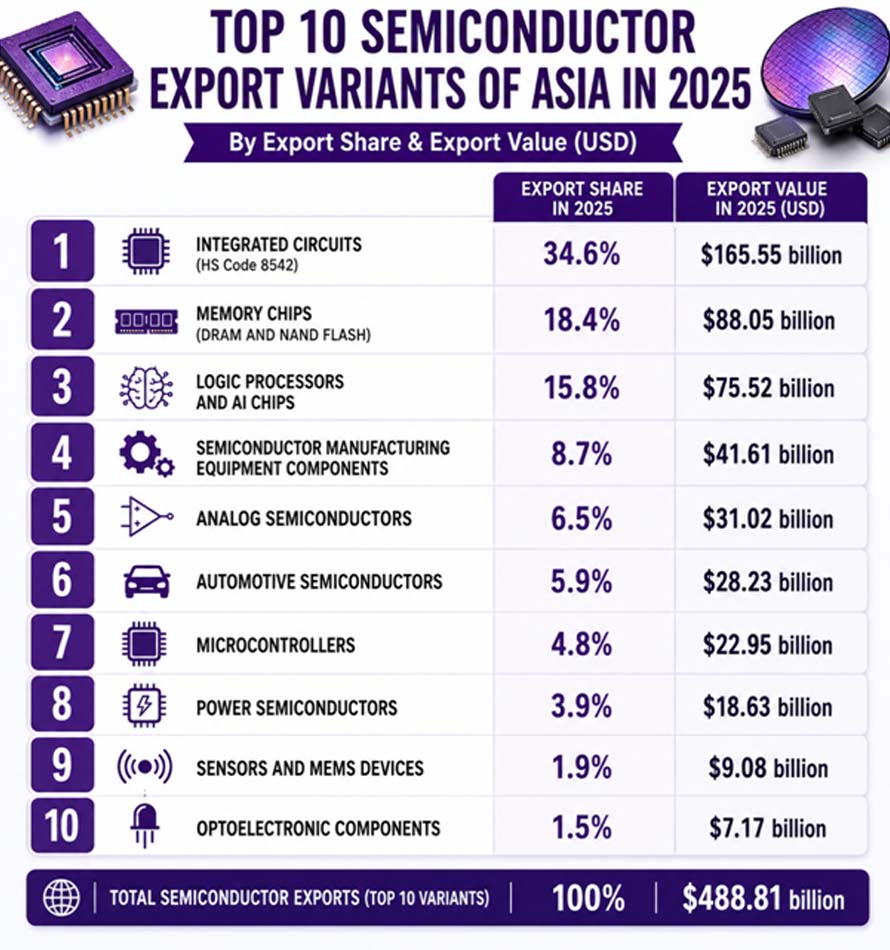
Asia Import Export Trade Data reported that the influential growth rate of the semiconductor exports of the continent is mainly because of the abundance of manufacturing ability from the top trading authorities. The regional output has diversified the overall portfolio, serving global trade compliance, resulting in a total valuation of semiconductor exports from Asia worth 550 billion US dollars in 2025. As represented by the Asia Import Export Market Analysis, the top 10 variants of semiconductor products exported from the continent in 2025 are,
- Integrated Circuits (HS Code 8542) – 34.6%
Integrated circuits hold a majority share in the export category across Asia. The smartphones, computers, networking equipment, and automotive electronics are traded under this category, which accounts for 34.6% of Asia's semiconductor exports.
- Memory Chips (DRAM and NAND Flash) – 18.4%
Memory chips account for 18.4% of the semiconductor exports of Asia. The demand rate from regions like South Korea and Taiwan is responsible for the deployment of trade continuity, driving the global demand.
- Logic Processors and AI Chips – 15.8%
Logic processors and AI chips represent 15.8% of the semiconductor trade. The growing demand for artificial intelligence, machine learning, and high-performance computing has made it one of the fastest-growing segments of semiconductor exports from Asia.
- Semiconductor Manufacturing Equipment Components – 8.7%
The specialized components for semiconductor manufacturing account for 8.7% of the semiconductor export trade of Asia. These products are increasingly important because of their effective use in manufacturing rates.
- Analog Semiconductors – 6.5%
Analog semiconductors report 6.5% of the semiconductor exports of Asia. Industrial automation equipment and power management solutions mostly demand analog semiconductors at present.
- Automotive Semiconductors – 5.9%
Automotive semiconductors account for 5.9% of the semiconductor exports of the Asian trade. Electric vehicle production and smart transportation technologies have been fuelling the overall trade of automotive semiconductors.
- Microcontrollers – 4.8%
Microcontrollers, mostly used in industrial machinery, consumer electronics, and connected devices, are reported at a trade accountability of 4.8% at present. The manufacturing ability of the topmost units in the domestic consumer base has maintained trade continuity.
- Power Semiconductors – 3.9%
Power semiconductors represent 3.9% of the overall semiconductor trade of Asia. Renewable energy systems, electric vehicles, and industrial power applications are some of the top categories traded.
- Sensors and MEMS Devices – 1.9%
Sensors and MEMS devices account for 1.9% of the global trade output of Asia. The semiconductor market, autonomous vehicles, healthcare equipment, and industrial monitoring systems are some of the top categories.
- Optoelectronic Components – 1.5%
Wrapping up the list of the topmost exported variants of semiconductors from Asia, optoelectronic components stand as the 10th most important one. The data transmission, advanced computing operations, and applications have been facilitating the export of optoelectronic components from Asia.
Regional Semiconductors Trade Performance of Asia in 2025
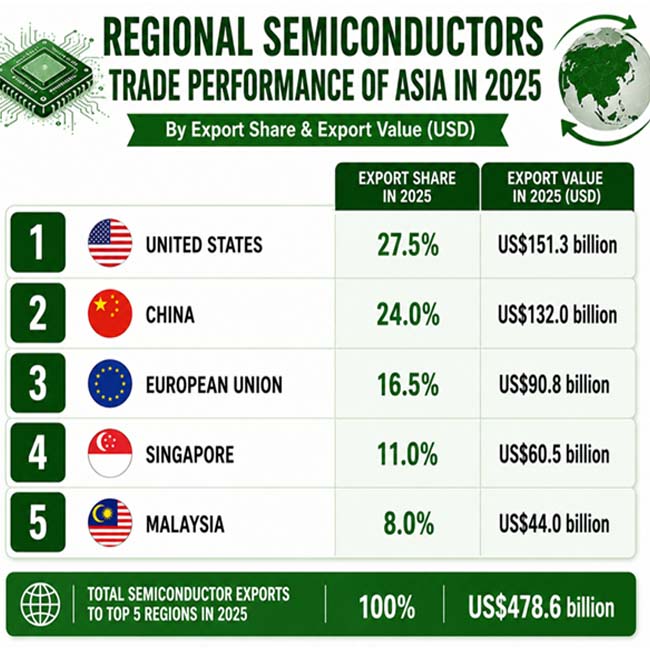
- United States – US$151.3 billion (27.5% share) - As Per USA Import Data; The United States has been one of the largest export destinations for Asia's semiconductor exports. The growing demand rate of computing infrastructure, data centres, consumer electronics, telecommunications, aerospace applications, and advanced automotive technologies has maintained the accountability of the country.
- China – US$132.0 billion (24.0% share) - As Per China Import Data; China represents 24% of the semiconductor export share of Asia. The overall trade of smartphones, computers, networking equipment, industrial machinery, and consumer electronics has maintained effective trade within both economies. The large-scale manufacturing operations are affected by the integrated circuits, memory devices, and processors.
- European Union – US$90.8 billion (16.5% share) - As Per European Union Import Data; The European Union reports 15.5% of the global semiconductor trade out of Asia. The increasingly utilized semiconductors in electric vehicles, factory automation systems, smart manufacturing technologies, and advanced communication networks have maintained the accountability rate.
- Singapore – US$60.5 billion (11.0% share) - Singapore represents 11% of the semiconductor export trade of Asia. The proper development of the logistic infrastructure, strong electronic systems, and the multinational semiconductor companies have supported the regional supply chain. It is the events that have made the investment in advanced manufacturing capabilities continuous while promoting the global semiconductor industry.
- Malaysia – US$44.0 billion (8.0% share) - As Per Malaysia Import Data; Wrapping up the list of the topmost export trade partners, Malaysia lists as the top fifth one, representing 8% share of the semiconductor export of Asia. The strong foreign investment from multinational technology and the industries involved in consumer electronics, industrial equipment, and telecommunication equipment production has promoted the overall trade.
Importance of Shipment-level Trade Intelligence in Semiconductor Exports
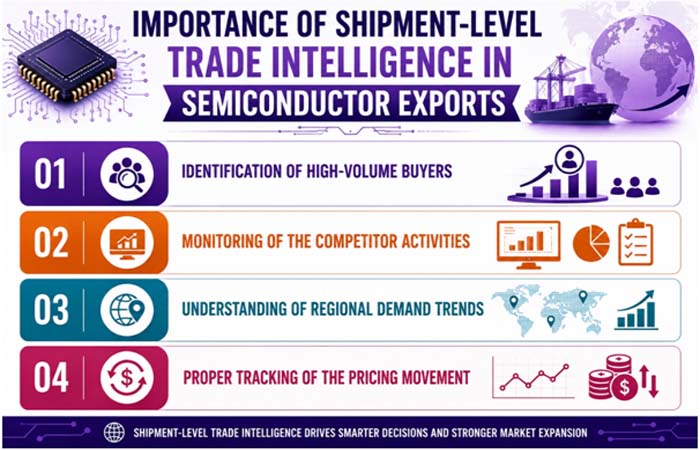
Due to the increasing intensification of the semiconductor traders on a worldwide scale, the shipment-level trade intelligence acknowledgment has now become one of the topmost factors for the research authorities to maintain compliance with the latest trade standards. The beneficial factors of Asia Import Export Data that increase the role of shipment-level trade intelligence in market expansion are,
- Identification of high-volume buyers - The businesses trying to expand their services can properly identify the high-volume buyers via the latest trade insights and the efforts put up by the government authorities in a specific sector of export.
- Monitoring of the competitor activities - The reliable access to the proper monitoring of the competitor activities helps businesses analyse the shipment product portfolios and market expansion strategies.
- Understanding of regional demand trends - The trade intelligence highlighted in the platform helps the authorities understand which semiconductor categories are the strongest as per the rising demand rate.
- Proper tracking of the pricing movement - Different government authorities set up different pricing patterns as per the globally increasing trade compliance. Businesses can properly monitor the fluctuations in the price of each rate across different markets with proper analysis.
How Does Semiconductor Export Data Support Business Growth?

- Market Expansion - The first and foremost benefit of the semiconductor export data is the market expansion. The business authorities trying to expand their services in the specific category can properly identify the emerging export destinations, which will eventually boost the growing semiconductor demand fulfilment as per the standard demand rates.
- Customer Acquisition - The reliable access to important information and potential business opportunities will help the customers get a proper understanding of the latest trade intelligence.
- Product Development - The alignment with the production strategies as per the globally evolving standards promotes the developmental initiatives taken by the government authorities for promoting the market standards.
- Risk Management - The diversification of the export strategies introduced by the trade authorities helps the business reduce dependence on individual markets while improving its resilience.
Policy Developments Impacting Asia’s Semiconductor Exports
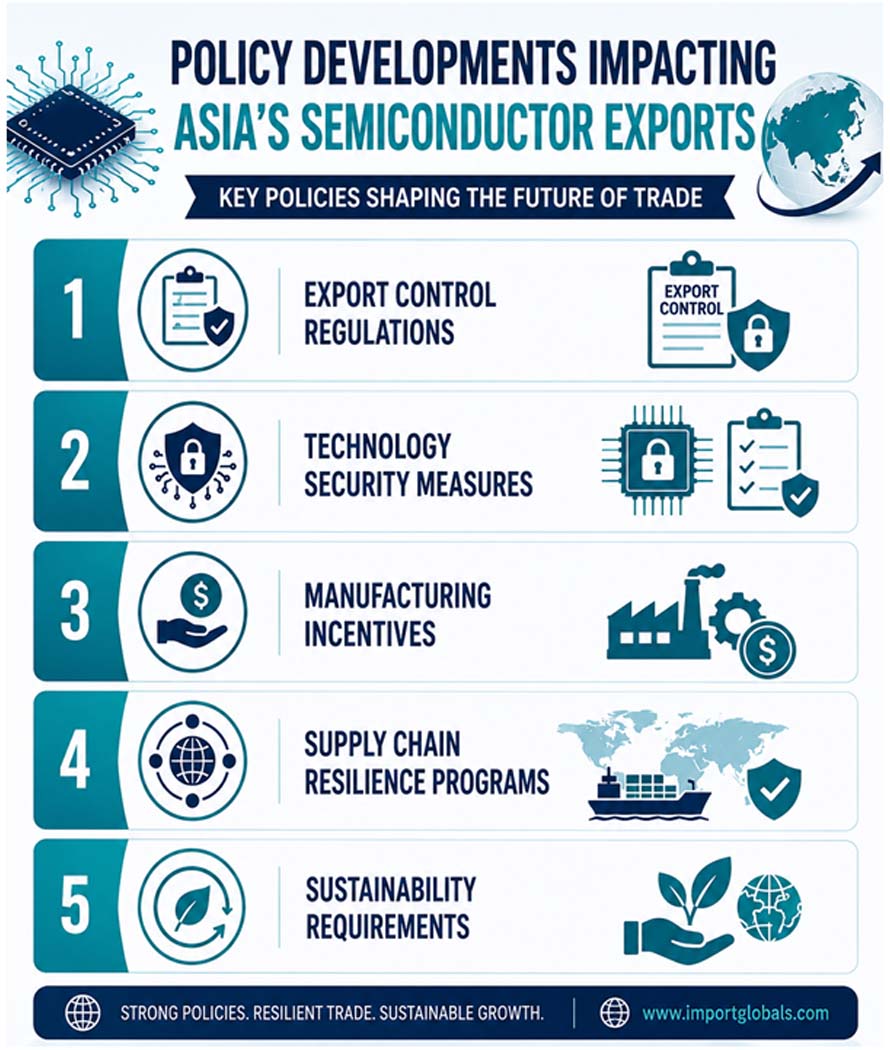
- Export Control Regulations - The government authorities worldwide are imposing severe export controls on their semiconductor exports mainly because of the growing global demand rate and to influence the international trade patterns to stay static, while increasing the export memorandum.
- Technology Security Measures - The advancement of semiconductor exports is mainly backed up by national security concerns and increased scrutiny. Technological compliance is the priority step towards the export of semiconductor essentials because of the quality-equipped products demanded on a worldwide scale.
- Manufacturing Incentives - Different authorities have been introducing incentives to support semiconductor production and investment. The growing global demand rate is a massive factor that has been influencing the trade of semiconductors.
- Supply Chain Resilience Programs - The encouraging diversification of the semiconductor supply chain by the government authorities has reduced the dependency risk. It has increased the expansion of semiconductor trades in different regions worldwide as per the demanded categories.
- Sustainability Requirements - The manufacturing practices are getting influenced by the environmental regulations. The investment decisions are also getting promoted to maintain the standards as per the increasing demand rate.
Top Factors to Resource From the Asia Semiconductor Export Data
1. Latest Semiconductor importing nations
2. Supplier analysis as per growing competition
3. Evaluation of the growing regional markets
4. Identification of buyer opportunities
5. Acknowledgement of the pricing trends
Conclusion - Semiconductor export of Asia is a representation of the growing importance of the specific commodity within the Asian continent. Asia export market statistics reported artificial intelligence application and the cloud computing infrastructure, along with advanced telecommunication systems, as the main factors creating unprecedented opportunities for worldwide manufacturers.
The Asia Export Data is a proper representation of the countries involved in the import and export of semiconductors from the continent, the manufacturing excellence of different regions within it, and strategic investment. The geopolitical challenges and regulatory changes are mainly shaping the Asian semiconductor exports. The shipment-level trade intelligence is important to understand the market dynamics with the proper identification of new opportunities.
CTA
Trying to get in-depth information on Asia semiconductor import export data? You have landed on the right page here. Import Global solves all the complexities with the latest trade activities of the countries within Asia via proper shipment-level analysis. Subscribe to www.importglobals.com, or email at info@importglobals.com the buyer and seller's information, along with the HS code and product level classification, are highlighted, which caters to the latest data acquisitions as per the evolving standards.
FAQ’s
Que. Why are semiconductor exports growing rapidly in 2025?
Ans. The increasing demand rate for AI chips, cloud computing infrastructure, electric vehicles, and advanced telecommunication technologies has recorded a proper spike in the semiconductor exports of Asia in 2025.
Que. Which Asian countries mostly export semiconductors from scratch?
Ans. Asia export import trade data reported Taiwan, South Korea, Japan, Singapore, Malaysia, and China as the top semiconductor exporting regions of Asia.
Que. What are the top-exported semiconductor products of Asia in 2025?
Ans. Integrated circuitsand automotive semiconductors are the top-exported semiconductor products of Asia in 2025.
Que. How accurate is Import Globals “Asia semiconductor export trade data”?
Ans. Import Globals Asia Semiconductor Export Trade Data is efficient for proper delivery of the shipment-level insights and is directly sourced from the customs trade providers.
Que. How frequently is the Asia semiconductor export data updated?
Ans. The Asia Semiconductor Export Data of Import Globals is updated as per the availability of the importing and exporting countries and the reporting cycles.
Que. Can I identify the competitive suppliers of semiconductors through export records?
Ans. Yes, via the proper monthly shipment tracking, you can easily identify the growing semiconductor export demand and the seasonal buying patterns.
Que. Which industries benefit most from semiconductor exports?
Ans. AI, automotive, telecommunications, aerospace, healthcare, and industrial automation benefit the most from semiconductor exports.
Que. How are the implemented government policies affecting the semiconductor exports?
Ans. Export controls, manufacturing incentives, supply chain resilience programs, and sustainability regulations are affecting the trade patterns while changing the investment decisions to maintain global compliance.
Que. How does Asia's semiconductor export data help businesses to grow?
Ans. Import Globals' Asia Semiconductor Export Data is considered a beneficial tool for business expansion because it provides visibility into buyer activity. It aids the competitor performance analysis with proper monitoring of the pricing trends and shipment-level trade.
Que. Where can you obtain detailed Asia Import Data or Asia Export Data?
Ans. Visit www.importglobals.com or email info@importglobals.com for more information on up-to-date data.
You Can Also Visit :-