Austria's Strong Exports of Machinery and Engineering
- Jan 15, 2026
Austria's Strong Exports of Machinery and Engineering
People often say that Austria has a "small open economy," but that doesn't fully illustrate how much its export engine has developed. In terms of machinery, engineering, and industrial technology, the country is always better than its size.
It ships high-quality parts and systems to Europe and to high-end markets outside of the EU. People don't usually think of Austria when they think of big engineering firms around the world. But its export profile shows that it largely sells machines and automobiles to other countries. As per Austria Import Data by Import Globals, A strong network of mid-sized industrial companies, supply chains that work all over the world, and the ability to create high-value commodities support this. Austria's lack of competitiveness is solely due to its inability to produce goods simultaneously.It is founded on accuracy, reliability, tailored solutions, and a robust partnership with suppliers, particularly in Germany and other European Union countries where industrial supply chains are interconnected.
As a result, Austrian engineering companies frequently must produce essential components for intricate industrial system networks. According to Austria Export Data by Import Globals, these components may encompass a wide range of items, including new elements for transportation, energy, and manufacturing systems, as well as robotics and automation solutions for enterprises.
The Overall Perspective: Automobiles and machinery constitute Austria's primary export commodities. In 2025, Austria's international trade performance slightly improved compared to 2024. But vehicles and tools were still the most important things to sell. This is important: No matter how much trade evolves, Austria's exports are always reliant on goods made by engineers.
Why Austria Makes the Best Machines: The "Hidden Champion" Model
Austria has an advantage in machinery because of its industrial ecology. Many of Austria's top engineering exports are mid-sized enterprises that are particularly knowledgeable about a small number of their goods. As per Austria Import Export Trade Data by Import Globals, these companies frequently win by:
1) Specialization and being right. Austrian exporters usually focus on hard assignments where performance and reliability are more essential than pricing.
2) Working with companies in Central Europe. There is always a need for parts and machinery that fit into broader value chains because it is close to Germany and other EU manufacturing centers.
3) Skilled workers and solid technical systems. Strong career routes and engineering skills help keep quality and process at a high level.
4) Compliance that is ready to be sent out. Most of the time, Austrian machinery and equipment meets rigorous EU standards. This is useful in global marketplaces that value industrial items that are controlled and certified.
Where Austrian Engineering Exports Go: First to Europe, Then to the Rest of the World
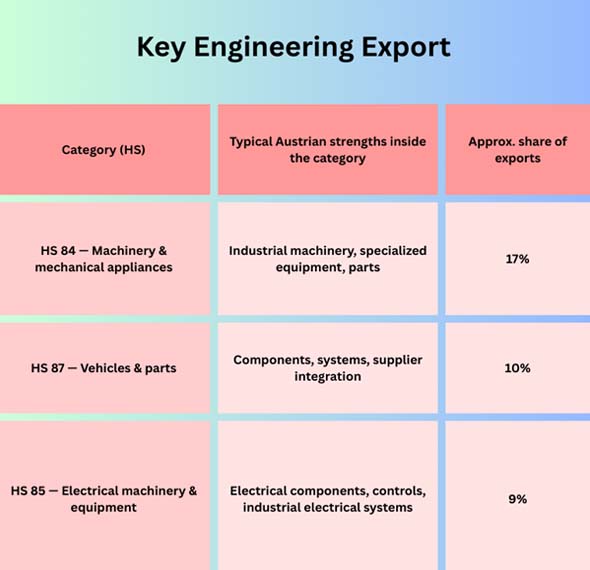
Austria's location in the heart of Europe and its significant linkages to EU supply networks are clear from its export geography. As per Germany Import Data by Import Globals, Germany is the key partner, both as a market and as a production network that gets parts and machines from Austria.
What Austria Exports in the "Machinery & Engineering" Sector: Key Sub-Sectors
Austria sends a lot of technical goods to other countries, but several things keep popping up:
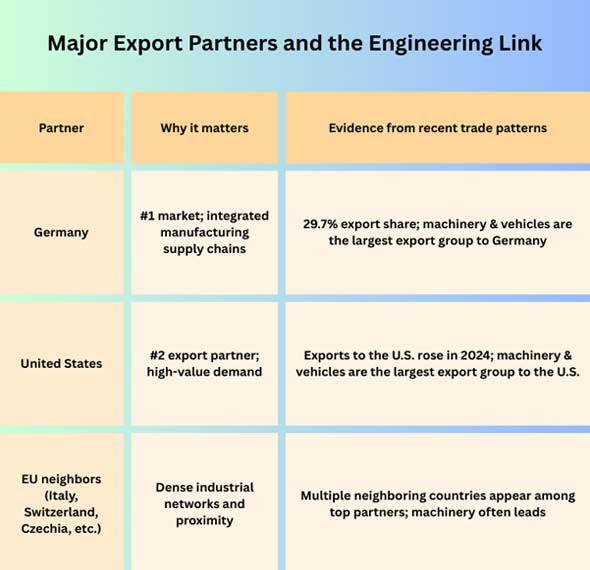
HS 84 Core: Industrial Machines and Specialized Tools
This includes machines used in factories, processing, automation, and other types of industrial activity. Not only is Austria selling "machines," but it is also sending parts and subassemblies that keep manufacturers running. These are often high-margin, high-spec products.
HS 85: Controls and Electrical Systems
As factories become more computerized, the divide between electronics and mechanical engineering becomes less obvious. As per Austria Importer Data by Import Globals, it's easier to export and make money from electrical control systems, industrial electrical parts, and equipment for power and automation.
Transportation and Automotive Engineering (HS 87)
Austria's exports of vehicles indicate what it can do and how it fits into the Central European automotive ecosystem. Even when the mix of products varies, the parts-and-systems model is still applicable, even when mobility changes (as with EVs and electrified systems).
The Competitive Outlook: What helps and hurts growth
Austria's exports of equipment and engineering are in a favorable long-term position because the global sector is still investing in three main areas:
1) Automation and making things run more smoothly in business. Manufacturing is getting better at controlling processes, using less energy, and making things more productive all around the world. This is making people want more complicated machines and parts.
2) The infrastructure needed to switch to sustainable energy. As per Austria Import Trade Analysis by Import Globals, Engineering solutions are in high demand because of the need to upgrade the grid, electrify it, and modernize enterprises.
3) Markets for compliance that are very valuable. Many clients, especially in North America and Europe, need equipment and supply chains that can be tracked and validated. Austrian exporters usually do well in these sectors.
But Austria Also has Some Issues:
Following European cycles. As per Austria Exporter Data by Import Globals, the EU is responsible for approximately two-thirds of trade, so when the economy slows down in a certain area, demand goes down.
Pressures on the cost and competitiveness of energy. Engineering exporters compete with them other all over the world, and the cost of inputs and industrial policy are vital. As per Austria Export Import Global Trade Data by Import Globals, Changes in tech. Digitalization, electrification, and software-defined industrial systems need to be updated all the time, especially in supply chains that have to do with cars.
The Next Step: More "Tech Inside" in Engineering Exports Austria's future edge in machinery is expected to expand when mechanical engineering combines digital technology and energy efficiency:
Improved machines (such sensors, controls, and predictive maintenance), Making procedures that utilize less energy, good parts for electrified industrial equipment, customized machines that are used in new value chains for production.
As per Austria Import Shipment Data by Import Globals, Austria doesn't have to become a software economy to compete, though. This means that Austrian machinery exporters are winning more and more by selling solutions that combine hardware, electronics, and integration instead of just hardware.
Finally, Austria's robust exports of machinery and engineering are not a fluke; they are part of the system. Austria's industrial base is an important part of the supply chains that support Europe's economy and serve high-end customers around the world.
About 37% of Austria's exports are machinery and automobiles. As per Austria Import Export Trade Analysis by Import Globals, the country is a major player in machinery (HS 84), electrical equipment (HS 85), and cars/parts (HS 87). Austria's primary strength is that it can make high-quality, specialized industrial goods that customers require to be productive and dependable. As the engineering industry develops toward automation, electrification, and efficiency, Austria's engineering exporters have a strong base to protect and grow their share of global trade. Import Globals is a leading data provider of Austria Import Export Trade Data.
FAQs
Que. Why is machinery so important to Austria's economy?
Ans. Austria is famous for developing high-quality industrial machinery, parts, and equipment that may be used in manufacturing supply chains all throughout Europe and the world.
Que. What percentage of Austria's exports are cars and machines?
Ans. According to recent official trade figures, over 37% of Austria's exports are in the machinery and vehicles category.
Que. What are the most essential places for Austrian engineering exports to go?
Ans. The EU is the most important trading partner, and Germany is the most important partner. The US is also a popular place to send high-value goods.
Que. What is the best opportunity for Austrian engineering exports to increase over the next 10 years?
Ans. Supplying industrial systems that automate, make things more efficient, and employ electricity, where Austrian precision and integration abilities are highly required.
Que. Where to get detailed Austria Import Export Trade Analysis?
Ans. Visit www.importglobals.com.