Bangladesh's reliance on cotton, fuel, and machinery for imports (2025–26)
- Jan 31, 2026
Bangladesh's reliance on cotton, fuel, and machinery for imports (2025–26)
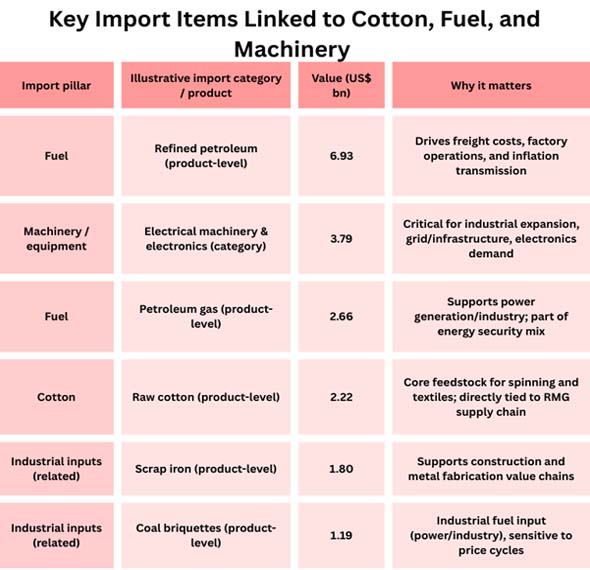
This is partly because it relies heavily on imports, which isn't talked about as much. Cotton, fuel (refined petroleum, LNG/petroleum gas, and other energy inputs), and machinery and electrical equipment will all have an impact on the country's industrial output, inflation, and foreign exchange stability between 2025 and 2026.
As per Bangladesh Import Data by Import Globals, These imports aren't just for eating; they're the "production inputs" that keep factories running, lights on, and logistics moving.
This dependence isn't harmful on its own. A lot of raw materials and capital products are brought in by many successful export economies. Bangladesh's biggest problem is how to deal with the risks of global price shocks, shipping delays, exchange-rate pressures, and limited access to financing while still increasing exports and making Bangladeshi goods more valuable.
Why These Three Inputs Take the Lead in Bangladesh's Import Story
1) Cotton: The Most Important Part of the Clothing Export Business
As Per Bangladesh Export Data by Import Globals, Bangladesh is one of the biggest exporters of clothing in the world, yet it doesn't grow a lot of cotton. That means that the whole clothing industry, from spinning and weaving to knitwear and finished clothes, depends on cotton and cotton yarn and textiles that come from other countries. When more cotton is imported, it usually means that textile capacity is being used more efficiently and that the RMG order pipeline is healthier. When they go down, it could mean that demand is weak, working capital is tight, or there are supply bottlenecks.
2) Fuel: As per Bangladesh Import Export Trade Data by Import Globals, the most important part of production, shipping, and keeping prices stable
Bangladesh is Affected by Fuel Imports in Three Ways at Once:
- Factory work (direct energy consumption, captive power, and industries that use a lot of energy)
- Transport and logistics (moving goods and people through ports, roadways, and inland corridors)
- Inflation and household budgets (the cost of fuel affects the cost of food and other products)
- Bangladesh's industrial growth remains depends on imported energy, especially refined petroleum products and gas-related imports, even if the country uses more renewable energy and becomes more efficient.
3) Machinery and electrical equipment: As per Bangladesh Import Custom Data by Import Globals, the "capital" that makes industrial upgrading possible
To grow exports and move into higher-value goods, you need sophisticated machines including textile machines, industrial equipment, power and grid parts, electronics, automation, and spare parts. When Bangladesh invests in expanding or modernizing its capacity, it generally buys more machinery from other countries. But they also raise the cost of imports right away and can make it hard to get foreign currency when times are tough.
Cotton Dependence: From Imports to Money Made from Exports
Bangladesh imports cotton because it makes clothes and sells them.
As Per Bangladesh Import Trade Analysis by Import Globals, the clothing ecology works in a simple loop: cotton comes in, textiles are manufactured, clothes are sent out, and money is made. As Bangladesh's clothing industry grows, it becomes more and more important to be able to import cotton.
Recent reports from the textile industry show that cotton imports stayed strong through 2024/25, with estimates of roughly 8.28 million bales for that market year and a forecast of 8.4 million bales for 2025/26. That scale indicates how much the industrial foundation relies on a consistent flow of cotton.
Supplier Concentration is a Concern That Isn't Obvious
When cotton comes from only a few places, fluctuations in pricing, shipping problems, or regulation changes can swiftly affect manufacturing profitability. As per Bangladesh Exporter Data by Import Globals, Bangladesh aggressively diversifies its sourcing among major exporters, and changes in supplier shares can have an effect on both cost and quality (fiber properties are important for different types of yarn and fabric).
What It Means for Competitiveness to Depend on Cotton
Cotton imports have an effect on:
- Working capital needs (LC availability, finance for imports)
- As per Bangladesh Importer Data by Import Globals, lead times are the amount of time it takes for cotton to arrive and for the finished item to be shipped.
- Cost structure (the price of cotton around the world, shipping, and the exchange rate)
- Compliance and traceability (more and more critical for brand buyers)
- Bangladeshi exporters' winning edge in 2025–26 will not just be low cost; it will also be reliability, speed, and compliance, all of which get better when cotton sourcing and logistics are reliable.
Bangladesh Still Needs a Macro Shock Absorber for Fuel Dependence
Why everyone has an issue with gasoline imports
The energy minister isn't the only one who cares about fuel. It makes:
- As per Bangladesh Import Trade Statistics by Import Globals, costs of making things (power, captive generation, and thermal processes)
- Costs of transportation (for raw materials coming in and exports going out)
- Inflation (the cost of fuel affects the cost of food and other goods)
- Stability in the foreign exchange market (energy payments are big and happen often)
- Bangladesh is still vulnerable to changes in global oil prices because refined petroleum is one of its top imports. When prices go up, the import bill goes up even if the amount doesn't. As per Bangladesh Import Shipment Data by Import Globals, this puts pressure on reserves and the exchange rate.
Gas and Lng Prices Are Important for Business
Petroleum gas, which is commonly a trade category for LNG and associated gas imports, is a big commodity. Bangladesh's capacity to get gas at predictable costs affects the competitiveness of its industries and the reliability of its power as energy demand rises.
What will change the fuel equation in 2025–26?
As per Bangladesh Import Export Trade Analysis by Import Globals, Bangladesh may lessen its vulnerability without slowing its progress by concentrating on:
- Energy efficiency in business (less fuel for each unit of production).
- Better control of demand (planning for peak loads and scheduling for industry).
- A blend of different types of energy (when it makes sense from an economic point of view).
- Less friction in logistics (delays at ports raise the cWhy buying machinery from other countries is a smart move.
- To improve industry, you need machines. For textiles, this comprises spinning frames, looms, knitting machines, dyeing and finishing equipment, and systems for checking quality. It includes grid equipment, industrial electrical parts, and production lines for making food, plastics, drugs, and other commodities for people to buy.
Machinery and Equipment: The Cost Now and How Productive It Is Tomorrow
It's easy to understand why:
- Importing machinery leads to more exports and better value addition since it increases capacity and productivity.
- The timing issue: money going out now, money coming in later
- Payments for machinery imports occurs right now, while the benefits come over time. If demand for exports drops or funding gets harder to get, companies may not be able to run at full capacity. This can make machinery imports feel like a burden instead than a way to grow.
How Bangladesh May Get Back to Importing Machinery Faster
As per Bangladesh Export Import Global Trade Data by Import Globals, the best policy and corporate priority areas for 2025–26 are: making sure that capital equipment runs smoothly by keeping the electricity steady and building up skills and maintenance ecosystems (downtime kills ROI).
Making customs and ports more predictable (delays in equipment slow down projects) and helping businesses get into new export markets so they can use their extra capacity into foreign revenuesost of energy that has already arrived)
The Big Picture: Managing Dependence Without Slowing Growth
Bangladesh's economic progress comes with the downside of having to buy a lot of cotton, petroleum, and machinery from other countries. The idea isn't to stop imports; it's to make sure that they stay useful and are paid for in a way that lasts. A strong strategy for 2025–26 usually looks like this:
- Cotton security and speedier shipping help keep the RMG supply chain safe
- Stable and efficient energy to make prices less likely to startle you
- Imports of productive gear and more use of it to transform investments into export earnings
- Better foreign exchange and trade finance systems so that imports of inputs don't stop production cycles
Conclusion
If Bangladesh can maintain those pillars stable, it won't be as risky to rely on imports and will be able to use them to boost exports, create jobs, and stay competitive in the long term. Import Globals is a leading data provider of Bangladesh Import Export Trade Data.
FAQs
Que. What is the reason for Bangladesh's large cotton imports?
Ans. Because its garment and textile sector is based on exports and needs raw cotton to make fabric and spin it, yet it doesn't make enough cotton at home.
Que. Why does the economy care so much about fuel imports?
Ans. Fuel costs affect the expenses of running factories, shipping goods, inflation, and money leaving the country. This means that global price shocks swiftly spread through the economy.
Que. Is it harmful for the trade balance because we import machinery?
Ans. Not always. They often show that money is being put into industrial capacity. The important thing is whether the increased capacity is used and turned into exports or value-added.
Que. What makes import dependency less risky?
Ans. Efficient ports and customs, reliable trade finance, a wide range of sources, energy efficiency, and policies that make exports faster and more productive.
Que. Where to get detailed Bangladesh Import Export Global Data?
Ans. Visit www.importglobals.com.