
Global Mineral Fuels Trade in 2025: Crude Oil, Lng and Petroleum Exports
- Nov 16, 2026
- 83 Views
Global Mineral Fuels Trade in 2025: Crude Oil, Lng and Petroleum Exports
In 2025, the world mineral fuels trade continued to be one of the largest components of international merchandise trade, with crude oil, refined oil products, gas, coal, and other mineral fuels covered by the HS code 27.
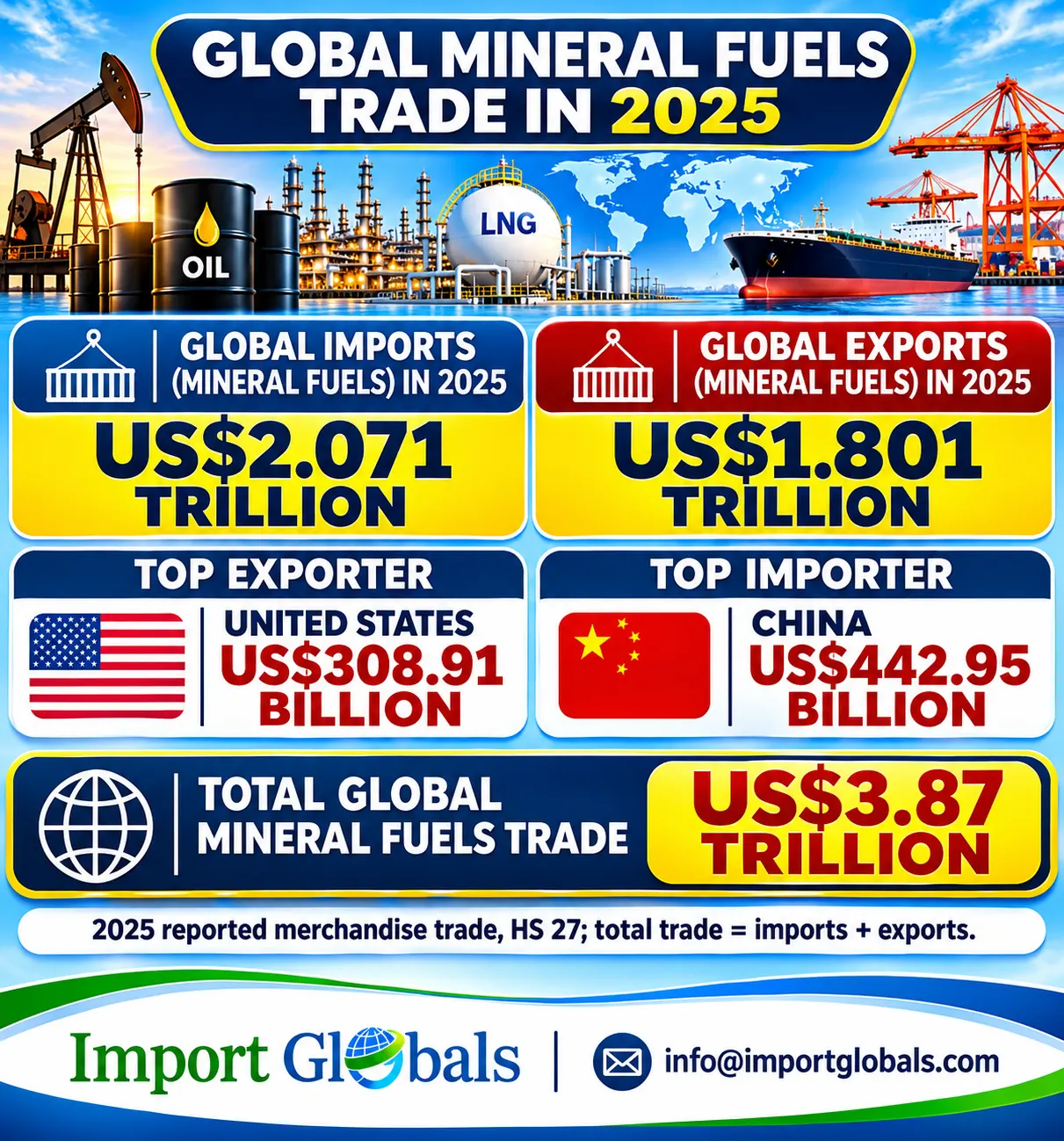
As per Global Trade Statistics, the global trade value in mineral fuels was just around $3.87 trillion for the year, of which $1.80 trillion was accounted for by exports and $2.07 trillion by imports. Both the exports and imports figures were down compared with 2024, with a decline in exports of some 6.81% and those of imports of 7.67%.
According to the statistics, the United States of America was the country with the largest exports of mineral oil worth $308.91 billion, followed by Saudi Arabia ($214.38 billion), Canada ($137.72 billion), Norway ($106.10 billion) and the Netherlands ($96.53 billion). On the imports tier of the market, China was the greatest importer ($442.95 billion), followed by the USA ($216.43 billion), India ($209.10 billion), Japan ($147.87 billion) and South Korea ($140.09 billion). In general, the data clearly indicates the significance of energy-exporting states and industrialized countries in the global supply of fuels.
Significance of Mineral Fuels in the Global Trade
Mineral fuels are one of the key components of global trade because of their ability to furnish the energy necessary for industries, transport, power, and manufacturing operations. Crude oil, refined oil, gas, and coal represent important products that have significant bearing on international economic growth and energy security. Their substantial input to international merchandise trade contributes to the generation of export revenues in many countries like the USA, Saudi Arabia, Canada, Norway, and Australia.
At the same time, other important importers like China, India, Japan, and South Korea try to fulfil their domestic energy needs and develop their industries by means of imports of fuel from their global counterparts. Influencing the prices of commodities, mineral fuels also affect prices and trade balances, says Global Shipment Data. Changes in supply and demand for energy, geopolitical environment, production decisions, and transportation disruptions have a big impact on prices and trade flows. At the same time, the increasing volume of investments in renewable energy is changing the situation in the energy sector.
Top 10 Variants of Mineral Fuels Exported Globally
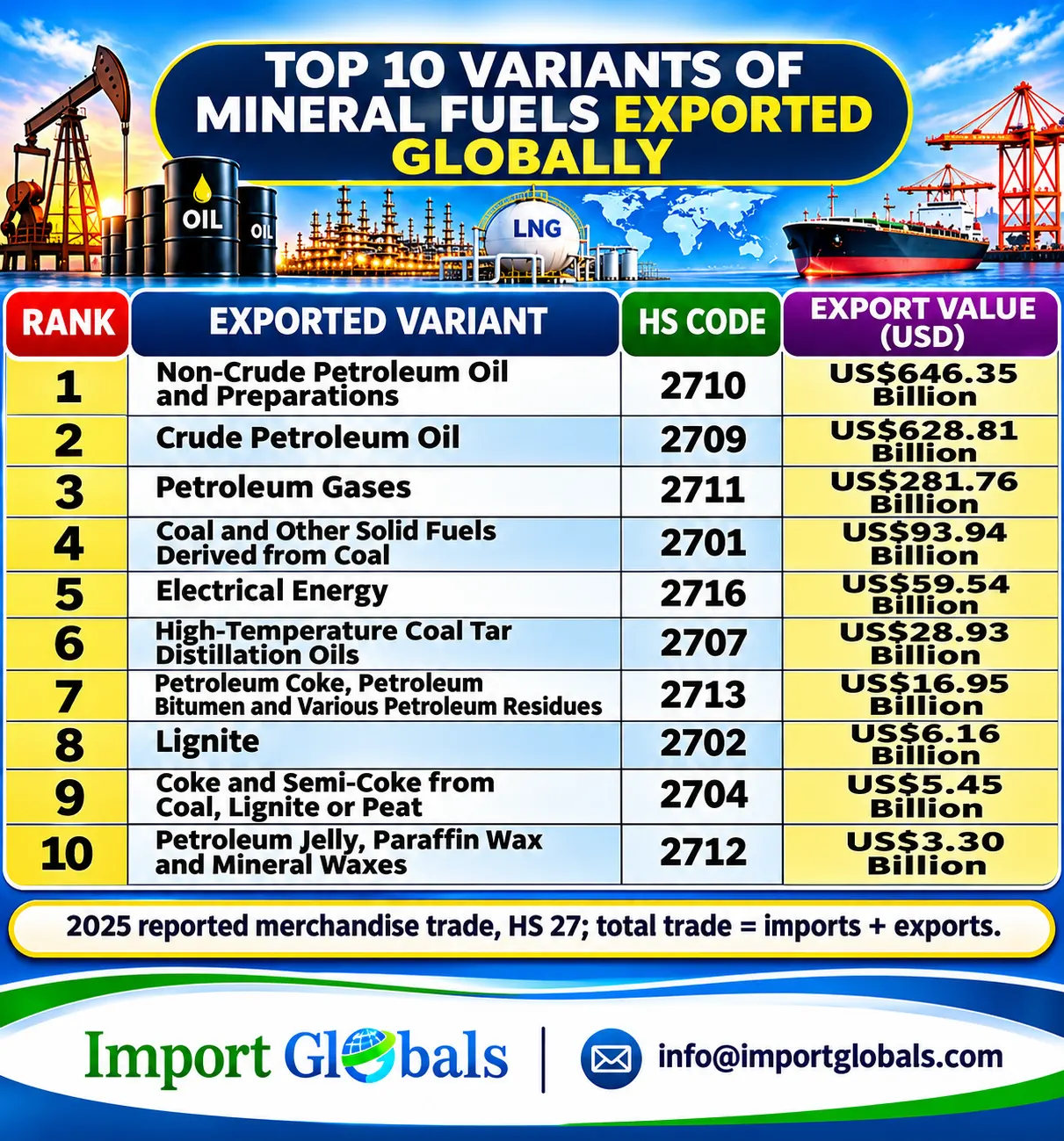
1. Non-Crude Petroleum Oil and Preparations (HS Code 2710), US$646.35 Billion
Non-crude petroleum oil comprises the oil products that are produced with the use of petroleum. These products are utilized in various sectors including transportation, manufacturing, generating power, and other commercial activities.
2. Crude Petroleum Oil (HS Code 2709), US$628.81 Billion
Crude petroleum is a major energy commodity traded globally. This commodity serves a crucial role in supplying refineries worldwide, where it is converted to gasoline, diesel, aviation fuels, petrochemical feedstock, and many other essential goods.
3. Petroleum Gases (HS Code 2711), US$281.76 Billion
Petroleum gases entail liquefied petroleum gases and other natural gas products. This group of commodities supports heating at home, electricity generation, manufacturing processes in industry, as well as transportation, says Global Import Data.
4. Coal and Other Solid Fuels Derived from Coal (HS Code 2701), US$93.94 Billion
Coal is still used for generating electricity, manufacturing steel, and heating industries. Major coal exporting countries supply international markets with consistent energy and important raw materials for industrial production processes.
5. Electrical Energy (HS Code 2716), US$59.54 Billion
Electrical energy is included in HS chapter 2716 statistics. Energy exported from one country to another helps cross-border energy supplies and improves energy distribution across the respective countries.
6. High-Temperature Coal Tar Distillation Oils (HS 2707) – US$28.93 Billion
This category includes products derived from the process of coal tar distillation. These items play a role in the chemical production sector, as they are used as raw materials for industrial chemicals or other products.
7. Petroleum Coke, Petroleum Bitumen and Various Petroleum Residues (HS 2713) – US$16.95 Billion
This commodity includes petroleum coke and other oily residues formed during the processing of petroleum. Petroleum coke and its residues find their use in the production of cement and for industrial heating applications, among others.
8. Lignite (HS 2702) – US$6.16 Billion
Lignite is a type of coal. It is used primarily for producing electricity and heat. The eruptive heat production and the matching standards with the global consumer base has supported the trade.
9. Coke and Semi-Coke from Coal, Lignite or Peat (HS 2704) – US$$5.45 Billion
Coke and semi-coke play an important role in various industrial activities, and their international trade activities are responsible for the well-functioning of the metallurgical sector.
10. Petroleum Jelly, Paraffin Wax and Mineral Waxes (HS 2712) – US$3.30 Billion
This group of products includes petroleum jelly, paraffin wax, and other types of mineral wax. These items can be used for various packaging and manufacturing purposes.
Top 10 Variants of Mineral Fuels Imported Globally
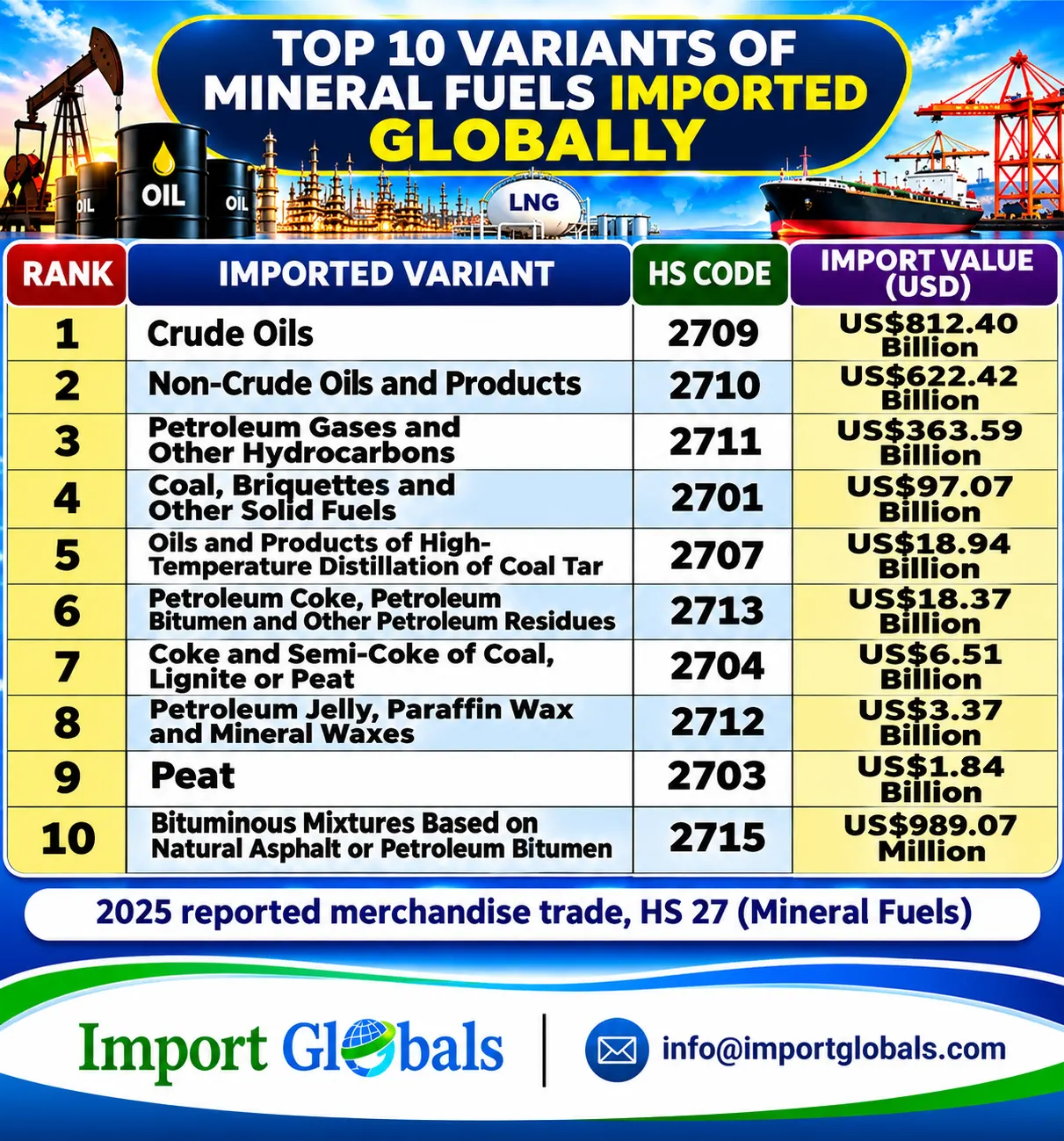
1. Crude Oils – HS 2709 – US$812.40 Billion
Crude oil ranks first among the world’s imported fuel minerals. Refineries acquire it for the production of gasoline, jet fuel, diesel, lubricants, and raw petrochemical materials for both industrial and consumer markets.
2. Non-Crude Oils and Products – HS 2710 – US$622.42 Billion
This category is made up of refined products like kerosene, gasoline, diesel, and lubricant oils. The products serve transportation, machines in different industries, power plants, and many businesses.
3. Petroleum Gases and Other Hydrocarbons – HS 2711 – US$363.59 Billion
Petroleum gas is made up of natural gas, propane, butane, and other gas hydrocarbons. Its use ranges from cooking to industrial operations as well as the generation of electricity.
4. Coal, Briquettes and Other Solid Fuels – HS 2701 – US$97.07 Billion
Coal and solid fuels play a crucial role in the generation of electricity, manufacturing of steel, and industrial heating. Global Trade Data reported it as a top commodity because of the growing demand rate.
5. Oils and Products of High-Temperature Distillation of Coal Tar – HS 2707 – US$18.94 Billion
The products have their origins in the distillation of coal tar, which makes them useful in the chemical industry, as they are used for making various types of aromatic compounds and industrial products.
6. Petroleum Coke, Petroleum Bitumen and Other Petroleum Residues – HS 2713 – Value: US$18.37 Billion
Petroleum coke and its by-products are major raw materials used in various industries. These are imported for the cement-making process, aluminum production, industrial heating, and other power-intensive processes around the world.
7. Coke and Semi-Coke of Coal, Lignite or Peat – HS 2704 – Value: US$6.51 Billion
Coke and semi-coke are critical for metallurgical processes, especially in the steel industry. Their import is important for blast-furnace works, industrial processes, and large-scale production.
8. Petroleum Jelly, Paraffin Wax and Mineral Waxes – HS 2712 – Value: US$3.37 Billion
Petroleum jelly, paraffin wax, and mineral waxes are useful in industries such as cosmetics, pharmaceuticals, packaging, candle-making, etc. Their imports are useful for consumer goods manufacturers and specific applications around the globe.
9. Peat – HS 2703 – Value: US$1.84 Billion
Peat is a type of organic matter used in horticulture, soil amelioration, growing media, etc. International imports help agricultural producers, nurseries, and special energy markets.
10. Bituminous Mixtures Based on Natural Asphalt or Petroleum Bitumen – HS 2715 – Value: US$989.07 Million
Bituminous mixtures are used in road building, waterproofing, and other areas related to infrastructural developments. Imports are useful to construction companies and public works that need bituminous minerals for their continuous trade activities.
Top 10 Global Exporters of Mineral Fuels in 2025
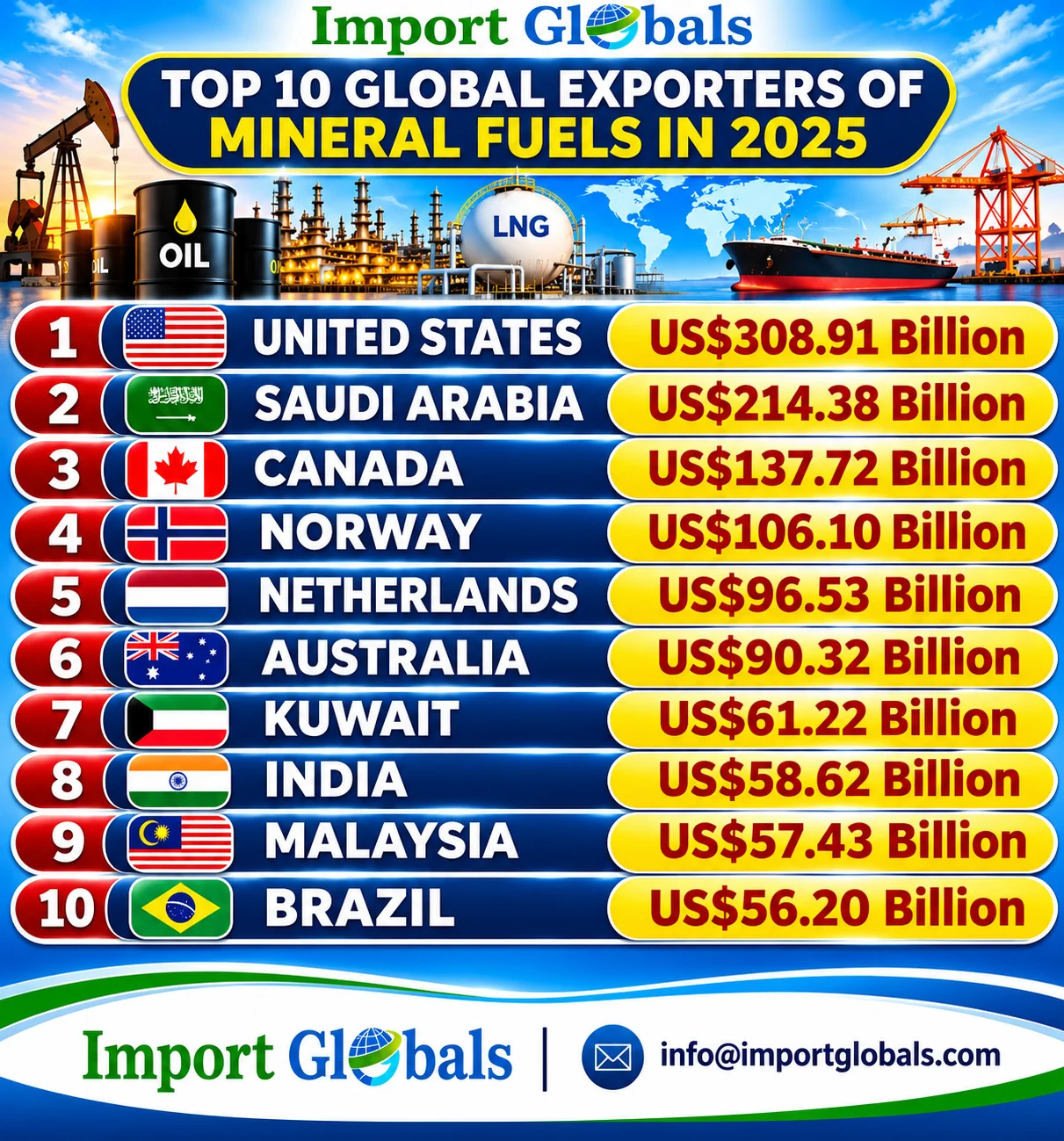
1. United States - 308.91 Billion U.S. Dollars
The U.S. has retained its position as the biggest exporter of mineral fuels in the world in 2025, handling significant quantities of crude petroleum, refined petroleum products, natural gas, and other energy products owing to its considerable production and refining capacities.
2. Saudi Arabia - 214.38 Billion U.S. Dollars
Saudi Arabia has continued to be a leading exporter of energy products mainly because of its active oil export activities and considerable oil production capacities.
3. Canada - 137.72 Billion U.S. Dollars
Canada has emerged as a significant exporter of mineral fuels, handling crude oil, natural gas, and refined fuels thanks to its abundant energy resources and established pipeline network, with the U.S. being its main trading partner.
4. Norway - 106.10 Billion U.S. Dollars
Norway owes its success as an exporter of mineral fuels to its huge offshore oil and gas production. European markets remain a key export destination for Norway’s energy products.
5. Netherlands - 96.53 Billion U.S. Dollars
The Netherlands is among the leading exporters of mineral fuels, especially through its refining, storage, and transportation capacities, aided by its extensive port systems.
6. Australia – USD 90.32 Billion
Australia has maintained its position as a leading exporter of coal, liquefied natural gas, and other mineral fuels as it continues to receive huge orders from Asian economies, notably in the industrial and power generation markets.
7. Kuwait – USD 61.22 Billion
Kuwait's exports of mineral fuels are highly driven by the operations of its oil sector. The level of Kuwait's crude oil production, its refining facilities, and transportation infrastructure make it one of the key energy product exporters in the world.
8. India – USD 58.62 Billion
India's exports of mineral fuels are driven by its refined products of petroleum. Being one of the countries with the highest refining capabilities allows India to utilize imported crude oil for the production of diesel, gasoline, and other oil products that are subsequently exported.
9. Malaysia – USD 57.43 Billion
Malaysia is recognized among the key exporters of petroleum products and natural gas. Due to its developed energy project and production and refining sectors, Malaysia exports mineral fuels to its neighbours and other countries.
10. Brazil – USD 56.20 Billion
Brazil has enhanced its position as an exporter of mineral fuels due to its high production of crude oil and increasing number of offshore operations.
Top 10 Global Importers of Mineral Fuels in 2025
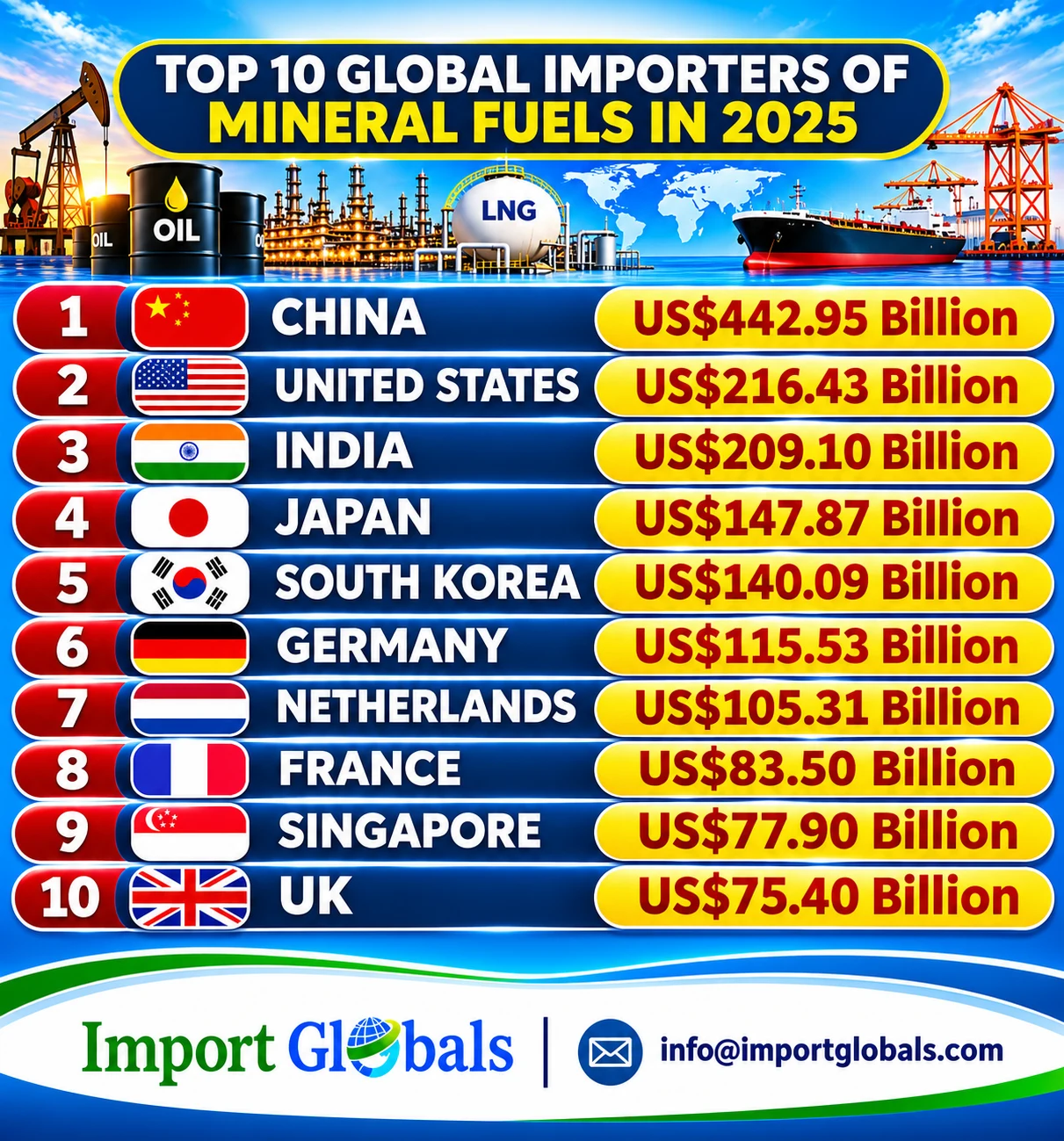
1. China – $442.95 Billion
In 2025, China had the highest mineral fuel imports among countries. China used its mineral fuels for electricity generation, manufacturing, transport, and petrochemical production, which means that China had a high level of energy consumption and high dependence on imports.
2. United States – $216.43 Billion
The United States had the second-highest mineral fuel imports. Although the country produced considerable energy resources, it still needs to import crude oil, finished goods, and other products to address regional demand and to support a large refining industry.
3. India – $209.10 Billion
India was also among the top mineral fuel importers in the world due to an increase in energy use, industrial development, and transportation needs. The country buys crude oil and petroleum products says Global Customs Data due to which the trade is increasing in a continuous manner.
4. Japan – $147.87 billion
Japan remained highly reliant on imports for mineral fuels due to the limited amount of fossil fuel reserves in the country. Imports of crude oil, LNG, and coal enable the country to generate electricity, develop manufacturing, and transport goods.
5. South Korea – $140.09 billion
South Korea has committed a significant quantity of mineral fuel imports to support industrial activities and the production of electricity. The country has been using oil, natural gas, and coal for petrochemical industry development, steel production, and general operation of the export-oriented economy.
6. Germany – US$115.53 Billion
Germany is included among the largest mineral fuels importers within Europe in 2025. These imports do support its industries, transport, electricity production and heating, with energy diversification playing an important role in long-term security of supplies.
7. Netherlands – US$105.31 Billion
The Netherlands continued to be one of the main mineral fuels importers in Europe given its advanced refining, storage and distribution capacities. The infrastructure of ports is useful for trade of energy and petroleum products in Europe.
8. France – US$83.50 Billion
France imported quite a number of mineral fuels for the purposes of transportation, industrial, and energy needs. Though significantly relying on nuclear electricity generation, petroleum products and natural gas make a crucial part of its imports.
9. Singapore – US$77.90 Billion
The position of Singapore in the ranking is determined by its role as an important international refining and trading hub. The mineral fuels imported by Singapore serve domestic markets and are re-exported to other regions.
10. UK – US$75.40 Billion
The UK continued to be the prominent mineral fuels importer in 2025. The imports of oil, gas, and refined fuels support transportation and manufacturing activities as well as electricity production and general energy consumption.
Companies Aiding the Global Mineral Fuels Trade of 2025
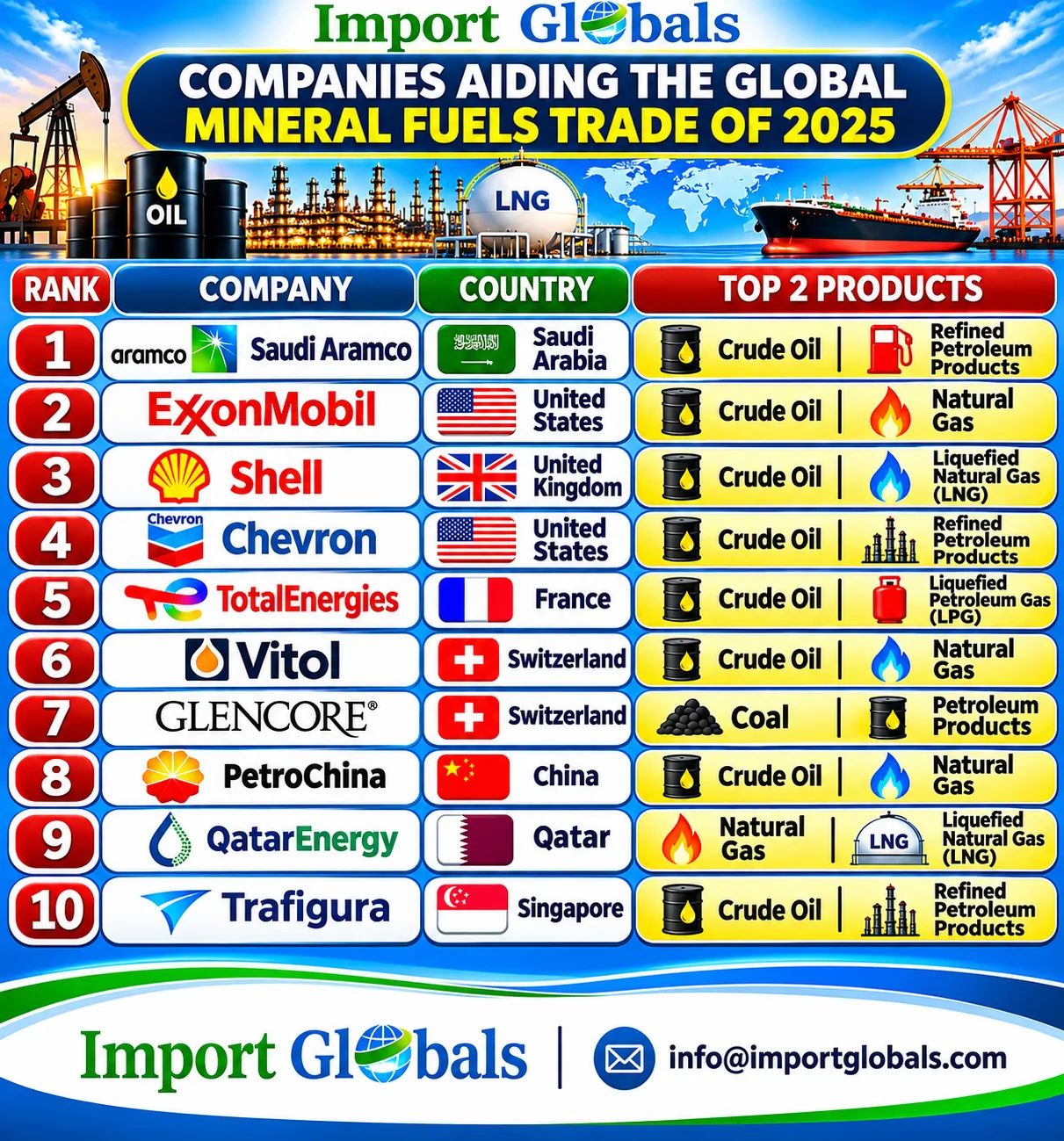
1. Saudi Aramco – Saudi Arabia
Saudi Aramco is recognized as the biggest integrated energy company in the world. It has significant operations in crude oil production and refining, petroleum export, and global trading.
2. ExxonMobil – United States
ExxonMobil helps the global market of fuels through crude oil, natural gas production, refining, petrochemicals production, and energy trading.
3. Shell – United Kingdom
Shell is among the biggest producers of crude oil. The company operates across the globe in the areas of crude oil production and refining, natural gas supply, and liquefied natural gas operations.
4. Chevron – United States
Chevron also assists in global trade of fuels through its oil drilling, production, refining, and marketing services across the world. It provides crude oil to different regions, says Global Customs Shipment Data.
5. Total Energies – France
Total Energies is a well-known international supplier of different kinds of petroleum products and liquefied gases. The company takes part in different activities of production, insurance of supplies, and providing services in trading.
6. Vitol – Switzerland
Vitol is one of the leading independent energy traders globally, with a turnover of US$343 billion and a delivery volume of 605 million tonnes of oil equivalent in 2025, demonstrating its important position in international fuel supply.
7. Glencore – Switzerland
Glencore delivers its services in international energy markets by trading in coal, crude oil and petroleum products. Its marketing chain allows producers, industries, and buyers of energy from many parts of the world to get connected to each other.
8. Petro-China – China
Petro China takes part in global fuel supply by carrying out petroleum exploration, gas production, refining, and international trading. The activities of this company fulfil the energy needs of China and link its domestic production with overseas markets.
9. Qatar Energy – Qatar
Qatar Energy is a leading trader of natural gas and LNG at the global level. The gas produced and liquefied by this company is sold to major consuming countries as a result of Qatar’s rich gas reserves, primarily in Asian and European markets.
10. Trafigura – Singapore
Trafigura is one of the biggest independent traders of commodities and operates in crude oil, refined products, natural gas and LNG. Its logistics, storage and shipping networks play a vital role in the international movement.
Future Trade Outlook of Global Mineral Fuels
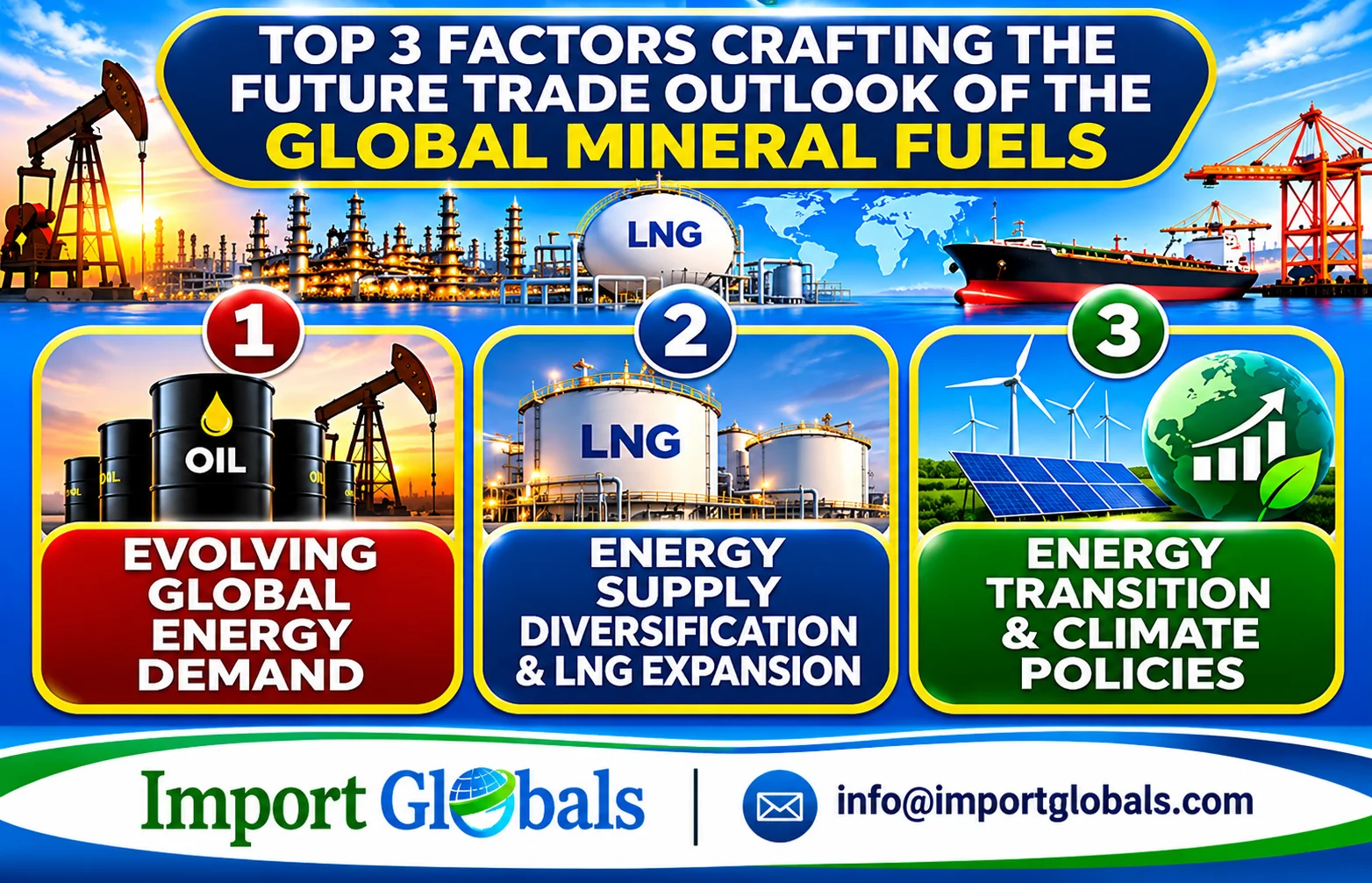
Trade in mineral fuels is expected to be an essential part of global commerce in the coming period, while changing energy requirements, political situations, and the move towards renewable energy will affect its growth. Those important exporters like the USA, Saudi Arabia, Canada, Norway and Australia will play an important role in supplying crude oil, refined fuels, gas and coal to the world market, while major importers like China, India, Japan, South Korea will need energy to produce goods, move products and generate electricity.
Thus, a demand for liquefied fuel gas and refined petroleum products will give an opportunity to those exporters who have an efficient production and distribution chain to provide buyers with these commodities. At the same time, price changes, shipping problems, trade regulations, and environmental issues may have a huge impact on business. Growing investment in solar and wind energy can change global fuel consumption over time. So companies will have to think about prices for goods, suppliers, tariff codes, and emerging markets.
Conclusion
The global trade of mineral fuels continued to play a significant role in the world's trade, achieving a total of US$3.87 trillion, composed of exports of US$1.80 trillion and imports of US$2.07 trillion. The USA was the major exporter, while China was the largest importer. The most traded goods remained crude oil, refined oil products, gaseous fuels, and coal. International trade in these goods provides support for various sectors, as well as means of transportation, electric power production, and electricity generation.
A number of energy companies such as Saudi Aramco, ExxonMobil, Shell, Chevron, Vitol and Qatar Energy are an important part of the international supply chain, including production, refining, trading and distribution. All in all, the trade values show a decline compared to 2024, reported Global Import Export Data; however, the importance of mineral fuels trade for the global economy is indisputable. The usage of Global Import Data, export data, and customs data makes it possible for businesses to find suppliers, study trade flows, learn about competitors, and discover their options in the international energy market.
CTA
Looking for accurate trade information regarding the global mineral fuels trade? You have finally landed on the right platform here. Import Globals helps businesses stay updated with accurate shipment insights and active trade information on the global mineral fuels trade. Subscribe to www.importglobals.com or drop an email at [email protected] to get detailed information regarding the mineral fuels trade of the nation to transform your international business growth.
FAQ’s
Que. What is the top globally imported mineral fuel in 2025?
Ans. Crude oil is the top globally imported variant of mineral fuels in 2025.
Que. What is the top globally exported mineral fuel in 2025?
Ans. Non-Crude Petroleum Oil and Preparations are the top globally exported mineral fuel in 2025.
Que. Who is the top mineral fuels exporter of the global marketplace at present?
Ans. The United States is the top mineral fuels exporter of the global marketplace at present.
Que. Who is the top mineral fuels importer of the global marketplace at present?
Ans. China is the top mineral fuels importer of the global marketplace at present.
Que. What is the global trade value of mineral fuels in 2025?
Ans. The global trade value of mineral fuels in 2025 is $3.87 trillion US dollars.
Que. What is the global export value of mineral fuels in 2025?
Ans. The global export value of mineral fuels in 2025 is $308.91 billion.
Que. How doesGlobal import-export data support business growth?
Ans. Global import-export data supports business growth via proper identification of buyers, suppliers, analysis of market demand, and development of effective market expansion strategies.
Que. What information is available in Global trade data?
Ans. Global trade data covers importer name, exporter name, shipment date, HS code, product details, quantity, pricing information, origin country, importing country, and port details.
Que. How frequently is the Global trade data updated?
Ans. Global trade data is updated on a monthly basis.
Que. Where can you obtain detailed information on Global trade data?
Ans. Visit www.importglobals.com or drop an email at [email protected] for detailed updates on Global trade data.
You Can Also Visit :-
