
Global Mobile Phone Exports: Leading Countries and the Brands They Ship
- Oct 22, 2026
- 19 Views
Global Mobile Phone Exports: Leading Countries and the Brands They Ship
In 2025, the global mobile phone export industry continued to play an important role in the international electronics market due to the booming demand for smartphones, the growing production capacity, and the diversifying suppliers.
The export value of wireless phones in the world, along with smartphones, was about US$301.6 billion by the year 2025, says Global Import Export Shipments Data. China was the leader in the market with export revenues of US$122.8 billion, which accounted for about 40.7 percent of worldwide exports.
Vietnam was the second leader with export revenues of US$31.3 billion, followed by India, Hong Kong, and the USA with export revenues of US$30.1 billion, US$22.8 billion, and US$17.0 billion, respectively. Thus, the five nations alone held around 75% of the global mobile phone export volume. From the company’s perspective, Apple was the dominant smartphone vendor globally in 2025, with approximately 20% of all smartphones delivered in the world. Samsung was the second with 19% market share. Companies enjoyed benefits from established supply chains, modern product development, and efficient distribution.
Global Mobile Phone Export Significance: Trade at a Glance in 2025
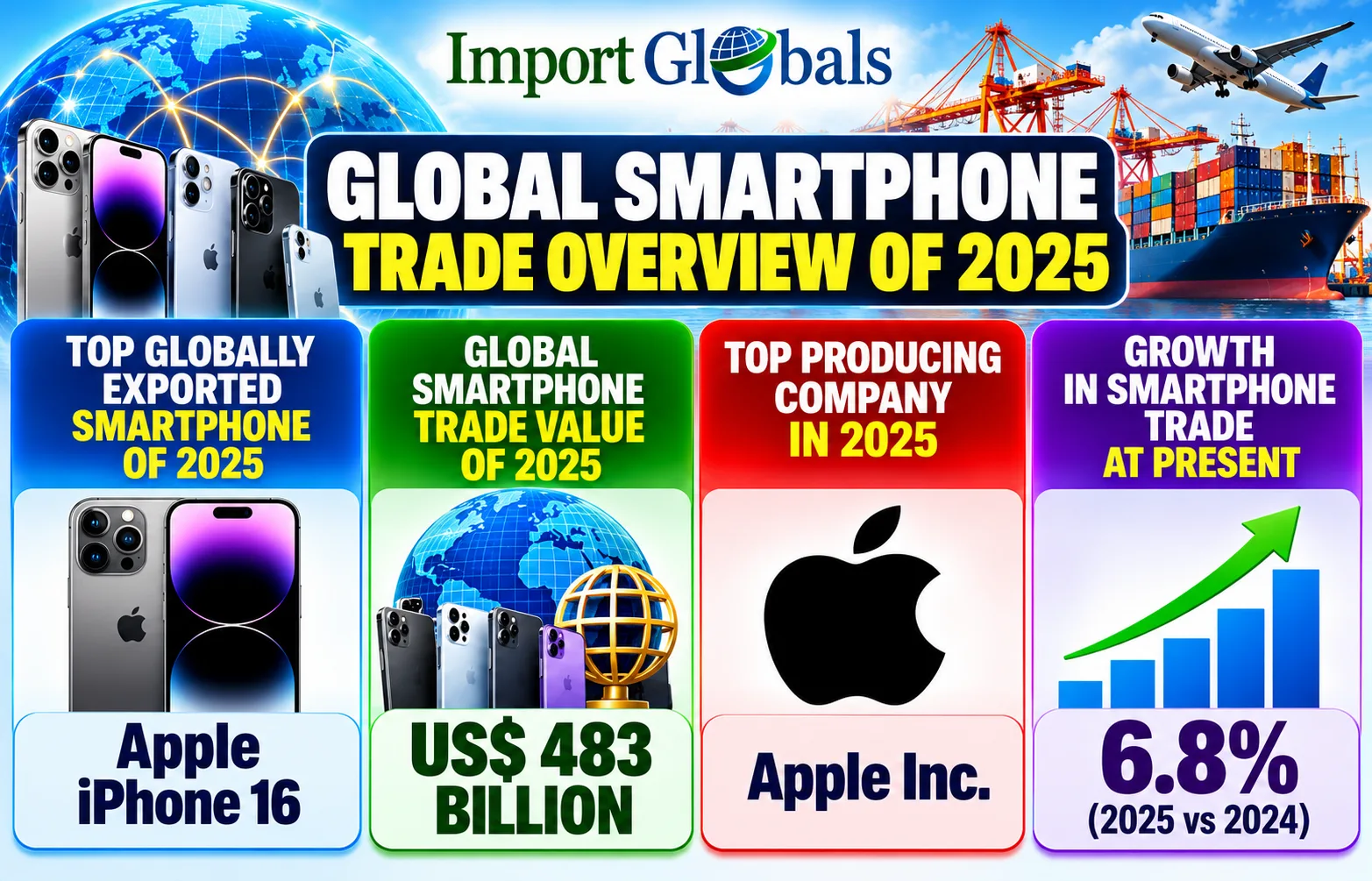
The global smartphone market has been a significant player in the international electronics trade because of the technological innovations, consumer demand, and the growing digital connectivity. The Global Import Data reported that the global smartphone trade is at a current valuation of 483 billion U.S. dollars, specifically characterized by the emphasizing value of mobile devices within the global marketplace.
Apple iPhone 16 is one of the top exported smartphones and is a demonstration of the power of premium smartphone products within the international trade arena. The 6.8% increase in the smartphone trade year has come across a hike in 2025, with a representative increase in the reported trade values. The growth pattern is a proof of the continuous role that smartphones will play in the supply chains. The companies looking for export smartphones, knowledge of global trade valuations and annual growth can study the markets for crafting their own way of trade.
Top 10 Mobile Phone Exporting Countries in 2025
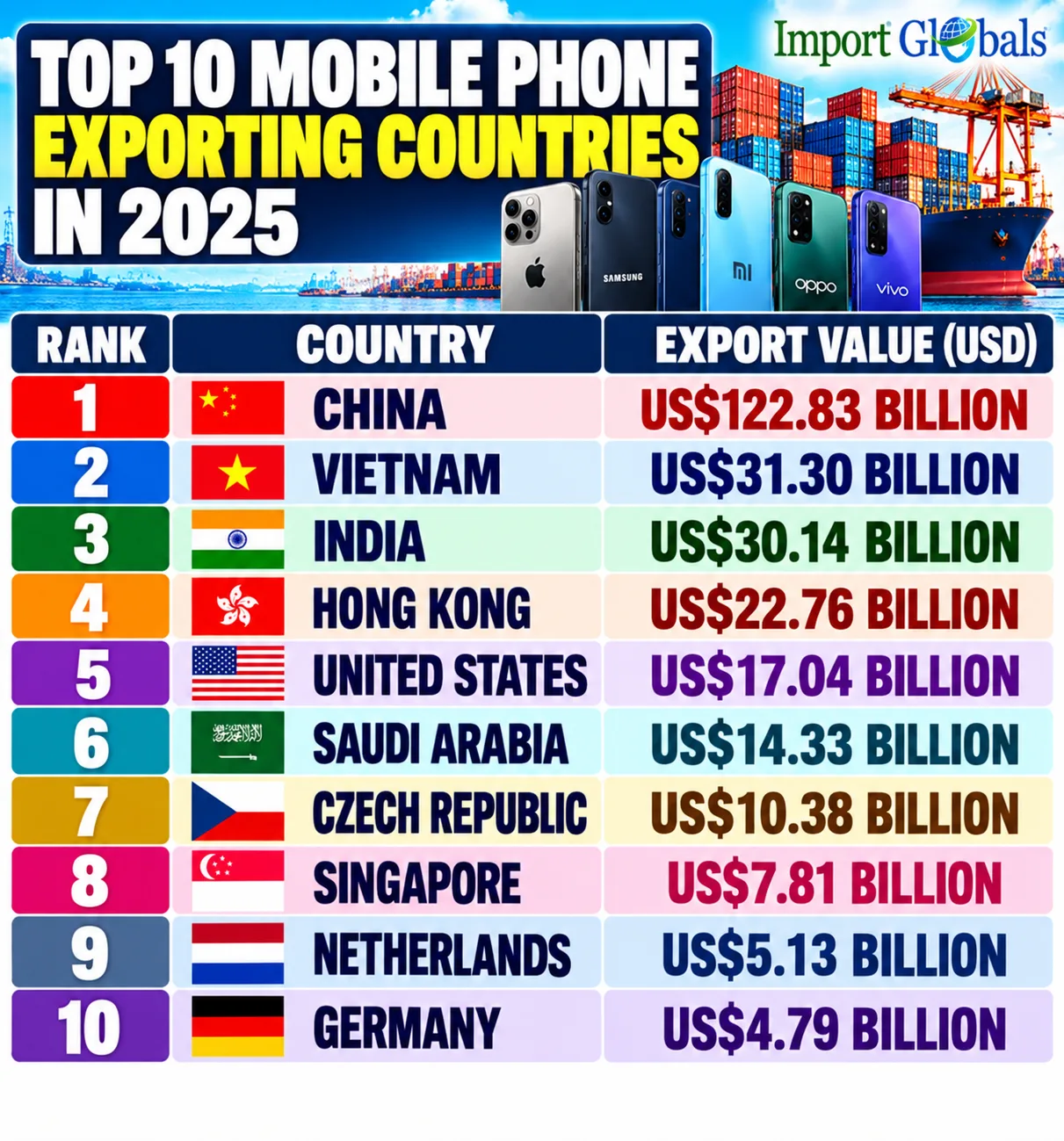
1. China — US$122.83 Billion
China has been the top mobile phone exporting nation because of the comprehensive electronic production ecosystem, and mainly parts producers, factories, and logistics trade, says Global Trade Statistics.
2. Vietnam — US$31.30 Billion
Vietnam remains a key centre for the manufacture and export of electronics as its uninterrupted production, coupled with its access to high receipts from overseas customers, allows for significant shipments.
3. India — US$30.14 Billion
India has solidified its position in mobile phone exports, as a result of the growth of its electronics manufacturing sector and the enhancement of its domestic assembly and investment in smartphones.
4. Hong Kong — US$22.76 Billion
Hong Kong contributes to global electronics distribution and re-exporting activities. Its export data has documented trade happening across borders, without a clear explanation of how many devices were assembled in Hong Kong itself.
5. United States — US$17.04 Billion
The United States is involved in the trade of cellular phones through re-exporting as well as other means of trade. Its involvement needs to be distinguished from the operations based on where phones were assembled.
6. Saudi Arabia — US$14.33 Billion
Saudi Arabia achieved an impressive amount of exports of wireless phone equipment in the year 2025. The yearly percentage of its exports rose significantly, while its specific goods composition and re-export contribution remain unclear.
7. Czech Republic — US$10.38 Billion
The Czech Republic’s exports enabled the country to contribute to the European phone trade through electronic components distribution and the location of networks in the region. The total value of its last year’s record dropped by about 20% compared to that of 2024.
8. Singapore — US$7.81 Billion
The capabilities of Singapore in the field of electronics delivery and international trade allow for the uninterrupted movement of devices throughout Asia and the entire world. The total amount of exports has gone up by about 36.6% compared to those of the previous year.
9. Netherlands — US$5.13 Billion
The role of the Netherlands in the distribution and logistics sphere is to serve as a European entry point for electronic device exports. Last year's record of mobile phone exports from the Netherlands has grown by almost 32.6%.
10. Germany — US$4.79 Billion
The Netherlands contributed to the European phone trade through technology distribution and international connections. As a result, the net exports of the country has grown.
Top Mobile Phone Product Categories for Export Opportunities in 2025
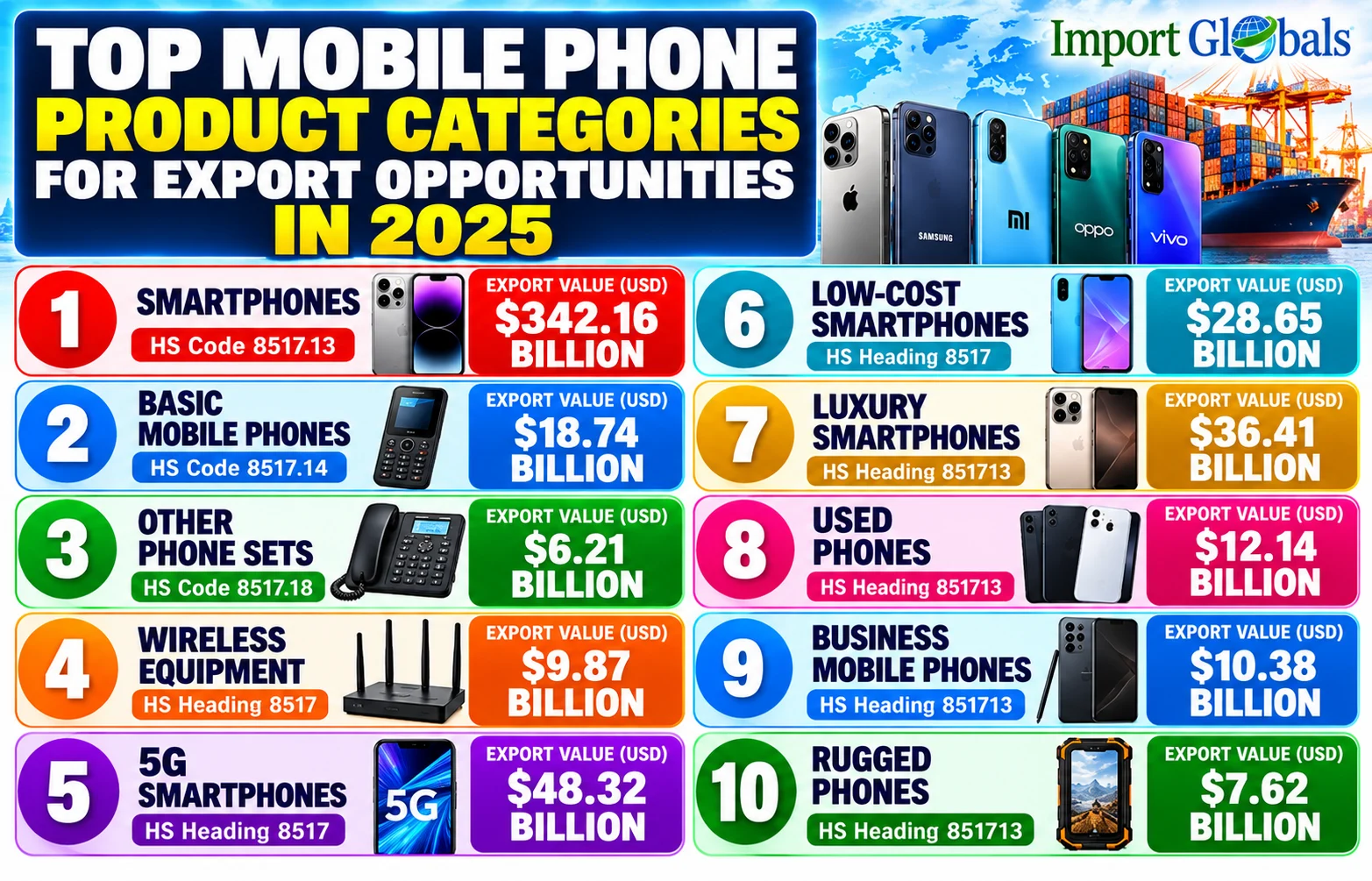
1. Smartphones — HS Code 8517.13
Smartphones are the main product category in the mobile export business reported Global Shipments Data. A number of elements affect export opportunities; such as market demand, branding, product features, manufacturing capabilities and export regulations.
2. Other Cellular or Wireless Network Phones — HS Code 8517.14
This category refers to mobile and wireless devices. Export potential is affected by the market demand for feature phones, basic phones, and devices used for specific types of activities or markets.
3. Other Telephone Sets — HS Code 8517.18
Other telephone sets fulfil specific communication tasks. Exporters are required to do due diligence concerning the state tariff number of products they intend to export so that none of the products are missed.
4. Wireless Communication Equipment — HS Heading 8517
This broader category encloses more telecommunications equipment rather than just mobile devices, so companies should distinguish phones from equipment that delivers data.
5. Mobile Phones with 5G Capability — HS Heading 8517
5G mobile devices provide opportunities for export in booming markets. Export potential will depend on such aspects as features of telecoms, compatibility with networks, prices, etc.
6. Low-Cost Smartphones — HS Heading 8517
Low-cost smartphones meet the needs of users looking for basic access to mobile technologies with little money. Exporters can make use of cheap production and proper distribution, as well as affordable products.
7. Luxury Smartphones — HS Heading 851713
Luxury mobile devices rely on the features of cameras, the power of processing units, software and security features, and brand image. Exporters should analyse the niche and price of products in demand.
8. Used Phones and Low-Cost Phones — HS Heading 851713
Used smartphones can fulfil the needs of those who buy mobile phone devices for lower prices. Exporters need to examine particular regulations in the countries of destination regarding second-hand electronic devices, product conditions, warranty coverage, and not violating importation laws.
9. Business Mobile Phone — HS Heading 851713
Business mobile phones have improved security and management, resilience, and connectivity. The expansion of business opportunities depends on how important the process of getting new goods is.
10. Rugged and Specialized Technological Devices— HS Heading 851713
Rugged technologies can be used in industry, logistics, services, or environmental tasks. Buyers look for durable, efficient models that perform well after purchase.
Top 10 Destination Markets and Brands Supplying Mobile Phones
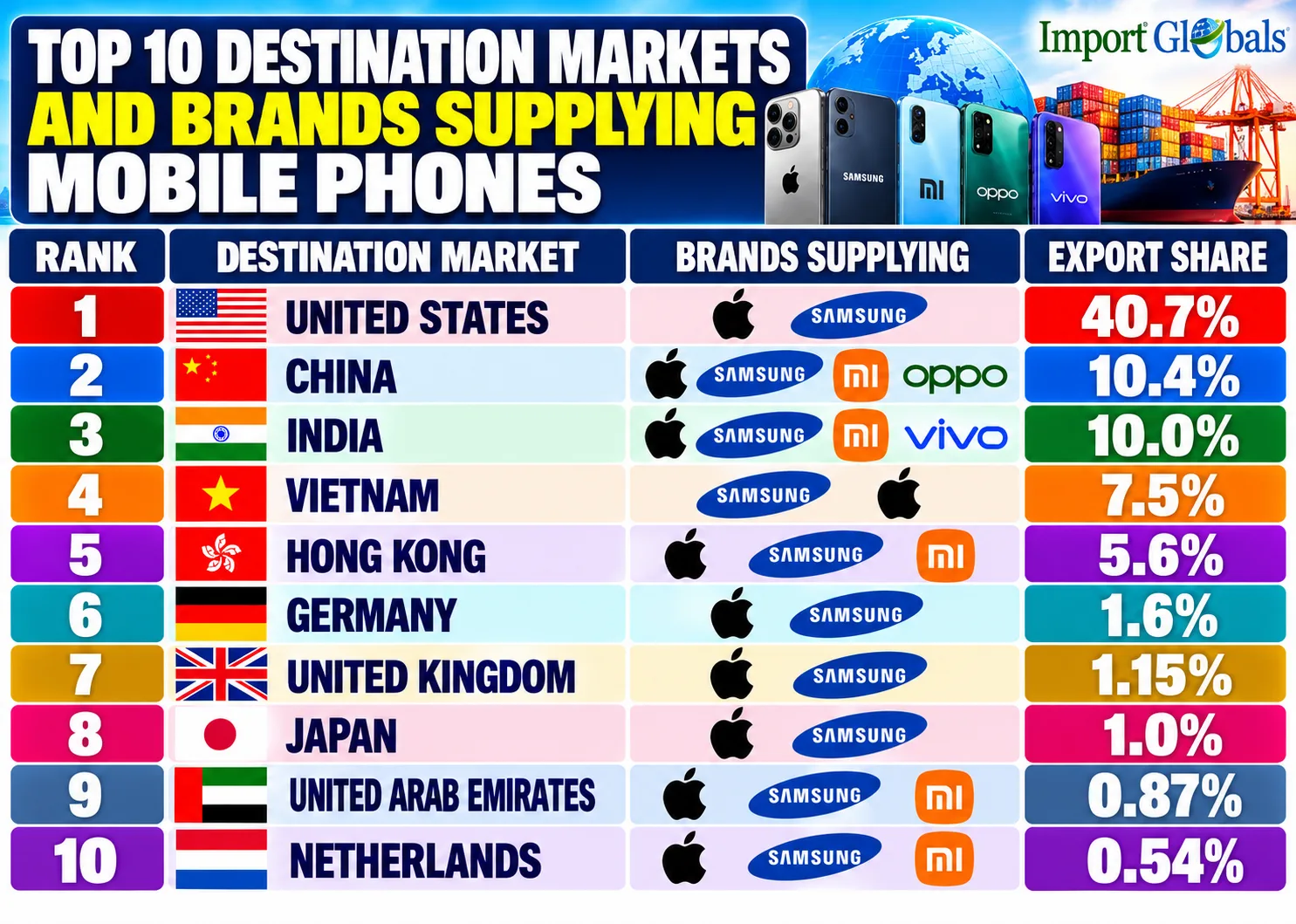
1. The United States — Apple and Samsung– Export share: 40.7%
The United States is a large market for mobile devices. The competition between Apple and Samsung occurs at both high-end and regular market levels; while importers examine compatibility with carrier networks, import tariffs, distribution costs, and certifications.
2. China – Apple, Samsung, Xiaomi, and OPPO– Export share - 10.4%
China is home to a vast manufacturing sector and many consumers, says Global Import Export Data. Both domestic manufacturers and global brands compete in this market, while products meant for imports show how customers’ preferences shape their production needs.
3. India – Apple, Samsung, Xiaomi, and vivo– Export share - 10.0%
India is a crucial market for mobile phones as well as an expanding hub for exporting devices. Factors such as local assembly and product pricing affect local competition as well as international transfers of the products.
4. Vietnam – Samsung and Apple– Export share - 7.5%
Vietnam has a long-established electronics manufacturing ecosystem. In the smartphone market; it plays the role of a production and assembly location, providing connections between international players and international consumers.
5. Hong Kong – Apple, Samsung, and Xiaomi– Export share - 5.6%
Hong Kong is a key location for electronics trade and distribution. All traded goods may potentially be re-exports, meaning it is necessary to distinguish between the exporting place and its birthplace.
6. Germany - Apple and Samsung– Export share - 1.6%
Germany's consumer electronics sector thrives; thanks to well-established sales systems and the popularity of higher-end and mid-priced gadgets. Importers are aware of the need to comply with European regulations, provide warranty services, and meet distribution standards.
7. United Kingdom - Apple and Samsung– Export share – 1.15%
The UK is a sizable consumer smartphone market. Competition in the market centres around product offering, connectivity to the network, services after the purchase, and price.
8. Japan - Apple and Samsung– Export share – 1%
Japan has a well-developed smartphone industry, and product quality, software integration technologies, stability of devices, as well as compatibility with local networks are crucial for customers' purchasing decisions.
9. United Arab Emirates - Apple, Samsung, and Xiaomi– Export share – 0.87%
UAE acts as both a consumer market and an area for distribution of gadgets in the region. Importers evaluate the demand locally as well as their ability to distribute goods in other areas.
10. Netherlands - Apple, Samsung, and Xiaomi – Export share – 0.54%
The logistics of the Netherlands ensure the delivery of electronic devices inside Europe. Imports and re-exports need to be taken into account to estimate consumer demand.
Top 10 Global Mobile Phone Brands in 2025
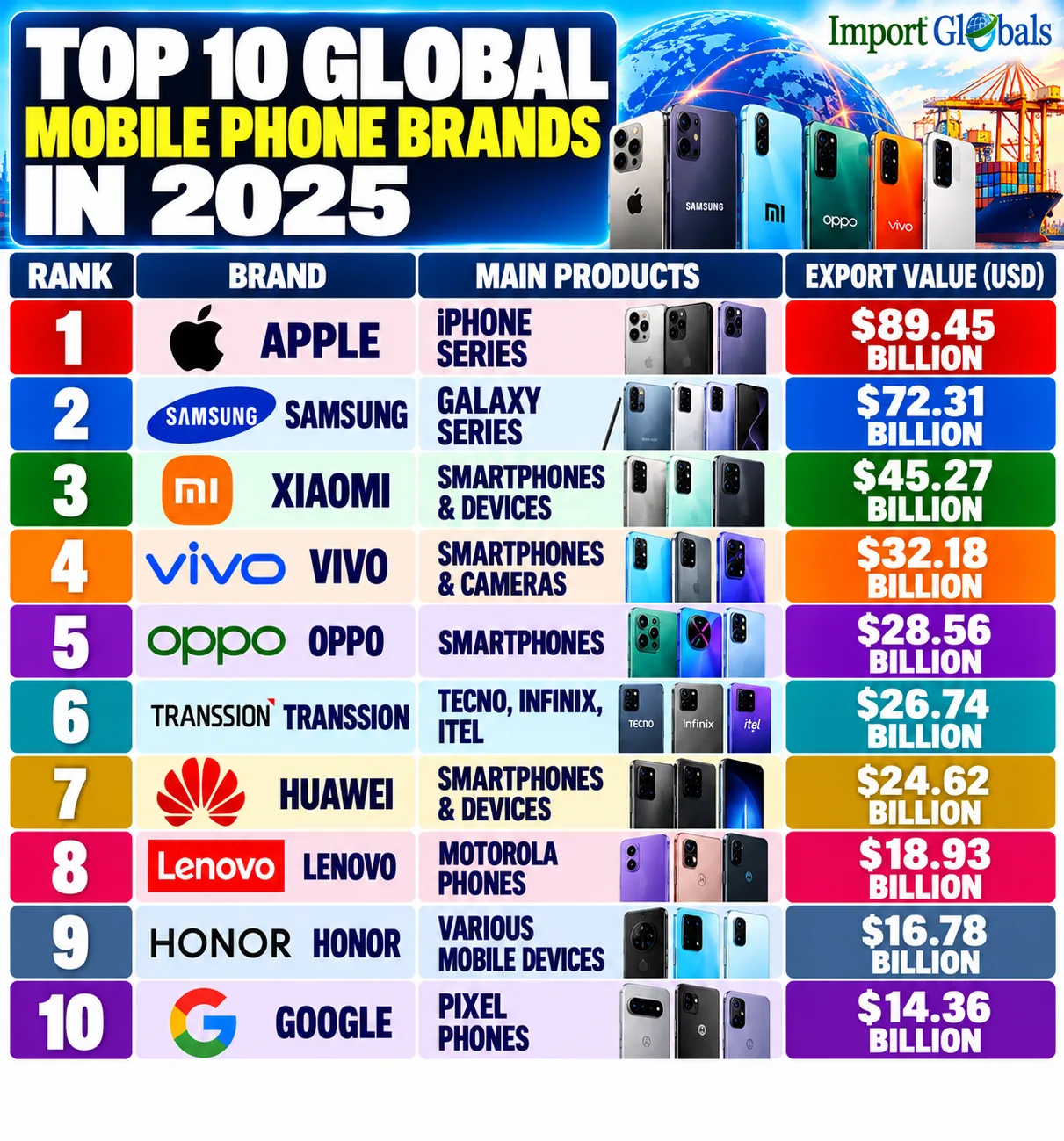
1. Apple: iPhone Series of Smartphones
In 2025, Apple took first place globally in smartphone shipments, reported Global Shipment Trade Data. Apple greatly benefited from its nurturing of its ecosystem products, high pricing strategies, and its efficiency in distribution.
2. Samsung: Galaxy Smartphones
Samsung reaches out to its different customers with its three brands, Galaxy S, Z, and A, in the mid- and high- price categories and uses all the advantages of its vast marketing-support resources.
3. Xiaomi: Smartphones and other Related Electronic Devices
Xiaomi is engaged in competing in the markets for low-end and high-end smartphones. Thanks to its wide range of products and good distribution, it manages to maintain demand in different countries.
4. Vivo: Smartphones and Cameras
Vivo is planning to win over customers by providing smartphones emphasizing unique design, camera features, and usability.
5. OPPO: Smartphones
OPPO is planning to win over customers by providing smartphones unique camera features, fast charging, and modern designs.
6. Transsion: TECNO, Infinix, Itel
Transsion’s different brands have been launched to target different segments of customers in emerging markets.
7. Huawei: Smartphones and Connected Devices
Huawei is occupying its niche in the industry by producing smartphones as well as consumer electronics, and its success is highly dependent on the trade acquired categories, says Global Trade Data.
8. Lenovo — Motorola Phones
Motorola works under Lenovo's umbrella to produce smartphones available in several price brackets and different territories.
9. Honor — Various Mobile Devices
Honor competes in the segments of mid-priced and premium devices. The sectoral growth rate is mainly supportive because of the better camera quality and the performance level.
10. Google — Phones from Pixel Line
The line-up of phones from Google competes with the help of the Android platform, computational photography capabilities, software functions, and access to Google services.
Statistical Analysis of Global Mobile Phone Exports: 2025
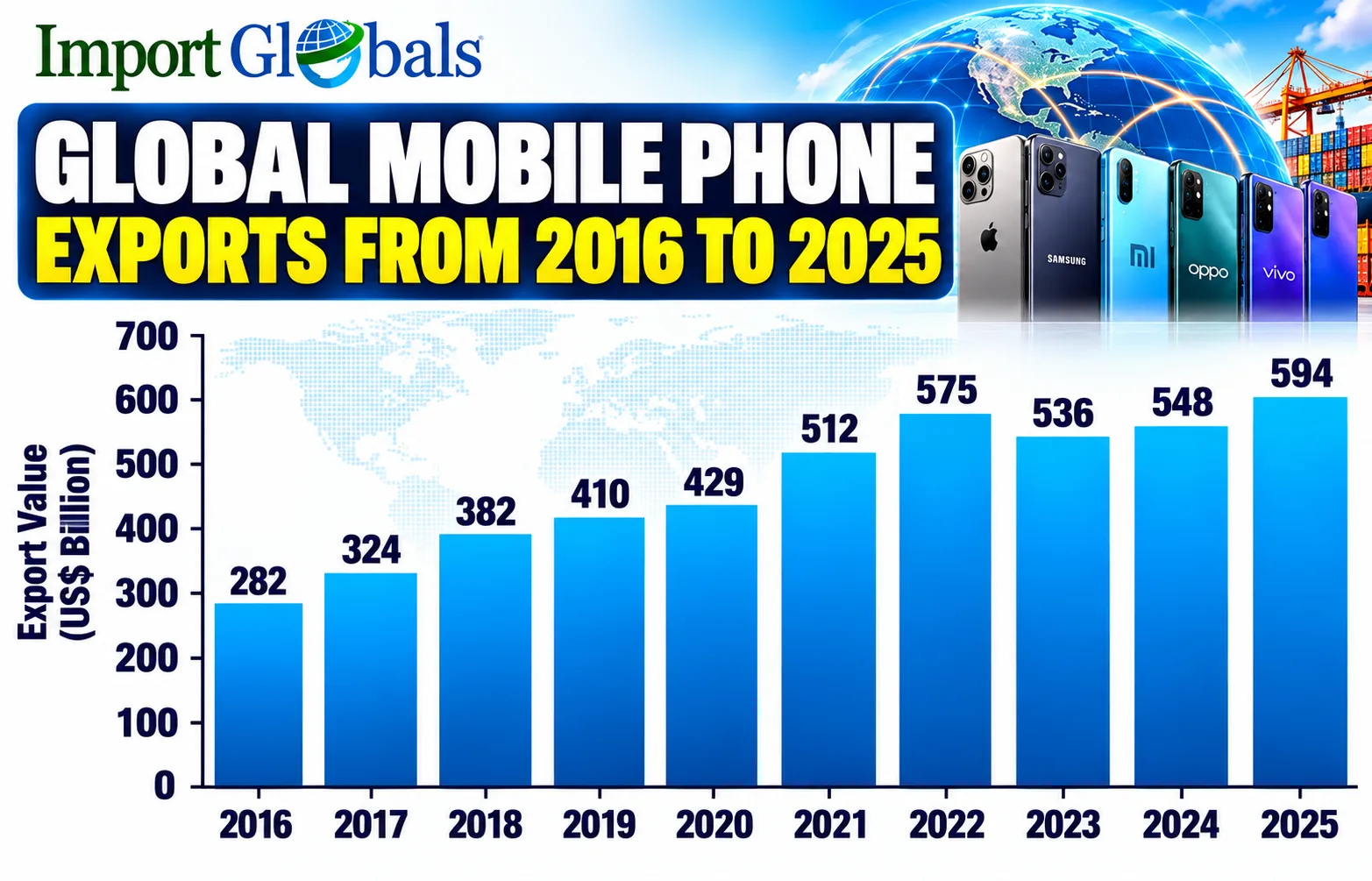
There was a general upward pattern of mobile phone exports over the period of 2016 to 2025, which gives evidence for the growing demand for smartphones and wireless communication technology. According to the Global Export Trade Data, the value of mobile phone exports amounted to US$282 billion in 2016, after which the exports increased to US$324 billion in 2017, and to US$382 billion in 2018. The upward trend continued throughout 2019; when exports reached US$410 billion, followed by US$429 billion in 2020. In 2021; the market continued expanding to US$512 billion, which shows how important mobile communication and electronics have become in international trade.
Then, in 2022 exports fell slightly and hit US$575 billion; the highest figure for the period up to that time. The industry went down in 2023, when mobile phone exports fell to US$536 billion. The sector was at its peak once more in 2024, when mobile phone exports amounted to US$548 billion, and then made another leap to US$594 billion. All in all, the mobile phone exports value grew by US$312 billion during the period of 2016 to 2025, which is approximately equal to a 110.6% growth.
Important Challenges in the Worldwide Mobile Phone Export Sector
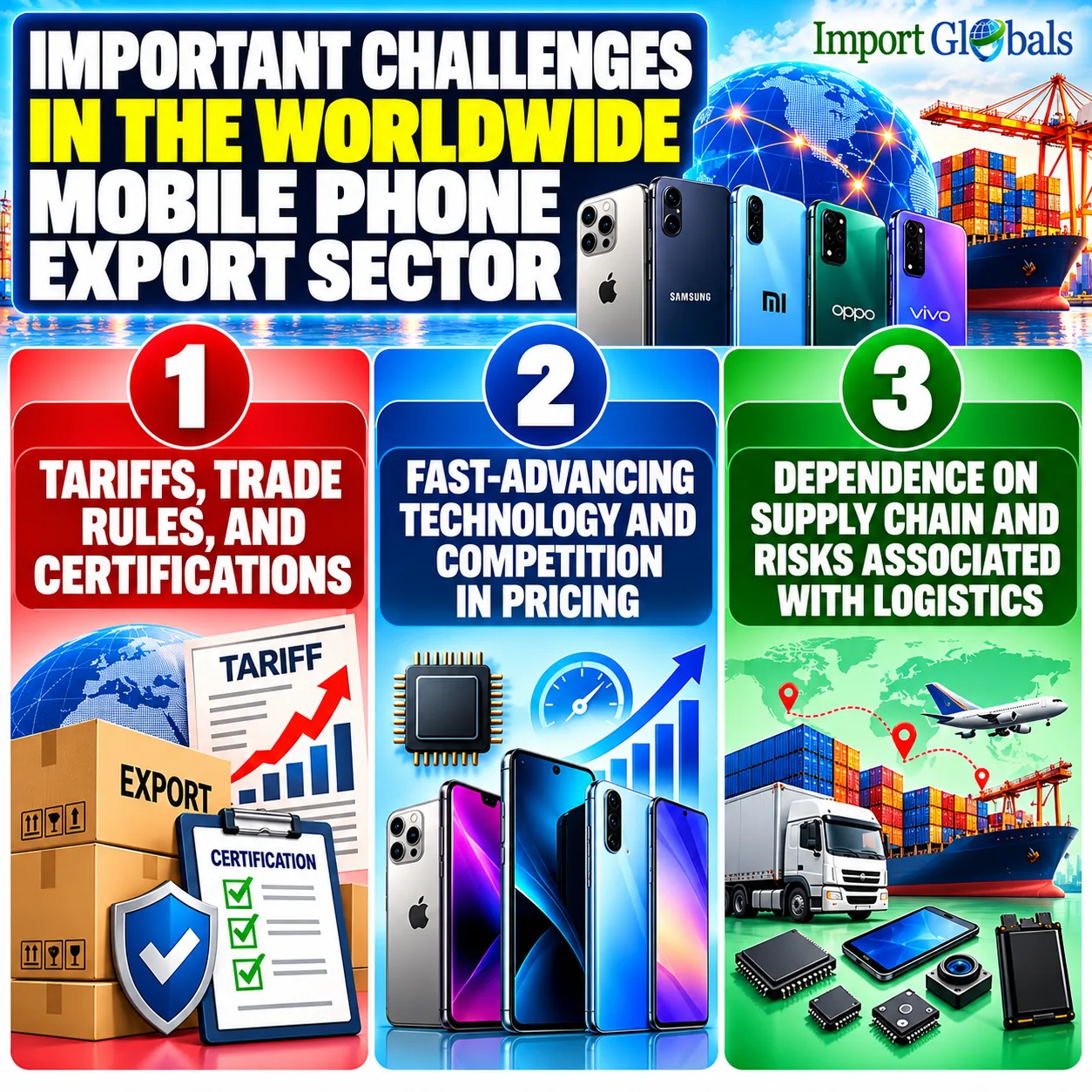
1. Tariffs, Trade Rules, and Certifications
Mobile phone exporters must adhere to the tariffs applicable in the countries they ship to; as well as various customs regulations such as the need for certification, labelling requirements, and product safety standards. Any change in trade rules may affect the cost of shipments. Therefore, exporters must check the regulations themselves before making any shipments.
2. Fast-Advancing Technology and Competition in Pricing
Smartphone technology is outdated fast; that is, processors, camera systems, networks, operating systems, batteries, etc. are changing rapidly. As a result, exporters have to keep up with how products are used today, manage inventories properly, as well as find appropriate pricing solutions once they engage with well-established companies and low-cost players.
3. Dependence on Supply Chain and Risks Associated with Logistics
Manufacturing mobile phones requires semiconductors, displays, batteries, camera parts, and other components which need to be acquired from international suppliers. Any logistics disturbance, freight price change, exchange rate change, or delivery delay may affect profitability. The situation can be improved if manufacturers raise awareness of their suppliers and make improvements in order management.
A Look at the Future of Global Mobile Phone Exports
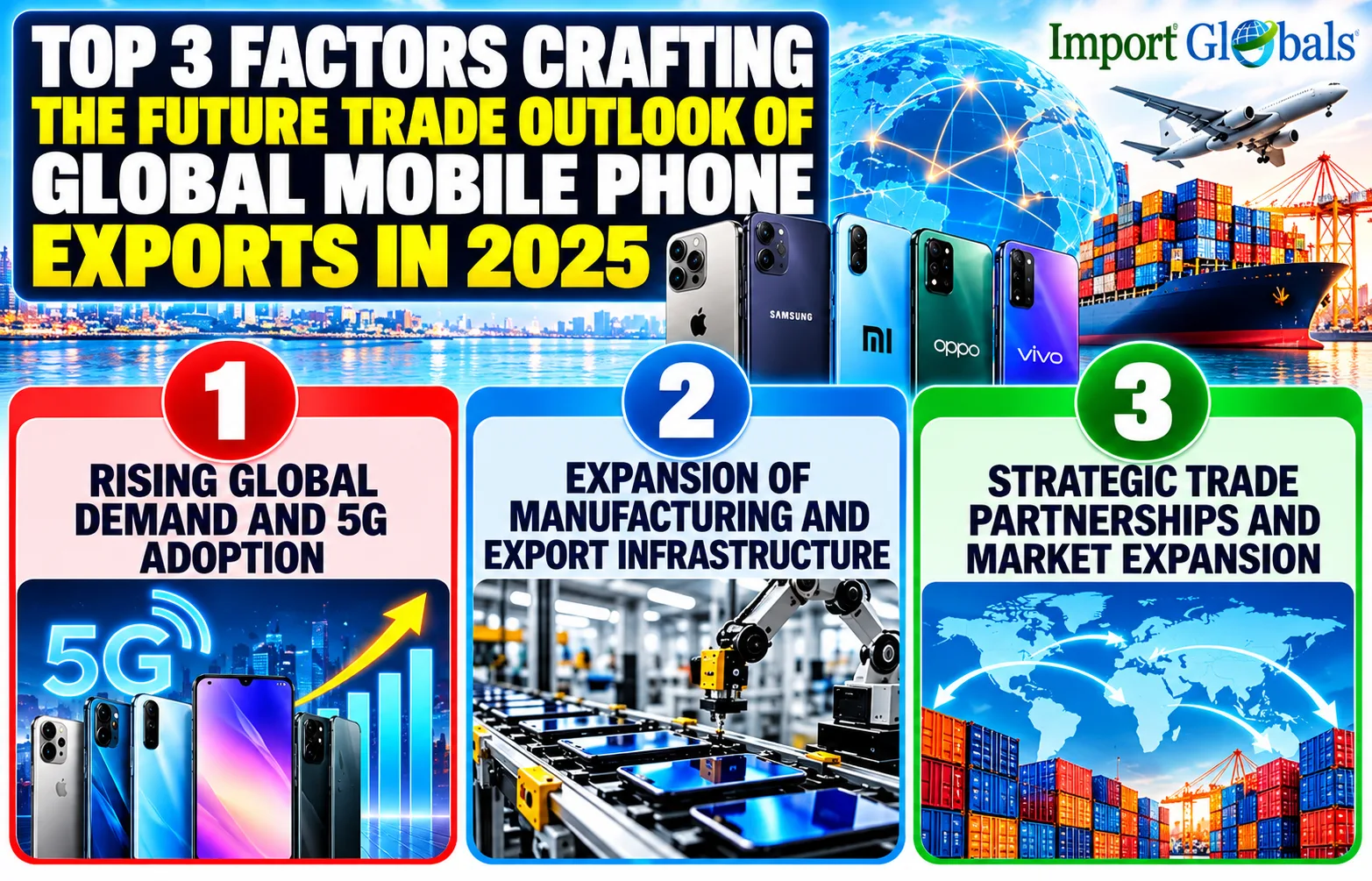
Mobile phone exports will be determined by the replacement cycle of consumers, the purchase of premium devices, the implementation of the fifth-generation connectivity (5G), as well as the growth of electronics manufacturing in Asia and other areas. In 2025, global smartphone shipments increased by 2%, as per Global Import Data. Apple had the highest market share with 20%, followed by Samsung with 19% and Xiaomi with 13%.
The fast pace of India’s export expansion and Vietnam’s well-established manufacturing capacity mean that the importance of the supply-chain diversification trend will likely persist. One of the hubs will remain China, where a vast component and manufacturing ecosystem exists. At the same time, regional distribution hubs will facilitate cross-border transactions.
In addition, exporters should be aware of tariffs imposed on imported devices, certification requirements, environmental issues, data protection challenges, and the limitations placed on used electronics. Exporters should find the best way to combine competitive prices with timely delivery, proper documentation, post-sale services, and a good reputation among buyers.
Conclusion
The year 2025 showed substantial growth in global mobile phone exports; which was the result of highly developed electronics markets being led by a number of nations, including China, Vietnam, and India. China appeared to be the most significant exporter in terms of export value, whereas Indian mobile phone exports were developing notably. On the level of brands, Apple was the leader in global mobile phone sales, with Samsung and Xiaomi following. The ranking of different countries and companies reflects only a part of the market.
For those companies that are looking for possibilities of entering new markets, conducting effective trade analysis in the field of exports is only possible if the analysis is based on the understanding of product definitions, destination-market characteristics, reliable suppliers, and the understanding of local legislation.
CTA
If you are trying to get the latest market information regarding the global smartphone trade, then you have come to the right platform here. Import Globals helps businesses stay updated with accurate market insights regarding the global smartphone trade. Subscribe to www.importglobals.com or drop an email at info@importglobals.com to get the latest information regarding the global smartphone trade to drive your international business growth.
FAQ’s
Que. Name the leading mobile phone exporter of 2025.
Ans. China is one of the leading mobile phone exporters of 2025.
Que. What is the export trade value of mobile phones from Vietnam in 2025?
Ans. The export trade value of mobile phones from Vietnam in 2025 is US$31.30 billion.
Que. How much of mobile phones were exported by India in 2025?
Ans. Around US$30.14 billion worth of mobile phones were exported by India in 2025.
Que. Name the leading global smartphone brand of 2025.
Ans. The leading global smartphone brand of 2025 is Apple.
Que. Which countries are the top mobile manufacturers at present?
Ans. China, Vietnam, and India are the top mobile manufacturers at present.
Que. How does Global import-export data support business growth?
Ans. Global import-export data supports business growth via proper identification of buyers, suppliers, analysis of market demand, and development of effective market expansion strategies.
Que. What information is available in Global trade data?
Que. Global trade data covers importer name, exporter name, shipment date, HS code, product details, quantity, pricing information, origin country, importing country, and port details.
Que. How frequently is the Global trade data updated?
Ans. Global trade data is updated on a monthly basis.
Que. Where can you obtain detailed information on Global trade data?
Ans. Visit www.importglobals.com or drop an email at info@importglobals.com for detailed updates on Global trade data.
You Can Also Visit :-
