
Malaysia Rubber Export Data: Global Market Trends
- Oct 20, 2026
- 41 Views
Malaysia Rubber Export Data: Global Market Trends
The rubber products industry of Malaysia has continued to play an important role in the country's manufacturing and exports in 2025, with medical gloves, industrial rubber products, tyres, tubes, and other rubber products being supplied to foreign markets.
As per the rubber export review prepared by the Malaysia Export Data, the export of rubber products was around US$5.16 billion in 2025 in comparison to US$5.61 billion in 2024, which shows a drop of around 7.9%.
There was no change in the pattern of where Malaysia’s rubber gloves were contributing to the export earnings; in fact, they are still considered a dominant part of the country’s exports to the international market due to Malaysia’s already well-established position as a producer within the healthcare and medical supply chain of the world.
Being the largest importer of rubber products from Malaysia, the US recorded the export value of about US 2.03 billion in rubber products for 2025 when compared to US$1.87 billion in 2024. It signifies an increase of about 8.9%, which demonstrates the importance of the US market in the business. Other major importers included China, Germany, and Japan.
Malaysia Rubber Export Trade at a Glance
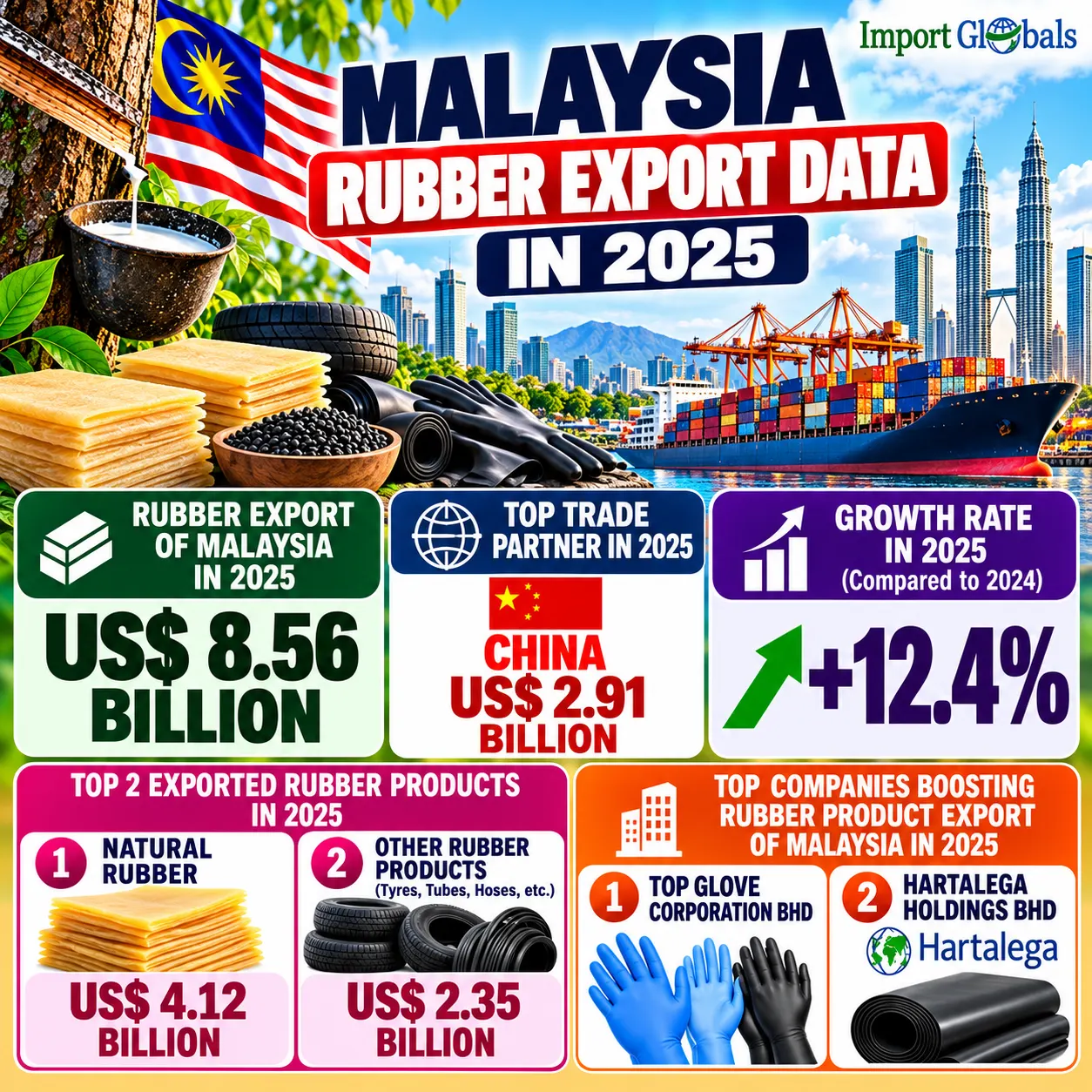
Malaysia’s rubber industry had a strong showing in international trade; with an export value of USD 8.56 billion, reflecting a growth of 12.4% compared to 2024. This performance was due to the country’s capabilities in rubber processing, manufacturing, and global supply chains. China was Malaysia’s largest trading partner for rubber exports in 2025; reflecting the dominance of Asia in Malaysia’s rubber exports, with rubber exports to China amounting to USD 2.91 billion.
Among the major exported items, natural rubber consisted of a total value of approximately USD 4.12 billion, underlining its importance to the use of rubber in various fields such as tire manufacturing and industrial applications. The rest of the rubber products, such as tires, hoses, and tubes, gave a total export value of around 2.35 billion, as per Malaysia Customs Data.
Top 10 Rubber Products Exported Variants of Malaysia in 2025
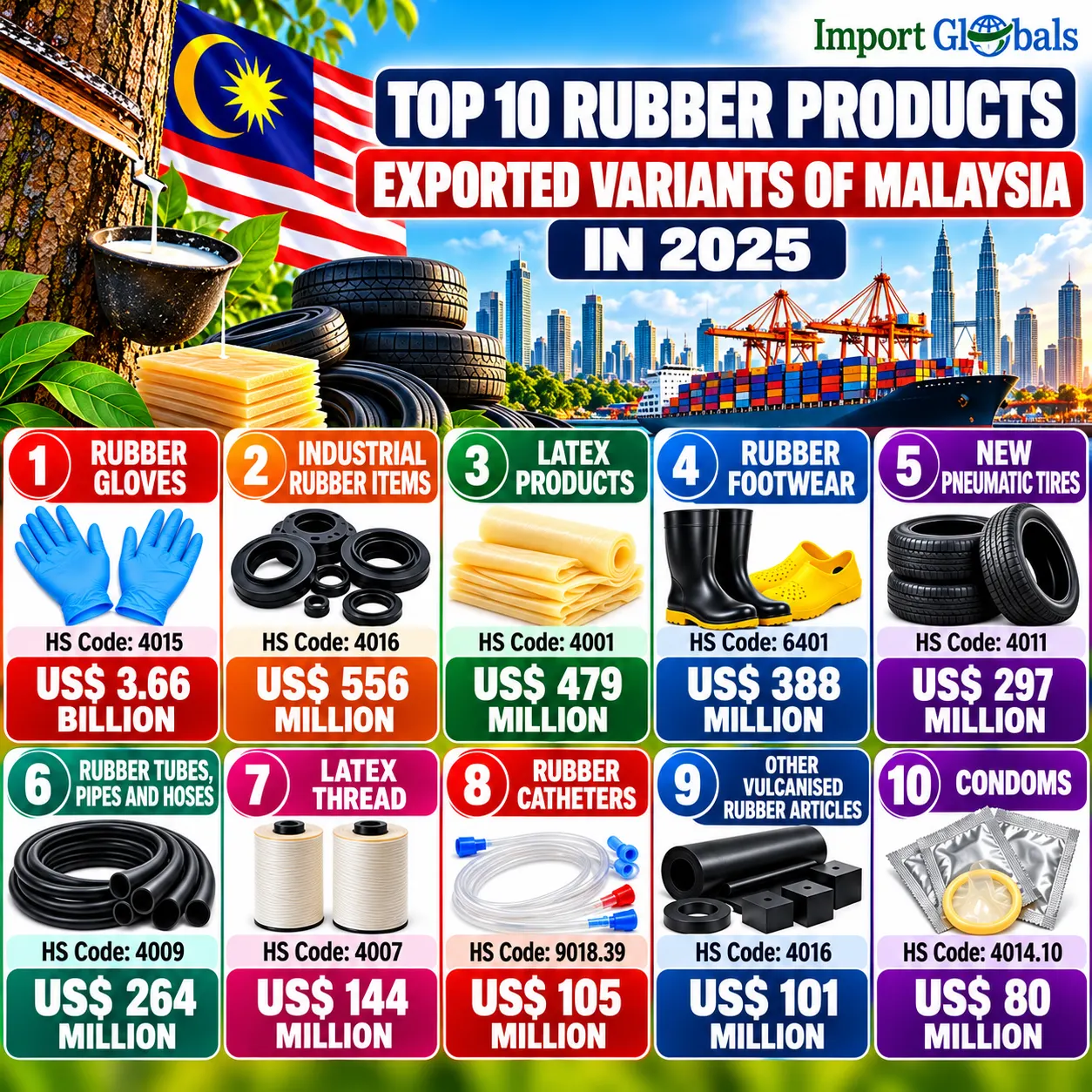
- Rubber Gloves (USD 3.66 Billion)
Rubber gloves were the leading product of Malaysian rubber product exports in 2025. They comprise medical, surgical, examination, and industrial gloves, which are used by health institutions, laboratories, manufacturing companies, and other distributors of safety products.
- Industrial Rubber Items (USD 556 Million)
Industrial rubber items refer to products such as seals, gaskets, washers, vibration control parts, and other moulded items. These products are widely used in automotive production, machine servicing, engineering works, and the supply chain of industrial machinery.
- Latex Products (USD 479 Million)
Malaysian products made of latex are used in medicine, industry, and manufacturing, says Malaysia Export Trade Data. The potential for export depends on the specifications of the product, the processing standards, the needs of the buyers, and the difference between unprocessed latex and finished rubber products.
- Rubber Footwear (USD 388 Million)
Rubber footwear includes waterproof shoes and other types of shoes that contain rubber in their soles or upper parts. These products are used by consumers, industries, and workers, and their demand is affected by such factors as price, life duration, comfort, and design of the product.
- New Pneumatic Tires — $297 Million
New pneumatic tires are used in passenger vehicles, commercial transportation, motorcycles, and machinery. Malaysian exporters compete based on quality, durability, performance characteristics, and relationships with auto part suppliers and international tire retailers.
- Rubber Tubes, Pipes, and Hoses — $264 Million
Rubber tubes, pipes, and hoses enable the transport of fluid in industrial machines, vehicles, agriculture, and manufacturing. Buyers typically check for resistance to pressure, temperature tolerance, flexibility, and suitability for the environment where the product will be used.
- Latex Thread — $144 Million
Rubber threads and cords are used in the making of elastic textiles, clothing, medical supplies, and in industry. Demand for exports depends on the elasticity, the tensile strength, and technical specifications set by the downstream manufacturers.
- Rubber Catheters — $105 Million
HS Code: 9018.39
Catheters are among the special medical equipment used in medical procedures and treatment of patients, as per Malaysia Import Customs Data. Exporters must follow all relevant regulations related to the medical devices, the material of construction, and standards of manufacture and quality control applied in the destination markets.
- Other Vulcanised Rubber Articles — US$101 Million
This category encompasses miscellaneous articles of vulcanised rubber that haven’t received more detailed classification. The product range can find applications in automotive, construction, machinery, and household service industries, with consumer demand influenced by the performance and reliability of the respective items.
- Condoms — US$80 Million
HS Code: 4014.10
Malaysia provides rubber condoms to both the global healthcare and consumer markets. Producers strive to compete with their rivals through the use of quality assurance, timely production, packaging, legal compliance, and distribution channels.
Top 10 Export Partners for Malaysia’s Rubber Products Exports
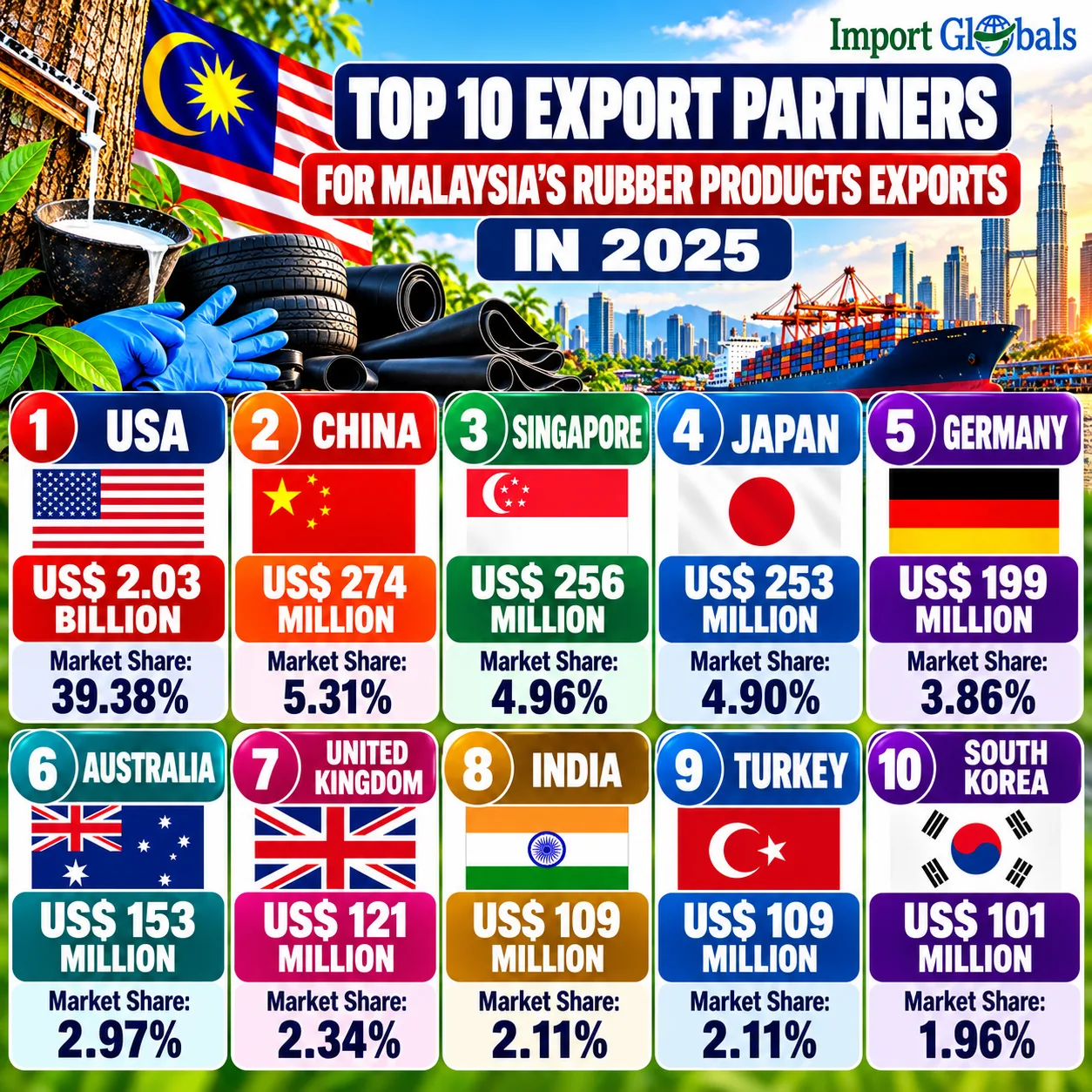
- USA — $2.03 billion | Market Share: 39.38%
In 2025, the USA became the biggest market for Malaysian rubber products. Searches by various sectors like automotive, healthcare, manufacturing, and industry were the main reasons for the high volume of exports to Malaysian suppliers working with the USA.
- China — $274 million | Market Share: 5.31%
China remained a key destination for Malaysian exports in rubber because of the strong backing of the manufacturing and industrial sectors. There are opportunities for exporters to benefit from the automobile sector, as well as the industry itself.
- Singapore — $256 million | Market Share: 4.96%
Malaysia Customs Shipment Data says that Singapore has become a major logistical hub for Malaysian rubber work. The country’s robust trading policies created opportunities for equipment suppliers who desire to have a presence in the region.
- Japan — $253 million | Market Share: 4.90%
Japan has been another important market for Malaysia’s rubber business, as its strong automotive sector, supported by manufacturing and healthcare needs, increased Malaysian rubber business exports. This created essential needs for consistent product quality, technical compliance, reliability, and more.
- Germany — US$199 Million | Market Share: 3.86%
Malaysia’s rubber-product exporters have potential opportunities in Germany related to providing products for industrial, automotive, and medical purposes. In making the purchase, the buyers would emphasize important factors such as reliability, performance of the goods, compliance with regulations, and, of course, consistent quality of goods received through the international supply chains.
- Australia — US$153 Million | Market Share: 2.97%
Australia represents an important market for rubber products of Malaysian origin being used in medical, building and construction, automotive, and industrial activity. Exporters may consider wholesale distribution opportunities as well as possible demand for particular rubber products.
- United Kingdom — US$121 Million | Market Share: 2.34%
United Kingdom is a good place for Malaysian rubber-product suppliers to gain access to the respective medical, industrial, and commercial rubber markets. Industry experts may investigate the process of importing and distribution networks of rubber products in various industries.
- India — US$109 Million | Market Share: 2.11%
India has good prospects for rubber products within the framework of its manufacturing, automotive, and healthcare industries. Malaysian exporters may benefit by analysing purchasing trends in the country from Malaysia Trade Statistics.
- Turkey — US$109 Million | Market Share: 2.11%
Turkey presents market opportunities in its manufacturing, automotive, construction, and industrial sectors. Suppliers in Malaysia may evaluate demand for rubber products, medical goods, and specialty products; as they consider transport costs and import regulations.
- South Korea — US$101 Million | Market Share: 1.96%
South Korea is another market for rubber products from Malaysia, having a strong manufacturing sector, automotive production, and industrial commerce. Exporters may evaluate the requirements for special products and look into likely collaborations with the producers and sales agents.
Top 10 Companies Boosting the Rubber Products Export of Malaysia
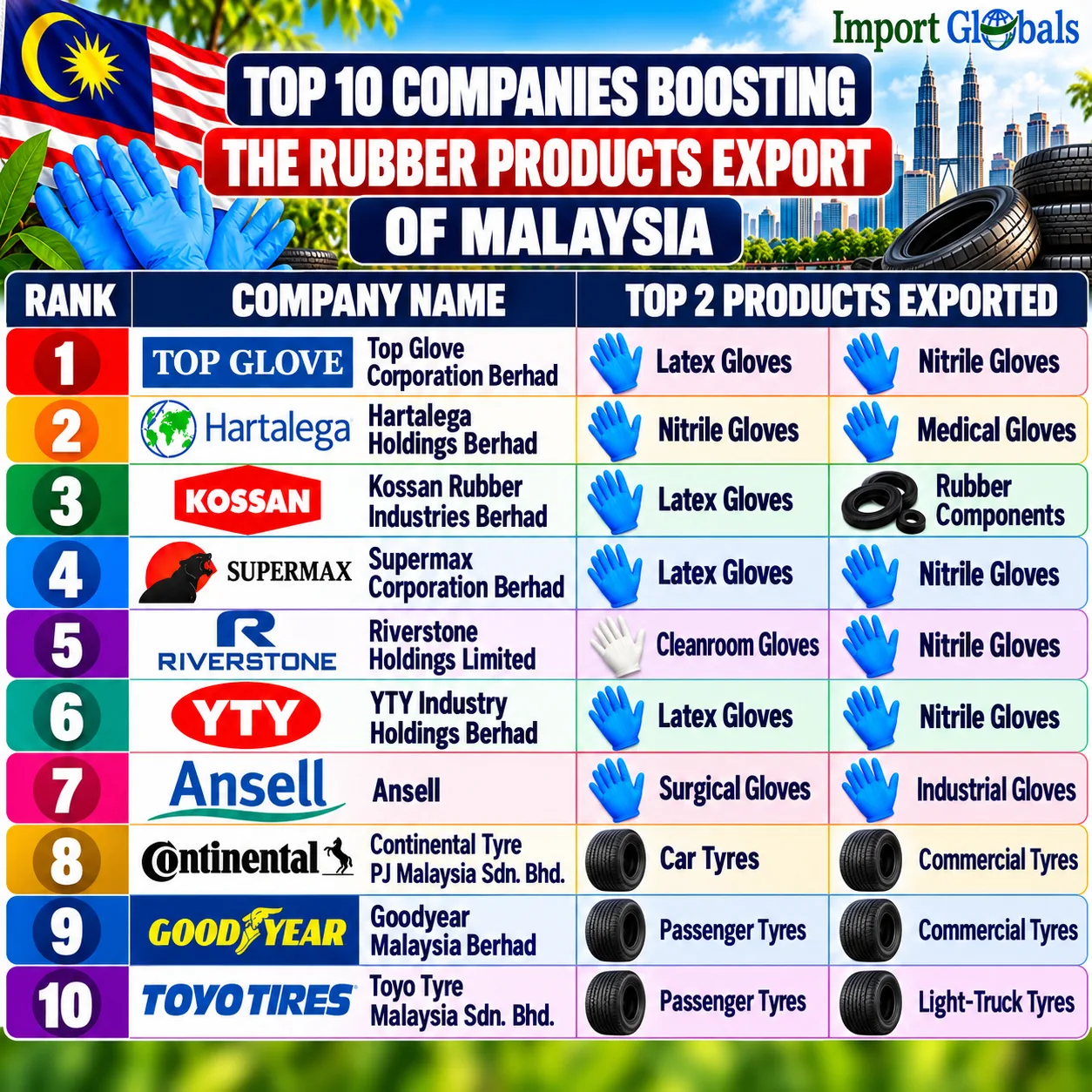
- Top Glove Corporation Berhad
Top exported products:
Latex exam and medical gloves
Nitrile exam gloves
Top Glove Corporation Berhad is one of the prominent manufacturers of rubber gloves in Malaysia and supplies to healthcare and industrial applications, along with general-purpose products. This organization has an extensive product line and a wide distribution network that connects Malaysian products with customers around the globe. It helps to place Malaysia on the map of competitive disposable glove producers in the industry.
- Hartalega Holdings Berhad
Top 2 products exported:
Nitrile examination gloves
Medical & specialized protective gloves
Hartalega Holdings Berhad specializes in manufacturing nitrile gloves for different purposes, including healthcare, laboratories, and food handling. Hartalega Holdings Berhad is known for its emphasis on efficient manufacturing processes, the effectiveness of production, and innovative development of the products with the use of emerging technologies.
- Kossan Rubber Industries Berhad
Main 2 products exported:
Latex and nitrile examination gloves
Technical rubber products and components
Kossan Rubber Industries Berhad operates in disposable glove production and technical rubber products. Its product range supports healthcare, automotive, marine, construction, and various industrial applications. Due to this diversification, it can operate in the international market, contributing to the overall rubber manufacturing and exporting ecosystem in Malaysia.
- Supermax Corporation Berhad
Main 2 products exported:
Latex examination gloves
Nitrile gloves used in medicine and industry
Supermax Corporation Berhad produces disposable gloves used in healthcare, laboratories, the food industry, and manufacturing. Its range of products is designed for those looking for equipment for medical interventions and safety in the working process. Supermax is known for rubber glove exports reports Malaysia Shipments Data.
- Riverstone Holdings Limited
Top 2 products exported:
Cleanroom gloves
Nitrile examination gloves
Riverstone Holdings Limited is in the business of protective gloves, including cleanroom gloves, whose products are used in industries where contamination control is important. The company produces protective gloves that are used in electronics, semiconductor processing and healthcare industries. This specialized business approach supports Malaysia in gaining access to high-value product markets for protective equipment where good quality and high standards of production are required.
- YTY Industry Holdings Berhad
Top 2 products exported:
Latex examination gloves
Nitrile examination gloves
YTY Industry Holdings Berhad is making its contribution in the field of disposable glove manufacturing and is supplying disposable gloves for medical and industrial use. Examination gloves are used in hospitals, laboratories, food preparation, and other areas. The company illustrates the capacity of Malaysian manufacturing of rubber products.
- Ansell
The 2 leading exported products:
Surgical and medical examination gloves
Industrial protective gloves
Ansell is a worldwide company that manufactures protective solutions. Its operations are situated in Malaysia. Ansell creates basic products such as medical gloves and special hand protection used for industrial purposes. Hence, this country participates in the production of medical gloves and special products for industries.
- Continental Tyre PJ Malaysia Sdn. Bhd.
The two principal products are:
Tires for cars
Tires for commercial vehicles
Continental Tyre PJ Malaysia is the representative of the tire manufacturing segment of Malaysia’s broader rubber-making industry. Tires are a part of automotive and transportation supply chains.
- Goodyear Malaysia Berhad
The top two exported products:
Passenger-car tyres
Commercial-vehicle tyres
Goodyear Malaysia is where Malaysia’s automotive tyre industry comes into play, producing rubber products for cars. There are specific characteristics that tyres must have, such as strength, traction, safety, and performance. This segment adds diversity to Malaysia’s rubber manufacturing industry and establishes connections with the automobile and transportation sectors.
- Toyo Tyre Malaysia Sdn. Bhd.
The top two products exported:
Passenger-car tyres
Light-truck tyres
The activity of Toyo Tyre Malaysia in Malaysia’s automotive rubber-products sector has a great effect on producing tyres suitable for cars and light trucks. These products are used in the sectors of road transport and replacement tyres where various characteristics such as durability, handling, and performance are highly important. The company illustrates the importance of tyre manufacturing in expanding the portfolio of rubber goods in Malaysia, reported Malaysia Trade Data.
Malaysia’s Rubber Products Statistical Analysis: Past 10 Years
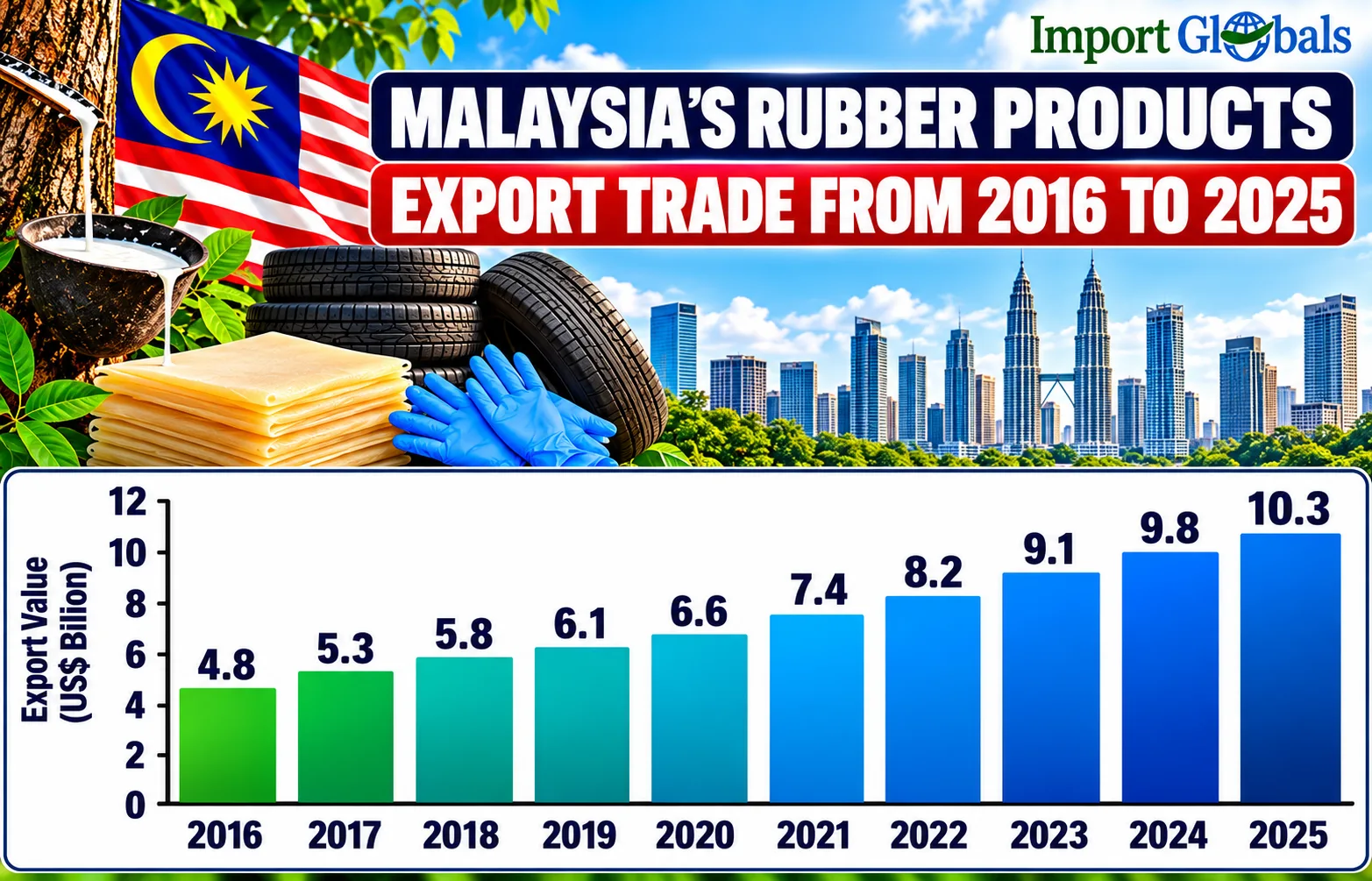
Malaysia’s rubber goods export sector kept expanding over the period from 2016 to 2025, showing how the rubber industry in Malaysia is becoming a major player in the global market. As the figures in the diagram hint at, the export value was set at US$4.8 billion in 2016 but went up to US$5.3 billion in 2017 and US$5.8 billion in 2018. In 2019, exports were US$6.1 billion, continuing to grow to US$6.6 billion in 2020. In 2021, the process continued, and rubber goods exports in Malaysia attained the value of US$7.4 billion.
Based on the upward trend of export values, the export value increased to US$8.2 billion in 2022. The value in 2024 reached US$9.8 billion. The export figure in 2025 was recorded at US$10.3 billion, the maximum value given in the chart. Overall, the export value has grown by US$5.5 billion from 2016 to 2025 (an increase of about 114.6%), which demonstrates how significant the growth of the rubber products trade in Malaysia is and how essential this process is to the country’s economy.
Bilateral Trade Overview With the Top Partner
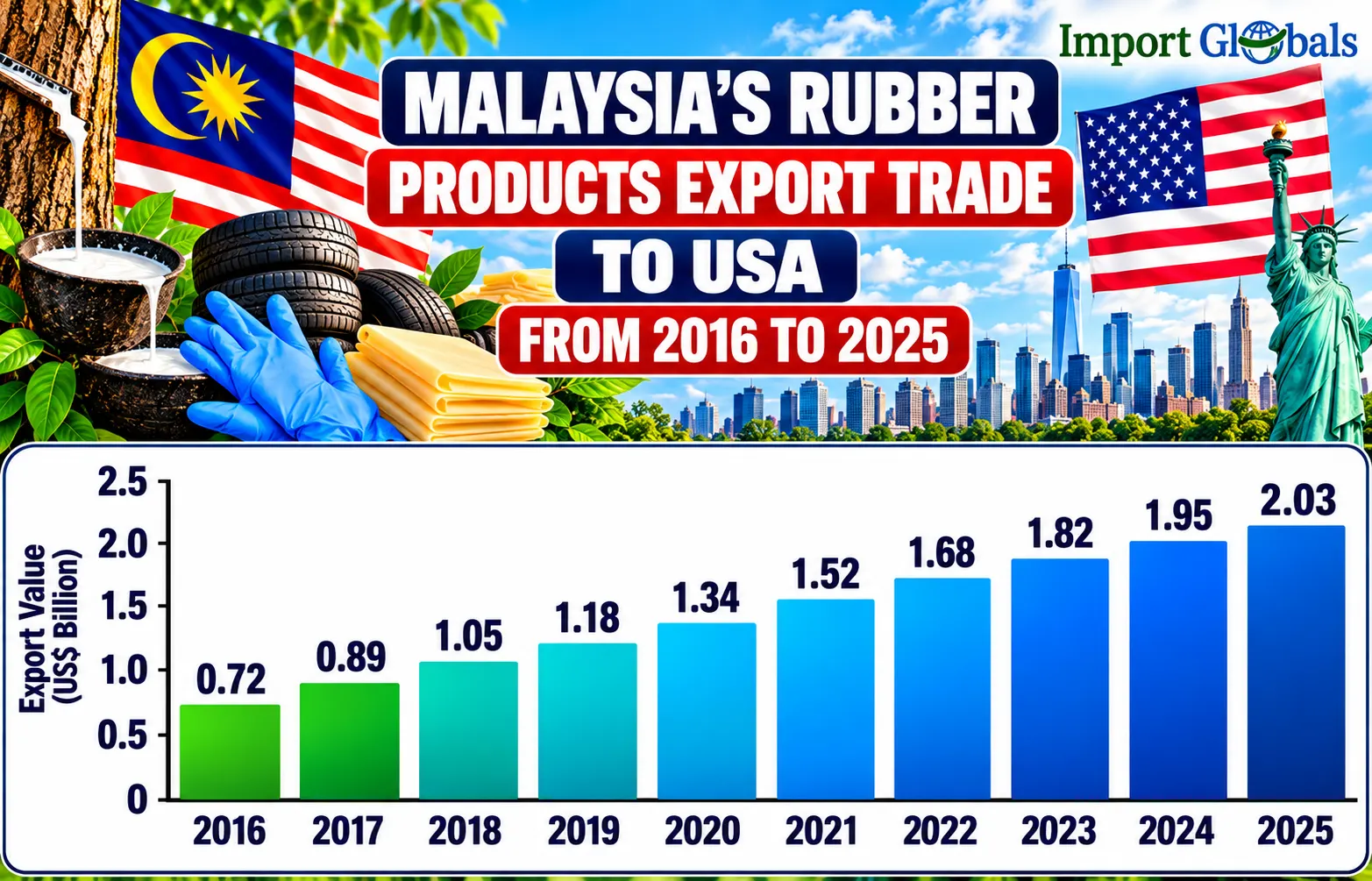
Malaysia’s trade with the United States in rubber has been growing steadily from 2016 to 2025, which indicates the significance of the American market for the Malaysian rubber production industry. According to the Malaysia Import Data presented, in 2016, the value of rubber exports to the USA was US$0.72 billion, and it grew to US$0.89 billion in 2017 and US$1.05 billion in 2018, which means that bilateral trade has been expanding.
In 2019, exports increased to US$1.18 billion and to US$1.34 billion in 2020. In 2021, the trend continued, and exports increased to US$1.52 billion. In 2022 the exports of rubber goods from Malaysia reached US$1.68 billion. In 2023, the revenue increased to US$1.82 billion. The figure reached US$1.95 billion in 2024, and finally, in 2025, it went up to US$2.03 billion. Therefore, in total, rubber exports of Malaysia to the USA increased by US$1.31 billion in the period from 2016 to 2025, which shows a growth of around 181.9%.
Future Trade Outlook of Malaysia’s Rubber Exports in 2025
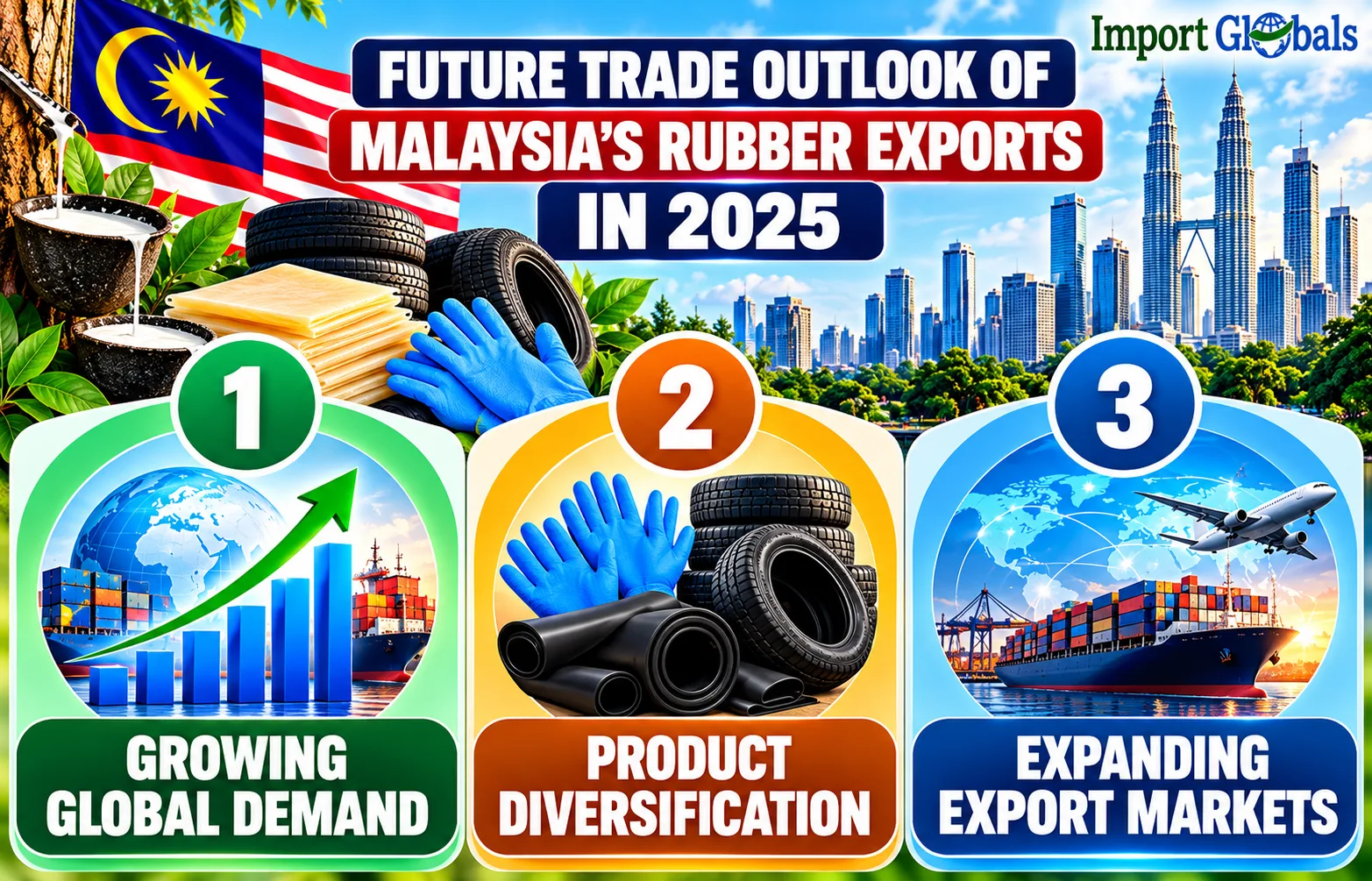
The rubber export industry of Malaysia is expected to present great opportunities in 2025 due to the demand for medical gloves, industrial rubber items, tires, tubes, and other special products. Manufacturing capabilities of Malaysia, as well as its global supply chain experience, continue to be significant advantages of the country. According to Malaysia’s Trade Statistics, gloves were one of the major contributors to rubber-based products in December 2025.
The US, China, Japan, and Europe offer opportunities for Malaysian exporters to enter those markets. The production of medical gloves can continue to keep up with the demand for Malaysian exports, while auto parts and industrial seals, hoses, and tires can help with the diversification of product mix. Nevertheless, competition from other manufacturing countries, changing tariffs, costs of production, and stricter environmental and labour regulations can affect the efficiency of exports.
Advancing technologies, automation, innovations in products, and sourcing of goods sustainably are important as they can help in increasing competitiveness. It will be beneficial for Malaysian producers to work on supply-chain efficiency and compliance with international standards.
Final Thoughts
Malaysia still plays a crucial role in the world rubber sector, exporting medical gloves, industrial rubber products, tires and tubes, as well as other special products. Its well-established supply chain and industrial base open opportunities in the healthcare, automotive, construction and industrial sectors.
According to the Malaysia Export Statistics, exports to the United States grew from $0.72 billion in 2016 to $2.03 billion in 2025, which corresponds to an impressive compound annual growth rate of around 181.9%. The article lists China, Singapore, Japan, Germany, and other countries as important regions for Malaysian rubber.
The leading suppliers, such as Top Glove, Hartalega, Kossan, Supermax, and Riverstone, show the importance of the glove sector, while tire and technical rubber suppliers provide diversification of the industry’s product range.
CTA
Looking for the latest information regarding Malaysia’s rubber products trade? Then Import Globals is here to resolve all your complexities regarding the latest market authorities understanding. The platform helps businesses explore global trade intelligence with accurate shipment information. Subscribe to www.importglobals.com or drop an email at info@importglobals.com for detailed analysis of the rubber products export of the country in order to drive the business strategies.
FAQ’s
Que. What is the reason behind the rubber export industry popularity of Malaysia?
Ans. The rubber export industry of Malaysia is popular because of its medical and examination gloves and industrial rubber products.
Que. What was the rubber products export valuation of Malaysia in 2025?
Ans. The rubber products export valuation of Malaysia in 2025 is 5.16 billion US dollars.
Que. What is the leading rubber products export variant of Malaysia in 2025?
Ans. Rubber gloves and industrial rubber items are the leading rubber products export variant of Malaysia in 2025.
Que. Name the destination that has been driving the rubber products export of Malaysia.
Ans. The United States is the destination that has been driving the rubber products export of Malaysia.
Que. How much rubber product has been exported by the Malaysian authorities to the USA in 2025?
Ans. The Malaysian authorities have exported rubber products worth 2.03 billion US dollars in 2025.
Que. What is the HS code for Malaysia’s rubber products?
Ans. The specific HS code for Malaysia’s rubber products is 40.
Que. How does Malaysia’s import-export data support business growth?
Ans. Malaysia’s import-export data supports business growth via proper identification of buyers, suppliers, analysis of market demand, and development of effective market expansion strategies.
Que. What information is available in Malaysia trade data?
Ans. Malaysia trade data covers importer name, exporter name, shipment date, HS code, product details, quantity, pricing information, origin country, importing country, and port details.
Que. How frequently is the Malaysia trade data updated?
Ans. Malaysia trade data is updated on a monthly basis.
Que. Where can you obtain detailed information on Malaysia trade data?
Ans. Visit www.importglobals.com or drop an email at info@importglobals.com for detailed updates on Malaysia trade data.
You Can Also Visit :-
- Malaysia Automotive Import-export Data: Latest Trends and Updates of 2025
- Malaysia-Singapore Trade: The Growing Opportunities and the Bilateral Integrity and the Import-export Analysis
- Malaysia's Top Trading Partners in 2025: The Market Trends and Statistics
- Electronic Machinery Dominates the Topmost Exports of Malaysia: The Latest Insights of the Fastest-growing Economy
