Gold Exports and Nicaragua's Growing Reliance on Mining Income
- Jan 22, 2026
Gold Exports and Nicaragua's Growing Reliance on Mining Income
The story of Nicaragua's exports has altered quickly. For years, the country's foreign revenues came from a combination of things, including manufacturing in free zones (particularly clothing) and traditional goods like coffee and meat.
But in the last ten years, gold has gone from being a major export to a defining one. As per Nicaragua Export Data by Import Globals, this has changed how Nicaragua gets foreign currency, how it pays for imports, and how vulnerable its economy is to global commodity cycles.
In 2025–26, this increased reliance on mining money has two sides. Higher gold prices and more exports can help the trade account and the government's income on the other hand. On the other hand, putting too much faith in one extractive export makes you more likely to be affected by price changes, regulatory and sanctions risks, and social and environmental challenges at home.
1) The New Export Reality: Gold as a Main Source of Income
Gold is currently Nicaragua's most valued export by a long shot. Recent trade figures show that Nicaragua's gold exports will be between $1.1 billion and $1.2 billion in 2023. As per Nicaragua Import Export Trade Data by Import Globals, this makes gold one of the country's top exports and a substantial source of foreign money. At the same time, macro assessments show that gold's percentage of total exports has grown a lot since the middle of the 2010s.
This development is important because it modifies the economy's "risk profile" when exports become more concentrated.When one product produces the most money from exports, macro stability becomes more sensitive to that product's global price, buyer demand, and financing conditions along the value chain.
2) Where Nicaragua's Gold Goes: Not Many Buyers, Clear Risk
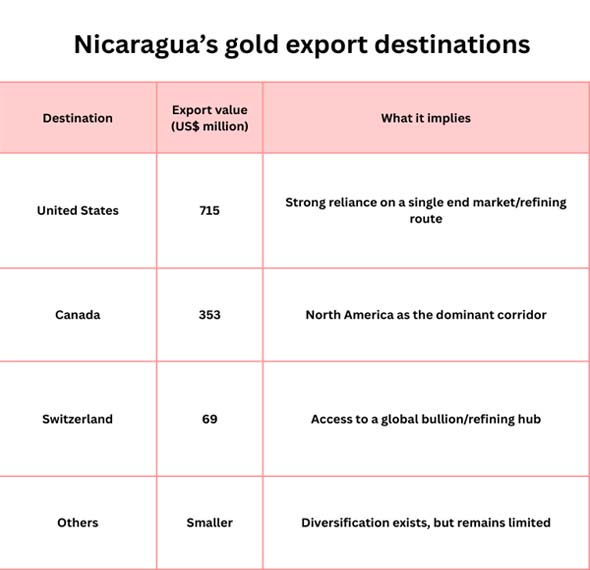
As per Nicaragua Import Data by Import Globals, people buy gold all throughout the world, but they aren't all in the same place. Most of Nicaragua's gold exports travel to a few markets, such as North America. This is because of trade routes, trading hubs, and business connections.
Trade researchers are asking important concerns because of this structure: How robust are these channels if the regulations for compliance are stricter? How big of a danger does the export pipeline suffer from its policies and reputation? And how easy is it for Nicaragua to alter its markets if a vital road gets blocked?
3) The Basics of the Value Chain: How Gold Turns into Money for Export
When gold is exported, it's not just "rocks leaving the country." Export revenues come from a chain with numerous steps, each with its own level of risk and value:
- Exploration and Licensing: permits, concessions, community involvement, and legal frameworks determine the regulations for who can mine and how they can do it.
- Extraction and Processing: Corporate mines make more minerals in bigger, more steady proportions, while artisanal and small-scale mining may be less stable and harder to govern. Documentation, custody controls, and compliance processes decide if gold can go into premium channels for transportation, refining, and sale.
- Export Settlement: The timeliness and reliability of payments coming in are vital for banks' liquidity and the availability of foreign currencies.
A important issue for 2025–26 is that when gold prices are high, its export effect is stronger since even small volume increase can lead to big gains in export value.
4) 2025: Prices Increase up and there are more Mining Exports
Gold prices around the world went up a lot till 2025, and benchmarks set new records multiple times during the year. As per Nicaragua Exporter Data by Import Globals, when prices go up, they frequently show up in export data as "better terms of trade," especially if the exporter can also sell more.
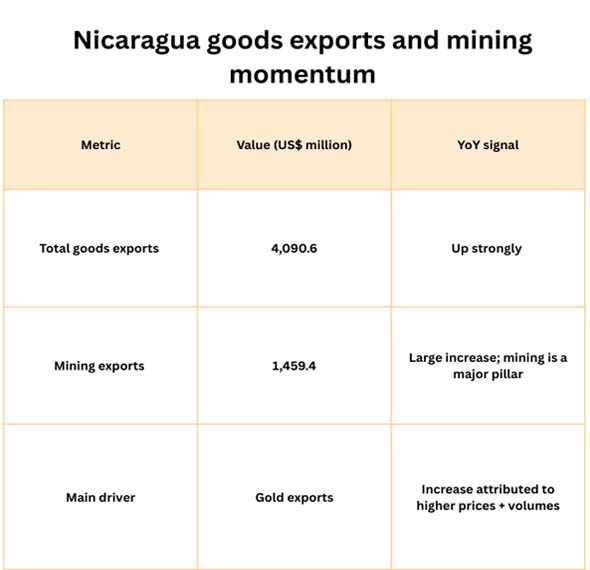
Nicaragua's official trade figures say that mining exports expanded a lot in 2025. Mining exports went up a lot in the first nine months of 2025 compared to the same time previous year. Gold was particularly named as the main factor, with both higher contract prices and larger amounts backing this up.
5) Why This Is "Dependence": The Big Connection Between Gold and the Economy
When a country relies heavily on one export earner, a number of macro channels become tighter:
A) Availability of Foreign Currency
The money we get from selling gold helps pay for imports. As per Nicaragua Importer Data by Import Globals, an increase in gold inflows can help the currency market and make it easier to get fuel, machinery, and other goods.
B) Fiscal Sensitivity
Mining often pays taxes, royalties, fees, and other business costs. Fiscal planning can have abrupt gaps if gold prices or volumes collapse, especially if budgets assume that prices would stay high.
C) Focus on Growth Models
If gold investments grow faster than other tradable sectors, the economy can become less stable. For example, mining may grow but other sectors that create jobs, such agro-industry and light manufacturing, may not.
In summary, gold can help the economy when it's going up, but it can also make planning harder when the cycle turns.
6) The Risks in 2025–26: What Could Go Wrong (and What to Look Out For)
Risk 1: The possibility of prices going back up
Gold is a "safe haven," but its price goes up and down. As per Nicaragua Import Trade Statistics by Import Globals, if global rates, risk sentiment, or central bank buying patterns change, the value of exports can go down even if Nicaragua's mining volumes stay the same.
Risk 2: Risk of compliance and a concentrated market
If compliance standards get stricter, imports are limited, or reputational issues arise, flows can be disrupted because a substantial share goes to only a few places. This is a bigger problem for gold than for export baskets with a wider range of goods.
Risk 3: Limits on social and environmental factors
When mining expands, it can cause problems in the community, with water and land, and with the company's reputation, which can impair its ability to get licenses and keep operating. When permissions or transportation become contested, these risks can lead to genuine trade problems.
Risk 4: "Jobs vs. export value" imbalance
Gold exports can be worth a lot of money, but they don't create as many jobs as sectors that require a lot of labor. That can make it hard to decide how to develop: great export earnings, but not so good for the economy at home.
Risk 5: Uncertainty about policies and sanctions
As per Nicaragua Import Export Trade Analysis by Import Globals, when exports depend a lot on a product that has to go through global financial and compliance systems, perceptions of country risk are more important.Even if gold exports keep rising, higher-risk perceptions might make it harder to get loans and limit the number of people who want to participate.
7) What a better export plan would look like
Not being so dependant doesn't imply stopping mining. As per Nicaragua Export Import Global Trade Data by Import Globals, this involves making sure that gold is a good thing and not a bad thing. A stronger approach usually entails exporting more than just gold. This includes making manufacturing exports stronger, boosting agro-processing, and making the value chains for coffee and meat more stable.
As per Nicaragua Import Shipment Data by Import Globals, the gold pipeline needs to be easier to follow and have higher standards so that people can get into the market and avoid compliance shock.
Clear and predictable budgetary frameworks so that mining profits lead to consistent public investment instead of boom-and-bust budgets.
Local value capture where possible: services, maintenance, logistics, and smart supply-chain investments that boost local benefits without putting too much pressure on downstream refining goals.
In conclusion, gold has become a macro variable for Nicaragua.
As per Nicaragua Import Custom Data by Import Globals, Nicaragua's gold exports are no longer just a narrative about the mining industry; they are a story about the whole economy. By 2023, gold made up a large part of all exports. By 2025, the country's trade performance reveals that mining exports are growing mostly because gold receipts are getting stronger. This dependence might be a good thing in 2025–26 if it is handled correctly. Prices are good, and worldwide demand for gold is still robust. But there is a risk that a highly concentrated export engine can make shocks worse, especially when policy, compliance, and social license to operate are involved.
The main point for trade intelligence teams is that watching Nicaragua now means tracking gold prices, quantities, destinations, and governance all in one place. This is because gold has become one of the country's most critical external economic levers. Import Globals is a leading data provider of Nicaragua Import Export Trade Data.
FAQs
Que. Why does Nicaragua need to export gold so badly right now?
Ans. Gold is now one of the country's most important exports and a substantial source of revenue from other countries. This makes trade performance more likely to be affected by the mining cycle.
Que. Does a rise in the price of gold mean that the country would automatically get more money?
Ans. Not always. Prices can make exports worth more, but the country's benefits depend on how well the government collects taxes, how many jobs are produced, and how the money is spent and shared.
Que. What is the largest risk of relying on gold exports?
Ans. Export receipts might drop quickly when prices drop or it's hard to get into the market. This makes it tougher to receive foreign currency and makes the economy more vulnerable.
Que. What can Nicaragua do to depend less on gold exports?
Ans. By making other tradable sectors stronger (including manufacturing and agro-processing), improving traceability and compliance to protect access to the gold market, and using mining earnings to increase overall productivity.
Que. Where to get detailed Nicaragua Import Export Global Data?
Ans. Visit www.importglobals.com.