Growth of Manufacturing and Its Influence on Philippine Trade: Recent Industrial Developments and Market Opportunities
- Sep 21, 2026
Growth of Manufacturing and Its Influence on Philippine Trade: Recent Industrial Developments and Market Opportunities
Manufacturing sector is one of the strongest facilitating factors in the economy of the Philippines and a key player in its international trade, reported Philippines Trade Data. The role of the Philippine manufacturing sector is quite significant as it has allowed local commodities integration into global production, contributing not only electronics and semiconductors but also food items, machinery, transport means, and chemicals.
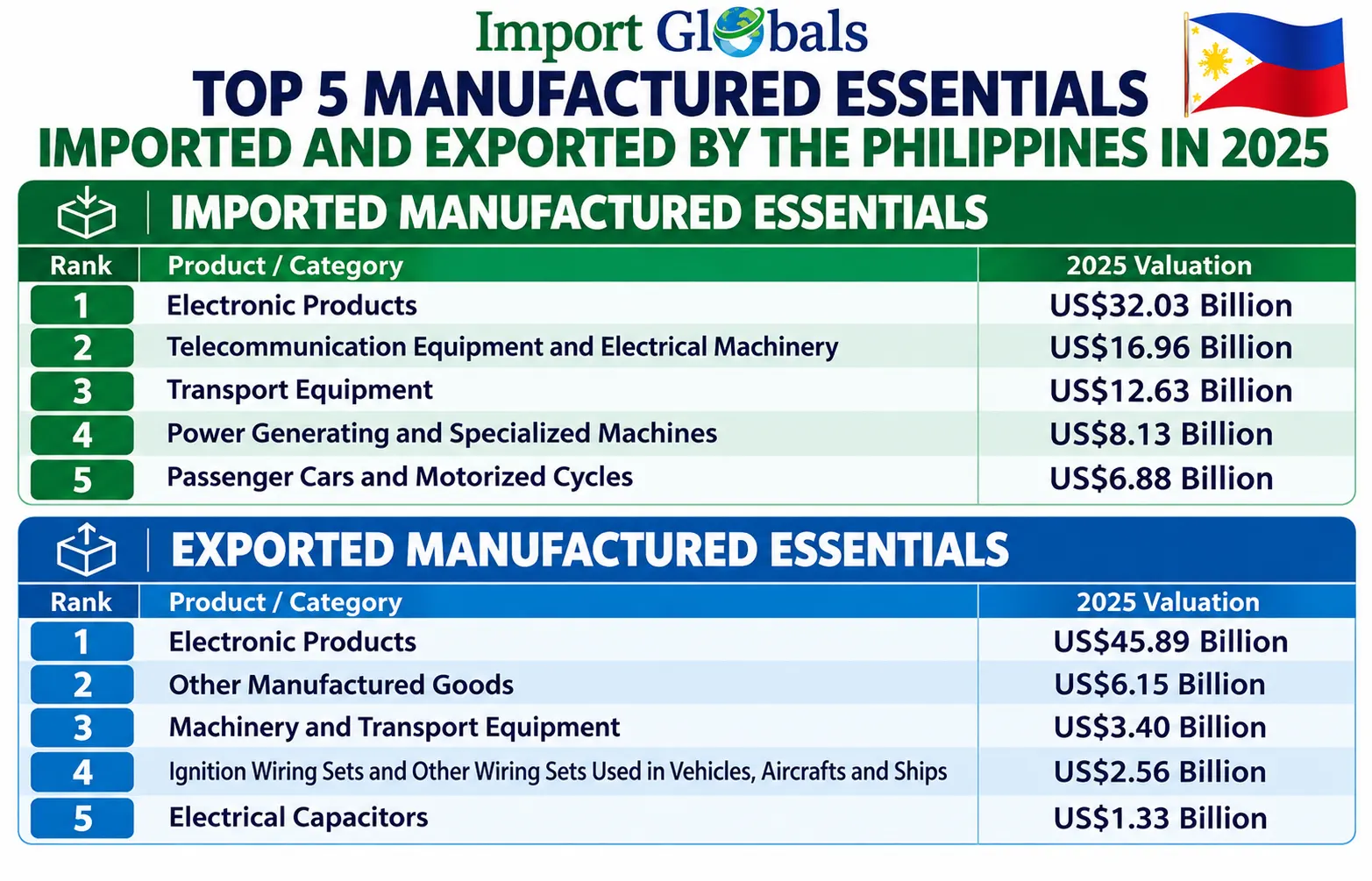
The role of manufacturing in the Philippines' international trade can be illustrated by the data on manufacturing exports presented below for the year 2025. According to the Philippines Shipments Data, manufactured products accounted for US$67.59 billion worth of exports, or 80.0% of the total exports of the country in 2025. Electronic products alone holds an accountability of US$45.89 billion worth of exports, or 54.3% of total exports, reported Philippines Customs Data.
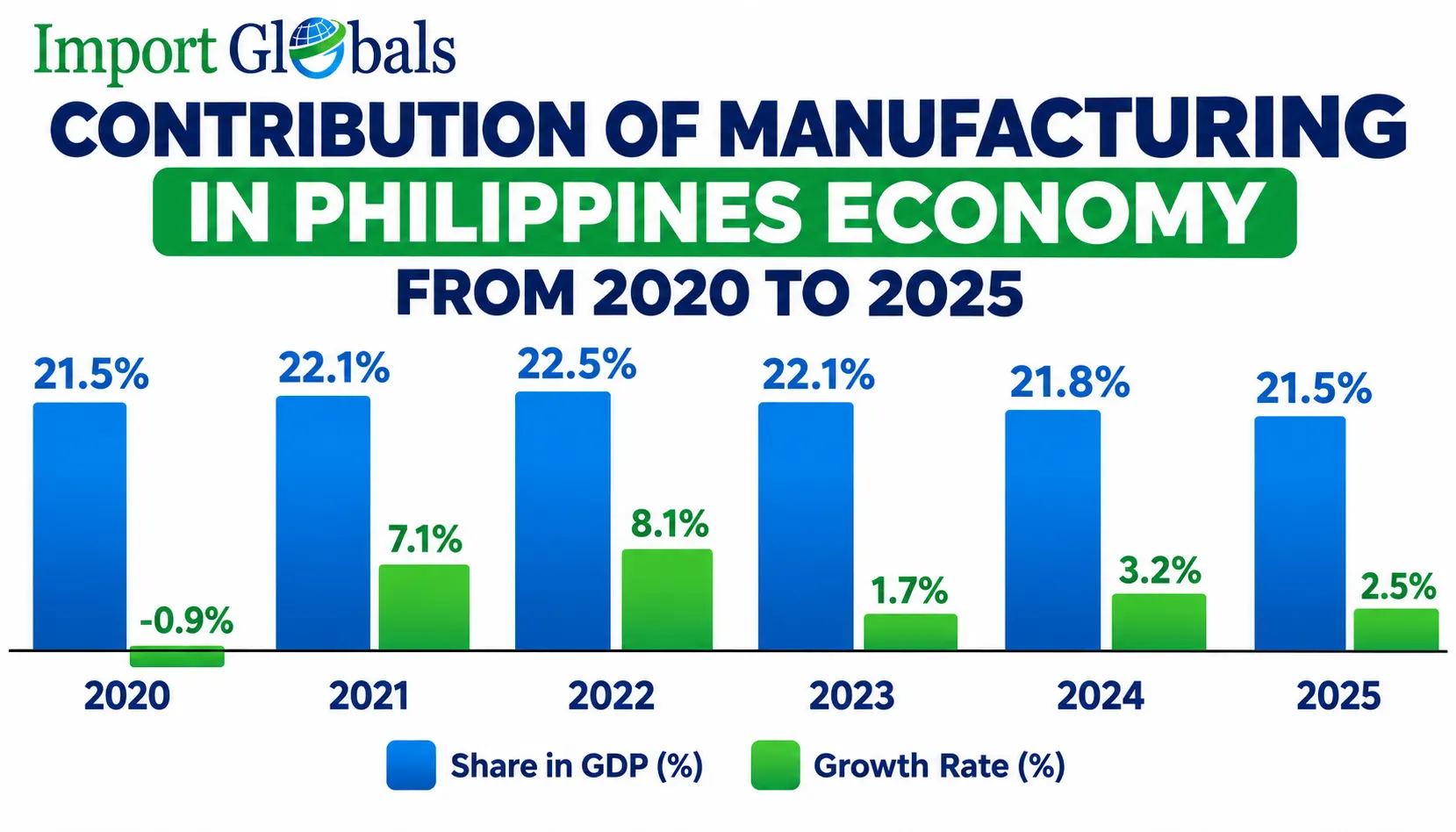
At the broader economic level, the GDP of the Philippines grew by 4.4% in 2025, while manufacturing recorded 2.5% growth. The total volume of goods and services exported during this year amounted to an increase of 8.1%.
These changes suggest that manufacturing is more than just something done in a country. Philippines Shipment Trade Data says that it has a direct correlation with export capacity in a country like the Philippines. The demand for raw materials and machinery in order to meet manufacturing targets, the amount of labour that would be employed, investment in the manufacturing sector, and the supply chain development are affected as well.
The Significance of Manufacturing Within the Philippines Economy
Manufacturing acts as a link between natural assets, foreign inputs, technology, labour, and global markets. One product uses raw materials coming from a different country, parts coming from another one, is assembled in the Philippines, and is sold around the world, reported Philippines Shipment Statistics.
In 2025, manufacturing played a part in the country's economic growth, but with just 2.5% yearly growth, it lagged behind several service industries. However, manufactured goods remained leaders within the Philippines' merchandise exports.
The reason we can realize the importance of this sphere is due to several points:
1. Exporting Products
Manufacturing provides quite a large number of products for export. In 2025, manufactured products made up 80% of total merchandise exports, says Philippines Customs Trade Data.
2. Industrial Employment
Manufacturing requires its own specialists for production, engineering, quality control, logistics, packaging, maintenance, and administration. According to the Philippine Trade Data, manufacturing projects that were approved in January-June 2025 were expected to create more than 5,000 jobs.
3. Import Demand
The manufacturing sector also leads to an increase in the demand for imported equipment, components, semi-finished goods, chemicals, fuels, and other inputs. Therefore, the rise in demand in the manufacturing sector has an impact on the trade balance of the Philippines.
4. Foreign Investment
Government authorities are initiating different investments for detailed classified improvement of the specific traded categories.
5. Supply-Chain Development
Manufacturing is a driver for the development of auxiliary industries like logistics, warehousing, packaging, transport, testing, maintenance, and business services.
Manufacturing in the Philippines in 2025
The manufacturing sector in the Philippines marked a time of increased production momentum in the year 2025.
On the 8th of June 2025, the Volume of Production Index showed that manufacturing output grew by 4.9% on a yearly basis in May 2025, representing the highest growth in production volume over the past 10 months, says Philippines Import Export Data. The sector saw massive growth in food manufacturing, which recorded a remarkable gain of 15.7%, whereas output from transport equipment jumped by 13.5%.
The success was largely important since the food processing and transport equipment manufacturing culminate in totally different dimensions of industrial operations. While food processing links the manufacturing activities to domestic consumption and outputs from agricultural farms, the transport equipment manufacturing links the country with industrial and automotive value chains.
Nevertheless, it is important to note that the yearly performance must not be confused with monthly growth. In the context of the 2025 results, Philippines Export Data said the growth in the manufacturing sector had reached only 2.5%. Therefore, the developments in the manufacturing industry during 2025 reflect continued progress.
Top Manufacturing Industries Supporting Trade in the Philippines
1. Electronics and Semiconductors
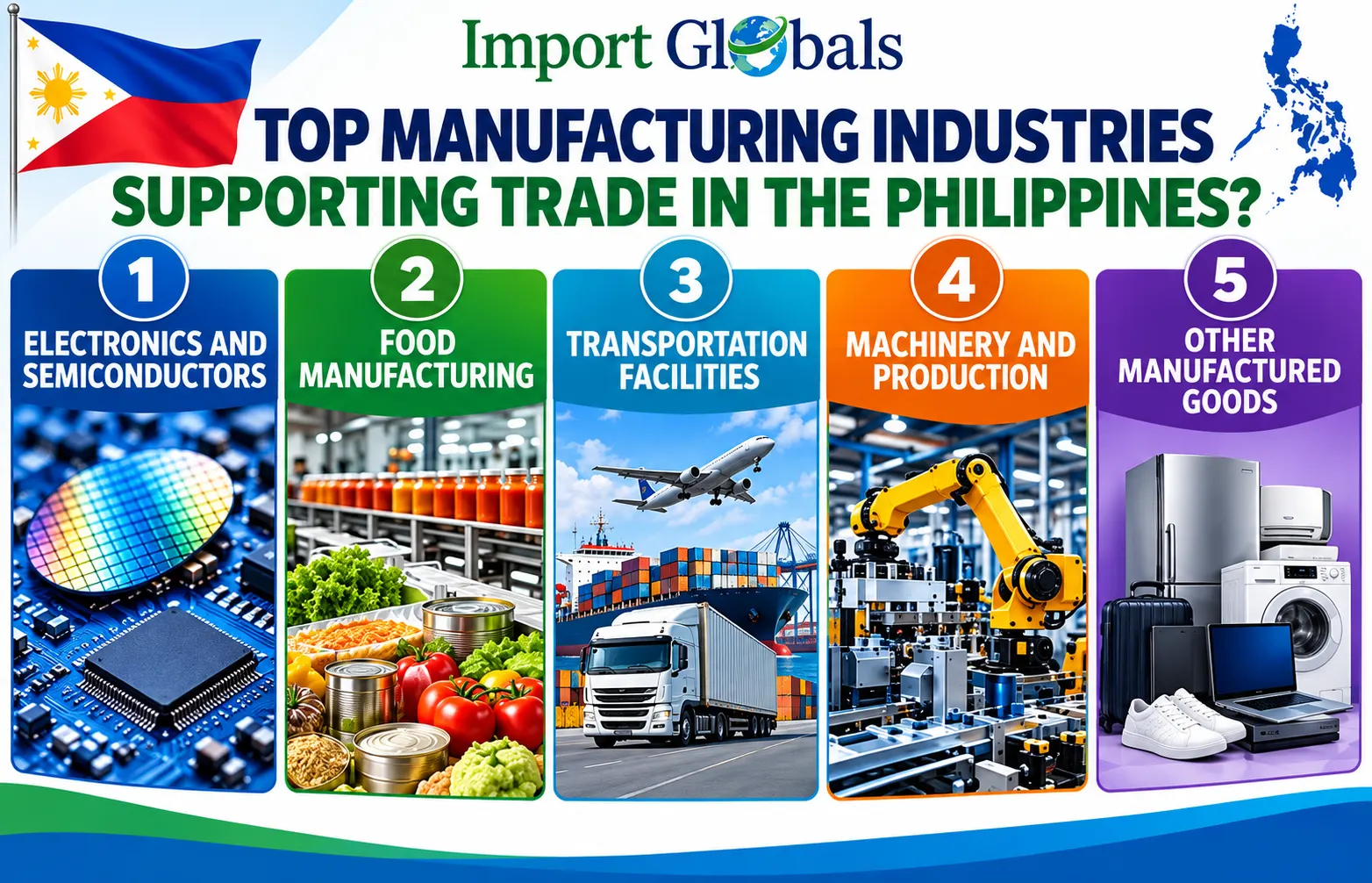
The electronics sector is one of the top facilitating factors of the merchandise export sectors. Various semiconductor devices, electronic devices, automotive electronics, and instruments are involved in the world's technological development, reported Philippines Customs Statistics.
The industry also generates the need for specialized machinery, equipment, components, and testing.
2. Food Manufacturing
Food is another very important area in industry. According to Philippine Trade Statistics, the growth of the food products subsector was 15.7% in physical production during May 2025.
3. Transportation Facilities
Manufacturing of transport facilities is growing in its impact on Philippine industry. The transportation factors have come across a hike of 13.5% in 2025.
4. Machinery and Production
Machinery is also a top facilitating factor of the country's exports. The country is mainly acquiring for equipment, devices, special machinery, and machines basically in the production processes, says Philippines Statistical Data.
5. Other manufactured Goods
According to Philippines Import Data, other manufactured goods holds an accountability of US$6.15 billion in Philippine exports in 2025, with a share of 7.3% of exports.
Top Trading Partners of the Philippines for Manufactured Essentials
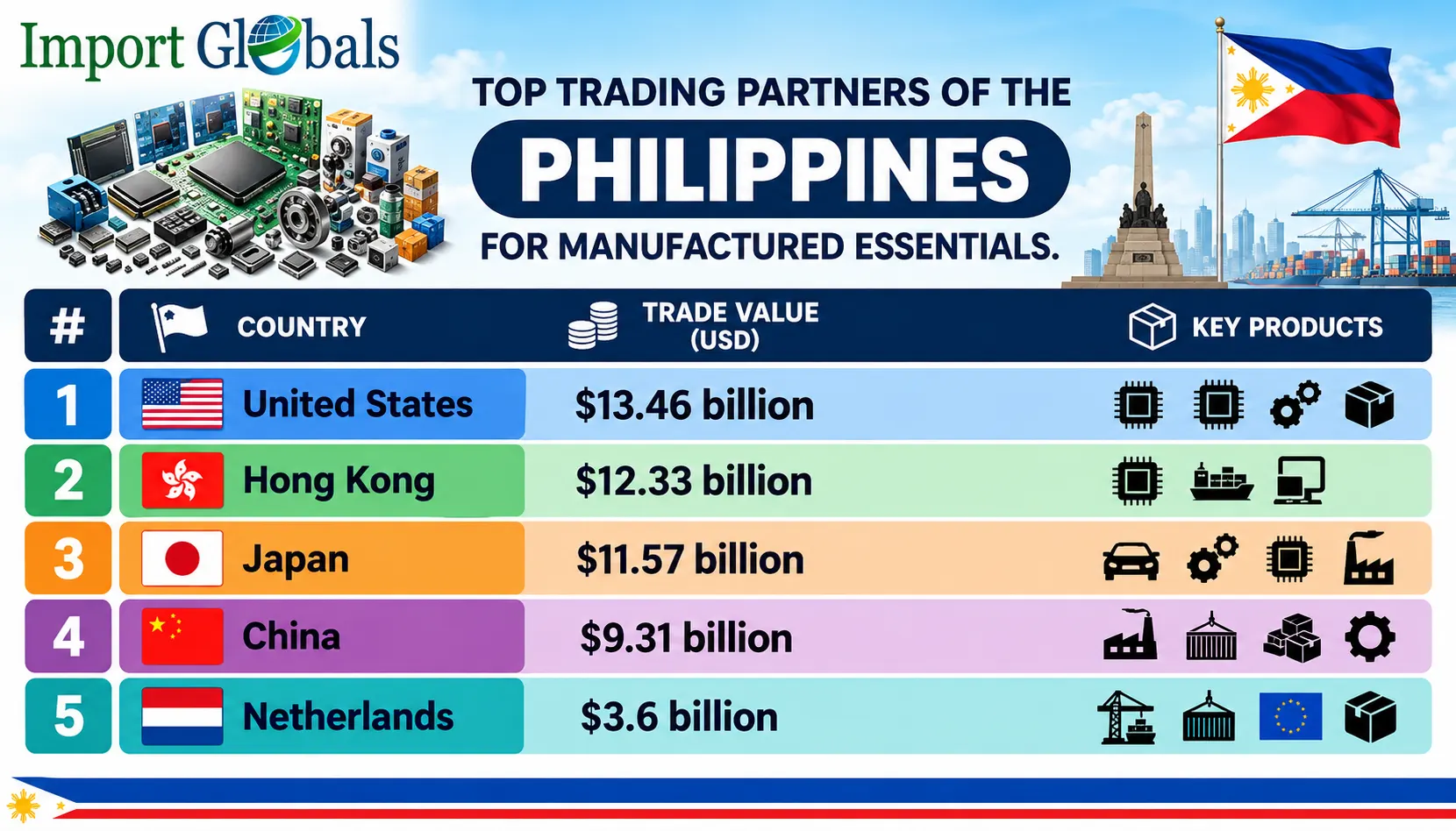
1. The USA
The USA is a top trading authority with Philippine backed up by the diversity in trade of exports of US$13.46 billion. The importance of the market is mainly attributed to electronics, semiconductors, machinery, and other manufactured products.
2. Hong Kong
Hong Kong was the second country with US$12.33 billion worth of Philippine exports in 2025. Philippines Import Customs Data says that the importance of the destination is attributed to electronics and the regional supply chains of Asia.
3. Japan
Japan was the third country with US$11.57 billion worth of Philippine imports in 2025. The trading relationship covers manufactured products, electronics, machinery, automotive products, and other industrial supply chains.
4. China
China reports US$9.31 billion of Philippine exports in 2025, that is mainly about 11% of export volume. The country is also among the major suppliers of Philippine imports, which makes it one of the most important trading partners for manufactured products.
5. Netherlands
The Netherlands was the fifth-largest destination of Philippine exports with US$3.6 billion, says Philippines Import Trade Data. It was also the largest export destination of the Philippines in the European Union, with 36.8% of exports to countries of the bloc coming from the Philippines in 2025.
Problems Confronting Growth of Philippine Manufacturing
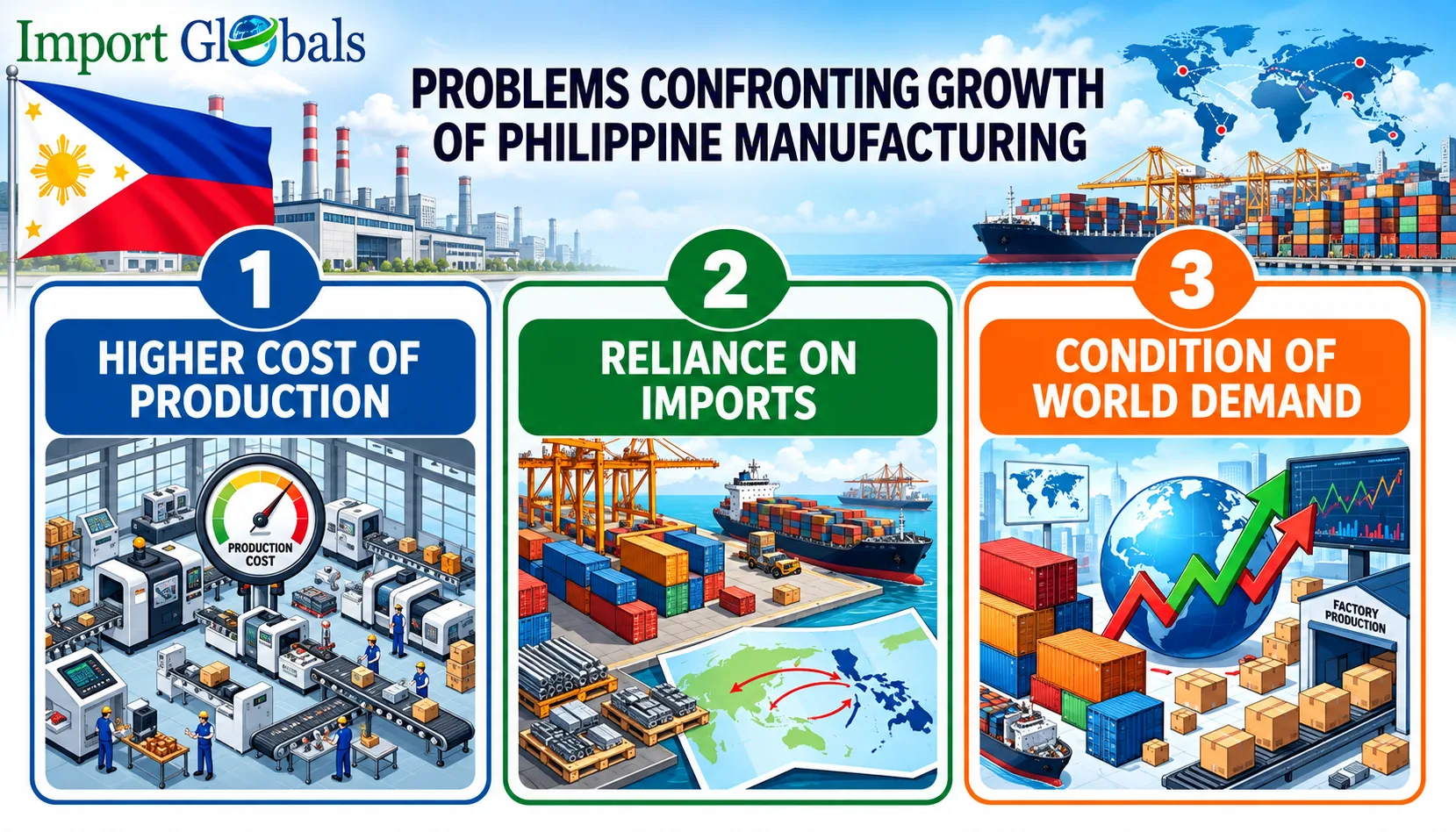
While there are many possibilities, the Philippine production sector must cope with a variety of structural and commercial obstacles.
1. Higher Cost of Production
The cost of energy, logistics costs, labour costs, the cost of imported components, and other costs tend to affect the competitiveness of manufacturers.
2. Reliance on Imports
Some manufacturing sectors have a considerable dependence on foreign machinery, parts, and raw materials. Thus, changes in international pricing may influence production costs, reported Philippines Customs Shipments Data.
3. Condition of World Demand
The global demand conditions are fluctuating in a continuous manner. An economic slowdown in key importing countries are mainly leading to a reduction in orders and volume of production.
What Are the Advantages of Import Globals for the Philippine Economy?
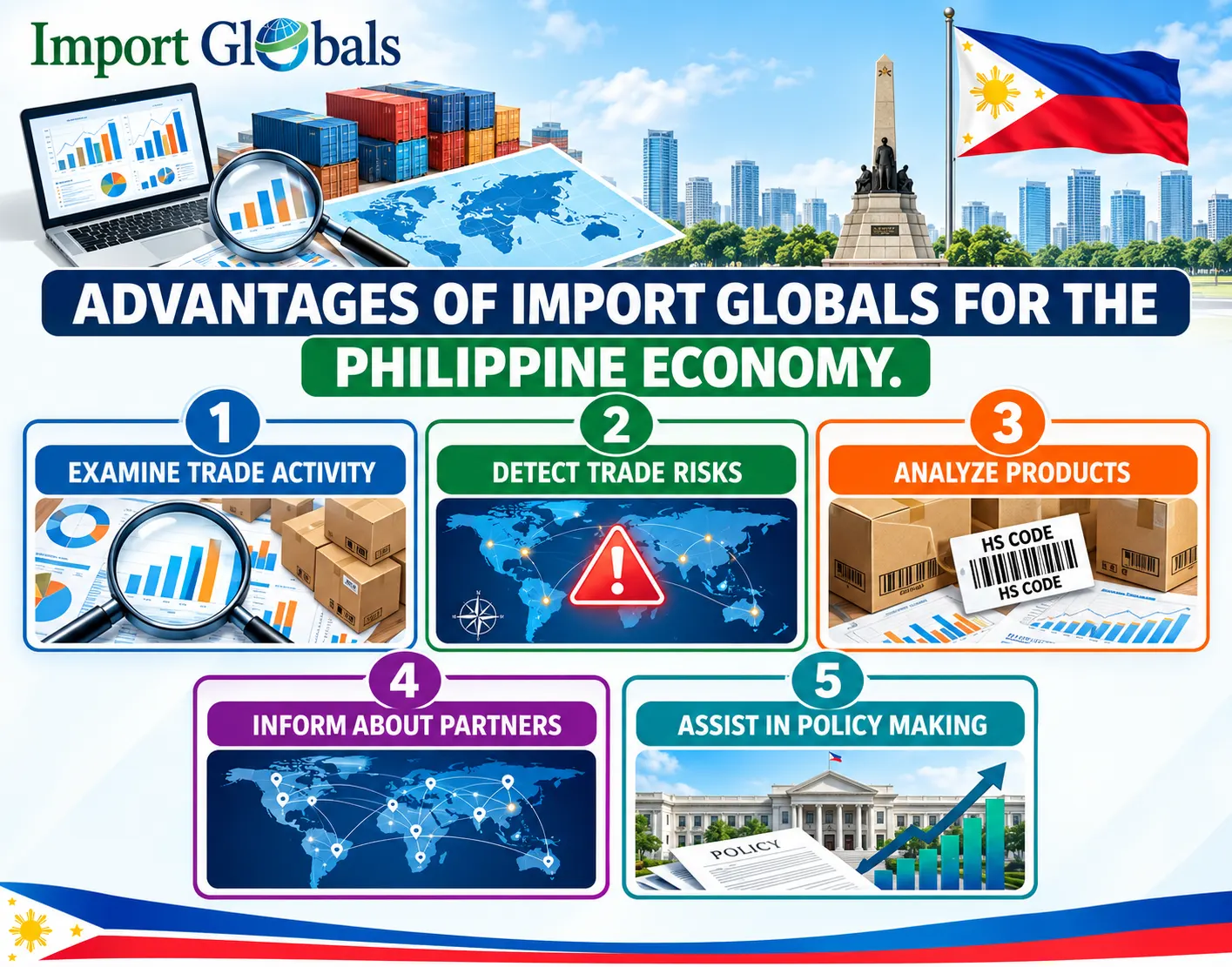
Import Globals aids in providing officials with in-depth shipment information and encourages intelligence by enhancing data information.
- Examine Trade Activity: Authorities can evaluate HS codes and product categories, shipment values and volume, their origin and destination points of each shipment, among others.
- Detect Trade Risks: The information related to Philippines Shipments Data can be used for detection of the frequent trade movements and risk-based monitoring together with official customs systems.
- Analyze Products: Officials can analyse certain products or HS codes to learn about product demand and its sources from markets worldwide.
- Inform About Partners: Import Globals also provides information about key suppliers, customers, destination markets, and international trading networks.
- Assist in Policy Making: The obtained data is applicable and ensures evidence-based decisions for trade development, market opportunities, etc.
Future Trade Outlook of Manufacturing Trade in the Philippines
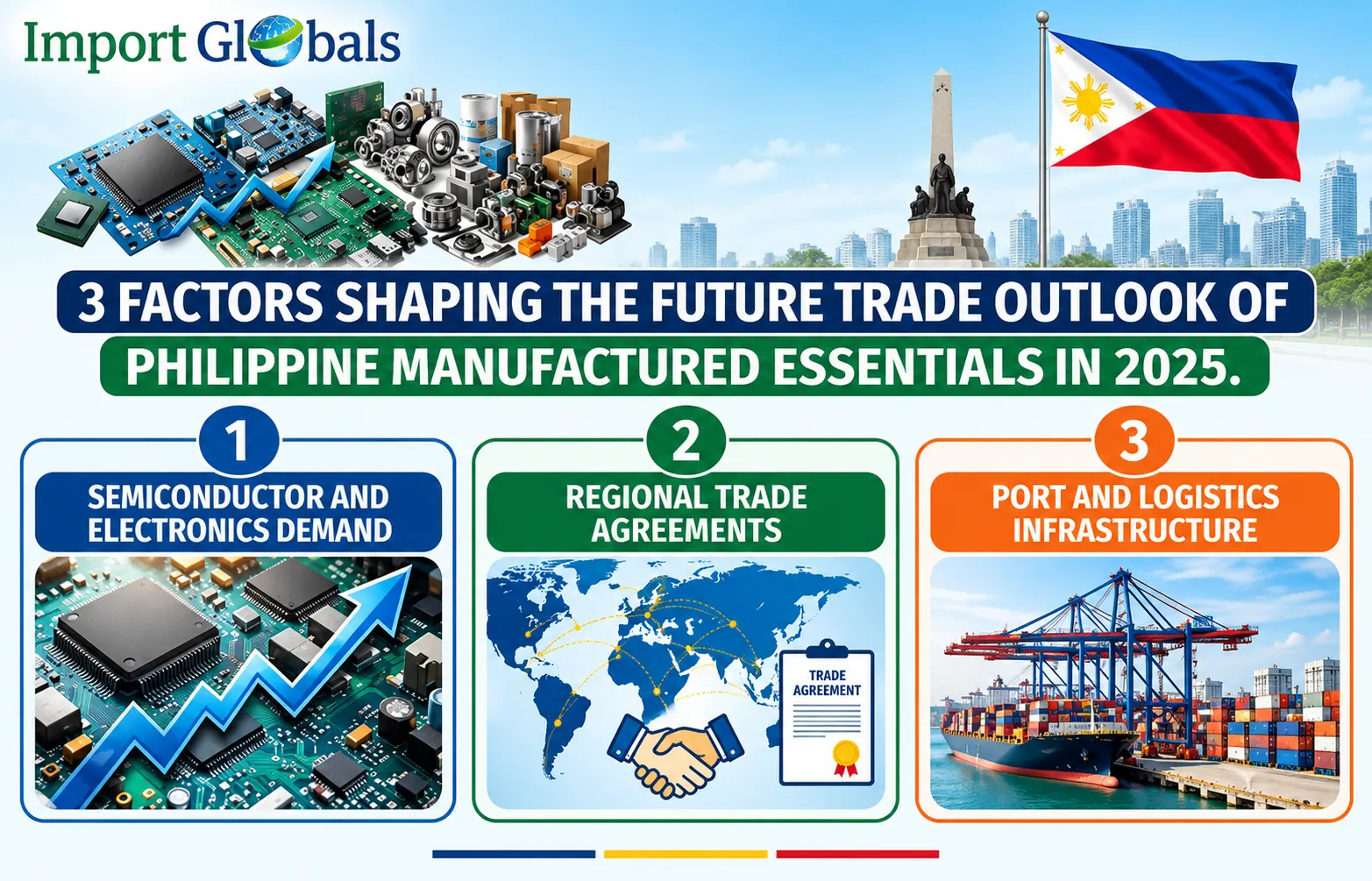
The future of Philippine manufacturing will rely on the ability of the country to increase the portion of high-value goods produced, enhance productivity, attract investments, improve supply chains, says Philippines Customs Statistics.
Electronics will continue to play an important role in the export profile of the country as the industry has built extensive international supply chains. More opportunities for growth can arise in automotive electronics, medical and industrial devices, food production, transport means, advanced manufacturing, and related industries.
The growth of electronics exports from the Philippines in 2025 is one of the signals that demonstrate an opportunity for high-value manufacturing, reported Philippines Bill of Landing Data. According to Philippines Import Export Trade Data, the value of electronics exports in 2025 reached $49.64 billion, almost reaching the adjusted peak level achieved in the respective sector in 2022.
Another important point is related to the need for diversification. Higher participation in several product groups and markets allows companies to decrease reliance on a small number of export sectors. The significance of regional trade will not diminish as Southeast Asia and East Asia are strongly linked by manufacturing and supply chains, and the USA and other developed countries remain key importers of the Philippines.
- Position in the world: 47th
- Exports in terms of merchandise: US$83.72 billion
- Growth rate for the previous year: ~14.7%
- Most exported good: Electronic products (US$45.89 billion)
- Most important destination of export: United States (US$13.46 billion)
- Manufactured goods: US$67.59 billion/80% of Philippine exports
CONCLUSION
The conclusion section points out that the Philippines has established an impressive reputation in manufacturing and merchandise trade at the international level. The Philippines Export Statistics for 2025 indicates that the amount of manufactured goods exported from the country reached US$67.59 billion. Given that US$45.89 billion came from the electronics sector, it is not surprising that electronic items were the leading sector of the total of US$67.59 billion.
The in-depth Philippines Trade Data can be helpful for all parties involved in the trading process, including authorities, businesses, researchers, and trade organizations, as it presents detailed information on products, HS codes, shipping activities, trading partners, importers, and exporters. In this respect, Import Globals can provide trade intelligence performance that can supplement information from trade data and help enhance trade analysis, assess opportunities, view markets, and provide aids for efficient planning work.
CTA
Trying to have knowledge regarding the Philippines latest trade updates of manufacturing essentials. Import Globals is here to rescue; the platform provides detailed information regarding the latest traded categories of the nation to transform your data sets into active trade intelligence. Subscribe to www.importglobals.com or drop an email at info@importglobals.com for information on the Philippines Trade to transform your business growth.
FAQ’S
Que. What is the global export trade rank of the Philippines in 2025?
Ans. The global export trade rank of the Philippines in 2025 is 47th.
Que. What are the top exported products of the Philippines in 2025?
Ans. Electronic products are the top exported products of the Philippines in 2025.
Que. What is the percentage contribution of manufactured goods in the Philippines’ exports?
Ans. Manufactured goods account for 80% of the Philippines ' exports in 2025.
Que. Name the largest export partner of the Philippines in 2025?
Ans. The United States is the largest export partner of the Philippines in 2025.
Que. What is Philippines Customs Data?
Ans. Philippines Customs Data is a detailed data sheet of the latest traded variants of the nation and the related factors.
Que. Why are HS Codes significant for the Philippines Trade?
Ans. HS Codes are significant for the Philippines Trade because they promote analysis of specific products.
Que. How does Philippines Import Export Data support business growth?
Ans. Philippines Import Export Data supports business growth via proper identification of buyers, supplier analysis of market demand, and development of effective market expansion strategies.
Que. What information does Philippines Trade Data cover?
Ans. Philippines Trade Datacovers Importer names, Exporter names, Shipment date, HS Code, Product Details, quantity, values, pricing information, origin country, importing country & port details.
Que. How frequently is the Philippines Trade Data updated?
Ans. Philippines Trade Data is updated on a monthly basis.
Que. Where can you obtain detailed information on Philippines Trade Data?
Ans. Visit www.importglobals.com or email at info@importglobals.com for detailed updates on global fuel and oil trade data.
You Can Also Visit :-
- Philippines Import Data 2026: The Latest Trade Statistics and Market Insights
- Philippines Import Data
- Philippines-Japan Trade Relationship Outlook for 2025: The Import-Export Analysis, Trade Statistics, and the Business Opportunities
- Philippines Import Top Importing Products of 2023
- Fastest-growing Export Industries of the Philippines in 2026: The Latest Exported Products and Business Opportunities