How HS Codes Improve the Trade Research of Indonesia: The Market Updates and the Latest Insights
- Aug 10, 2026
How HS Codes Improve the Trade Research of Indonesia: The Market Updates and the Latest Insights
Indonesia is a representative trader of globally demanded essentials and is a top import economy of Southeast Asia and the top trader too, because of its extensive natural resources, large consumer market, manufacturing capacity, and strategic geographic location.
The international trade portfolio of the country covers a wide range of commodities like mineral fuels, palm oil, nickel products, iron and steel, electrical machinery, chemicals, and agricultural products. Indonesia Customs Data reported that the diversification of the trade environment is due to the accurate reliability of the country's foreign resources. The harmonized system codes are responsible for providing a standardized understanding of the classification of traded products, along with acknowledgment of the researchers, exporters, importers, and investors for identification of specified product categories.
Indonesia's classification of trade crafts the landscape of the country. The nomenclature of the tariff rates and HS code classification is responsible for trade statistics, import and export controls, licensing, customs documentation, and other regulatory processes. International trade is increasing over time, which is why HS-based research is preferred. Indonesia Trade Data reported that the country exported products worth 282.95 billion US dollars in 2025, with an overall growth rate of 6.15% on a year-on-year scale.
What Are the HS Codes in Indonesia?
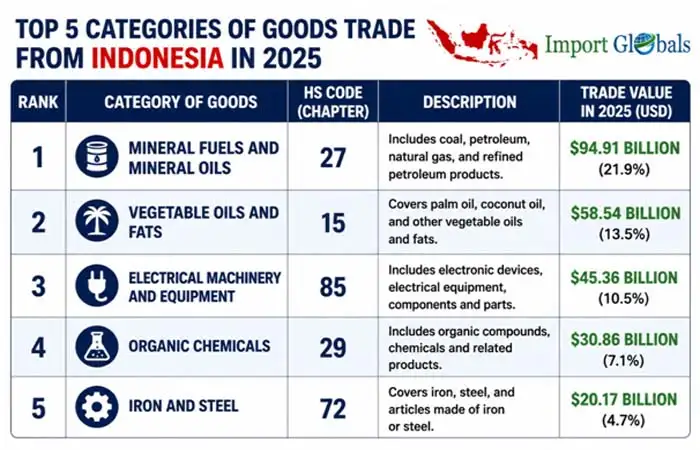
HS code of a specific product is basically the standardized product classification used for identification of goods traded across borders. The generation of the classified products at the six-digit level helps the authorities get additional digits for national tariffs and statistical requirements. The classification framework incorporated into the BTKI has been promoting the trade integrity of the nation. Indonesia Customs Shipments Data reported that the Directorate General of Customs and Excise has been maintaining the product descriptions as per the HS and AHTN systems.
The classification of the system therefore helps the businesses trying to be progressive with the acknowledgment of the distinguishing factors for different categories. The classification of the product is especially important because it helps countries with import-export trade research and the product names connected with the traded categories.
Why Are Hs Codes Important for Indonesia Trade Research?
HS codes have been continuously improving Indonesia trade research because of the reliable information on comparable and product-specific traded categories. The HS code of specific products helps the authorities with the acknowledgment of Indonesia's exports and imports, understanding of particular Indonesian products, and supply-specific product classification in Indonesia.
The officials can preferably rely on the specific factors, as the official statistics help the authorities with the demonstration of the importance of HS-based classification. The publication of the foreign trade statistics using commodity classification helps businesses trying to be progressive with information on trade by commodity and destination country.
How Does Hs Code Improve Indonesia Trade Data Accuracy?
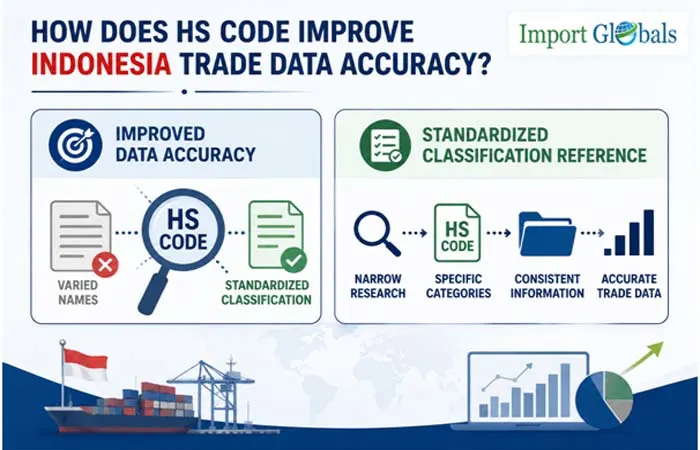
- Improved Data Accuracy - The significant benefit of understanding product classification with HS code is that it improves data accuracy. Product names may vary considerably, which can confuse businesses. The HS code classification describes the product using different commercial names, which resolves complexities of trade.
- Standardized Classification Reference - Importers researching electrical machinery might depend on keyword research in a fully-fledged manner, but understanding the HS code classification helps businesses narrow the research to particular product categories to obtain consistent information. Indonesia Export Data helps the authorities with useful acknowledgement of Indonesian industries like electronics, machinery, chemicals, metals, and palm oils.
How Does Hs Code Help Businesses With Product-level Export Opportunities?
The highly diversified export structure of Indonesia, as reported by Indonesia Import Data, is mostly dependent on non-oil and gas exports with major support from the commodity groups, including animal and vegetable fats. The HS code classification allows businesses to move beyond broad industry-level analysis and examination of individual product categories.
Exporters looking for a service upgrade can get a proper acknowledgement of the nickel-related trade to use relevant HS classification to distinguish between raw materials, intermediate products, and processed nickel products. Businesses researching palm oil can analyse the product classification along with the treatment of vegetable oils. The product-level approach helps companies identify the specific goods that are in demand among the global consumer base.
How Does Hs Code Support Import Market Research?
The classification of HS codes is considered important because it helps the authorities with import market research. The import of specific products by Indonesia, like machinery, electrical equipment, vehicles, industrial inputs, and chemicals, may create confusion for the business authorities looking for trade expansion with similar information on trade.
The HS code classification helps the authorities get proper information regarding when the imports reached their highest trade levels, with an increase in profitability in the corresponding period in the same year. Businesses can use the HS code to determine the imported products as per the increasing demand rate. The importers can navigate the import value, import quantity, country of origin, supplier activity, import information, year-on-year growth rate, average shipment value, and market concentration with the HS code analysis, says Indonesia Statistical Data.
How Does Hs Code Classification Facilitate the Acknowledgement of Latest Insights on Indonesia's Trade?
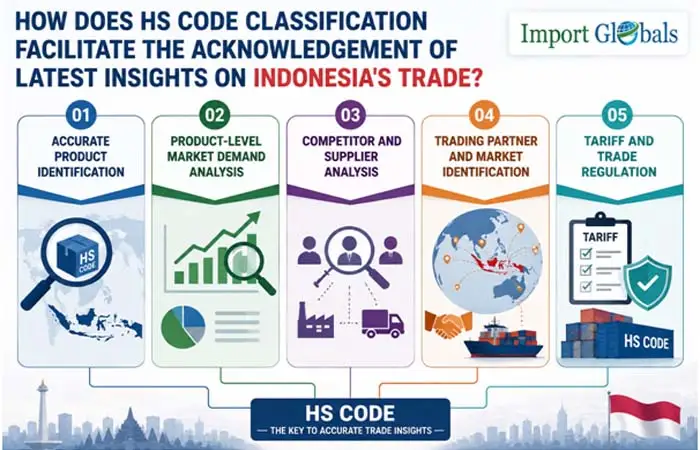
- Accurate Product Identification - HS code classification, as reported by the Indonesia Customs Trade Data, provides accurate information on trade to the business authorities for products traded in Indonesia. The differentiation of the product categories is classified along with the navigation of the confusion during market research. The HS code classification helps the authorities reduce the problem by assigning products to specific internationally recognized classifications. The acknowledgement of the trade improves the accuracy of Indonesia Import Export Data to analyse the exact products they are interested in.
- Product-Level Market Demand Analysis - HS code allows businesses to conduct detailed product-level market demand analysis. Studying broad categories like machinery, electronics, or agricultural products helps the authorities investigate specific products using their corresponding trade classifications. Businesses can compare import and export value shipments to identify products with increasing or declining demand rates. The information helps the companies recognize the emerging opportunities. The monitoring of the HS-coded products helps the authorities determine the product categories along with the development of the appropriate pricing.
- Competitor and Supplier Analysis - Indonesia Export Trade Data reported that the HS code classification helps the businesses with a structured approach to identification of competitors and suppliers. The authorities can identify the active exporters, importers, manufacturers, and suppliers with the acknowledgement of the latest trade activities. The businesses trying to be progressive and further promote the shipment frequency, quantities, and trade values with an understanding of competitor behaviour. This information supports supplier evaluation and sales prospecting while helping the companies identify the potential gaps.
- Trading Partner and Market Identification - HS code helps the businesses with identification of the countries that actively support the products for purchasing of trade from Indonesia. The HS classification helps the authorities with destination markets along with strong demand for Indonesia's products. The businesses can compare the trade values along with shipment quantities and market participation. It allows exporters to discover potential new markets while helping importers identify the sourcing destinations.
- Tariff and Trade Regulation - Businesses can navigate the trade complexities with an understanding of tariff and trade regulation insights. The investigation of the applicable customs duties helps the authorities with preferential tariff rates, import taxes, licensing requirements, and regulatory conditions. This information evaluates the potential landed cost. The accurate classification further maintains the statistical growth rate as per the globally traded compliance.
How Does Hs Code Help Indonesian Exporters Get Into New Emerging Markets?
The HS code classification gives a clear visualization to Indonesian exporters regarding the new international markets. The Indonesian company exports a particular product using the HS code to investigate other countries. The comparison of the size of import markets helps the authorities with growth rates, competitor suppliers, tariff conditions, and trade requirements.
The Indonesian exporter with strong demand for a particular HS-coded product in one Asian market can research the other, says the Indonesia Import Statistics. It overall creates a systematic approach for the progressive authorities for random selection of potential markets, which navigates the trade complexities of the users for historical trade data to prioritize the countries where the product demand is demonstrated.
How Does Hs Code's Acknowledgement Reduce Indonesia Trade Risk?
HS code reduces Indonesia's trade research risk for different authorities. Businesses investing in the market can have sufficient knowledge about product demand, competitors, and buyers. The classification of the HS code-based analysis helps the authorities reduce the research risk by providing structured product-level information.
Businesses can navigate the trade complexities with an investigation into the increasing import demand rate, growing export activity, multiple active suppliers, strong buyer participation, and the increasing shipment frequency. It helps the authorities with information on tariff, regulatory logistics, and economic research that keeps them more informed on market entry and sourcing destinations.
Future Trade Outlook of the Hs Code-based Trade Research in Indonesia
The HS code-based trade research of Indonesia will increase data-driven export performance and will continue to expand because of the investments of the government authorities in overall trade. The increase in product categories will be more diversified with the acquisition of detailed product-level intelligence. The HS code can support the transition with proper creation of the common classification framework.
The increasing importance of manufacturing, mineral processing, and electronics will help the authorities related to products, agricultural commodities, and downstream industries. The companies combine HS code with shipment intelligence, buyer information, and market trends along with the development of a comprehensive understanding of Indonesia's international trade, says Indonesia Shipment Trade Data.
Government and Customs Support for Hs Code Classification
The customs authorities help businesses establish the BTKI for proper trade framework building. The harmonized system code-based understanding of the trade helps the authorities support customs tariffs, trade statistics, and import and export controls.
The Indonesian customs framework connects the classification with customs declaration. The accurate HS classification provides a detailed overview to the business authorities that helps them avoid selecting a particular HS code alone to reduce a lower tariff.
Conclusion
HS code has been a valuable tool for business authorities looking for service expansion. The broad trade information into structured product-specific intelligence makes the dataset accurate for classification into the latest strategies. The BTKI framework of the Indonesian authorities, as reported in the Indonesia Custom Shipment Data, helps progressive traders with preferential trade agreements, taxes, restrictions, and customs documentation. The value of HS code extends to customs compliance.
The use of identification of high-demand products helps the authorities with identification of buyers, monitoring of shipment trends, and comparison of trade values, along with developmental activities of international sourcing and sales strategies. The combination of HS code classification helps businesses with shipment-level trade intelligence, therefore providing businesses with a stronger foundation for entering Indonesia.
CTA
If you are trying to have an upgrade in your business in the Indonesian market, you have landed at the right platform. Import Globals helps businesses with Indonesia Import Export Trade Data to support business growth. The extensive trade intelligence helps businesses with the identification of research importer and exporter names, shipment quantities, trade values, origin and destination markets, and supports relevant trade information. Visit www.importglobals.com or drop an email at info@importglobals.com to get reliable access to the Indonesia import-export trade intelligence to accelerate your global business growth.
FAQs
Que. What do you mean by HS codes in Indonesia?
Ans. HS codes in Indonesia are standardized product classification that provides the identification of the goods in international trade.
Que. Why are the HS codes important for trade research?
Ans. HS codes are important for trade research because they give a product-level understanding of the specific targeted category that allows businesses to analyse the product categories, importers, and exporters.
Que. What is BTKI in Indonesia?
Ans. BTKI is Buku Tarif Kepabianan Indonesia. It is one of the official customs tariffs and goods classification frameworks that is basically based on the HS code classification.
Que. How does HS code promote identification of Indonesian export opportunities?
Ans. HS code promotes identification of Indonesian export opportunities through analysis of destination market studies, competitor analysis, and identification of potential buyers.
Que. How does HS code help with tariff research?
Ans. HS code classification helps the authorities determine applicable customs duties, preferential tariffs, and certain import or export requirements.
Que. How does HS code support competitor analysis?
Ans. HS code supports competitor analysis with acknowledgement of narrowed trade research to specific products and examination of the company's shipment quantities and values associated with the essentials.
Que. Name the topmost beneficiary industries of Indonesia's HS code research.
Ans. Agriculture, palm oil, mining, nickel ore, and iron and steel are the topmost beneficiary industries of Indonesia's HS code research.
Que. How does Indonesia trade data support business growth?
Ans. Indonesia trade data supports business growth via proper identification of buyers, supplier analysis of market demand, and development of effective market expansion strategies.
Que. What information is available in Indonesia import-export data?
Ans. Indonesia import-export data covers Importer names, Exporter names, Shipment date, HS Code, Product Details, quantity, value, pricing information, origin country, importing country & port details.
Que. How frequently is the Indonesia Trade Data updated?
Ans. Indonesia Trade Data is updated on a monthly basis.
Que. Where can businesses obtain detailed information on Indonesia import-export data?
Ans. Visit www.importglobals.com or drop an email at info@importglobals.com for detailed acknowledgement of the Indonesia HS code-based trade analysis.
You Can Also Visit :-