Kenya Machinery Import Trade Data: Business Opportunities of 2025

- Sep 08, 2026
Kenya Machinery Import Trade Data: Business Opportunities of 2025
Kenya has become a major commercial and industrial centre in East Africa, mainly because of infrastructure development, manufacturing, agriculture, construction, logistics, energy projects, and a growing digital services industry. With the improvement of domestic production capacity, companies in various industries are turning to imported machines and mechanical, electrical, and industrial equipment.
According to Import Globals’ Kenya Import Data, Kenya had an overall import value of US$25 billion in 2025, with machines and mechanical appliances accounting for US$3.26 billion (about 12% of the total imports). Electrical equipment made up US$2.19 billion (around 11% of imports).
Thus, the combined data on Kenya’s imports of machinery makes it of great interest to manufacturers, exporters, distributors, procurement companies, and investors interested in the East African market.
The Key Role Played by Kenya in the Regional Market for Machinery
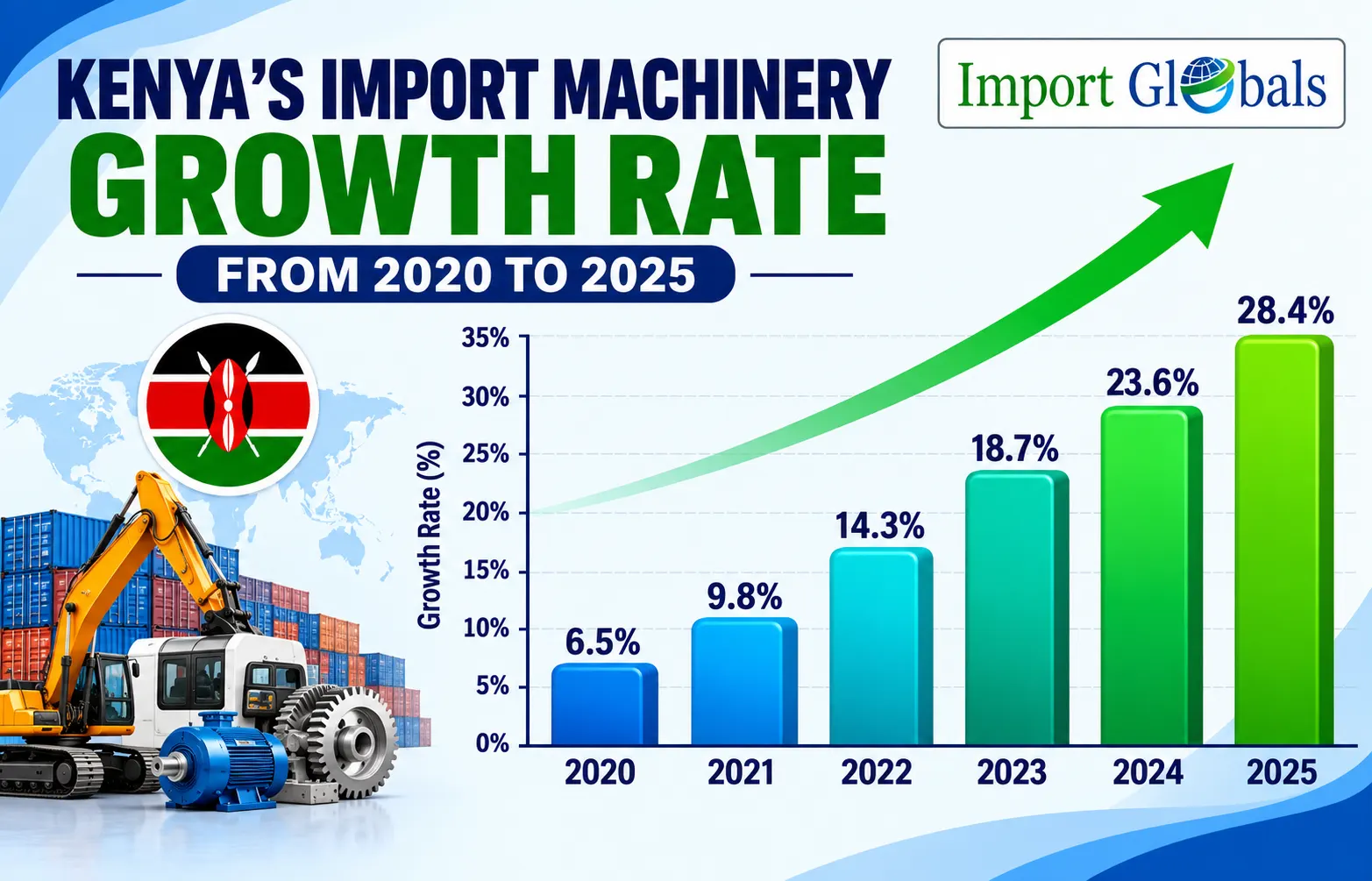
Kenya occupies a unique position as far as its location in Eastern Africa is concerned, reported Kenya Export Data: it has well-developed transport means, developed trade networks, is becoming the business hub in the region, and also takes great advantage of its Mombasa Port.
Kenya's demand for machines can be traced to its economic development: the construction sector needs machines such as excavators, starters, cranes, concrete mixers, boring machines, and many other products; producers need machines for producing goods, and numerous agricultural machines are used for producing and storing products in agriculture.
Official statistics show that Kenya is very active. The reports of the Kenya National Bureau of Statistics as per the Kenya Customs Data show that the GDP of Kenya increased by 4.6% in 2025; the construction industry showed the strongest achievements with its growth rate of 6.8%, while the mining sector grew by 14.9%. The transport and storage services sector reached 3.7%, while telecommunications services grew by 4.8%.
Top Machinery Imports in Kenya
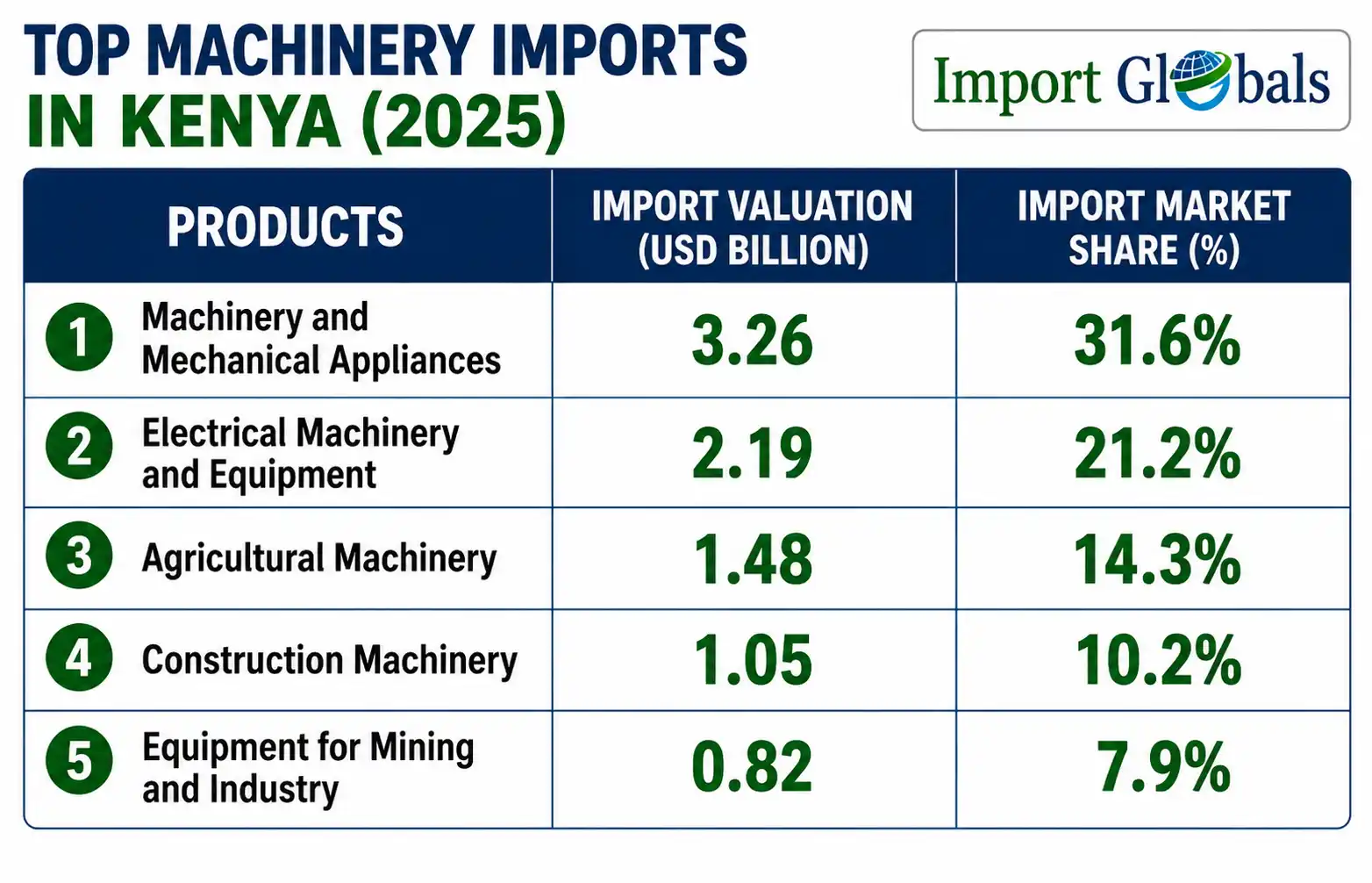
1. Machinery and Mechanical Appliances
Machinery and mechanical appliances are among the key sectors of Kenya’s imports. Import Globals projects the value of this sector to reach USD 3.26 billion in the year 2025.
Demand for machinery and appliances is generated in manufacturing, construction, farming, mining, transportation, energy, and business sectors. Equipment suppliers should focus on providing their products to companies operating in these sectors and requiring production lines and equipment, machines, engines, pumps, compressors, lifting equipment, and machinery.
2. Electrical Machinery and Equipment
Electrical machinery and equipment had a total of USD 2.19 billion in Kenyan goods imported in 2025. The sector’s growth is supported by the increased use of electricity, development of industries, telecommunications, business construction, renewable energy, and use of digital infrastructure.
The range of products offered comprises electrical transformers, electric control equipment, electric motors, electrical generators, electrical circuit equipment, electricity management systems, industrial electrical components, and automation technologies.
3. Agricultural Machinery
Agriculture plays a key role in the Kenyan economy, according to Kenya Shipments Data, creating opportunities for the supply of farming machinery and devices for improving productivity.
Through the supply of tractors, irrigation systems, speeders, harvesters, threshers, pest-control devices, milking machines, grain processing equipment, cold storage systems, and food processing systems, foreign suppliers can benefit from opportunities emerging in Kenya.
The opportunity is particularly relevant in cases when the equipment is able to cut down labour input, increase output, decrease post-harvest losses, or enhance processing capabilities.
4. Construction Machinery
According to Kenya Trade Data, the construction sector of Kenya grew by 6.8% in 2025. This opens an avenue of opportunities for suppliers of excavators, bulldozers, front-end loaders, cranes, concrete mixers, drilling machinery, homogenizers, asphalt equipment, and other construction machinery.
Construction machinery can also create business opportunities beyond the sale, through the rental of equipment, its servicing, sales of spare parts, refurbishment, and maintenance.
5. Equipment for Mining and Industry
As per the Kenya Import Statistics, the mining sector has come across a recent increase of 14.9% in 2025. The growth in mining activity will result in demand for drilling equipment, crushers, conveyors, screening technologies, pumps and compressors, material handling systems, and mineral processing equipment.
Suppliers who are familiar with the business conditions and who offer reliable after-sales service may have a good chance of succeeding in this business.
Top Partners of Kenya in the Field of Machinery Supply
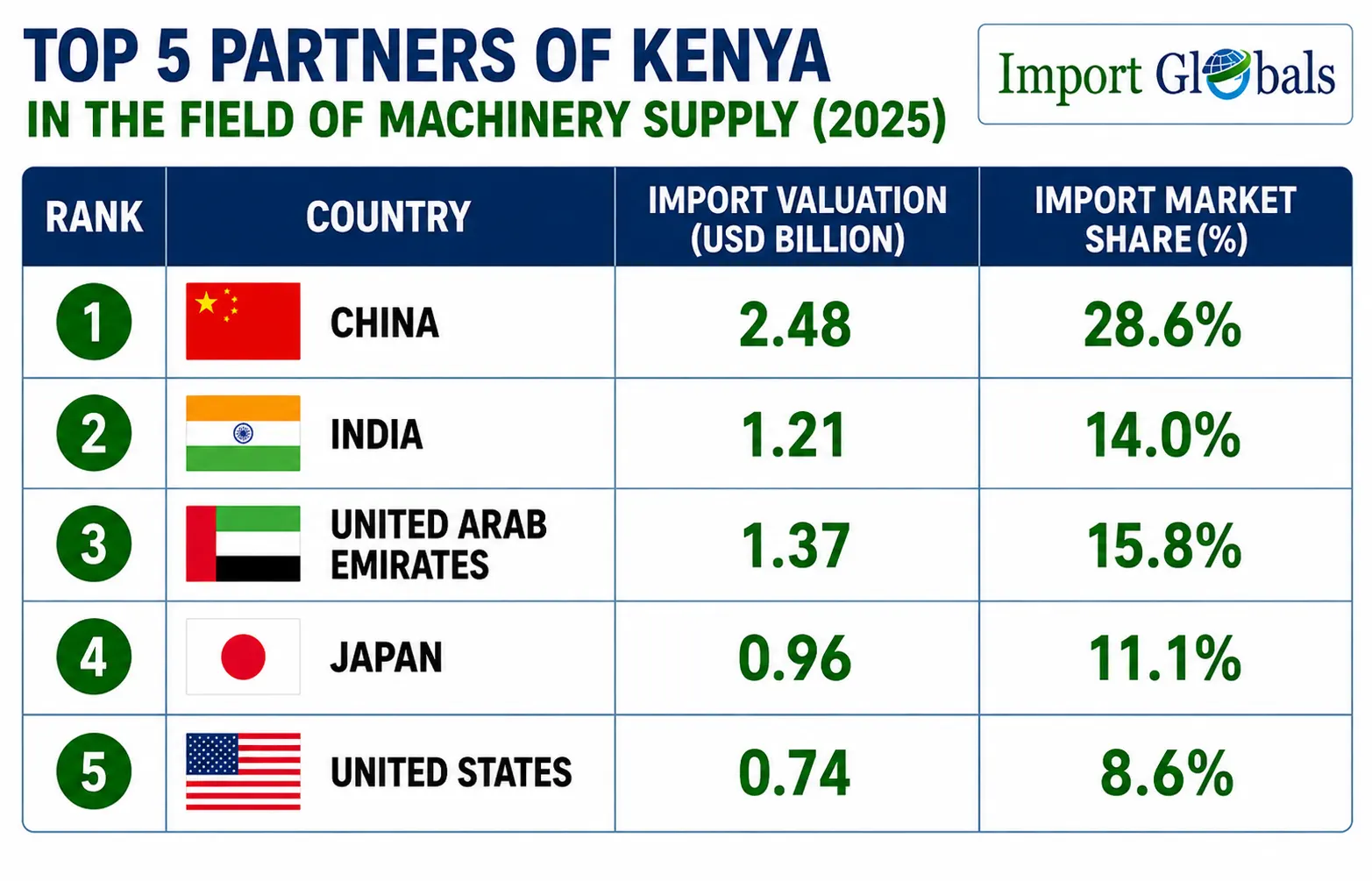
Kenya has a strong network of sourcing relationships with several countries from Asia, the Middle East, Europe, and North America. The report by Kenya Shipments Trade Data shows that in 2025, Kenya's top trading partners in terms of machinery imports were the following countries: China, the United Arab Emirates, India, the United States, Malaysia, Japan, Russia, Oman, South Africa, and Kuwait.
According to other trade reports for 2025, major sources of machinery imports into Kenya also include China, India, the UAE, Japan, Saudi Arabia, and the USA.
1. China
China Export Data reported the country as a significant sourcing market for Kenya. It has manufacturers providing numerous machinery, electrical equipment, building equipment, agricultural machinery, components, and industrial products. Kenyan businessmen can benefit from Chinese machinery, which has many options at different prices.
2. India
India is another important source of machinery and industrial products. The existing manufacturing base in the country gives a chance to supply agricultural machinery, equipment, pharmaceuticals, engineering products, etc.
3. United Arab Emirates
The UAE occupies a significant place, making it an important regional trading and redistribution centre, reported UAE Export Data. Machinery imported by companies from the UAE makes it possible for Kenyan buyers to work with various manufacturers and distributors worldwide.
4. Japan
Japan Export Data reported that the country is famous for its high-quality engineering, automobile technologies, industrial equipment, precise machinery, etc. Thus, the machines produced in Japan will find use in industries that need reliable equipment.
5. United States and Europe
The suppliers from the US and the European markets can offer specialized machines, advanced automation technologies, industrial machines, and energy equipment, says US Export Data.
Sectors Boosting Kenya's Need for Imported Machinery

- Manufacturing Sector - The manufacturing sector is one of the sectors that generate maximum volume for imports of machinery reported Kenya Export Trade Data. Technically, the machinery is needed for manufacturing, packaging, processing, materials handling, quality testing, and automation. Machinery dealers can take advantage of this aspect by identifying manufacturing facilities and businesses planning to expand their operations.
- Agriculture and Food Production - Agriculture is important for creating demand for machinery used in either primary production or processing.Machinery categorized as being involved in milling, drying, sorting, packaging, cooling, irrigation, harvesting, and processing can be useful in transitioning from production of primary goods to the final commercial products.
- Construction and Infrastructure - The growth in construction creates demand for machinery for lifting, assembling, paving roads, processing concrete, and moving dirt.Contractors in infrastructure can easily become repeat buyers since machinery needs replacement parts, servicing, repairs, and improvements.
- Mining and Quarrying - Mining and quarrying need special machinery that is capable of use under harsh conditions. Possible objects of mineral exportation include crushers, drilling equipment, pumping machinery, conveyor belts, and material processing machinery.
Types of Problems Encountered by Machinery Importers in Kenya
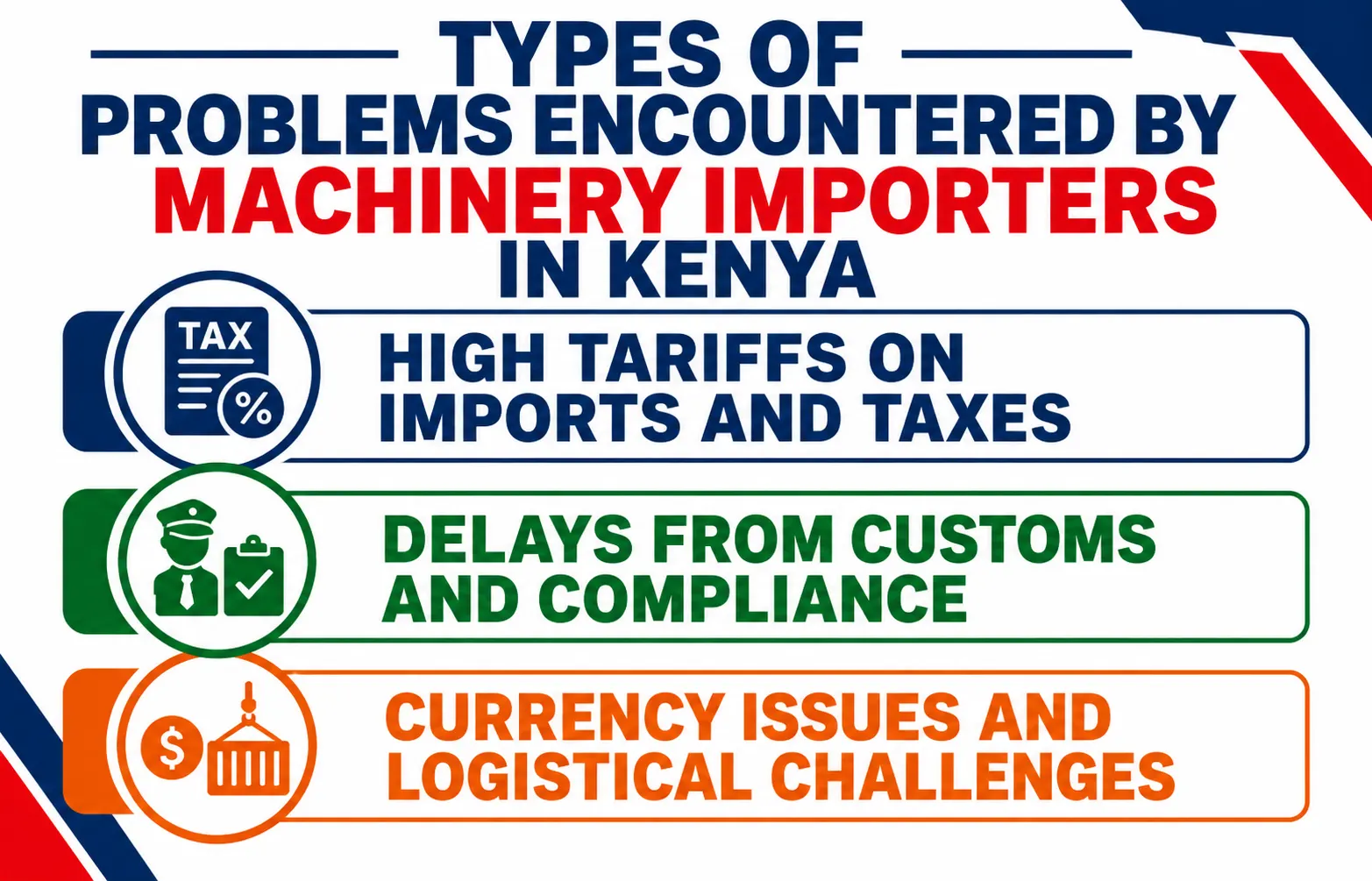
- High Tariffs on Imports and Taxes – Importers of machinery can incur various duties, VAT, import inspection fees, and other taxes, all of which increase the cost of machinery.
- Delays from Customs and Compliance – Mistakes in classifying HS codes, incomplete documentation, requirements for certification, and shifting customs requirements can slow the clearance of machinery.
- Currency Issues and Logistical Challenges – Changes in the exchange rate can increase the prices of machinery purchased abroad, while expenses and delays in transportation can add to the cost of importing machinery.
How Does Import Globals Kenya Import Data Support Business Growth?

Import Globals Kenya Import Trade Data is considered an effective tool for business authorities trying to stay progressive. The latest traders can get the acknowledgement of the competitive analysis along with the database and the highlighted shipment-related information of HS code, price trends, trade partners, and other trade details. The machinery companies can support several business functions with effective identification of buyers that helps the exporters find companies involved in the specific industry.
Supplier identification and market entry help international companies understand the competitive landscape. Competitor shipment tracking also allows businesses participating in the market to gain awareness. The demand analysis with Kenya Trade Data helps businesses identify products and categories with strong import activity. The objective mainly converts the trade information into actionable business intelligence, according to Kenya Customs Trade Data.
Future Trade Outlook of Kenya Machinery Imports

The future of Kenya's machinery imports will mainly be connected to industrialization, infrastructure investment, agricultural modernization, energy development, and private sector investment. The proper hike in machinery and other capital equipment will demonstrate the overall scale of the capital equipment demand rate. The construction of 6.8% expansion and mining and quarrying will point toward continued equipment requirements in productive sectors.
The machinery exporters will consider currency movements, freight costs, and taxation for the establishment of Asian suppliers. The progressive traders will be able to get competitive pricing with valuable machinery spare parts and availability trade for acknowledgement of the financing options and after-sales service.
Key Takeaways of Kenya Machinery Import Data
- The approximate import valuation of Kenya is at 25 billion U.S. dollars in 2025.
- Machinery and mechanical appliances account for 3.26 billion U.S. dollars of the current imports.
- Electrical machinery accounts for 2.19 billion U.S. dollars of the revenue.
- China is Kenya's top sourcing nation.
- Construction, mining, manufacturing, and agriculture are the facilitating factors of Kenya's machinery import data.
- Machinery exporters can use the trade data for buyer discovery and competitor analysis.
Conclusion
Kenya machinery import data is considered a valuable factor in shaping the overall trade growth of different traders. The manufacturing, construction, agriculture, mining, energy, logistics, and infrastructure sectors help businesses stay updated on the latest marketing regions. The proper increase in machinery and capital equipment demonstrates the continuous importance of imported equipment in Kenya's productive capacity.
Exporters and manufacturers, along with the biggest opportunity, will be able to identify Kenya imports. The real advantage is linked to the determination of the machinery being purchased, along with the buyers' and suppliers' information. The trade intelligence supports businesses in transforming Kenya import activity into actionable market intelligence. The latest combination of product-level analysis with buyer identification effectively supports supplier discovery and market entry research.
CTA
Looking for the latest upgraded dataset on Kenya’s machinery trade? You have landed on the right platform here. Import Globals has special expertise in providing detailed updates regarding the machinery trade of Kenya. Subscribe to www.importglobals.com or drop an email at info@importglobals.com for detailed updates on the Kenya Trade Data to drive your business growth.
FAQs
Que. What is the import trade value of machinery from Kenya in 2025?
Ans. The import trade value of machinery from Kenya in 2025 is 3.26 billion U.S. dollars.
Que. What is the import value of Kenya in 2025?
Ans. The import trade value of Kenya in 2025 is 25 billion U.S. dollars.
Que. Who are the top import partners of Kenya?
Ans. China, the UAE, and India are the top import partners of Kenya.
Que. Name the top industries driving the machinery trade of Kenya.
Ans. Manufacturing, agriculture, construction, and mining are some of the top industries driving the machinery trade of Kenya.
Que. What is the import trade rank of Kenya in 2025?
Ans. The import trade rank of Kenya in 2025 is 74th.
Que. What makes the Kenyan machinery import data significant for exporters?
Ans. Kenya machinery import data is important because it keeps the database of the latest emerging traders updated with actual shipment insights.
Que. How does Kenya import-export data support business growth?
Ans. Kenya import-export data supports business growth via proper identification of buyers, supplier analysis of market demand, and development of effective market expansion strategies.
Que. What information is available in Kenya trade data?
Ans. Kenya trade data covers importer names, Exporter names, Shipment date, HS Code, Product Details, quantity, values, pricing information, origin country, importing country & port details.
Que. How frequently is the Kenya trade data updated?
Ans. Kenya trade data is updated on a monthly basis.
Que. Where can you get detailed information on Kenya trade data?
Ans. Visit www.importglobals.com or drop an email at info@importglobals.com for detailed updates on Kenya trade data.
You Can Also Visit :-