The Fastest-growing Export Industries of Brazil in 2026: The Latest Market Updates
- Aug 11, 2026
The Fastest-growing Export Industries of Brazil in 2026: The Latest Market Updates
Brazil is the strongest trader in the global marketplace because of the effective support from extensive agricultural resources, mineral reserves, energy production, and expanding industrial infrastructure.
The export economy has been benefiting from the strong international demand for agricultural commodities, crude petroleum, iron ore, food products, aircraft machinery, and other industrial goods. The Brazilian export performance has been a strong contributor to the country's economic growth rate.
The export valuation of 82.3 billion US dollars in the first half of 2026 is driven by the continuous trade of petroleum, minerals, and agricultural products among the major cargo categories. The enormous agricultural production base and the growing energy industry and mining capacity are reported by the Brazil Trade Data as the main factors creating opportunities for Brazilian exporters across both commodity and value-added industries. The export outlook is being influenced by the implementation of the Mercosur-European Union trade agreement.
Why is Brazil a Major Exporting Nation?
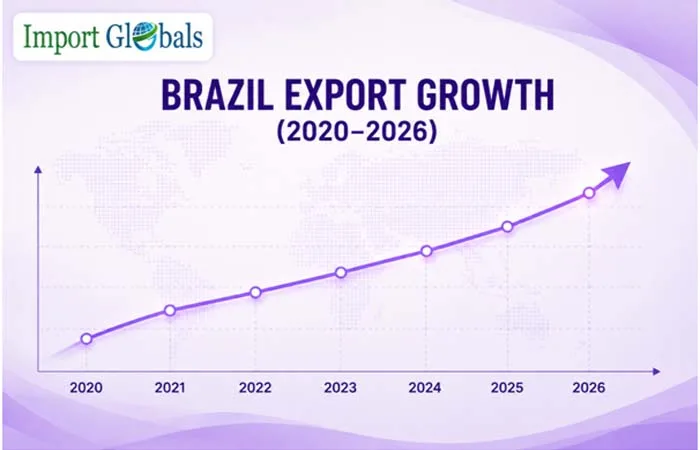
Brazil is one of the leading exporting economies mainly because of the abundant natural resources, large agricultural production capacity, extensive coastline, and diversified industrial base. The country is a globally significant supplier of soybeans, coffee, sugar, meat, corn, iron ore, and crude oil. Agriculture has been serving as the strongest foundation of Brazil's international trade. Brazil Export Data reported that the crop trade amount is around 30-39 million tons at present. Soybeans, corn, and rice are the major components of national grain, legume, and oilseed production.
The geographical diversity has been supporting the year-round production of agricultural commodities. The extensive farmland and favourable climatic conditions have helped Brazilian exporters serve different markets across Asia, Europe, the Middle East, and North America. The nation has been serving as one of the significant reserves of iron ore, crude petroleum, and natural resources. Industries such as aircraft manufacturing, food processing, and paper manufacturing have increased the value-added component of Brazilian exports.
Brazil's Export Economy in 2026
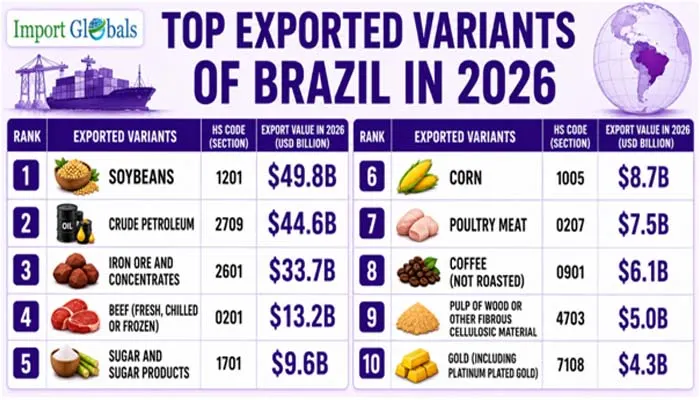
The export economy of Brazil is driven by the combination of agricultural commodities, energy products, mining, food processing, and industrial manufacturing. Official economic data have reported the exports of goods and services as the main factors promoting overall trade. The transportation equipment among the sectors has maintained a positive contribution.
Export competitiveness is supported by large-scale production, modern agricultural technology, the establishment of mining operations, and reliable access to the major international markets. The export basket is getting diversified due to exports of soybeans, crude oil, iron ore, and agricultural commodities. The manufactured products' contribution to international trade has crafted the overall landscape, says Brazil Customs Shipment Data.
The Fastest-growing Export Industries of Brazil in 2026
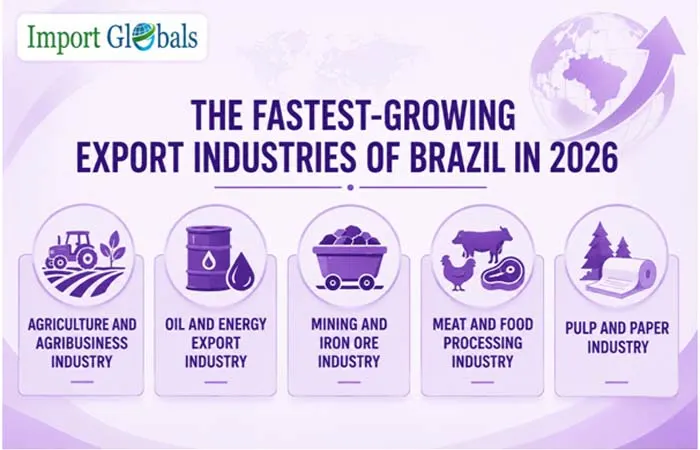
- Agriculture and Agribusiness Industry - The agriculture industry is one of the significant contributors towards the export landscape of the nation. Brazil Export Statistics reported the establishment of the country itself as a leading international supplier as the main factor driving trade growth. Soybeans are the top traded variants under the specific industry. The large production base has been providing significant opportunities in oilseeds, animal feed, vegetable oils, and processed agricultural products. The harvest and continuous high production levels have supported the agricultural export capacity. The high international demand for food, animal feed, and biofuels has maintained the positioning of the nation as a top agricultural exporter.
- Oil and Energy Export Industry - The oil and energy export industry is also a major growth factor that has been shaping the trade landscape of the Brazilian authorities. The crude petroleum trade has maintained the important role played in the export diversification of the country. The increasing demand from Asia, Europe, and North America has supported the export volumes. The extraction of petroleum and natural gas from these sectors contributes positively to the export performance. The energy industry is supported by the strong position in renewable energy along with trade growth. Hydropower, ethanol, biodiesel, and solar power have created opportunities for the export of energy-related technology. The combination of crude oil production and renewable energy capabilities has diversified the energy export profile.
- Mining and Iron Ore Industry - The mining industry has been continuously playing a critical role in Brazilian international trade. Iron ore is one of the most important mineral exports. Extensive mineral reserves and large-scale mining operations have maintained the competitive positioning in the international mining market. The sector has been supporting the trade of manganese, copper, bauxite, gold, and other mineral resources. The growing global demand for metals required for construction, electric vehicles, and renewable energy infrastructure has created additional opportunities, says Brazil Import Export Data.
- Meat and Food Processing Industry - The meat and food processing industry is also crafting the trade outlook. Beef, poultry, pork, processed meat, sugar, coffee, fruit products, and other commodities are the latest variants under the specific industry. The livestock industry has been maintaining significant production capacity with improvements in the cold chain logistics and traceability. The food products were also identified as contributing factors to the export performance. The continuous growth of global food consumption has created additional export opportunities.
- Pulp and Paper Industry - The Brazilian authorities have properly developed the highly competitive pulp and paper industry as the main factor contributing to the large-scale forestry resources trade. The pulp is widely used by international paper manufacturers. Brazil Import Data reported the favourable climatic conditions and advanced forestry management as the main factors supporting the overall trade. Brazilian exporters have been promoting the high-value opportunities in packaging materials, tissue products, and other processed forestry essentials.
Different Factors Driving Brazil's Export Growth
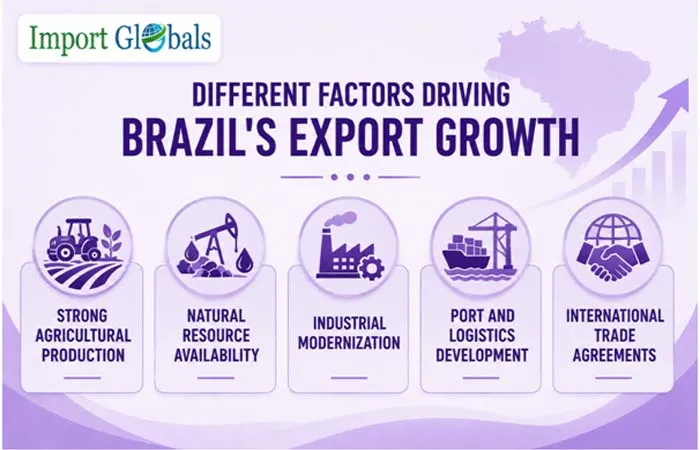
- Strong Agricultural Production - The agricultural production ability of the country is one of the strongest factors that have been supporting the exports. The high production of soybeans, corn, coffee, sugar, and other commodities has maintained the static trade ranking of the region.
- Natural Resource Availability - The abundance of natural resources, including petroleum, iron ore, bauxite, copper, and other minerals, is listed by the Brazil Trade Statistics as the main factor supporting the trade landscape. The increasing global demand for industrial and energy transition has created additional opportunities.
- Industrial Modernization - The modernization of manufacturing units like advanced manufacturing, digital technologies, and industrial infrastructure has helped Brazilian manufacturers increase productivity while maintaining competitiveness in international markets.
- Port and Logistics Development - The extensive coastline and large port network are reported by Brazilian Statistical Data as the main factors promoting trade in agricultural commodities, petroleum, minerals, and manufactured goods. About 95% of the exports and imports of Brazilian authorities are making the logistic infrastructure more vulnerable to the international trade system.
- International Trade Agreements - The trade agreements signed by the government authorities in Mercosur and other international trade arrangements have expanded the market access opportunities. The Mercosur-European Union provisional trade agreement has maintained the framework of effective trade while combining the market of approximately 720 million people with a GDP exceeding 22 trillion.
Top Export Markets for Brazil in 2026
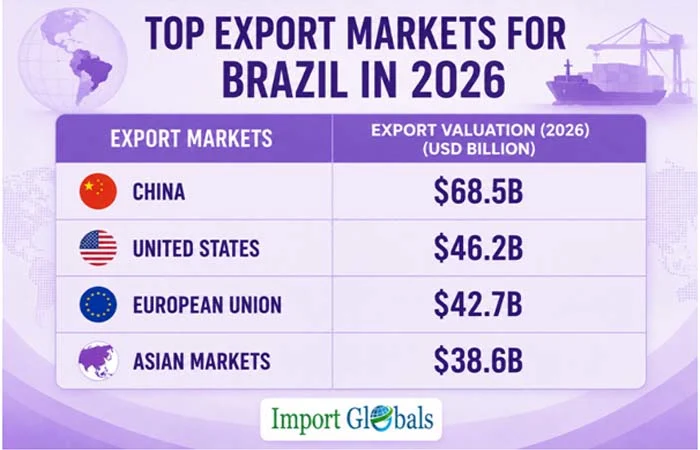
- China - China Import Data reported itself as one of the top export markets for the Brazilian authorities. The effective supply of soybeans, crude petroleum, iron ore, and meat from the Brazilian authorities has maintained the bilateral integrity.
- United States - The US Import Data reported the effective resourcing of energy products, agricultural products, aircraft, steel products, and other industrial commodities as the main factors creating the bridge between both regions. The trade conditions have been more challenging, due to which the tariff measures have supported the overall trade hike. Brazil's official data reported that exports to the United States have dropped by 13% in the first half of 2026.
- European Union - The EU Import Data remains an important destination for Brazilian agricultural, food, mineral, and sustainable products. The implementation of the Mercosur-EU trade agreement has increased the importance of the European market.
- Asian Markets - Japan, South Korea, India, and other Asian markets are listed by the Asia Import Export Data as the main factors driving Brazil's trade growth. The agricultural commodities supply, minerals, and energy products trade with the leading nations have crafted the bilateral integrity and the pricing ranges as per the global trade compliance.
Business Opportunities Related to the Export Industries
The Brazilian manufacturing industry is continuously creating opportunities for international businesses. The agricultural exporters have been mainly benefiting from the growing international demand for soybeans, coffee, sugar, meat, corn, and processed food. The mining companies are right now creating opportunities related to iron ore, copper, bauxite, and minerals required for clean energy technologies.
The oil and gas sector has been continuously generating opportunities for offshore equipment. The aerospace and automotive manufacturing sectors for component suppliers, technology companies, and industrial equipment manufacturers have supported the overall trade. Businesses entering the Brazilian market can use the shipment-level trade intelligence for active identification of exporters, overseas buyers, product categories, and shipment volumes.
How Does Brazil Customs Shipment Data Support Business Growth?
Brazil Import Export Trade Data has been serving as a valuable tool for business authorities looking for service expansion. The visibility into trading companies helps the authorities identify potential buyers, along with the valuation of the competitors and analysis of the product demand rate.
Businesses can use information like importer name, exporter name, HS code, product description, and quantities to develop effective international sourcing and sales strategies. This type of trade intelligence helps the authorities reduce the sourcing risk while helping the organization make data-driven decisions.
Future Export Outlook of Brazil in 2026
Brazil's export outlook is positive, mainly because of agriculture, petroleum, mining, food processing, aerospace, and other transportation equipment. The strong export momentum is driven by increasing service exports, while petroleum and natural gas extraction has maintained an effective contribution towards the positive trade.
The future export performance has been dependent on commodity prices, global food demand, energy markets, and logistic capacity. The exchange rate movements and environmental standards have been supporting international trade policies. The Mercosur-European Union agreement has created new market access while changing the tariff conditions in the United States. Brazil is therefore expected to focus on export diversification while maintaining value-added manufacturing along with sustainable agriculture and renewable energy, says Brazil Statistical Data.
The Government Initiatives Supporting Brazil's Export Trade
The Brazilian government has been continuously launching different initiatives to support the digital customs systems. The portal UNICCO Siscomex, export licensing, and electronic documentation have been launched by the government authorities to maintain effective trade. The implementation measures connected with the Mercosur-EU trade agreement include export quotas, preferential origin certification, and electronic procedures.
The government has developed the Mercosur-EU opportunities for information about Brazilian exports to the European Union. This measure has improved transparency while overall reducing the administrative barriers and helping Brazilian companies identify the new international market opportunities.
Conclusion
The export economy of Brazil in 2026 has been shaped by a combination of agriculture, strong natural resource availability, and energy production. The agriculture, oil, mining, food processing, and automotive sectors have been supporting export performance. The first quarter export performance is mainly because of the continuous trade momentum with the Mercosur-European Union agreement and the creation of additional opportunities. The changing tariff conditions in the United States have demonstrated the importance of developing diversified export destinations. Brazil has been representing a significant sourcing and market expansion opportunity with reliable access to shipment-level trade intelligence, helping organizations identify active buyers and suppliers.
CTA
If you are looking for an expansion in your business in the Brazilian market, you have landed at the right platform here. Brazil import-export trade data of Import Globals helps businesses with identification of verified buyers and suppliers, analysis of competitor activities, and evaluation of shipment trends. The extensive customs database helps the authorities with acknowledgement of importer and exporter images, product code descriptions, shipment quantities, and destination information. Subscribe to www.importglobals.com or drop an email at info@importglobals.com to stay updated with the latest information regarding the top industries facilitating Brazil's exports to accelerate your global business growth.
FAQs
Que. Name the fastest-growing Brazilian export industries in 2026.
Ans. Agriculture, oil and energy, mining, and food processing are the fastest-growing export industries of Brazil in 2026.
Que. Name the top exported products of Brazil in 2026.
Ans. Soybeans, crude petroleum, iron, and meat are the top exported products of Brazil in 2026.
Que. Why is Brazil a top agricultural exporter?
Ans. The extensive agricultural land, favourable climatic conditions, and advanced farming technologies have maintained Brazil's position as a top agricultural exporter.
Que. Name the major Brazilian export markets of 2026.
Ans. China, the United States, and the European Union markets are the major Brazilian export markets of 2026.
Que. How is the Mercosur agreement affecting Brazilian exports?
Ans. The Mercosur agreement is affecting Brazil's exports with improved market access and production, while eliminating tariffs.
Que. What is the export overview of Brazil in the first quarter of 2026?
Ans. Brazil has exported 82.3 million US dollars of products in the first half of 2026.
Que. Name the Brazilian industries benefiting from the global energy transition demand.
Ans. Mining, biofuels, renewable energy, and industrial equipment are the Brazilian industries benefiting from the global energy transition demand.
Que. How does Brazil customs shipment data support business growth?
Ans. Brazil customs shipment data supports business growth via proper identification of buyers, supplier analysis of market demand, and development of effective market expansion strategies.
Que. What information is available in Brazil trade data?
Ans. Brazil trade data covers Importer names, Exporter names, Shipment date, HS Code, Product Details, quantity, values, pricing information, origin country, importing country & port details.
Que. How frequently is the Brazil Trade Data updated?
Ans. Brazil Trade Data is updated on a monthly basis.
Que. Where can businesses obtain detailed information on Brazil import-export trade intelligence?
Ans. Visit www.importglobals.com or drop an email at info@importglobals.com for detailed analysis of Brazil's import-export trade intelligence.
You Can Also Visit :-