The Semiconductor Export Market of Malaysia in 2025: The Global Market Analysis
- Jul 23, 2026
The Semiconductor Export Market of Malaysia in 2025: The Global Market Analysis
Malaysia has established its position as one of the leading semiconductor export markets in the past few years. The transformation of the country from a simple electronics assembly destination to a strategic centre for semiconductor fabrication has maintained its trade image as a reliable exporter.
Malaysia's Semiconductor Export Data reported the continuous role of the nation in the global electronics supply chain, with the main factors supporting the industry being artificial intelligence, automotive electronics, and consumer electronics.
The significant increase in the global demand for advanced chips, power semiconductors, sensors, and integrated circuits has strengthened the performance of the country as a reliable trader. International companies like Intel, Infineon, Texas Instruments, ASE, Micron, and many other technology giants have continuously expanded their manufacturing operations across Malaysia. Malaysia Export Data reported semiconductors as one of the factors promoting the largest export categories.
The investment in advanced packaging technologies, AI chip manufacturing, electric vehicle semiconductors, and automation has enhanced the competitiveness of the nation within the international marketplace. Businesses have been continuously looking to understand the global semiconductor demand. Identification of reliable buyers, monitoring of competitors, and evaluation of international pricing trends have benefited from the shipment-level Malaysia Semiconductor Trade Data. Import Globals is providing comprehensive Malaysia trade intelligence to enable businesses to identify exporters, manufacturers, importers, suppliers, and distributors. Subscribe to Import Globals, the leading Malaysia import-export trade data provider, for staying updated with the latest information regarding the nation's semiconductor exports via Malaysia Trade Data.
A Short Overview of Malaysia's Semiconductor Export Market
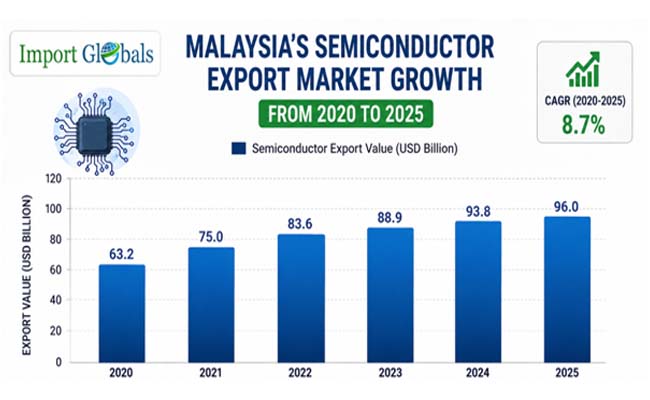
Malaysia has long been recognized as the largest semiconductor exporter. The advancement of the electronic manufacturing economies has maintained the solidification of the country's trade. The contribution of the nation towards the global semiconductor value chain has maintained the trade of testing, packaging, integrated circuit manufacturing, sensors, microcontrollers, and power semiconductors through different procedures for global trade standards compliance. Malaysia Statistical Data represented the electrical and electronic products category at 40% of the total exports, with semiconductors representing the largest segment.
The proper development of the industrial ecosystem and the experienced workforce have been considered supportive for the government-integrated policies to attract global semiconductor investment. Malaysia has been serving as one of the numerous international market collaborators, mainly because of trade with Singapore, China, the United States, Hong Kong, and Taiwan. The proper hike in investments in artificial intelligence, cloud infrastructure, and 5G networks has created additional demand for Malaysian semiconductor products.
Why is Malaysia Considered a Global Semiconductor Export Leader?
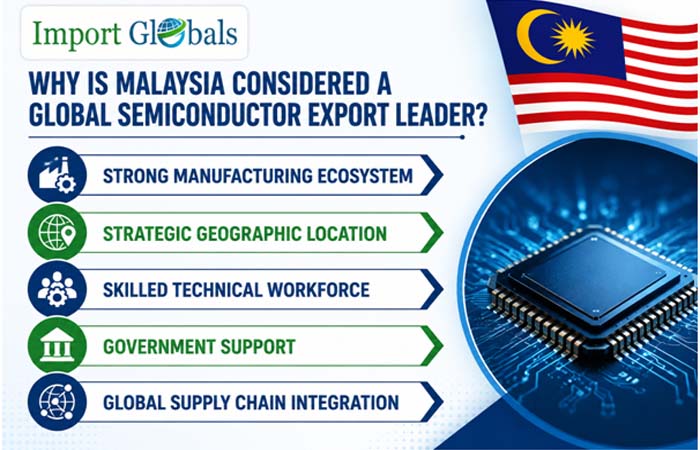
- Strong Manufacturing Ecosystem - Malaysia has represented itself as one of the global semiconductor export leaders because of the hundreds of multinational corporations operating in the country. The manufacturing facilities present across Penang, Kulim, and Johor have maintained trade integrity.
- Strategic Geographic Location - Malaysia Customs Data reported the geographic location of the country as the main contributor towards the semiconductor export of the nation. The proper international shipping routes have enabled the country to export efficiently to Asia-Pacific, Europe, and North America while reducing logistics costs.
- Skilled Technical Workforce - Malaysia has developed a highly trained engineering workforce with specialization in semiconductor manufacturing. The advancement of chip testing automation, robotics, and electronic production has supported the overall trade.
- Government Support - The government has been continuously launching different measures to promote high-value manufacturing. Through investment incentives, research funding, and digital transformation, the government has maintained industrial modernization.
- Global Supply Chain Integration - Malaysia has been serving as a critical production base because of the numerous international semiconductor manufacturers strengthening their position in the country. The overall representative factors have mainly maintained the trade transformation within the global electronic supply chain.
What Information is Available in Malaysia's Semiconductor Export Data?
Malaysia's Semiconductor Export Trade Data contains detailed information regarding the semiconductor shipments of the nation. The information highlighted for Malaysia's semiconductors is rooted in different categories like exporter name, importer name, product description, HS code, shipment date, export quantity, export value, unit price, country of destination, port of loading, port of discharge, country of origin, and trade frequency.
All this data set mentioned together in one place gives a clear visualization to the business authorities that are looking for the current activity details regarding Malaysia's semiconductor shipments. The data set highlighted overall helps the business authorities with identification of verified buyers, monitoring of competitors, and analysis of pricing strategies. It even helps the authorities with evaluation of market demand, optimization of sourcing decisions, and further helps the authorities with discovery of new traditional business opportunities.
Top Semiconductor Exported Variants of Malaysia
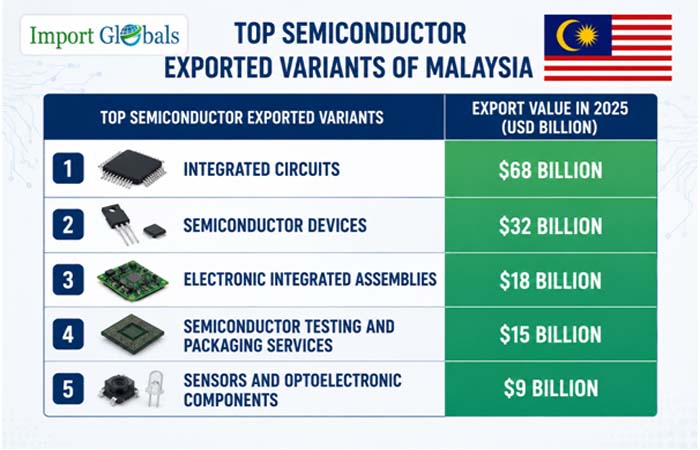
- Integrated Circuits - Malaysia Trade Data reported integrated circuits as one of the top semiconductor variants exported from the country. The overall trade of integrated circuits from the nation has totalled at a staggering rate of 68 billion US dollars in 2025. AI processors, microcontrollers, memory chips, and analog ICs are the latest variants exported.
- Semiconductor Devices - Semiconductor devices report 32 billion US dollars of exports from Malaysia. Power semiconductors, MOSFETs, transistors, diodes, and voltage regulators are the latest exported variants.
- Electronic Integrated Assemblies - Electronic assemblies’ generation of exports was 18 billion US dollars in 2025. The overall increase in the global consumer demand rate has maintained the effective trade of telecommunications equipment and industrial automation.
- Semiconductor Testing and Packaging Services - Malaysia Import Data reported that semiconductor testing and packaging services are exported at a valuation of 15 billion US dollars in 2025. This is mainly because of the hike in the proper demand rate regarding testing services on a global scale.
- Sensors and Optoelectronic Components - Wrapping up the list of the topmost exported variants of semiconductors from Malaysia, sensors and optoelectronic components are also significant ones. Optical sensors, LEDs, image sensors, and photonic semiconductor products account for 9 billion US dollars of Malaysia's exports in 2025.
Latest Business Opportunities
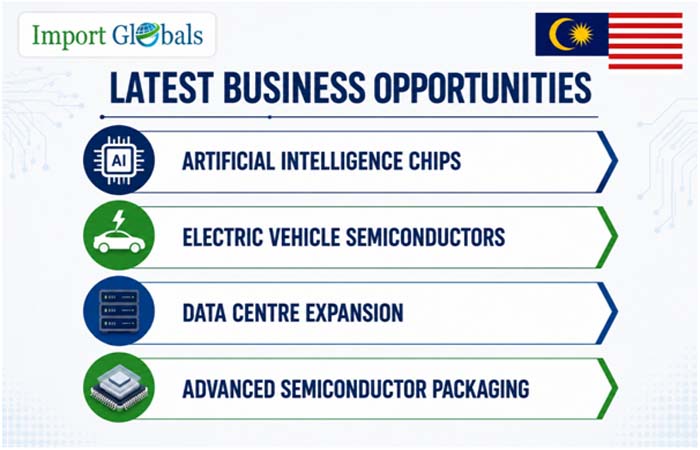
- Artificial Intelligence Chips - As reported by Malaysia Import Export Data, the adoption of AI worldwide has overall increased the demand for processors. This is why artificial intelligence chips have emerged as a significant opportunity for Malaysia's semiconductor trade.
- Electric Vehicle Semiconductors - The proper expansion of the EV market has been offering substantial opportunities for Malaysian manufacturers. It has overtaken the trade of modules, sensors, microcontrollers, and battery management components while generating significant export revenue.
- Data Centre Expansion - Different global investments in hyper scale data centres have continuously increased semiconductor demand. It has even supported the trade of server storage systems, networking equipment, and cloud infrastructure.
- Advanced Semiconductor Packaging - Advanced semiconductor packaging is also a significant opportunity for Malaysia's semiconductor trade. The expertise of the country in semiconductor assembly and testing positions it to benefit from the next-generation chip packaging technologies.
Top Companies Boosting Malaysia's Semiconductor Exports
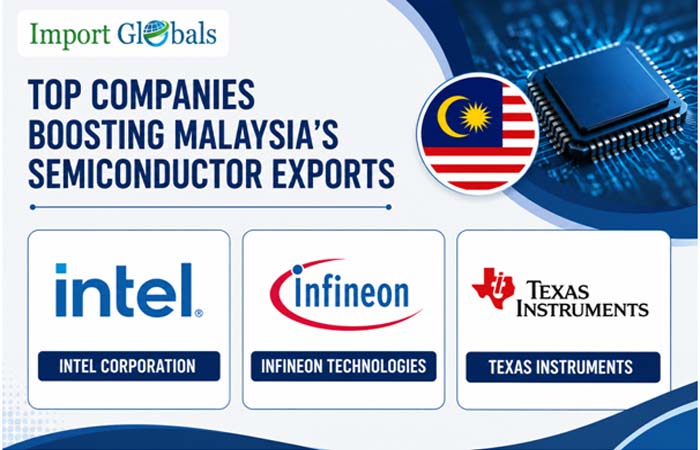
- Intel Corporation - Intel is considered one of the significant authorities boosting Malaysia's semiconductor exports. The facilities in Penang and Kulim have maintained the test of advanced processors and semiconductor products.
- Infineon Technologies - Infineon is also a significant beneficiary of Malaysia's semiconductor export trade. The manufacturing facilities engaged in the production of power chips, automotive semiconductors, sensors, and industrial electronics have supported the overall trade.
- Texas Instruments - Texas Instruments, with active operation of major semiconductor manufacturing and testing facilities in Malaysia, has supported the country's trade. Texas Instruments exports analog integrated circuits, embedded processors, and power management chips, which have supported the trade, mainly in healthcare, industrial automation, and consumer electronics industries.
Accurate Insights Into Malaysia Semiconductor Export Data
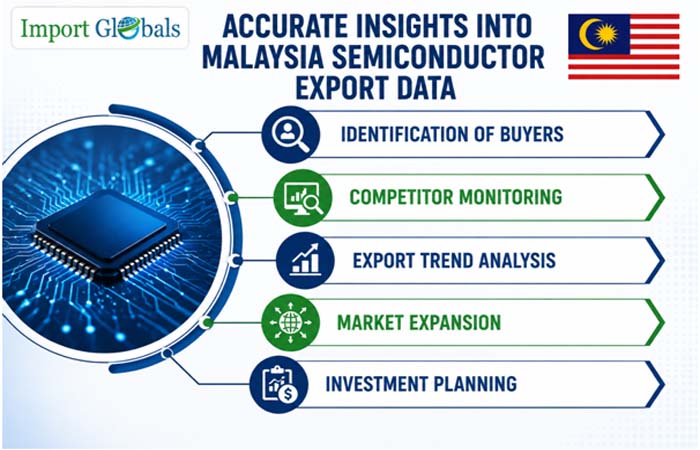
- Identification of Buyers - The shipment-level export intelligence highlighted in Malaysia semiconductor trade allows Malaysian exporters to identify genuine international semiconductor buyers. It even helps them with verification of the purchasing histories.
- Competitor Monitoring - Businesses trying to be progressive can even evaluate the competitor shipment frequencies and the product portfolios. The businesses can properly understand the pricing strategies with destination markets and customer networks.
- Export Trend Analysis - The Malaysia Export Trade Data is considered beneficial because it helps businesses with analysis of long-term export growth, seasonal demand, pricing fluctuations, and emerging semiconductor technologies.
- Market Expansion - The export statistics are considered beneficial because they help businesses with a proper understanding of the increasing demand rate and even diversify their export destinations.
- Investment Planning - The manufacturers right now are able to use the trade intelligence for proper evaluation of market opportunities. It even helps them establish production facilities for expanding the manufacturing capacity.
Global Market Analysis
The global semiconductor industry is continuously experiencing transformation because of artificial intelligence, electric vehicles, industrial automation, and other cloud computing services. Malaysia is emerging as one of the biggest beneficiaries of this structural shift in the semiconductor trade mainly because of the overall trade expansion. Artificial intelligence applications have been continuously requiring powerful processors, graphics, chips, AI accelerators, and memory devices. The high development of the semiconductor ecosystem is positioning the country towards capturing growing demand across high-value segments, says Malaysia Trade Data. Electric vehicles have been representing their position as one of the specific growth opportunities of the global trade.
Modern electric vehicles require thousands of semiconductor components for battery management systems. Autonomous driving technologies and infotainment systems have been maintaining the charging infrastructure and safety controls. The global diversification of the semiconductor supply chain has encouraged multinational corporations while expanding manufacturing operations outside traditional production centres. The political stability, reliable infrastructure, and skilled workforce have been continuously attracting significant foreign direct investment. The advanced packaging technologies, including 2.5D, 3D, and chiplet integration, has maintained the high heterogeneous integrity of trade.
Future Trade Outlook
The Malaysian semiconductor export industry will experience a strong and optimistic growth rate in the upcoming period. The proper hike in investment in artificial intelligence, autonomous vehicles, renewable energy systems, and telecommunication infrastructure will support the growing trade rate. Malaysia Customs Trade Data reported the government initiatives as the main factor promoting high-value manufacturing, digital transformation, advanced semiconductor research, and workforce development.
Global manufacturers are increasingly diversifying the semiconductor supply chain to improve its resilience while creating additional opportunities. The well-developed industrial ecosystem and reliable infrastructure have maintained long-standing relationships with multinational technology companies.
Conclusion
Malaysia has strengthened its position as one of the leading semiconductor exporters because of the advanced manufacturing capabilities, highly skilled and talented workforce engaged in the manufacturing units, and the strong government support. The traditional demand rate for AI chips, automotive semiconductors, industrial electronics, cloud computing infrastructure, and advanced packaging has driven the export growth rate.
The reliable access of the country to comprehensive Malaysia Semiconductor Trade Data enables businesses to identify genuine buyers and evaluate international demand rates. Malaysia Import Trade Data reported that semiconductor technologies are continuously evolving, with the country's position as one of the reliable and competitive semiconductor manufacturing destinations worldwide.
CTA
Looking for an expansion in your semiconductor business on a global scale, Import Globals is a ready-to-go choice for you. The semiconductor export data with verified shipment-level intelligence helps business authorities with importer and exporter details, HS codes, product description, shipment values, quantities, pricing analysis, and destination countries. Visit www.importglobals.com or drop an email at info@importglobals.com to unlock actionable intelligence regarding Malaysia semiconductor exports to accelerate your global business growth.
FAQs
Que. What is Malaysia's top semiconductor export?
Ans. Integrated circuits are Malaysia's top semiconductor export in 2025.
Que. Why is Malaysia important in the global semiconductor industry?
Ans. Malaysia is considered important in the global semiconductor industry because it helps lead semiconductor manufacturing, assembly, testing, and packaging hubs.
Que. Name the major Malaysian semiconductor importers of 2025.
Ans. Singapore, China, and the United States are the major Malaysian semiconductor importers.
Que. What industries are mainly using Malaysian semiconductor exports?
Ans. Automotive, artificial intelligence, and telecommunications are mainly using Malaysian semiconductor exports.
Que. What information is available in Malaysia semiconductor export data?
Ans. Malaysia semiconductor export data covers Importer names, Exporter names, Shipment date, HS Code, Product Details, quantity, value, pricing information, origin country, importing country & port details.
Que. How does Malaysia Semiconductor Export Data support business growth?
Ans. Malaysia Semiconductor Export Data supports business growth via proper identification of buyers, supplier analysis of market demand, and development of effective market expansion strategies.
Que. What is the global export trade rank of Malaysia in 2025?
Ans. The global export trade rank of Malaysia in 2025 is 23rd.
Que. What is the semiconductor export trade value of Malaysia in 2025?
Ans. The semiconductor export trade value of Malaysia in 2025 is 98 billion US dollars.
Que. Name the top states of Malaysia working as a top semiconductor manufacturing hub?
Ans. Penang, Kedah (Kulim), Selangor, Johor, and Melaka are the top states of Malaysia popular as a top semiconductor manufacturing hub.
Que. Where can businesses access reliable Malaysia semiconductor export data?
Ans. Visit www.importglobals.com or drop an email at info@importglobals.com to get access to Malaysia semiconductor export data.
You Can Also Visit :-