Vietnam's Record Growth in Merchandise Trade in 2025: What the Billion-dollar Milestone Means for Global Players (2025–2026)
- Mar 11, 2026
Vietnam's Record Growth in Merchandise Trade in 2025: What the Billion-dollar Milestone Means for Global Players (2025–2026)
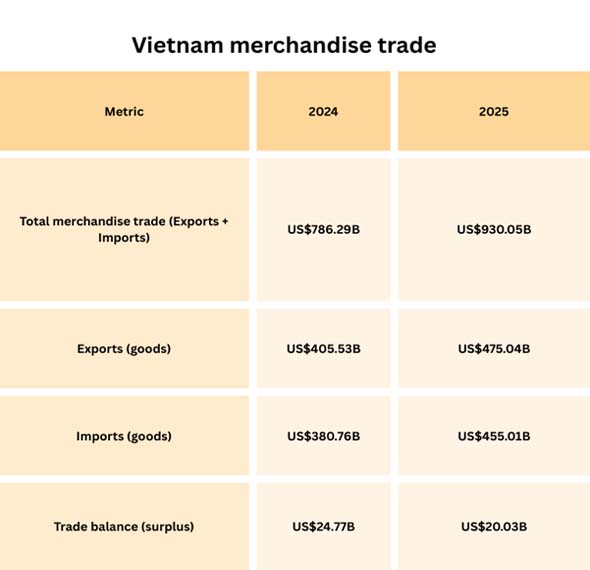
Vietnam closed 2025 with a merchandise import–export turnover of roughly US$930 billion, marking one of the strongest annual jumps the country has recorded in recent years.
The Headline Says That Vietnam Has Just Entered a New Trade Orbit
As per Vietnam Import Data by Import Globals, the year’s performance matters far beyond “a big number”: it signals that Vietnam is no longer just an alternative manufacturing base in Asia, but a core node in global supply chains—especially for electronics, consumer goods, and an expanding set of industrial components.
For global players—importers, exporters, sourcing managers, logistics providers, investors, and trade-finance teams—Vietnam’s 2025 surge is a practical message: capacity, capability, and connectivity improved, but so did concentration risks (market dependency, imported-input exposure, tariff scrutiny, and compliance complexity). In 2026, the opportunity is still strong, yet the playbook needs to be smarter.
Putting Vietnam's Trade Results for 2025 in Context
A rapid way to understand 2025 is to compare it against 2024, which was already a strong year for exports and a sizeable surplus. In 2025, both exports and imports accelerated, keeping Vietnam’s total turnover on a steep upward curve.
As per Vietnam Export Data by Import Globals, this pattern—exports up strongly, imports up even more—often indicates a manufacturing economy moving up the curve: rising orders and assembly volumes typically pull in more intermediate goods, components, and machinery.
Four Real Drivers of the 2025 Jump
Vietnam’s 2025 trade expansion was not a single-sector story. It was the combined effect of (1) electronics scaling, (2) supply-chain repositioning, (3) import intensity in advanced manufacturing, and (4) a steady broadening of export baskets.
1) Electronics Became the Growth Engine (Again—now at a Higher Level)
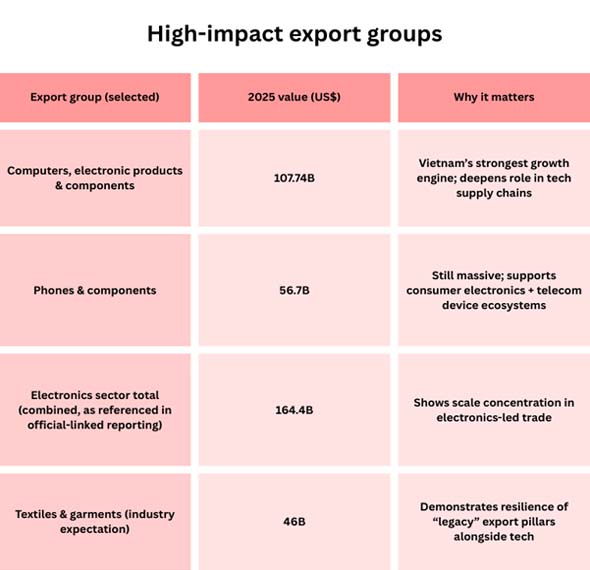
As per Vietnam Import Export Trade Data by Import Globals, electronics has been Vietnam’s signature export story for years, but 2025 added a new twist: computers, electronic products, and components crossed the US$100B mark, making the category the most important export driver and widening the gap over several other groups.
A single mega-category crossing US$100B is more than bragging rights. It changes how global companies plan: they treat Vietnam less like a “backup line” and more like a primary production geography, with longer-term supplier development, tooling, and logistics commitments.
This electronics-led surge also reshaped Vietnam’s import profile: more electronics exports typically mean more imported components and materials—especially when domestic supplier ecosystems are still catching up.
2) Supply-Chain Diversification Kept Moving—and Vietnam Captured More of It
As per Vietnam Import Custom Data by Import Globals, many multinationals have been diversifying production footprints across Asia to reduce single-country dependency, improve resilience, and meet delivery timelines. Vietnam benefited because it can combine industrial park depth, a large workforce, improving port/airport connectivity, and a policy environment built around export manufacturing.
For global buyers, that means Vietnam has become more central in multi-country sourcing strategies. For competing producers, it means Vietnam is now a benchmark in Southeast Asia for speed-to-scale in select manufacturing verticals.
3) Import Growth Tells the “production Scale” Story
Vietnam’s imports grew even faster than exports in 2025. This isn’t automatically negative. In a manufacturing hub, rising imports often reflect:
- Higher demand for intermediate inputs (chips, components, specialized materials)
- Increased purchases of capital equipment (machinery, tooling, production lines)
- More energy, chemicals, and industrial inputs supporting factory throughput
- The implication: Vietnam’s factories were not just shipping more—they were building more capacity and pulling more value through the system.
4) Export Breadth Improved, but Value-add Remains Uneven
As per Vietnam Exporter Data by Import Globals, beyond electronics, Vietnam sustained momentum in traditional pillars (apparel, footwear, furniture, selected agro-products) while also pushing more complex industrial categories. But the value-add split across the economy remains uneven—especially between domestic firms and foreign-invested manufacturers.
The structural fact that global participants must comprehend: FDI predominates the export apparatus.
As per Vietnam Importer Data by Import Globals, Vietnam’s export ecosystem is deeply integrated with foreign-invested production. The split matters because it affects supplier selection, localization potential, pricing power, and resilience.
In 2025, reports of the official data pointed out two major things:
- The domestic sector had a big trade deficit.
- The foreign-invested sector posted a large surplus and continued to dominate exports.
- For global companies, this means Vietnam’s trade strength is partly “import–assemble–export” at scale. As per Vietnam Import Shipment Data by Import Globals, that is still a major advantage—fast manufacturing throughput and proven export capability—but it creates two strategic considerations:
- Supply-chain risk: disruptions in imported inputs (chips, components, chemicals, specialized materials) can ripple quickly.
- Localization opportunity: firms that help develop Tier-2/Tier-3 local suppliers can reduce lead times and improve compliance outcomes, while also gaining cost advantages.
What Vietnam's Turnover of About Us$930 Billion Signifies for Businesses Around the World (Practical Effects)
1) Buyers and Sourcing Heads: Vietnam is No Longer “plan B.”
As per Vietnam Import Export Trade Analysis by Import Globals, if you source electronics, consumer goods, furniture, textiles, or components, Vietnam’s scale in 2025 suggests you can treat it as a long-term primary sourcing base, not just a diversification experiment. But to win, you’ll need stronger vendor governance:
- Supplier audits beyond the factory floor (sub-tier mapping).
- Dual-port routing strategies (to reduce chokepoints)
- Clear rules on origin documentation and transshipment compliance
- Lead-time buffers for peak seasons and customs surges
2) Manufacturers: Capacity is Rising, but Component Dependence is the Constraint
As per Vietnam Export Import Global Trade Data by Import Globals, Vietnam’s high-growth export sectors remain dependent on imported components. Manufacturers operating in Vietnam can improve resilience by:
- Building localized supplier development programs
- Signing long-term contracts for critical inputs
- Designing products for component flexibility (alternate BOM options)
- Investing in testing/quality infrastructure locally to reduce rework cycles
3) Logistics and Freight: Expect Higher Throughput—and Higher Volatility
When a country’s total turnover crosses ~US$930B, the logistics ecosystem becomes a competitive advantage. Freight forwarders, 3PLs, and carriers can all gain from more business, but they need to keep an eye on:
- Risk of peak-month surges and port congestion
- Changes in the availability of containers
- Changes in customs clearance, especially for restricted or high-risk groups
- More attention is being paid to paperwork because of tariffs and laws about where things come from.
In 2026, logistics companies who have trade compliance, visibility tech, and robust contracts with carriers will be in the greatest shape.
4) Investors: Vietnam is Turning the "Manufacturing + Trade" Flywheel Faster
As per Vietnam Import Export Global Data by Import Globals, Vietnam's trade boom in 2025 supports the idea that investment leads to growth: large-scale manufacturing draws foreign direct investment (FDI), which boosts exports, which pays for infrastructure and capability enhancements, which attracts further investment. For investors, the key question in 2026 is not “can Vietnam grow trade?” but:
- Can Vietnam increase domestic value-added?
- Can it deepen high-tech production beyond assembly?
- Can it manage tariff pressures and maintain market access?
Those who back enabling ecosystems—industrial real estate, logistics, energy reliability, compliance software, high-skill training—may find durable tailwinds.
5) Trade Compliance Teams: Scrutiny Rises With Success
As Vietnam’s share in global trade expands, compliance attention grows too. Global companies should assume tighter checks on:
- Rules of origin, certificates, and supplier declarations
- Anti-circumvention risks in sensitive product categories
- Product-specific standards (safety, labeling, ESG reporting)
- Audit readiness for sub-tier suppliers
A practical move for 2026 is to treat compliance as a design requirement, not a post-shipment function. The forecast for 2026 is good for opportunity, but the risk map is more complicated.
Early 2026 indicators show Vietnam still moving at a fast clip, and policy messaging continues to emphasize export growth targets and industrial momentum. At the same time, global trade is still weak. Changes in tariffs, uneven demand, and shocks to the supply chain can all change the outcomes of each quarter at any time.
For people that play on a global scale, the greatest thing to do is to be balanced:
- Use Vietnam's size to your advantage to get things done faster and for less money.
- To decrease the risk of concentration, use multi-country sourcing or multi-site techniques.
- Put money into localization so that your business doesn't rely on inputs as much and can change more easily.
- As your market share grows, make sure your compliance processes get better since consumers will pay more attention to them.
- There is more than one story about Vietnam's 2025 record. It shows that the country has gotten better and can now affect trade flows instead of just taking advantage of them.
Conclusion
Vietnam's goods trade will reach roughly US$930 billion in 2025, which shows that the country has a mature export engine that is fueled by electronics scale, deeper global integration, and better manufacturing skills. The message for businesses all over the world is clear: Vietnam is a key part of the supply chain, and planning for 2026 should reflect that.
But the winners won’t be those who simply “shift orders.” The winners will be those who build durable Vietnam strategies—supplier ecosystems, logistics resilience, compliance robustness, and product design that fits a world where trade policy can change quickly.
Vietnam’s record year opens doors. Smart execution in 2026 decides who walks through them profitably. Import Globals is a leading data provider of Vietnam Import Export Trade Data.
FAQs
Que. Why did Vietnam's trade surplus go down in 2025 even though exports went up?
Ans. Imports grew faster than exports because there was more demand for the parts, resources, and machinery used in making things.
Que. What industry helped Vietnam's exports grow the most in 2025?
Ans. The main driver of growth was electronics, especially computers, electronic goods, and parts, which made more than $100 billion.
Que. What is the biggest risk for businesses that get most of their supply from Vietnam?
Ans. Concentration risk: depending on one place, being open to imported goods, and having to obey stricter laws about customs and origins.
Que. What should companies all throughout the world do differently in 2026?
Ans. Put money into projects that help sub-tier suppliers see better, be ready for origin and compliance, dual logistics routing, and localization for suppliers to make them less dependent on components.
Que. Where to get a detailed Vietnam Import Trade Analysis?
Ans. Visit www.importglobals.com.