WTO Prediction: By 2026, Global Trade Growth could Slow to 1.9%
- Apr 27, 2026
WTO Prediction: By 2026, Global Trade Growth could Slow to 1.9%
There have been some very large changes in global trade in the last few years. Geopolitical tensions have risen, new technologies have come out, and supply chains have changed. After a big rise in 2025, the global trading system is currently expected to grow more slowly.
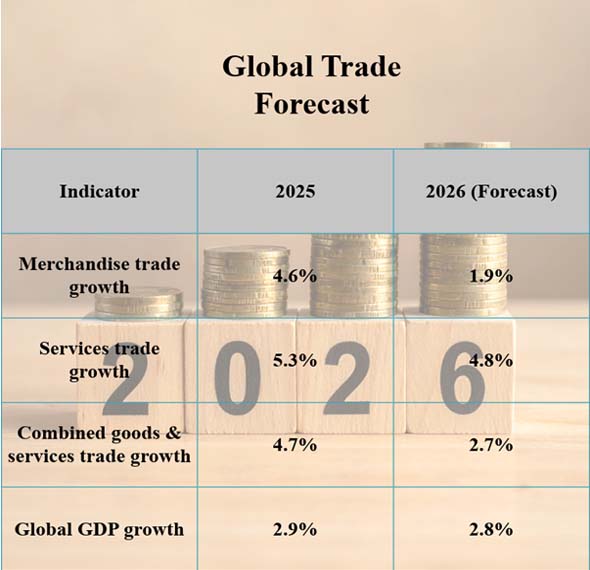
The World Trade Organization (WTO) forecasts that the growth of global merchandise trade will slow down to roughly 1.9% in 2026, down from a strong 4.6% in 2025.
As per USA Export Data by Import Globals, the drop is due to both economic and political factors. In 2025, commerce activity went up a lot because there was a lot of demand for digital goods, especially those related to AI. Businesses sent their items out early to avoid paying higher taxes. Trade is anticipated to slow down a lot in 2026 as these transient factors go away and worries about the world intensify.
The international trading system is still strong, even though trade is slowing down. It is still anticipated to increase. But businesses and politicians need to be ready for a time when growth will be slower, risks will be higher, and supply chains will change.
A Strong but Short-Term Rise in Global Trade Performance in 2025
The global economic system receives an unexpected boost in 2025. There were both structural and cyclical factors for trade growth that was better than expected. Based on USA Import Export Trade Data by Import Globals, a key cause for this was the rapid rise of the market for AI-related goods such semiconductors, data center equipment, and advanced computing technology. Investments in technology went up a lot over the world, which made the requirement for electronic parts and machinery go up. These items were a major factor in the increase of merchandise commerce during the year.
Front-loading of imports was another key factor. Businesses sped up shipments in case tariffs went up or trade was limited. This caused trade flows to go up and down for a short time, especially between Asia, North America, and Europe.
Also, global supply systems were still getting back on track after being disrupted by the pandemic and past geopolitical crises. Manufacturing output went up in a number of important exporting areas, which led to more commerce. As per Europe Import Custom Data by Import Globals, but most of these things were only ephemeral. The expansion that happened in 2025 is not anticipated to continue at the same rate as inventory levels stabilize and global demand returns to normal.
WTO's Prediction for World Trade in 2026
The WTO's Global Trade Outlook and Statistics 2026 say that the growth of merchandise trade will slow down a lot in 2026. The baseline prediction says that trade volumes will grow by 1.9% in 2026, then slowly rise to 2.6% in 2027.
At the same time, trade in services like tourism, logistics, and digital services is expected to develop faster than trade in products. The growth of services trade is predicted to be about 4.8% in 2026. This is a little less than the previous year, but it is still rather significant.
As per United Kingdom Import Trade Analysis by Import Globals, it is expected that the combined growth of goods and services trade would be about 2.7% in 2026, which is in line with the growth of the world economy. The slowdown doesn't mean there's a catastrophe; it just means things are getting back to normal after a year that was particularly robust.
Important Reasons for the Trade Slowdown
There are a few short-term and long-term reasons why global trade growth is likely to decline in 2026.
1. Conflicts Between Countries and Trade Tensions
As per Iran Export Data by Import Globals, Geopolitical conflicts are still one of the biggest threats to world trade. There is more unpredictability in energy markets and global transportation routes because of conflicts in important areas, especially the Middle East.
When geopolitical tensions cause energy prices to go up, it can make transportation more expensive, lower industrial output, and slow down trade between countries. In really extreme scenarios, difficulties with key shipping routes might have a large impact on supply chains around the world. WTO experts fear that continued geopolitical tensions could make global trade growth even slower than what was expected.
2. Raising Tariffs and Protectionism
Another key cause for the downturn is the emergence of protectionist trade policies. Over the past few years, many countries have raised tariffs, curtailed imports, and passed legislation to protect their own industries. In the short term, these kinds of restrictions may boost specific industries, but they usually hinder global trade by making it more expensive and harder for enterprises to enter new markets.
As per Russia Import Data by Import Globals, tariff hikes between big economies have already changed supply chains. For example, countries in the same region have made trade treaties and moved their factories closer to home.
3. High Expenses of Shipping and Energy
Energy costs are particularly significant for trade around the world since fuel prices have a big effect on transportation and logistics. When oil prices go up, it costs more to ship things by sea and by air, which makes trade between countries more expensive. People may be less likely to buy traded goods when prices go up, especially in fields where price is really important, like agriculture and industry. The WTO argues that long periods of high energy prices could slow down the expansion of trade even more.
4. Slowing the Growth of the World Economy
It is also thought that global economic development would slow down a little bit in the next few years. The WTO says that global GDP growth will stay at 2.8% in 2026 and 2027, which is a little less than the 2.9% increase seen in 2025. As per USA Import Data by Import Globals, trade growth is strongly tied to economic output, so as the economy grows more slowly, trade growth also slows down.
Trade Trends in Different Areas
Even though commerce between countries is growing more slowly, trading patterns within regions are nevertheless changing.
Asia
As per Vietnam Import Export Trade Analysis by Import Globals, Asia is still the most active area for trade around the world. Several Asian economies are still seeing growth in exports thanks to fast industrial production, technological exports, and robust manufacturing networks.
Europe
European trade growth is still slow, but it's being driven by advanced manufacturing industries like cars, machinery, and drugs. But changes in regulations and energy prices could have an effect on trade.
The United States and Canada
As per Mexico Export Import Global Trade Data by Import Globals, Regional supply chains are having a bigger and bigger effect on trade in North America, especially through deals like the United States–Mexico–Canada Agreement (USMCA). Nearshoring developments are likely to make trade across regions more integrated.
Newly Developed Economies
Developing countries are becoming more important in global trade, especially when it comes to making things and trading goods. But large economies are also more likely to be hurt by things like changes in commodity prices and geopolitical crises.
Trends in Several Sectors That Affect Global Trade
Even while trade growth is slowing down overall, some sectors are still driving international trade.
Electronics and Technology
There is still a lot of demand for semiconductors, advanced computing hardware, and AI-related infrastructure. These areas made a big difference in the commerce boom of 2025.
Green Technologies and Renewable Energy
As the world works to cut down on carbon emissions, commerce in renewable energy technology like solar panels, wind turbines, and parts for electric cars is growing.
Trade in Agriculture
For food security around the world, agricultural exports are still quite important. But in some areas, problems with fertilizer supplies and increased energy costs could make it harder to exchange food.
Trade in Services
Digital services, financial services, and tourism are all growing quickly. This is making the trade in services develop faster than the trade in goods.
Risks That Could Make Global Trade Even Slower
The WTO also says that the risks to trade in 2026 are mostly on the downside.
Here are some of the biggest risks:
- More and more geopolitical confrontations
- More and more taxes and trade barriers are going up
- Long-lasting shocks to energy prices
- Problems with the supply chain
- Weak demand from consumers in big economies
If energy prices stay high, the growth of merchandise trade could drop even more, to about 1.4% in 2026. Import Globals says that changes like these would have a huge effect on the world's economy and the stability of commerce.
What this means for People and Businesses that make Decisions
Businesses, governments, and investors will all be affected by the predicted slowdown in global trade growth.
Making the Supply Chain more Diverse
Companies are making their supply chains more varied to minimize the risk of trade problems and problems with other countries.
Trade in Various Areas
Companies are focusing on markets and trade relationships in their own area, which is making trade more local.
Investing in Digital Trade
Digital technologies are transforming how things move, how trade happens across borders, and how the supply chain is managed.
Policies that Operate Together
Governments may need to work together more closely to keep the global trading system stable.
Last Thoughts
The WTO's projection that global trade in goods will expand by 1.9% in 2026 illustrates that the way things are traded throughout the world is changing. After a strong surge in 2025, trade growth will probably slow down because of increasing tariffs, fluctuating energy prices, and slower economic development.
Trade around the world is still running strong, even with these issues. International trade is still strong thanks to new technologies, digital services, and the capacity to trade between places. Also, trade volumes are still predicted to go up, although at a slower rate.
In the next few years, global supply chains will alter a lot. Trade will become more local, and sectors that depend on technology will become more vital. Businesses and policymakers who adapt to these changing dynamics will be better able to deal with the changing world of global commerce. Import Globals is a leading data provider of USA Import Export Trade Data.
FAQs
Que. Why do people think that global trade would slow down in 2026?
Ans. Trade growth is likely to slow down because of geopolitical tensions, rising tariffs, higher energy prices, and a slower global economy.
Que. What does the WTO think will happen to global trade in goods?
Ans. The WTO says that global trade in goods will expand by roughly 1.9% in 2026, down from 4.6% in 2025.
Que. What parts of the economy are making global trade grow?
Ans. Some of the fastest-growing areas of international trade are technology products, AI-related equipment, renewable energy technologies, and digital services.
Que. Is it possible that global trade growth would be lower than the WTO's prediction?
Ans. Yes. Trade growth could drop to about 1.4% in 2026 if geopolitical tensions rise or energy prices stay high.
Que. Where to get detailed USA Import Export Global Data?
Ans. Visit www.importglobals.com.