During the Iran War, European Oil Companies Did Better Than American Oil Companies in the Global Energy Markets
- Apr 29, 2026
During the Iran War, European Oil Companies Did Better Than American Oil Companies in the Global Energy Markets
European energy giants like BP, Shell, and TotalEnergies earned more money than their American counterparts by employing complex trading strategies that took advantage of market shifts. In 2026, the conflict between Iran and Western countries caused a significant drop in the global oil market.
Import Globals reported that this crisis led to one of the worst disruptions in Europe’s oil and gas supply lines in recent history. Issues arose in manufacturing, transportation routes, and trade between regions. As a result, oil prices surged worldwide.
Europe gets a lot of information about imports from Import Globals. This information shows that ExxonMobil and Chevron are two American companies that work hard to keep making the same amount of products and to have long term agreements to get the supplies they need.
On the hand European companies have big teams that sell products. These teams do well when prices are changing a lot. When there was a conflict in Iran European energy companies found a chance to make more money. They had some problems making products but they were able to make a lot of money by trading.
This article looks at how the war in Iran affected the worlds energy markets. It also looks at why European oil companies did than American companies like ExxonMobil and Chevron. The war, in Iran started in 2026 and quickly became a big problem that affected the oil industry everywhere. One of the most crucial things that happened was that shipping stopped going through the Strait of Hormuz. A lot of oil and liquefied natural gas from around the world travels through here.As tensions rose and shipping routes became unknown, the world's oil supply became much tighter almost right once.
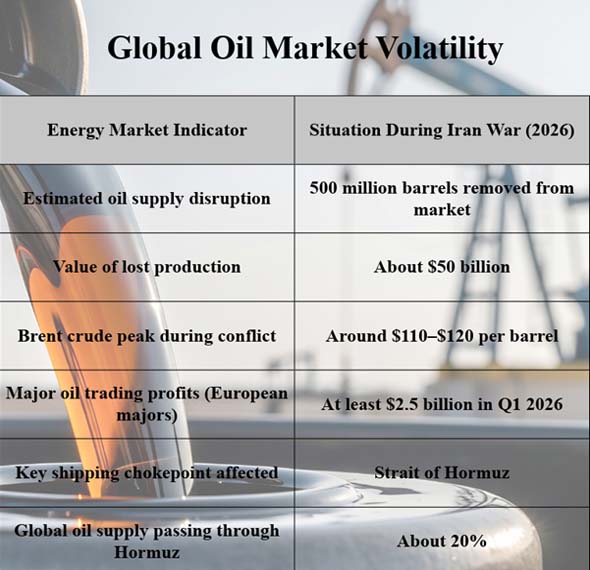
Experts say that more than 500 million barrels of oil were removed off the market in the first 50 days of the war. Experts think that the lost production was worth roughly $50 billion. The event also had a huge effect on the prices of benchmark oil. At one point, the price of Brent crude reached above $110 a barrel, but it fell quickly when talks of a ceasefire began. There were a lot of price fluctuations in the market throughout this crisis, allowing traders to capitalize on market pricing fluctuations to generate a profit. The major benefit for large energy companies (with significant trading arms) was that they were able to generate profits throughout this crisis.
What European Oil Companies Have That Other Traders Do Not
According to Import Globals' data on the export of Europe, European oil companies have made significant capital investments into their trading operations (i.e., the act of buying or selling crude oil or gas - or other, refined products - on every marketplace globally). This is not the same as the usual oil exploration/production businesses.
European oil companies have significant trading arms (such as BP, Shell, and TotalEnergies) that serve as intermediaries between shippers (who transport crude and refined oil and gas) and those who wish to purchase oil and gas (such commodity traders, financial derivatives, and futures markets).
When you have two marketplaces and the prices of commodities are not the same and the price of commodities changes over time this can give traders ways to make money. The commodities traders were really active during this time because of the Iranian Crisis. European oil companies had a chance to make a lot of money during this time.
In the three months of 2026 people say that European oil companies made at least $2.5 billion from trading commodities. This money from trading commodities helped European oil companies make up for the money they lost because of problems with shipping and production, in the Middle East. The commodities traders and European oil companies were happy to have this chance to make money from commodities trading.
As per Europe Import Export Trade Data by Import Globals, European businesses did very well for a multitude of reasons:
- Years of experience buying and selling stuff
- All around the world, there are big networks of transportation links and supply contracts.
- More advanced approaches to deal with risk
- Very good at trading options
These benefits help them quickly adapt to changes in the industry. The oil firms in the U.S. are behind
Based on Europe Import Custom Data by Import Globals, European oil corporations did well throughout the crisis, but it took longer for U.S. energy companies to see the benefits of changes in the market. For instance, ExxonMobil and Chevron normally focus on upstream production and long-term supply contracts instead of trading stocks. Their business plan is based on stability and steady income streams, not on generating a lot of money quickly through trading.
Because of this, American businesses didn't change as rapidly when oil prices started to swing up and down quickly during the Iran conflict. Some businesses even complained they lost money since delivery were late and they had to adjust their hedging plan because they feared prices would go higher. During the crisis, the stock values of European firms went up, but the stock prices of U.S.companies fell down. This is because the two groups acted in different ways. Big firms in Europe benefit from exchanging energy. Based on Europe Import Trade Analysis by Import Globals, many European energy companies performed quite well in the first few months of the Iran dispute.
BP
BP is one of the biggest oil companies in the world that trades oil. The company reported that its trading section did "exceptionally" well in the first quarter of 2026, when energy costs increased up. BP traders took advantage of price differences in other parts of the world and the fact that it was hard to get goods to the Middle East. This let the business make the most of the price variations between Europe, Asia, and North America.
Shell
Based on Europe Exporter Data by Import Globals, Shell also observed that its hydrocarbon and liquefied natural gas (LNG) operations were performing well.The company's trading arm generated significant revenue by expediting the delivery of commodities to individuals worldwide, even during periods of low gas production. Shell maintained a substantial advantage during the crisis due to its extensive fleet of vessels and long-term LNG contracts.
TotalEnergies
However, TotalEnergies, a substantial French energy company, also disclosed that trading generated substantial revenue for them. Based on Europe Importer Data by Import Globals, its traders generated nearly $1 billion by trading petroleum oil from the Middle East and other financial derivatives during the war's most severe phase. The proceeds compensated for the production losses that resulted from the unstable region. As of 2026, the entire energy market will be unstable.
The oil market has been more uncertain than it has been in a long time as a result of the conflict in Iran. As per Iran Import Data by Import Globals, the world's events caused a rapid fluctuation in oil prices, as people's sentiments regarding supply and demand were influenced.
Traders were constantly required to modify their positions in response to news regarding diplomatic negotiations, military strikes, and shipping concerns. The Strait of Hormuz remains one of the world's most significant energy obstacles. Shipping and energy prices worldwide are immediately affected by any complications with this route.
The Part Energy Trading Plays in Today's Oil Companies
The events of 2026 show how essential trading operations have become for big oil firms. In the past, oil firms made most of their money from finding, producing, and refining oil. In the last few decades, though, trade divisions have become a key source of wealth. These trading desks work in a way that is similar to banks. They look at market trends, guess how prices will change, and carry out complicated deals that involve shipping oil and derivatives contracts. Trading divisions usually make money by:
- Arbitrage between oil markets in different regions
- Hedging plans for refining and production operations
- Guessing how prices will change
- Improving the logistics of shipping and storage
These enterprises make moderate earnings while the markets are stable. But at times of crisis, profits can go up a lot since prices can change so quickly.Effects on the global energy trade.
The war in Iran has brought to light some critical patterns in the world's energy markets. As per Europe Import Export Trade Analysis by Import Globals, first, developments in the world of politics are still one of the key reasons why energy prices go up and down. Conflicts in big producing areas can throw off global supply chains in just a few days. Second, energy corporations that have many types of businesses, including trading divisions, are better able to handle crises. Third, the war has shown how important maritime chokepoints like the Strait of Hormuz are. When shipping routes are in danger, trade between countries can quickly become unstable. Finally, the crisis has made people more interested in finding new ways to get energy and in techniques for spreading out their energy sources. Businesses and nations are endeavoring to reduce their dependence on Middle Eastern oil.
The Energy Market's Future
Despite the fact that discussions regarding a ceasefire have alleviated some tensions, the global energy market remains highly susceptible to geopolitical risks. The global supply and demand for oil are so closely balanced that even minor fluctuations can result in substantial price fluctuations. It is likely that energy corporations will continue to allocate funds to trading instruments in order to more effectively manage these risks. The financial trading divisions and the traditional energy production operations are also expected to collaborate more, according to analysts. Based on Europe Export Import Global Trade Data by Import Globals, the success of their trading desks during the Iran conflict may underscore the importance of maintaining extensive global trading networks for major European energy companies. In the interim, investors may motivate U.S.corporations to reconsider their trading strategies, which are generally secure.
In Conclusion,
The 2026 Iran conflict has revolutionized the global energy landscape and underscored the significance of trading for major oil companies. The war disrupted supply networks and resulted in billions of dollars in lost production. However, it also presented corporations with significant opportunities to generate revenue by managing unstable markets. European oil companies, including BP, Shell, and TotalEnergies, were among the most significant beneficiaries due to their extensive global trading networks and supply chains. Import Globals is a leading data provider of Vietnam Import Export Trade Data.
FAQs
Que. What was the reason for the superior performance of European oil corporations in comparison to their American counterparts during the Iran war?
Ans. These organizations generated billions of dollars in trading profits throughout the crisis.
Que. What impact did the conflict in Iran have on the world's energy supply?
Ans. During the early phases of the crisis, the fighting stopped exports through the Strait of Hormuz and took some 500 million barrels of oil off the market.
Que. Which corporations made the most money from trading oil throughout the crisis?
Ans. BP, Shell, and TotalEnergies, three of the biggest energy firms in Europe, all said they made a lot of money from trading in the first quarter of 2026.
Que. What makes the Strait of Hormuz vital for trade around the world?
Ans. The Strait of Hormuz is one of the most important shipping routes for energy in the world because over 20% of the world's oil supply goes through it.
Que. Where to get detailed Europe Import Export Global Data?
Ans. Visit www.importglobals.com.