An Analysis of the Impact of the US-Iran-Israel War on International Trade, Oil Prices, and Shipping Costs from 2025 to 2026
- Mar 08, 2026
- 87 Views
An Analysis of the Impact of the US-Iran-Israel War on International Trade, Oil Prices, and Shipping Costs from 2025 to 2026
The geopolitical crisis between the US, Iran, and Israel in 2026 was one of the worst in recent history and hurt the world economy. According to Import Globals, the war has effects all around the world, but it is mostly political and military. Because of the war, the cost of transportation, oil, and trade routes has gone up over the world.
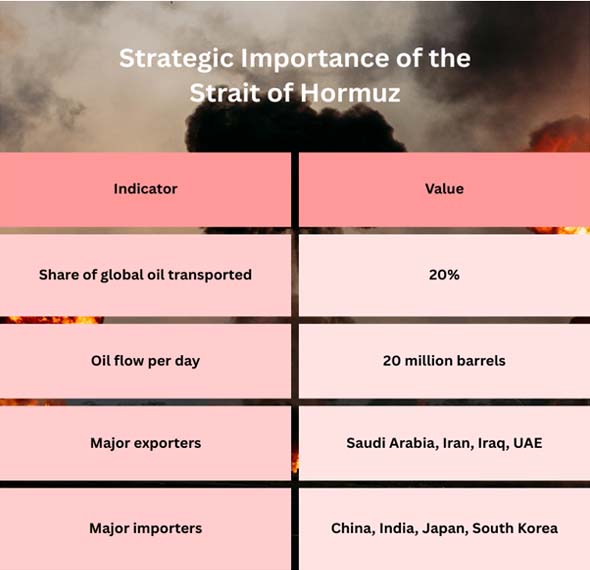
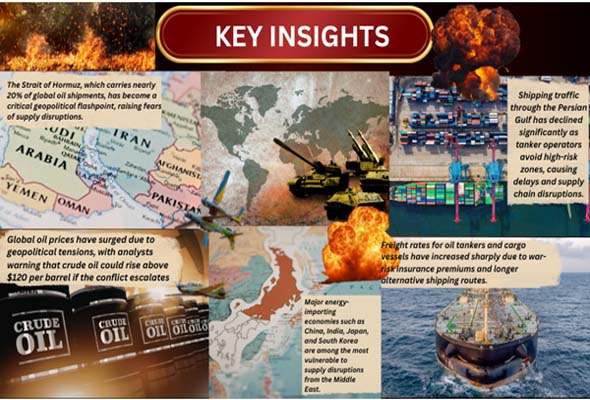
According to Import Globals' Iran Import Data, the Middle East is an essential place for moving commodities and providing energy to other parts of the world. The Strait of Hormuz is one of the most important chokepoints for crude oil and liquefied natural gas (LNG). It connects the Persian Gulf to the rest of the world. Problems in this area can quickly affect trade and the world economy. This little river is very important for moving energy around the world because it carries about 20% of the world's oil.
Because of the fight between Israel, Iran, and the US, the area has gotten more and more dangerous. Transportation costs through Hormuz have gone down a lot. Ships carrying oil are being delayed, insurance costs for ships have gone up, and shipping companies are moving ships avoid areas of violence. Because of this, trade is in a bad state right now, with rising pricing for goods, more economic uncertainty, and higher transportation costs. This article looks at how the battle affected energy markets, trade, and shipping networks around the world in 2025 and 2026.
Trade Between Iran and the US
Based on USA Export Data by Import Globals, Iran and the United States have been at variance politically for an extended period; however, they continue to conduct business with one another. The majority of this industry is dedicated to the production of items that are beneficial to humans, such as food, medicine, and agricultural apparatus. Nevertheless, trade remains relatively low due to the numerous restrictions that Washington has imposed on Tehran's economy.
The United States has maintained sanctions against Iran since the Iranian Revolution in 1979. These sanctions impede the conduct of numerous business activities, including finance and oil trading. After the United States withdrew from the Iran nuclear agreement in 2018, these penalties became increasingly severe. The United States reinstated economic restrictions on Iran's financial and oil sectors.
The only items that can still be traded between the two countries are humanitarian products, such as medical supplies and medicines, as a result of these restrictions. Direct investment, trading energy, and big industrial exchanges are still mostly against the law. The U.S. and Iran traded roughly $838 million worth of goods and services in 2024. A lot of that was services, not products.
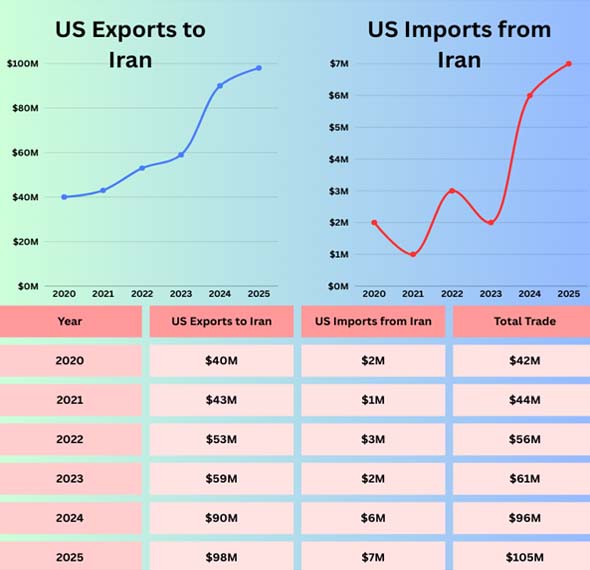
Trade Between the Us and Iran in the Past Five Years
The volume of trade between the US and Iran is still very small compared to trade between other countries. But it has evolved a little because of limited trade and exclusions for humanitarian reasons. As per USA Import Export Trade Data by Import Globals, the U.S. exported Iran around $90 million worth of products and acquired about $6 million worth of goods from Iran in 2024. The U.S. had a trade surplus as a result.
These numbers suggest that the two countries don't trade too much with each other. The U.S., on the other hand, trades with huge partners like China and the European Union for hundreds of billions of dollars every year. Because of this, the US-Iran-Israel conflict has largely economic impacts on the worldwide market, not on trade losses between the two nations directly.
Trade Between Iran and Israel
Iran and Israel do not have any official trade links. Iran and Israel stopped talking to each other after the Iranian Revolution in 1979, when Iran established a strong anti-Israel political stance.
For this reason:
- There are no official trade agreements.
- Can't do business with each other directly.
- There are limits on how much money can be sent between the two countries.
- According to USA Import Data by Import Globals, there is no direct trade between Iran and Israel. They don't do business directly with each other; instead, they do business through third-party countries or global supply chains.
Why the War Still Affects World Trade
Even if Iran and Israel don't trade directly, their war nevertheless has an effect on trade around the world because both countries are vital for shipping lanes and security in the Middle East.
Collapse of Trade During Wartime
Even though the US, Iran, and Israel don't trade much with each other, their dispute has a major effect on the world economy. As per USA Import Trade Analysis by Import Globals, the fundamental reason is that the Middle East is one of the most important areas in the world for shipping and oil trade. The war affects a number of significant worldwide trade networks:
- Oil exports
- Shipping paths
- Insurance markets
- Prices of things
- Chains of supply
For example, military tensions in the area have already made it hard for ships to get through the Strait of Hormuz, which is a crucial conduit for oil exports throughout the world. Because energy is so important for transportation and industry, higher oil prices quickly make trade more expensive around the world. As per Israel Exporter Data by Import Globals, this means that countries that are far away from the war, like Germany, Japan, or Brazil, may have to pay more for transportation and see prices rise.
The US-Iran-Israel War's Most Affected Countries
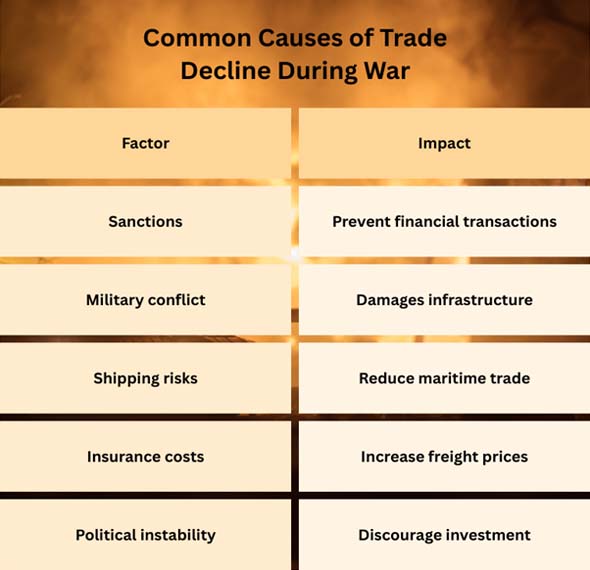
There have always been economic concerns that made trade drop drastically during wars.
During times of conflict, governments set limits on things like:
- Bans on trade
- Sanctions against the economy
- Limitations on shipment
- Export controls
- Restrictions on money
- These stages make it take longer for products and services to cross borders.
As per Iran Importer Data by Import Globals, the continuous conflict between the US, Iran, and Israel has already caused shipping delays, higher oil costs, and higher insurance rates. All of these things make trade between countries less efficient.
Why the Strait of Hormuz is Important for the World Economy
The Strait of Hormuz is one of the most important areas in the world for ships to pass through. It connects the Arabian Sea and the Persian Gulf to the world's shipping network. This little river is where a lot of the world's energy exports go. As per Iran Import Shipment Data by Import Globals, if there is a battle in the Strait of Hormuz, it might become blocked or dangerous, which would have a big impact on the world's oil supplies.
Recent reports claim that there are now fewer ships and more fears about energy shortages because of the increased military activities in the area. Just the idea of closing the strait can make oil prices go up and shipping costs go up all around the world.
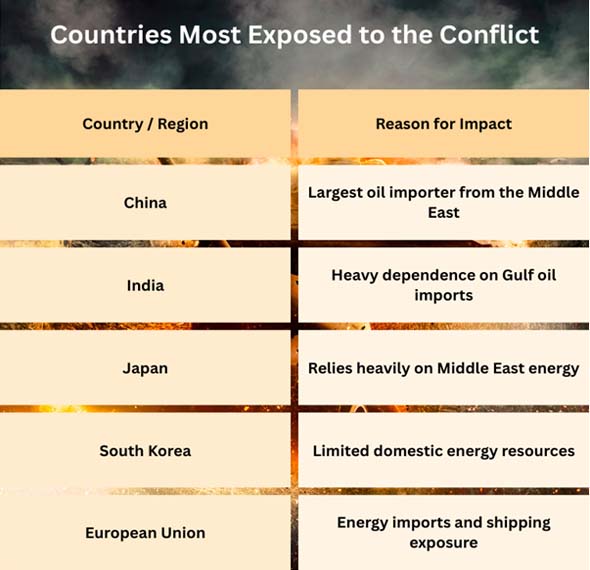
The war doesn't have the same effect on the economy of the whole planet. Countries who derive a lot of their energy from the Middle East are in far more danger.
The US-Iran-Israel War's Most Affected Countries
As per Israel Import Export Trade Analysis by Import Globals, the Middle East is one of the most important areas in the world for trade and the flow of energy. Saudi Arabia, Iran, Iraq, Kuwait, Qatar, and the United Arab Emirates are some of the countries that collectively make up a substantial part of the world's oil and natural gas supply.
There are a number of key marine routes that connect the area to markets throughout the world, such as
- Strait of Hormuz
- The Strait of Bab el-Mandeb
- Shipping lane in the Red Sea
- The Suez Canal
The Strait of Hormuz is the most important one. It is the main means that oil producers in the Gulf transmit crude oil to North America, Europe, and Asia. Any problems in this area have an immediate impact on energy markets all across the world.
So, if the military gets engaged in the area, it might change the whole global trade system, not just the supply of oil. Asia is especially at risk because a lot of its energy originates from the Strait of Hormuz.
Experts argue that issues in the strait might have a huge effect on the energy security of nations like China, India, Japan, and South Korea, who get most of their oil from the Middle East. This is why political turmoil in the Gulf could soon cause increased energy prices, inflation, and slower economic growth around the world.
The Middle East's Strategic Role in World Trade
One of the first things that happened because of the war was that shipping in the Persian Gulf ceased. Recent news says that traffic across the Strait of Hormuz has gone down a lot. Because of safety concerns and military threats, only a few of the usual ships are passing through.
This huge decline in traffic indicates how badly global maritime trade has been affected. Tankers carrying oil, LNG, and other supplies are being delayed or forced to wait offshore because of safety concerns. As per Iran Export Import Global Trade Data by Import Globals, Shipping companies are also sending ships on longer routes, such the Cape of Good Hope. This makes the trips take longer and require more fuel.
Less Shipping Traffic in the Gulf
As per USA Import Export Global Data by Import Globals, World politics may make energy markets more unstable, especially when there is a war in an area that supplies a lot of the world's oil.
The US-Iran-Israel conflict has made people anxious about supply concerns, which has prompted oil prices to go up. Experts predict that more violence could cause the price of crude oil to rise a lot.
If tensions stay high, the price of Brent crude might rise to $120 per barrel or more, according to recent market forecasts. The geopolitical risk premium in global energy markets is larger, which is why this is happening.
These rising oil prices have a number of effects on the economy:
- Airlines and transportation companies have to pay extra for petrol.
- More inflation in economies that buy energy.
- Shipping goods around the world is getting more expensive.
- A 20–30% rise in oil costs can slow down the growth of the world economy by as much as 1%. This illustrates that disruptions in the energy sector can have a large effect on the economy as a whole.
Fluctuations in Oil Prices and Shocks in the Energy Market
The battle has caused oil prices to rise, as well as the costs of shipping and insurance. Maritime insurance firms group war-risk areas into groups depending on how likely it is that ships may be attacked by missiles or stopped by naval forces. As per Israel Import Data by Import Globals, insurance companies have added new high-risk locations as tensions grow in the Gulf.
This is Why:
- The cost of war-risk insurance has gone up a lot.
- Shipping oil now costs a lot more.
- Some shipping companies no longer do business in the area.
- For example, charter rates for Very Large Crude Carriers (VLCCs) sailing to Asia have gone up a lot because there aren't as many ships and the risks are higher.
Costs of Shipping and Insurance Are Going Up
Modern global trade needs shipping networks that are swift and reliable. When war blocks vital trade routes, it has an effect on supply chains in a lot of different areas. Based on Iran Export Data by Import Globals, the violence has also slowed down the delivery of industrial goods and those that have already been made. For example, exporters in a number of countries have complained that shipments have been held near war zones because they are worried about safety. This indicates that issues in the global supply chain can happen even to enterprises that are far removed from the crisis location.
Problems in The Global Trade Supply Chain
Countries that get their energy from other countries are more likely to have problems with oil supplies from the Middle East. These economies rely heavily on oil supply from Gulf suppliers that are reliable. They have to find other suppliers if there is an issue, which normally costs more. For example, during the crisis, governments have tried to stabilize energy markets by giving consumers temporary waivers that let them buy more oil from other sources.
Impact on Major Importing Countries
According to USA Import Export Trade Data by Import Globals, Shipping companies have begun to use alternate routes to carry products since the risks in the Persian Gulf are rising. The Red Sea corridor is a key link between Europe and the Middle East via the Suez Canal.
But this route is also not safe because of attacks on commercial ships and rising tensions between countries in the area. This is why some companies are using the Cape of Good Hope route, which passes around the Red Sea and the Persian Gulf.
These new channels keep trade moving, but they raise the cost of shipping and the time it takes to get goods to their destination.
Global Economic Consequences
The US-Iran-Israel issue has effects on the economy that go beyond the energy markets. There are already certain macroeconomic impacts that are starting to show up:
- Prices for energy and transportation are increasing higher, which is causing inflation to increase up.
- Countries that buy energy from other countries are growing more slowly.
- Financial markets are more unstable
- Issues with the supply chain in several areas
The war has had a tremendous impact on the stock markets. As investors change their minds about how fast the world economy will grow and how high prices will go, stock markets have fallen and energy costs have risen.
If the war goes on for a long time, oil prices could increase above $150 per barrel, which would be very harmful for the stability of the global economy.
Long-Term Effects on Global Trade Patterns
The fight has immediate implications that are bad, but it might also affect how trade operates around the world in the long run. Countries and businesses are likely to try a number of things to decrease geopolitical risks:
- Getting power from more than one place
- Adding to the reserves of strategic oil
- Putting more money into renewable energy
- Making new trade routes
- Making the supply chain stronger
Based on USA Import Custom Data by Import Globals, many countries are already investing in energy diversification and supply chain security to make themselves less dependent on trade routes that are simple to attack.
This might speed up greater changes in the world economy, such the emergence of regional trade blocs and the restructuring of international supply chains.
Conclusion
The fight between the US, Iran, and Israel has created one of the largest shocks to global trade and energy markets in a long time. The war has fouled up shipping routes, risen the price of oil, caused shipping costs go up, and made the world's supply systems less reliable.
The Strait of Hormuz is at the center of the problem. It is a major energy corridor that carries a lot of the world's oil. Businesses and economies all across the world are feeling the effects of rising tensions in this sector.
Geopolitical stability is vitally important for the world economy. greater gasoline prices, greater transportation costs, and trade flows that aren't working right are some examples of this. If the fighting continues, the economy could get worse, with prices going up, growth slowing down, and financial markets becoming less stable.
The crisis highlights how crucial it is to have stronger international cooperation, more stable global supply networks, and more varied energy systems to decrease the economic effects of conflicts between countries. Import Globals is a leading data provider of USA Import Export Trade Data.
FAQs
Que. What does the Strait of Hormuz mean for trade between countries?
Ans. About 20% of the world's oil supply passes through the Strait of Hormuz every day, making it a particularly vital maritime chokepoint for trade and energy markets.
Que. How has the conflict between the US, Iran, and Israel affected the price of oil?
Ans. The turmoil has made it harder for businesses to work in the Middle East, which has pushed oil prices beyond $90 per barrel. If the problems keep happening, experts estimate prices might rise to $120 to $150.
Que. Why is the war making shipping costs go up?
Ans. Shipping costs are growing up because ships have to pay more for war-risk insurance, conduct longer trips, and deal with increased security issues in critical shipping lanes.
Que. Which countries are most hurt by the war?
Ans. Some of the biggest economies that buy energy are China, India, Japan, and South Korea. They are severely disadvantaged because they get oil from the Middle East.
Que. Where to get detailed USA Import Data or Iran Export Data?
Ans. Visit www.importglobals.com.