
How War Is Affecting Import–Export Trade in 2026
- Oct 28, 2026
- 124 Views
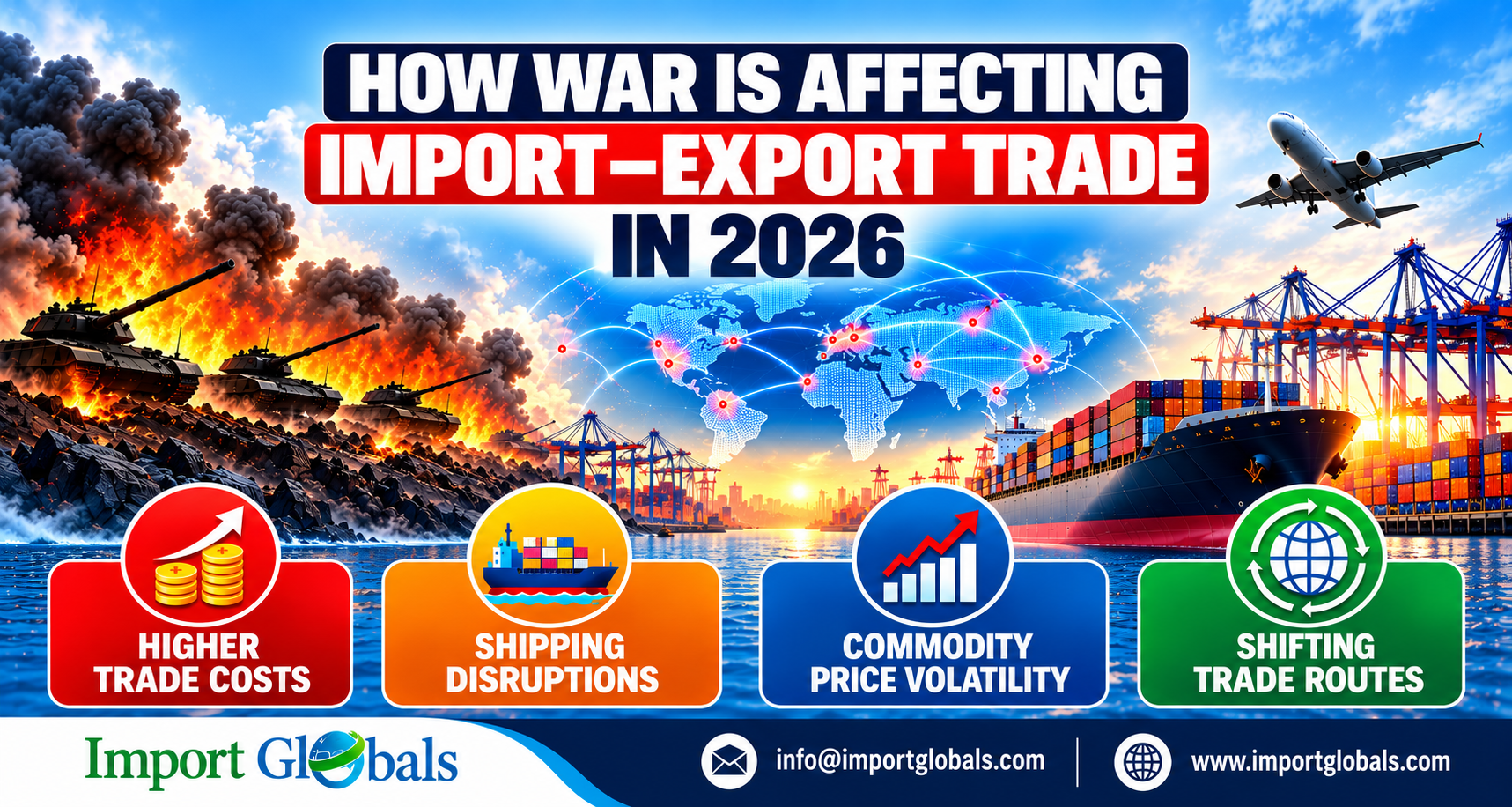
How War Is Affecting Import–Export Trade in 2026
In 2026 international trade will encounter substantial challenges, due to disruptions in shipping routes, energy supplies, commodity markets and international supply chains caused by geopolitical conflicts. Wars are no longer contained to the countries involved. Their consequences are spilling over continents, affecting the cost of imported raw materials, the availability of manufactured goods, the prospects for exports and the delivery schedules of international shipments.
The conflict in the Middle East has put great strain on the Strait of Hormuz, one of the world’s key energy transit chokepoints. Meanwhile, security threats in the Red Sea continue to play a role in shipping decisions between Asia and Europe, while the Russia-Ukraine war presents ongoing risks to Black Sea shipping and agricultural exports. The overlapping disruptions are a reminder of the vulnerability of global trade when several key transport corridors are put under pressure at the same time.
October 2026 outlook projects that the volume of global merchandise trade will expand by 3.9% in 2026, up from its March forecast of 1.9%. This more positive view is less about the fading of geopolitical risks and more about resilience in global supply chains and demand for certain goods. Also sees weaker prospects for trade in commercial services, partly because of disruption to transport and travel.
For importers, exporters, manufacturers and logistics companies, understanding these developments has become a necessity. Companies have to look for other suppliers, watch volatile freight costs, search for possible export markets and understand how conflicts can impact specific goods.
It allows companies to identify global shipping trends, find potential trading partners and understand changes in global sourcing. Reliable data helps companies make good business decisions in a more uncertain trading environment.
Crisis in the Strait of Hormuz: Disruptions in Energy Supplies and Its Impact on World Trade
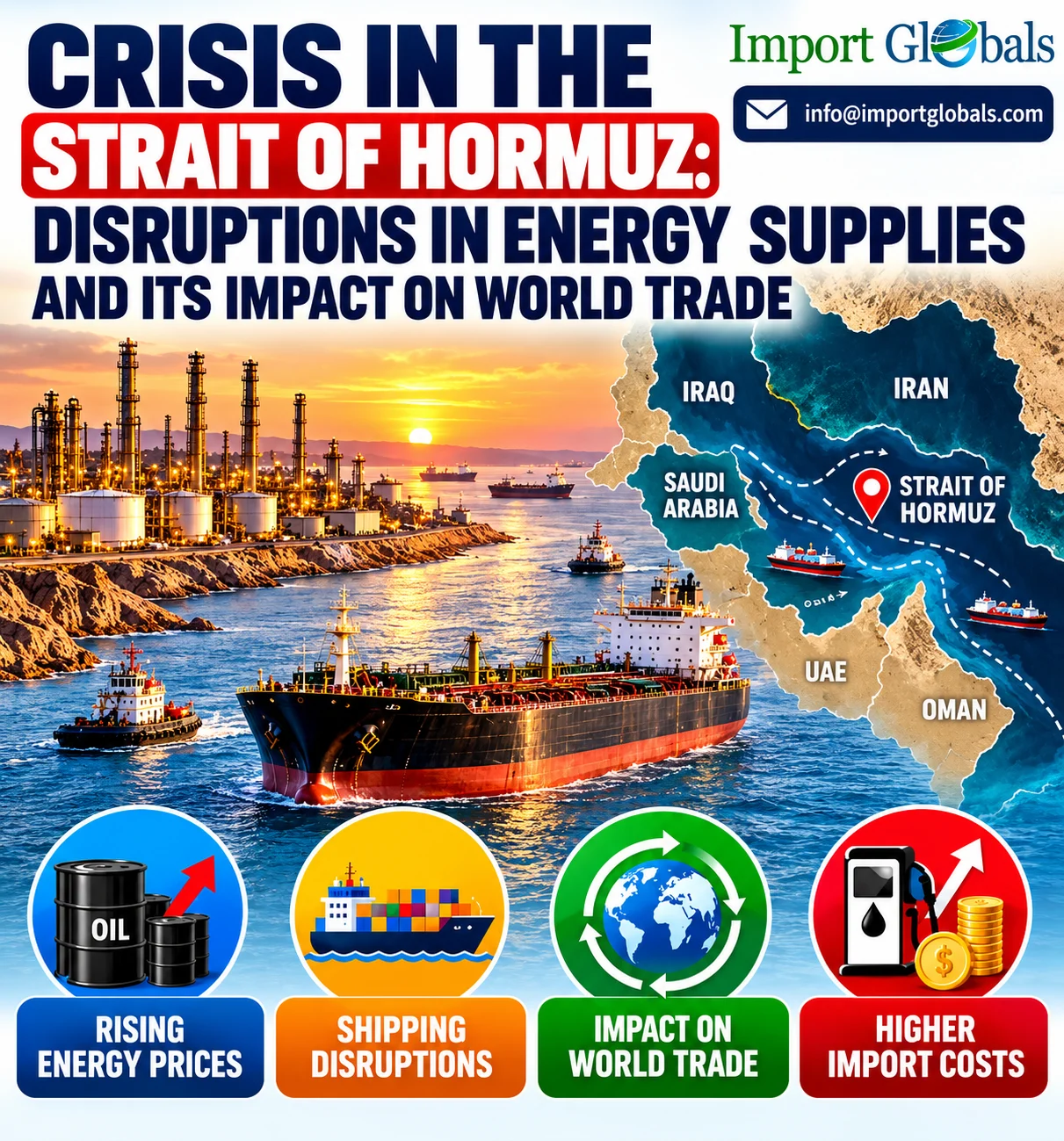
The Strait of Hormuz is a very important sea way connecting the Persian Gulf with the world’s oceans. It carries large volumes of crude oil, petroleum products and other energy related cargoes. Any disruption to this corridor can have an impact on international trade far beyond the energy sector. Fuel is a significant input to manufacturing, transportation, electricity generation and agricultural production.
The passage through the Strait has become less certain for shipping companies, energy traders and fuel-reliant businesses in 2026 because of the conflict. The crisis has affected thousands of seafarers and attacks on international shipping have raised serious concerns over the movement of fuels, fertilizers and other commodities, the International Maritime Organization said in August.
All Industries are impacted. Higher energy prices could lead to higher production costs for manufacturers. Carriers may charge extra fuel and security surcharges. Importers may pay more for petroleum-based chemicals, plastic materials, synthetic fibers and other energy-intensive products.
More emphasis on the trade balances of energy-importing countries. Import bills are getting costlier in foreign exchange terms for governments and private firms. Imports priced in dollars can also be more expensive locally, because of currency movements.
Exporters are affected, too. Higher fuel and transport costs can put severe pressure on the margins of companies selling low margin products in competitive international markets. Buyers could delay orders or demand lower prices. Some customers may wish to have suppliers closer to their markets.
Global Trade Statistics helps companies identify the country of origin for specific energy products, review historical import values and compare the concentration of sourcing across markets. You can also get another layer of analysis from the Global Import Export Shipments Data. “Businesses can look at where shipments are coming from, where shipments are going, and how trading relationships could change.
You can use Import Globals to explore international shipping patterns and potential supplier markets. However, businesses should use shipment intelligence alongside existing carrier advisories, official market information and professional risk assessments when making purchasing decisions.
Red Sea and Suez Canal Disruptions: Rising Shipping Costs and Longer Routes
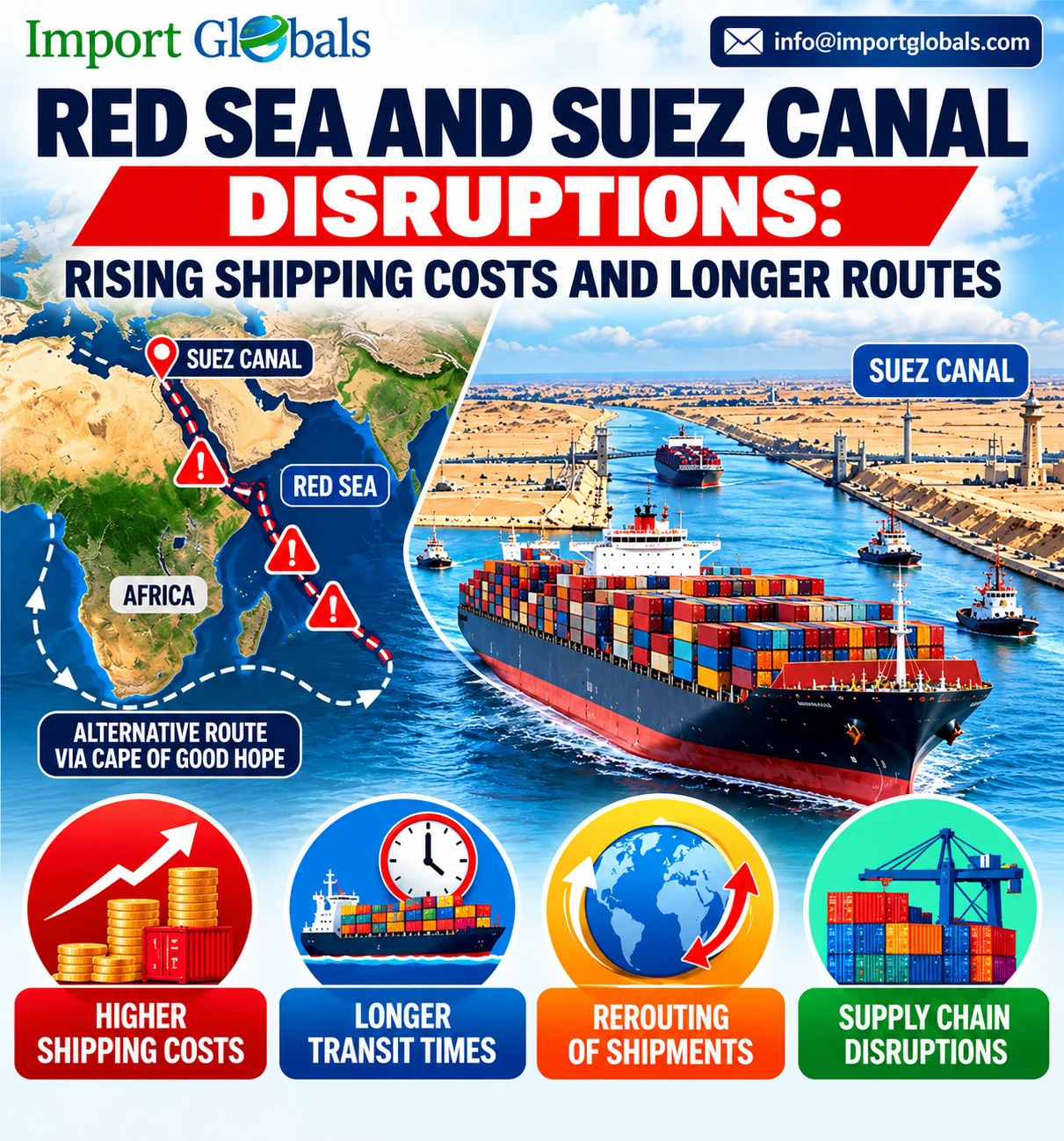
Security threats are increasing in the Red Sea and the Bab el-Mandeb Strait and some shipping companies are considering rerouting vessels around the Cape of Good Hope. This alternative route may increase the sailing distance, fuel consumption and transit time. It can impact vessel schedules, container availability and interconnections between shipping services.
Uncertainty and rising costs were caused by major maritime route disruptions, the World Food Program said in October 2026. Delivery times had increased by 30-50 days on some routes affected by Red Sea disruptions and rerouting, it said. Delays may vary depending on service, origin, destination and conditions.
Longer transit times can present big problems for companies that operate with just-in-time inventory. The electronics maker’s production may be delayed and imports of components are on hold. A clothing store may have seasonal merchandise after the peak season. The exporter may be late in a delivery and suffer contractual penalties or damage to customer relations.
Inventory costs can also be increased by shipping problems. Companies may have to order earlier, hold more safety stock or pay higher air freight costs for urgent shipments. These measures may offer the promise of continuity, but they may also tie up cash which could otherwise be used to support business expansion.
A business can’t expect every shipment to go the same way, or suffer the same delay. Transit times are subject to the carrier's discretion, congestion at ports, transshipment arrangments, security conditions and vessel availability.
Globals Import Export Trade Statistics helps companies to understand how goods move from origin to destination and how reliant they are on specific sourcing regions. Global Import Export Trade Data also can help the researchers to compare the markets and find the alternative supplier countries which are worth to be investigated.
Globals Imports can help businesses in this research process by assisting them to explore international shipment information and market opportunities. For operational decisions, companies should check current routes, sailing schedules, insurance conditions and freight quotations directly with the respective logistics providers.
Russia–Ukraine War: Effects on Grain, Fertilizers and Agricultural Exports
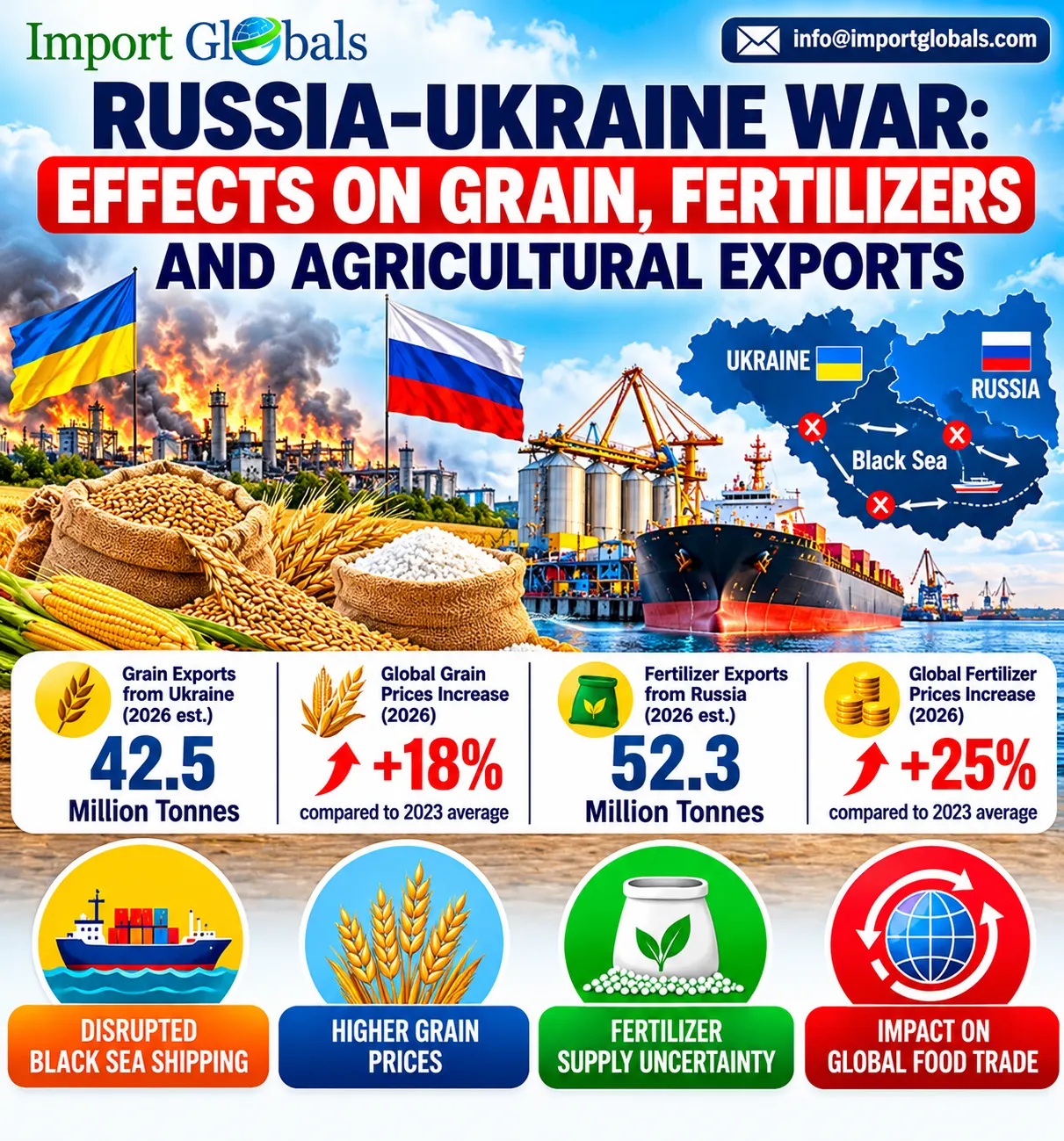
The Russia-Ukraine conflict has had a significant impact on global agricultural trade, affecting grain shipments, fertilizer supplies and export routes. “Russia and Ukraine are large exporters of wheat, corn, sunflower oil and other agricultural products. Infrastructure damage associated with the conflict, port restrictions, shipping risks and trade sanctions have made international markets uncertain.
1. Global Food Security and Grain Exports
Wheat and corn are among the agricultural products which have been most affected by the conflict. Sanctions, payment difficulties and logistical problems have disrupted Ukraine’s Black Sea ports and disrupted Russia’s export flows. Those pressures have contributed to greater volatility in international grain and shipping prices. Countries that rely on Black Sea supplies have had to look for other sources, buy from other exporters or build bigger food reserves. Wheat and corn are major food and feed commodities and changes in the price of the grains are of particular concern for importers in parts of Africa, the Middle East and Asia.
2. Increasing Costs of Farming and Fertilizer Supply
Russia is a major global producer of fertilizer and fertilizer inputs like nitrogen-based products and potash-related products. Supply chains have been hit by trade restrictions linked to the war, higher energy costs, transport disruptions and payment difficulties. The cost of fertilizers has an impact on the farmer’s production decisions, the yields of crops and profit. As fertilizer becomes more expensive or unavailable, some farmers may reduce application rates or switch crops, potentially affecting global food production and future export capacity.
3. Sunflower Oil and other Agricultural Products
The big players are Ukraine and Russia, the sunflower oil market. Harvesting, processing, port operations and disruptions to maritime transport can affect export availability. Buyers could turn to alternative supplies such as soybean, palm or rapeseed oil. Such a substitution could feed price pressures in the wider edible oil market.
4. Trade Diversification and Market Intelligence
Importers and exporters must monitor changing trade routes, supplier availability, freight costs, customs requirements and international restrictions. Global Import Export Data, Global Import Export Shipments Data, Global Trade Data and Global Trade Statistics helps businesses to find out alternative suppliers, evaluate market demand, analyze trade flows and mitigate procurement risks.
5 Outlook for Agricultural Trade
The long term outlook depends on the security situation, on the export infrastructure, access to shipping, energy prices and fertilizer availability. Trusted trade intelligence and diversified sourcing will continue to be essential for building resilient agricultural supply chains and ensuring food security.
Rising Freight Rates, Insurance Premiums and Import Costs
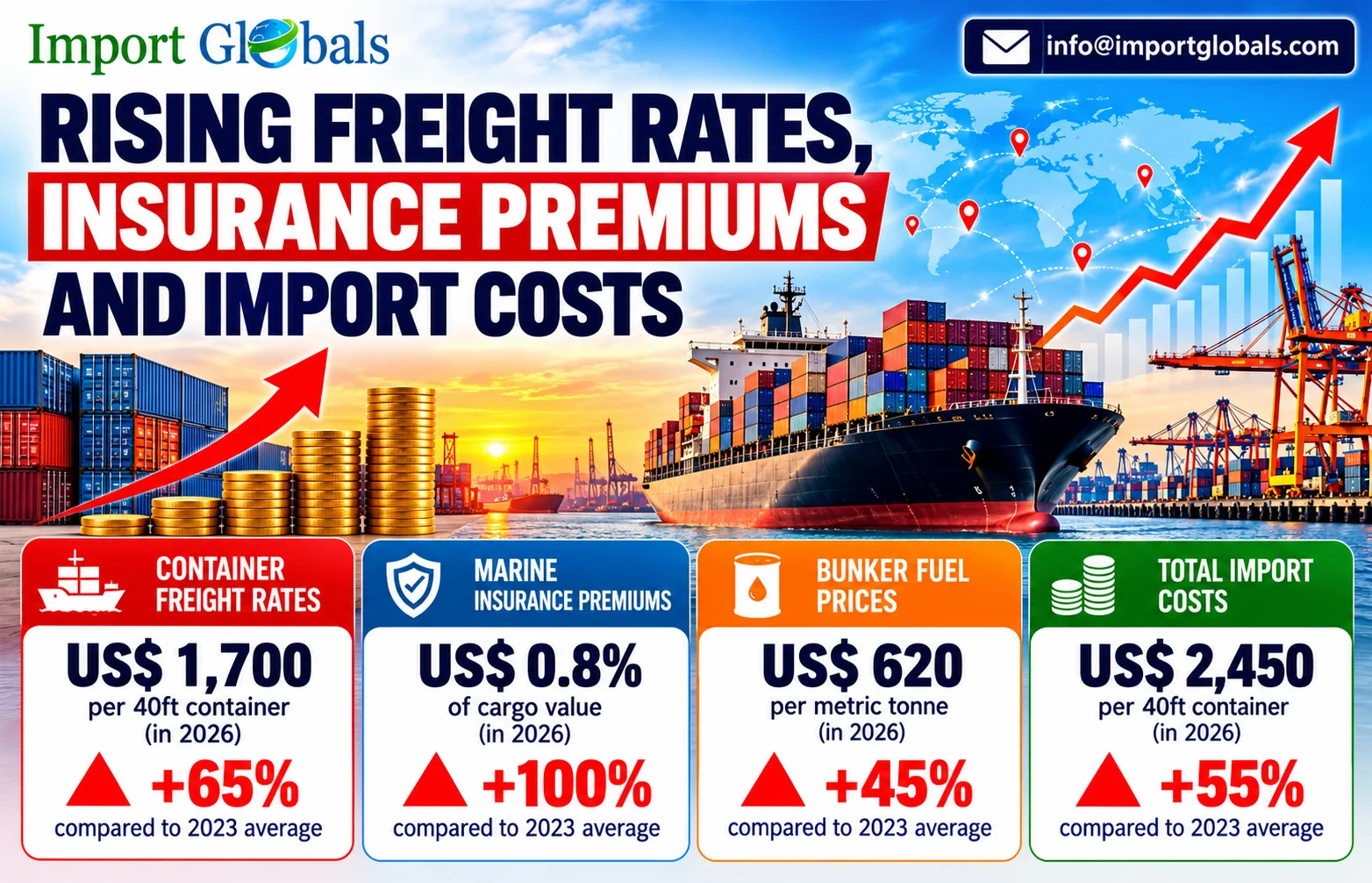
2026 will see shipping costs be a massive problem for people buying and selling goods all over the world. Rising fuel costs, changes to insurance terms and issues with key sea routes can all add to the cost of moving goods between international markets. 4 main cost drivers are laid out in the infographic. Higher logistics costs are bad for world trade.
1. Container Freight Rates Climb 65% to US$1,700
Container freight rate: $1,700, an increase of 65% from the base rate. Other factors driving up freight rates are longer journeys, a shortage of ships, congestion at ports, fluctuating fuel prices and security surcharges. Importers are facing higher landed costs and when transportation prices increase it can put the squeeze on exporters’ margins. Businesses should also shop for quotes from carriers to save money and look at other routes.
2. Marine Insurance 0.8% of Value of Goods Plus 100%
The marine insurance rates are 0.8% of the cargo value, which is 100% more than the base rate shown in the infographic. If shipping lanes affected by conflict present security risks, insurers could review the risk of voyages or alter policy terms or premiums. Traders should check the insurance coverage, exclusions and deductibles and war-risk provisions before shipping valuable goods.
3. Bunker Fuel is $620 a Metric Ton up 45 Percent
The bunker fuel price, at US$620/metric ton, is 45% higher than the baseline. “The most expensive thing for a shipping company to run is its fuel. Higher fuel prices and longer detours will add to the cost of running ships, which could mean higher prices for imports and the introduction of freight surcharges. Businesses need to be aware of carrier notices and these should be included in their budgets.
4. Total Cost to Import: $2,450 Per 40-Foot Container (up 55 Per cent)
The infographic shows that the total cost for a 40-foot container is US$2,450, which is 55% higher than the base rate. Freight, insurance, fuel and handling costs can increase, harming working capital and reducing competitiveness of a business. Importers must be in a position to calculate the landed costs of the goods they wish to buy correctly before placing an order.
Sanctions and Export Controls: New Compliance Challenges for Traders
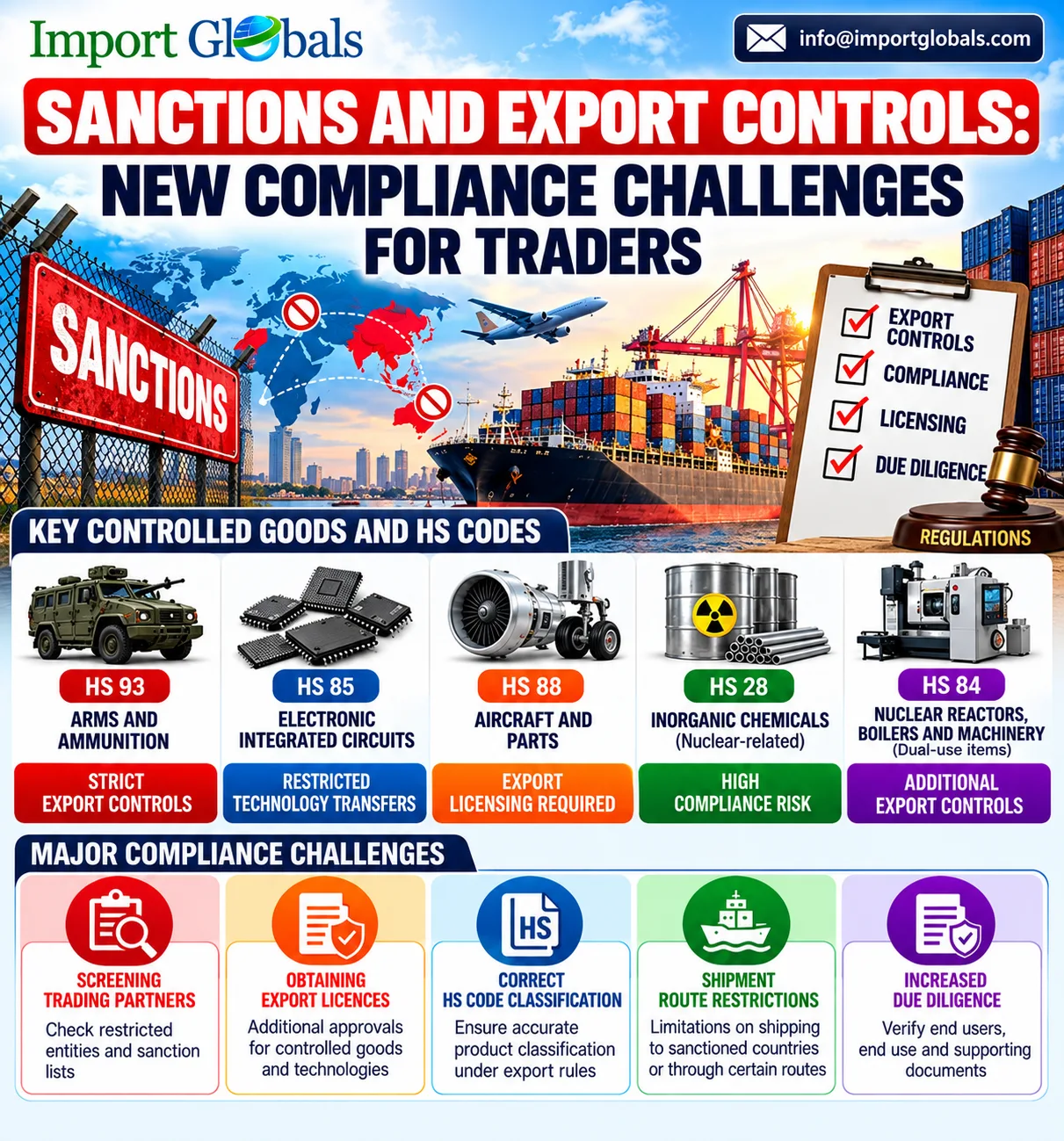
Geopolitical tensions, economic sanctions, and export control regulations are reshaping global supply chains, creating more compliance challenges for international trade in 2026. Importers, exporters, manufacturers and logistics providers have to understand their trading partners, product classifications, shipment destinations and licensing requirements. Companies also need to check certain export control classifications and sanctions lists, because an HS code alone won’t tell you if you can legally ship the product. The products traded are classified according to the Harmonized System (HS) codes.
1. Arms and Ammunition – HS Code 93
HS Code 93 covers firearms, ammunition and some military equipment. These products may be subject to national export control and licensing requirements and restrictions on certain end users or end uses. Traders must check product specifications, required authorizations and buyers’ legal status before shipping internationally.
2. Electrical Machinery And Electronics - HS Code 85
Electrical machinery and equipment and parts thereof Certain high-end electronics, semiconductors and specialized technology may be controlled if they have military, surveillance or other restricted applications. Businesses will need to verify technical specifications, destination regulations and licensing requirements and end-use declarations.”
3. Aircraft, Spacecraft and Parts Thereof - HS Code 88
HS Code 88 comprises aircraft, spacecraft and parts thereof. Some components and technologies may be subject to export controls for strategic reasons, and especially if they are intended for military or other restricted users. Exporters must know the classification requirements and have obtained the required approvals before exporting the controlled items.
4. Chemicals - HS Code 28
HS Code 28 includes inorganic chemicals and related products. Chemicals that might be used in regulated industrial processes or in prohibited uses may need to be looked at more closely. Traders have to verify the precise chemical identity, concentration, purpose, destination and any restrictions.
5. Machinery and Mechanical Appliances - HS Code 84
Machinery, mechanical appliances, computers and industrial equipment. Specialized equipment may be controlled where it can contribute to military or strategic capabilities. Good technical documentation and screening of end users can help companies identify potential compliance issues.
6. Compliance in Real Life
Customer and intermediary screening, HS classification checks, sanctions lists, accurate shipment documentation and monitoring of regulatory changes They also should check licensing requirements before taking orders or shipping goods. These are called HS codes. Then there are legal control lists which restrict even more.
How Import Globals Supports Trade Research
Import Globals provides companies with import-export shipment intelligence and trade research tools that help them identify international trading patterns and potential supplier markets. “Data on shipments should supplement, not replace, official sanctions screening and other legal compliance checks.
Industries Most Affected by War-Related Trade Disruptions
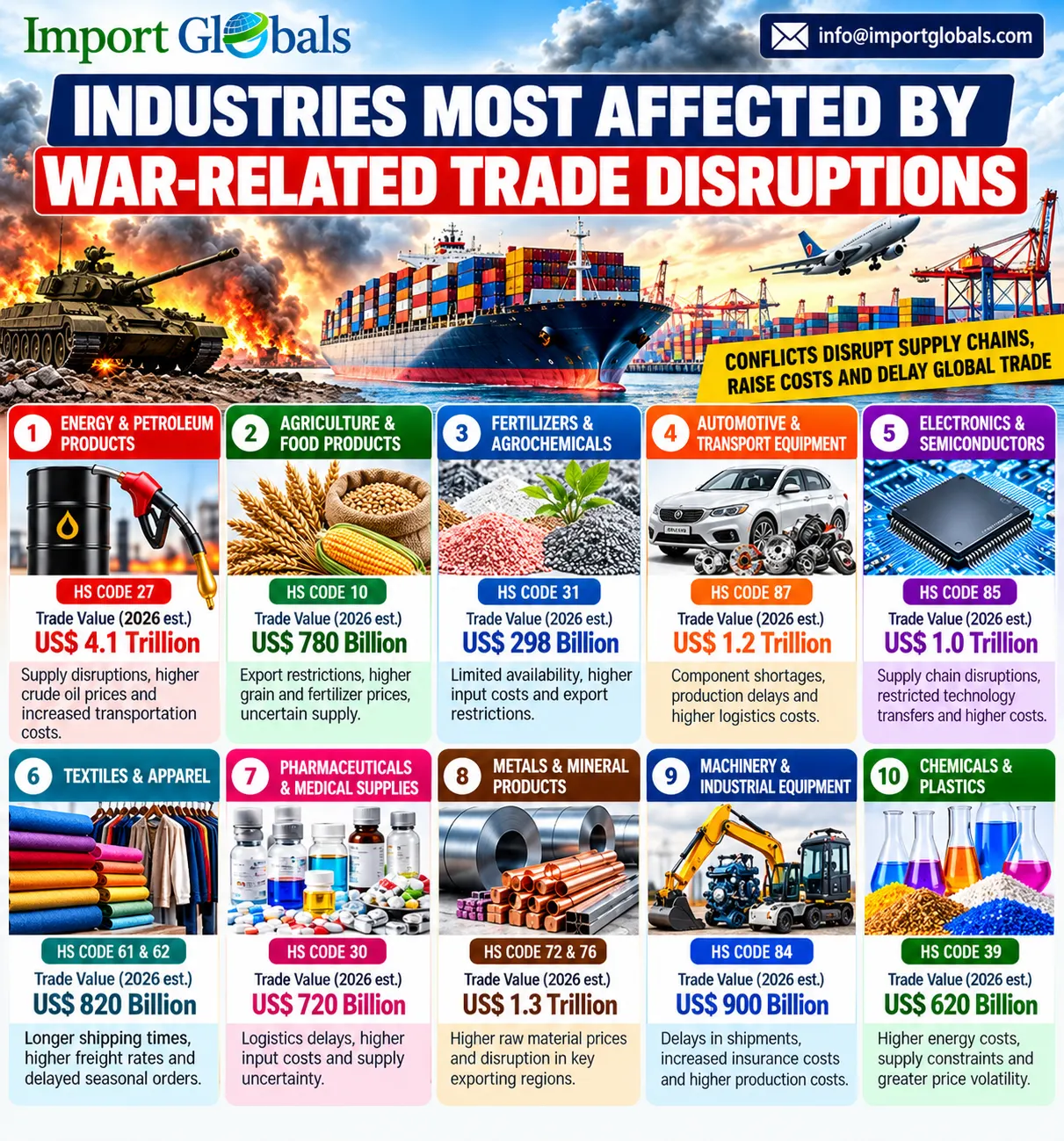
The war has disrupted international trade and will affect shipping routes, commodity prices, the availability of suppliers and delivery times by 2026. The challenges are impacting different industries in different ways depending on their dependence on energy, raw materials, transport networks and global suppliers. Accurate Harmonized System (HS) codes allow importers and exporters to keep track of trade flows by product and gage market exposure.
1. Mineral Fuels, Oils and Products of their Distillation - HS Code 27
Mineral Fuels, Mineral Oils and Products of HS Chapter 27 are highly vulnerable to disruptions around strategic maritime routes and geo-political conflicts. Energy flow restrictions can increase the costs of fuel, freight and manufacturing. Importers will need to watch their energy suppliers, international prices and alternative sourcing markets closely to reduce uncertainty in supply.
2. Cereals & Agri Products - HS Code 10
Wheat, rice and corn are all products that are included in Chapter 10 of the Harmonized System. Fighting in the countryside could cut off ports and transport links, slowing exports and driving up the cost of food imports. Companies will have to look for other suppliers, watch crop availability, export bans and changes in global demand.
3. Fertilizers — HS Code 31
HS Chapter 31 Fertilizers Important factors in agricultural production. Shipping disruptions, higher energy prices and tight fertilizer supplies are all factors that could contribute to the cost of farming and impact crop production in coming years. Importers can control their risk by diversifying their suppliers across countries and by considering their seasonal purchasing requirements.
4. Electrical Machinery and Equipment and Parts thereof - HS Code 85
HS Chapter 85 Electrical machinery and equipment and parts thereof; Production may be delayed if manufacturers do not get imported parts to their plants in time. Electronics companies should consider supplier concentration, shipping routes and alternative sources.
5. Vehicles And Parts Of Vehicles - HS Code 87
Rising transportation costs and delays in sourcing key parts could impact vehicle assembly and shipments abroad. “It’s good for the car industry to have backup suppliers, visibility on shipments.
6. Pharmaceuticals and Medical Products – HS Code 30
Medicinal substances Chapter 30 of the Harmonized System 8. They need to be safely transported and responsibly regulated. Conflict related problems may lead to delays and affect the availability of medicines and medical supplies, especially those needing special handling.
7. Iron and Steel - HS Code 72
Construction material, infrastructure help. Higher energy costs, freight and broken supply lines for raw materials could cause delays or stoppages on industrial projects.
How Global Import Export Data Helps Businesses Navigate Uncertainty
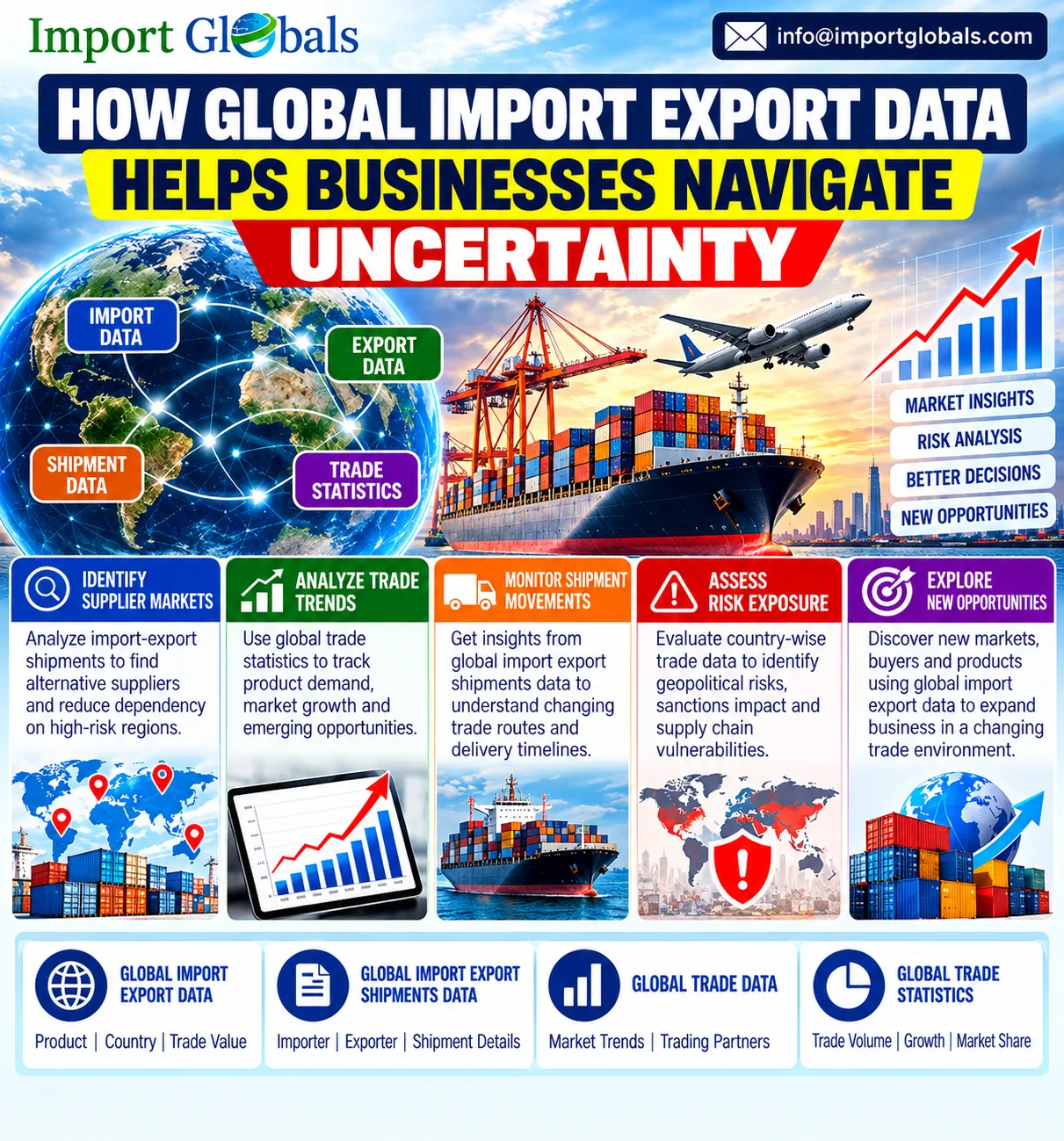
In a volatile trading environment, businesses need more than just breaking news. They want information to help them understand how geopolitical events connect to actual import-export activity. You can use Global Import Export Data to find out product categories, supplier countries, destination markets and historical trade values. This research can help companies to identify concentration risks, assess the significance of individual markets and develop a short list of alternative sourcing locations.
Import Export Shipments Worldwide Depending on countries, sources of data and fields, data may provide information at shipment level. These records are available for businesses to research exporters, importers, product descriptions, where shipments originated and where they were destined, and other transaction details. Coverage varies by jurisdiction. Some shipment information may be restricted, delayed or unavailable.
Global Trade Data gives a wider base for analyzing international trade. It can help researchers to understand the flow of goods between countries, to compare import and export trends, and to study how trading relationships have changed over time.
Global Trade Statistics are particularly useful for comparing the size, growth rates, trade balances and relative importance of supplier countries. If used wisely they can help companies identify potential opportunities and determine which markets deserve deeper investigation.
For example, an importer experiencing delays in one sourcing region could look at trade flows from other countries to find potential suppliers and compare historical trade activity. The company would then have to verify production capacity, product quality, certifications, pricing and delivery terms before deciding on the source.
Similarly, an exporter who experiences weak demand in one market could conduct trade research to identify markets where demand for its product seems to be stronger. It doesn’t guaranty sales but gives you a more structured basis from which to develop the market.
Businesses looking for import-export shipment information and international trade opportunities can investigate Import Globals, a service provider. It assists companies in analyzing trade patterns and potential trade links. It aids in market intelligence and shipment research. The best results are obtained by combining trade data with current market news, official statistics, logistics information, regulatory checks and direct supplier verification.
Practical Strategies for Importers and Exporters in 2026
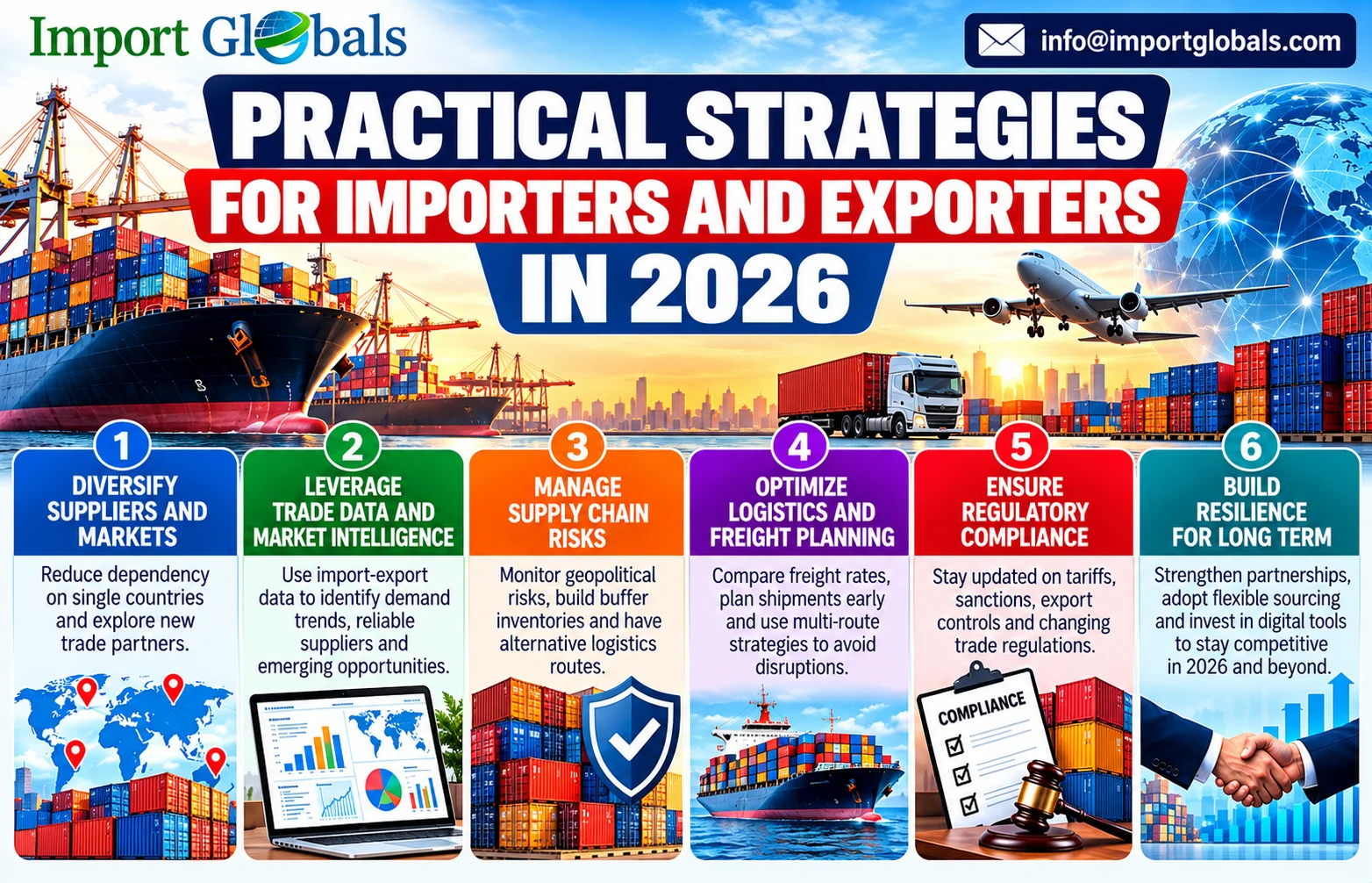
It will be a year of challenges and opportunities and international trade will be one of the major drivers for companies in 2026. So companies are getting more careful. And that’s because of increasing logistics costs, changing trade rules, geopolitical tensions, changing tariffs and supply-chain breakdowns. The 2026 Practical Strategies for Importers and Exporters infographic outlines 6 key strategies that can help improve efficiency, mitigate risk and build resilient global supply chains.
1. Broaden the Supplier and Market Base
Firms reliant on a single source or country are vulnerable to unexpected supply chain disruptions. Importers need to find new sources of supply, evaluate the capabilities of potential suppliers and develop relationships with reliable trading partners. Exporters can open new markets by exporting to new countries and attracting new international buyers. Diversity is a way to deal with different trading conditions.
2. Leverage Trade Data & Market Intelligence
Good trade information can reveal a business’ market demand, assess its competitors and identify potential business opportunities. Global Export Import Data and Global Trade Statistics “This can help these companies assess supplier countries, product flows, trading partners and emerging market trends.” Import Globals offers companies trade research and shipment intelligence tools to explore international trade opportunities.
3. Managing Risks in the Supply Chain
“Companies need to take into account geopolitics, the reliability of suppliers, congestion at ports, commodity prices and the risk of transport disruption. Develop contingency plans, identify alternative sources of supply and maintain adequate safety stocks of critical products to minimize operational disruptions. If companies are warned of risks in advance they can make alternative arrangements for sourcing and delivery.
4. Better Freight and Logistics Planning
Profitability and competitiveness are directly affected by transport costs. Importers and exporters alike must take the time to study freight quotes in detail, examine different shipping routes, keep an eye on shipments and plan deliveries. Working with freight forwarders and logistics partners means better visibility, less unnecessary delays and better delivery commitments.
5. Know the Rules Global Traders
Need to be aware of customs procedures, tariffs, sanctions, export controls, product standards and documentation requirements. “Having the right shipment documentation and HS code classification can help companies avoid customs delays and compliance issues. If you are trading controlled products or entering new markets you will need to take into account the relevant regulations.
6. Build Endurance For The Long Haul
Sustainable international trade needs flexible purchasing strategies, good supplier relations, online information sources and ongoing market research. Global conditions change and so do competition, customer demand and trading partnerships. Companies therefore need to keep looking at their costs.
Future Outlook: Building Resilient Global Trade with Import Globals
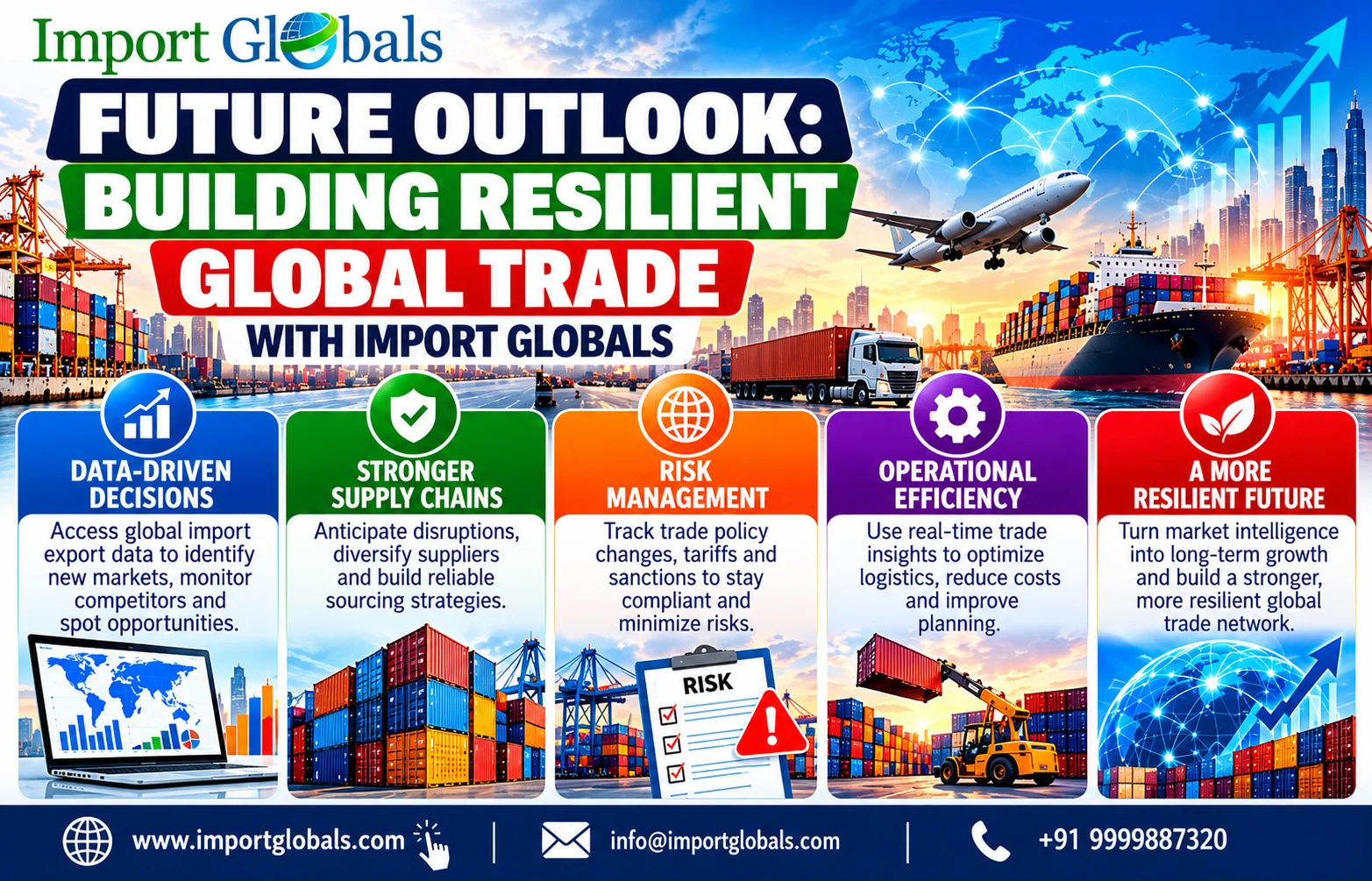
The future of international trade will hinge on companies’ ability to adapt to geopolitical uncertainty, changing market conditions, supply chain disruptions and evolving trade regulations. The Import Globals infographic reveals five ways importers and exporters can grow their business, find opportunities and remain competitive in 2026 and beyond.
1. Data-Driven Decision Making
World import and export data helps companies look at patterns in the international market, look at their competitors, find potential customers and discover new opportunities. Companies may evaluate product demand, trade values, supplier countries, and shipment movements to make data-driven decisions about sourcing and market expansion. “Good trade intelligence takes the guesswork out of your future planning.
2. Supply Chains of Tomorrow
Dispute Trade policy and shipping delays are reshaping the currents of global commerce as … Supply chain resilience is becoming more significant. To build more resilient supply chains, companies will need to diversify their supplier base, explore new sourcing markets and build strong relationships with their trading partners. “The more suppliers you have, the more contingency plans you have, the less dependent you are on one country or one mode of transport.
3. Management of Risks
International traders also must take into account geopolitical events, tariffs, sanctions, export controls and other regulatory changes. Early identification of potential risks allows businesses to develop contingency plans, review contracts and protect their commercial interests. Trade intelligence can also be used by exporters and importers to analyze the concentration of suppliers, and to determine how vulnerable they are to certain markets.
4. Effectivness of Operation
By planning logistics intelligently, companies can keep transportation costs under control, avoid delays and improve their delivery performance. Monitor shipment status, compare freight quotes, evaluate alternative shipping routes, and ensure adequate inventory levels to improve operational efficiency. Logistics planning companies have access to up-to-date market information and are better able to handle unforeseen interruptions.
5. Building A more Resilient Future
Flexibility, continuous market research and good international partnerships are the basis of long term success. Monitor sourcing strategies. Follow customer demand. Use online resources. Investigate new export markets. These tools will help companies stay on track and to continue to grow as conditions change.
Conclusion
“Trusted trade intelligence, combined with flexible sourcing and resilient logistics planning will help companies to be better prepared for disruptions and protect their long-term competitiveness.”
Import Globals provides import-export data and shipment intelligence to companies to help them enter international markets. It helps companies find potential trading partners, analyze market trends and improve their trade research strategies. “Trusted trade intelligence, combined with flexible sourcing and solid logistics planning can help companies be better prepared for disruption and protect their long term competitiveness.”
CTA
Are geopolitical conflicts, rising freight rates, shipping delays, and fluctuating commodity prices affecting your business in 2026? Strengthen your international trade strategy with reliable insights from Import Globals. Subscribe at www.importglobals.com or drop an email at info@importglobals.com for detailed updates on How War Is Affecting Import–Export Trade in 2026.
FAQs
Que. How is war affecting global import-export trade in 2026?
Ans. War disrupts shipping routes, increases transportation costs, and creates uncertainty in international supply chains.
Que. Which industries are most affected by war-related trade disruptions?
Ans. Energy, agriculture, fertilizers, automotive, electronics, pharmaceuticals, and metals are among the affected industries.
Que. Why does war increase international shipping costs?
Ans. Longer shipping routes, higher fuel prices, rising insurance premiums, and security risks increase transportation expenses.
Que. How does Global Import Export Data help businesses manage trade risks?
Ans. It helps businesses identify alternative suppliers, analyze trade trends, monitor shipments, and explore new markets.
Que. How can Import Globals support businesses during global trade disruptions?
Ans. Import Globals provides trade data and shipment intelligence to support market research and informed international business decisions.
Que. How frequently is the Global Import Export Trade Data updated?
Ans. Global Import Export Trade Data is updated on a monthly basis.
Que. Where can you obtain detailed information on Global Import Export Trade Data?
Ans. Visit www.importglobals.com or drop an email at info@importglobals.com for detailed updates on Global Import Export Trade Data.
You Can Also Visit :-
Global Import Export Trade Data of 2023
Global Trading Products of 2023
Import globals a solution for all your trade-related problems
