
Indonesia’s Machinery Imports: The 2025 Trade Overview
- Oct 27, 2026
- 130 Views
Indonesia’s Machinery Imports: The 2025 Trade Overview
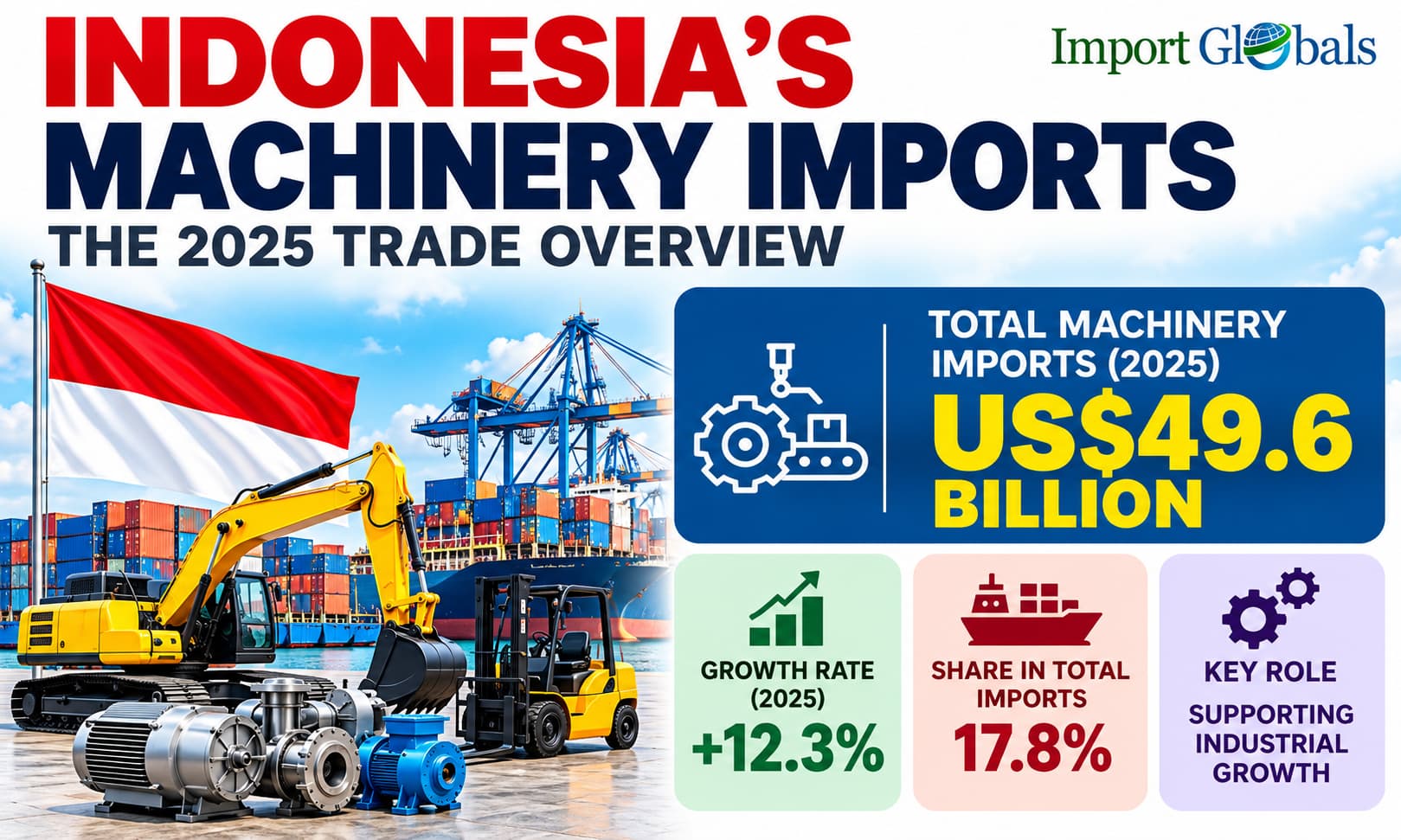
The machinery import sector of Indonesia was a crucial element of the industrial and manufacturing chain of the country in 2025, as it was backed by rising demand for manufacturing machines, construction machinery, data processing equipment, and specialized industrial equipment.
In 2025, the country imported machinery and mechanical appliances classified under HS Chapter 84 in the amount of about US$36.64 billion, which shows a growth of 7.91% compared to the previous year. Prior to this date, Indonesia’s imports of machinery were greatly facilitated by purchases of automatic data processing machines, self-propelled earth-moving machinery, special equipment, and other industrial equipment.
Among the most important suppliers was China, which delivered machinery worth about US$19.74 billion to the Indonesian market. Japan, with the volume of machinery imports amounting to approximately US$3.11 billion, became the second largest supplier, followed by Singapore with about US$2.12 billion and the USA with about US$1.83 billion of machinery imports. The leadership of China shows the role of Asian supply chains in meeting the machinery requirements of Indonesia, reported Indonesia Customs Shipment Data.
Indonesia Machinery Trade at a Glance
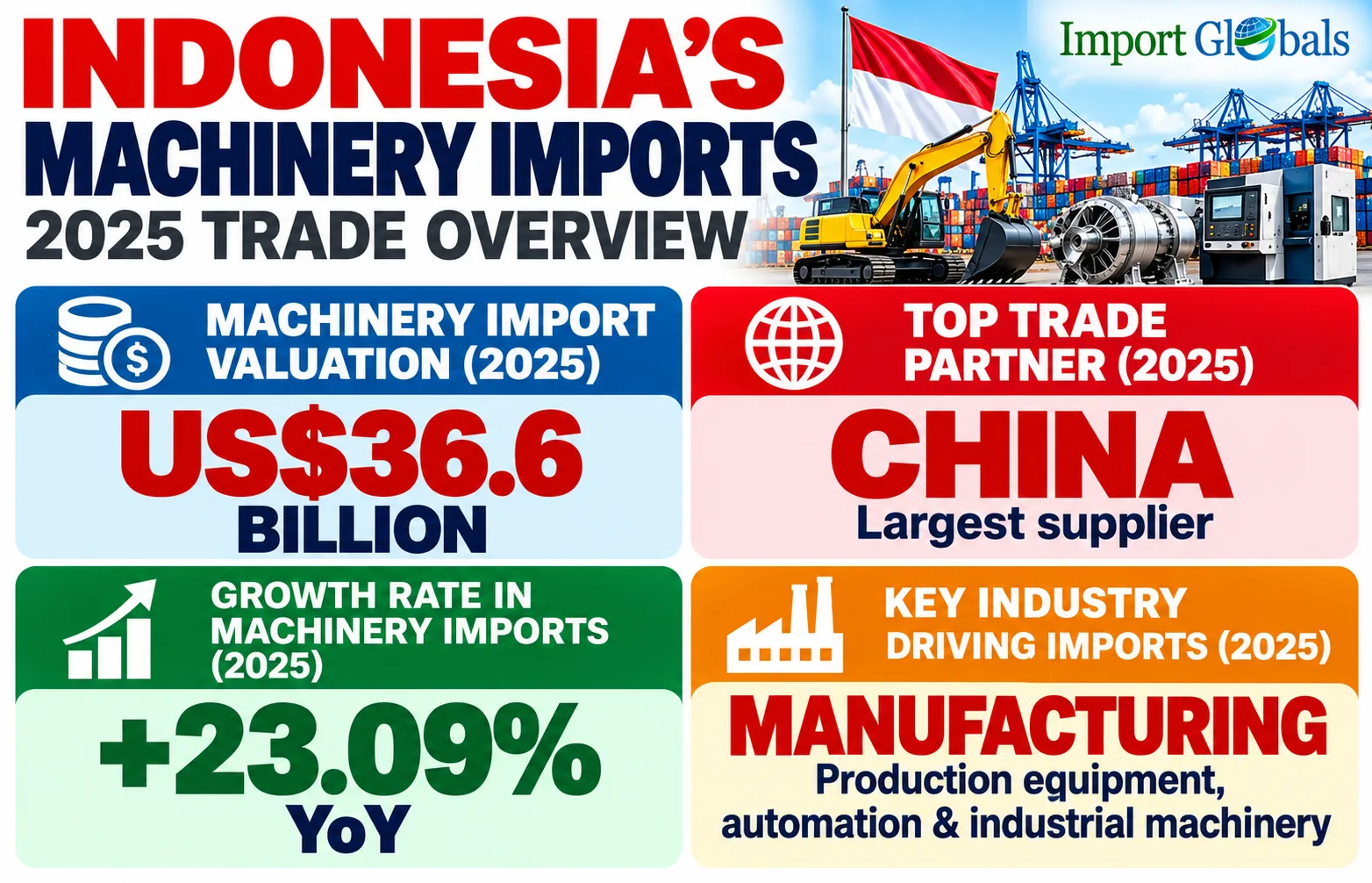
In 2025, Malaysia’s imports of machinery and mechanical appliances surged strongly, reflecting the country’s booming industrial operations and manufacturing activities as well as its need for advanced equipment and technological capabilities. As per Indonesia Trade Data, machinery imports in Indonesia stood at an astonishing US$ 36.6 billion in 2025, showing remarkable growth of 23.09% over a year. This boom in imports speaks to the growing role of foreign machines in driving the major part of industrial operations, development of infrastructure, and technological upgrading in the economy of Indonesia.
In 2025, China took the leading position in exporting machines to Indonesia, as well as playing a key role as the country’s trading partner and supplier of machines, industrial systems, manufacturing equipment, and production technologies. Manufacturing continues to take the lead in terms of the machinery import industry, due to its great demand for production equipment, all kinds of automation, and machinery operations. This trend helped local manufacturers improve their operational efficiency, boost their production capabilities, modernize plants, and become competitive in the domestic and global markets.
Top 10 Machinery Imported Variants of Indonesia in 2025
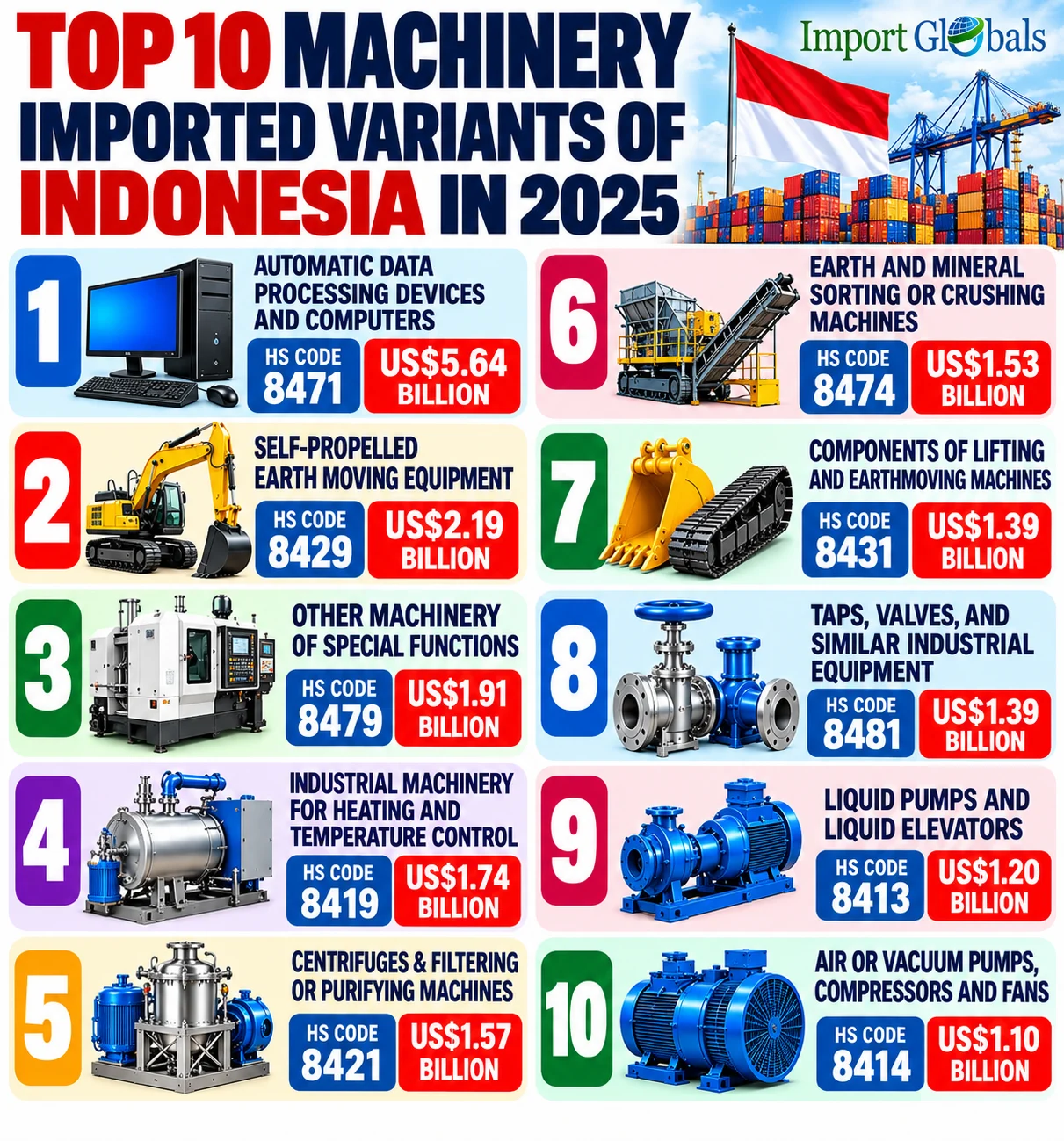
1. Automatic Data Processing Devices and Computers - HS Code 8471 - Import Valuation: $5.64 Billion
Indonesia imported computers and equipment to facilitate the process of digitization, automate offices, run enterprises, as well as use industrial computing and build information technology infrastructures to develop the economy.
2. Self-Propelled Earth Moving Equipment - HS Code 8429 - Import Valuation: $2.19 Billion
Earth moving machines play a vital role in the construction, mining and infrastructure industries in Indonesia, reported Indonesia Export Data. For instance, bulldozers, graders, and similar types of equipment make possible excavation, land preparation, road building, and large construction projects.
3. Other Machinery of Special Functions - HS Code 8479 - Import Valuation: $1.91 Billion
Special machines are involved in various manufacturing processes not covered by any other group. They provide automation of certain processes, help in handling material, and launch special production lines, which bring the efficiency of operations to new levels and improve efficiency.
4. Industrial Machinery for Heating and Temperature Control - HS Code 8419 - Import Valuation: $1.74 Billion
Industrial machines for processing are state-of-the-art devices for heating, cooling, drying, and thermal treatment of solid, liquid, and gaseous materials. The Indonesian industry uses this equipment in chemical processing, food production, pharmaceutical, and industrial manufacturing companies.
5. Centrifuges & Filtering or Purifying Machines - HS Code 8421 - Total Imports: $1.57 Billion
Filtering or purifying machines are the top fifth imported variants of Indonesia regarding the machinery category, says Indonesia Customs Data. The purification of water is getting more important in passing time due to which purifying machines are in overall demand from the global consumer base and basically in Indonesia. The machine has made it possible for industries in Indonesia to ensure the quality of supplies.
6. Earth and Mineral Sorting or Crushing Machines - HS Code 8474 - Total Imports: $1.53 Billion
Earth and mineral sorting or crushing machines are at a staggering import valuation of 1.53 billion US dollars. Crushing, screening and sorting machines are mainly used in industrial sectors for marble crushing industries and the construction industries of Indonesia. This industry has driven the consumer-based demand rates of Indonesia regarding mineral sorting or crushing machines.
7. Components of Lifting and Earthmoving Machines - HS Code 8431 - Total Imports: $1.39 Billion
The imported machine parts are needed for normal operations and use of good lifting, excavation, and earthmoving machines. The imported parts support the reliability of machinery and minimize the losses in work due to broken machines.
8. Taps, Valves, and Similar Industrial Equipment - HS Code 8481 - Total Imports: $1.39 Billion
Taps, valves and similar industrial equipment help the industries regulate the flow of liquids and gases. Factories, energy plants and chemical plants have been supporting the overall trade.
9. Liquid Pumps and Liquid Elevators — HS Code 8413 — Import Valuation: US$1.20 Billion
Liquid pumps play an essential role in agriculture, manufacturing, mining, construction, and water distribution. The need for machines for liquid transfer and fluid circulation, among other important functions of these pumps, will rely on Indonesian industries.
10. Air or Vacuum Pumps, Compressors and Fans — HS Code 8414 — Import Valuation: US$1.10 Billion
Air pumps, compressors, and fans are important in industrial ventilation systems, refrigeration systems, and systems used for production processes such as pneumatic systems, among others.
Top 10 Import Partners of Indonesia for Machinery
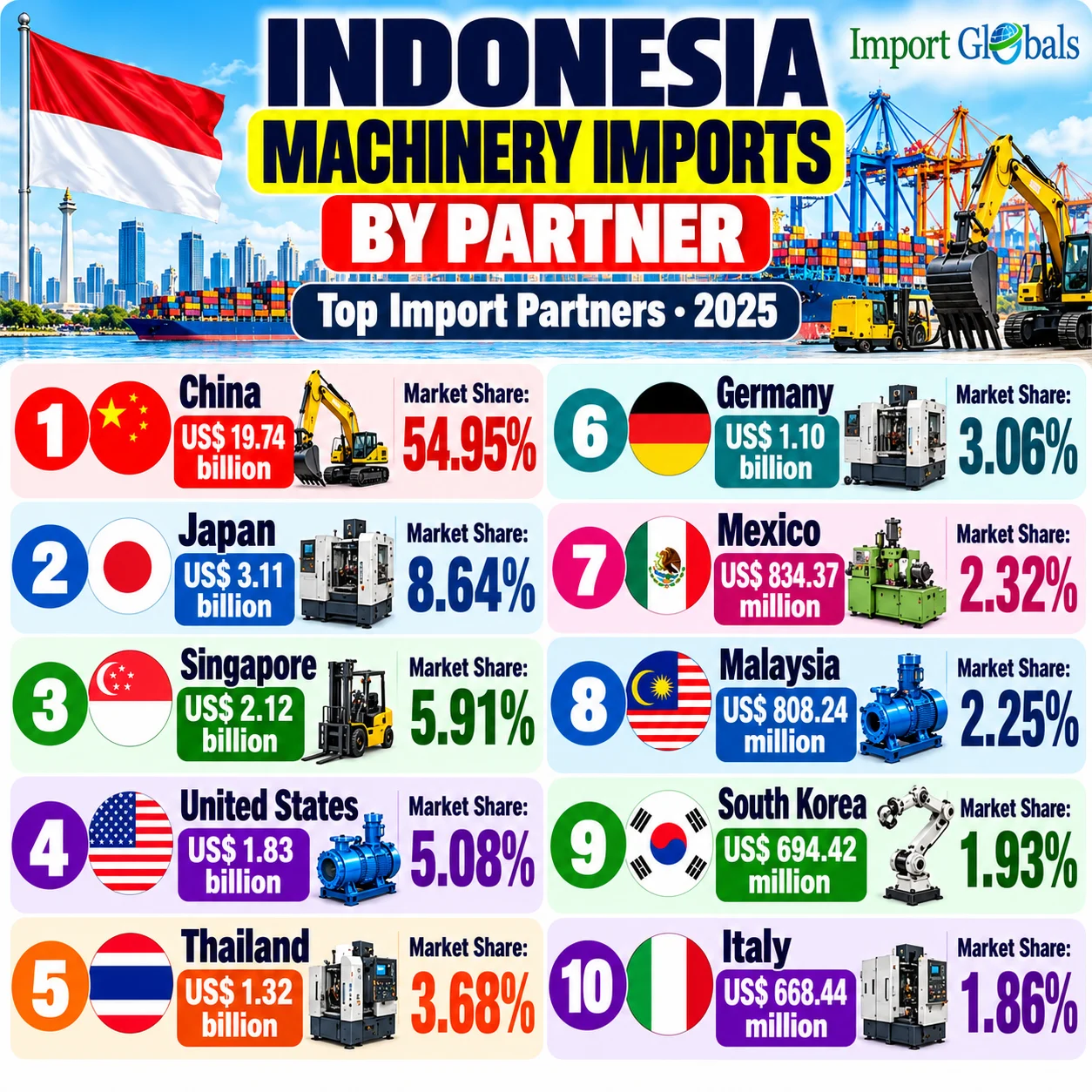
- China - Import Value: US$19.74 billion | Market Share: 54.95%
China enjoys a dominant role in Indonesia’s machinery imports as it exports equipment used for industrial activity, production machinery, computers, and parts. The combination of strong production capability within the country and existing supply chains helps China maintain its position as a major supplier, reported Indonesia Import Export Data.
- Japan - Import Value: US$3.11 billion | Market Share: 8.64%
Japan supplies Indonesia with precision machinery, industrial equipment, and automation technologies. Its industry-specific knowledge helps the automotive and electronics industries as well as promotes modernization of industries.
- Singapore - Import Value: US$2.12 billion | Market Share: 5.91%
Singapore has established itself as a regional hub for distribution of machinery, industrial equipment, and technical parts. Strong logistics infrastructure and networks of businesses assist in transporting machinery into Indonesia.
- United States - Import Value: US$1.83 billion | Market Share: 5.08%
The United States is a supplier of sophisticated industrial machinery, specialized equipment, and modern technological systems. The high technological level of American industry helps to boost the productivity of manufacturing processes, energy, construction, and automation in industry.
- Thailand — Import Value: US$1.32 Billion | Market Share: 3.68%
Thailand provides Indonesia with machinery and mechanical equipment for its manufacturing and automotive industries. The closeness of location, connection in trade through ASEAN, and the existence of integrated manufacturing networks allow effective transfer of machinery to border states.
- Germany — Import Value: US$1.10 Billion | Market Share: 3.06%
Germany delivers the most sophisticated industrial machinery and precision engineering equipment. Its developed engineering industry helps Indonesia get machinery and services that allow the creation of more efficiency in operations, as per Indonesia Trade Statistics.
- Mexico — Import Value: US$834.37 Million | Market Share: 2.32%
Mexico provides machinery and mechanical equipment to Indonesia through international manufacturing and distribution networks. Its industrial production capabilities offer the opportunity to export special equipment and units abroad.
- Malaysia — Import Value: US$808.24 Million | Market Share: 2.25%
Malaysia is at the seventh top position of Indonesia's import partner. The market share of the specific country is 2.25%. Industrial machinery and mechanical components are mainly supplied to Indonesia. The common location includes the connectivity of supply chains and the nearby regions for cross-border trade.
- South Korea - Import Valuation: US$694.42 Million | Market Share: 1.93%
South Korea stands at the eighth position in Indonesia's machinery import partners list, the market share is 1.93%. The specialties of South Korea in producing electronics, automotive technology and advanced manufacturing has facilitated the industrial development of Indonesia.
- Italy - Import Valuation: US$668.44 Million | Market Share: 1.86%
The export of special machinery, processing machinery and other forms has maintained the expertise of the country in manufacturing technology, mainly beneficial for companies to improve the production processes and quality.
Top Companies Facilitating the Machinery Imports
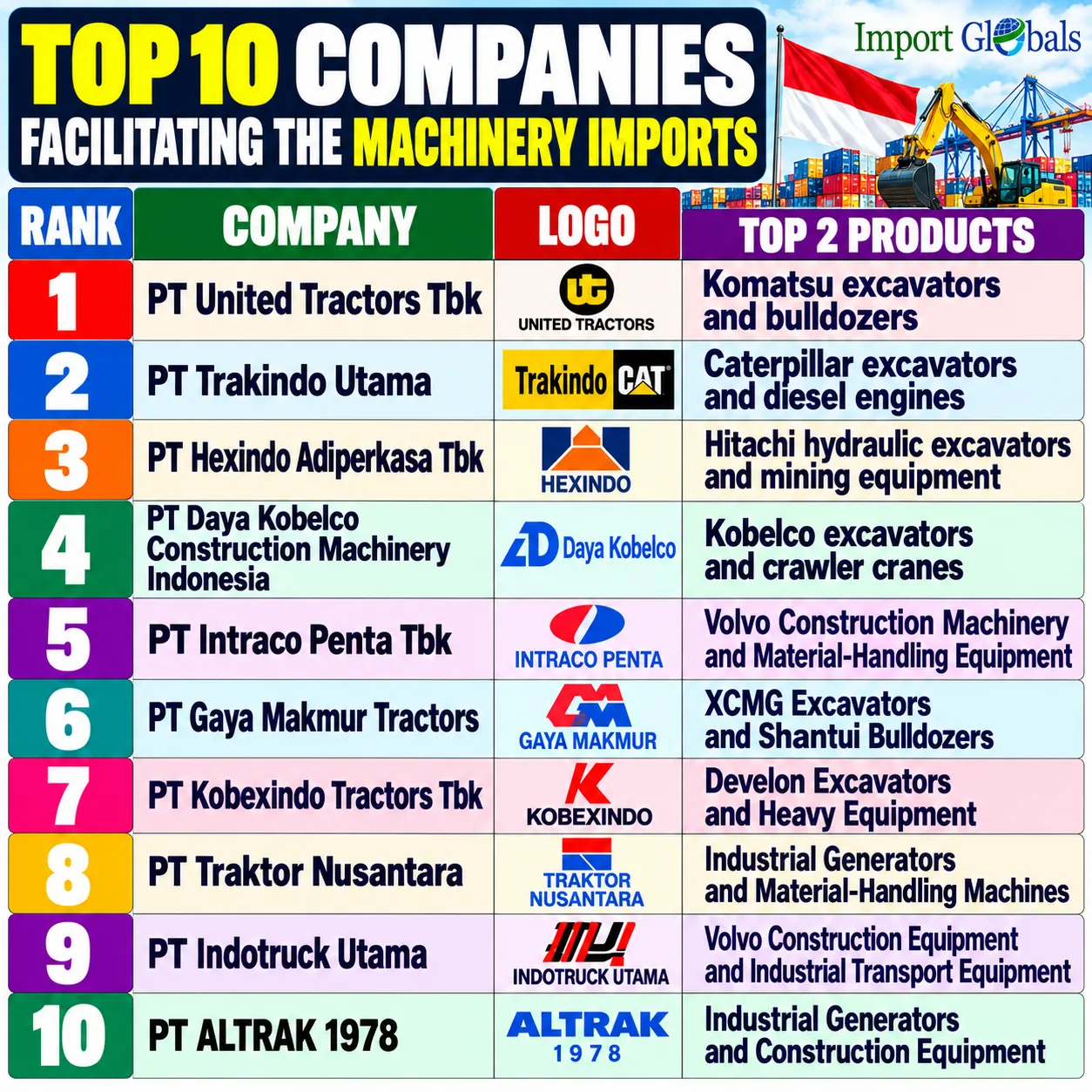
- PT United Tractors Tbk
Top 2 products: Komatsu excavators and bulldozers
United Tractors engages in distributing heavy machinery throughout the territory of Indonesia, providing assistance to mining, construction, and infrastructure projects. Their wide range of services and machinery contributes to keeping demand for the equipment and spare parts from abroad.
- PT Trakindo Utama
Top 2 products: Caterpillar excavators and diesel engines
Trakindo provides machines and engines produced by Caterpillar to the mining, construction, and industrial sectors in Indonesia. Distribution of the equipment, provision of maintenance services, and manufacturing of spare parts keep demand for foreign machines at a high level.
- PT Hexindo Adiperkasa Tbk
Top 2 products: Hitachi hydraulic excavators and mining equipment
Hexindo is engaged in distribution of construction and mining equipment, focusing on Hitachi machinery. Their range of products is applied to fulfil earthmoving, excavation, and resource extraction operations, thus keeping demand for imported machines and components alive.
- PT Daya Kobelco Construction Machinery Indonesia
Top 2 products: Kobelco excavators and crawler cranes
Daya Kobelco supplies machinery for construction projects in mining, building, and infrastructure industries in Indonesia. Their machinery supports excavation and lifting processes and consequently makes imports of this specific type of equipment and components relevant.
- PT Intraco Penta Tbk
Primary Products: Volvo Construction Machinery and Material-Handling Equipment
Intraco Penta provides heavy equipment and industrial solutions to Indonesian companies. The active involvement of the company in construction activities, mining and material handling has driven the demand for the imported machinery. It has solidified Indonesia's ranking as a top importing authority, says Indonesia Customs Trade Data.
- PT Gaya Makmur Tractors
Primary Products: XCMG Excavators and Shantui Bulldozers
Gaya Makmur Tractors has been a top company facilitating the import of machinery in Indonesia. The machines manufactured in the specific production company helped Indonesian contractors acquire imported machines for road building and other big projects.
- PT Kobexindo Tractors Tbk
Primary Products: Develon Excavators and Heavy Equipment
The specific authority is mainly popular for the heavy equipment distribution across construction, mining and industrial clients. The wide range of machinery and after-sales services has maintained its solidification in the demand for imported excavators sourcing in specialized machinery.
- PT Traktor Nusantara
Primary Products: Industrial Generators and Material-Handling Machines
Traktor Nusantara provides industrial machinery and equipment to Indonesian markets. The equipment they provide helps to facilitate logistics, production, energy generation, and construction activities, thus creating the demand for imported equipment and maintenance supplies.
- PT Indotruck Utama
Primary Products:Volvo Construction Equipment and Industrial Transport Equipment
Indotruck Utama operates in the construction, logistics, and industry sectors of Indonesia and distributes machinery equipment for construction purposes. Its portfolio is beneficial in providing support for infrastructure activities, transport of goods, and industrial productivity.
- PT ALTRAK 1978
Primary Products: Industrial Generators and Construction Equipment.
ALTRAK provides various types of machinery and equipment from different industrial sectors. It delivers machines for our needs in the infrastructure sector, construction, and industry, says Indonesia Import Data.
Statistical Analysis of Indonesia Machinery Imports
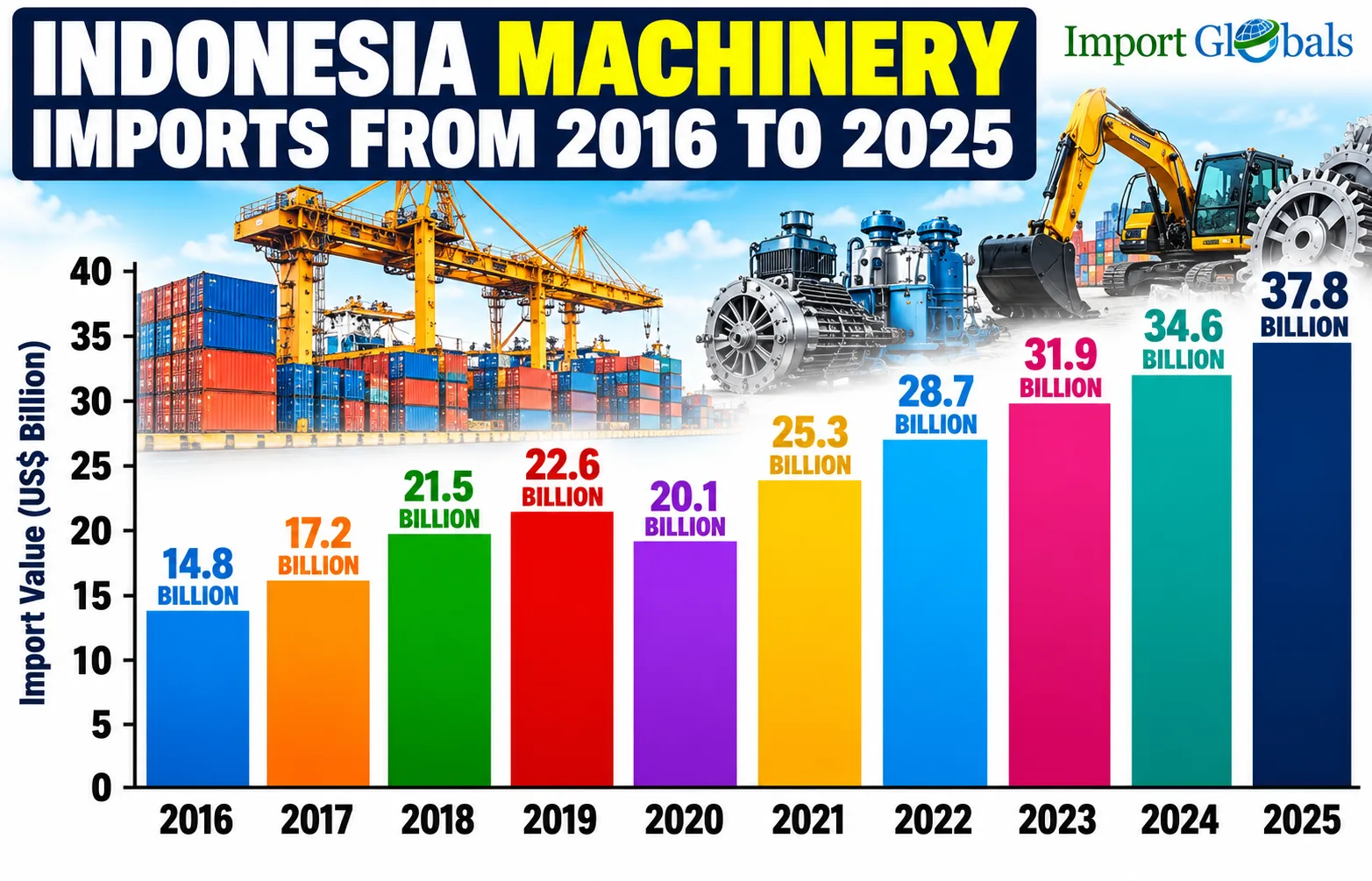
Machinery imports in Indonesia have increased over the period 2016 to 2025. The overall increase from 2016 to 2025 regarding the machinery import of Indonesia is mainly because of the increasing industrialization, infrastructure development and the hike in the demand for high technology machinery in Indonesia. As reported by the Indonesia Customs Shipment Data, the machinery imports were at a staggering rate of 14.8 billion U.S. dollars in 2026, 17.2 billion U.S. dollars in 2017, and 21.5 billion U.S. dollars in 2018. The upward trend is continued due to the consumer demand rate increase.
The import has reached a valuation of 22.6 billion U.S. dollars, but the imports has dropped by 20.1 billion in 2020. The market has recovered successfully with the increase in the imports by 25.3 billion in 2021 and 28.7 billion in 2022. The significant increase in the overall rate in import in 2023 has stood at a rate of 37.8 billion U.S. dollars. The machinery imports have overall increased by 23 billion from 2016 to 2025, that is at a rate of 155.4%. The continuous increase is a representative of Indonesia becoming more reliant on international suppliers.
Bilateral Trade Overview of 2025: The Significance of Top Region
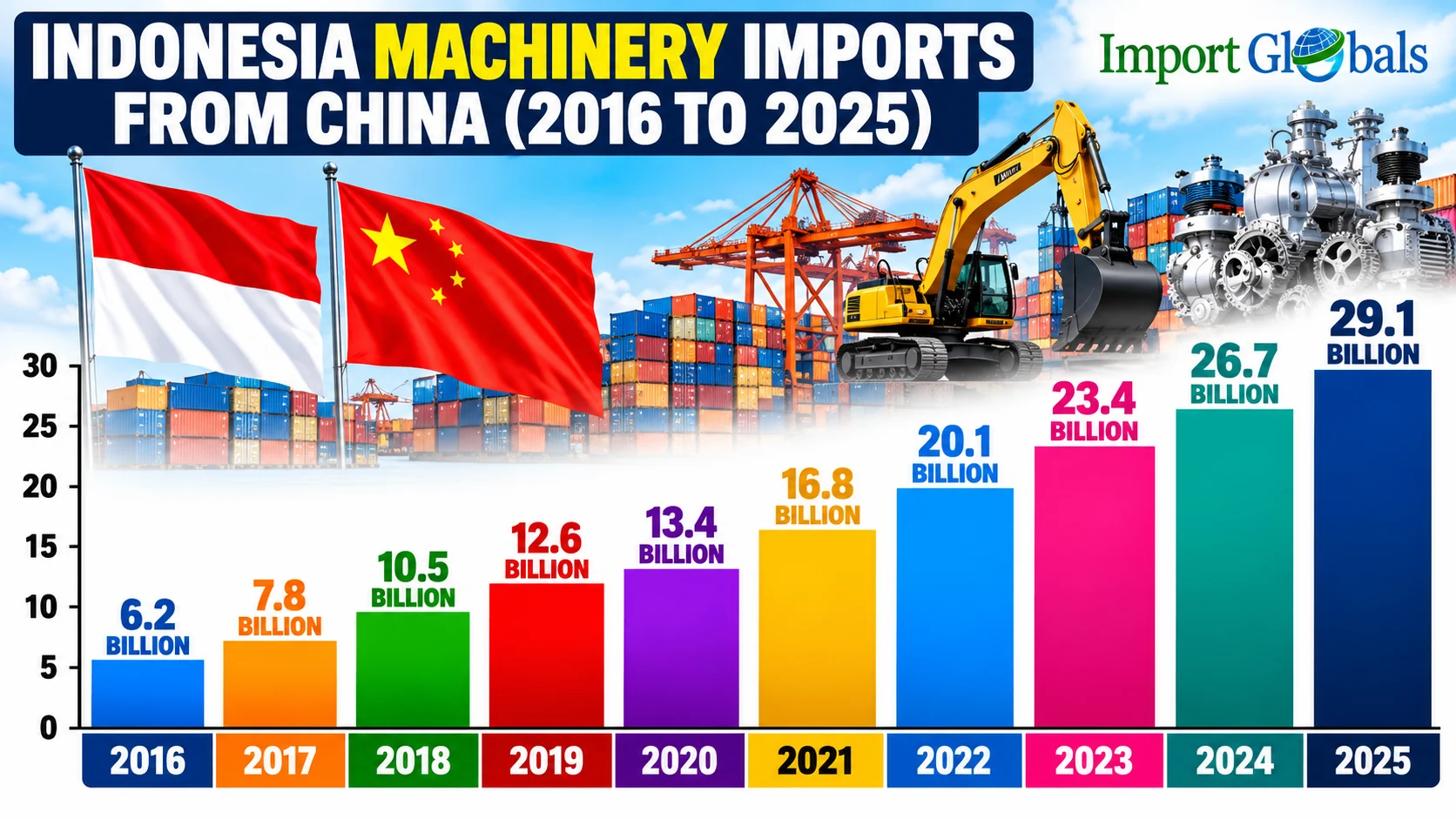
Between 2016 and 2025, imports of machinery into Indonesia from China showed notable growth, indicating the importance of China as a manufacturer and supplier of manufacturing technologies and equipment. Based on the data presented in the graph, imports of machinery into the country amounted to $6.2 billion in 2016; which increased to $7.8 billion in 2017 and to $10.5 billion in 2018. The growth trend continued in 2019 when machinery imports reached the value of US$12.6 billion, as per Indonesia Export Trade Data. In 2020, machinery imports grew slightly to US$13.4 billion; despite many disruptions in the global economy. In 2021 machinery imports increased to US$16.8 billion as manufacturing sector activities resumed and the demand for machinery grew.
The growth continued in 2022; when machinery imports reached US$20.1 billion. In 2023, machinery imports amounted to US$23.4 billion. The growth trend continued in 2024 and 2025, when Indonesia’s machinery imports from China reached their maximum value of US$26.7 billion and US$29.1 billion, respectively. In total, the increase in imports of machinery from China is equal to $22.9 billion, which means growth of approximately 369.4%. This growth highlights the importance of Chinese machinery in the development of Indonesian manufacturing, construction, mining, and infrastructure industries again.
Challenges Interrupting Indonesia's Machinery Imports in 2025
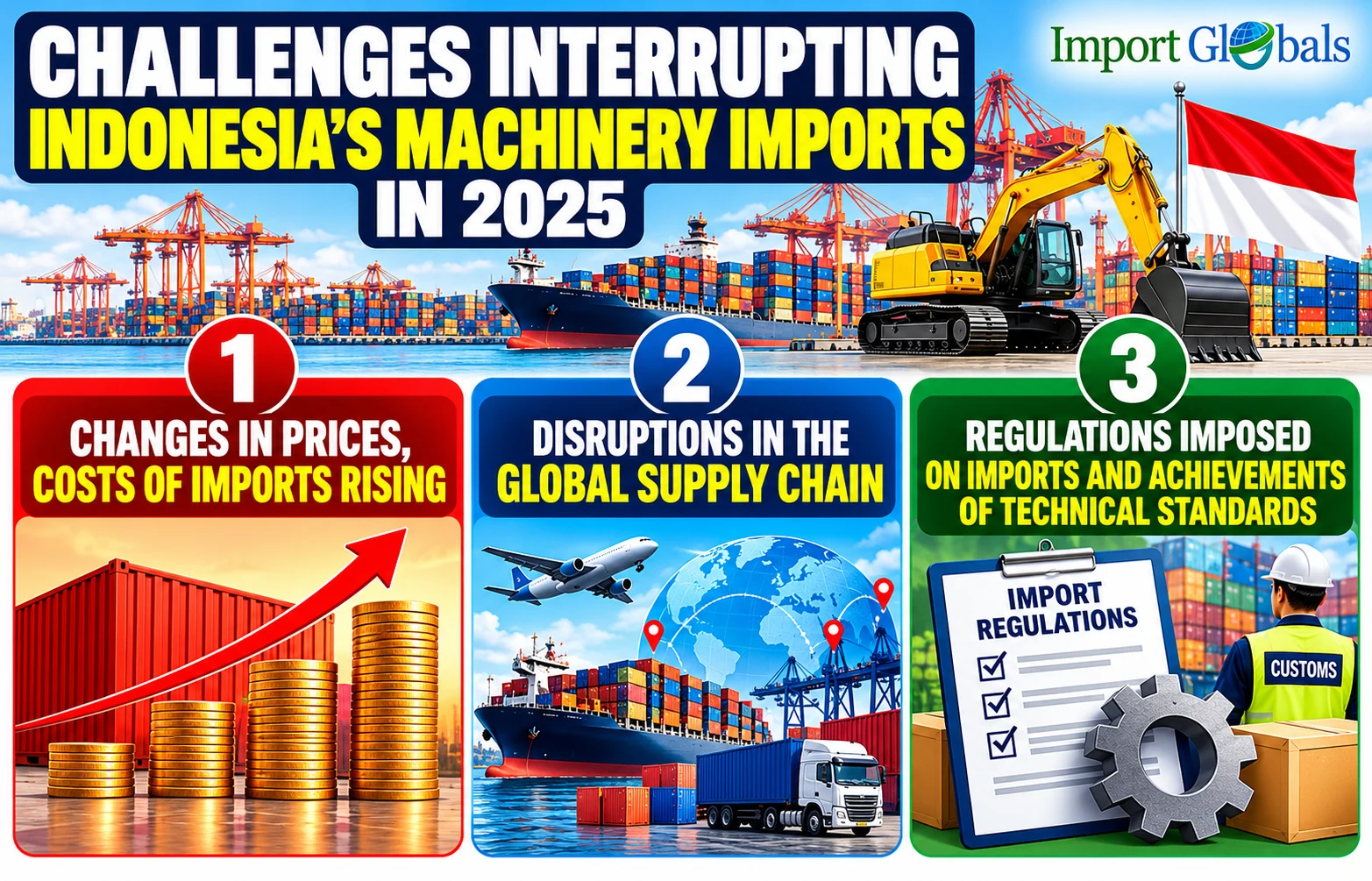
1. Changes in Prices, Costs of Imports Rising
The decline in the value of the Rupiah against other important currencies increases machine prices. The rise in prices may lead to delays in buying machines, problems with the allocation of the company's finances and a decrease in investment activity of Indonesian producers.
2. Disruptions in the Global Supply Chain
Delays in international shipping: geopolitical confrontations, and problems in transportation mean that machinery cannot be delivered. Longer lead times lead to a rise in freight costs, prolongation of industrial projects, and uncertainty for Indonesian companies.
3. Regulations Imposed on Imports and Achievements of Technical Standards
Changing policies of customs clearance, documentation needs, standards, and certification requirements may become a factor complicating procurement of machines. Delays in compliance cause an increase in administrative expenses, delayed customs clearance, and missed installation dates, reported Indonesia Customs Trade Data.
Future Trade Outlook of Indonesia Machinery Imports
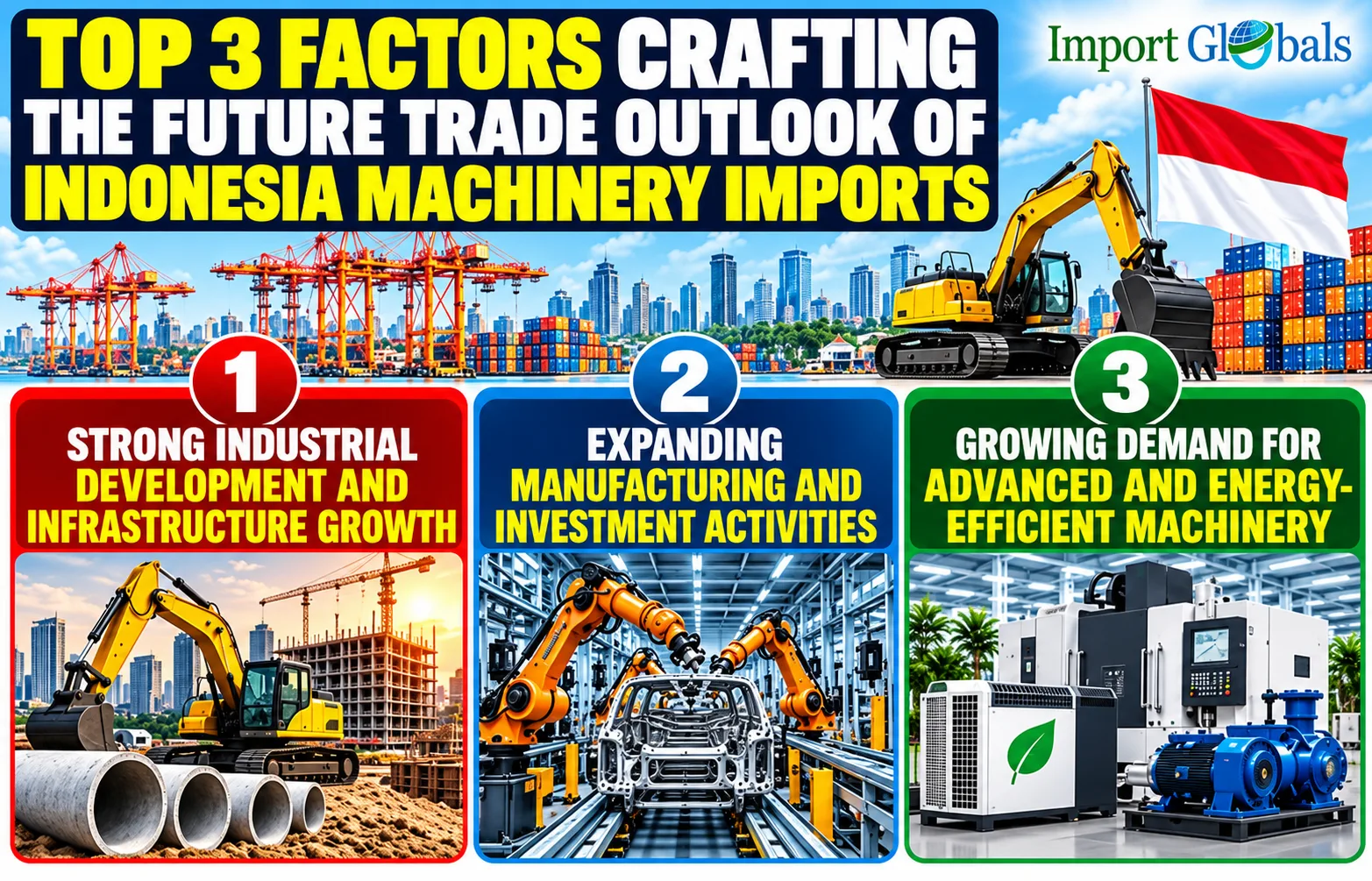
Indonesia’s prospects for importing machinery remain strong, thanks to the country’s industrial development, infrastructure projects, investments in manufacturing, and increasing use of new technologies. From the figures given, machinery imports were recorded at US$37.8 billion in 2025, compared to US$34.6 billion in 2024, showing that there is a high demand for imported machinery. Japan, Singapore, South Korea, Germany, and the USA will also be able to supply specialized machinery, precision machines, automation systems, and advanced technology. Most machinery will be imported for construction, mining, food processing, electronics, and automobile manufacturing.
In the future, digitalization, automation of factories, energy efficiency, and smart manufacturing may open new doors for foreign suppliers. Demand for robotic devices, computer-controlled machinery, industrial pumps, compressors, and manufacturing machines may grow as companies strive to become more productive and successful.
Conclusion
The machinery import figures of Indonesia in 2025 mention the increasing role of foreign producers in terms of the country’s industrial development, enhancement of manufacturing, as well as improvement of infrastructure operations. The reports about trade show almost USD 36.64 billion of imports of machinery under HS Chapter 84. China represents the first position in the suppliers’ ranking, followed by Japan, Singapore, and the USA, as per Indonesia Export Statistics. Automatic data processing machines, equipment for earth moving, specialized industrial machinery, as well as pumps and filtration machines can be the most important categories that help to meet many industrial needs of Indonesia.
Despite the difficulties such as fluctuations of currency, delivery problems, and the import restrictions, the demand for modern machinery remains high. The modernization of production, construction, mining, and automation fields will help develop the international manufacturers’ market.
CTA
Looking for the latest marketing opportunities regarding the machinery trade of Indonesia? then Import Globals is here to resolve all your trade complexities; with accurate market insights. The platform helps businesses explore international trade patterns with custom data and shipment-level insights. Subscribe at www.importglobals.com or drop an email at info@importglobals.com for detailed updates on Indonesia’s trade to transform your international business growth.
FAQ’s
Que. What is the machinery import valuation of Indonesia in 2025?
Ans. The machinery import valuation of Indonesia in 2025 is 36.64 billion U.S. dollars.
Que. What is the average growth rate of Indonesia’s machinery imports in 2025?
Ans. The average growth rate of Indonesia’s machinery imports in 2025 is 7.91%.
Que. Name the largest machinery import partner of Indonesia in 2025.
Ans. China was the largest machinery import partner of Indonesia in 2025.
Que. Name the top country that has been supplying machinery to Indonesia.
Ans. China is among the top import partners that have been supplying machinery to Indonesia.
Que. What are the top major machinery products imported by Indonesia?
Ans. Earth-moving equipment and automatic data processing machines are the top machinery products imported by Indonesia.
Que. What is the HS code for machinery and mechanical appliances?
Ans. Machinery and mechanical appliances fall under the HS code 84.
Que. How does Indonesia’s import-export data support business growth?
Ans. Indonesia’s import-export data supports business growth via proper identification of buyers, suppliers, analysis of market demand, and development of effective market expansion strategies.
Que. What information is available in Indonesia trade data?
Ans. Indonesia trade data covers importer name, exporter name, shipment date, HS code, product details, quantity, pricing information, origin country, importing country, and port details.
Que. How frequently is the Indonesia trade data updated?
Ans. Indonesia trade data is updated on a monthly basis.
Que. Where can you obtain detailed information on Indonesia trade data?
Ans. Visit www.importglobals.com or drop an email at info@importglobals.com for detailed updates on Indonesia trade data.
You Can Also Visit :-
