
Importing Steel and Aluminium into Belgium: Duties, CBAM and Compliance
- Nov 03, 2026
- 26 Views
Importing Steel and Aluminium into Belgium: Duties, CBAM and Compliance
Belgium is crucial to international companies that provide steel and aluminum, thanks to its strong manufacturing industry, good position in Europe and efficient logistics network. According to the World Bank WITS data on trade statistics, Belgium imported iron and steel to the tune of around $7.92 Billion and aluminum and its products to the tune of around $2.86 Billion in 2025.
Belgium’s main import partners are Germany, France, the Netherlands, Italy and other production markets in Asia. The Port of Antwerp-Bruges is of great importance for the international transportation of goods, which gives Belgium a more important role as a trading country in Europe.
Belgium Import Data has become an important source of information in 2026, especially for business companies that want to learn more about the trends in sourcing for steel and aluminum, the main suppliers, demand for products and trading activity of competitors. Importers will find trade intelligence at the shipment level useful.
Regulatory compliance is another factor for metal traders to consider. Since 1 January 2026, the EU Carbon Border Adjustment Mechanism (CBAM) has entered its final stage, covering specific iron, steel and aluminum products. Metal importers need to be aware of the authorization requirements, carbon footprint, classification and reporting requirements for the imported goods. The EU has also launched a new system for steel imports since July 2026. Belgium Export Data and Belgium Trade Data also assist international companies to analyze export locations, find potential buyers, track movements of trade and discover new business opportunities.
Import Globals is working to make market research for international markets easier. The company provides import and export trade data services to help companies gather global trade information, analyze shipping patterns and find buyers and suppliers. In 2026, Belgium will be an attractive destination for exporters and importers of steel and aluminum with the growing demand for reliable suppliers and compliance with regulations.
Top Countries Exporting Steel and Aluminium to Belgium
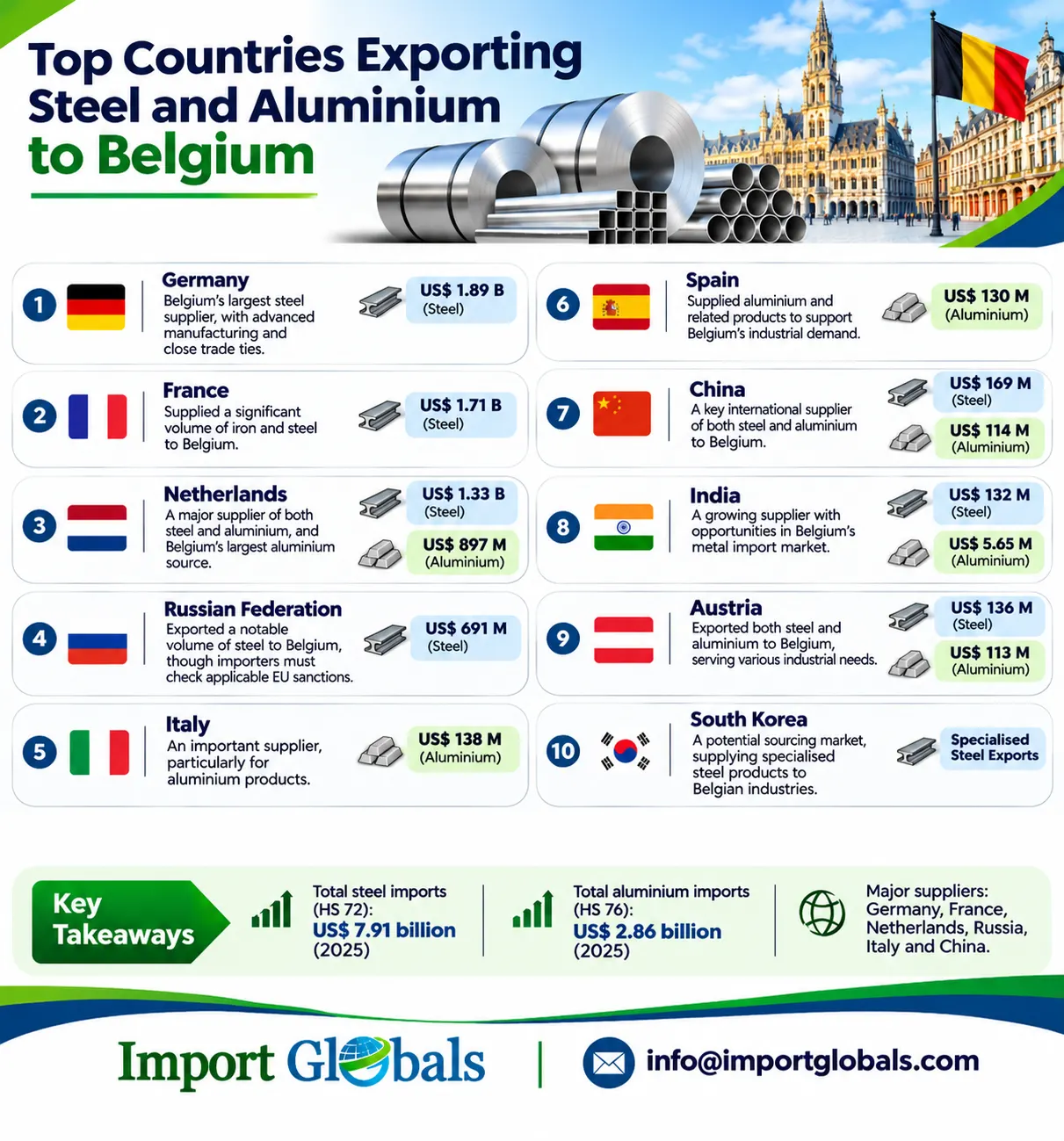
Belgium is a key country for the import of steel and aluminum in Europe thanks to its developed manufacturing, construction and international logistics sectors. According to World Bank WITS data on trade for 2025, Belgium imported about $7.91 billion worth of iron and steel and about $2.86 billion worth of aluminum and related materials.
1. Germany
Germany is the biggest iron and steel supplier to Belgium. Iron and steel imports to Belgium from Germany stood at about $1.89 billion in 2025. The country has the manufacturing capacity and geographical proximity.
2. France
France has a well established steel industry and imported iron and steel worth around $1.71 billion to Belgium.
3. Netherlands
As for the Netherlands, about $1.33 billion worth of iron and steel were imported. It is also the largest exporter of aluminum to Belgium, exporting approximately $897 million worth of aluminum.
4. Russian Federation
Iron and steel exports from Russia to Belgium were estimated to be at around $691 million in 2025. Exporters should be mindful that they need to check the relevant sanctions imposed by the European Union concerning trading activities.
5. Italy
Italy is another of the major suppliers, particularly of aluminum products. In 2025, Italy exported an estimated $138 million worth of aluminum to Belgium.
6. Spain
Aluminum and product supplies from Spain to Belgium were worth nearly $130 million in 2025.
7. China
China continues to be an important supplier of iron and steel (around $169 million) and of aluminum ($114 million) to Belgium.
8. India
India can be considered as an exporter of metals to the Belgian market of metal imports worth $132 million for iron and steel and $5.65 million for aluminum.
9. Austria
Exports of iron and steel from Austria were valued at an estimated $136 million, and exports of aluminum were valued at an estimated $113 million.
10. South Korea
Another market that can be explored for sourcing steel products for Belgium is South Korea.
Belgium's Import Duties and EU Tariff Regulations for Steel and Aluminium
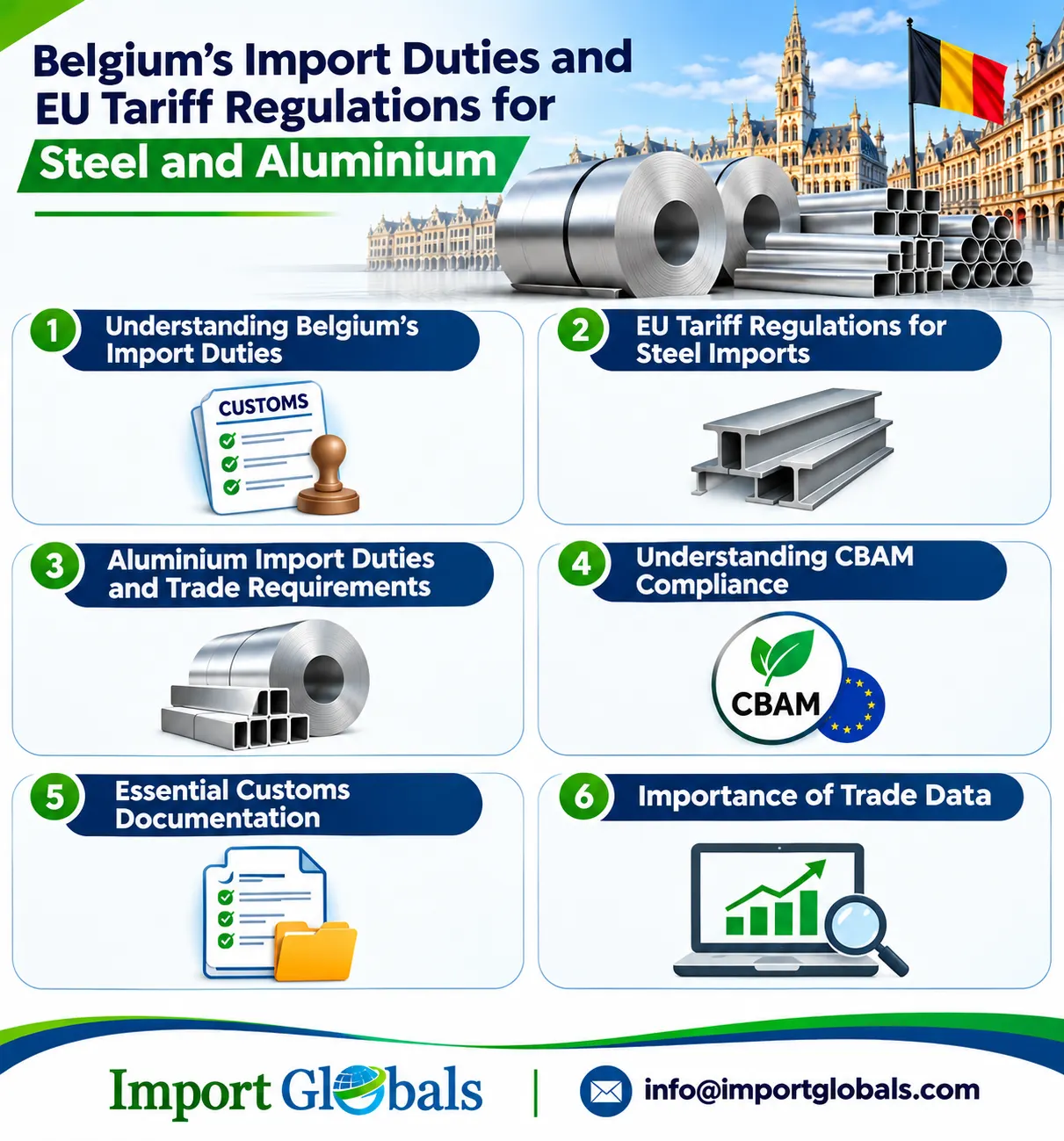
Belgium is an important importer of steel and aluminum products for international companies in these industries. However, before they can deliver their products to Belgium, they need to know how EU customs duty works, what tariffs exist, what kind of product classification there is, etc.
1. Understanding Belgium's Import Duties
Belgium follows the EU’s Common Customs Tariff system, which determines import tariffs based on the product’s classification, country of origin and any trade deals that apply. It has to be an HS or CN code.
2. EU Tariff Regulations for Steel Imports
From 1 July 2026, the EU will introduce a new import regime for steel with tariff rate quotas for certain steel products. When the quota is filled, out-of-quota imports could attract additional duties of 50%. It is suggested that the importer should check whether the quota has been exhausted before placing foreign orders.
3. Aluminium Import Duties and Trade Requirements
Relevant EU tariffs, trade defense measures and product specific requirements are also applicable to aluminum imports. They may also contain anti-dumping and countervailing duties.
4. Understanding CBAM Compliance
The Carbon Border Adjustment Mechanism (CBAM) definitively entered into force on 1 January 2026. This mechanism applies to selected iron, steel and aluminum products. Importers have to make sure that the relevant provisions for authorization, reporting of emissions and certification are complied with.
5. Essential Customs Documentation
Typically companies require a commercial invoice, packing list, transport document, correct HS code and certificate of origin, as and when needed.
6. Importance of Trade Data
Import Globals is an organization that offers import and export trade data services and assists companies in analyzing Belgium import data and locating international suppliers.
Understanding CBAM 2026: Carbon Border Tax Requirements for Importers
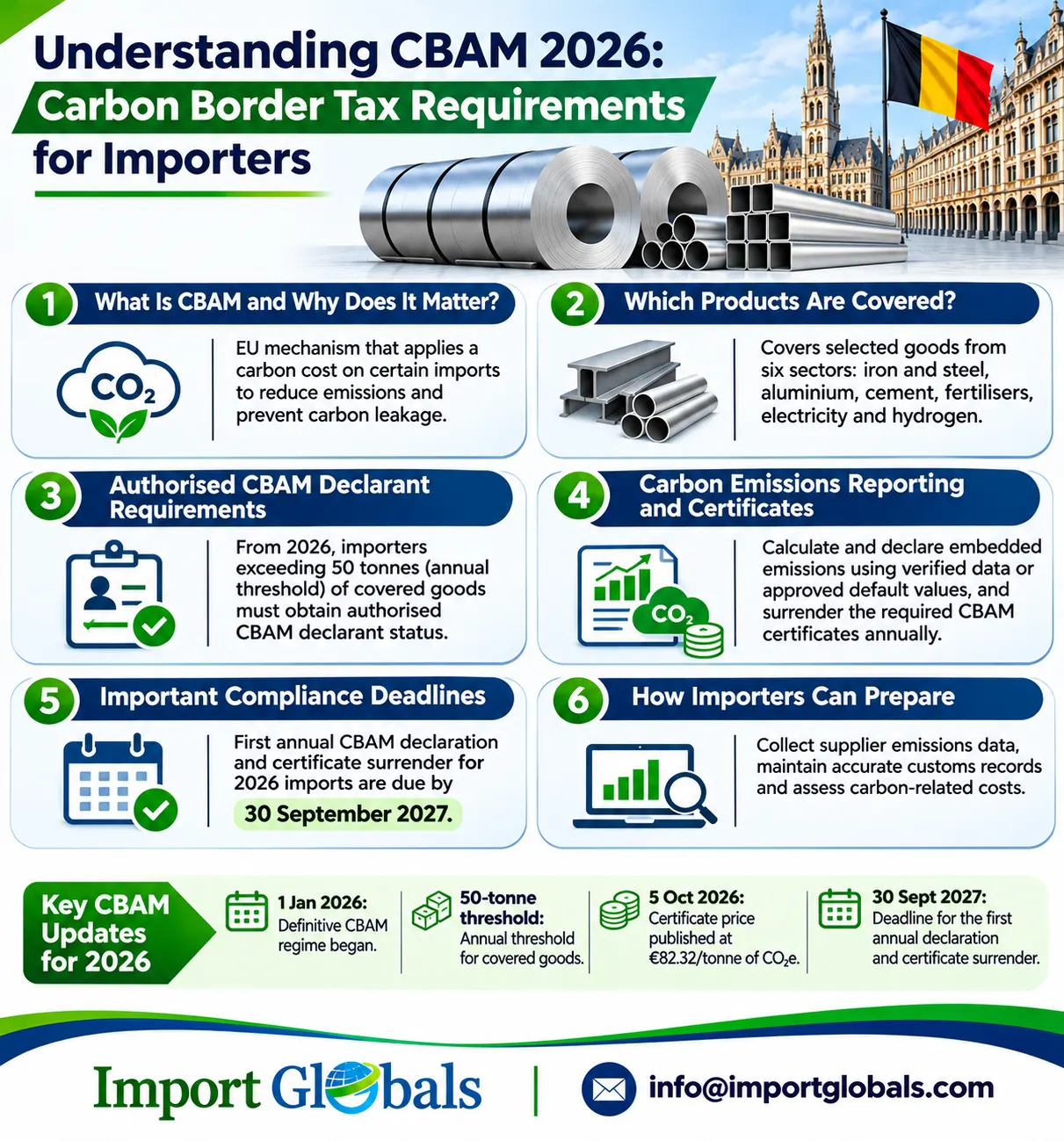
The Carbon Border Adjustment Mechanism (CBAM) is among the primary regulations of the European Union. The mechanism seeks to reduce carbon emissions and promote sustainable international trade. CBAM has been in force since 1 January 2026 and has imposed a number of financial and information requirements on importers of certain products such as iron, steel and aluminum into Belgium and other European Union member states.
1. What Is CBAM and Why Does It Matter?
The CBAM seeks to introduce a carbon cost on carbon intensive imports equivalent to the cost imposed on products manufactured in the European Union.
2. Which Products Are Covered?
The CBAM will apply to selected products in six sectors: iron and steel, aluminum, cement, fertilizers, electricity and hydrogen. It is important for the importers to check the CN code of the product that they are importing to see if it is applicable.
3. Authorised CBAM Declarant Requirements
From 2026, all importers importing more than 50 tons of any of the goods covered in a year will have to be an authorized CBAM declarant.
4. Carbon Emissions Reporting and Certificates
They need to declare the embedded emissions of the product at the point of manufacture.” The approved default values or verified emissions of the producer may be used to estimate the emissions. Then the corresponding CBAM certificates are surrendered annually.
5. Important Compliance Deadlines
The first declaration of the year of CBAM on imports in 2026 will be made on 30 September 2027 together with certificate surrender.
6. How Importers Can Prepare
Collect supplier emission details, keep customs documents right and evaluate carbon costs. Import Globals provides import export trade data services to help companies analyze global trade flow and locate suppliers.
Essential Documents Required to Import Steel and Aluminium into Belgium
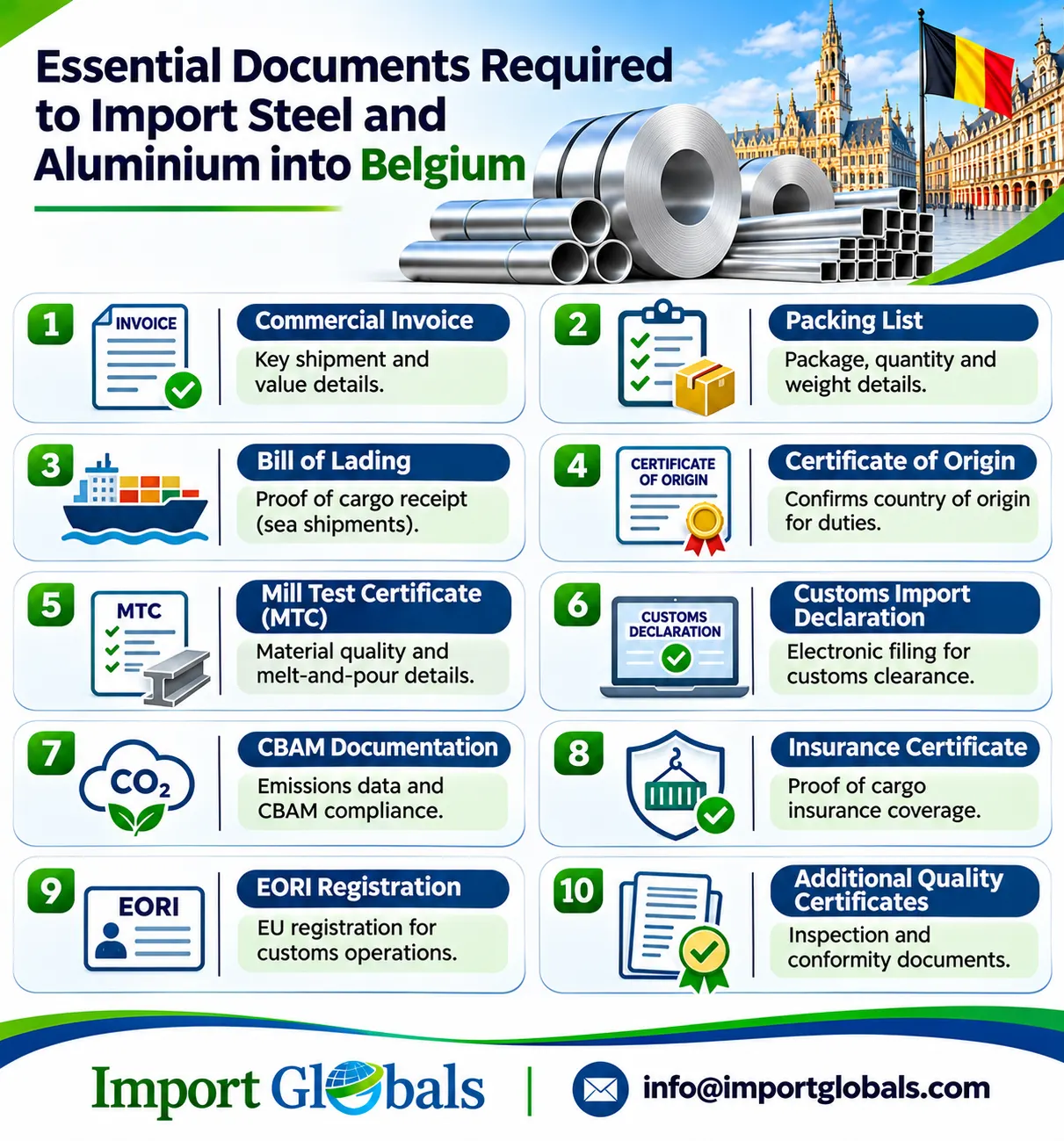
The customs rules of the European Union demand the use of correct documents for importing steel and aluminum into Belgium, thereby preventing transit delays and guaranteeing smooth international trade.
1. Commercial Invoice
The commercial invoice is a mandatory customs document, which contains information on exporter and importer, goods being imported, HS code, quantity, unit price, total value of the shipment and currency.
2. Packing List
Packing list gives information on the contents of the cargo, including number of packages, quantity of goods, net and gross weights, size and mode of packaging. It helps in confirming the imported cargo to the customs authorities.
3. Bill of Lading
The Bill of Lading is the evidence that the cargo has been received from the shipping company in case of sea transportation. Other modes of transport use other documents like CMR and Airway bills.
4. Certificate of Origin
This document shows the country where the steel and aluminum was imported from. It is good to know about the custom duties and origin restrictions.
5. Mill Test Certificate (MTC)
The MTC is used to provide technical details on steel products such as chemical composition, mechanical characteristics, quality requirements and heat numbers. It is an important document which is used to determine the melt-and-pour country of the steel in accordance to the applicable EU requirements and is effective from 1 October 2026.
6. Customs Import Declaration
In the meantime, the importer has to prepare an electronic customs declaration with information such as product classification, customs value, country of origin, etc.
7. CBAM Documentation
For the covered steel and aluminum products, the importer shall maintain the data of embedded carbon emissions and meet the CBAM requirements.
8. Insurance Certificate
This document proves that the cargo is insured in case of any losses or damages incurred during transport.
9. EORI Registration
It is necessary to obtain an EORI number for relevant EU customs processes.
10. Additional Quality Certificates
Depending on the properties and applications of the goods, other documents may also be needed.
EU Product Standards and Quality Certifications for Steel and Aluminium Imports
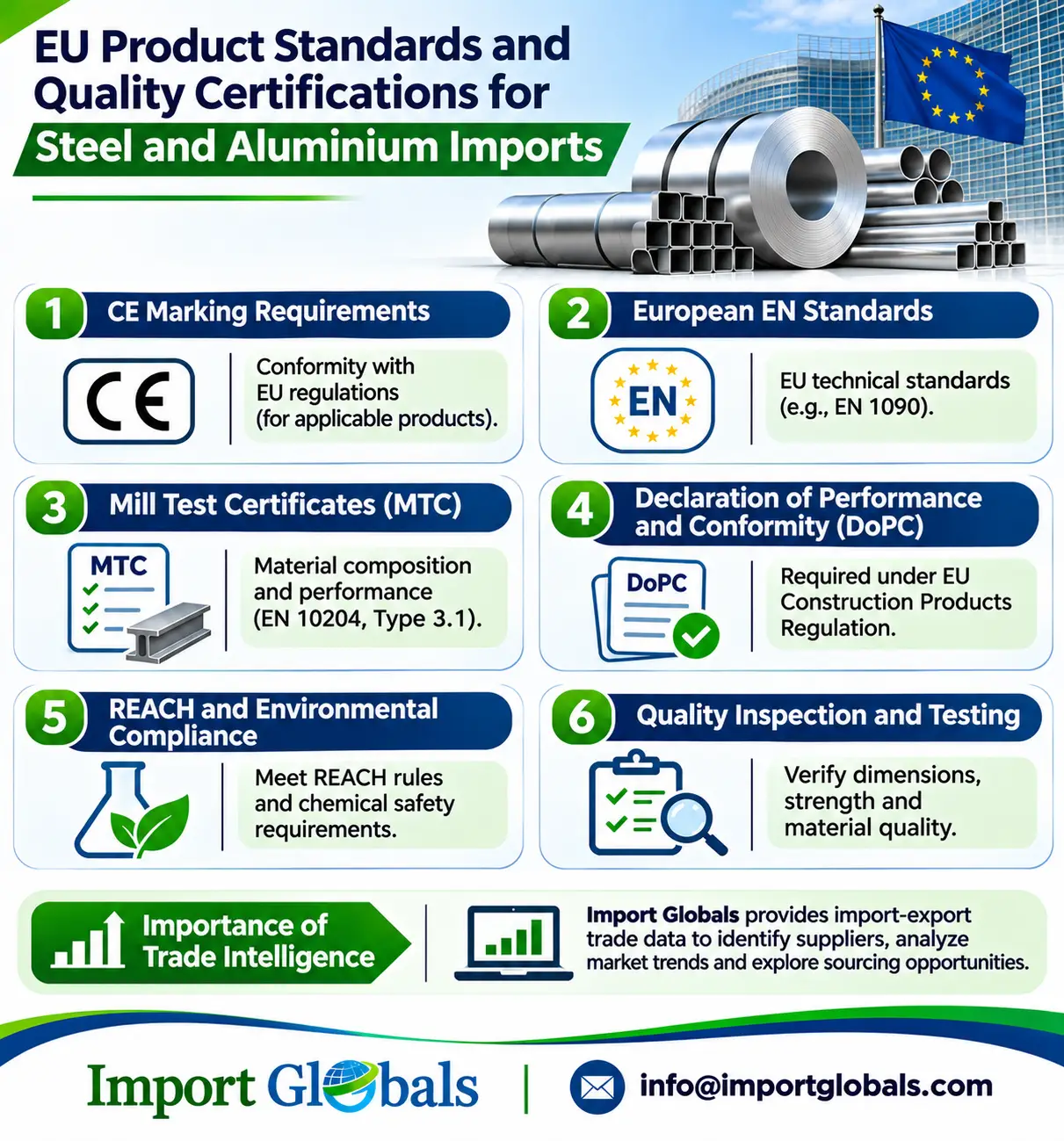
The importing of steel and aluminum to Belgium involves adherence to EU product regulations and requirements in terms of safety and quality. This regulatory framework ensures that imported metals meet certain technical, environmental and performance requirements when entering the EU market.
1. CE Marking Requirements
CE marking is important for the steel and aluminum products that fall under EU harmonization directives. Construction products need CE marking to prove they are in line with harmonized technical specifications or European Technical Assessments. However, CE marking is not necessarily required for normal imports of raw metal.
2. European EN Standards
European Norms (EN) define the standards for metal quality, strength, measurements, chemical composition and mechanical properties. For example, EN 1090 is of particular use for steel and aluminum construction products.
3. Mill Test Certificates (MTC)
Mill Test Certificates give the required data on the chemical composition of the material, mechanical strength, manufacturing process and quality standards.
4. Declaration of Performance and Conformity
The construction products within the scope of application according to the EU Construction Products Regulation should have the proper Declaration of Performance and Conformity (DoPC).
5. REACH and Environmental Compliance
Importers have to consider the requirements of REACH for chemical substances and safety information. Environmental and sustainability requirements may also apply, depending on the product type.
6. Quality Inspection and Testing
Laboratory testing and inspection would be beneficial to confirm correct dimension, tensile strength, corrosion resistance and material components.
7. Importance of Trade Intelligence
Import Globals is an organization that provides trade statistics services and assists organizations to source international and understand the trends of the market.
Customs Clearance Process at the Port of Antwerp-Bruges
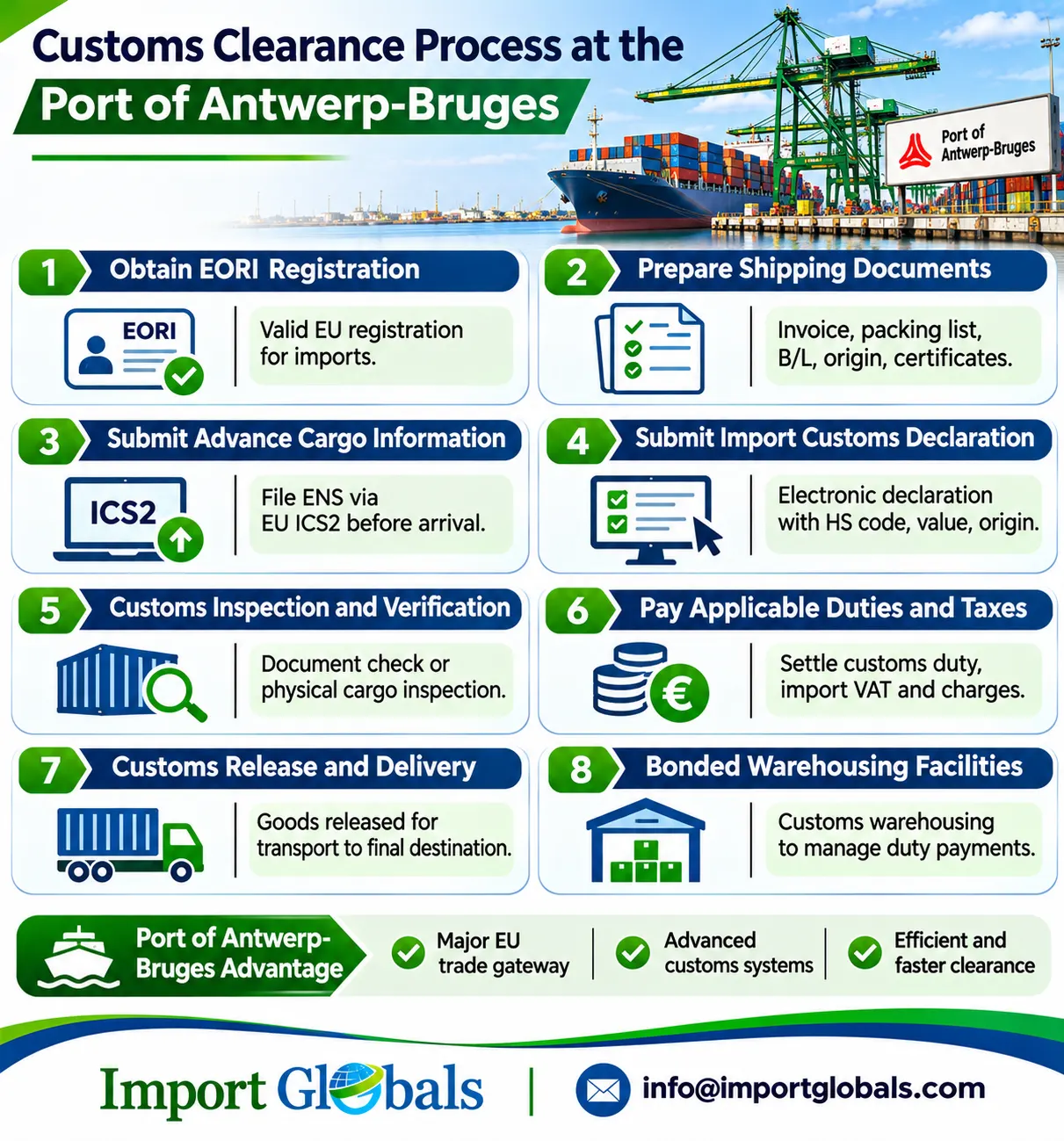
The Port of Antwerp-Bruges is one of Europe's main ports for international trade. The port is involved with steel, aluminum, machinery, chemicals and other industrial products. The Port of Antwerp-Bruges is an important entry point for business firms bringing their products to Belgium and other European Union countries, thanks to its modern logistics infrastructure and customs electronic facility.
1. Obtain EORI Registration
The importers need to have a valid Economic Operators Registration and Identification (EORI) number to carry out the necessary customs formalities in the EU.
2. Prepare Essential Shipping Documents
Before receiving shipment, the importer must arrange commercial invoice, packing list, bill of lading, certificate of origin and product certificates.
3. Submit Advance Cargo Information
The carrier or the supply chain operator responsible for the cargo shall submit the Entry Summary Declaration (ENS) using the EU Import Control System 2 (ICS2). Customs authorities will be able to carry out a security risk assessment based on accurate data.
4. Submit the Import Customs Declaration
An electronic import declaration shall be submitted by the importer or his/her authorized customs broker through the customs system of Belgium. HS codes, customs value, product origin and quantity/duties shall be included in this declaration.
5. Customs Inspection and Verification
The customs authorities in Belgium have the right to examine documents, inspect cargo or verify compliance with EU regulations.
6. Pay Applicable Duties and Taxes
Importers are required to pay any customs duties, import VAT and any other applicable charges. Some companies could benefit from VAT on imports deferment thanks to Belgian customs representation agreements.
7. Customs Release and Cargo Delivery
When the customs procedures are completed and the products are released, then it is possible for the importer to organize transport to warehouses or factories and other locations in Europe.
8. Bonded Warehousing Facilities
It is also possible to take advantage of customs warehousing or other special customs procedures at the port.
How to Calculate Import Costs: Customs Duties, VAT and CBAM Charges
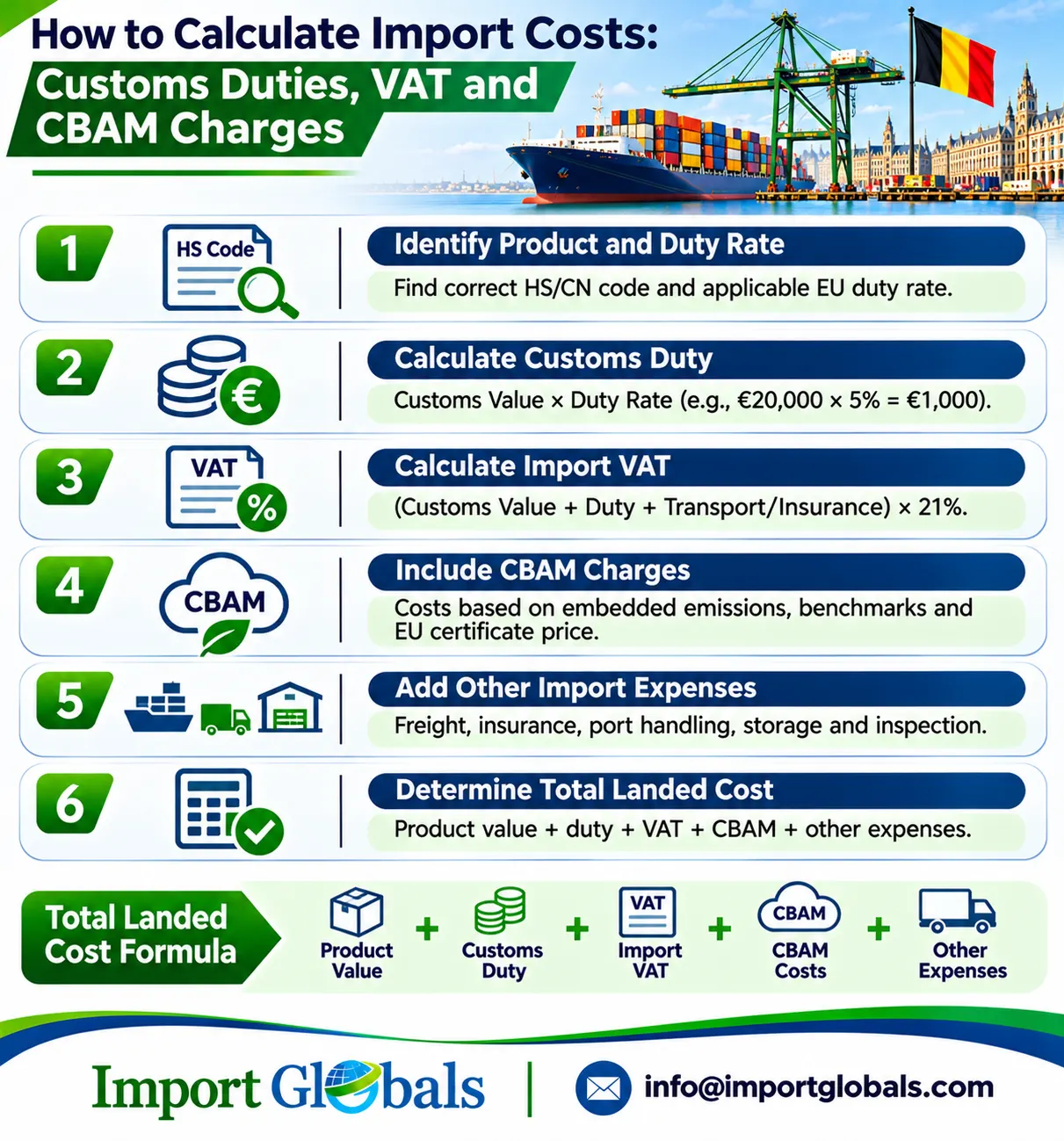
However, the calculation of the price charged by the supplier to import goods to Belgium is not everything needed to get an idea of the total landed cost.
1. Identify the Customs Duty
Start by finding the correct HS or CN code for your product. The applicable EU customs duty depends on the product classification, country of origin and any preferential trade agreement or additional trade measure.
Formula:
Customs Duty = Customs Value × Applicable Duty Rate
For example, if the customs value is €20,000 and the duty rate is 5%, the customs duty is €1,000.
2. Calculate Import VAT
In Belgium the rate applied to import VAT is normally 21%. VAT is calculated on the taxable base, which consists of the customs value, the customs duty and some other additional costs such as transport and insurance up to the first destination.
Formula:
Import VAT = VAT Taxable Base × 21%
However, VAT registered entities may be entitled to claim the import VAT under the provisions of the Belgian VAT law.
3. Include CBAM Charges
Importers should consider the requirements of the Carbon Border Adjustment Mechanism (CBAM) for steel and aluminum products covered by it. Costs depend on the level of embedded emissions, the applicable benchmarks, the price of certificates and the carbon price in the country of origin.
4. Add Other Import Expenses
Add expenses related to freight, insurance, port charges, customs clearance, storage, and inspection.
5. Determine the Total Landed Cost
Consider the product value, customs duty, import VAT, CBAM costs, and other costs for calculating total import cost.
Common Challenges Faced by Steel and Aluminium Importers in Belgium
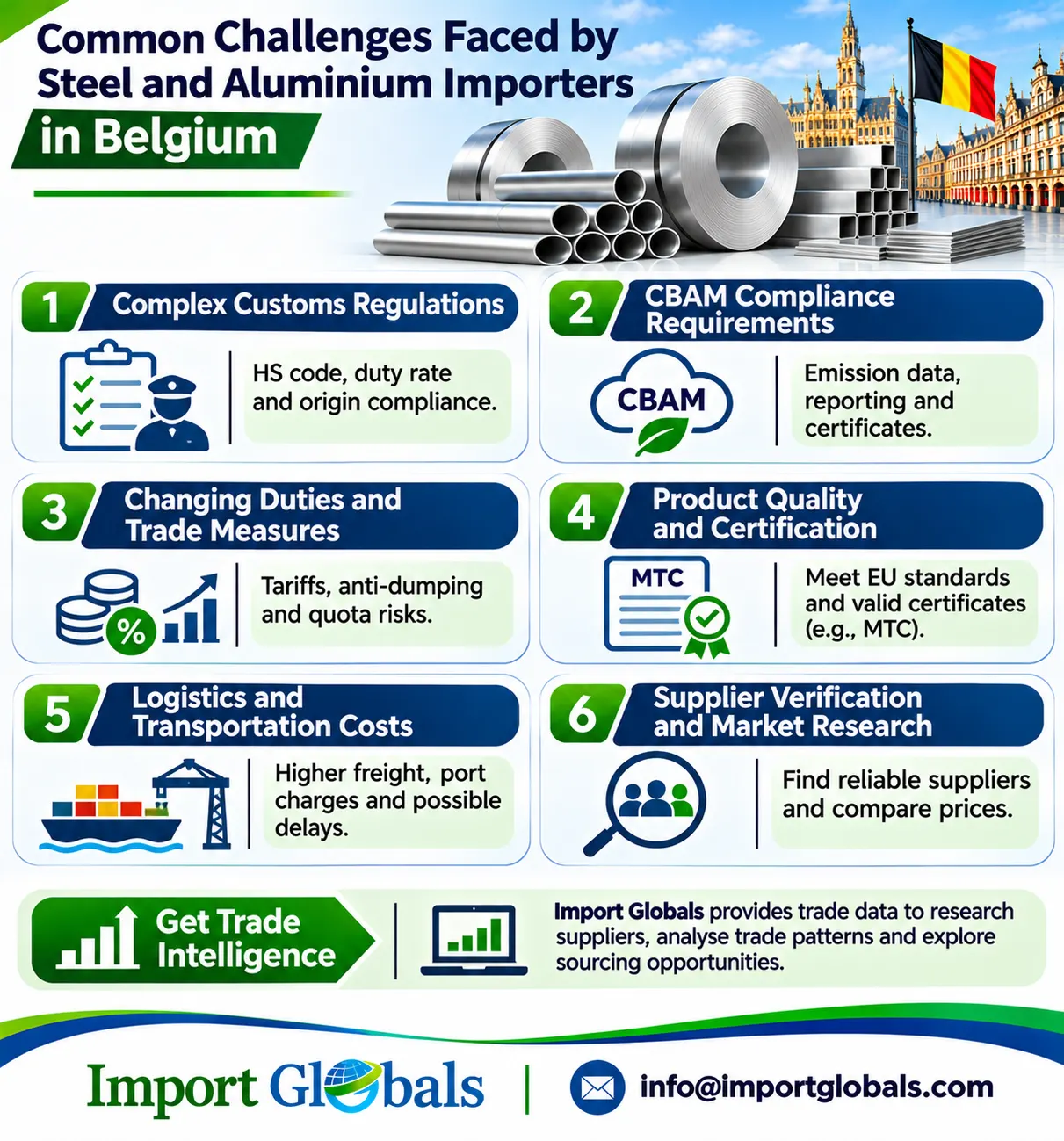
Some business opportunities can be found in the import of steel and aluminum into Belgium. However, international traders will face a number of challenges such as regulatory, financial and logistics. Awareness of such problems helps importers to avoid non-compliance, and minimize delays and costs.
1. Complex Customs Regulations
It is important to find the correct HS/CN codes, customs duties and country of origin. Errors in this respect can result in extra duties, penalties and delays to goods at customs.
2. CBAM Compliance Requirements
Furthermore, the Carbon Border Adjustment Mechanism (CBAM) was introduced, which imposes additional obligations on enterprises importing specific steel and aluminum products.
3. Changing Import Duties and Trade Measures
The final price of the metal may be affected by the tariff rates applied by the EU, trade defense instruments, quota and antidumping duties. Companies need to check current rules and regulations for importing before placing orders overseas.
4. Product Quality and Certification
Steel and aluminum products shall be in accordance with European standards of technology and safety. It is not easy to guaranty that the mill test certificate, proper specification and quality documents are present.
5. Rising Logistics and Transportation Costs
The landed cost will be affected by the cost of freight, unloading, handling and delivery. The delivery schedule will also be influenced by potential congestion at the gateway and at the Port of Antwerp-Bruges.
6. Supplier Verification and Market Research
Looking for a supplier, comparing prices and analyzing the shipment history can be difficult. Import Globals makes it easier for businesses to perform their supplier research and trade flow investigations by providing import-export trade data services.
Future Trends and Business Opportunities in Belgium's Steel and Aluminium Trade
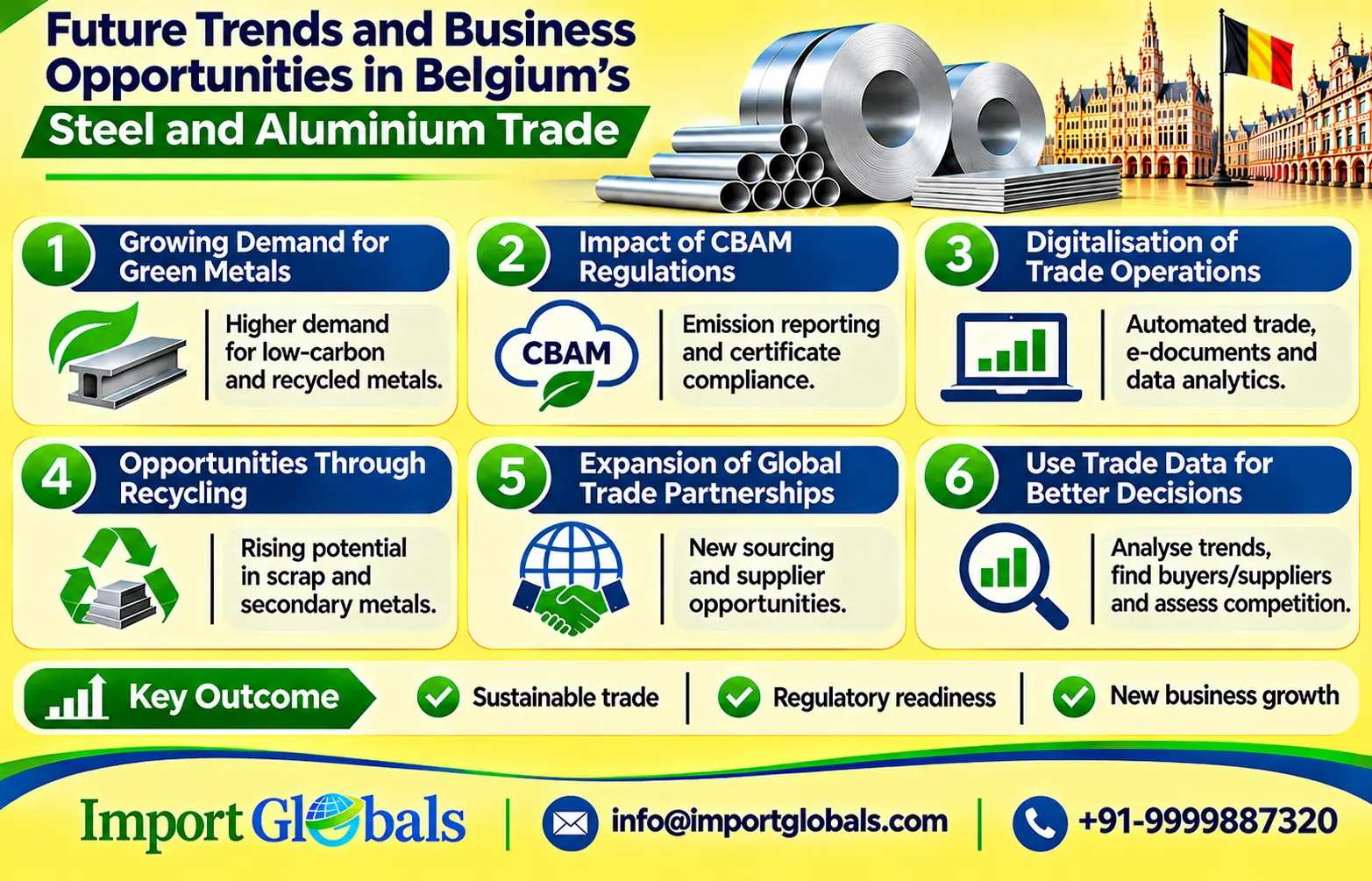
The aluminum and steel trading sector in Belgium is going through a transition period, driven by issues of sustainability and technology. Belgium is one of Europe’s leading importers and exporters of goods. This makes it a good destination for metal traders and metal manufacturers.
1. Growing Demand for Green Metals
European industries have been working to reduce their carbon footprint in the production process. “As demand increases, there will be new opportunities to source recycled aluminum, green steel and sustainably produced metal.
2. Impact of CBAM Regulations
The Carbon Border Adjustment Mechanism will pose a major challenge for carbon emissions from metals imports. For companies that know the process of emissions and supplier certification, it will be easy.
3. Digitalisation of Trade Operations
International trade will be revolutionized by digital records and analytics, and new customs systems. Shipment data allows companies to monitor their own active suppliers, as well as the competition.
4. Opportunities Through Recycling
The circular economy has a lot to offer in scrap metal recycling and second hand metals trading. Companies can become green by using recycled metal products.
5. Expansion of Global Trade Partnerships
There are possibilities for developing international supplier networks due to proximity to the European markets and efficient logistics infrastructure which is installed. The importers could consider forming alliances with the suppliers across the world.
6. Using Trade Data for Better Decisions
Conclusion
Import Globals provides import-export trade data services to help companies analyze shipment patterns, find new potential customers and suppliers, and learn about the competition.
Sustainable sourcing practices, knowledge of regulations and trade intelligence can be combined to identify emerging opportunities in Belgium’s steel and aluminum market.
The inclusion of steel and aluminum imports from other countries to Belgium gives international traders, manufacturers and distributors many opportunities. However, regarding importing products there are some aspects that need to be taken into consideration such as customs duties in the EU, classification of products, origin, quality and CBAM. Such things as documentation, changeable trade regulations, and full calculation of the cost of goods before ordering should always be kept in mind.
It may be of benefit to understand the state of affairs on the Belgian import/export market to be able to find the right suppliers and to take the right sourcing decisions. Belgium trade data, Belgium import data, Belgium export data Access can help to analyze shipment trends, trade partners and market opportunities.
Import Globals can assist you with import/export trade data services. They will help you to analyze your international trade activity, find potential suppliers and know your competition in the market.
CTA
Looking for growth in your business of steel and aluminum trading in Belgium? Need trade intelligence across the globe? You can find information about potential buyers, suppliers, and market opportunities with the help of Import Globals. Go to www.importglobals.com or contact us at [email protected].
FAQs
Que. What documentation is necessary for importing steel and aluminium into Belgium?
Ans. Commercial Invoice, Packing List, Transport Document, Customs Declaration, Certificate of Origin, and Product Certificates are usually required.
Que. What customs duties are charged for steel imports into Belgium?
Ans. Customs duties vary depending on HS/CN code, country of origin and EU trade rules.
Que. What does CBAM mean for steel and aluminium imports?
Ans. CBAM is a tool in the EU system that takes into account the carbon footprint of certain imported goods.
Que. When did the CBAM definitive phase start?
Ans. The CBAM definitive phase commenced from 1 January 2026.
Que. Do imported aluminium require quality certification in Belgium?
Ans. Imported products should meet corresponding EU requirements and provide technical documentation.
Que. What is the standard import VAT rate in Belgium?
Ans. In Belgium, the import VAT rate is 21%.
Que. What port is crucial for the import of steel and aluminum to Belgium?
Ans. The port of Antwerp Bruges plays a significant role in international metal trade.
Que. How do companies analyze the steel and aluminum trade in Belgium?
Ans. Import Globals offers information services on international import/export trade to analyze suppliers, buyers, and shipments.
Que. How frequently is Belgium's steel and aluminium import-export trade data updated?
Ans. Belgium's steel and aluminium import-export trade data is generally updated monthly, depending on the data source and country-specific reporting schedules.
Que. Where can you obtain detailed information on Belgium's steel and aluminium import-export trade data?
Ans. Visit www.importglobals.com or email [email protected] for detailed information and updates on Belgium's steel and aluminium import-export trade data.
You Can Also Visit :-
