
North American and European Trade Friction in 2026: How Tariffs Are Reshaping Global Trade Flows
- Nov 02, 2026
- 35 Views
North American and European Trade Friction in 2026: How Tariffs Are Reshaping Global Trade Flows
In 2026, the trade relationship between North America and Europe will be about trade disputes on tariffs, the competition in the industries, the different regulations, and the supply chain of the globalized world. Europe’s economies do big business with the US, Canada and Mexico. But there are still conflicts in terms of trade.
“Trade policies and tariffs are still very much an issue for importers and exporters.” Trade fights over goods like steel, aluminum, cars, agricultural products and high tech goods can increase costs and make it harder to obtain goods from other countries. Businesses also have to deal with differing standards for goods and their carbon emissions, customs rules and regulations and rules for online business.
The effects are seen in automotive industry, drugs, machineries, chemicals, energy and aerospace industry. Companies are reassessing their suppliers and looking for other places to purchase goods and to handle inventories so they can deal with uncertainty. By 2026, business across the transatlantic remains active despite the fluctuating tariffs.
Having accurate North America Import Export Data and Europe Import Export Trade Data provides insight into developing trade trends, evaluates suppliers, and also allows companies to assess their risk of paying tariffs based on the value of imported/exported products.
Looking ahead, greater communication, open trade policies and cooperation on regulations will be important to reduce any possible friction. Those companies that leverage trade statistics and supply chain strategy will be better positioned to navigate the uncertainties.
Major Tariff Disputes Between the United States, Canada, Mexico, and the European Union
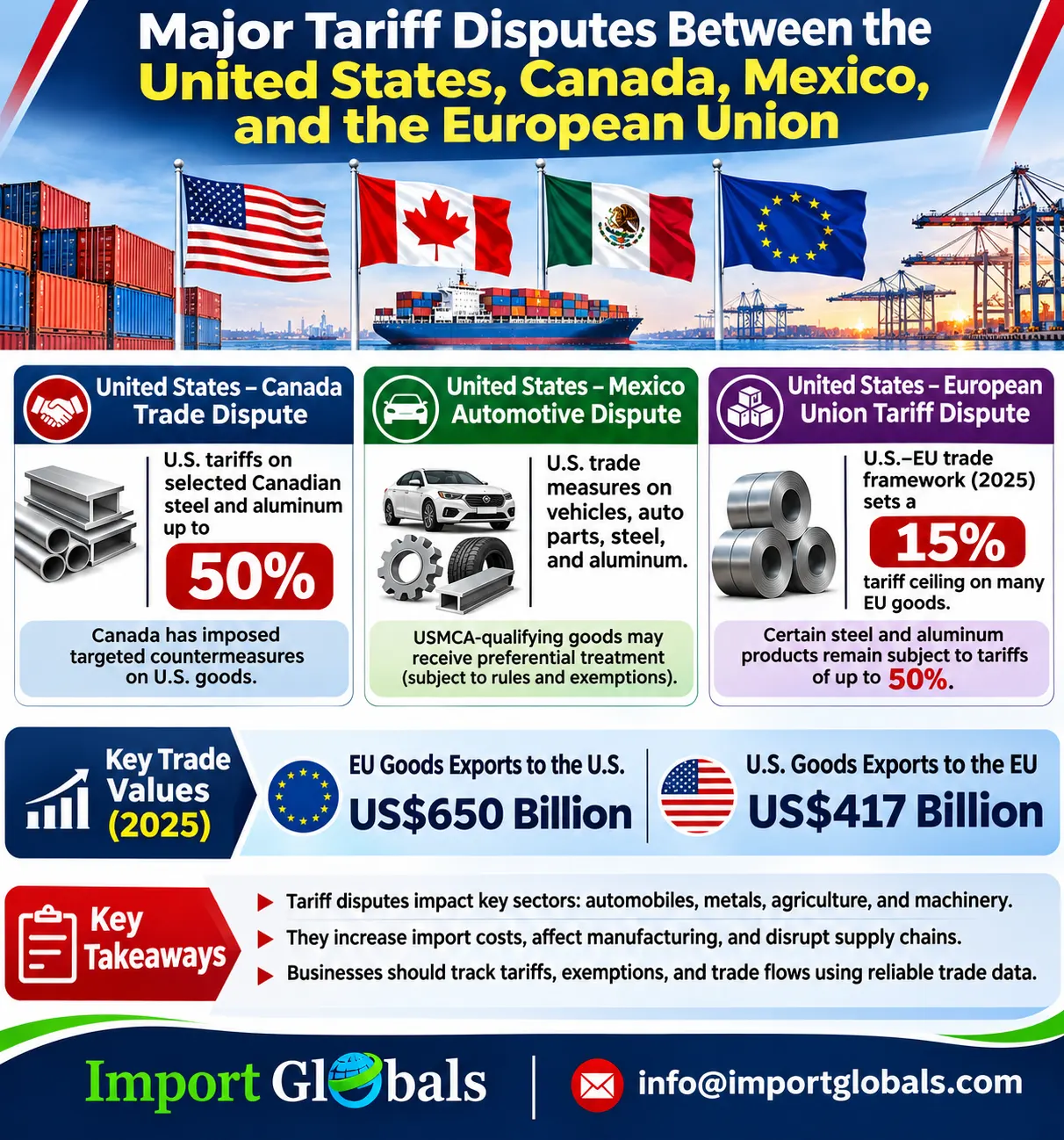
Tariff disputes between North America and the European Union will continue to impact international business, production costs and global logistics through 2026. Cars, steel, aluminum, agriculture and heavy machinery are the big points of contention.
Major Tariff Disputes and Trade Values
1. United States–Canada Trade Dispute: U.S. tariffs on some Canadian imports of steel and aluminum have added to the fraying for metals and manufacturing sectors. A tariff rate of 50% will be applied on certain products for certain imports of steel and aluminum. Some Canadian tariffs have been met with counter-measures.
2. United States–Mexico Automotive Dispute: U.S. trade policies impact vehicles, automotive parts, steel and aluminum coming from Mexico. Products eligible under the USMCA may be given preferential treatment under the special product-specific conditions and exceptions.
3. United States–European Union Tariff Dispute: In 2025, the United States and the European Union defined the trade relationship between the two . Most EU items can be taxed at a maximum of 15 per cent tariffs, with some exceptions . Some steel and aluminum products could be hit with tariffs of up to 50 percent.
4. Trade Values and Economic Impact: In 2025, the EU’s exports to the US were worth around US$650 billion, whereas the US’ exports to the EU were US$417 billion. The scale of the trade makes it clear that resolving disputes over tariffs is economically important to both countries.
5. Trade Intelligence and Business Strategy: Businesses will be able to analyze shipment value, determine products that will be impacted by the new tariffs, estimate tariff exposure and find other suppliers.
Key Industries Affected by Transatlantic Tariffs: Automotive, Steel, Aluminium, and Machinery
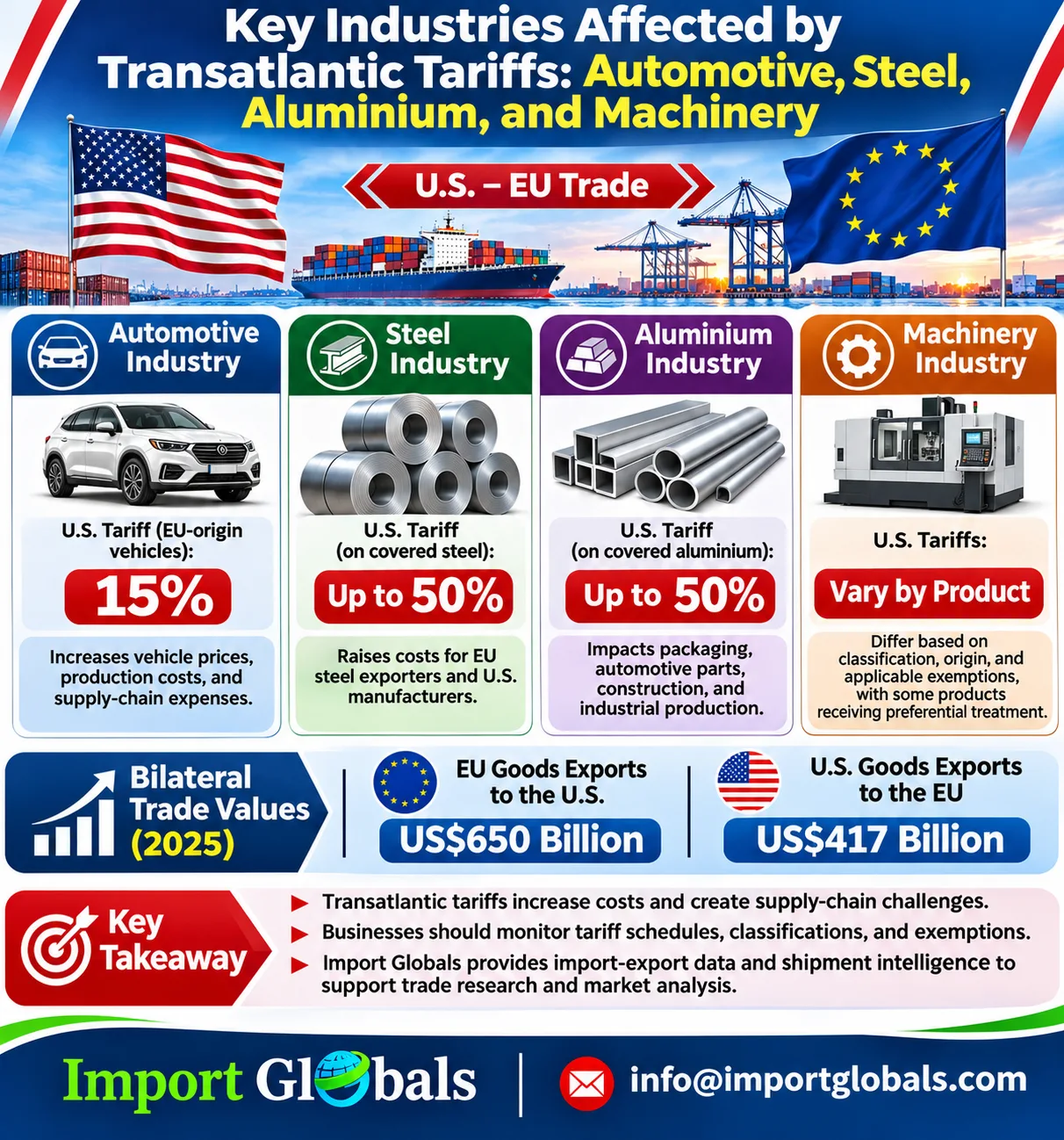
Tariffs from the US to the EU and from the EU to the US will impact industry production costs and sourcing in 2026. The auto, steel, aluminum and machine industries all have different tariff rules, exemptions and compliance requirements.
1. Automotive Industry: Under the US-EU trade structure, many of the EU’s cars must pay US tariffs of up to 15%. The tariffs affect cars from Europe that are exported to the USA. The tariffs can increase the cost of the vehicles and their manufacturing.
2. Steel Industry: In the USA, tariffs of up to 50% are imposed on covered steel goods under Section 232. This has added costs for European steelmakers and for US firms that depend on steel imports.
3. Aluminium Industry: It also imposes tariffs of up to 50% on aluminum products covered by it The effect isn’t limited to packaging, but automobiles, building material and manufacturing industries. Higher import costs might drive companies to look for other sources for their materials.
4. Machinery Industry: Depending on the product categorization, origin and whether the product is eligible for exemptions, different duties may apply to machines and metal-intensive devices. Certain products may be subject to favorable terms. Other products may be subject to additional taxes, which increase the cost and expenses of equipment.
5. Bilateral Trade Values: Goods exports from EU to US in 2025 were at about US$650 billion and from US to EU were at about US$417 billion. Such huge amounts of trade show how important good business relationships and the negotiation of tariffs can be.
How Import-Export Data Reveals Changes in North American and European Trade Flows
1. Understanding Changing Trade Flows
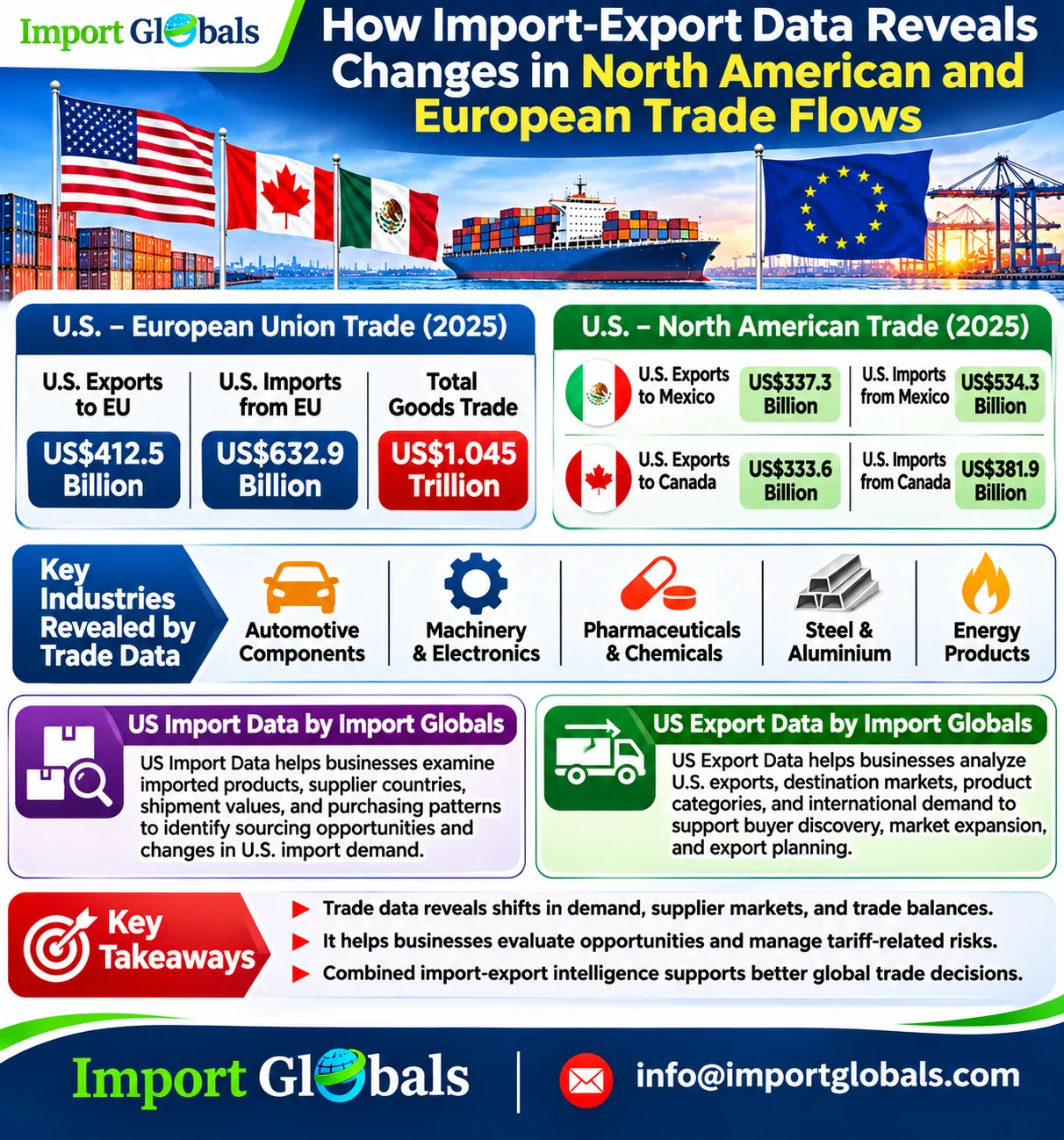
Import/export statistics tell companies who is taking market share, what products are selling and where new sources of supplies can be found. In 2025, the United States exported $412.5B of its products to the European Union, and imported $632.9B of its products from the European Union. Two-way trade totaled $1.045 trillion.
2. Monitoring North American Trade
The North American trade numbers show how important integrated supply chains really are. In 2025, the United States exported $337.3 billion of goods to Mexico and imported $534.3 billion of goods from Mexico. Exports to Canada: $333.6 billion Imports from Canada: $381.9 billion.
3. Identifying Industry-Level Opportunities
The trade data provides a snapshot of what’s going on in the automotive parts, machinery, electronics, pharmaceuticals, chemicals and energy sectors. Companies can see how much each item is worth, find new buyers and check if tariffs or changing demands affect sourcing.
4. Using Trade Intelligence for Business Decisions
Monthly shipment records, customs declarations, product classifications and annual trade statistics give companies the ability to track market changes, evaluate competition and enhance sourcing strategies. Looking at data over several years allows you to see longer-term trends, rather than temporary fluctuations.
US Import Data helps businesses to analyze imported products, countries of suppliers, shipment values and buying trends. Import Globals helps market research by allowing companies to find sourcing opportunities and assess shifts in U.S. import demand.
US Export Data helps companies to analyze U.S. exports, destination markets, product categories and international demand. Import Globals offers trade intelligence to help buyers discover new markets, expand their reach, and plan for exports.
Retaliatory Tariffs and Trade Barriers: Impacts on Bilateral Trade
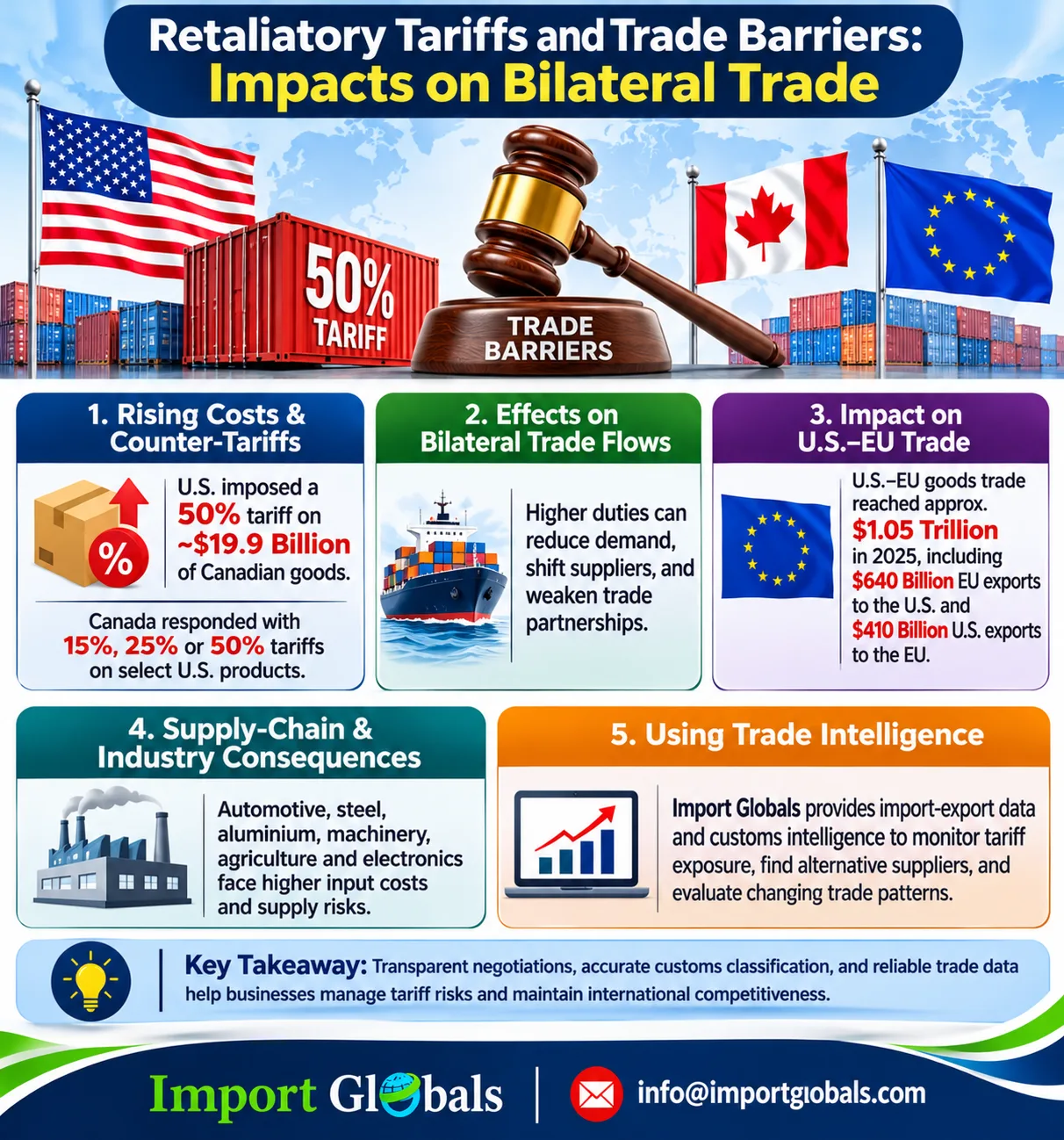
Trade barriers and retaliatory tariffs affect trade between two countries in a way that increases costs, reduces competitiveness and requires an evaluation of the international sourcing strategy. By 2026, the United States, Canada and European Union will demonstrate the effects of tariffs on exporters, manufacturers and consumers.
1. Rising Costs and Counter-Tariffs
The U.S. imposed a 50% tariff on about $19.9 billion of Canadian imports, effective Aug. 22, 2026. Canada hit back with tariffs of between 15% and 50% on some U.S. imports, to take effect on Sept. 8, 2026. Industries impacted include metals, agricultural equipment, appliances, electronics and consumer products.
2. Effects on Bilateral Trade Flows
Higher duties would raise the price of the import and decrease demand for that specific product. This will force importers to look elsewhere for their requirements, such as local sources or other markets, and exporters will lose their customers. This could have an impact on the existing business relations between the two countries.
3. Impact on US–EU trade
In 2025, US-EU goods trade was valued at around US$1.05 trillion, with around US$640 billion of EU goods exported to the US versus US$410 billion of goods exported from the US to the EU. Such extensive trade activities could be a problem with tariffs on industrial goods and metals.
4. Supply-Chain and Industry Consequences
Besides the production of the automotive industry, steel, aluminum, machinery, agriculture and electronics are particularly vulnerable to trade restrictions. Higher input costs could impact production budgets, procurement and profitability. Research also concluded that tariff issues can lead to a change in import flows to alternative sources, even after tariffs have been lowered, in previous EU retaliations.
5. Using Trade Intelligence
Import Globals’ export-import data and customs intelligence services help businesses find the value of their shipments, alternative supplier options, tariffs and changes in bilateral trading relationships.
Supply Chain Diversification: How Businesses Are Searching for Alternative Trading Partners

Among the strategies that companies will implement in 2026 is diversifying their supply chain in the face of the impact of tariffs, political tensions, disruption to shipping and rising purchase costs. Companies will build global supply chains that aren’t dependent on any single country or even a single supplier.
1. Exploring Alternative Sourcing Markets
More and more companies are looking at supply chains from India, Vietnam, Mexico, even other countries in South East Asia. U.S. import trends research shows that Vietnam, Mexico and Taiwan have become important alternative countries for goods that used to be imported from China.
2. Reducing Dependence on Single Suppliers
Car, electronics, machinery, drug and renewable energy companies have been seeking more than one supplier for key parts. This is because any trade restrictions or disturbances in any specific market can be avoided and thus there will be no delay in the production.
3. Managing Procurement Costs and Trade Values
Before any purchase orders are changed, supplier quotations, shipping costs, import duties and delivery dates are compared. For example, a company imports components of US$10 million, US$6 million from the main supplier and US$4 million from another supplier. This approach minimizes dependence on a single supplier.
4. Using Import-Export Data for Supplier Discovery
Companies use trade data to find out who the exporters are, measure demand for products, benchmark trading partners and track changes in shipment values. The OECD estimates that changing supply chains could reduce international trade by more than 18%.
The Role of Customs Data in Tracking Tariff-Driven Import and Export Changes
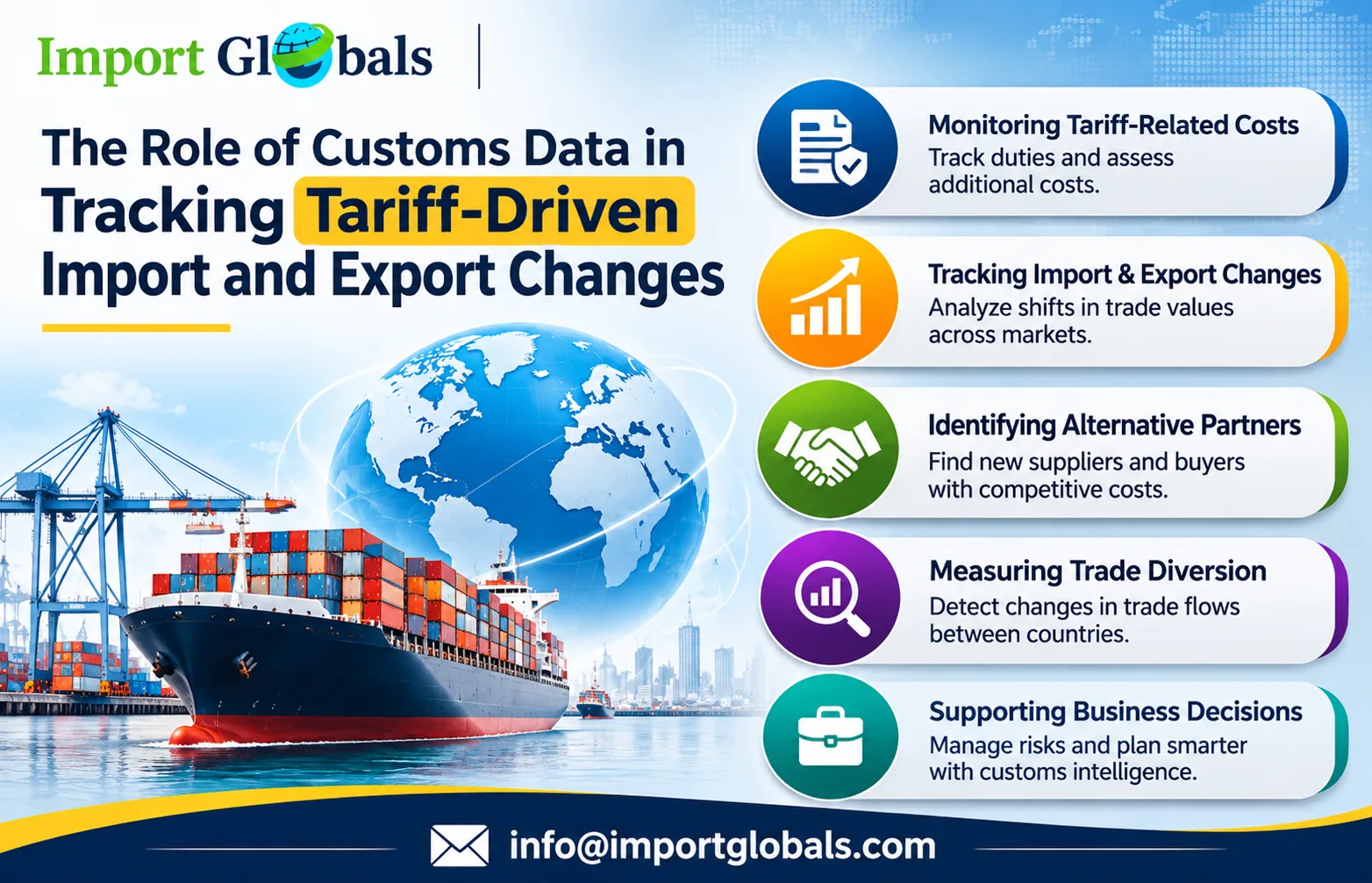
Customs information is an important element of evaluating the impact of tariff policies on trade, cost of goods, volume of cargoes, and relations with suppliers. By 2026, companies rely on dependable customs data to assess trade policies and to shape their global sourcing strategy.
1. Monitoring Tariff-Related Costs: This is because customs classification gives such information as products categorizations, value of cargo, country of origin and customs duties payable. For example, if a shipment worth US$1 million incurs 15% duty, an additional US$150,000 duty will be payable on the goods.
2. Tracking Changes in Import and Export Values: Monthly and annual customs statistics help the organizations to analyze trends in reduction of import, increase of export and shift to other suppliers. The WTO’s tariff and trade comparison tool enables comparison by product, trade partner and tariff.
3. Identifying Alternative Trading Partners: Higher tariffs could also lead importers to seek sources in countries with lower competitive landed costs. Valuable information from the customs office is in the location of exporters, comparison of shipment patterns and identification of new sources.
4. Measuring Trade Diversion: Chinese exports to the U.S. fell by roughly $104 billion between 2025 and 2024, the European Central Bank said. But exports from China to the eurozone had jumped by around $32 billion in the same period.
5. Supporting Business Decisions: “Companies can use customs intelligence to analyze tariff risk, validate classification, assess competition and manage logistics risk.
Emerging Trade Opportunities for Asian and Other Global Exporting Markets
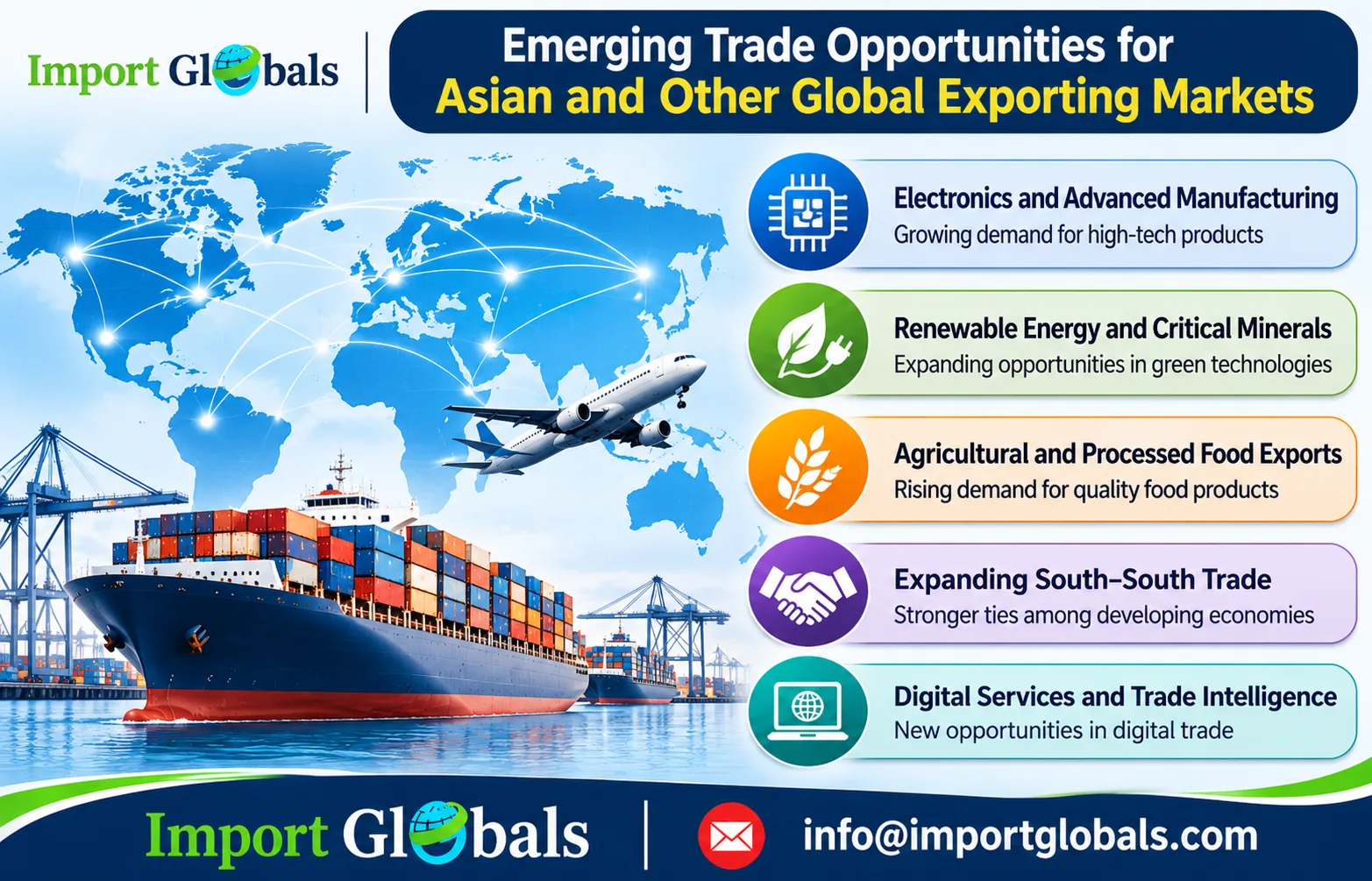
Asian and other global exporters are finding new prospects through the diversification of their supply chain operations, digital commerce, green energy and rising demand from developing economies at the year 2026. The ones who can find new places and know the requirements of the buyers will have an advantage in international business and exports.
1. Electronics and Advanced Manufacturing
China, South Korea, Japan, Taiwan, India and Vietnam remain major players in the global electronics and advanced manufacturing value chain. Semiconductors, electrical machinery, electronic parts and industrial machinery are some products with good growth opportunities.
2. Renewable Energy and Critical Minerals
The demand for solar products, batteries, components for electric vehicles and energy storage systems presents business opportunities for producers and providers of minerals. Exporters offering competitive prices and reliable production facilities and meeting environmental standards should consider partnerships with energy companies and industries around the world.
3. Agricultural and Processed Food Exports
Exporters of India, Thailand, Vietnam, Brazil etc. could explore the possibilities of exporting rice, spices, seafood, coffee, fruits, processed foods etc. In developing countries, there is a potential demand, but exporters have to comply with the standards related to food safety, labeling, etc.
4. Expanding South–South Trade
South-South trade has become very important. South-South merchandise exports were valued at roughly $6.8 trillion in 2025, and 57% of developing countries’ exports were to other developing economies. Thus, there is ample opportunity for companies in Asia, Africa and Latin America to build regional alliances.
5. Digital Services and Trade Intelligence
Exporters have alternatives to products through digital services, software, process outsourcing and online distribution. Import Globals’ import-export data and shipment insights allow companies to discover buyer activity, compare destinations, assess competitors and recognize trading partners.
Challenges for Importers and Exporters: Rising Costs, Compliance, and Market Uncertainty
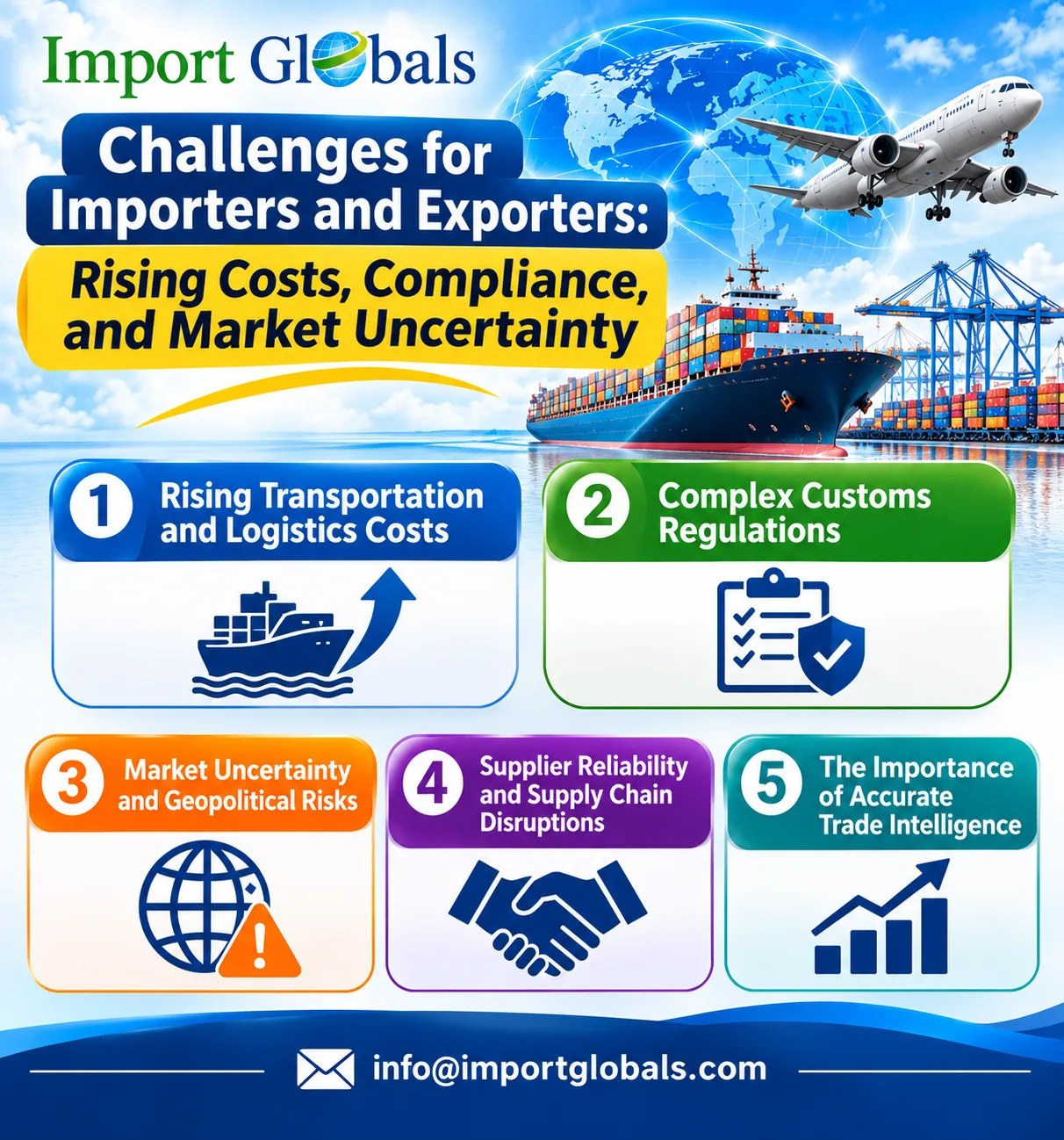
There are plenty of opportunities for companies wishing to extend their business, get more clients and enhance global supply chains by means of international trade. However, there are several difficulties facing importers and exporters, which can affect their profits, plans for expansion and ability to compete in international markets. Some of the major challenges affecting business transactions across the world include high operating costs, complex regulations and volatile markets.
1. Rising Transportation and Logistics Costs
Operators of international business suffer financially from higher freight rates, high fuel costs, high port charges and high warehousing costs. Transport costs can be raised by delays in shipment, lack of containers, and political instability. Importers may have to pay higher prices for procurement. Exporters may find it difficult to compete in foreign markets in terms of product pricing.
2. Complex Customs Regulations and Compliance Requirements
International business is very sensitive to change in the economic, political environment, exchange rate and change in policies. Trading bans, sanctions, high tariffs and regional tensions may affect international distribution suppliers and channels. The change of demand and prices may cause problems with forecasting in international business.
3. Market Uncertainty and Geopolitical Risks
Economic cycles, political relations, changes in exchange rates and government policies have a strong impact on world business operations. Barriers to trade, sanctions, higher tariffs and local disputes can interrupt current supplier relationships and logistics in international trade. Consumer demand and the price of commodities are unpredictable.
4. Supplier Reliability and Supply Chain Disruptions
One of the big problems is to have reliable suppliers and make sure the products are consistent. Late delivery of goods to the consumers may result from delays in production, shortages of raw materials and supplier disruption. "So businesses need to look at alternative channels for procurement.
5. The Importance of Accurate Trade Intelligence
Companies can use reliable information about global imports / exports, shipping records and market intelligence to identify alternative suppliers, track competitors, predict demand and identify new opportunities.
Future Outlook for North American–European Trade and the Role of Trade Intelligence
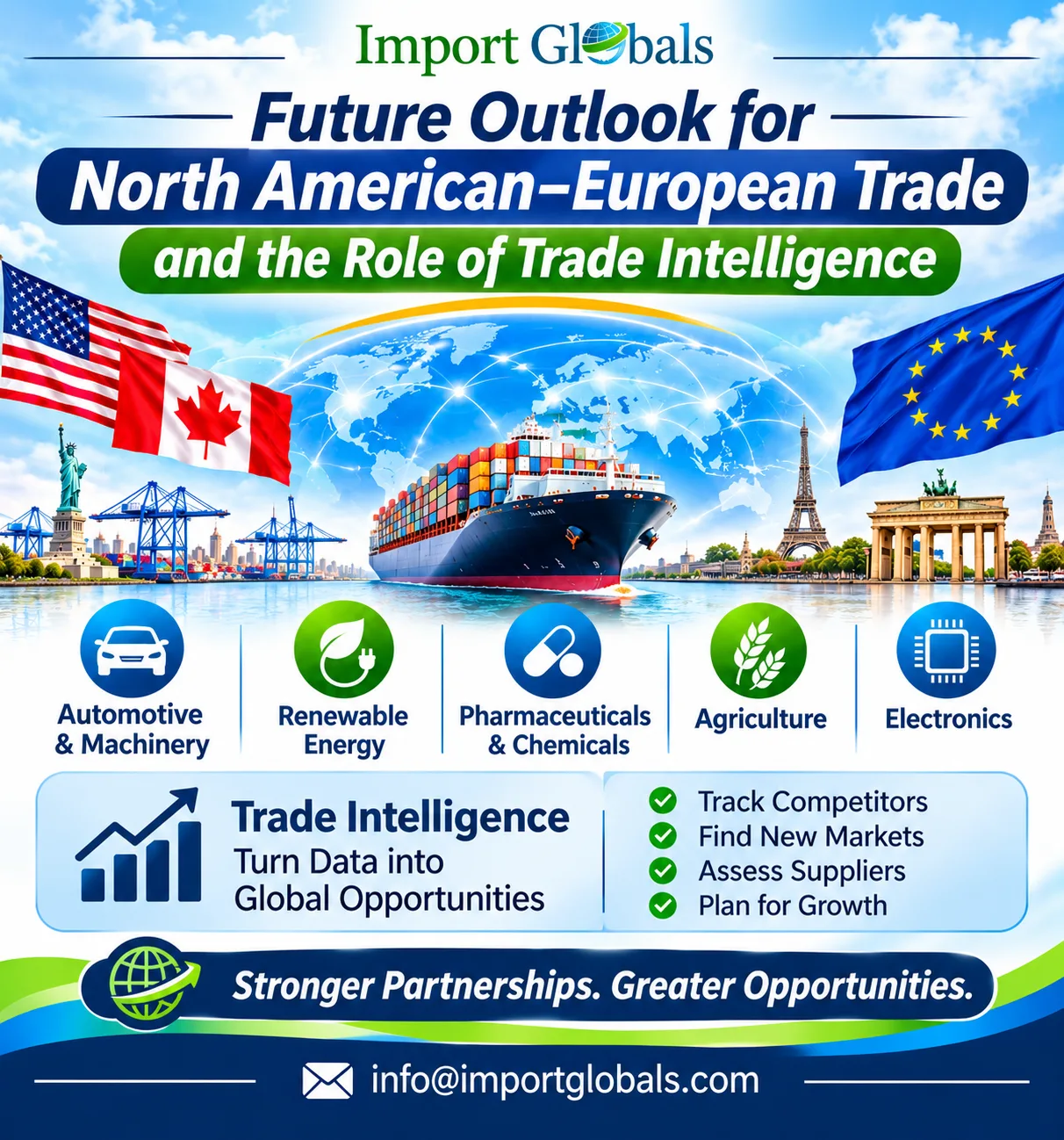
The future for North America-European Trade looks bright, continuing to benefit from increasing economic integration, advances in technology, industry and investment and the changing global supply chains. Important trading partners for European countries like Germany, France, the Netherlands, Italy and the UK are the North American countries USA, Canada and Mexico. Over the next few years, trade between the two regions will expand in sectors such as automotive parts, pharmaceuticals, machinery, electronics, renewable energy equipment, agriculture and chemicals.
One of the key factors that will shape the future development of trade is the growing demand for sustainable products and sustainable energy technologies. Both regions are launching initiatives in the area of electric vehicles, equipment for solar power generation, wind turbines, batteries and storage solutions and efficient equipment for industrial production. These trends will create more opportunities for exporters, importers, producers and international suppliers.
Some of the problems faced by organizations include fluctuating tariff policy, geo-political issues, high cost of transportation, different regulations, and supply chain disturbances. The businesses will need to have good information about the market to know about the possible threats.
That’s where trade intelligence will be crucial.” International import-export data, customs clearance information, Bill of Lading Data, commodity information through HS codes and supplier-buyer intelligence help organizations understand new trends in trade. By analyzing shipment sizes, import values, export destinations and competition activities, they can identify new markets and new business partners.
Moreover, trade intelligence allows companies to monitor competitors’ shipments, evaluate the reliability of suppliers, anticipate demand for products, and identify lucrative opportunities for market entry. This is possible by using trading platforms like Import Globals.
To summarize, the future of North American-European business is dependent on stronger partnerships, diversification of the supply chain, sustainable innovation, and data-driven business strategies. The companies that can seize the opportunity of international business and gather trade intelligence will have an easier path to growth and success.
Conclusion
Tariffs and trade policy changes are making trade between North America and Europe more and more complicated in 2026. This is a greater risk of cost pressure and supplier uncertainty that requires accurate market intelligence. “Those that analyze trade flows, tariffs and sourcing practices will be able to identify partners and adjust their strategies. North America And Europe Import Data With the Import Data, businesses will be able to analyze the market demands, suppliers, shipments and trade flow changes. Manage your global business strategy with Import Globals. Get smart import/export information about new opportunities and competitive moves. Make informed decisions.
CTA
Europe Import Data and North America Import Data, so that you can assess the effects of tariffs, spy on your competitors, discover new markets and sources. Discover powerful global trade intelligence at www.importglobals.com or connect with our team at [email protected] to explore how our data can support your business growth.
FAQs
Que. What causes trade friction between North America and Europe in 2026?
Ans. Tariffs, changing trade policies, geopolitics, and competition in industries cause trade friction.
Que. What role do tariffs play in trade between North America and Europe?
Ans. The tariffs increase the cost of imports, influence pricing of products, and make businesses rethink about their suppliers.
Que. In which industries are the trade policies changing?
Ans. There are changes in automotive, steel, aluminium, pharmaceuticals, machinery, electronics and agriculture industries.
Que. How are companies reacting to the new tariffs?
Ans. Firms diversify their suppliers, look for alternative markets, and adjust their strategies on supply chains.
Que. How do tariffs affect global trade flow?
Ans. The tariffs can change shipments, destination of sourcing and encourage firms to look for new business partners.
Que. Why is import/export data important in 2026?
Ans. The data will allow businesses to monitor shipments, find their suppliers and learn about international demand.
Que. How can Europe Import Data and North America Import Data help the businesses?
Ans. These datasets will help with analysis of trade patterns, competitive intelligence, sourcing and international demand.
Que. How can Import Globals support businesses facing trade friction?
Ans. Import Globals provides trade intelligence to help companies analyse global shipments, discover suppliers and make informed trade decisions.
Que. How frequently is North American and European import-export trade data updated?
Ans. North American and European import-export trade data is generally updated on a monthly basis, depending on the source and country.
Que. Where can you obtain detailed information on North American and European import-export trade data?
Ans. Visit www.importglobals.com or email at [email protected] for detailed information and updates on North American and European import-export trade data.
You Can Also Visit :-
