Malaysia Palm Oil Export Data: The Global Market Trends and Trade Analysis
- Jul 30, 2026
Malaysia Palm Oil Export Data: The Global Market Trends and Trade Analysis
Malaysia has consistently maintained its position as one of the leading palm oil exporters with an extensive supply rate of high-quality palm oil and palm-based products to hundreds of international markets.
The favourable tropical climate, modern plantation management, efficient refining industry, and government-backed agricultural policies have supported the trade of edible oils worldwide from the country. As reported by Malaysia Export Data, palm oil is one of the significant factors that is generating the majority of the export revenue of the nation. Malaysia has continuously been investing in sustainable plantation management, downstream processing facilities, and logistics infrastructure.
Malaysian palm oil has mainly become known for its consistent quality, competitive pricing, and reliable supply chain, along with a well-developed export ecosystem. Different exporters, importers, manufacturers, distributors, and sourcing agencies are utilizing Malaysia Palm Oil Export Data to get reliable access to shipment-level customs intelligence covering exports to major international destinations. The customs database enables businesses to identify verified overseas buyers, evaluate supplier networks, and analyse shipment records. The data set overall helps the authorities in reducing commercial risk with proper support for international expansion.
Why is Malaysian Palm Oil in Demand Globally?
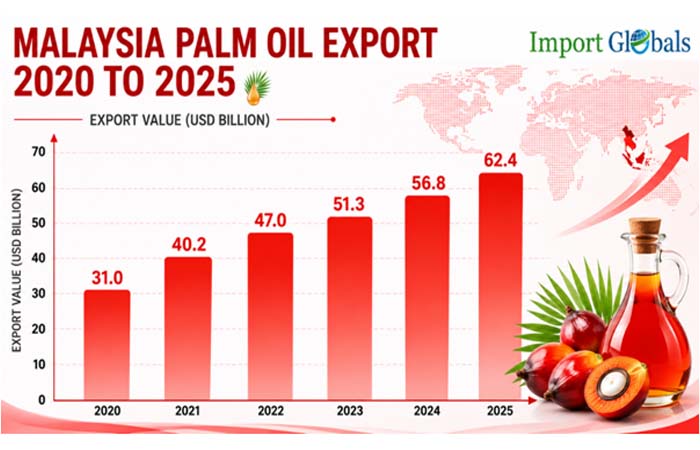
Malaysia has been continuously dominating the international palm oil industry because of the advanced agricultural practices, efficient refining facilities, and strong logistic infrastructure. Palm oil is widely used across multiple industries mainly because of its high productivity and wide range of industrial applications. Different factors supporting the palm oil exports of Malaysia in 2025 are large-scale commercial plantations, competitive production costs, strong government support, sustainable plantation management initiatives, well-developed port and logistics infrastructure, rising biodiesel consumption, and expansion of processed food manufacturing.
Malaysia Export Trade Data reported that the international demand for palm oil has been continuously increasing, which has helped manufacturers maintain a stable income rate. Palm oil is widely used in cooking oils, margarine, bakery products, and confectionery for sustainable trade. The versatility of palm oil has enabled the authority to build long-term trade relationships with numerous importing countries.
Top Malaysian Palm Oil Importers
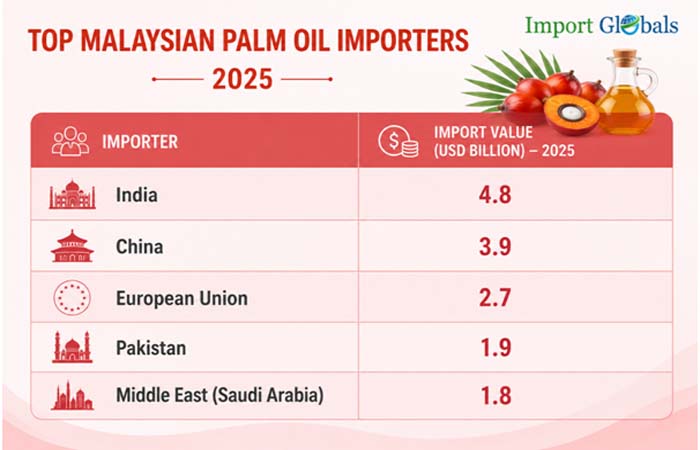
- India - It is one of the top importers of Malaysian palm oil in 2025, holding a valuation of 4.8 billion US dollars of trade. Crude palm oil, refined palm oil, cooking oils, and bakery fats are the latest traded variants. The rapidly growing population and the expanding food processing sector have supported the strong bilateral trade.
- China - Malaysia's latest palm oil trade to China was valued at 3.9 billion US dollars in 2025, according to China Import Data. The proper trade of Oleochemicals, industrial palm derivatives, and cosmetics manufacturing has continuously driven the long-term demand rate.
- European Union - The palm oil exports to European countries from Malaysia are 2.7 billion US dollars in 2025. The sustainability in trade regulations and the import of refined palm oil and specialty fats have maintained the renewable energy applications trade.
- Pakistan - Pakistan has imported palm oil worth 1.9 billion US dollars in 2025. Refined edible oils, cooking oils, and crude palm oil have supported the import of food manufacturers and domestic distributors.
- Middle East - Saudi Arabia import data reported itself as one of the top importing authorities of Malaysia's palm oil from the Middle Eastern region. The country has recorded a total import valuation of 1.8 billion US dollars in 2025. The regional imports, including processed food ingredients, bakery fats, and confectionery oils, have maintained the household consumption rate.
Latest Palm Oil Products Exported by Malaysia
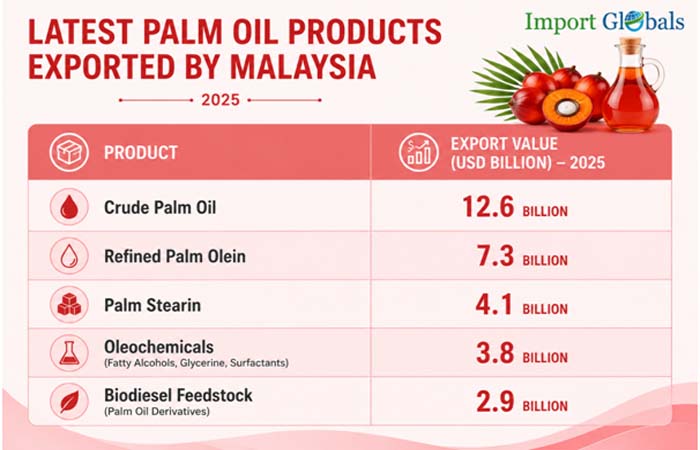
- Crude Palm Oil - Crude palm oil is one of the top exported variants of Malaysia. The specific commodity has been serving as one of the primary raw materials for refining industries.
- Refined Palm Olein - Malaysia's top palm oil exports include refined palm olein. The overall trade of commercial food processing, restaurants, and packaged food has maintained excellent cooking properties and affordability.
- Palm Stearin - Palm stearin is also a significantly used ingredient in margarine manufacturing. The proper hike in the global demand has increased the trade expansion mainly because of the expanding industrial applications.
- Oleochemicals - The significant export of palm oil from Malaysia includes Oleochemicals as one of the top traded commodities. Fatty alcohols, glycerine, and surfactants are the latest variants traded.
- Biodiesel Feedstock - The emphasis of the Malaysian authorities on renewable energy has increased the export of palm oil derivatives. Different countries have been continuously importing Malaysian feedstock’s to support the sustainable fuel programs.
Industries Facilitating Malaysia's Palm Oil Export
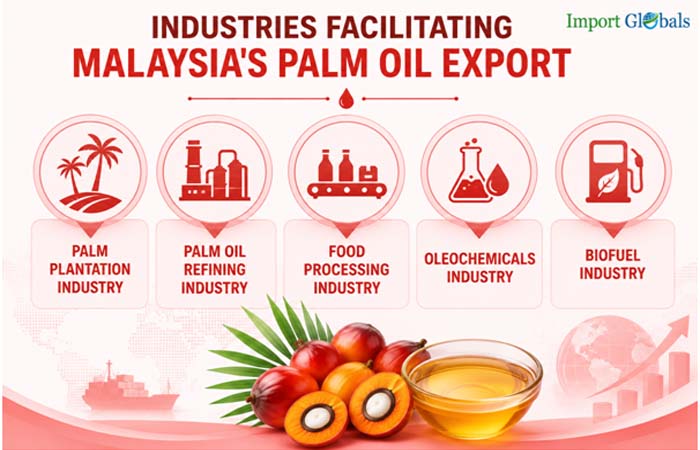
- Palm Plantation Industry - The palm plantation industry is one of the significant backbones of Malaysia's palm oil export growth rate. The continuous investment in improved seed varieties, mechanized harvesting, and agricultural practices has increased plantation productivity.
- Palm Oil Refining Industry - Malaysia has established itself as one of the most advanced refining industries. The premium quality palm oil products have been considered satisfactory for traditional food safety. The continuous investment in refining technology has supported value-added exports.
- Food Processing Industry - The food manufacturers' processing of palm oil into margarine, bakery fats, and chocolates has supported the effective trade of palm oil from the Malaysian authorities. The trade of packaged foods has supported the export worldwide.
- Oleochemicals Industry - Palm-derived Oleochemicals are one of the top traded variants of Malaysia's export portfolio, says Malaysia Trade Data. The supply rate of raw materials used in soaps, detergents, and cosmetics has maintained the overall trade solidification.
- Biofuel Industry - The proper expansion of the biodiesel sector is backed up by the government-supported renewable energy programs. The growing biodiesel production has strengthened the export of palm oil feedstock while creating new opportunities.
Why is Malaysia Palm Oil Export Data Important for Market Research?
Malaysia Palm Oil Trade Data is considered a valuable tool for market research. The database overall helps the authorities with exporter name, importer name, product description, HS code, and shipment volumes. Businesses looking for accurate Malaysia trade intelligence can properly identify the verified overseas buyers along with proper evaluation of supplier performance and analysis of competitors. The shipment-level customs intelligence supports informed commercial decisions with the proper reduction in procurement risk.
The importers can compare their supplier performance while supporting the trade through logistics companies and other trade patterns. The businesses looking for accurate Malaysia travel intelligence can properly identify the verified overseas buyers for maintaining the evaluation of the supplier performance along with analysis of competitors and monitoring of pricing trends. The shipment-level customs intelligence supports informed commercial decisions while reducing procurement risk and improving international business expansion.
Reasons Behind Malaysia's Palm Oil Export Success
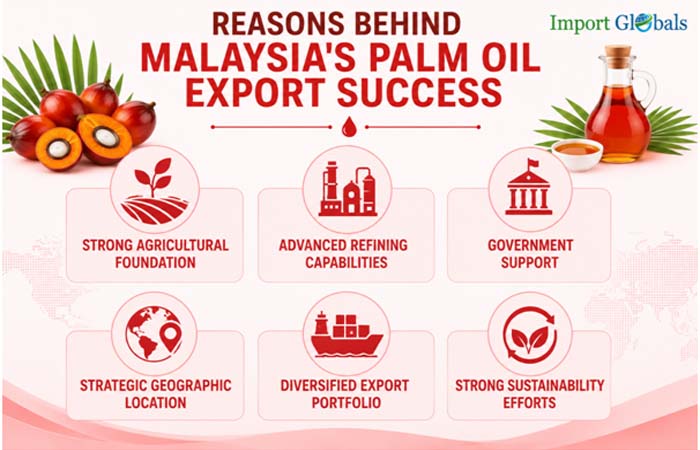
- Strong agricultural foundation - The decades of experience of the Malaysian authorities, as reported by Malaysia Trade Statistics, in cultivation supported by scientific research and skilled labour has supported efficient plantation management.
- Advanced Refining Capabilities - The modern refining technology has enabled Malaysian exporters to manufacture premium quality products to meet the strict international standards and customer specifications.
- Government Support - The government initiatives promoting sustainable production and plantation development have strengthened Malaysia's competitiveness. The export incentives, research programs, and customs modernization have supported the overall trade of the Malaysian authorities.
- Strategic Geographic Location - Malaysia's location along major international shipping routes has maintained the connectivity of the country to Asian, Middle Eastern, European, and African markets while reducing transportation costs.
- Diversified Export Portfolio - The export of crude palm oil, refined palm oil and specialty fats from Malaysia has reduced the dependence of the nation on a single product category while supporting the overall trade.
- Strong Sustainability Efforts - The adoption of sustainable certification programs has improved Malaysia's reputation as a top environmentally conscious supplier to international buyers. It has overall supported long-term export growth.
Market Opportunities for Businesses

- Food Manufacturing - The global food manufacturers have continuously been creating significant palm oil trade opportunities. With consistent quality, affordability, and reliable supply, the opportunities exist mainly for wholesalers, distributors, retailers, and packaged food companies.
- Cosmetics and Personal Care - The palm oil trade of the country is mainly derived from soaps, shampoos, lotions, skincare products, and personal care formulations. The rising consumer demand has continued to support imports.
- Renewable Energy - The proper hike in the biodiesel mandates has continuously created opportunities for exporters. This has ensured a reliable supply of fuel feedstock to energy producers.
- Industrial Manufacturing - The palm oil derivatives are getting increasingly utilized with effective trade from lubricants, candles, cleaning chemicals, plastics, and pharmaceuticals. The expansion of export opportunities beyond food products has supported the overall trade.
- Supply Chain Services - The increasing export volumes have generated significant opportunities for freight forwarders. The shipping companies and insurance firms have overall supported the trade finance institutions while supporting international commerce.
Future Outlook of Malaysia's Palm Oil Exports
Malaysia's palm oil export industry is highly positive mainly because of the renewable fuels, processed food ingredients, and industrial raw materials trade across different regions, as reported by Malaysia's Export Statistics. The continuous investment in sustainable plantation management and downstream manufacturing has strengthened Malaysia's competitiveness for the future. Supply chain diversification, technological innovation, and artificial intelligence have improved operational efficiency while reducing delivery times.
The international manufacturers have continuously promoted the country's image as a dependable sourcing destination. The emerging markets across Africa, South Asia, and Latin America have significantly contributed to the future demand rate. The expanding downstream manufacturing has allowed Malaysia to increase exports of higher-value refined products without reliance on crude palm oil exports. The shipment-level palm oil export data is becoming increasingly valuable for exporters, importers, and manufacturers as it helps market research firms seek verified buyers with competitor intelligence and supplier evaluation.
Conclusion
Malaysia has continuously been expanding its role as one of the strongest palm oil exporting nations. The advanced refining capabilities, sustainable production practices, and reliable international supply chain have maintained effective trade. The rising demand from food processing, cosmetics, pharmaceuticals, and renewable energy has continuously supported the export growth rate. The government-backed industrial development and modern logistics programs have maintained downstream manufacturing investment while strengthening the country's competitiveness.
The shipment level of Malaysia Palm Oil Export Data enables businesses to identify verified international buyers and evaluate suppliers' strategies. International trade has become increasingly data-driven, and customs intelligence has been essential for businesses looking for long-term growth. It reduces commercial risk and supports the successful expansion of trade into new global markets.
CTA
Looking for expansion in your international trade business, you have landed at the right platform here. Import Globals is skilled in providing detailed shipment-level intelligence on Malaysia's palm oil exports. The database helps exporters with the latest acknowledgment of sourcing agencies and market research firms. Subscribe to www.importglobals.com or drop an email at info@importglobals.com to get reliable access to the detailed Malaysia Palm Oil Export Data to accelerate your global business growth.
FAQs
Que. Which country is the top importer of Malaysian palm oil?
Ans. India is one of the top importers of Malaysian palm oil.
Que. Name the top palm oil exported from Malaysia.
Ans. Crude palm oil, refined palm oil, and palm stearin are the top palm oils exported from Malaysia.
Que. How does Malaysia palm oil export data support business growth?
Ans. Malaysia palm oil export data supports business growth via proper identification of buyers, supplier analysis of market demand, and development of effective market expansion strategies.
Que. What information is available in Malaysia export data?
Ans. Malaysia export data covers Importer names, Exporter names, Shipment date, HS Code, Product Details, quantity, values, pricing information, origin country, importing country & port details.
Que. What is Malaysia's global position in the palm oil trade
Ans. Malaysia is the second-largest palm oil exporter in 2025.
Que. Name the topmost beneficiaries of Malaysia export data.
Ans. Exporters, importers, manufacturers, and sourcing agencies are the topmost beneficiaries of Malaysia export data.
Que. How frequently is Malaysia Import Data updated?
Ans. Malaysia Import Data is updated on a monthly basis.
Que. Why is shipment-level customs intelligence important?
Ans. Malaysia customs data is important because it helps the authorities with the latest acknowledgment of the shipment values and pricing trends.
Que. How does Import Globals support international market expansion?
Ans. Import Globals helps businesses with proper identification of verified buyers and evaluation of suppliers, along with monitoring of competitors and analysis of shipment-level customs intelligence.
Que. Where can businesses obtain detailed Malaysia palm oil export data?
Ans. Visit www.importglobals.com or drop an email at info@importglobals.com for reliable access to Malaysia palm oil export data.
You Can Also Visit :-