
Top 10 Plastic Products Exported Worldwide in 2025: HS Codes and Export Values

- Oct 29, 2026
- 37 Views
Top 10 Plastic Products Exported Worldwide in 2025: HS Codes and Export Values
In 2025, plastics remained a key player in international trade, supporting industries ranging from packaging to automotive, construction, electronics, healthcare and consumer goods. Polyethylene (PE), polypropylene (PP), polyvinyl chloride (PVC) and polyethylene terephthalate (PET) continued to be an important raw material for plastic manufacturers worldwide. Commodities traded included finished products such as plastic packaging, pipes, sheets, films, containers and industrial parts.
China, Germany, the United States, South Korea and Japan are all major manufacturing economies and key nodes in global plastics supply chains. Export performance has been affected by production capacity, raw material prices, energy costs, logistic costs and demand in importing markets. The development of manufacturing centers also helped trade because there were more places to sell goods and goods were less competitive.
By 2025 sustainability was a big consideration. Environmental regulations, recycled-content mandates and circular-economy initiatives have pushed exporters to look for recyclable materials and sustainable packaging solutions. But volatile petrochemical prices, trade restrictions and changing consumer tastes continued to buffet the industry.
Exporting and importing firms use data to identify suppliers and evaluate export markets. The International Import Export Shipments Data contains shipment level data. World Trade Data, World Trade Statistics. Study HS codes, export value, market demand & potential buyers. Import Globals provides companies with an opportunity to explore the global markets and make informed decisions on sourcing and exporting.
Top 10 Plastic Products Exported Worldwide in 2025: HS Codes and Export Values
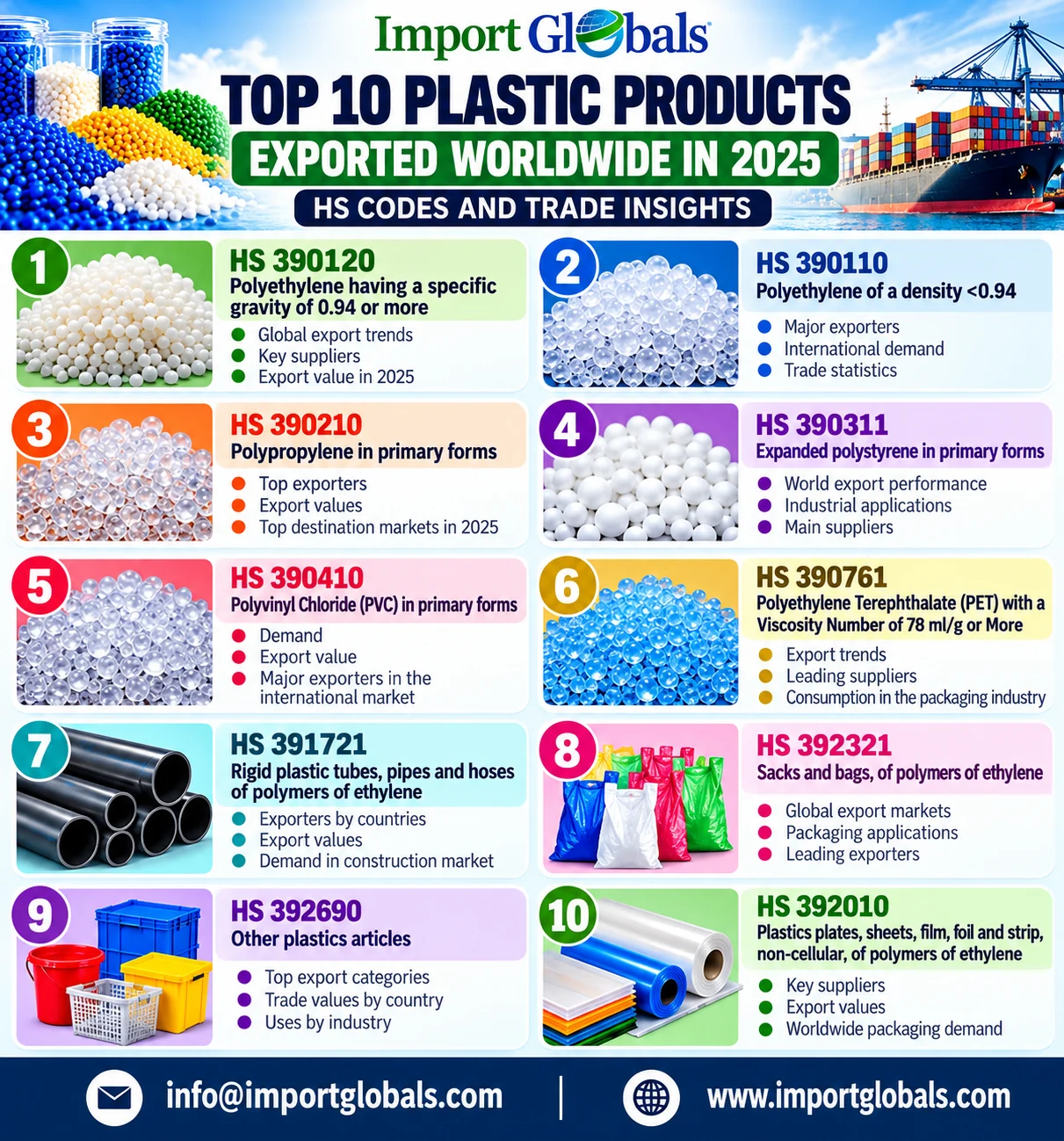
1. HS 390120 – Polyethylene having a specific gravity of 0.94 or more: Global export trends, key suppliers and export value, 2025.
2. HS 390110 - Polyethylene of a density <0.94: Major exporters. International demand and trade statistics.
3. HS 390210 – Polypropylene in primary forms: Top exporters, export values and top destination markets in 2025.
4. HS 390311 - Expanded polystyrene in primary forms: World export performance, industrial applications and main suppliers.
5. HS 390410 - Polyvinyl Chloride (PVC) in Primary Forms Demand, export value and major exporters in the international market.
6. HS 390761 - Polyethylene Terephthalate (PET) with a Viscosity Number of 78 ml/g or More: Export Trends, Leading Suppliers and Consumption in the Packaging Industry.
7. HS 391721 – Rigid Plastic Tubes, Pipes and Hoses of Polymers of Ethylene: Exporters by countries, export values and demand in construction market.
8. HS 392321 – Sacks and Bags, of Polymers of Ethylene: global export markets, packaging applications and leading exporters.
9. HS 392690 - Other Plastics Articles Top export categories, trade values by country, and uses by industry.
10. HS 392010 - Plastics plates, sheets, film, foil and strip, non-cellular, of polymers of ethylene: Key suppliers, export values and worldwide packaging demand.
Leading Plastic Exporting Countries and Their Global Market Shares
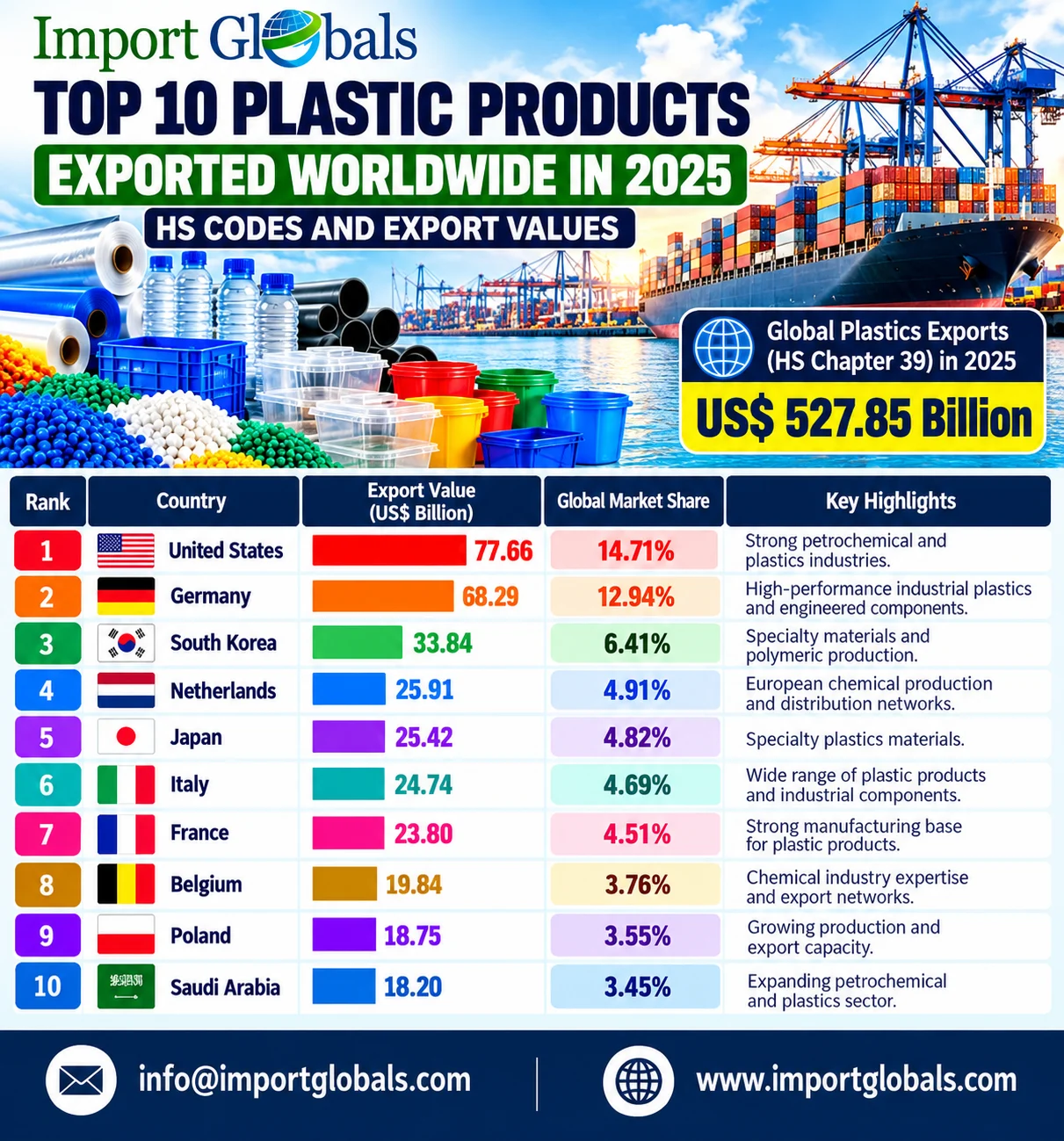
In 2025, world exports of Plastics and articles thereof (HS Chapter 39) totaled some US$ 527.85 billion. The supply base is global and diverse. The following figures show main exporters and their share of world recorded exports.
1. United States - Exports US$77.66 billion which represents 14.71% of the total exports registered in the world. The petrochemical and plastics industries are significant in the United States.
2. Germany - $68.29 billion (12.94% of total export). Top products included high-performance industrial plastics and engineered components.
3. South Korea - 6.41% Specialty materials and polymeric production Exports US$33.84 billion.
4. Netherlands - $25.91 billion (4.91% of total U.S. exports) European chemical production and distribution networks.
5. Japan - $25.42 billion (4.82% of total exports) Specialty plastics materials.
6. Italy - US$24.74 billion (4.69%).
7. France - Accounted for US$23.80 billion, or 4.51% of the total.
8. Belgium - 19.84 billion US$ 3.76% Total export.
9. Poland - US$18.75 billion (3.55%).
10. Saudi Arabia - $18.20 billion (3.45% of total exports).
Major Importing Countries for Plastic Products in 2025
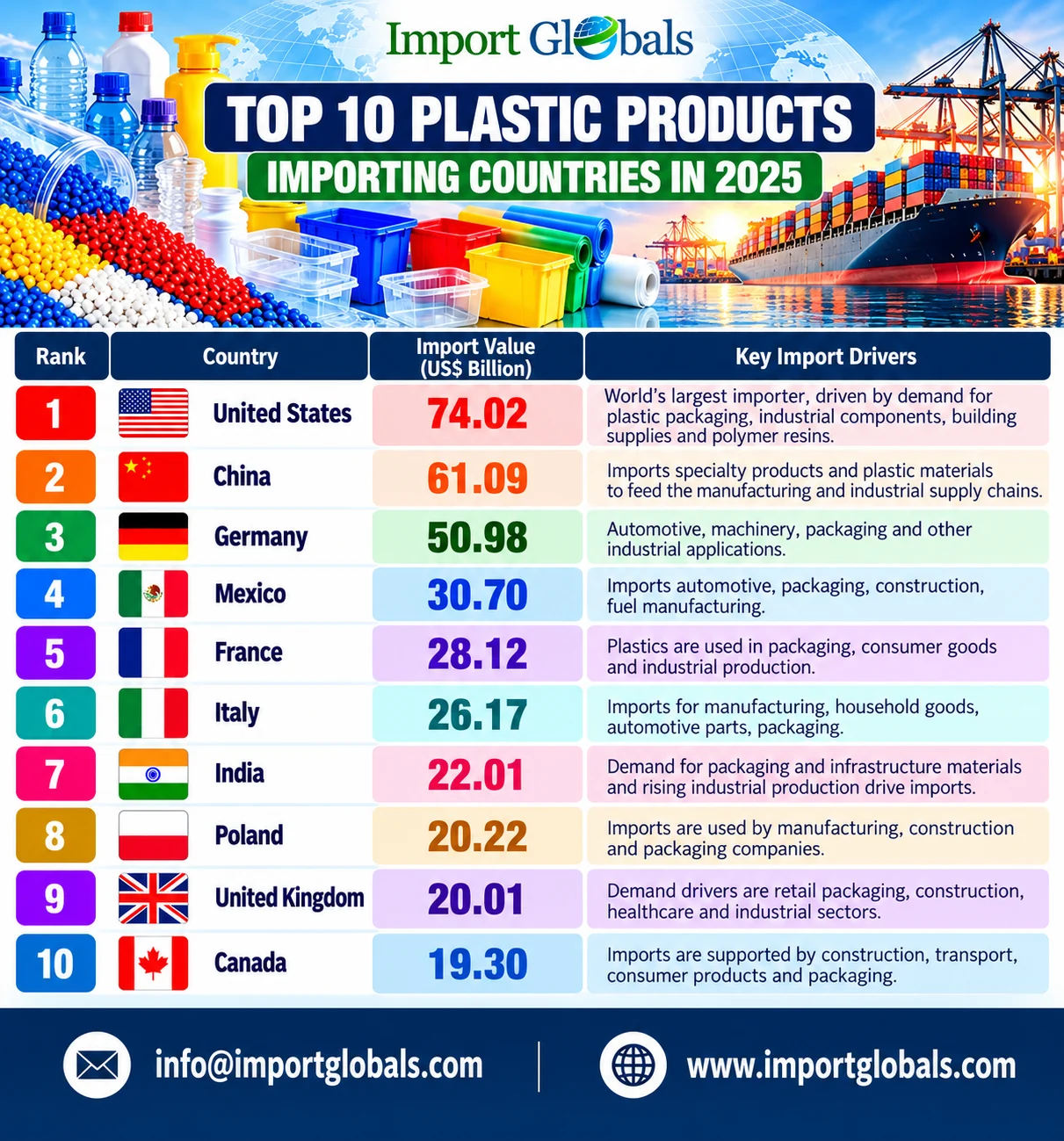
Imports of plastics and articles thereof (HS Chapter 39) are high globally and support industries such as packaging, automotive, construction, electronics, healthcare and consumer goods. 2025. The trade statistics showed that world imports were about US$709 Billion. Its main markets of import were US, China and Germany.
World Top 10 Plastic Importers 2025
1. United States - US$74.02 Billion : The world's largest importer ever, driven by demand for plastic packaging, industrial components, building supplies and polymer resins.
2. China – US$61.09 Billion : China imports specialty products and plastic materials to feed the manufacturing and industrial supply chains.
3. Germany – US$50.98 Billion : Automotive, machinery, packaging and other industrial applications need.
4. Mexico – US$30.70 Billion : Imports automotive, packaging, construction, fuel manufacturing.
5. France - US$28.12 Billion : Plastics are used in packaging, consumer goods and industrial production.
6. Italy – US$26.17 Billion : Imports for manufacturing, household goods, automotive parts, packaging.
7. India - US$22.01 Billion : Demand for packaging and infrastructure materials and rising industrial production drive imports.
8. Poland — US$20.22 Billion : Imports are used by manufacturing, construction and packaging companies.
9. United Kingdom – $20.01 Billion : Demand drivers are retail packaging, construction, healthcare and industrial sectors.
10. Canada – $19.3 Billion : Imports are being supported by construction, transport, consumer products and packaging.
Plastic Raw Materials and Polymers: Key Export Categories and Trade Values
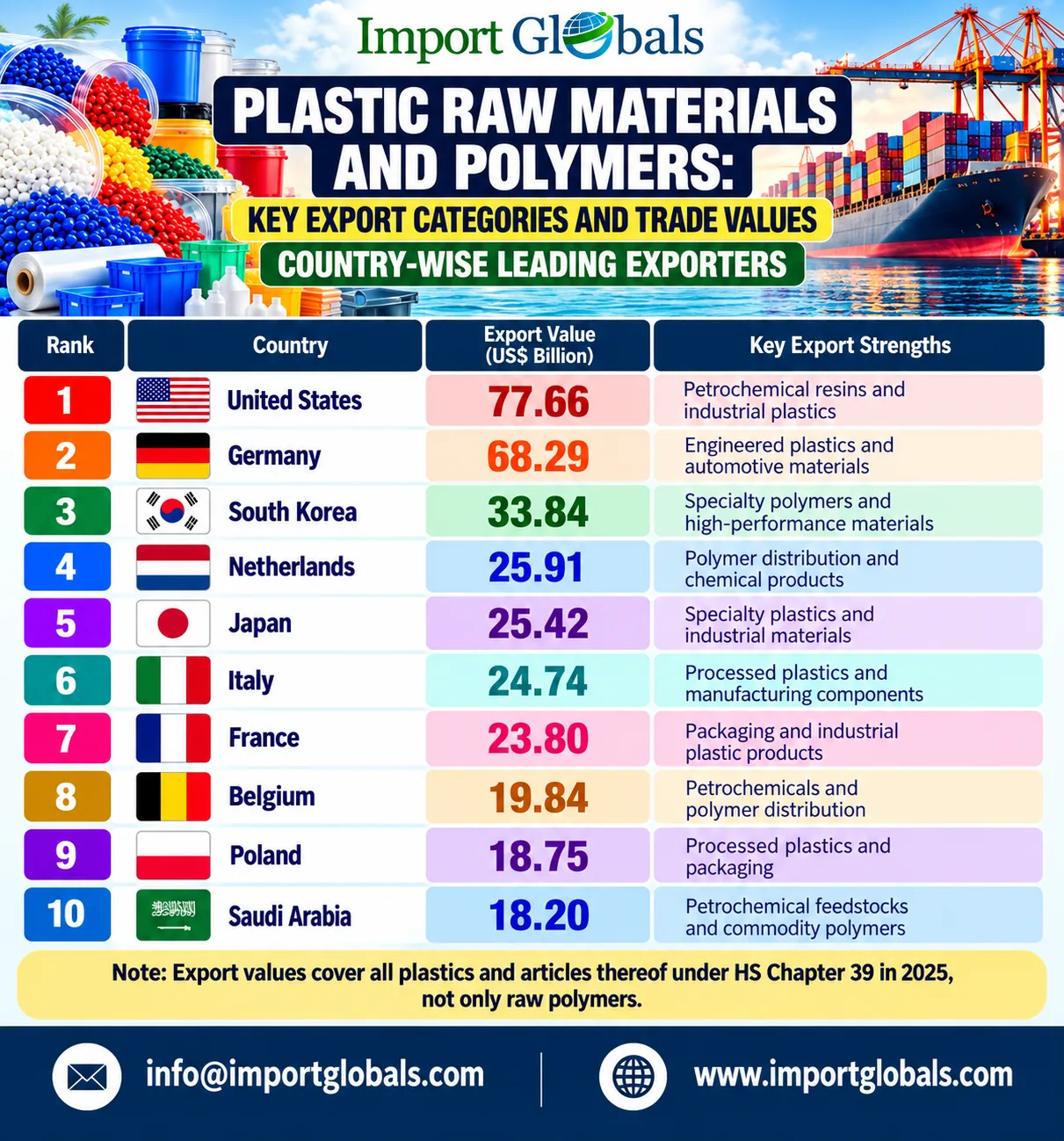
The United States and Germany were the world’s largest exporters of plastics and articles thereof (HS Chapter 39) in 2025. They export raw polymers and finished plastic products, so the figures below cover not only export of raw polymers.
Plastic Packaging Products: Global Export Demand and Major Markets
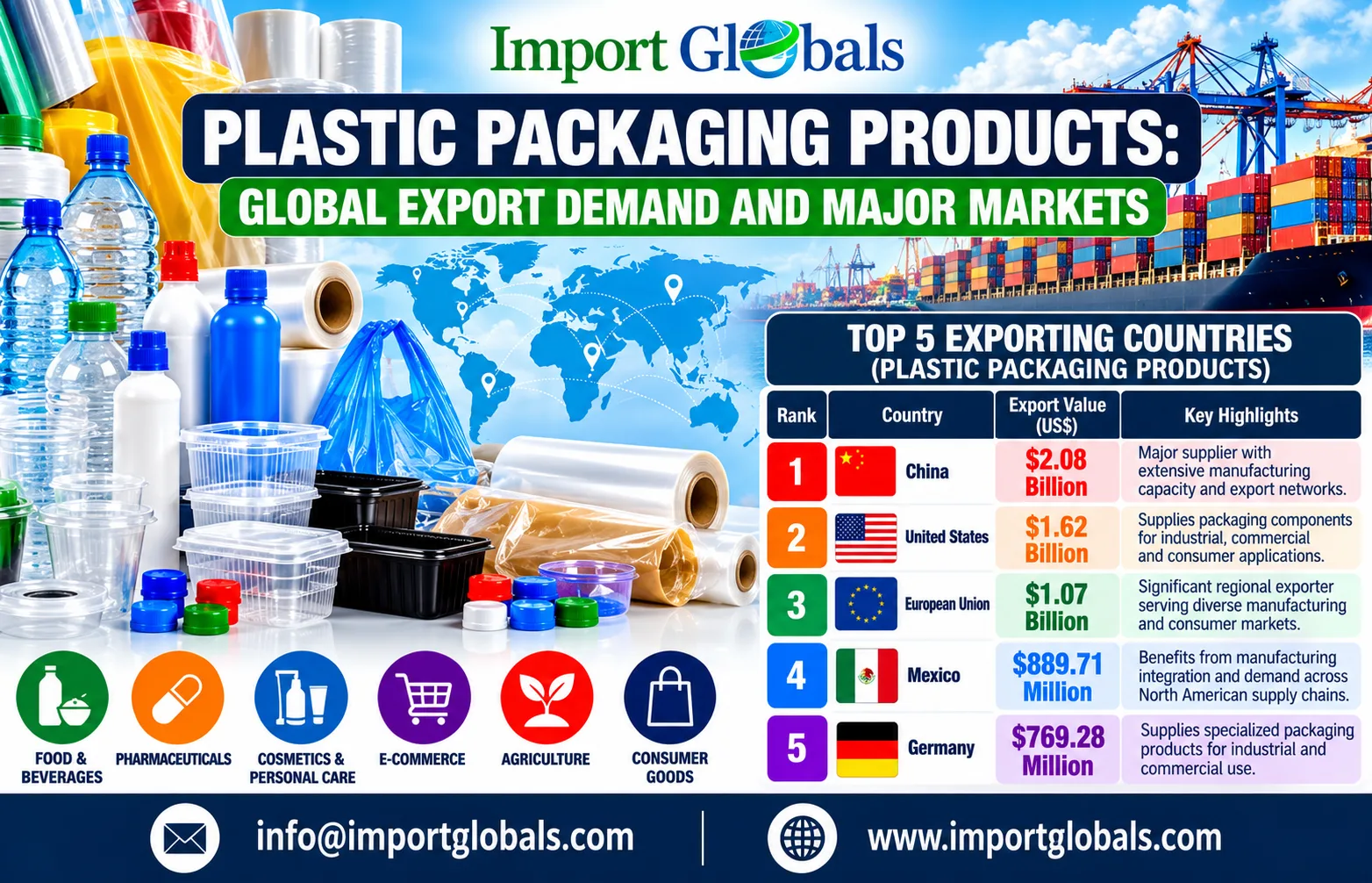
Plastic packaging products are at the heart of world trade and are used in many industrial sectors including food and beverage, pharmaceuticals, cosmetics, personal care, e-commerce, agriculture and consumer goods. The 2025 demand for plastic packaging was driven by the need for lightweight, durable, moisture resistant and affordable materials to protect and transport goods through global supply chains.
Its main exports include plastic bottles and containers, boxes and crates, sacks and bags, caps and lids and closures and protective packaging materials. Products are assigned to a number of Harmonized System (HS) codes, the most important of which is HS 3923 for articles of plastic used for conveying or packing goods, including stoppers, lids, caps and other closures.
Top Exporting Nations and Trade Value
1. China – US$2.08 Billion : China is the world’s largest exporter of plastic articles for packaging with well developed production and export networks.
2. United States – $1.62 Billion : Provides some components for industrial, commercial and consumer packs.
3. EUROPEAN UNION - $1.07 Billion : Broad based regional exporter to a wide range of manufacturing and consumer markets.
4. Mexico – US$889.71 Million : It benefits from manufacturing integration and demand from North American supply chains.
5. Germany – US$769.28 Million : Provides specialized packaging products to industrial and commercial sectors.
The figures are for HS 392390 only not the entire plastic packaging industry.
Leading Import Markets & Perspective
Packaging suppliers will have opportunities in the US, Germany, France, UK and other large manufacturing and consumer economies. Demand is being driven by retail growth, pharmaceutical distribution, food safety requirements and cross-border e-commerce. However, sustainability regulations, policies to reduce plastic waste and recycling mandates are driving manufacturers toward recyclable packaging and alternate materials.
Import Export Worldwide Data helps companies find buyers, compare suppliers, examine trade values at the HS code level and explore new markets. So, Import Globals is helping companies to make better exporting decisions, by making them knowledgeable about international trading flows.
Industrial Plastic Products: Pipes, Sheets, Films and Components
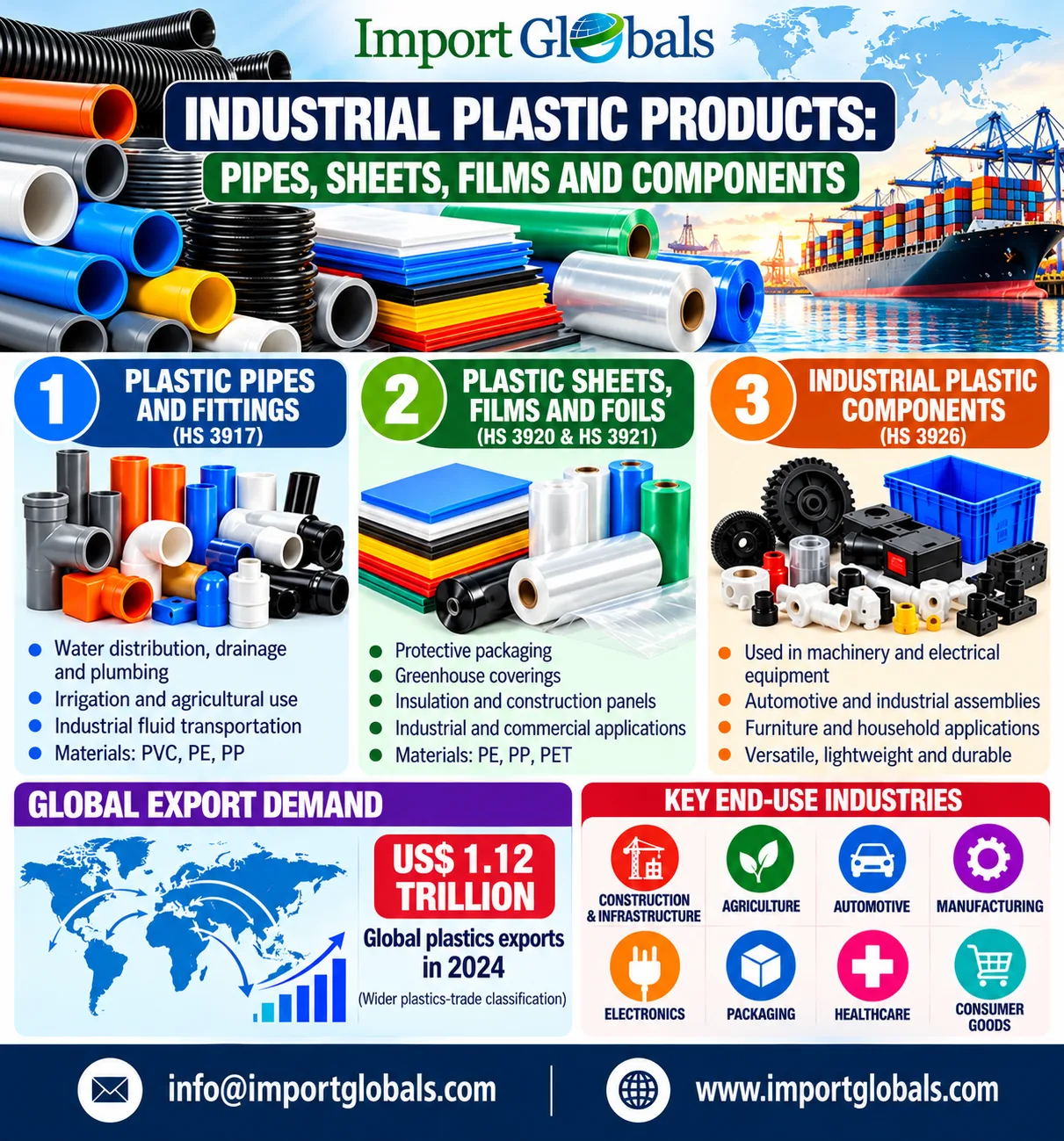
Plastic goods used in industry are important to global manufacturing, construction, infrastructure, packaging, automotive fabrication, electronics and agriculture. They are versatile, light weight, resistant to corrosion and durable and as such can be used as suitable replacement materials for certain metals, glasses and traditional building materials. Infrastructure development, industrial growth and the need for low-cost components are driving global demand.
Major Industrial Plastic Product Categories
1. Plastic Pipes and Fittings (HS 3917)
Plastic pipes, tubes, hoses and fittings are commonly used in water distribution, drainage, irrigation, plumbing and industrial fluid transfer. Common materials are polyvinyl chloride (PVC), polyethylene (PE) and polypropylene (PP). These products are used in the construction projects and in the agricultural irrigation systems.
2. Plastic Sheets, Films and Foils (HS 3920 and HS 3921)
Plastic sheets and films are used for protective packaging, greenhouse covers, insulation, building panels, and in manufacturing processes. Polyethylene, polypropylene and PET films are industrially and commercially important. Reinforced and laminated products are used for special packaging and engineering applications.
3. Industrial Plastic Components (HS 3926)
This category covers a range of plastic products for machines, electrical equipment, automotive systems, furniture and industrial assemblies. These components are valuable to manufacturers for their versatility, low weight and ability to be molded into complex shapes.
Global Export Demand and Trade Opportunities
International trade in plastics comprises raw polymers, intermediates and finished products. Global plastics exports under UN Trade and Development’s broader plastics-trade classification were about US$1.12 trillion in 2025, the report said. This measure covers a broader set of plastic-related goods and should not be confused with exports under HS Chapter 39 only.
Companies can research HS codes, supplier countries, destination markets, and shipment trends to identify commercial prospects. Import Globals allows companies to leverage trade intelligence to investigate trade flows and make informed sourcing and export decisions.
Factors Driving Global Plastic Exports in 2025
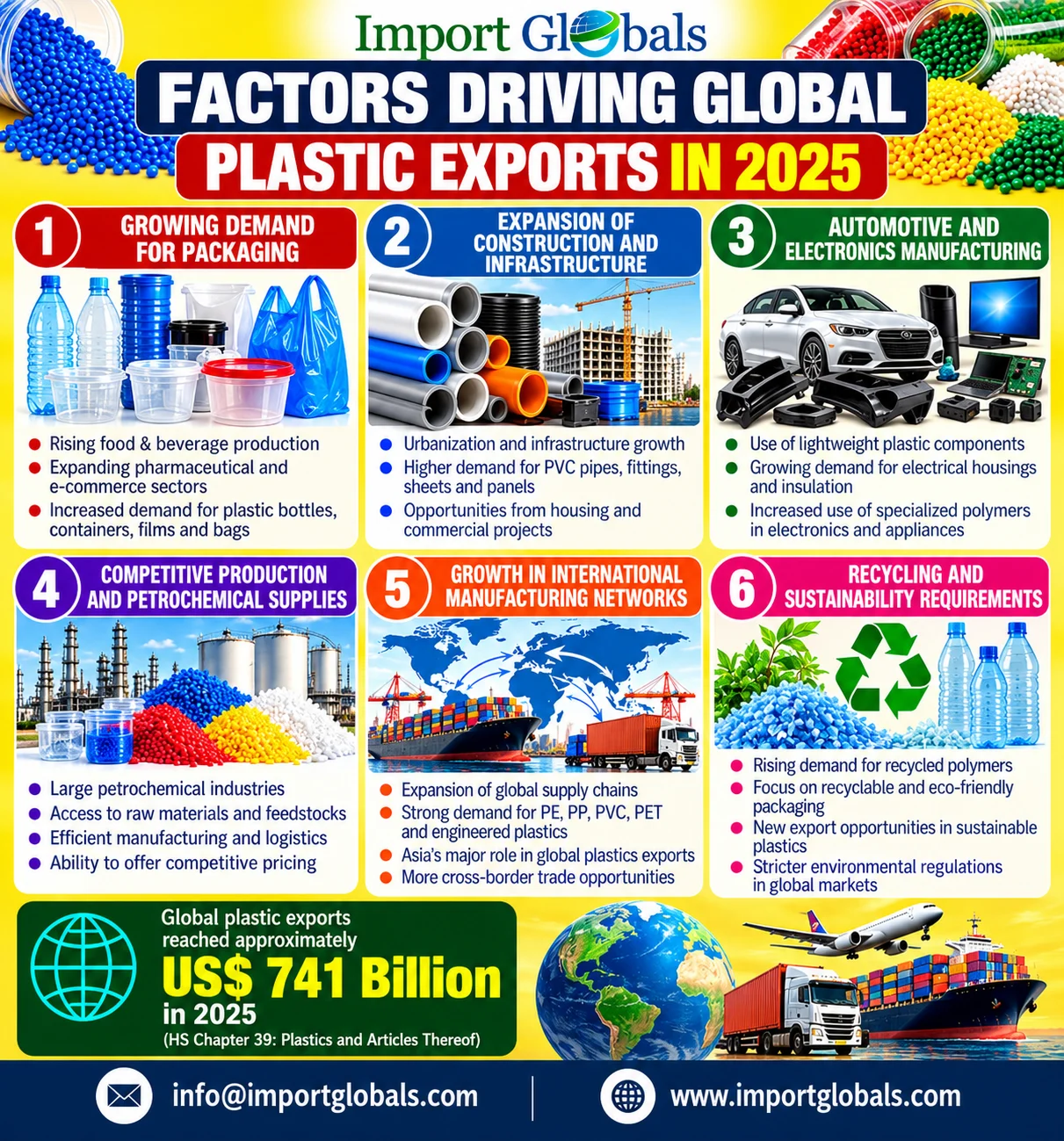
Plastics were still a major global export commodity in 2025 supporting international trade and boosting industries including packaging, construction, automotive, healthcare, electronics and agriculture. The International Trade Center indicates that in 2025, global exports of HS Chapter 39 (Plastics and Articles Thereof) amounted to approximately US$741 billion.
1. Growing Demand for Packaging
Plastic bottles, containers, films, bags and protective packaging are part and parcel of the food and beverage production, pharmaceuticals, e-commerce and consumer goods. There is good demand for light weight and durable packaging materials from the export houses.
2. Expansion of Construction and Infrastructure
The demand for PVC pipes, plastic fittings, insulation materials, sheets and panels is driven by urbanization and infrastructure development. Manufacturers supplying water systems, housing and commercial projects will benefit from emerging markets.
3. Automotive and Electronics Manufacturing
Plastics are used by automakers to make cars lighter, and to build interior parts, electrical housings and insulation. Also important are specialized polymers in the casings and components of the electronics manufacturers.
4. Competitive Production and Petrochemical Supplies
Countries with large petrochemical industries, available feedstocks, efficient manufacturing plants and established shipping networks can offer competitive prices for polymers and finished plastic products to international buyers.
5. Growth in International Manufacturin
Polyethylene, polypropylene, PVC, PET and engineered plastics are traded across borders in supply chains linking producers and manufacturers. Asia was the source of almost 60% of all plastic exports worldwide in 2025, demonstrating its role in global supply chains.
6. Recycling and Sustainability Requirements
“The need for recycled polymers, and for recyclable packaging, opens new export opportunities. However, higher environmental standards and differences between national regulations can increase the costs of compliance for exporters.
Challenges Affecting the Worldwide Plastics Export Industry
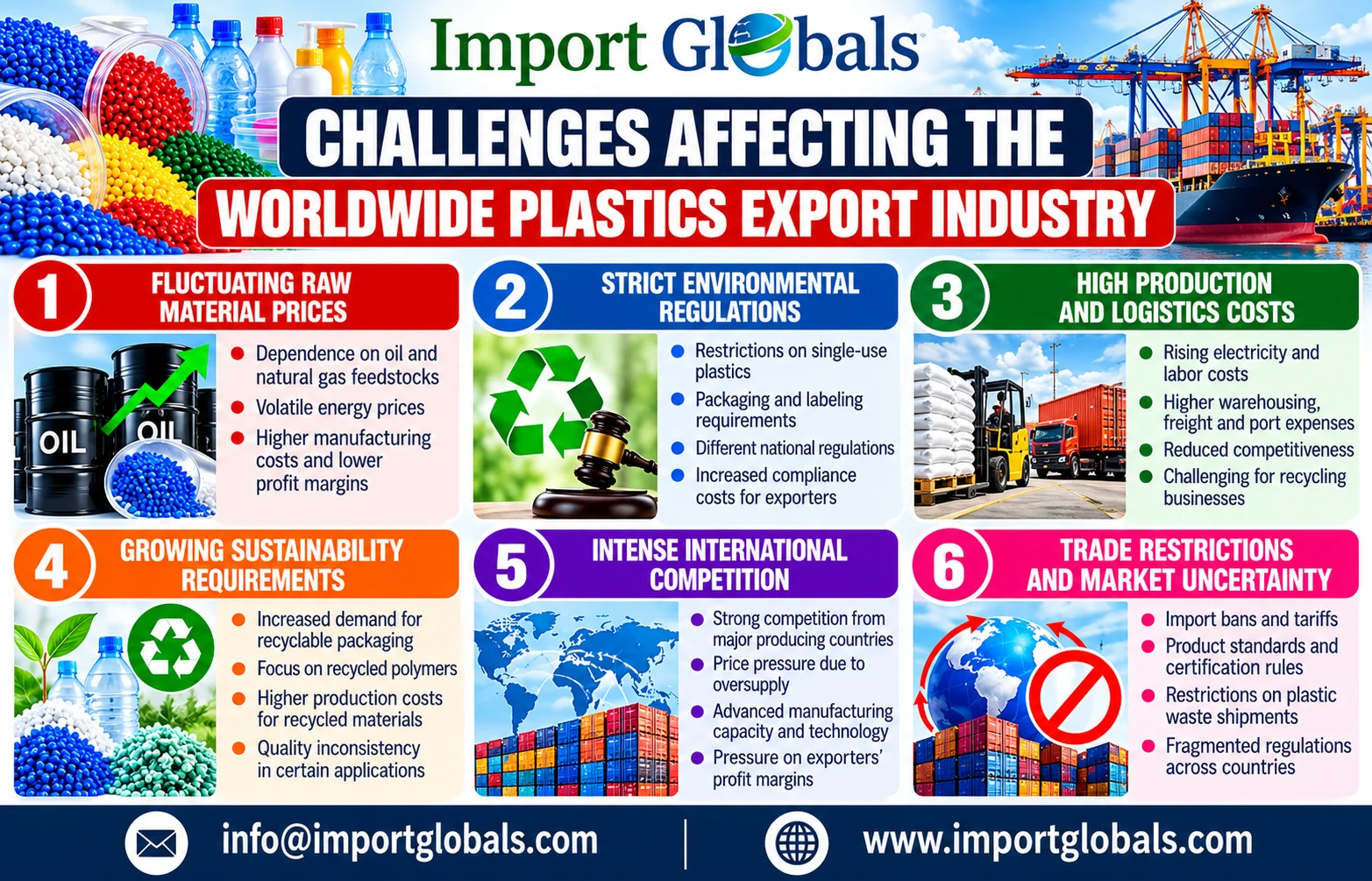
By 2025, the international plastics export industry had many challenges including volatile raw material prices, rising costs of production, more strict environmental regulations and unpredictable international demand. Plastic manufacturers, exporters, recyclers and companies involved in cross-border trade felt these factors.
1. Fluctuating Raw Material Prices: Petrochemical feedstocks from oil and natural gas Most plastics are. Export prices and profit margins are harder to control as supply disruptions for polymers and higher energy costs can increase manufacturing costs.
2. Strict Environmental Regulations: Countries introduced more and more restrictions on single-use plastics, packaging requirements, labeling rules and waste management. Differences between national rules raise the costs of compliance for exporters, especially small and medium-sized enterprises.
3. High Production and Logistics Costs: Costs for electricity, labor, warehousing, freight and port handling can eat into exporters’ competitiveness. These costs are particularly hard for recycling businesses under pressure from cheaper virgin plastics.
4. Growing Sustainability Requirements: Buyers want packaging that is recyclable, recycled polymers and products with a reduced environmental impact. However, the production of recycled materials can be more expensive and their inconsistent quality may limit their use in some applications.
5. Intense International Competition: Major producing countries compete on price, capacity, technology and established distribution channels. polymer prices and exporters’ are weighed down by oversupply.
6. Trade Restrictions and Market Uncertainty: Tariffs, product standards and limits on shipments of plastic waste may interfere with established supply chains. Fragmented rules pose a challenge for sustainable plastics trade, said the UN Trade and Development body.
Future Outlook for Global Plastic Exports: Market Opportunities and Trade Trends
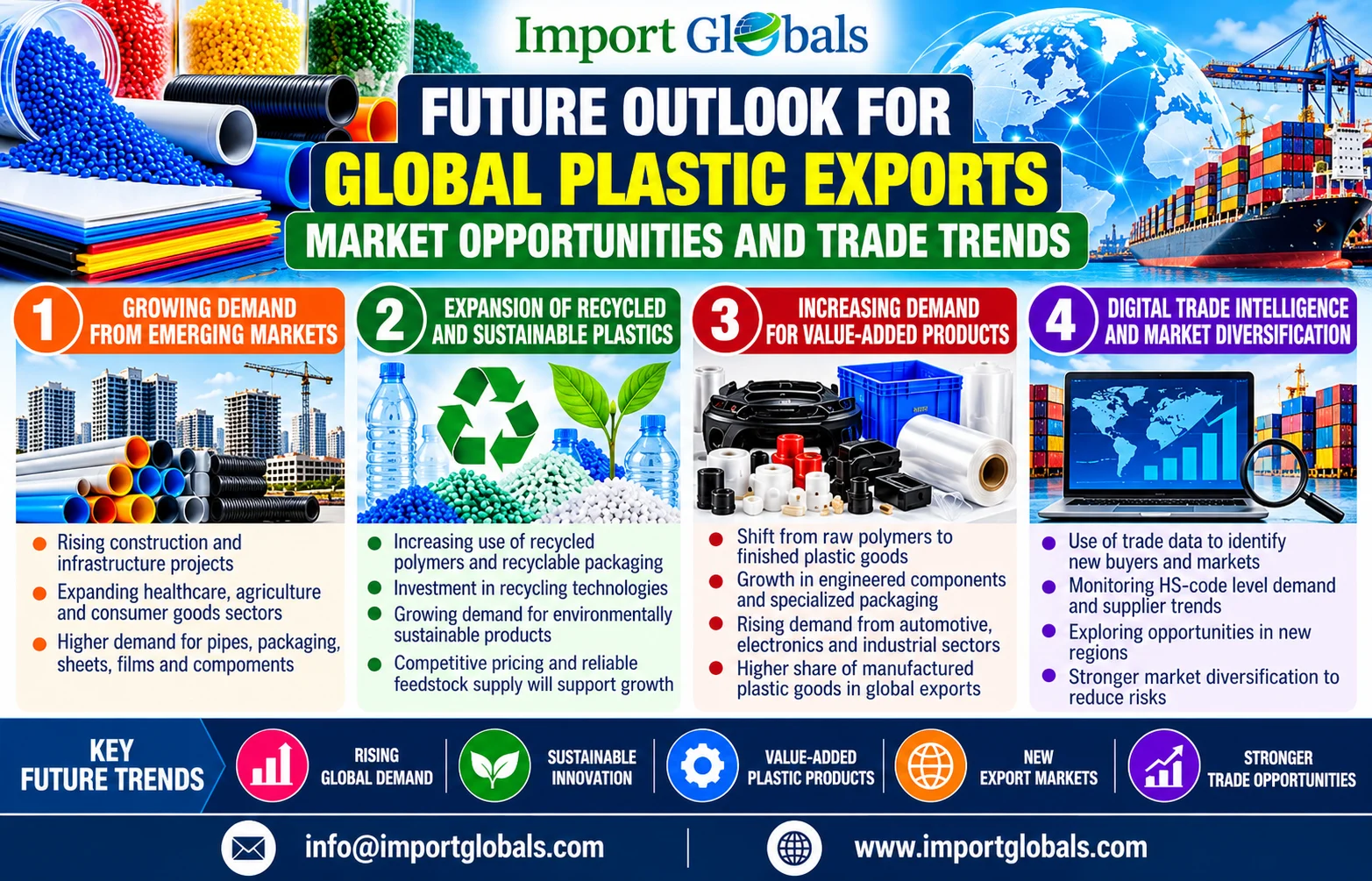
Industrial demand, technological innovation, changing environmental regulations and the rising prominence of sustainable materials will shape the future of global plastic exports. Global trade in plastics in 2025 was worth around US$1.12 trillion, or about 5% of global trade in goods.
1. Growing Demand from Emerging Markets
“Plastic exporters will benefit from the expected rise in construction, urbanization, healthcare, agriculture and consumer goods manufacturing in the emerging economies. There is a demand for plastic pipes, packaging materials, sheets, films and industrial parts that could underpin new export partnerships.
2. Expansion of Recycled and Sustainable Plastics
Concerns about the environment are pushing manufacturers to look at recycled polymers, recyclable packaging and alternative materials. There is a market for companies to invest in recycling technologies and in producing consistent, high quality recycled resins for customers looking for more sustainable products. But future growth depends on competitive prices, reliable supplies of feedstocks and good regulation.
3. Increasing Demand for Value-Added Products
Trade opportunities could also be in finished plastic goods such as engineered components, specialty packaging and precision molded products, as well as raw polymer resins.
4. Digital Trade Intelligence and Market Diversification
By monitoring international demand, comparing supplier countries, identifying potential buyers and tracking the evolution of trade flows at HS code level, exporters will be able to enhance their competitiveness.
Conclusion
The future of the world’s plastic exports depends on sustainable production, technological innovation, competitive prices and growing international demand. New opportunities for exporters will arise in packaging, construction, automotive manufacturing and recycled polymers. However, the environmental regulations will still affect the market performance. Raw material price fluctuations and international competition will be observed. Looking at reliable suppliers, emerging markets and changing trade patterns can help businesses improve their export strategies. Import Globals provides reliable Global Import Data and Global Trade Data which helps companies to analyze market trends, identify potential buyers, assess competitors and take informed international trade decisions.
CTA
Unlock valuable market insights with reliable Global Import Export Shipments Data and Global Trade Statistics. Identify potential buyers, analyze competitors, discover emerging markets, and strengthen your export strategy with shipment intelligence. Visit www.importglobals.com or contact info@importglobals.com to Explore Global Plastic Export Opportunities and make informed business decisions.
FAQs
Que. What are the major exports of plastic products in the world?
Ans. The exports are mainly polyethylene, polypropylene , pvc , pet , plastic packaging , pipes , sheets , films and plastics industrial parts.
Que. Who are the top exporters of plastic products?
Ans. The US, Germany, South Korea, China, Japan, Italy and the Netherlands are the leading players in the world’s plastics trade.
Que. How do you plan to find international buyers for your plastic products?
Ans. They can then pull out import data, shipment details, HS codes and countries of destination to find potential buyers and buying trends.
Que. What is Global Import Data? How can it be used by exporters?
Ans. The global import data helps the exporters to find the importing countries, product demand, potential customers and market opportunities.
Que. How Global Trade Data Can Help You In Plastic Export Business?
Ans. Global Trade Data enables companies to track their activity in foreign markets, monitor their competition, benchmark their trading partners and analyze export trends.
Que. What are the main HS Codes for research of plastic export?
Ans. Key codes are HS 3901 for polyethylene, HS 3902 for polypropylene, HS 3904 for PVC, HS 3917 for plastic pipes and HS 3923 for plastic packaging articles.
Que. What’s wrong with the global trade in plastic exports?
Ans. The main problems are the price volatility of raw materials, transport costs, environmental regulations, international competition and the growing demand for sustainability.
Que. How can Import Globals help businesses explore opportunities on plastic exports?
Ans. Import Globals provides import-export data and shipment intelligence to assist companies in conducting market research, identifying potential trading partners and making informed export decisions.
Que. How frequently is the Imports Exports of Plastic Products Data Updated?
Ans. Imports Exports of Plastic Products Data is updated on a monthly basis.
Que. Where can you obtain detailed information on Imports Exports of Plastic Products Data?
Ans. Visit www.importglobals.com or drop an email at info@importglobals.com for detailed updates on Imports Exports of Plastic Products Data.
You Can Also Visit :-
