The OECD's 2025–26 Trade Performance Outlook for Sweden: What It Says About Exports and Net Trade
- Mar 09, 2026
The OECD's 2025–26 Trade Performance Outlook for Sweden: What It Says About Exports and Net Trade
Sweden is one of Europe's sophisticated economies that is most sensitive to trade. This is especially clear when global demand, the krona, or cross-border supply chains change. In 2025–26, the story isn't just "exports up or down."
The Trade-led Character of Sweden is Back in the News
It's also about how trade affects a domestic economy that is being helped by lower inflation, higher household purchasing power, and increased government investment. As per Sweden Import Data by Import Globals, to put it another way, Sweden's future looks like a two-engine model: domestic demand does most of the work, and trade goes from being a short-term drag to a more neutral (or somewhat supporting) role.
The OECD's most recent forecasts provide us a clear picture of this time:
- In 2026, GDP growth picks up, but mostly because of domestic factors.
- Exports are still growing, but not as quickly as they could be because of problems in important partner markets and ongoing trade tensions.
- Net exports (net trade) are almost stable in terms of growth contribution. They turn slightly negative in 2025 and stay a small drag in 2026.
The macro baseline for 2025–26 is that growth will become better, but trade will stay hard.
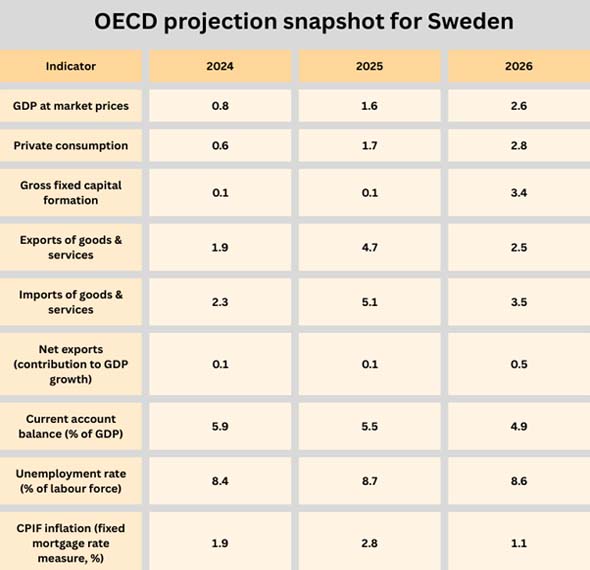
As per Sweden Export Data by Import Globals, the OECD's main prediction is that Sweden's economy would pick up speed from 2025 to 2026, with a wider recovery in spending and investment. Trade is an element of that recovery, but not in a "boom" kind. Exports are going up, but not as quickly as they do in stronger trade cycles. Imports are also going up because demand at home is going up, so net trade isn't a huge growth engine.
What this Table Means for the Future of Trade:
Exports go up in 2025 and 2026, but the rate slows down in 2026, even as GDP grows faster. That gives us a strong hint that commerce isn't the main reason for the rise in 2026. In 2026, imports grow faster than exports, which is what happens when households and investment demand bring in more foreign goods.
As per Sweden Import Export Trade Data by Import Globals, the net exports contribution stays negative (little in 2025, a little bigger in 2026), which means that trade is not projected to be the main engine of growth throughout this time.
Why Net Trade Can Still Take Away From Gdp Even While Export Growth is "Positive."
This is one of the most common things that people get wrong in trade stories. Sweden can have expanding exports and still see net exports hurt GDP growth if imports grow faster. This is especially true when:
- Consumers spend more (imported goods and parts rise),
- Companies put more money into capital goods and intermediate inputs.
- The economy comes back from a bad time and restocks its shelves, which typically means importing a lot of goods.
- That's pretty much the OECD story for 2025–26: domestic recovery improves import quantities, so net trade doesn't add much to growth even though exports climb.
What does the OECD mean by "Subdued Exports"?
A group of outside and financial elements that are especially important for an open economy shape the outlook:
1) Demand from Main Export Markets is Weak to Mixed
Sweden is very connected to the value chains and demand cycles of Europe.Some countries of the euro area are growing slowly, which could mean fewer orders for Swedish exporters. This is especially true for parts of the industrial sector that go through cycles.
2) Issues with Trade and Policies That Aren't Obvious
As per Sweden Import Custom Data by Import Globals, when trade barriers go up or uncertainty rises, businesses put off making investments, shift their stock, or look for new suppliers. Sweden's export base, which includes cars, machinery, industrial parts, pharmaceuticals, and tech-related goods, can be greatly affected by changes like these. The reason for this is that these items are closely linked to industrial networks around the world.
3) The Krona and How Competitive Prices Are Compared to Other Currencies
Changes in currency affect both the competitiveness of exports and the prices of imports. A higher krona can lower inflation on imports (good for consumers and the economy as a whole), but it can also make it harder for exporters to compete on price in other countries.
The Trade Outlook for 2025: Better Balances, but Not a Trade Boom Yet
As per Sweden Import Trade Analysis by Import Globals, the OECD's predictions are for the whole economy, but Sweden's monthly trade reports show how trade is doing right now. The net trade balance for goods in late 2025 is substantially stronger than it was the year before. This makes sense in a world where demand is stable and import costs aren't excessively high.
It's good to remember this progress, but it shouldn't be seen as a sign that things will keep getting better all year. A monthly surplus could expand not simply because exports go up, but also because imports go down. And as the OECD projection shows, stronger domestic demand in 2026 might lead to more imports, which would automatically lower net trade's contribution to GDP growth, even if exports are still expanding.
Trade's Influence in GDP: Sweden's Openness Increases Both Risk and Reward
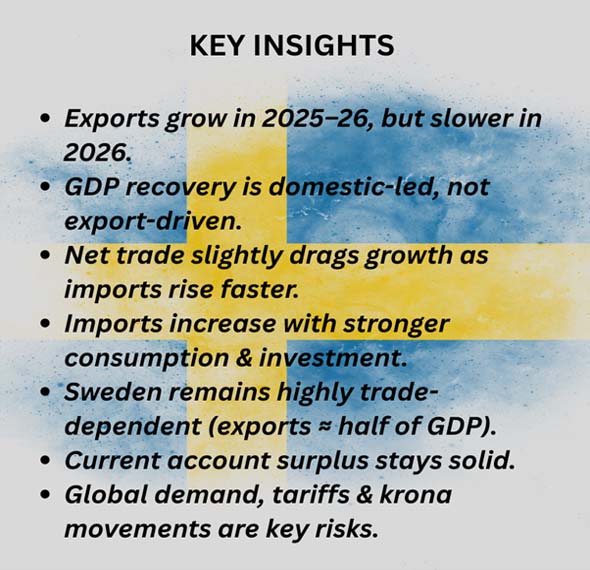
As per Sweden Exporter Data by Import Globals, one thing that makes Sweden unique is how big trade is compared to the rest of the economy. A recent OECD study shows that exports make up a large part of GDP, and that this is split between goods and services. That matters for 2025–26 because it shows how external shocks, such as tariffs, changes in demand, shipping problems, or rerouting of supply chains, can swiftly become macroeconomic problems.
When exports are that big compared to GDP, even "subdued but positive" export growth can still have a big impact on industrial activity, investment plans, and the need for workers, especially in areas and sectors that export a lot.
2026: Why Domestic Demand Comes First and Trade is the "Stabilizer"
As per Sweden Importer Data by Import Globals, the OECD's story for 2026 is that consumers and investments will rebound more quickly, thanks to lower inflation and government spending, but exports would increase at a slower rate. The growth mix is important for trade because it affects which areas of the economy are having problems.
How the Demand Mix in 2026 Will Effect Trade
- Household recovery: usually leads to more imports of consumer products and inputs from other countries in retail supply chains.
- Investment rebound: frequently involves a lot of imports, such as machinery, equipment, and intermediate inputs.
- As per Sweden Import Shipment Data by Import Globals, public spending and investment might raise the demand for imported parts or capital goods, depending on how they are bought.
- The OECD thinks that imports will expand faster than exports in 2026, which would keep net exports slightly negative as a contributor to growth.
Net Trade Contribution: What it Means and What it Doesn't
A negative net trade contribution doesn't suggest that Sweden is "losing competitiveness" or that exporters are failing. As per Sweden Import Export Trade Analysis by Import Globals, during a recovery phase, it can just mean that domestic demand is strong and investments are going up. It does, however, give us two useful pieces of information for 2025–26: Export growth alone won't be enough to explain Sweden's overall speed up in 2026.
Most of the growth in GDP is likely to come from domestic engines. External risks are still crucial because export growth is expected to be slow. If global demand unexpectedly drops, export growth could fall short and become a bigger problem, especially if the recovery at home also slows down.
Important Risks and Factors That Could Change Sweden's Trade Outlook for 2025–26
There are a number of things that can change the trade trajectory from the baseline:
Shock to Global Demand (Europe/US)
Exports make up a substantial percentage of GDP, so if major trading partners stop buying as much, it can quickly cut back on industrial production and investment.
Tariffs and Trade Barriers
If trade tensions rise, they can have an effect on lower export volumes, delayed orders, or changes in supply chains, especially in industries that are at risk of policy changes.
The Journey of the Krona
More appreciation can help bring down inflation, but it can also make things harder for exporters. On the other hand, depreciation might make a country more competitive, but it can also boost the cost of imports and make inflation harder to control.
Cycles of Inventory and How Much You Import
As investment and consumption climb in 2026, import intensity can surprise on the upside, keeping net exports negative even while exporters are doing "fine." What to keep an eye on in 2026 if you want to know about exports and GDP contribution.
These are the practical milestones you can use to see if Sweden is following the OECD "base case":
- Export volume growth compared to the ~2.5% projection: If this trend continues, it could mean that global demand is lower or that competition is getting stronger.
- Import growth compared to the ~3.5% projection: greater imports could signal a stronger rebound at home (positive), but they could also keep net exports negative (neutral for GDP, but it changes the story).
- Net exports: As per Sweden Export Import Global Trade Data by Import Globals, if they go more negative than predicted, trade will be a stronger drag. If they get closer to zero, trade will be more helpful than expected.
- Monthly net trade balances are valuable for signaling, but they are best understood when looked along with patterns in imports and changes in currency.
Conclusion
The easiest way to sum up Sweden's trade prognosis for 2025–26 is that exports will keep growing steadily in a tough external market, while a recovery in domestic demand will boost imports. In the OECD baseline, exports keep going up, but net trade stays a tiny negative factor in GDP growth since imports go up too as the economy recovers. That's not a contradiction for Sweden; it's just the way an open economy usually looks when it goes from a weak phase to a broader recovery.
The essential point is that Sweden's economic story for 2026 will probably depend less on a big rise in exports and more on whether people start spending and investing again, while exports stay strong enough to not become a bigger problem. Import Globals is a leading data provider of Sweden Import Export Trade Data.
FAQs
Que. The OECD thinks Sweden's exports will rise between 2025 and 2026?
Ans. Yes. In 2025, export volumes are expected to expand a lot, and they will remain growing in 2026, albeit at a slower rate.
Que. Why does net trade still hurt GDP growth even if exports go up?
Ans. This is because imports are expected to rise faster than exports. This is frequently a sign of higher domestic demand and investment during recovery.
Que. What does "net exports contribution to GDP growth" mean?
Ans. It shows how much real GDP growth changes when imports go down and exports go up in a given year.
Que. What are the major threats to Sweden's trade in 2026?
Ans. Less demand from outside the country, greater trade problems, and changes in currency that make things less competitive and raise the cost of imports.
Que. Where to get detailed Sweden Import Export Global Data?
Ans. Visit www.importglobals.com.