UK's Fastest-Growing Export Industries in 2025: The Comprehensive Market Updates

- Sep 14, 2026
UK's Fastest-Growing Export Industries in 2025: The Comprehensive Market Updates
The United Kingdom is one of the leading trading economies of the global marketplace, backed by a strong service sector, an advanced manufacturing base, financial expertise, and extensive connections with international markets.
UK Trade Data show that the country has exported goods and services worth 1.25 trillion US dollars, while continuously expanding its international trade activity. The export economy is led by the high-value industries, including financial services, professional and business services, information and communication technology, and pharmaceuticals and chemicals. Services are the strongest export engine, highlighting the increasing importance of knowledge-intensive activities like banking, insurance, consulting, technology, intellectual property, and other professional services.
The merchandise trade in machinery and transport equipment is on the rise and plays an important role in generating export revenues. UK Customs Data reported that the European Union is a critical player for British goods, while America, particularly the United States, is another major market for UK exporters. The United Kingdom is gradually strengthening its commercial relationship across Asia-Pacific, the Middle East, and other emerging markets, while helping businesses diversify the international customer base. London and the Southeast are the important centres, mainly for financial and professional services, while Northern England and Scotland are the midland contributors towards the energy, food and beverage sectors.
UK Export Overview of 2025: The Details of Britain's Exports
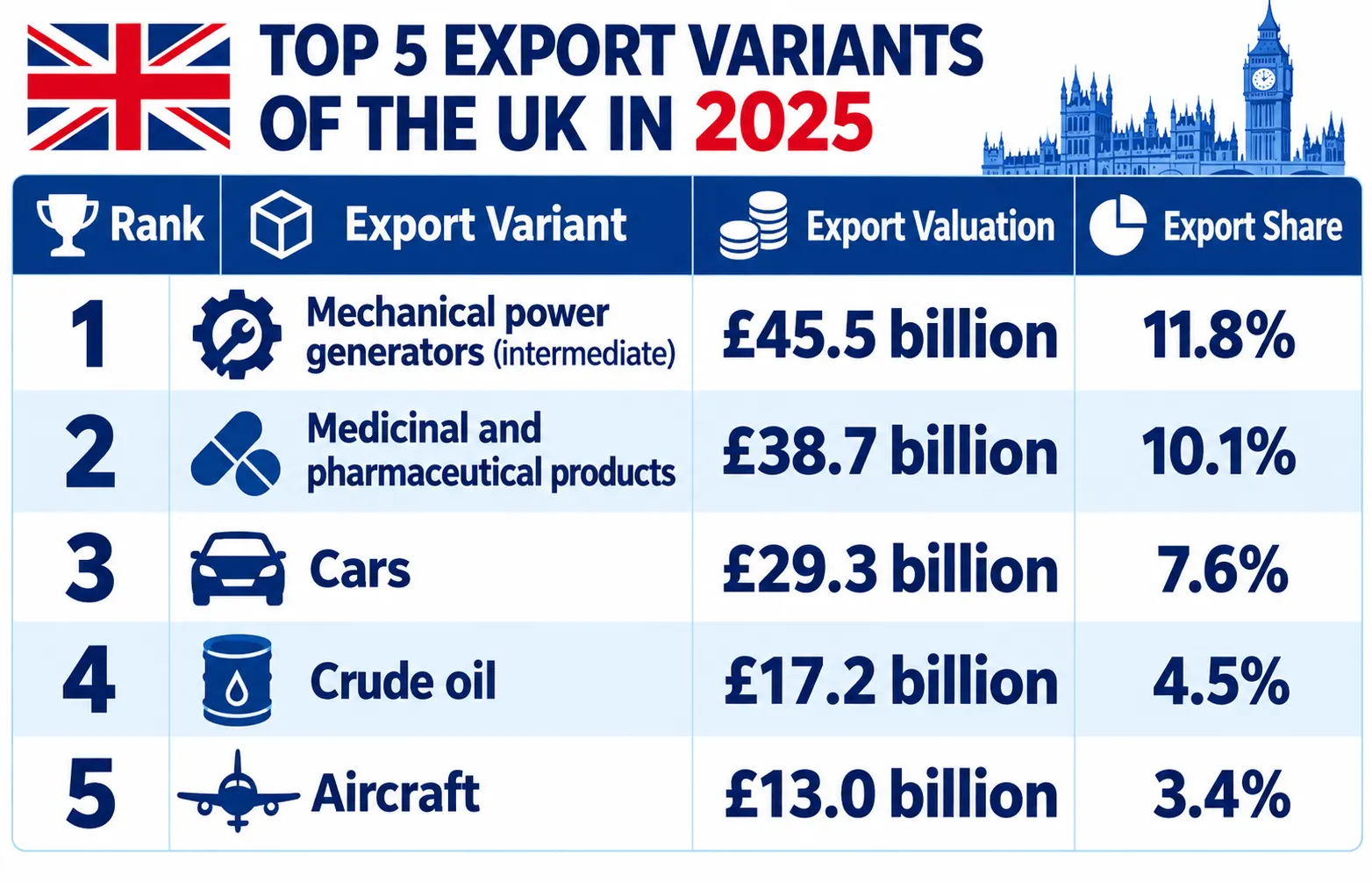
The United Kingdom has maintained a strong, resilient position in international trade, backed up by the globally competitive service sector and the advanced goods-producing industries. UK Export Data reported that the country recorded total exports of 1.25 trillion in goods and services during 2025. UK Customs Shipment Data reported the importance of the UK in the global marketplace. Services are the primary contributor to export earnings, reflecting the established capabilities in financial services, professional and business services. Merchandise exports are continuously providing substantial revenues for industries such as machinery, transport equipment, pharmaceuticals, aerospace products, electrical equipment, and energy-related commodities.
The United States is the largest individual export destination, while the European Union represents a significant share of the British international trade. The exporters are continuously increasing export opportunities across Asia-Pacific, the Middle East, and other emerging markets for the purpose of diversifying the customer base while strengthening the international supply chain. The regional distribution of export activity is on the way to highlight the importance of London and the Southeast for financial and professional services.
Top Export Industries of the UK
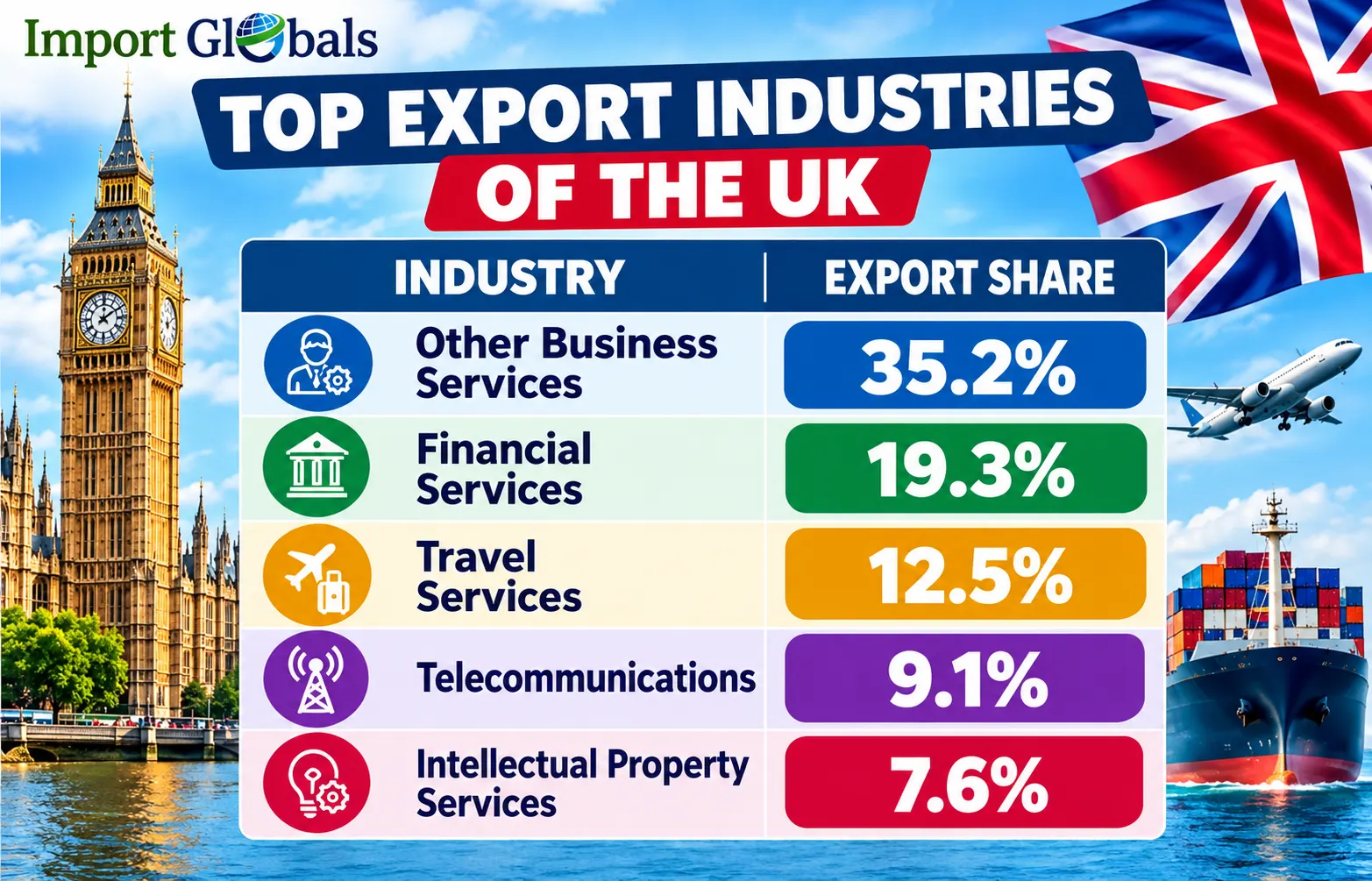
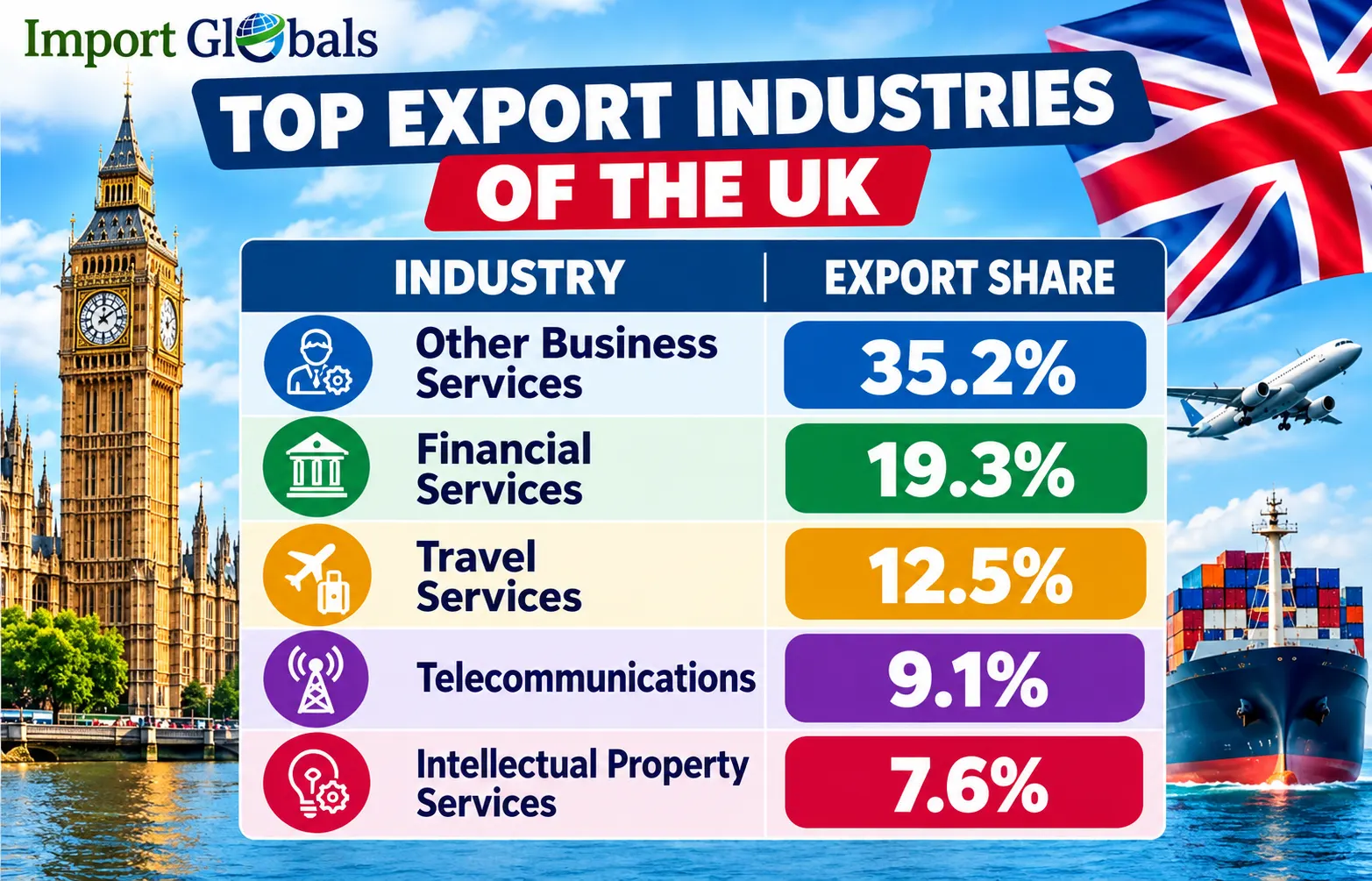
- Other Business Services: UK Shipment Data reported other business services as the top sector, accounting for a massive share of the export industry of the United Kingdom. The specific region accounted for 256 billion U.S. dollars of the export earnings. The sector mainly covers consulting, professional, technical, legal, accounting, research, and other business-related activities. The strong international demand is a representation of the expertise of the British authorities in driving the economy.
- Financial Services: UK Customs Statistics listed financial services as the sector, accounting for 141 billion U.S. dollars of the United Kingdom's exports. The specific region reported 19.3% of service exports. The industry has recorded strong growth, backed by banking, insurance, investment management, securities, and other financial activities. The positioning of the country as a leading global financial centre has strengthened international trade performance. The demand from the United States, European markets, Asia-Pacific, and the Middle East has provided significant opportunities for UK financial service exporters.
- Travel Services: Travel services are also an active contributor to UK service exports. The specific region accounted for 91 billion U.S. dollars of exports, representing 12.5% of the nation's total service exports. International visitors are responsible for generating the export earnings through spending on accommodation, transportation, restaurants, entertainment, retail, and tourism-related activities. The historical attractions, cultural reputation, and sporting events are continuously attracting visitors from major international markets.
- Telecommunications: UK Trade Shipments Data reported the telecommunications sector as the facilitating sector, crafting the overall trade rank of the country. The industry is responsible for 67 billion U.S. dollars of the United Kingdom's exports, accounting for 9.1% of the revenue share. The industry mainly benefits from Britain's expanding digital economy, technology companies, skilled workforce, research capabilities, and innovation ecosystem. Telecommunications data solutions and other digital services are increasingly demanding international businesses to create opportunities.
- Intellectual Property Services: Wrapping up the list of the top industries driving the UK's export, intellectual property services also stands as a significant one. It accounts for 55 billion U.S. dollars of the market share and 7.6% of the export. The strong research ecosystem, pharmaceutical industry, and technology sector have supported the international demand for patents, copyrights, trademarks, and other intellectual property-related services. It demonstrates the growing strength as a knowledge-based economy.
Top 5 Export Partners of the UK in 2025
1. United States
In 2025, the United States was the UK’s top export partner, thanks to British demand for services and goods. The top exports were financial and professional services, pharmaceutical products, machinery, vehicles, and chemical products. The strong relationship between the UK and the US offers plenty of opportunities for UK exporters.
2. Germany
Germany was one of the top export destinations for the UK due to the demand for automobiles, machinery, chemicals, electrical equipment, and pharmaceutical products. Being the largest manufacturing economy in Europe, Germany is an important market for British industrial suppliers. In addition, UK exporters have access to the supply chain and distribution networks of Germany.
3. Netherlands
The Netherlands is an important destination for UK exports, supporting the country in logistics, says UK Import Data. British companies export energy products, chemicals, machines, pharmaceuticals, food products, and manufactured goods to the Netherlands. Rotterdam port increases the flow of British goods in Europe.
4. Ireland
Ireland has close trade relations with the UK as a result of its geographical proximity, connected supply chains, and historical business relations. Major exports to the UK from Ireland include machinery, medicinal products, foodstuffs, chemicals, and manufactured goods. Cross-border trade has made Ireland a major market for British producers in many industries.
5. France
France is the major destination for UK exports in Europe, as trade includes machinery, cars, pharmaceuticals, chemicals, foodstuffs, and professional services. Its big customer base and proximity to Britain provide opportunities for British businesses in the region.
Issues Related to British Trade in the Year 2025
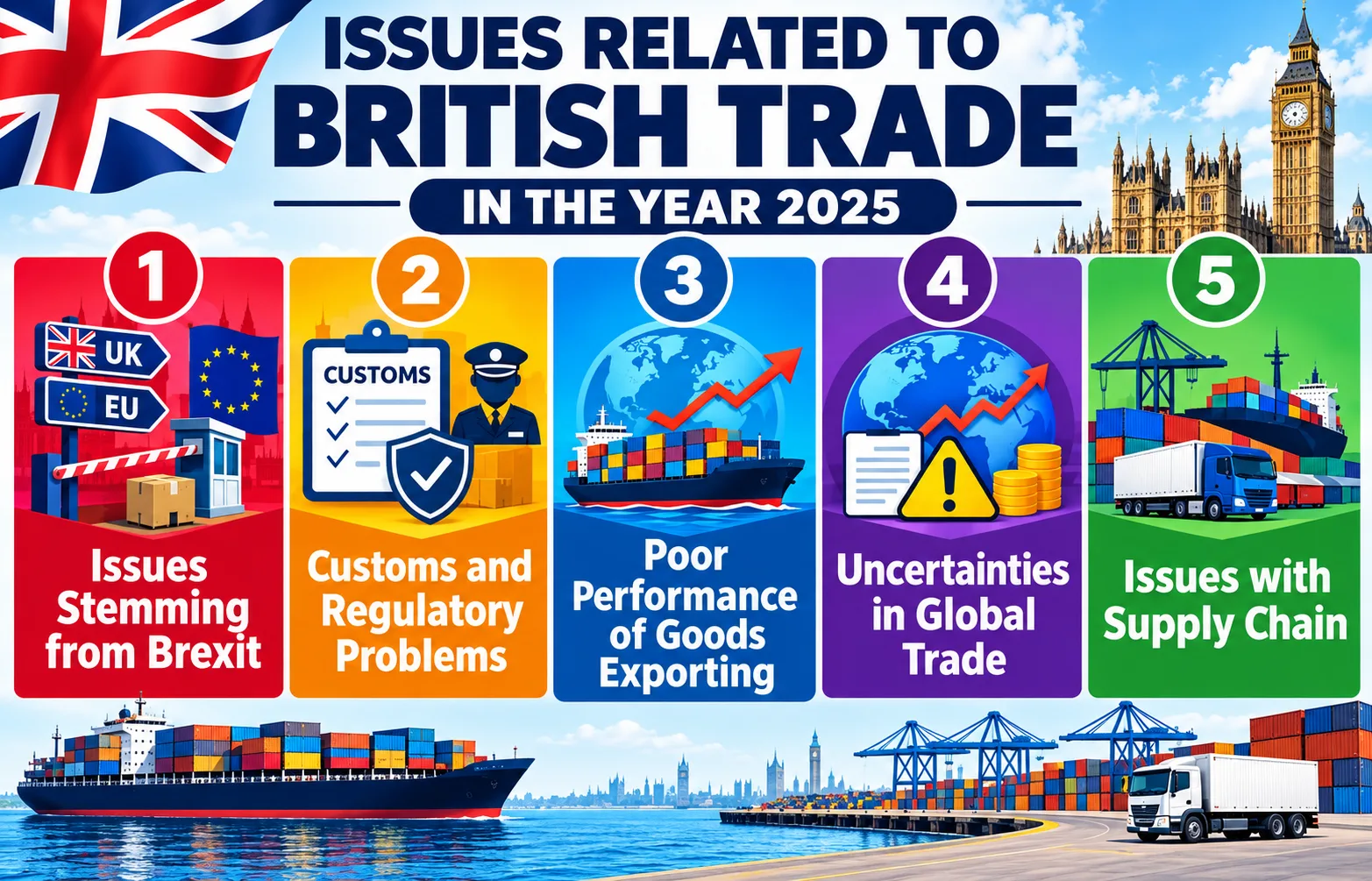
1. Issues Stemming from Brexit
As a result of Brexit, companies from the UK that engage in trade with Europe have to observe additional customs procedures, documentation, and border control issues. While the UK-EU Trade and Cooperation Agreement facilitates tariff-free trade, exports have to contend with administrative complexities. Such obligations lead to additional expenses, longer shipping periods, and difficulties, particularly for small enterprises.
2. Customs and Regulatory Problems
Exporters from the UK must comply with several customs regulations and standards as required by international markets. Across different sectors such as food and agriculture, making sure that these obligations are fulfilled requires extra knowledge and funds, adding to the difficulties.
3. Poor Performance of Goods Exporting
The goods exporting sector in the UK experienced constant challenges due to a lack of competitiveness in the year 2025, reported UK Statistical Data. As a result, manufacturers faced high competition, market changes, and the cost of production. Goods exports performed poorly compared to services exports in the long run, which means that the UK heavily relies on its services exports and thereby proves the need for enhancing its manufacturing capabilities, productivity, and competitiveness in the international markets.
4. Uncertainties in Global Trade
The changes in tariffs, geopolitics, economic instability, and alterations of international trade policies caused uncertainties for UK exporters. The abrupt change of policies can impact the prices of products, entry to markets, transport expenses, and need for goods. Therefore, companies had obstacles in forecasting their exports and making future plans, especially if they had businesses in several countries.
5. Issues with Supply Chain
Both domestic and international supply chain problems hindered the effective movement of products, timely procurement of raw materials, transportation timeframes, and delivery schedules. Conflicts, blockages in delivery routes, port congestion, and logistics limitations added to the risks for UK entrepreneurs. Enterprises relying on external vendors and transport networks experienced problems related to maintaining inventory levels, reported UK Shipments Trade Data, keeping costs under control, and consistently delivering goods overseas.
Statistical Growth Overview of the UK From 2020 to 2025
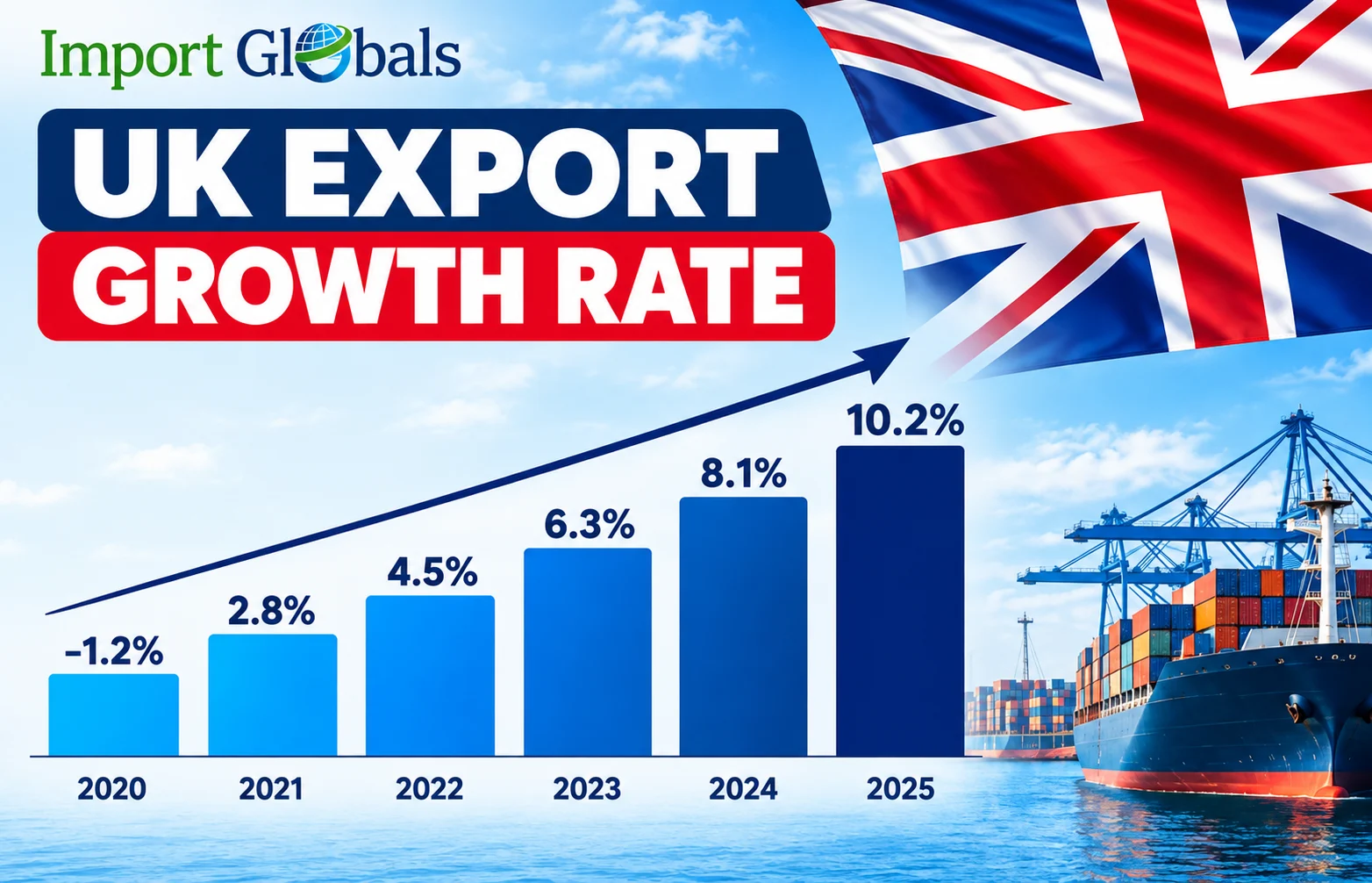
The change in the UK's economy between 2020 and 2025 went through a considerable downturn driven by the ongoing pandemic, followed by a rapid recovery and stabilization. In 2020, the UK was hit by a 5.7% decline in GDP due to the wide-reaching impacts of COVID-19 and restrictive measures concerning the economy. The strong growth of the economy took place in 2021, with GDP up by 9.3%, said UK Customs Trade Data.
The rise continued into 2022, with growth spiking at 11.1% as economic activity leaped back into motion. In 2023, growth was at 6.6%, with the most recent ONS data showing that the growth rate remained unchanged at 5% in 2024 and 2025. It can be concluded that the period under review marks the transition of the UK economy from considerable decline to recovery and subsequent growth stabilization, while some negative factors like inflation, interest rate hikes, low productivity, and issues with external trade were still influencing the country’s economic situation.
The Future Trade Outlook of UK Industries

The future of the United Kingdom's top export industries will be positive because services, technology, financial activities, and professional services are upgrading the country's overall export ranking. UK Trade Data reported that the exports will increase by 3.5 to 7.6% in the coming years. The overall growth trend suggests that the export growth will mainly depend on the knowledge-intensive and technology-driven industries. The United States, European markets, Asia-Pacific, and emerging economies will be important destinations, promoting diversification and helping British exporters manage regional and geopolitical risk.
The investments in digitalization, artificial intelligence, research, and clean technologies, as reported by the UK Trade Statistics, will create new export opportunities. Businesses looking for UK Customs Statistics, and UK Shipments Custom Data can help the authorities identify active markets through understanding of product demand, analysis of competitors, and development of more targeted international expansion strategies.
Conclusion
The United Kingdom's export outlook seems promising, backed up by financial activities, professional services, and advanced industries, strengthening the positioning of the country in global trade. The continuous expansion of the knowledge-intensive and technology-driving sectors will create new opportunities for British exporters. UK Trade Customs Data reported the United States, European Union, Asia-Pacific and the emerging economies as the main factors supporting market diversification and helping businesses manage geopolitical and supply chain risks.
The investments in digitalization, artificial intelligence, research, innovation and clean technologies will shape the next phase of export growth. Businesses seeking to expand their international trade can get updates on the UK Trade Shipments Statistics for valuable insights into product demand and emerging opportunities.
CTA
If you're looking for an active expansion in your business strategies in the United Kingdom, you have come to the right platform. Import Globals helps businesses diversify their trade strategies within the United Kingdom with active market insights. Subscribe to www.importglobals.com or drop an email at info@importglobals.com for detailed updates on the United Kingdom's export industries to drive your international business growth.
FAQ’s
Que. What is the export trade value of the United Kingdom in 2025?
Ans. The export trade value of the United Kingdom in 2025 is 1.25 trillion US dollars.
Que. What is the largest export industry of the United Kingdom?
Ans. Other business services are one of the largest export industries of the United Kingdom.
Que. Why are services important to the United Kingdom export?
Ans. Services are important to the United Kingdom's exports because of its capabilities in finance, consulting, technology, and industry.
Que. Name the largest export market of the United Kingdom.
Ans. The United States is the largest export market of the United Kingdom.
Que. What is the importance of the European Union for the UK exports?
Ans. The importance of the European Union for UK exports is facilitated by major trading capacity, bilateral integrity, and effective tariff rates.
Que. Name the UK industries that have strong future export potential.
Ans. Financial services, technology, and artificial intelligence are some of the top industries that have strong future export potential.
Que. How does UK import-export data support business growth?
Ans. UK import-export data support business growth via proper identification of buyers, supplier analysis of market demand, and development of effective market expansion strategies.
Que. What information is available in UK trade data?
Ans. UK trade data covers Importer names, Exporter names, Shipment date, HS Code, Product Details, quantity, values, pricing information, origin country, importing country & port details.
Que. How frequently is the UK trade data updated?
Ans. UK trade data is updated on a monthly basis.
Que. Where can one get detailed information on UK trade data?
Ans. Subscribe to www.importglobals.com or drop an email at info@importglobals.com for detailed updates on UK trade data.
You Can Also Visit :-
- UK Import Landscape of 2026: The Latest Trade Statistics and Market Insights
- UK-US Bilateral Trade 2026: The Rising Imports and the Narrow Goods Surplus Overview
- The UK Shift from Goods Trade to Services-Led Trade
- The UK Textile and Apparel Trade of 2025: The Market Analysis, Key Products, and the Top Destination Markets