EU - South Korea Digital Trade Agreement: The Comprehensive Overview of the Business Impacts and Digital Trade Outlook of 2026
- Jun 19, 2026
EU - South Korea Digital Trade Agreement: The Comprehensive Overview of the Business Impacts and Digital Trade Outlook of 2026
The global economy is getting more digitalized with time due to certain initiatives launched by several governments like the European Union-South Korea digital trade agreement, which strengthened commercial relations between the two regions. The influential agreement right now is one of the static frameworks shaping international digital commerce, cross-border data flows, e-commerce regulations, cybersecurity operations, and digital service expansion. The partnership between the regions is a representation of the significance of digital trade in global economic development. It even promotes technological collaboration along with international business connectivity.
South Korea Trade Statistics reported the digital trade partnership between the European Union and South Korea as the main factor expanding the cloud computing services, fintech solutions, AI-based technologies, and digital manufacturing systems. Several new opportunities are created by the EU-South Korea digital trade agreement for the exporters, importers, logistic operators, digital service providers, and manufacturing companies.
The growth rate in digital infrastructure, smart manufacturing, and online business ecosystems has been increasing the significance of digital trade agreements worldwide. The bilateral digital trade activities are expected to experience substantial growth at present, mainly backed up by the European Union and South Korea digital trade agreement.
Why is the Eu-South Korea Digital Trade Agreement Considered Important for Global Trade?
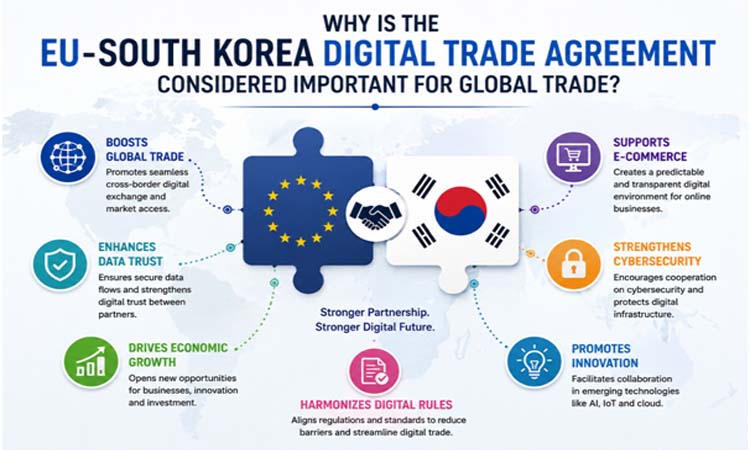
The European Union-South Korea Digital Trade Agreement is considered important for global trade because it has been serving as a strategic framework for the strengthening of international digital commerce. The role of this agreement is to promote secure and transparent online trade operations.
The main focus of the agreement is to simplify the cross-border data movement while comparatively protecting consumer privacy, supporting digital start-ups, and improving cybersecurity coordination. The increase in the role of artificial intelligence, digital banking, block chain technology, and e-commerce platforms has made the digital trade agreements an essential resource for economic growth.
EU Import Data and South Korea Import Data listed the dependency of both regions on digital infrastructure for trade management as the factors behind the successful establishment of this trade agreement in order to promote supply chain visibility. The agreement is considered essential because it supports paperless customs documentation and enhances digital payment systems. It even strengthens the cybersecurity operation along with the improvement of digital market access for small and medium enterprises.
The main motive of the agreement is to support the modernization of trade procedures along with the advanced customs technologies. The European Union and South Korea will Keep on getting benefits from faster shipment processing while reducing the operational cost and enhancing the market visibility.
The Exclusive Hike in Digital Trade Growth Between the European Union and South Korea
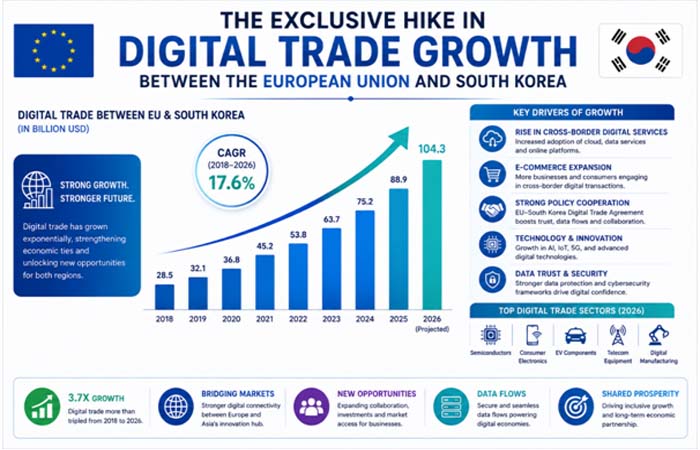
The overall trade relationship between the European Union and South Korea is getting a boost at present, mainly because of the trade agreements signed, along with the consumer protection framework implemented by the European Union and the international trade policies. The European Union Import Export Data represented the trade of digital products and services as factors benefiting both economies.
EU-South Korea digital trade agreement has positively impacted the cloud computing services, semiconductor technologies, artificial intelligence systems, fintech services, online retail platforms, cybersecurity solutions, and automotive digital systems. The investments in 5G infrastructure by the government authorities of both nations, along with digital logistics systems and industrial automation technologies, have supported the growth in digital trade. Different business operators in manufacturing, healthcare, transportation, finance, and e-commerce are increasingly relying on a digital trade framework for efficient operations.
Beneficiary Industries of the EU-South Korea Digital Trade Agreement
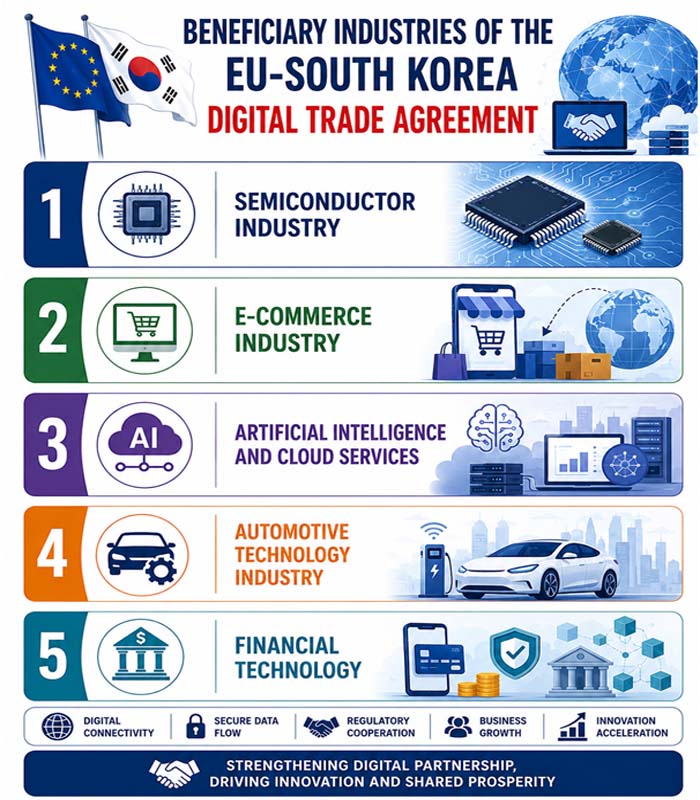
1. Semiconductor Industry - South Korea is popular as the leading semiconductor on a global scale. The EU-South Korea digital trade agreement has conceptually boosted the semiconductor supply chain while maintaining the cooperation between the European Union manufacturers and the Korean chief producers. South Korea Export Data says at present, the semiconductor export from South Korea to the European Union has increased, mainly because of the rising demand for AI processors, automotive chips, and industrial electronics.
2. E-commerce Industry - The E-commerce industry is also benefiting from the EU-South Korea digital trade agreement. The cross-border online retail trade has become the biggest advantage of the agreement. The European and Korean businesses are benefiting mainly because of the simplified digital payment systems, online customer verification, and paperless customs procedures. South Korea Customs data reported that the shipment within the EU and South Korea is the main factor increasing the consumer demand for electronics, fashion products and beauty products.
3. Artificial Intelligence and Cloud Services - The South Korea Shipments Data reported the artificial intelligence and cloud services as a significant beneficiary of the digital trade agreement. The businesses operating in both regions in this sector are mainly investing in AI-powered logistics, smart factories, predictive analysis, and automated customer service. The rising import of advanced Korean digital technologies has been expanding the operations within the South Korean market.
4. Automotive Technology Industry - The acceleration of innovation in electric vehicles, connected mobility systems, and autonomous driving technologies is due to the South Korean automotive manufacturers. The South Korean Shipments Data also reflected the increasing exports of automotive sensors as a key factor in digital vehicle management systems.
5. Financial Technology - Wrapping up the list of the topmost beneficiary industries of the EU-South Korea Digital Trade Agreement, Financial Technologies stands as the fifth one. The digital agreement has overall improved the cross-border Fintech operations while promoting the digital payment integrity and financial data exchange between different institutions of Europe and South Korea. Block chain systems and online payment gateways have experienced rapid growth because of the improved regulatory coordination of trade.
The Latest Sectoral Export of South Korea to the European Union
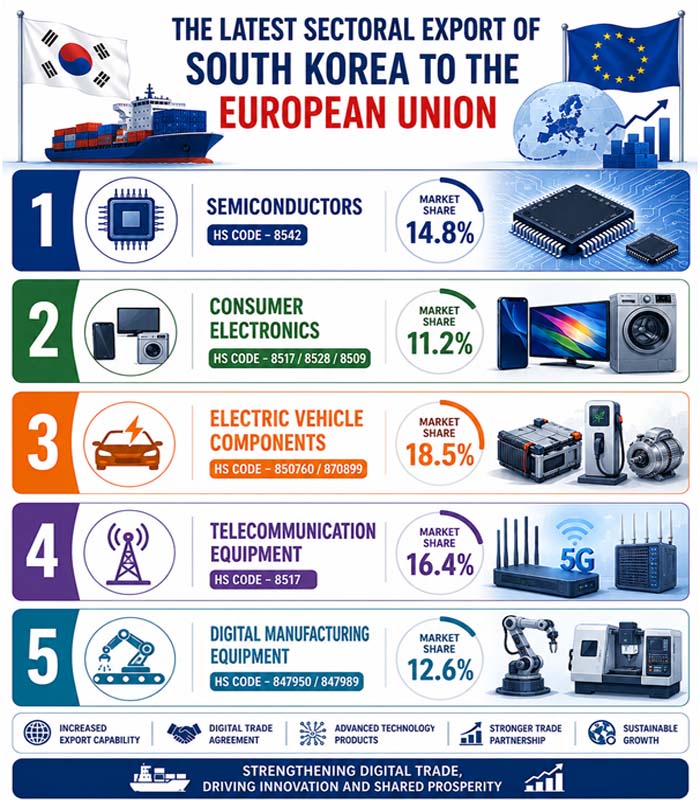
The European Union and South Korea digital trade agreement has increased the export capabilities of South Korea while maintaining the advancement of technology products and digital equipment. The following sectors are the most experienced ones of the EU-South Korea digital trade agreement.
1. Semiconductors (HS Code - 8542) (Market Share - 14.8%) - After the trade agreement was signed between the European Union and South Korea, semiconductors have become the largest supplied category towards Europe while dominating the bilateral digital trade activities.
2. Consumer Electronics (HS Code - 8517 / 8528 / 8509) (Market Share - 11.2%) - South Korea Export Data listed consumer electronics as the second most exported category to the European Union. Smartphones, smart appliances, OLED displays, and digital entertainment systems are being traded the most for European consumers.
3. Electric Vehicle Components (HS Code - 850760 / 870899) (Market Share - 18.5%) - The import of electric vehicle components in the European Union from South Korea has increased because of the digital trade agreement and the consumer-based demand rate in Europe. Korean batteries, charging systems, and digital automotive components are the top exported categories.
4. Telecommunication Equipment (HS Code - 8517) (Market Share - 16.4%) - 5G infrastructure expansion has increased the demand rate of telecommunication equipment in the European Union. Networking technologies are getting a hike in their trade to the European consumers.
5. Digital Manufacturing Equipment (HS Code - 847950 / 847989) (Market Share - 12.6%) - The European manufacturers are heavily importing Korean automation technologies for advancing their industrial digitalization equipment and robotic systems.
The Latest Import of South Korea From the European Union
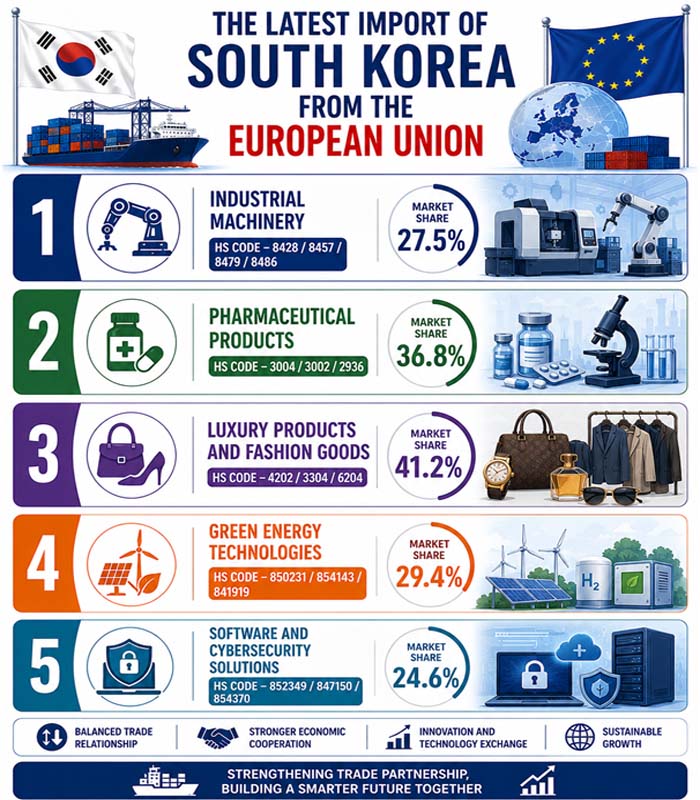
South Korea has maintained its resilience as a top trader via a proper balance and its trade deficit. South Korea Import Customs Data represented the following sectors as the ones that have experienced a hike in their imports from the European Union during the EU-South Korea digital trade agreement.
1. Industrial Machinery (HS Code - 8428 / 8457 / 8479 / 8486) (Market Share - 27.5%) - The smart manufacturing technologies of industrial machinery in the European Union have maintained their competitiveness in the demand rate of South Korea's consumer base.
2. Pharmaceutical Products (HS Code - 3004 / 3002 / 2936) (Market Share - 36.8%) - The pharmaceutical innovation of the European Union is unique and impressive. The biotechnology products trade has maintained the integrity of both regions while dominating the Korean healthcare imports.
3. Luxury Products and Fashion Goods (HS Code - 4202 / 3304 / 6204) (Market Share - 41.2%) - The South Korean consumers are demanding luxury products and fashion goods from the European Union mainly because of the quality of European luxury products.
4. Green Energy Technologies. (HS Code - 850231 / 854143 / 841919) (Market Share - 29.4%) - South Korea has been mainly importing green energy technologies from the European Union because of its hydrogen systems and environmental solutions from Europe.
5. Software and Cybersecurity Solutions (HS Code - 852349 / 847150 / 854370) (Market Share - 24.6%) - The increasing digitalization of business has accelerated the imports of European enterprises. The cybersecurity platforms have expanded the import of software solutions in South Korea from the European Union.
The Impact of the Eu-South Korea Digital Trade Agreement on Different Businesses
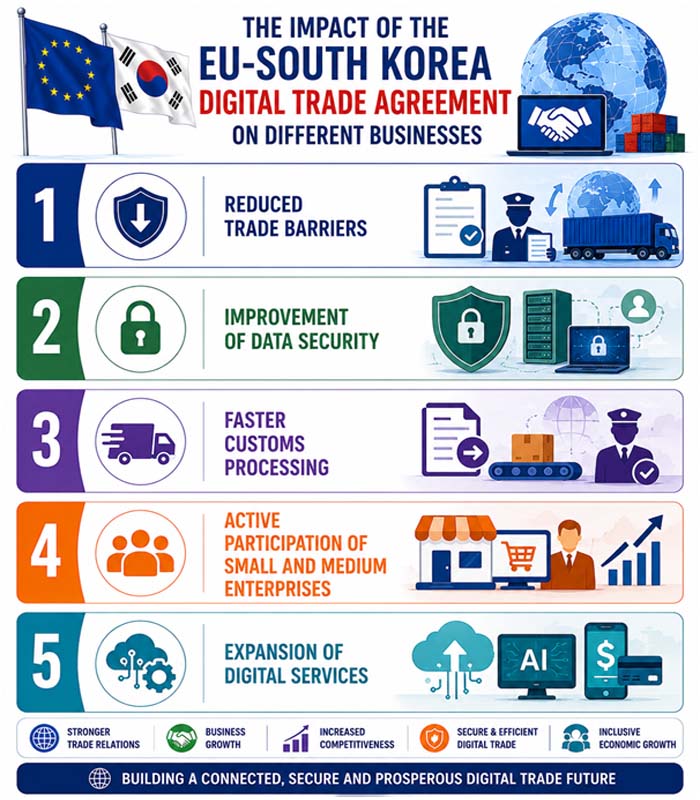
The EU-South Korea digital trade agreement has introduced business advantages for exporters, importers, manufacturers, logistics providers, and digital service companies. Below are the specific impacts that the agreement has caused.
1. Reduced Trade Barriers - The European Union import export data listed the reduced trade barriers as the top impact, as the agreement is mainly focused on the simplification of digital customs documentation and reduced administrative complexities.
2. Improvement of Data Security - The enhanced cybersecurity framework introduced by the agreement has helped the business authorities secure customer information. It has even improved the trust among trading partners.
3. Faster Customs Processing - The proper implementation of the paperless customs system has accelerated the shipment rate. Eventually, the delays in the shipments are reduced while maintaining global trade compliance.
4. Active Participation of Small and Medium Enterprises - Small and medium-sized enterprises' participation in international trade fairs has increased, backed up by the simplified e-commerce regulations.
5. Expansion of Digital Services - The market access for cloud computing, AI solutions, and fintech services has been expanded mainly because of the agreement signed between the two regions.
Challenges Associated With the Eu-South Korea Digital Trade Agreement
1. Data Privacy Regulations - The European Union authorities maintain strict data privacy laws under the GDPR regulations. This might get interrupted due to the agreement.
2. Cybersecurity Risks - The dependence on digital trade systems will increase the exposure of the trade data to cyber threats and digital fraud.
3. Technology Competition - The increasing competition within global technology companies will impose pricing pressures and innovation challenges for the smaller and medium enterprises of both regions.
4. Regulatory Alignment - The businesses will continuously adapt to the evolving digital regulations landscape, promoting the technical standards across both markets.
5. Supply Chain Vulnerabilities - The geopolitical tensions and semiconductor shortages will continue to affect the technological supply chains.
Industries Under Pressure Due to the EU - South Korea Digital Trade Agreement
1. Traditional Retail Businesses - The extensive growth of cross-border e-commerce has created severe pressure on traditional retail businesses while affecting their overall revenue rate.
2. Small Manufacturers without Digital Infrastructure - The companies without digital transformation strategies are struggling to compete internationally because of the digitalization of cross-border trade.
3. Businesses with Weak Cyber Security Systems - Businesses with weak cybersecurity systems are more exposed to cyber threats, resulting in increased data loss with insufficient digital security measures.
Most Affected Trade Categories by Hs Code Classification
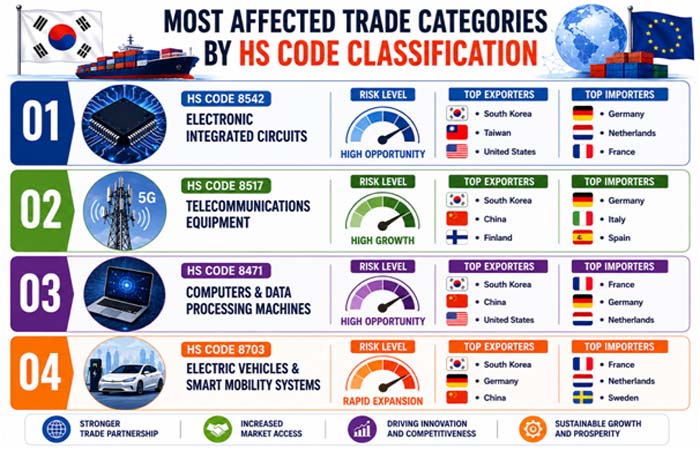
HS Code 8542 – Electronic Integrated Circuits
Risk Level: High Opportunity
Integrated circuits are one of the top traded digital technology products between South Korea and the European Union after the EU-South Korea Digital Trade Agreement.
TOP EXPORTERS
• South Korea
• Taiwan
• United States
TOP IMPORTERS
• Germany
• Netherlands
• France
HS Code 8517 – Telecommunications Equipment
Risk Level: High Growth
The 5G equipment demand rate has increased the trade of telecommunication equipment within both regions. The communication technologies are witnessing a significant increase in their overall trade demand.
TOP EXPORTERS
• South Korea
• China
• Finland
TOP IMPORTERS
• Germany
• Italy
• Spain
HS Code 8471 – Computers & Data Processing Machines
Risk Level: High Opportunity
The digitalization of businesses has increased the trade of computers and data processing machines for advanced computing systems.
TOP EXPORTERS
• South Korea
• China
• United States
TOP IMPORTERS
• France
• Germany
• Netherlands
HS Code 8703 – Electric Vehicles & Smart Mobility Systems
Risk Level: Rapid Expansion
Electric mobility technologies have also gained a massive hike in their trade between both economies while promoting the bilateral trade.
TOP EXPORTERS
• South Korea
• Germany
• China
TOP IMPORTERS
• France
• Netherlands
• Sweden
How Do the European Union Import Export Data and South Korea Trade Data Help Businesses Grow?
The European Union Import Export Trade Data and South Korea Trade Data give detailed information regarding the shipment-level insights. It helps businesses identify opportunities while reducing the market risks associated with severe trade expansion.
1. Monitoring of Trade Trends - The proper analysis of the European Union import-export data and South Korea trade data helps businesses identify the rising demand patterns across digital products and technology sectors.
2. Identification of Competitive Suppliers - The proper identification of competitive suppliers helps the business authorities evaluate the supplier performance while sourcing alternatives using the leading trade intelligence platforms.
3. Active Tracking of Buyers - The trade data even promotes the tracking of businesses while monitoring their purchasing patterns and market preferences.
4. Risk Management - Shipment-level insights of the specific product help businesses plan their inventory management for market entry in different regions.
5. Competitor Analysis - Import export intelligence of the topmost competitors helps businesses monitor the competitive pricing and shipment volume.
The Future Outlook of the Eu-South Korea Digital Trade Agreement
The European Union-South Korea digital trade agreement will play a transformative role in the economic integrity of both nations in the near future, too. The investment made by both regions in AI innovation, semiconductor manufacturing, digital infrastructure, and smart industrial systems will increase the green digital technology trade, strong border fintech innovation, cybersecurity collaboration, and digital customs modernization.
The continuous expansion of digital trade activities will overall strengthen the supply chain efficiency, technological innovation, and international business connectivity. Different sectors will benefit from the trade agreements while boosting the trade efficiency of several regions within the European Union.
A Comprehensive Outlook on Global Digital Trade
The global digital trade will be mainly backed up by technology partnerships, regulatory modernization, and data-driven commerce. The EU-South Korea digital trade agreement is considered a major step towards the proper resilience of the digital economy. Digital platforms, smart logistics systems, AI technologies, and e-commerce solutions have transformed global business operations.
The countries focusing on digital trade modernization are expected to gain significant economic advantages. The European Union import export data will provide critical insights for businesses seeking expansion opportunities.
Conclusion
The European Union-South Korea Digital Trade Agreement is the influential framework crafting the digital trade of both economies at present. The main motive of the agreement is to support digital innovations by securing cross-border trade and advanced customs modernization. The European Union and South Korea will continue to strengthen their trade relationship via several investments in semiconductor AI systems, e-commerce, cloud computing, and digital infrastructure. The businesses utilizing the European Union Import Export Data and South Korea Import Data can get deeper visibility into the evolving trade opportunities and market developments via the Active Trade Insights.
CTA
Trying to get the in-depth information regarding the South Korea Trade Statistics and the European Union Import Export Data, you have landed at the right platform here. Import Global provides accurate shipment-level trade intelligence to resolve all your complexities of trade regarding the identification of profitable opportunities. Subscribe to www.importglobals.com or email info@importglobals.com to access detailed global trade intelligence and advanced digital trade analytics.
FAQ’S
Que. What is the EU-South Korea Digital Trade Agreement?
Ans. The EU-South Korea Digital Trade Agreement is a proper framework launched by the government authorities of both nations to secure digital commerce, cross-border data transfers, and e-commerce growth.
Que. Why is digital trade considered beneficial for 2026 trade?
Ans. Digital trade support is considered important in 2026 because it supports online commerce, AI technologies, cloud computing, smart manufacturing, and international business connectivity.
Que. What are the top beneficiary industries of the digital trade agreement?
Ans. Semiconductor, manufacturing, e-commerce, fintech, cloud services, telecommunications, and automotive technology industries are the top beneficiaries of the EU-South Korea trade agreement.
Que. How can Import Globals South Korea Trade Data supports business growth?
Ans. Import Globals South Korea Trade Data provides detailed identification of buyers, suppliers analysis of market demand and development of effective market expansion strategies.
Que. What information is available in the South Korea Trade Data?
Ans. The South Korea trade data provides Importer names, Exporter names, Shipment date, HS Code, Product Details, quantity, values, pricing information, origin country, importing country & port details.
Que. What are the challenges associated with digital trade?
Ans. Data privacy regulations, cybersecurity risks, supply chain disruptions, and regulatory compliance are the major challenges associated with digital trade.
Que. How does the EU-South Korea digital trade agreement help small businesses?
Ans. The EU-South Korea digital trade agreement helps small businesses simplify digital trade procedures, improve e-commerce, and reduce operational barriers for small and medium enterprises.
Que. What is the role of cybersecurity in digital trade?
Ans. Cybersecurity protects digital transactions, consumer transactions, cloud systems, and online business operations.
Que. Which countries are the top technology exporters in this agreement?
Ans. South Korea and European Union member states are the top exporters of semiconductors, telecommunications equipment, and digital technologies in this agreement.
Que. How frequently is the South Korea Trade Data updated?
Ans. South Korea Trade Data is updated on a monthly basis.
Que. Where can businesses access detailed digital trade intelligence implemented by the European Union and South Korea?
Ans. Businesses can access the EU-South Korea detailed information of the digital trade agreement by subscribing to www.importglobals.com or by emailing info@importglobals.com.
You Can Also Visit :-
- The Export Market of the European Union in 2024: Brief Overview of the Major Exporters and Trading Partners
- A Look at European Countries and Trade Around the World in 2024
- How Energy Prices Change the Trade Balances of European Countries
- South Korea Steel Export Data
- AI and Data Center Demand: A New Era for South Korea's Chip Exports (2025–2026)