Sweden's Top Trade Partners of 2025: The Market Opportunities and the Statistical Growth Overview
- Sep 01, 2026
- 201 Views
Sweden's Top Trade Partners of 2025: The Market Opportunities and the Statistical Growth Overview
Sweden, a country in Northern Europe, is a top trading authority at present time because of the integrity with the European Union, the strategic positioning in the Nordic region and the reliable access to the Baltic Sea and the highly developed transport infrastructure.
The economy of the nation is mainly backed up by the manufacturing essentials, automotive products, machinery, electrical equipment, pharmaceuticals, chemicals, forest and other high-value industrial goods. Sweden Customs Data reported that the import and export of the nation are currently valued at 204 billion U.S. dollars and 217 billion U.S. dollars in 2025. The trade network of the economy is mainly concentrated in the European market, with proper reflection of the close integration with the European Union. Germany and Norway are also the top trade partners of Sweden, with significant contributions to the merchandise trade.
The import and export trade forum of Sweden is getting updated with time because of the increasing productivity rates and the higher consumer-based acquisitions. The trading relationship of the country and the bilateral integrity is a result of the regional supply chain and the international markets. Germany has been providing an important market for Swedish industrial and automotive products. The United States is a major destination of Swedish exports, says Sweden Statistical Data. The overall trade portfolio is continuously backed up by industrial activities and the bilateral integrity with the top trading regions. The European logistics and distribution hub has further supported the ranking of the nation as a reliable trader. Sweden import-export landscape is a proper tool for business authorities trying to expand within the Swedish market.
Why is Sweden an Important Trading Region of the Global Marketplace?
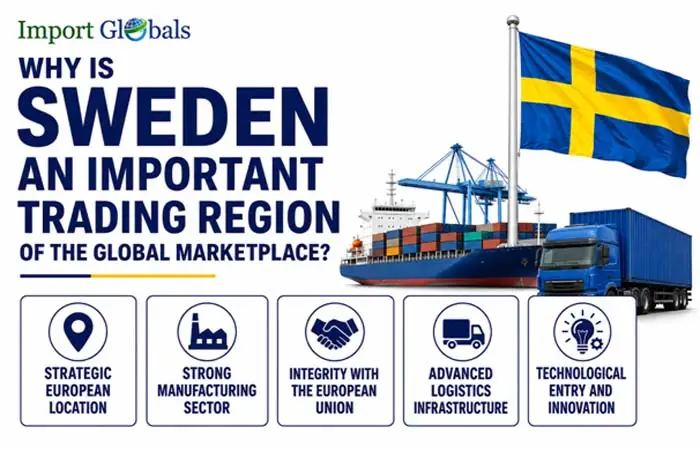
Sweden is popular as one of the top trading regions of the global marketplace because of its location, advanced industrial base, strong logistics network, and technological capabilities. Different factors like its location within the European Union, strong manufacturing sector, and its integration with the European Union have been maintaining the overall trade strength. Below are the proper reasons why Sweden is an important trading region of the global marketplace.
- Strategic European Location - The positioning of the country in Northern Europe has given the country reliable access to the Nordic countries, the Baltic region, and the wider European markets. The coastline has maintained connectivity while promoting the regularization of trade, says Sweden Shipments Data.
- Strong Manufacturing Sector - The globally competitive industries, covering automobiles, machinery, and electrical equipment, have facilitated subsequent trade within the connected regions.
- Integrity with the European Union - The benefit of the Swedish economy with reliable access to the European Union single market has allowed businesses to participate in an extensive regional supply chain. Denmark, Finland, and the Netherlands have upgraded the overall trade portfolio.
- Advanced Logistics Infrastructure - The modern ports, highways, railways, and distribution networks are being developed to maintain a proper trade forum. The overall network has made the country an important logistics and distribution point in Northern Europe.
- Technological Entry and Innovation - The Swedish authority is mainly looking for a strong research, innovation, engineering, and technology ecosystem. High-value technology and industrial products mainly contribute to the export competitiveness for an updated trade ranking.
Top Five Trade Partners of Sweden
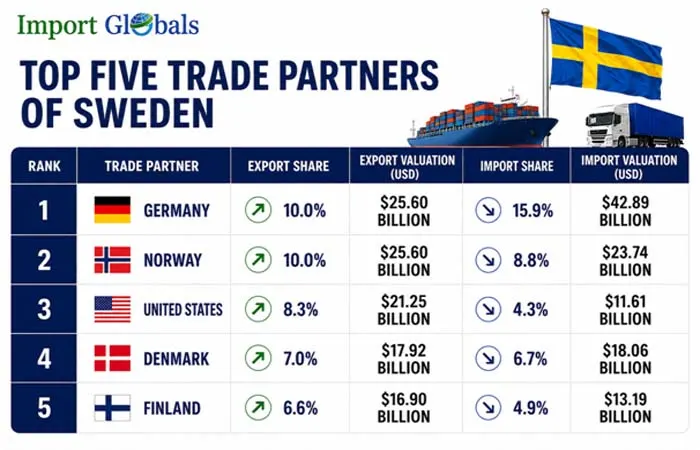
1. Germany — Export Share: 10.0% | Import Share: 15.9% - Germany is the top trade partner of Sweden, as reported by the Germany Import Data. The country holds an export share of 10% and an import share of 15.9% in Sweden's economic growth. The trade flows are mainly concentrated on automobiles, machinery, electrical equipment, pharmaceuticals, chemicals, and industrial components. The large manufacturing base and the geographical proximity have made it a critical trade partner of the Swedish authorities.
2. Norway — Export Share: 10.0% | Import Share: 8.8% - Norway is also one of the top trading partners of Sweden and the leading non-European Union trade relationship of the country. The accountability in the export share is 10%, and the accountability of imports is 8% for Swedish authorities. The bilateral relationship is benefiting mainly from the geographical proximity, extensive road and maritime connections, integrated Nordic supply chains, and Sweden's export of machinery and vehicles.
3. United States — Export Share: 8.3% | Import Share: 4.3% - The United States is also a top trade partner of Sweden. The high-value manufactured products and the representative exports to the United States accounted for an 8.3% share, with a reported import share of 4.3%. The Swedish merchandise imports and exports to the U.S. are mainly concentrated towards automobiles, machinery, pharmaceuticals, telecommunications, and electrical products.
4. Denmark — Export Share: 7.0% | Import Share: 6.7% - Sweden Customs Trade Data listed Denmark as a top trading partner. The country accounts for 7% of the export share and 6.7% of the import share. The trade between both economies is backed up by food products, chemicals, electrical equipment, vehicles, and other manufactured goods. The participation in interconnected Nordic regions has maintained the global trade ranking.
5. Finland — Export Share: 6.6% | Import Share: 4.9% - Finland's export share is at 6.6% with import accountability of 4.9%. The imports from Finland were mainly at a rate of 9.87 billion U.S. dollars for the Swedish authorities. The bilateral trade relationship is strengthened by the geographic proximity and the transport connections.
Factors Promoting the Bilateral Integrity of Sweden

- Strong Economic and Trade Relations - Sweden Import Data show that the bilateral integrity of the Swedish authorities is mainly because of the deep economic and trade relationships with major partners, mainly Germany, Norway, Denmark, Finland, the United States and the Netherlands. Active participation of Swedish companies in European and global supply chains has maintained the trade of industrial technologies and the efficient import of energy raw materials, components and advanced equipment. The integration of the Swedish authorities with the European Union has facilitated the movement of goods.
- Strategic and Regional Cooperation - The strategic and regional cooperation has shaped the bilateral relationship. The geographic positioning in Northern Europe, mainly connecting with the Nordic countries, Baltic region and broader European market, has promoted the development of stronger relationships with neighbouring countries. The participation in European institutions has increased engagement in regional security frameworks. Bilateral cooperation is mainly important for addressing shared challenges.
- Innovation, Sustainability and Technological Collaboration - Innovation and sustainability are mainly important for increasing the influence of bilateral integrity with international partners. The highly developed technology and research ecosystem has strengthened telecommunications and engineering, clean energy, automotive technology, life sciences and digital solutions. The emphasis on renewable energy, sustainable manufacturing and green technologies has created opportunities for cooperation with countries looking for cleaner and more efficient economic models. The businesses and research institutions are able to collaborate with foreign partners on technological development.
Industries Crafting the Economic Growth of Sweden

- Automotive and Engineering Industry - Sweden Trade Data reported the automotive and engineering industry as one of the major contributors towards the economic growth rate. The overall trade is supported by globally recognized manufacturers, advanced engineering capabilities, and strong research and development. The establishment of the country's expertise in commercial vehicles, passenger cars, and industrial equipment has mainly contributed to exports, employment, technological innovation, and international investment. The advancement of electric vehicles, battery technologies, autonomous mobility, and sustainable transportation solutions has maintained integrity with the European supply chain. The continuous investment in automation and digitalization has strengthened the industry's contribution.
- Information Technology and Telecommunications - Information technology and telecommunications are responsible for representing an important pillar of Sweden's economy, supported by advanced digital infrastructure, skilled professionals, and strong innovation capabilities. The sector mainly contributes to exports, productivity, high-value employment, research, and foreign investment. The strong collaboration with technology companies and institutions encourages the innovation and commercialization of new technologies. The focus of the authorities on digital transformation and advanced connectivity has supported businesses across manufacturing, finance, and public services. These developments make technology one of the essential drivers of the economic growth rate of Sweden.
- Pharmaceuticals and Life Sciences - Pharmaceuticals and life sciences are playing a significant role in the economic growth rate. The properly established ecosystem mainly involves pharmaceutical companies, biotechnology firms, medical technology manufacturers, and research institutions. The industry is basically responsible for supporting the development and production of medicines, medical devices, diagnostics, biotechnology solutions, and healthcare technologies. The strong research capabilities and cooperation have helped the industry accelerate innovation while attracting international partnerships. The advanced healthcare infrastructure places an emphasis on scientific research while strengthening the sector's competitiveness.
How Does Import Globals Sweden Import Export Data Help in Business Growth?
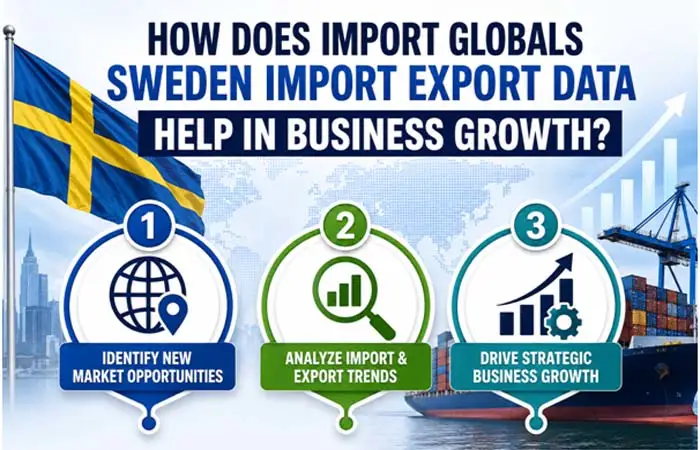
Import Globals Sweden Import Export Data is considered an effective tool for business authorities that are looking for current specifications of traded categories within the region. The proper understanding of the Sweden Export Data gives a visualization to the businesses looking for service expansion in collaboration with the Swedish authorities.
The progressive traders can refer to the Sweden Customs Shipments Data and Sweden Trade Statistics to get an analysis of the top traded products from the nation and the overall shipment quantities, along with the quality products traded. The optimization of the country's trade activity helps businesses get a visualization of the latest trade trends. Progressive traders can even stay updated with marketing strategies while making their own entry more reliable. The commodity-level import and export information gives the traders a broader basis for market analysis.
Future Trade Outlook for Sweden

The future of the Swedish economy will be positive, backed by the advanced industrial base, strong integration with the European Union, strategic location in Northern Europe, and the increasing demand for high-value manufactured products. Automotive, machinery, electrical equipment, pharmaceuticals, telecommunications, and sustainable energy will be important components of the international trade portfolio. The continuous investment and the development of the electric vehicles trade will create new opportunities for Swedish exporters. The close trade relationships with Germany, Norway, the United States, and Denmark will support future merchandise trade.
The participation of the country in the European supply chain will strengthen the cross-border movement of industrial components. Sustainable sourcing, digitalization, and resilient logistics will mainly promote the international trade ranking. Sweden Import Export Trade Data will provide detailed visibility into changing commodity demand, shipment patterns, and trading partners by region. The continuous monitoring of Sweden's Customs Shipments Data will help the authorities identify potential markets.
Conclusion
Sweden has established its position as one of the reliable trading authorities because of its strategic Northern European location, advanced manufacturing capabilities, and logistics infrastructure. Finland will be an important trading partner, supported by Sweden's positioning within the regional and international supply chain. The automotive and engineering, information technology, and telecommunications sectors will continue to contribute to economic development while maintaining international investment. The strong bilateral relationship, regional cooperation, sustainability initiatives, and technology collaboration will create additional opportunities for future trade expansion.
Key Takeaways of Sweden's Trade Growth
- The economy is connected with the European Union but supports the regularity of trade.
- Strategic northern European location facilitates reliable access to Nordic countries.
- Industrial export base is mainly concentrated in automotive engineering, electrical equipment and telecommunications.
- Technology and innovation driving growth promotes an advanced technology ecosystem, digital infrastructure, and research capabilities.
CTA
Looking for an expansion in your import-export trade in Sweden? You have come to the right platform here. Import Globals is skilled in providing detailed information regarding the analysis of the trade flows, commodity shipment activity, trading partners, and market trends. Progressive traders can use the reliable trade intelligence for the identification of potential buyers and suppliers, understanding of competitive activity, and the building of market entry strategies. Subscribe to www.importglobals.com or drop an email at info@importglobals.com for detailed updates on Sweden's latest trade.
FAQs
Que. What are the top trade partner regions of Sweden in 2025?
Ans. Germany, Norway, and the United States are the top trade partners of Sweden in 2025.
Que. Why is Sweden significant for international trade?
Ans. Sweden is a significant part of international trade because of its strategic Northern European location, advanced manufacturing sector, and developed transport infrastructure.
Que. What are the top exported industries of Sweden?
Ans. Engineering, machinery, electrical and telecommunication equipment are the top exported industries of Sweden.
Que. What are the top factors supporting Sweden's trade growth?
Ans. European integration, regional supply chain, and advanced logistics have been supporting Sweden's trade growth.
Que. Why is the geographic location of Sweden beneficial for international trade?
Ans. The geographic location of Sweden in Northern Europe provides the country with reliable access to the Nordic region and Baltic region, increasing trade via coastline ports, railways, and distribution infrastructure.
Que. What are the topmost industries shaping Sweden's economic growth?
Ans. The automotive and engineering, information technology, and telecommunications sectors are the topmost industries shaping Sweden's economic growth.
Que. How does Sweden import-export data support business growth?
Ans. Sweden import-export data support business growth via proper identification of buyers, supplier analysis of market demand, and development of effective market expansion strategies.
Que. What information is available in Sweden trade data?
Ans. Sweden trade data covers Importer names, Exporter names, Shipment date, HS Code, Product Details, quantity, value, pricing information, origin country, importing country & port details.
Que. How frequently is the Sweden trade data updated?
Ans. Sweden trade data is updated on a monthly basis.
Que. Where can one get detailed information on Sweden trade data?
Ans. Visit www.importglobals.com or drop an email at info@importglobals.com for detailed analysis on Sweden trade.
You Can Also Visit :-