Russia Wheat Export Data: Top Buyers and Global Markets
- Sep 10, 2026
Russia Wheat Export Data: Top Buyers and Global Markets
In 2025, Russia remained among the world's top wheat producers, thanks to its vast farmland, strong grain-production capacity, competitive grain prices, and robust agricultural logistics across Africa, the Middle East, and Asia.
In 2025, Russia Trade Data says that the country was expected to export about 41 million tons of wheat and maintain its status as the world’s leading wheat exporter. The estimated value of wheat exports in Russia in 2025, according to international statistics, was about US$8.6 billion; however, other sources estimate different values depending on the criteria used for classifying the products and periods of reporting.
According to the information given by Russia Shipments Data, the total exports of goods from Russia in 2025 were about US$418.3 billion, and thus, using the said US$8.6 billion for vaccines, it is possible to estimate wheat export contribution to the overall export value of Russia at about 2.1%. Wheat is also among the most essential components of Russian agricultural exports, with grains accounting for nearly 30% of total exports from agriculture in Russia. The key wheat importers from Russia include Egypt, Turkey, Sudan, Saudi Arabia, and Kenya, which proves the crucial role played by Russia as part of the international food supply chain.
Importance of Wheat Export in Russian Economy
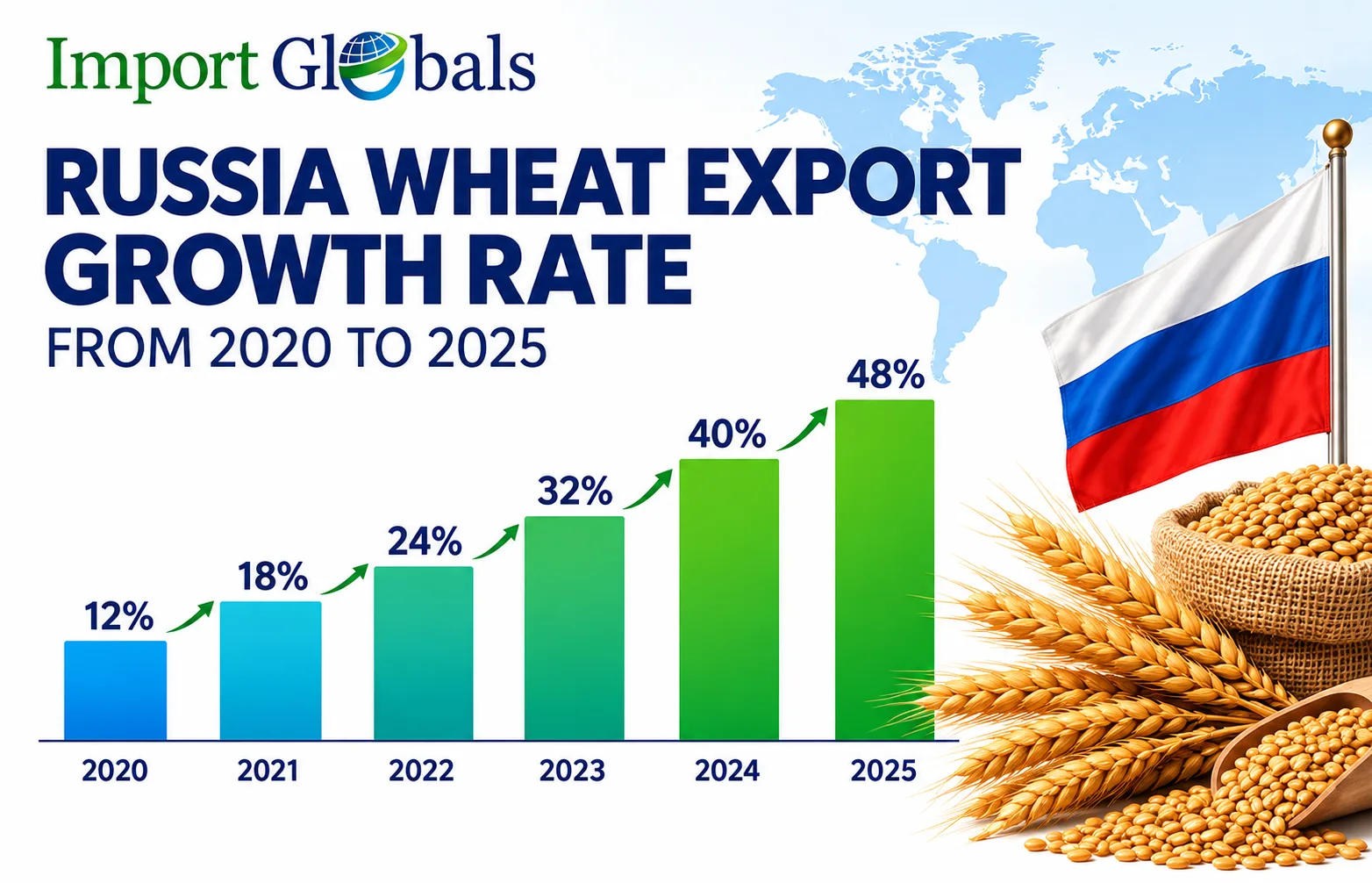
Wheat export is a strategically crucial point for the Russian economy since it helps strengthen agriculture and generates foreign cash flow for Russia, making the rural population employed and improving Russia’s position in the global food market. Russia Shipments Trade Data listed that the nation has managed to obtain its status as a world leader in terms of wheat exports—the country’s wheat exports are dominant in the total cereal export structure.
The wheat export forecast for the marketing year 2025/26 is about 45 million metric tons, which is approximately 80% of the total Russian cereal export. The role of the sector in the economy is not limited to the export cash flow it generates, since large exports make the farming sector generate demand for grain, storage capacities, rail transport, ports, shipping, and food production says Russia Export Data.
Top Wheat Exported Variants of Russia
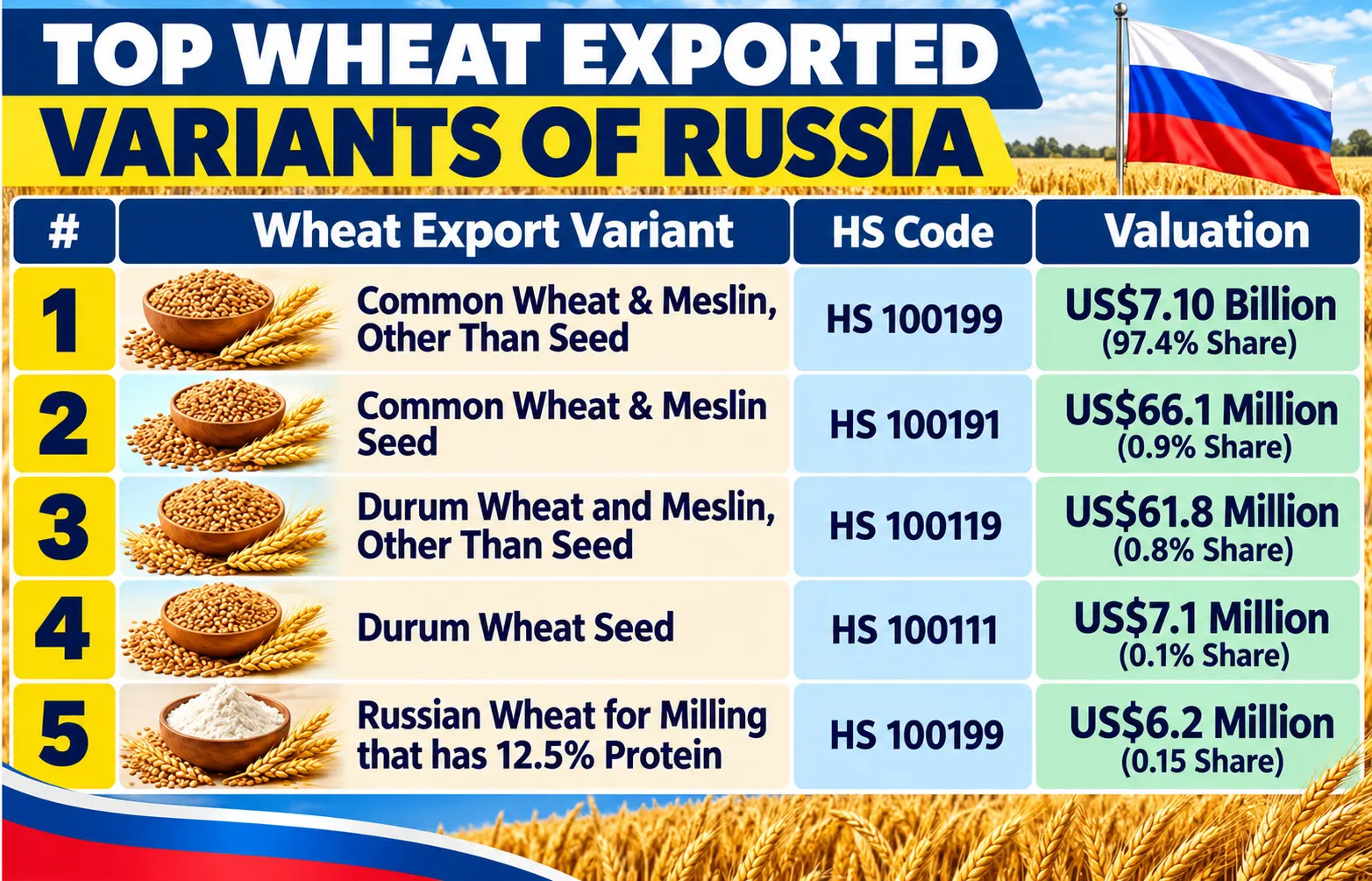
1. Common Wheat & Meslin, Other Than Seed (HS 100199) — US$7.10 Billion | 97.4% Share
Common wheat without seed is Russia's leading wheat export category. It refers to wheat that is commercially traded and mainly used in milling, flour production, food processing, etc. Russia’s huge agricultural base and Black Sea export facility provide sufficient conditions for many international orders, says Russia Customs Data. At the same time, other countries from Africa, the Middle East, and Asia are receiving this product for food supplies.
2. Common Wheat &Meslin Seed (HS 100191) — US$66.1 Million | 0.9% Share
Common wheat and muslin seed is used for agricultural planting and does not refer to wheat that is used as food. The given category includes only the reproductive material that is sent to other countries' agricultural markets. Although it is much smaller than the commercial wheat that is sold, it still has some significance to trade, says Russia Import Data. The highly developed agricultural sector of Russia allows this country to participate in the world agricultural markets with ease.
3. Durum Wheat and Meslin, Other Than Seed (HS 100119) — US$61.8 Million | 0.8% Share
The trade of durum wheat not used for sowing provides food processing businesses with special products. Durum wheat is especially suitable for producing pasta, semolina, couscous, and similar items. Although Russia supplies less durum wheat than common wheat, this category opens various specialized international markets with unique products, says Russia Import Export Data. Thus, its appearance is a sign of the diversification of Russia’s grain export portfolio beyond usual milling wheat.
4. Durum Wheat Seed (HS 100111) – US$7.1 Million | 0.1% Share
Durum wheat seed belongs to specialized agricultural exports designed for the needs of planting and growing crops. It is used by farmers to create durum wheat for pasta and semolina production. The volume of Russian exports in this category is rather small compared to the export of common wheat; nevertheless, it takes its position in Russia’s export of agricultural products.
5. Russian Wheat for Milling that has 12.5% Protein – HS 100199 – US$6.2 million | 0.15 share
Russian milling wheat, which has an approximate 12.5% protein content, is another commercially recognized specification of the commodity of common wheat. It has applications in flour production and baking. Russia Trade Data reported it as the main contributor, mainly because of the latest demanded variants.
The Main Industries That Contribute to Russia's Wheat Exports in 2025
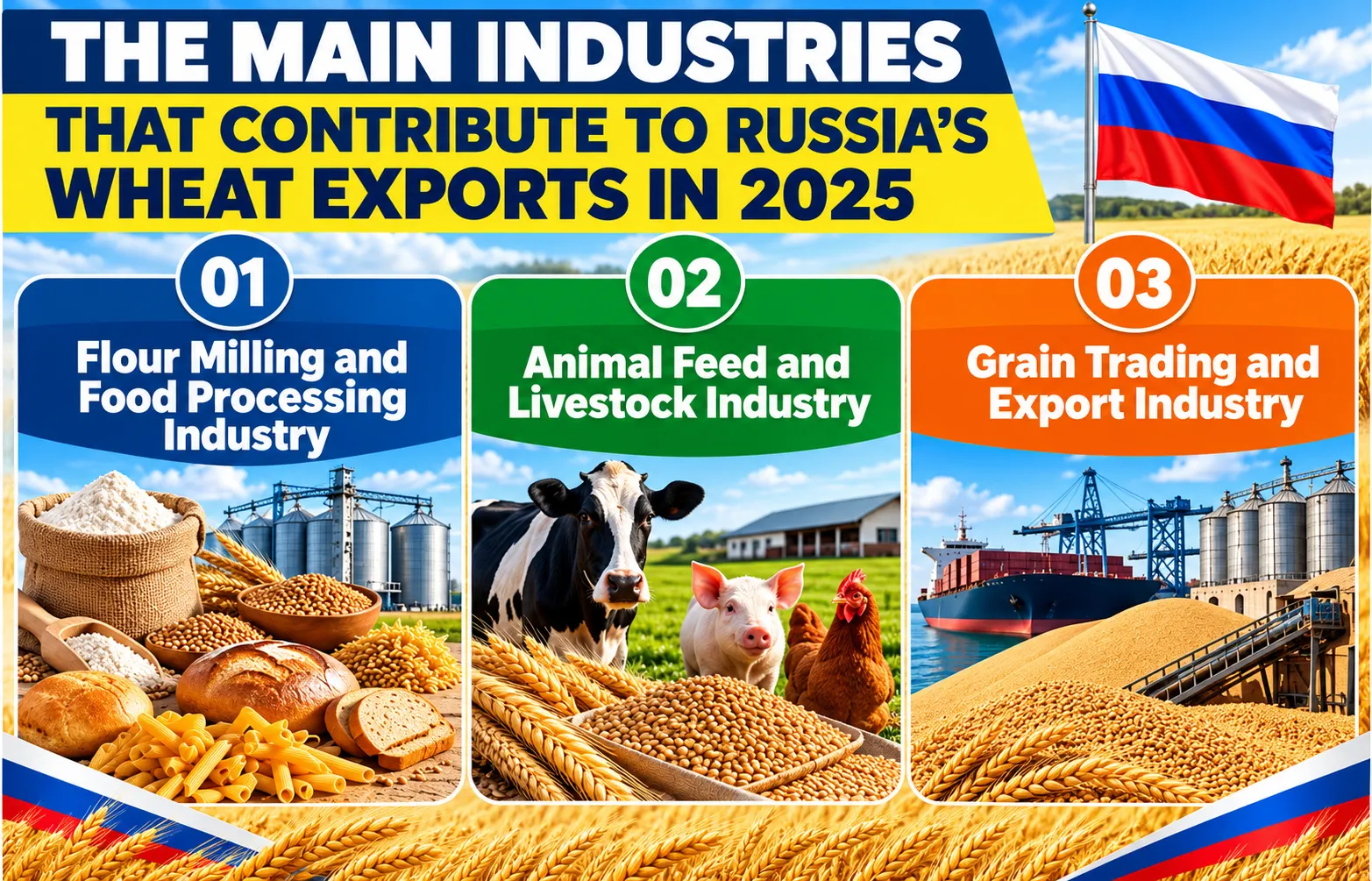
- Flour Milling and Food Processing Industry — Wheat is distributed in many countries of the world where flour, bread, pasta, baked goods, and other products are produced. Continuous demand from wheat-importing countries allows Russian companies to export wheat effectively, says Russia Import Statistics.
- Animal Feed and Livestock Industry — Russia Customs Trade Data listed livestock industry as the massive contributor crafting the wheats trade. Wheat of lower grades is used in the production of livestock and poultry feeds, which gives Russia additional possibilities for exporting its grain.
- Grain Trading and Export Industry — Trading companies, exporters of grains, storage companies, and agricultural companies allow Russian producers to enter international markets. In the agricultural season of 2025-2026, Russia is supposed to export about 46.5—48 million tonnes of wheat.
Top Export Partners of Russia for Wheat Exports
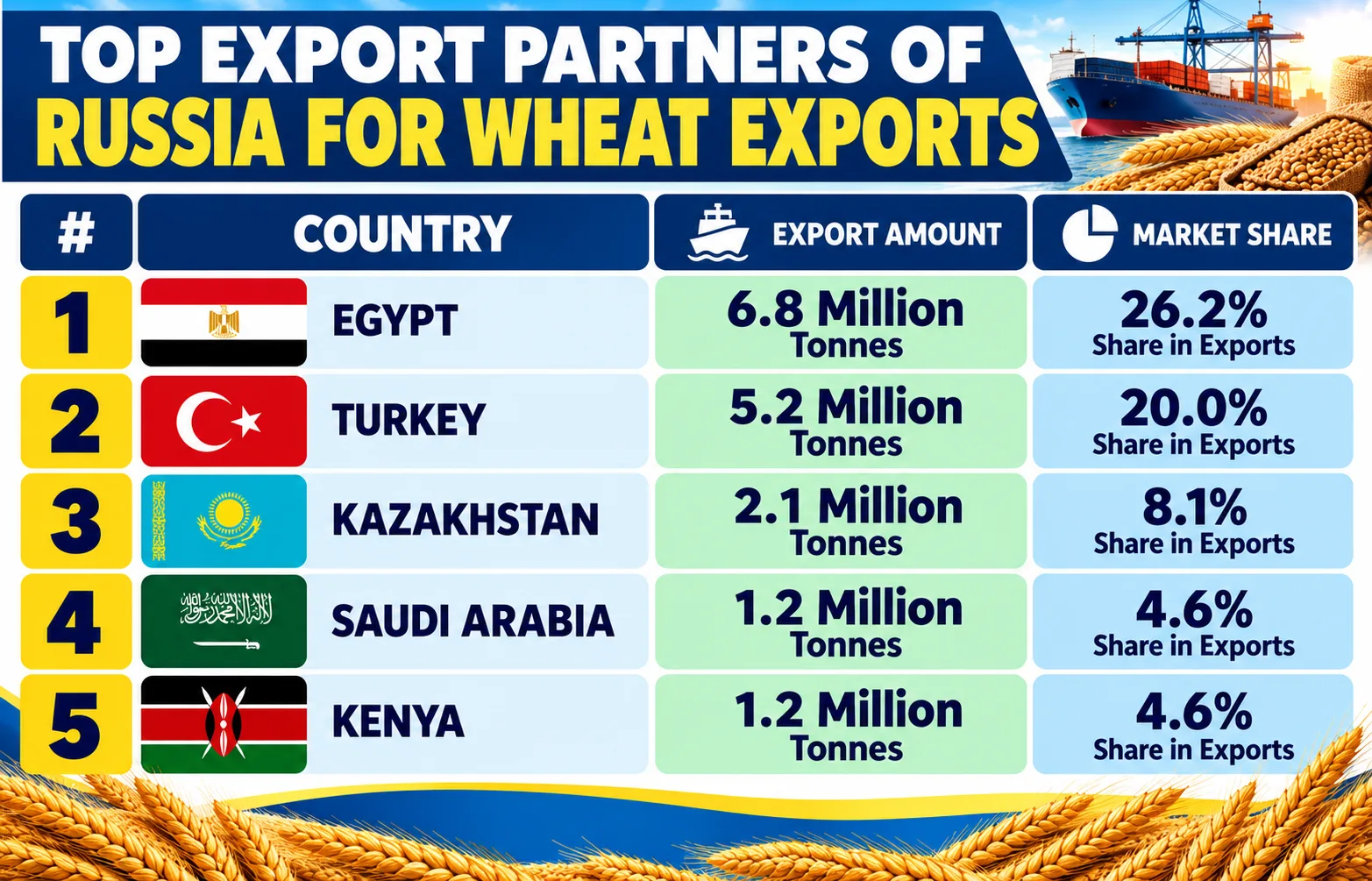
1. Egypt - 6.8 million tonnes | 26.2% share in exports
Egypt Import Data shows that the country is one of the top export partners of Russia, with an overall share of 26.2% of wheat exports. The bilateral relationship is a basic power driving the global presence of both nations.
2. Turkey - 5.2 Million Tonnes | 20.0% share in Exports
Turkey is also a regional contributor to Russia's wheat exports. Turkey Import Data reported that the country has the advantage of its proximity to the Black Sea, which helps the shipment process of wheat and contributes to lower delivery costs.
3. Kazakhstan — 2.1 Million Tonnes | 8.1% Export Share
Kazakhstan Import Data reported that the nation has imported around 2.1 million tonnes of Russian wheat in 2025 and has become an important regional trading partner. The common border and developed land-transport channels have made it a significant contributor to grain transportation.
4. Saudi Arabia — 1.2 Million Tonnes | 4.6% Export Share
Saudi Arabia Import Data reported that the nation has received approximately 1.2 million tonnes of Russian wheat. The developed maritime routes from Russian ports to the Middle East are mainly based on regular shipments and contribute to the expansion of presence in the Saudi wheat market.
5. Kenya — 1.2 Million Tonnes | 4.6% Export Share
Kenya Import Data indicate that the nation has imported about 1.2 million tonnes of Russian wheat in 2025, and thus became another important African destination. Population growth, food consumption, and local milling requirements are the main factors influencing the demand for imported wheat in Kenya.
Challenges Affecting the Wheat Exports of Russia
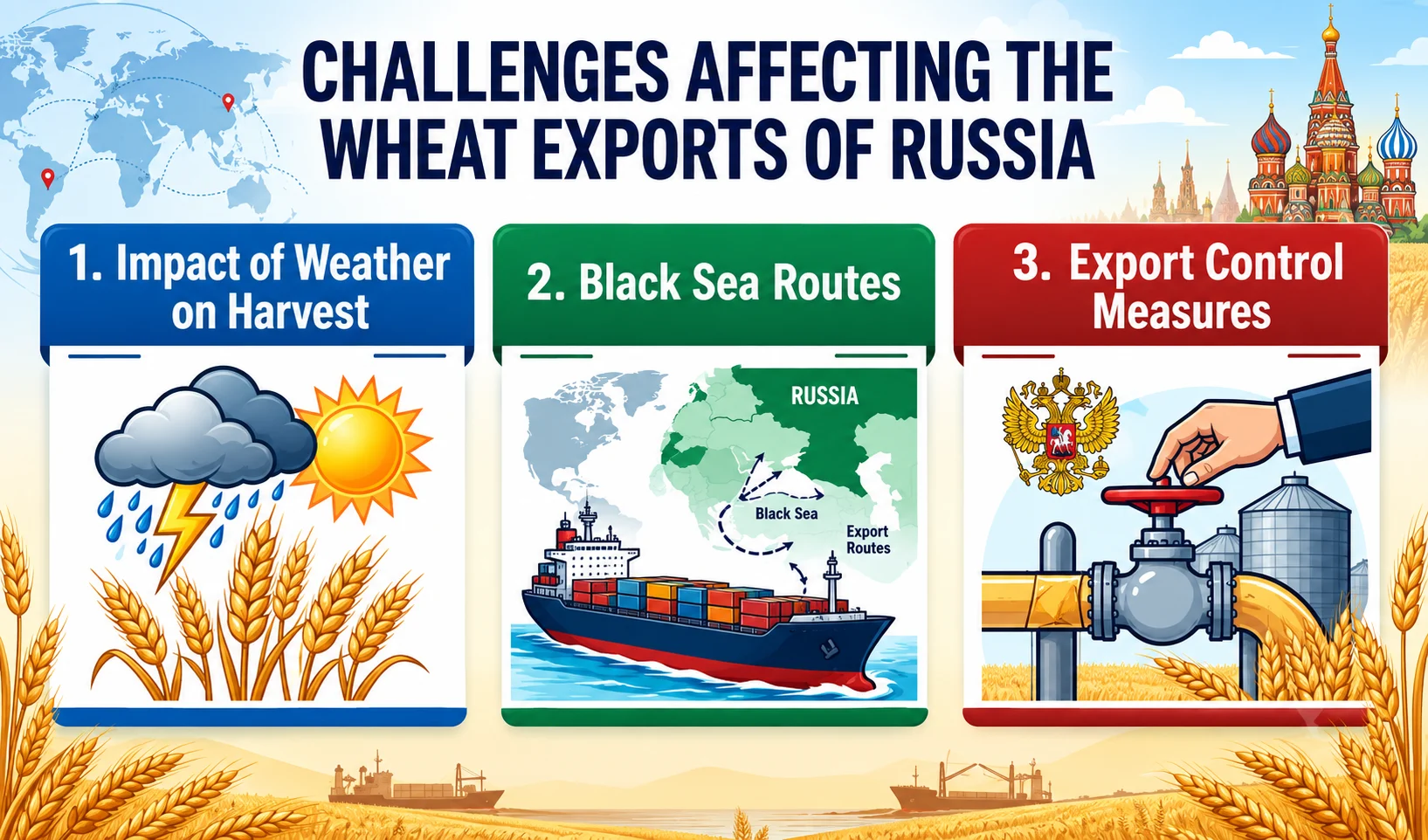
1. Impact of Weather on Harvest
Russia Import Trade Data reported that weather changes are mainly affecting the overall shipments of wheat from Russia. The climatic conditions are disrupting the regularised trade flow, thus affecting the overall revenue generation.
2. Black Sea Routes
The transportation of trade through Black Sea routes has given the country easy access to the vulnerabilities of global trade. Transportation irregularities may lead to an effective growth of overall shipments, driving the trade ranking says Russia Import Export Trade Data.
3. Export Control Measures
State measures aimed at the protection of domestic food resources can limit export volumes. On 30th of June 2025, Russia changed the rules in the area of wheat exports and limited shipments to those for members of the EAEU. This means that exporters may not have enough opportunities, and that can complicate the situation in case of high demand on the international market.
How Does Import Globals Help With Russia Wheat Exports?
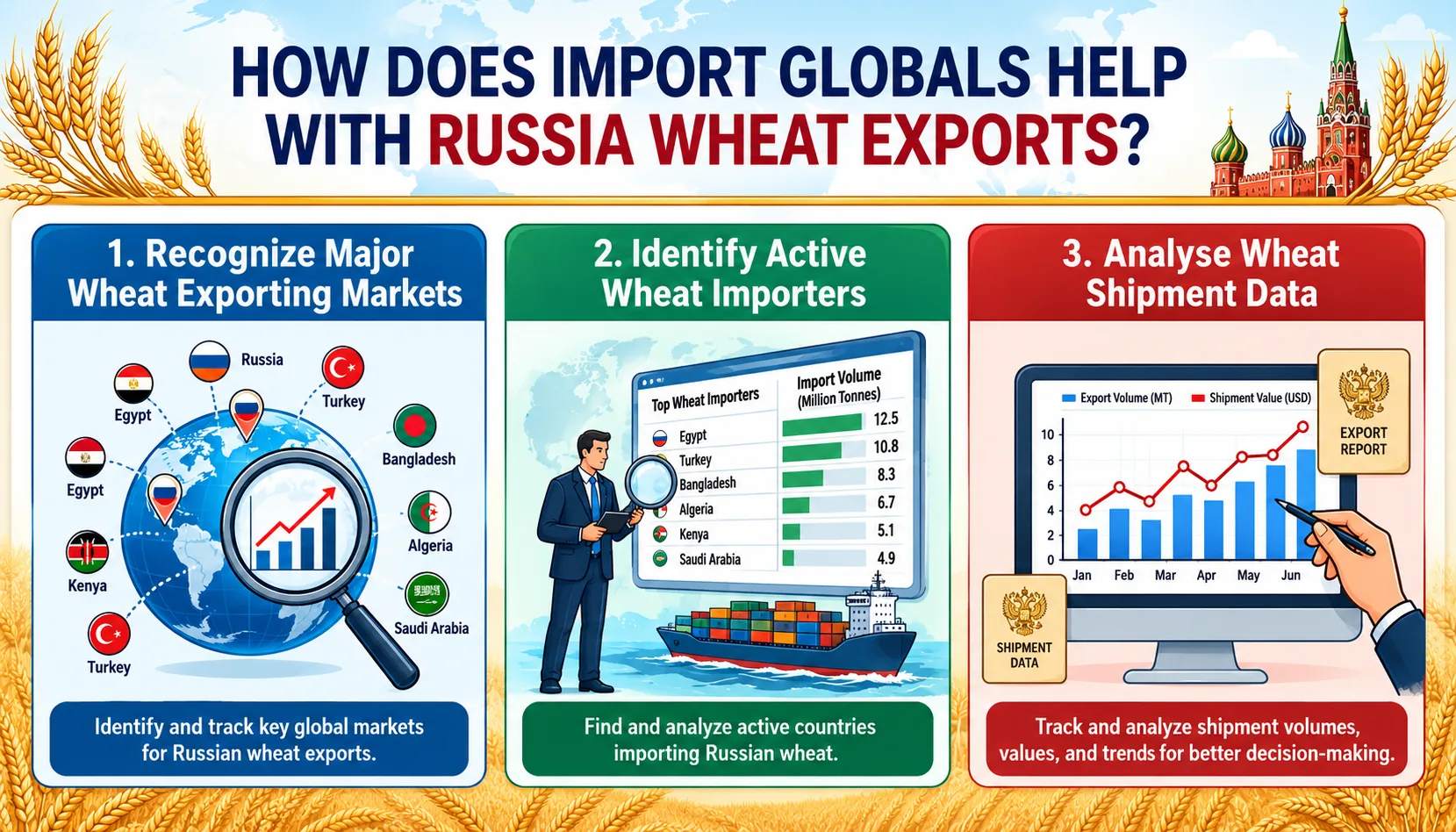
Import Globals has the potential to enable businesses, exporters, researchers, and analysts to know how the Russian wheat export industry works and how it moves. It provides information on trade statistics by shipment. It allows searching the data by HS code, name of the product, name of the importer/exporter, country of shipment, name of the port, quantity, and value.
1. Recognize Major Wheat Exporting Markets
The users of Import Globals can see the data about destination countries that are importing wheat from Russia, as per the Russia Customs Import Data. This information helps them highlight the important markets of wheat export and the potential opportunities for export.
2. Identify Active Wheat Importers
Import Globals also shows the names of importers and exporters, along with the names of products and the volume of shipments, and this information is helpful in tracking those companies that are purchasing wheat actively.
3. Analyse Wheat Shipment Data
Import Globals also has historical data on shipments, and that Russia Trade Statistics can show users some changes in the trade of wheat.
Future Outlook for Russia's Wheat Exports
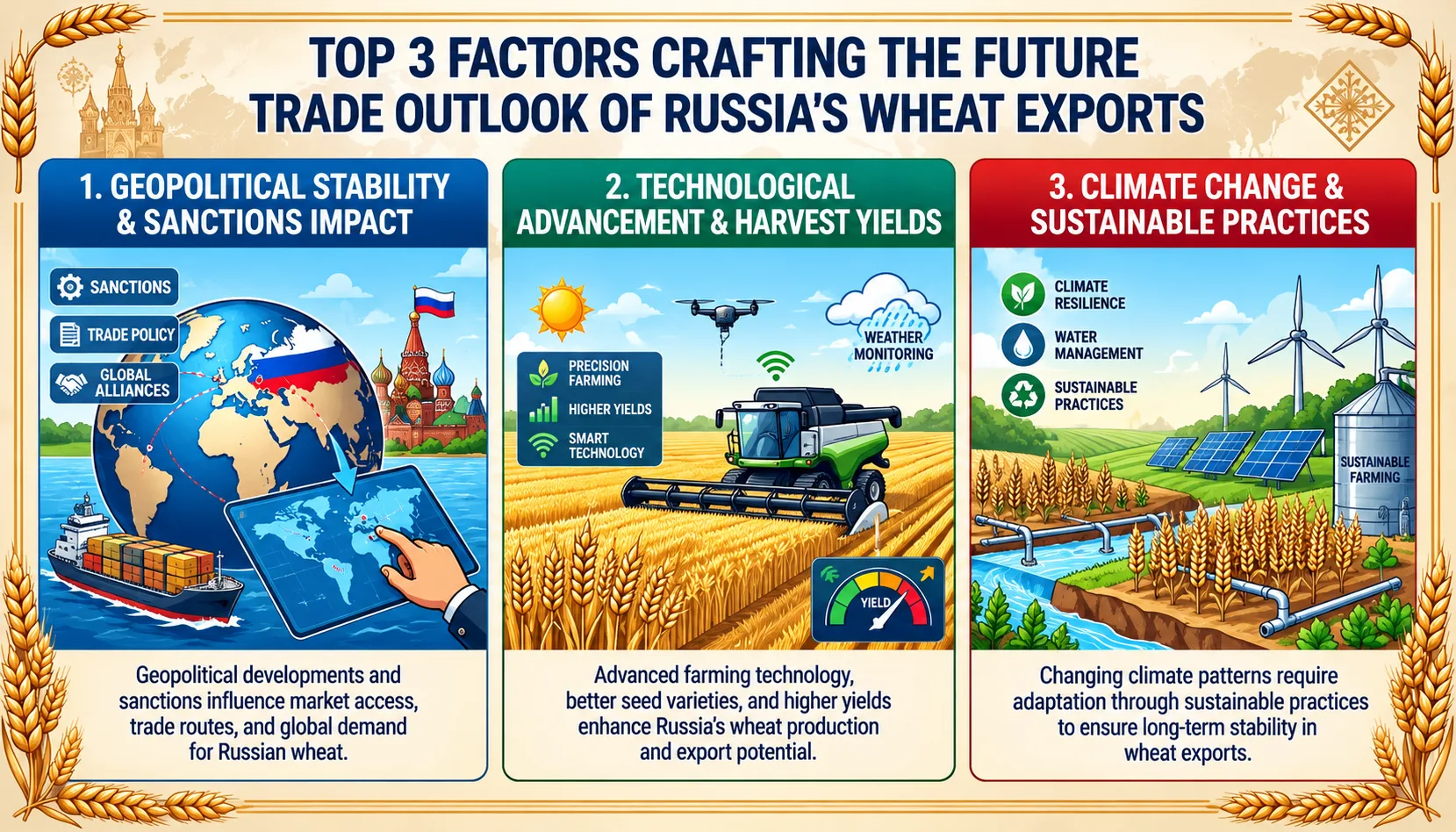
The outlook for Russia's wheat exports seems encouraging given that the country produces large volumes of wheat, with favourable prices and agricultural land as well as demand from major wheat importing countries. Russia is projected to be among the major wheat exporters going forward, and the growth is likely to benefit from demand from countries such as Egypt, Turkey, Saudi Arabia, and other developing countries.
However, future growth will rely on the weather patterns and quantity of wheat harvested, the price of wheat internationally, and the means of sea transport, says Russia Trade Data. Geopolitical implications and military actions in the Black Sea region are likely to complicate matters by causing spikes in freight costs and limiting possible shipment timelines, thus forcing Russian exporters to develop alternative routes.
Conclusion
In 2025, Russia’s exports of wheat remained one of the cornerstones of its agricultural industry thanks to strong production capabilities, extensive farmland, low prices, and a strong established international delivery network. Strong demand from hundreds of buyers of wheat in the Middle East, Africa, and Asia created additional opportunities for Russian wheat exporters.
At the same time, the export of wheat was affected by adverse weather conditions and geopolitical tensions, problems with logistics, export limitations, and changes in the world wheat price system, says Russia Import Export Data. In the coming years, Russia’s ability to offer good prices, increase its agricultural productivity, widen its export markets, and maintain proper transport infrastructure will highly impact its ability to perform effectively on the wheat export market.
CTA
If you are trying to get a detailed overview of the latest wheat products exported from the nation, then you have landed on the right platform. Import Globals has special expertise in providing detailed updates regarding the latest wheat exports from the nation. Subscribe to www.importglobals.com or drop an email at info@importglobals.com for the latest marketing strategies regarding the wheat exports of the nation to drive your global business growth.
FAQ’s
Que. What is the export trade value of wheat from Russia in 2025?
Ans. The export trade value of wheat from Russia in 2025 is $8.6 billion US dollars.
Que. What is the global trade rank of Russia in 2025?
Ans. The global trade rank of Russia in 2025 is 22nd.
Que. What is the export trade share of wheat in Russia’s economy?
Ans. Wheat accounts for 2.1% of Russia’s economy.
Que. Name the top industry driving Russia’s wheat exports in 2025.
Ans. The agricultural and wheat cultivation industry is the top one driving Russia’s wheat exports in 2025.
Que. Who is the top export trade partner of Russia for wheat trade in 2025?
Ans. Egypt is the top export trade partner of Russia for wheat exports in 2025.
Que. Name the top variant of wheat exported from Russia in 2025.
Ans. Common wheat and Maslin are the top exported variants of wheat from Russia in 2025.
Que. How does Russia import export data support business growth?
Ans. Russia import export data supports business growth via proper identification of buyers, supplier analysis of market demand, and development of effective market expansion strategies.
Que. What information is available in Russia trade reports?
Ans. Russia Trade Datacovers Importer names, Exporter names, Shipment date, HS Code, Product Details, quantity, values, pricing information, origin country, importing country & port details.
Que. How frequently is the Russia Trade Data updated?
Ans. Russia Trade Data is updated on a monthly basis.
Que. Where can you obtain detailed information on Russia Trade Data?
Ans. Visit www.importglobals.com or drop an email at info@importglobals.com for detailed updates on Russia Trade Data.
You Can Also Visit :-
- Russia Customs Data: A Comprehensive Guide for Progressive Importers and Exporters
- Russia Export Data: An Overview of the Products Traded and the Global Market Role of the Country
- Information About Russia's Oil Exports, Such as How Much Oil Russia Makes and WHO Sells It
- Introduction to the Fossil Fuels Export Market of Russia
- Russia Top Exporting Product Of 2023-2024