Sweden Steel Trade Data: Imports, Exports, and Market Analysis
- Sep 15, 2026
Sweden Steel Trade Data: Imports, Exports, and Market Analysis
In 2025, Sweden continued to be a key player in the world’s steel trade, thanks to its established reputation as a manufacturer of top-quality and advanced steel products. In that year, Sweden’s iron and steel exports were estimated at US$7.01 billion, which represented approximately 3.5% of Sweden’s total merchandise exports.
This clearly shows that the steel sector plays a significant role in the country’s exports, reported Sweden Trade Data. Sweden’s steel products were shipped to various countries across Europe, North America, and Asia, with important customers being Germany, Italy, the USA, and other European nations.
Sweden Customs Data says that the strength of Sweden’s steel exports is attributed to the manufacturing of specialty and value-added steel products. This specialty steel is used in the automotive sector, construction, engineering, machinery, and energy production. The successful steelmaking industry and commitment to innovation and sustainability give Sweden a competitive edge in international markets. Sweden’s position in the world’s rankings of iron and steel exporters was around 15th place in 2025, which indicates its significance in the steel trading industry.
The Significance of Steel in Sweden’s Economy
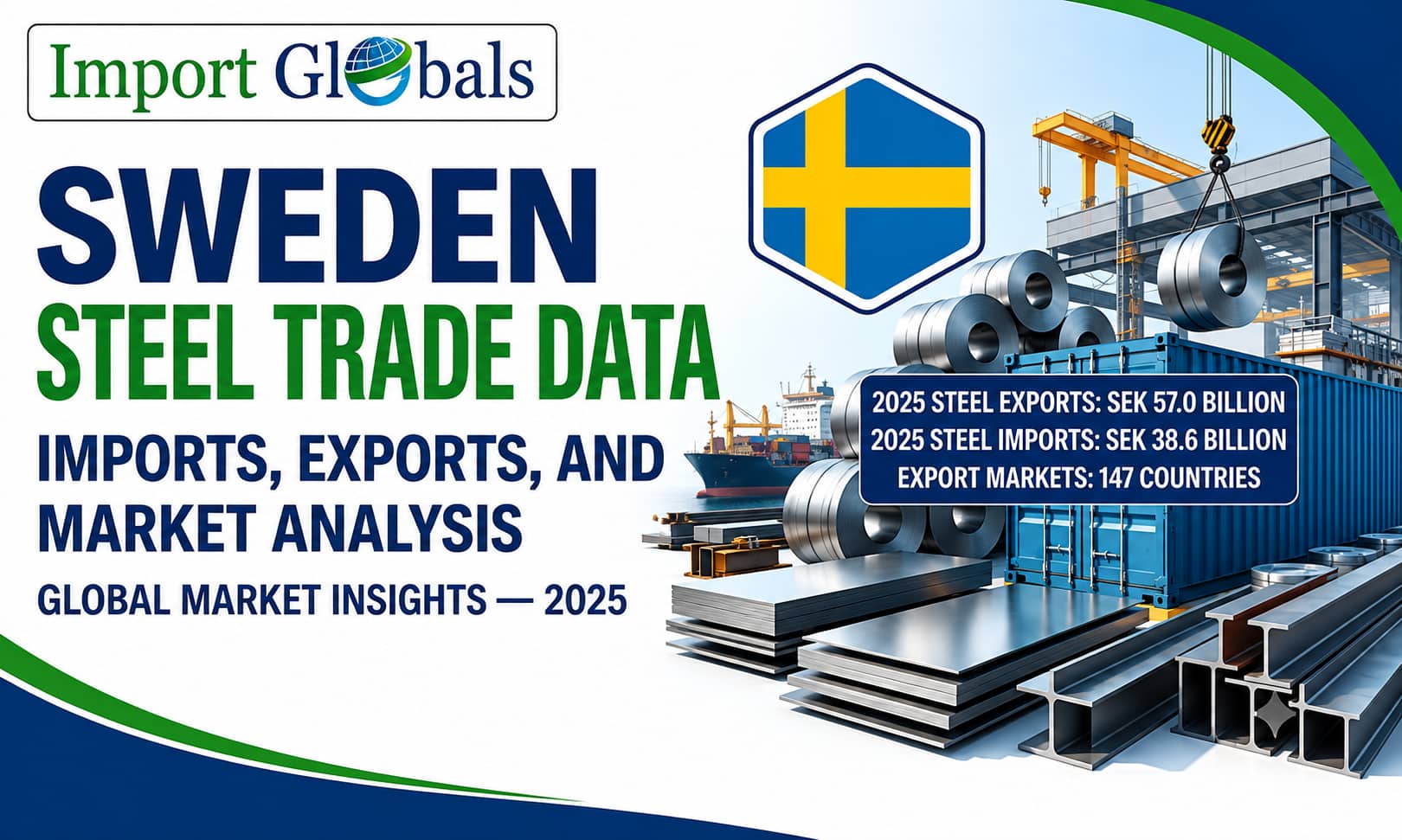
Steel plays a crucial role in Sweden’s foreign trade and indicates the country’s long-standing experience in producing high-tech and special steel products. In 2025, the total value of exported finished steel products, including semi-finished products and billets, amounted to SEK 57 billion ($5.3 billion), says Sweden Export Data. In the same year, Sweden imported steel worth SEK 38.6 billion, as per Sweden Customs Trade Data. Thus, Sweden generated a great trade surplus due to steel exports, which constituted about 2.8% of the total merchandise exports of the country.
The value of steel products is more than just the amount of exports achieved. For example, Sweden produced about 4 million tons of crude steel in 2025, of which 54% fell on alloy steels. Many of those products were exported to foreign markets. The country exported steel to over 140 countries, with 68% of total steel exports going to the EU and the UK. Thus, the advantage of Sweden in this industry is in the production of specialty, advanced, and value-added steel rather than regular steel.
The Top 5 Imported Steel Product Types of 2025 in Sweden
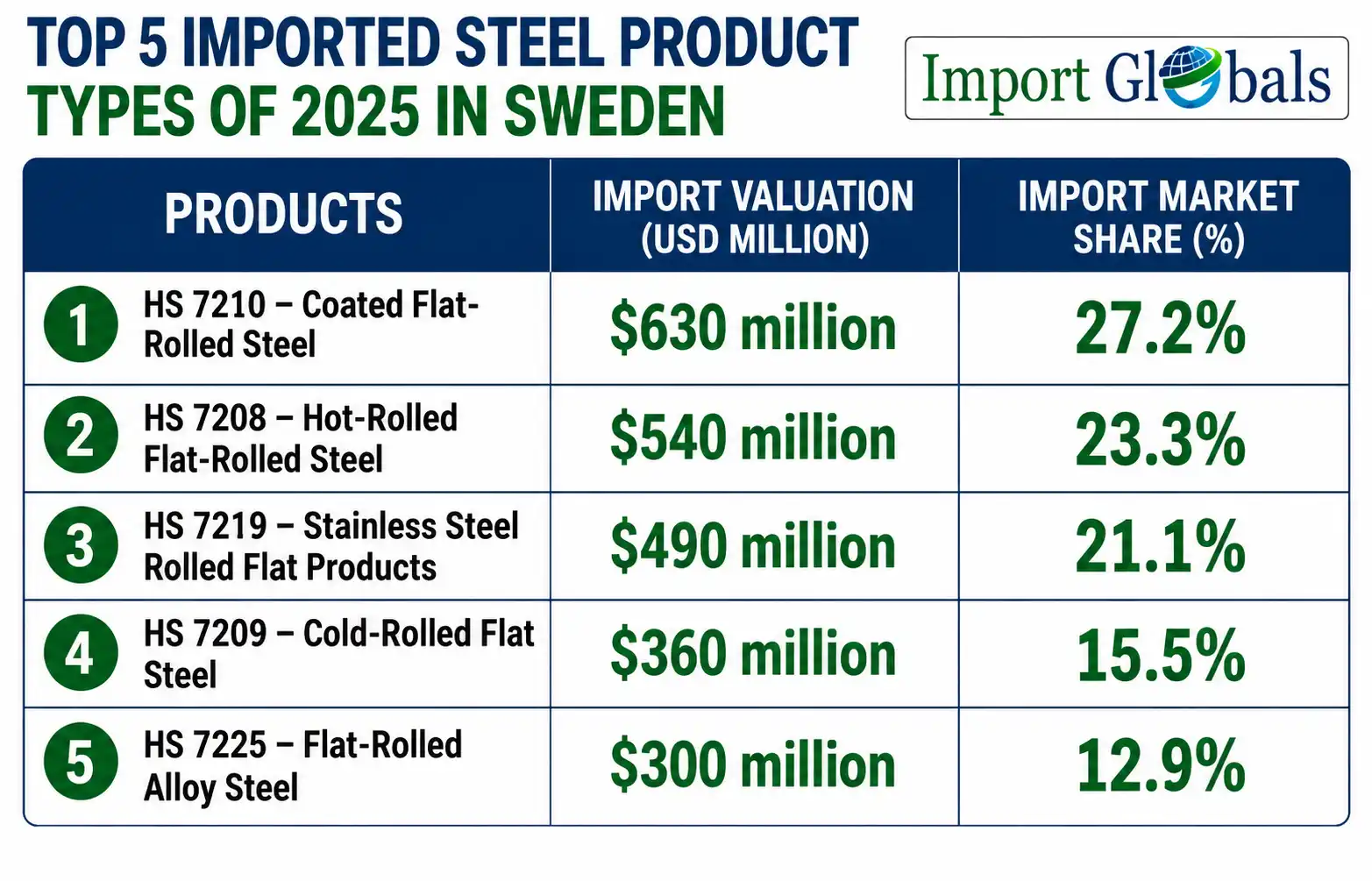
1. HS 7210 - Coated flat-rolled steel - US$630 million
This category of steel is a very crucial class of imports and represents the steel product types that are coated or plated with different kinds of coatings such as zinc, aluminum, tin, etc. Coated Flat-Rolled Steel is used extensively in various industrial product types ranging from automobiles and buildings to appliances and engineering structures and other specialized types. Sweden Customs Statistics reported that Manufacturers in Sweden make use of these coated products while taking advantage of the availability of specialization of local producers who make higher quality types.
2. HS 7208 - Hot rolled flat rolled steel - US$540 million
Hot rolled flat rolled steel is another major category of imports for Sweden. These types of steel products are widely used in construction, machinery and car parts manufacture, industrial machinery applications, and many others. Sweden Import Export Data says that the Imports help manufacturers in Sweden in their quest to find the standard steel grades which they need in sufficient quantity, ensuring that they always have the necessary price competitiveness of the items that they might not be able to produce using local suppliers or even special manufacturers in Scandinavia.
3. HS 7219 – Products made of Stainless Steel that are Rolled Flat - US$490 million
Stainless steel rolled flat products are the key raw materials used in advanced manufacturing, engineering, food production, chemicals, energy, and construction industries in Sweden. The category includes wide rolled stainless sheets and coils made by either hot or cold rolling methods. Imports enable producers to gain access to the different grades, gauges, surface finishes, and specifications required for manufacturing.
4. HS 7209 – Flat Steel Rolled Cold - US$360 million
Flat steel rolled cold is another very important imported product because it has a smooth surface, close dimensions, and can be easily formed into shape. Sweden Shipments Data reported that it is used in manufacturing parts for the automotive industry, household appliances, machines, electrical machinery, and fabricated products. Imports add to the capacity of producing steel in the country and add standard grades to manufacturing.
5. HS 7225 – Flat-Rolled Alloy Steel —US$300 million
Flat-rolled alloy steel consists of specialized types of steel that have elements improving the strength, hardness, resistance to corrosion, etc. Swedish industries utilize this type of steel in engineering, automotive, machinery, energy, and industrial equipment manufacturing. The imports allow companies to obtain specific compositions of alloy steels, while modern production capacity in Sweden is focused on sophisticated and high-performance steels.
Top 5 Exported Steel Products of Sweden in 2025
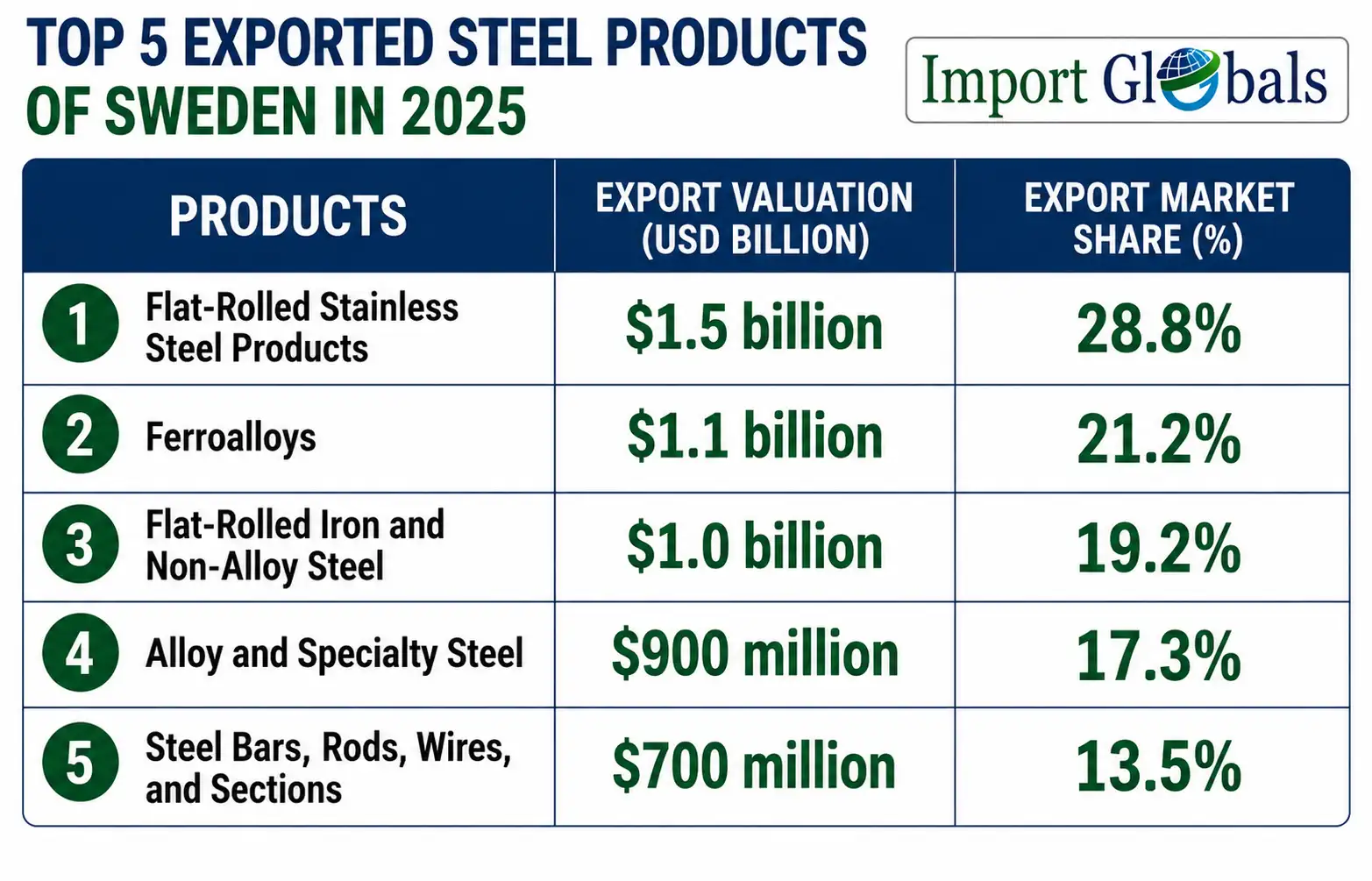
1. Flat-Rolled Stainless Steel Products — Reported at US$1.5 billion
As an extensive stainless steel flat product exporter, Sweden has been known for distributing products like sheets, plates, and coils. These products are highly regarded for their durability, corrosion resistance, and precision; hence, they have a big market application in automobile manufacturing, engineering, construction, food processing, and industrial equipment. In fact, Sweden is globally known for its high-quality steel products.
2 Ferroalloys — US$1.1 Billion
Ferroalloys are used as raw materials in the manufacture of quality steels, reported Sweden Trade Statistics. Sweden is known for exporting ferroalloys containing elements such as chromium, manganese, and silicon that add strength, hardness, and corrosion resistance to steels. This also contributes to Sweden's overall metal trade.
3 Flat-Rolled Iron and Non-Alloy Steel — US$1.0 Billion
Sweden's exports consist of large quantities of flat-rolled iron and steel, says Sweden Shipment Trade Data, which includes hot-rolled, cold-rolled, and coated products. These materials serve the automotive, construction, machinery, and manufacturing industries and meet the requirements of steel manufacturers.
4. Different Types of Alloy and Specialty Steel — US$900 Million
Alloy and specialty steel is an important part of Sweden's value-added steel export. These products are made to endure tough usage and deliver high strength, durability, and wear-resistance qualities. They find applications in a wide range of fields, such as engineering, automotive, energy sector, machinery industry, and more, where reliability and performance are important.
5. Steel Bars, Rods, Wires, and Sections — US$700 Million
Sweden is exporting a lot of different steel bars, rods, wires, and shapes for construction, engineering, the automotive industry, and other industrial manufacturing. Swedish manufacturers are quite competitive in producing different specialty grades and precision-engineered products. Technical perfection, in addition to durability, makes these products an important part of Sweden's steel export market.
Massive Brands Supporting Sweden Steel Exports
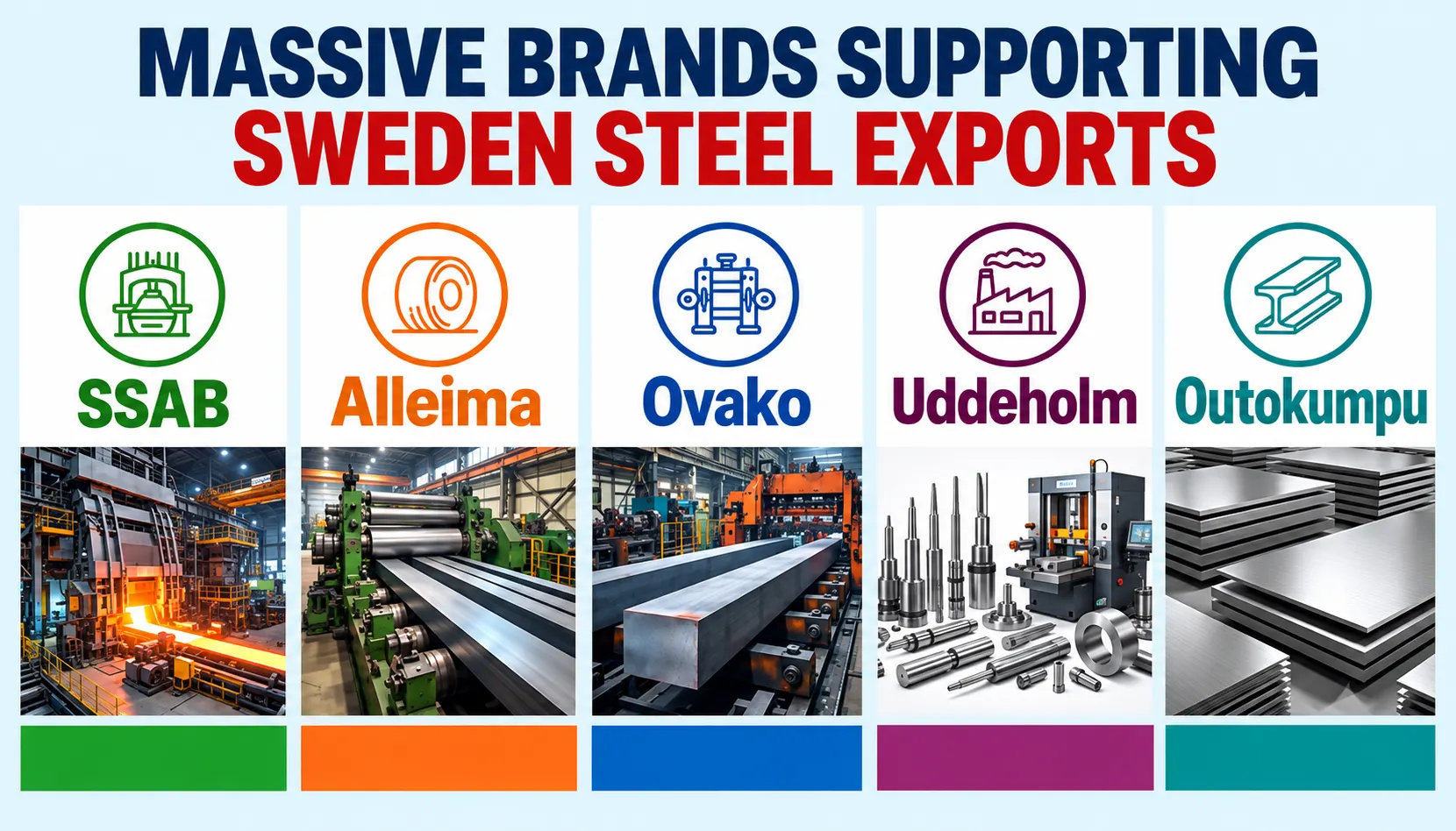
- SSAB - One of the most renowned steel companies in Sweden, specializing in high-strength steel production, advanced and premium steels. The brands under its name include Hardox, Strenx, Docol and SSAB Zero. Its distribution network ensures global export of Swedish steel, reported Sweden Import Data.
- Alleima - A Notable Swedish manufacturer of advanced stainless steels and high-performance alloys. Its purpose is to produce goods for industries like aerospace, energy, chemical processing, medical technologies, and many others.
- Ovako - A company focusing on producing engineering steels, especially those used in manufacturing bearings, gears, and other specialized steels. Its goods are used in demanding applications and exported worldwide.
- Uddeholm - A special Swedish brand of steel famous worldwide for providing tool steels for tooling, molding, die casting, and advanced manufacturing. Its equipment enhances Sweden’s value-added steel exports, reported Sweden Trade Statistics.
- Outokumpu - Having its main office in Finland, Outokumpu possesses a large production facility in Sweden. Sweden Import Data says that it is known as a major actor in the stainless-steel industry there.
Top Trade Partners of Sweden: The Essential Role Played in Imports and Exports
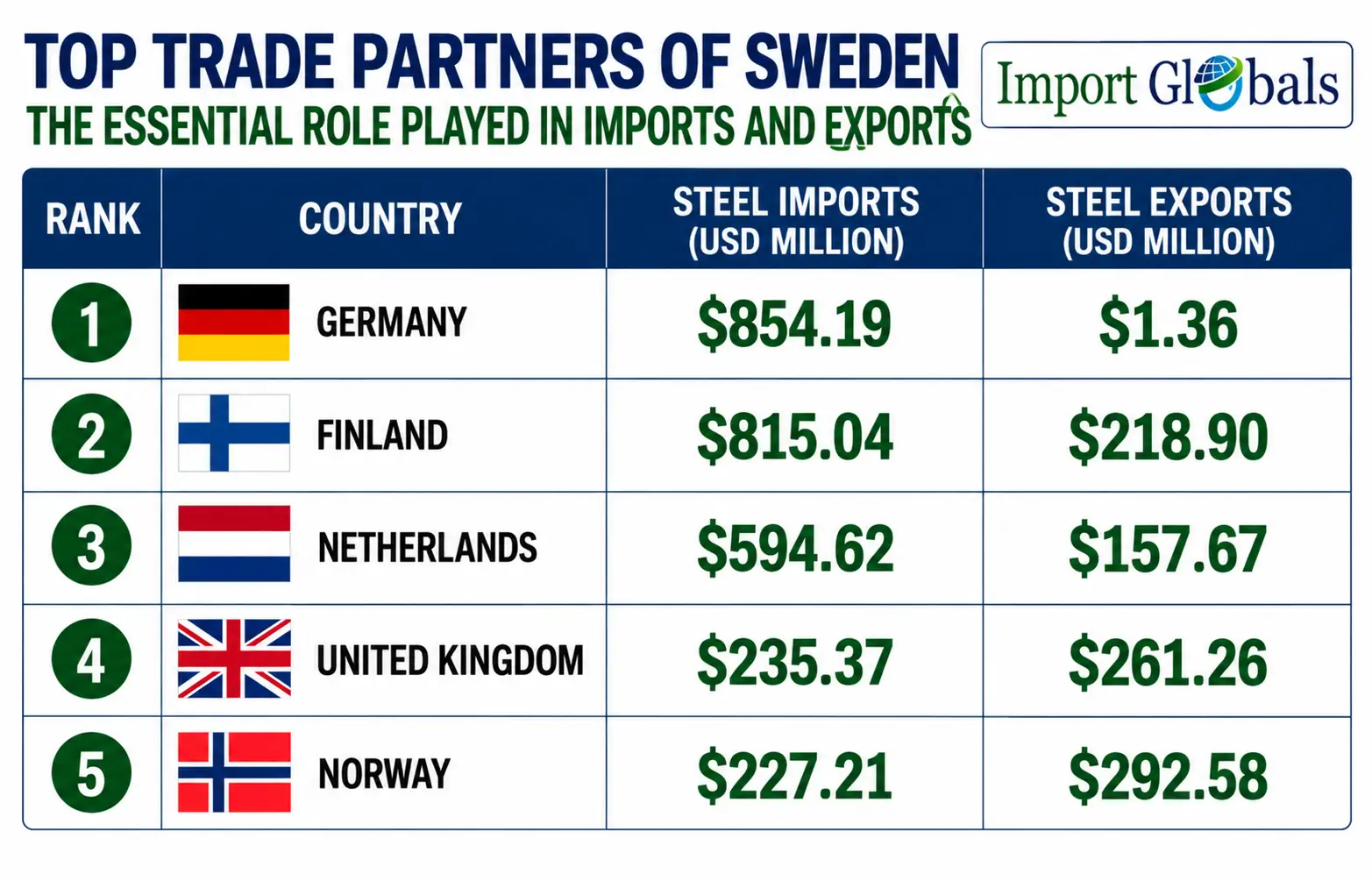
1. Germany – US$ 854.19 Million Imports | US$ 1.36 billion exports
Germany served as Sweden's top partner for steel trading in 2025. Sweden Import Statistics says that imported iron and steel are worth USD 854.19 million from Germany, whereas exports to Germany reached USD 1.36 billion. The reason behind this transaction is the close relationship between the countries, as both belong to the integrated supply chain within Europe, where steel is distributed across borders for automotive, engineering, construction, and other purposes.
2. Finland – US$ 815.04 Million Imports | US$ 218.90 Million Exports
Finland turned out to be the second-largest steel provider for Sweden in 2025, supplying it with USD 815.04 million worth of iron and steel goods. Sweden shipped goods for USD 218.90 million in the opposite direction. As the countries are located closely yet experience challenges with maintaining stable links and transportation routes due to their geography, Finland emerged as a significant importer of steel goods from Sweden.
3. Netherlands – US$ 594.62 million imports | US$ 157.67 Million Exports
The Netherlands provided Sweden with USD 594.62 million worth of iron and steel goods, while its exports to the Netherlands amounted to USD 157.67 million, reported Sweden Statistical Data. Thanks to the strong logistics system and distribution capabilities, the Dutch ports managed to become one of the main transportation points for distributing steel across Europe.
4. United Kingdom — US$235.37 Million Imports | US$261.26 Million Exports
In 2025, the United Kingdom was an important partner in steel trade with Sweden. Sweden imported steel from the United Kingdom worth $235.37 million and exported steel worth $261.26 million to the United Kingdom. Both countries engaged in steel trading in several diverse categories such as construction, engineering, manufacturing, etc.
5. Norway — US$227.21 Million Imports | US$292.58 Million Exports
In 2025, Norway also remained one of the important Nordic partners for Sweden in steel and iron trade. Sweden imported iron and steel from Norway worth $227.21 million while exporting iron and steel worth approximately $292.58 million to Norway. The geographical proximity, developed transportation links, as well as Nordic industries being interrelated, have contributed to the success of the trade between Sweden and Norway, as reported by Sweden Trade Data. According to the reported statistics, Sweden exported steel to Norway worth approximately $325 million.
Government Policies Supporting Sweden’s Steel Exports
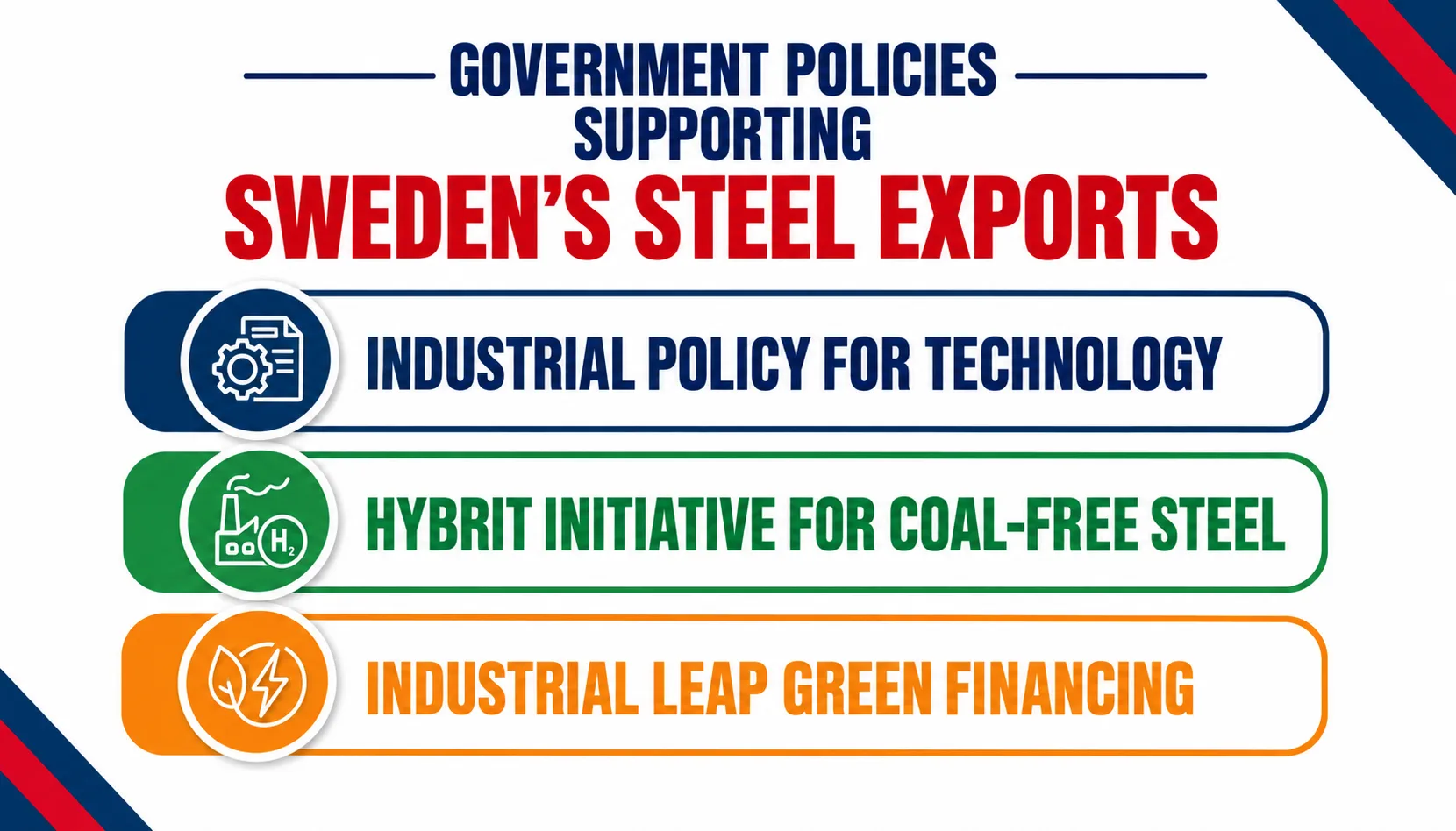
1. Industrial Policy for a Technologically Advanced and Competitive Industry
Launched in 2025, Sweden’s industrial policy aims to enhance the country’s competitiveness by promoting strategic technologies from inception to commercialization. It also concentrates on improving the attractiveness of investments in industry, infrastructure, energy systems, and simplified regulations, thus ensuring better circumstances for steel producers to expand production.
2. HYBRIT Initiative — Government-Assisted Coal-Free Steel Production
HYBRIT implementation involving SSAB, LKAB, and Vattenfall develops steel production on the basis of hydrogen produced without coal and coke. Sweden Customs Data says that some of the project costs were financed by the Swedish Energy Agency and the EU Innovation Fund. The technology can cut emissions drastically and provide Swedish exporters with the needed competitive advantage.
3. Industrial Leap — Financing a Green Transformation
The Industrial Leap program by the Swedish Energy Agency supports initiatives aimed at lowering industrial CO2 emissions. As an example, Ovako steel producer obtained funds for its project of heating with the use of fossil-free hydrogen in Hofors.
The Future Trade Outlook of the Sweden Steel Industry
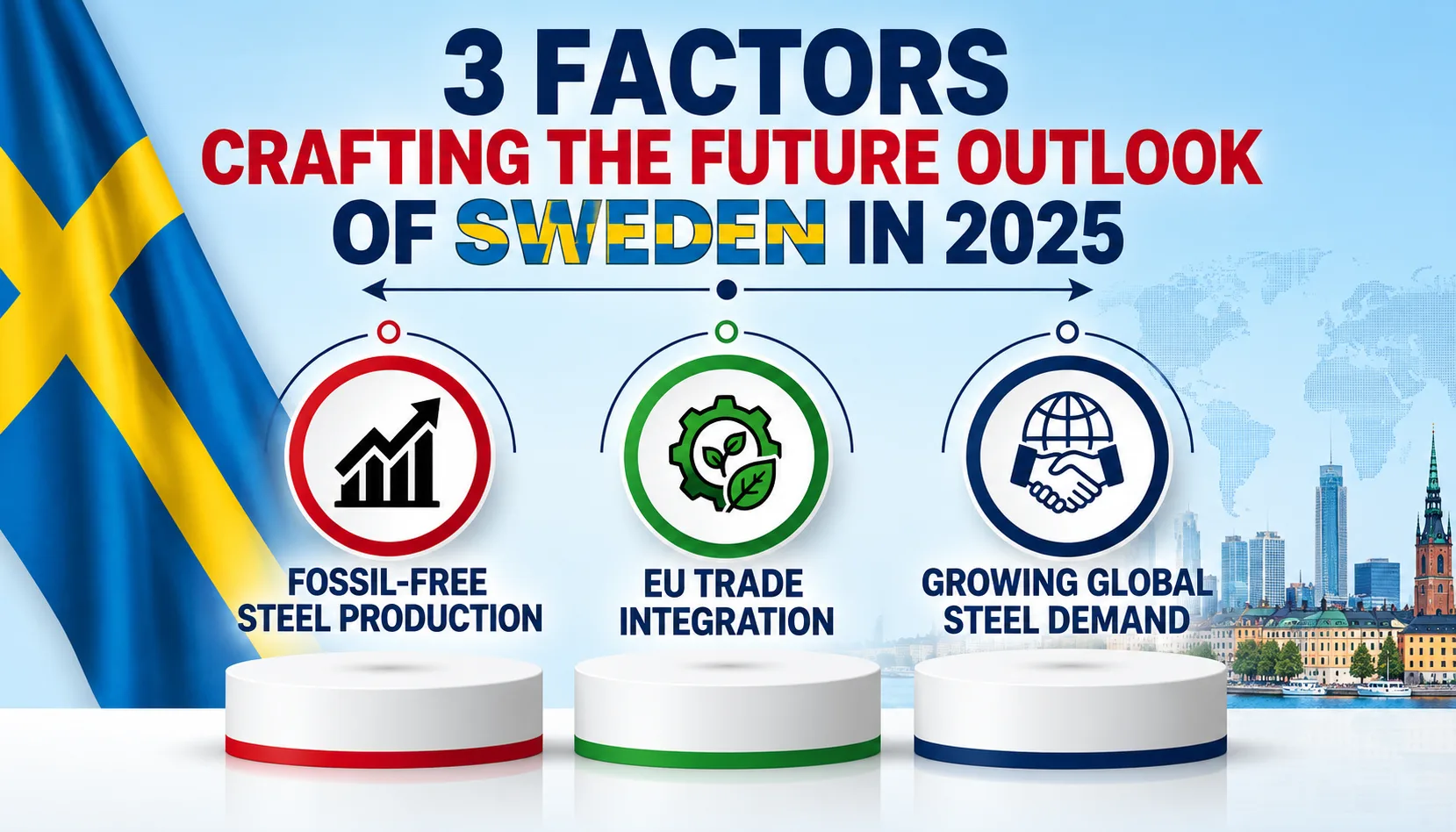
The Swedish steel industry is expected to be optimistic in the coming years. The steel exports, as reported in the Swedish Trade Export Data, will demonstrate the strong international orientation. The future outlook of the nation will be mainly dependent on the ability to commercialize green and fossil-free steel. The initiatives, including HYBRIT and major investments in electrified steelmaking, are on the way to strengthening the competitive advantage.
The industry will face significant challenges. Global steel overcapacity, lower-priced imports, and geopolitical tensions will drive changes in trade policies, whereas energy costs will pressure the Swedish producers. The specialization in alloy and specialty steels will result in a decrease of a few percentage points in bilateral trade, providing a strong foundation for future export growth.
Conclusion
Sweden is a significant participant in the global steel trade. The competitive strength of the nation is backed up by the increasingly low-carbon steel productivity. The steel exports demonstrate a strong contribution to the national economy. The continuous investment in green technologies, innovation, and advanced manufacturing is on the way to help Swedish producers capture the emerging international demand. The well-positioned country, Sweden, is on the move to maintain and build a stronger role in the future market for sustainable and technologically advanced steel.
CTA
Looking for deeper insights into Sweden steel trade? You have come to the right platform for solving your complexities. Import Globals holds expertise in providing bill of lading records, product-level trade flows, and buyer and supplier intelligence. Subscribe to www.importglobals.com or drop an email at info@importglobals.com for detailed updates on Sweden trade to upgrade your international platform while building smarter international steel export strategies.
FAQs
Que. What is the export trade value of steel from Sweden in 2025?
Ans. The export trade value of steel from Sweden in 2025 is 7.01 billion US dollars.
Que. What is the top steel product imported in Sweden in 2025?
Ans. Coated flat-rolled steel is the top steel product imported in Sweden in 2025.
Que. What is the top steel product exported from Sweden in 2025?
Ans. Flat-rolled stainless steel products are the top one exported from Sweden in 2025.
Que. What is the percentage of alloy steel in Sweden's steel production?
Ans. The percentage of alloy steel in Sweden's steel production is 54%.
Que. What is the reason behind the competitive Sweden steel industry?
Ans. The specialization of the country in high-performance specialty and alloy steels makes it an industry competitive on a global scale.
Que. What is HYBRIT?
Ans. HYBRIT is an initiative involving SSAB, LKAB, and Vattenfall, developing fossil-free iron and steel production using hydrogen-based technology.
Que. How does Sweden import-export data support business growth?
Ans. Sweden import-export data support business growth via proper identification of buyers, suppliers, analysis of market demand, and development of effective market expansion strategies.
Que. What information is available in Sweden trade data?
Ans. Sweden trade data covers importer names, exporter names, shipment date, HS code, product details, quantity, values, pricing information, origin country, importing country, and port details.
Que. How frequently is the Sweden trade data updated?
Ans. Sweden trade data is updated on a monthly basis.
Que. Where can you obtain detailed information on Sweden trade data?
Ans. Visit www.importglobals.com or email at info@importglobals.com for detailed updates on Sweden trade data.
You Can Also Visit :-